“What It’s Like To Lose Your Local Post Office”

Another in the Huffington Post series of the effects of local authority cuts:

“Mole Meade is dedicated to the Post Office. The trade union rep has spent half of his life working as a clerk, while also representing its thousands of employees.

But after 30 years, his expresses his loyalty to the firm in a different way. He now frequently fights alongside councillors and community leaders to halt the disappearance of post offices from British high streets, as branches are closed across the country.

“I’ve seen it go through rack and ruin,” says Meade, who is now an executive at the Communication Workers Union.

Last year, Lewisham in London lost the last two Post Offices branches directly controlled by the company, known as “crown” sites, as Sydenham and New Cross pulled down their shutters for good in a move local councillor Alan Hall described as a “national scandal”.

But the Post Office has been under immense pressure to shut down those branches. Crown post offices now make up just 2% of the national postal network, having fallen from 373 branches in 2009, to 262 in March last year. Mostly, they have been subsumed into local news agents, or WHSmiths.

The closures are particularly poignant in light of rising concerns about the death of the high street, and discussions about how to draw more customers in as numbers continue to fall nationwide. Forecasters predict some 175,000 jobs could be lost as footfall declines again this year.

“You’ve got a government currently banging on about ‘oh, we’ve got to do something about the high street’, and they’re the ones killing it off,” Meade said.

The Sydenham closure was “probably one of the most offensive” closures, he said. It wasn’t just a place to post a letter or a package – as a full service site it was also where people could apply for work permits, or sort out issues with their immigration status.

“What happened in Sydenham, this happens in every office that’s got UK border agency facilities. People who come to Britain for economic, political, asylum reasons have to get UK border agency facilities at some point and with the closure of Sydenham, those facilities evaporated,” he told HuffPost UK.

But like so many decisions driven by austerity over the past few years, the closure made sense on paper. Services were not withdrawn completely, and people could go to WHSmith stores for some of the things the post office provided them with. But as with similar cuts across the UK, there was a quiet but profound impact on the people who relied on it.

The slow decline of the post offices is just one of the cuts that we have been examining in our new series, What It’s Like To Lose. After nearly eight years of shrinking local budgets, HuffPost UK has been focusing on the disappearing bus routes, leisure centres, clinics and job centres that together paint a picture of what life is like for millions of people who rely on public services in the age of austerity.

Now, the shuttered branch in south London’s New Cross stands vacant. “This was a post office that was very well used – always queues out the door. So there was very much a need in the neighbourhood, and we didn’t want either of them to go,” says Laura Wirtz, a local resident.

Wirtz was an instrumental figure in the campaign against the New Cross closure, heading up the petition of 3,000 signatures which was eventually presented to Downing Street last February.

She told HuffPost UK: “When I started the campaign and started taking the petitions around the pubs, I would hear comments like ‘Oh, we’re going to lose that as well?’.”

“We’d already lost the bank, and the library was only kept open for two days a week but then volunteers are running it. We’re just losing all of our essential services and the only things that still exist are private, promotional spaces.

“There’s nothing owned by us, nothing that’s for the community and so there’s just a general feeling that the amenities we depend on, they’re not going to be open for us, and there’s nothing we can do about it.”

But this is not simply a story of one post office being closed, says Lewisham councillor Joe Dromey, who opposed the closure of the New Cross crown site. This was a whole constellation of pressures. “It’s part of a wave of closures of Crown post offices we’ve seen in recent years which has been an effort by the post office to save money and cut costs,” he told HuffPost UK.

“The reason why it delivers big savings for the Post Office is because it replaces decent, well-paid union organised jobs on secure terms, with low-paid, insecure work. The savings are on the back of undermining decent, quality work,” he said.

Grievances were aired at local council meetings last year, with local residents fearing the economic impact of the closure, as well as longer queues and poorer service. Consultations were even held between residents and Post Office bosses, which councillor Liam Curran labelled a “cosmetic exercise”.

A campaign was launched online, adopting the #SaveOurPostOffice hashtag. Their action culminated in a number of petitions being presented to Downing Street. But it didn’t stop the closures.

Curran told HuffPost UK: “They all closed down one by one. Last year, there was about just under 300 that were crown branches. But before that, there was thousands and thousands of them. Now they’re closing, despite all the lobbying a petitions from people up and down the country, they’re being ignored.”

Founded in 1986, Post Office Ltd now has a network of 11,500 branches across the UK, directly employing 8,000 employees in its Crown branches, and 50,000 in its sub-post offices. It broke off from the privatised Royal Mail in 2012 to become an independent, state-owned firm as part of the Postal Services Act 2011.

But it has weathered challenging conditions, and faced questions over its viability as it began to report losses reaching £108m in 2007.

In a bid to overhaul the brand’s fortunes, the government provided a £1.7bn cash injection in 2007, in hopes that it could become profitable again by 2011. Part of this deal saw 85 Crown sites close, most of them sold to retailer WHSmith.

The 2007 government subsidy was followed up in 2010 with £1.3 billion in funding to help the firm further. As part of efforts to modernise, it introduced two new types of shop – open plan ‘main sites’ with longer hours and more services, and ‘local style’ post offices which are housed within corner shops and are open during retail hours.

Simultaneously, the number of Crown sites fell, with figures showing that by the end of March, there were 262, making up 2% of the entire network, compared with 373 in 2009. A 10-year deal was drawn up between Post Office Ltd and WHSmith, in which 61 sites are to be sold to the high street giant until 2026.

Curran said he fears that the government is set on privatising the Post Office completely. “It’s the equivalent to a national service like the railways, water, power, that actually should be under the ownership of the public through the government, and that provides a service that benefits people.”

He said it is part of “the story of wider privatisation, and government priorities.”

The Post Office told HuffPost UK it does not take branch changes lightly.

“The Post Office is not immune to the pressures facing all retailers, and we must respond to the unprecedented change taking place on high streets and adapt to changing customer needs.

“We want our services to remain at the heart of communities, including in Lewisham, in a way that’s financially sustainable, not just for today’s customers but tomorrow’s too. 98% of the Post Office network is run in this way, on an agency or franchise basis. It’s a model that works through delivering the benefits of shared overheads and footfall.”

The company reassured customers that they would still be able to rely on the facilities they expect, adding that there are “very rarely changes” to services over the counter.

“We do not make changes to our branches lightly – but we need to make them if we are to ensure that our services remain at the heart of towns and cities, not just in the short term, but for the long term too.”

It is clear that, amid the changing face of New Cross high street, the loss of the Crown post office signifies the fall of yet another constant, a reliable community nerve centre.

Meade said: “It affects the very fabric of our high streets and our society, because what you can’t put a price on is a person, whether young or old, can go to the post office weekly, and that’s probably the only people they speak to.

“You can’t put a price on that.”

https://www.huffingtonpost.co.uk/entry/what-its-like-to-lose-your-post-office_uk_5c46f58ae4b0bfa693c6e267?guccounter=1

“Outgoing NHS digital chief wrote ‘puff piece’ for future employer in ‘jaw-droppingly inappropriate’ behaviour”

“NHS England’s outgoing chief digital officer has been criticised for “jaw-droppingly inappropriate” behaviour after she announced her departure for a health technology start-up she had praised in a “puff piece” article without disclosing she was joining its payroll.

Juliet Bauer is currently serving out her notice period after announcing she was departing from NHS England last week, and faced criticism for leaving the NHS to join a health tech firm— days after the long-term plan called for a major NHS expansion in the sector.

Bauer, one of the top officials who worked on the NHS Long-Term Plan, is accused of a conflict of interest after she wrote a high-profile article in The Times newspaper praising Kry, a video appointment app, without disclosing she had been hired by the company.

In the article last week, and under her NHS title, Bauer wrote that data provided by “Europe’s biggest video GP consultation provider” showed “high levels of patient and GP satisfaction.”

She said that from April she would taking up a new job at “one of the largest and most trusted digital healthcare providers in Europe,” but did not specify that she would be joining Kry, leading to NHS England distancing themselves from the article.

Speaking to the Financial Times (FT), Meg Hillier, chair of the public accounts committee (PAC), labelled the article a “puff piece advert for the new employer,” and said she was “shocked at the lack of judgement.”
“This revolving door of senior officials going into businesses they have worked with has long been an issue but this is brazen,” Hillier added, arguing that the move was “jaw-droppingly inappropriate.”

As reported in the FT, the chief clinical information officer for health and care Simon Eccles defended his former colleague and said she was a “fantastic” during her time at the NHS, but acknowledged that the article had been inappropriate.

He said: “I think muddling that (view) with any individual commercial provider, which that piece did, was a mistake.

“There’s nothing wrong with saying ‘I now work for a company who’s trying to do this and I think that this company will do great things’ once you’ve left us, but that’s not what happened.”

Bauer announced her departure days after the long-term plan she helped to develop was published, but Eccles emphasised that she could not have had any undue influence over the tech-focused NHS Long-Term Plan.”

http://www.nationalhealthexecutive.com/Robot-News/outgoing-nhs-digital-chief-wrote-puff-piece-for-future-employer-in-jaw-droppingly-inappropriate-behaviour

“David Davis Reveals £3,000-An-HOUR Job With Firm Led By No-Deal Brexit Champion”

“David Davis has landed a £3,000-an-hour job with JCB, the multi-national construction giant led by a billionaire who has championed a no-deal Brexit.

Theresa May’s former Brexit Secretary disclosed his lucrative role as ‘external advisor’ for Lord Anthony Bamford’s firm in the official MP register of interests on Thursday.

It was revealed the Tory MP will make £60,000-a-year in 2019 and 2020 working just 20-hours-a-year for the firm. …”

https://www.huffingtonpost.co.uk/entry/david-davis-lands-ps3000-an-hour-job-with-firm-led-by-no-deal-brexit-champion_uk_5c48aa5ee4b025aa26bf5e22

Councillor AND an ex-councillor headache for Seaton Town Council on social media

Statement by recently-elected town mayor Ken Beer:

“I am issuing the statement below on behalf of Seaton Town Council and it’s staff because of recent comments on social media

Complaints have been made to the Monitoring Officer at EDDC about both former Councillor Richard Webster and Councillor Peter Burrows. There are no double standards, since the Monitoring Officer is investigating the complaints against both individuals. Seaton Town Council has made it very clear that it does not condone Cllr Burrows’ behaviour towards Mr Gary Millar of The Hat Micropub. Equally it deplores Mr Webster’s behaviour towards the Town Clerk and Council staff who have behaved in a wholly professional manner, and his latest comments only seem to aggravate his offence. The Council is concerned about councillors misusing social media and will be discussing new proposals to ensure that all members use social media in a responsible manner.

Ken beer-TOWN MAYOR”

Newton Poppleford bus fares: Claire Wright has constructive meeting with Stagecoach (says Stagecoach)

Owl wonders when Swire last got on a bus … or cared about bus fares.

“The Stagecoach South West managing director has agreed there is work to do after a ‘constructive’ meeting with the Ottery Ward councillor. …

The issue of high bus fare prices in Newton Poppleford was highlighted by resident Helen Buttery.

She helped organise a protest in the village in November and said prices in the area were ‘crazy’.

The protest was joined by parents and children from the local school as well as the chair of the Newton Poppleford Parish Council, Hazel Jeffery, who said that the increase of housing means the need for affordable travel is growing.

The protest sparked a meeting between councillor Claire Wright along with Helen and the Stagecoach South West managing director Bob Dennison in December to discuss the issue.

Claire noted that the disproportionately expensive fares were caused by historical zone charges.

In the meeting, Claire said the managing director agreed to look at these zones with a view to making the situation fairer for Newton Poppleford and to also check whether numbers had altered since the scrapping of the ‘child add on’ fare in May last year.

Mr. Dennison told The Herald: “I had a very constructive meeting with Councillor Wright and one of her constituents in December and agreed to look into a number of points she raised about our Newton Poppleford services.

“We have since been analysing current patronage levels and trends in the area and also included information from a focus group and survey focussing on broader issues.

“However, there is still some work to do and the feedback will then require detailed analysis and discussion before we will be in a position to make any firm proposals.”

At the price of £16.60, five adults travelling across Devon for the day costs the same as one adult and two children purchasing a return to Sidmouth.

At the protest, Helen said the removal of the £1 child add on fare, which was available when bought with an adult ticket, means it now costs £4.80 for a child to travel from Newton Poppleford to Sidmouth. …”

https://www.sidmouthherald.co.uk/news/bus-protest-newton-poppleford-1-5855783

“Asthma rising among ‘generation rent’ as damp and mould boost emergency hospital visits, experts say”

Eat or heat …

Generation rent” is suffering worsening levels of asthma because of the deteriorating quality of housing, a new report suggests.

A survey of 10,000 sufferers found that “millennials” – those aged between 18 and 29 – are now twice as likely to be hospitalised as a result of the respiratory condition than those in their 60s.

Experts at Asthma UK, who compiled the report, said younger people with asthma are now at greater risk because of increased difficulties finding good-quality housing without mould and damp problems.

Figures from the charity indicate a deteriorating picture for millennial asthma sufferers, of whom only 25 per cent where receiving basic care in 2016 …”

https://www.telegraph.co.uk/news/2019/01/23/asthma-rising-among-generation-rent-damp-mould-boost-emergency/
(pay wall)

EXCLUSIVE: Seaton Mayor resignation: business owner’s statement last night

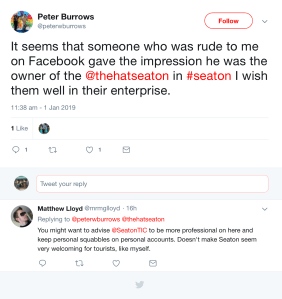
This is the full statement by Mr Gary Miller (owner, The Hat micropub) as given to Seaton Town Council last night, along with a screenshot and transcript of the now deleted tweets to which he refers:

THE TWEETS:

Transcript:
Twitter @peterburrows 1 January 2019 11.38 am
Burrows tweet:
It seems that someone who was rude to me on Facebook gave the impression that he was the owner of @thehatseaton in #seaton I wish them well in their enterprise.

Comment on above Tweet
Matthew Lloyd @matthewlloyd 16 hr
replying to @peterburrows @thehatseaton
You might want to advise @seatonTIC to be more professional on here and keep personal squabbles on personal accounts. Doesn’t make Seaton seem very welcoming to tourists like myself.

THE STATEMENT BY MR MILLER LAST NIGHT:
(verbatim)

“Good evening. I am Gary Millar, the sole owner of The Hat Micropub in Queen Street. I am addressing the issue of Mr. Peter Burrows, the then Mayor and current Councillor on both a local and district level, attacking my livelihood and business.

On the afternoon of New Year’s Day, Mr. Burrows had a very public argument about fox hunting with a private individual on the Facebook page ‘Seaton Views’. This escalated to a robust exchange of views between the two protagonists. (Amusingly both share the same perspective on the matter). Mr. Burrows, who is surely used to the rough and tumble of political debate, took exception to being called a very naughty word. His inexplicable reaction was to use his title of Seaton Mayor to make a direct attack on me, accusing me of being disparaging to the mayor, and to tell thousands of subscribers to a Twitter page called @SeatonTIC, to avoid my business. On the face of it this was the official Seaton Tourist Information Centre page.

This is a grossly stupid response from any public official in any circumstances. You could not make it up.

It is not at all clear why Mr. Burrows chose The Hat as opposed to the many other local businesses that his detractor frequents. Surely, as a public official involved in my various applications, he would have known who I was?

I do not use social media for anything other than professional reasons. If social media users followed the guidelines given in the Hat including “No nasty opinions” and “Be respectful and remember there are other people around you”, the internet would be a kinder place.

Both @SeatonTIC and Seaton Views are ostensibly neutral and exist for the benefit of the people of and visitors to Seaton. However, they are administered by Mr. Burrows which gives him the control over their content. Reportedly, other supposedly impartial social media sites revolving around Seaton are also administered by him. Personally, it disturbs me that a public official has such a domination of information without a clear declaration of interest.

For example – Mr. Burrows selectively deleted his unsavoury exchange on Seaton Views and blocked his detractor from the site. Yet he also closed the @SeatonTIC page entirely, not at the request from the Council as reported, but unilaterally overnight on the 1st/2nd January after legal action was threatened against the then unknown poster. This had two effects – first; we are unable to see how many people viewed his tweet to assess the damage caused. Secondly; imagine the impression given to thousands of potential holidaymakers following what they would reasonably have considered the formal Seaton Tourist Information Twitter page – A strange tweet from the town Mayor attacking a local small business, followed by an unexplained blackout.

This cannot be good for either my business nor the image of the town as a whole. Surely, directing subscribers to the official Tourist Information Site would at least have been a productive step.

I would argue that these actions were not a selfless act by Mr. Burrows, or in the interests of myself or Seaton, but a means of covering tracks. A clear case of canting.

I have yet to receive a proper apology from Mr. Burrows. His statement of resignation last week did not make it clear that I was not the person who insulted him, then he justified his actions, and finally boorishly he ended with him giving himself a pat on the back for a job well done. Unfortunately, any apology at this time now sounds hollow.

Mr. Burrows was high profile in his role as Mayor and councillor on both local and district levels. As such I view both the local and district councils legally culpable for his actions, regardless of these being rogue or not. I expect both the local and district council to do their legal duty and mitigate any damage against me. This includes a full and open investigation of Mr. Burrows conduct in office, including on social media, and disciplinary or legal action wherever possible. This motion of no confidence, and the complaint to the East Devon Monitoring Officer is a positive response by the Seaton Town Council.

Despite undoubted damage to my business, the support of my regulars, and other public support helps me believe that moving to Seaton to open up a new and innovative business was the right decision. My sincere thanks to you all and I hope to continue to serve you real ales, ciders and other fine beverages in a friendly environment for many years to come.

There is however still much to do from both Councils to support the current small traders and promote the opening of new dynamic, interesting small shops in Seaton. Encouraging visitors to move to the traditional trading area, now called The Cultural Quarter, from the lower end of town is an urgent requirement to start. Regrettably, after a year of trading in Seaton and having contributed in various forums, I have yet to see any concrete or effective steps to this end by the Council. This is an opportunity for both the Council and traders to reset and have a fresh start.

In conclusion I would urge all councillors to support this motion of no confidence. What most surprises me is that Mr. Burrows has not recognised his position as being untenable and has not resigned already on his own volition.

Thank you for your time and attention.”

Failed police merger cost £250,000

Owl says: A quick check of the members on the police oversight committee’s views first might have saved a lot of money!

“Devon and Cornwall Police Commissioner Alison Hernandez confirmed that the project to explore a potential merger had cost the two forces £200,000.

That was split on a 70:30 basis between her force and Dorset’s, with the Home Office providing an additional grant of £50,000.

Questions about the cost of the abandoned merger were raised after Dorset’s Police and Crime Commissioner Martyn Underhill said directly it had cost about £500,000 when he appeared at the Dorset County Council Safeguarding, Overview and Scrutiny Committee.

The figure for the move preparations was later revised by Mr Underhill’s office.

But both police and crime commissioners’ offices have now confirmed the total figure was £250,000.

[Hernandez said] The two police forces have a combined budget of well over £4m and employ more than 7,000 people, so it was right and proper that we explored in detail the implications of a potential merger on them and, importantly, the public that they serve.” from Alison Hernandez Police and Crime Commissioner for Devon and Cornwall”

The two police forces have a combined budget of well over £4m and employ more than 7,000 people, so it was right and proper that we explored in detail the implications of a potential merger on them and, importantly, the public that they serve.”

Ms Hernandez stopped the merger plans in October, saying at the time there would not be enough benefit to communities in Devon and Cornwall to justify a resulting increase in council tax.”

https://www.bbc.co.uk/news/live/uk-england-devon-46864649

Enterprise Zone “gazelle” companies (some in Devon) have unintended consequences

“Britain’s fastest-growing businesses could be contributing to job losses, according to research that claims the government’s policy of backing entrepreneurial companies “may be fundamentally at odds” with tackling regional inequalities.

A study of the performance of more than six million companies over a period of 17 years found that high-growth businesses had a “spillover” effect that could damage local employers.

Fast-growing companies, sometimes dubbed “gazelles”, have been identified in recent years as a way of boosting job creation and improving the nation’s productivity. Despite accounting for less than 5 per cent of businesses, these companies create about half of all new jobs and typically show higher levels of productivity.

However, the study, conducted by the Enterprise Research Centre, found that companies with the fastest employment growth — 20 per cent growth every 12 months for three consecutive years — tended to grow by “hoovering up” jobs from slower- growing businesses in the same region, in what the researchers called a “crowding-out competition effect”.

A 1 per cent rise in the incidence of high-growth businesses in a region was found to actually slightly cut employment, by 0.35 per cent on average — equivalent to a net loss of about 122,000 jobs UK-wide over the period studied, 1997-2013. The worst affected regions included the Scottish Highlands, Cheshire, the North East, Lincolnshire and Devon. In contrast, many urban areas in the South East and Midlands saw a net jobs gain.

Negative effects were most pronounced in the manufacturing sector and rural parts of the UK, where competition for skilled workers was most intense, the researchers said.

The fastest growing companies often attract the most skilled workers in a region where such staff are scarce, leaving slower-growing rivals struggling to attract employees and having to pay more to keep existing team members. As a result they hire fewer people and could be forced into job cuts.

Mike Harding, director of Inspira Digital, said that his ecommerce agency based in Barnstaple, Devon, competes with a London-based agency with a satellite office in north Devon. “If you have someone offering London wages here, that is a black hole that sucks up the local talent,” he said.

The issue can be exacerbated by large companies being offered tax breaks to open an office in Devon in the name of local development, Mr Harding said.

Professor Jun Du of Aston University, one of the authors of the research, said that “while encouraging clusters of fast-growth firms can bring productivity benefits to whole supply chains, some regions and industries with acute skills shortages could see unintended consequences”.

Source: The Times (pay wall)

“This Is What It’s Like To Lose Your Sunday Bus Service”

In a new series, HuffPost UK is examining how shrinking local budgets are affecting people’s daily lives. These are stories of what it’s like to lose, in a society that is quietly changing. If you have a story to tell, email basia.cummings@huffpost.com.

“When Staffordshire council announced on April 1 that they were cutting the local Sunday bus service – a lifeline for many of its regular passengers – people thought it was a bad joke.

The route was a thread connecting the local community, linking Stafford and Cannock in the West Midlands. But it was no April Fool’s Day prank.

Like so many decisions taken by local authorities in the era of austerity, it made sense on paper. Staffordshire County Council said it could no longer keep the buses running because numbers had dropped so much, the subsidies needed to make up for the loss in fares were “simply not sustainable”.

The local bus operator, Arriva Midlands, said at the time that “cuts to funding” were forcing them to withdraw the subsidised service. According to county council cabinet member Mark Deaville, “some journeys are costing taxpayers £10 a time”.

On its own, of course, the cutting of this one bus route is not worthy of a national news report. It is, at best, a local story affecting a relatively small number of people. But it is in paying closer attention to thousands of small financial decisions like this that we see the reality of government-led austerity, and the way it is quietly changing Britain.

In our HuffPost UK series, What It’s Like To Lose, we are exploring how these changes at a local level link up to paint a national portrait of austerity – from the closures of community libraries, or the centralisation of medical services or job centres, to the disappearance of affordable leisure centres or local post offices. As local authorities find themselves picking off the “low-hanging fruit” of services that have seen their use go down in recent years, what does it mean if you are one of the people for whom that still really matters?

When we visited Cannock on a grey December day, standing at a bus shelter was 80-year-old Jocie Lucas, taking refuge from the driving rain. For her, the cut was a blow to her sense of freedom. “I have a free bus pass, but I’m so confused these days as to when the buses are running that I hardly use it now,” she said. “I’ve lost some of that independence to travel where and when I want, and now I have to rely on lifts from family.”

What has happened to the residents of Cannock is happening across the country. Buses remain by far the country’s most popular form of public transport – 4.65 billion journeys are made each year, two-and-a-half times more than on the train.

But despite their levels of use, almost 17,000 bus routes have disappeared over five years across the UK, according to the Traffic Commissioner’s annual report. Tightened council budgets have made services that were under-used, but previously considered essential, vulnerable to cuts. The Campaign for Better Transport says there has been a £182m – or 45% – cut in local authority-supported bus services since 2010.

In Staffordshire, like in many councils across the UK, the changes came following a funding consultation last year. Tanya Dance, who runs the Copper Kettle cafe overlooking Cannock’s bus depot, was particularly hard hit by the decision – she had become a bus ticket vendor just months before the Sunday services were cancelled.

“There used to be queues of passengers on a Sunday, which was one on my busiest days,” she said. “A lot of the old folk with their free bus passes would only venture out on a Sunday and spend time shopping and in my cafe.”

Dance said the move has seen her takings halve in the last eight months. And the disruption, she thinks, has mainly affected her elderly customers.

For them, the service was vital. It was the only opportunity many of them had to go out and socialise, or visit church, she said. “To stop all buses on a Sunday seems way too drastic. Cannock isn’t exactly isolated but its pretty rural and buses are a lifeline for many around here,” she said.

Jocie Lucas echoes this, saying she used to enjoy travelling into town on a Sunday. “Now and I’m in other people’s hands, so that takes away some of the fun.”

But it’s not just the elderly who have had to adjust. Teenagers Alicia Slyde and Dean Mayo, both from a suburb of Cannock, said they now have to walk 45 minutes to get to town. “Sunday is the only day I can go shopping because of work commitments in the week and neither of us drive or can afford a cab, so we walk it to town and back now,” Mayo said. “It’s hard work carrying all the shopping home but we have no choice. “

Slyde added: “The bus service around here is dreadful during the week and then non-existent on a Sunday. Even getting to college every day is hit-and-miss as far as buses go. But stopping the Sunday service just doesn’t make sense. That’s the one day people get to themselves and want to travel.”

More than 2,000 people have signed a petition started by local campaigner Lee Murphy, asking the council to reverse its decision. Some of those who have signed mentioned nurses and staff working at local care homes needing to get to work.

Murphy told HuffPost UK that a regular user of one of the Cannock services relies on it to reach his brother, who is disabled. “He still requires the same care on Sundays, but how is he able to travel to him? Both Cannock and Stafford hospitals are cut off – neither train station are close enough,” the campaigner said.

“In addition to this, users paying as much as £520 a year for a Cannock/Stafford region bus pass will receive less value for money. This is unfair to hard-working commuters who deserve to use their pass for evenings and weekends too.”

Kevin Chapman, a spokesman for the Better Transport campaign, said the vast majority of the lost routes serve rural communities, like Cannock. “When the local bus service goes this often results in people in these areas becoming more isolated,” he said. “We are faced with a nasty cocktail of reduced funding for councils and operators cutting routes, while in the middle of it all we have vulnerable people who may rely on the bus to get out and about.”

But as always, decisions to cut services are complex. Staffordshire County Councillor Mark Deaville said the money saved had been directed to the services people use the most. “Our changes affect only four subsidised Sunday services from the Cannock depot, and the decision to stop all of its other Sunday bus journeys is a commercial decision for Arriva and not the county council.”

In Staffordshire, one local MP is the defence secretary and former government chief whip, Gavin Williamson, who said he is extremely concerned about the removal of the Cannock service, which he described as a “lifeline”.

Speaking to HuffPost UK, the senior Tory said it is “deeply damaging for the elderly who may rely on the buses to get them to the shops or to and from church on a Sunday,” he said. “It is important we do all we can to fight these cuts and I hope Arriva reconsider their decision.”

Teenage commuter Esme Walker, agrees. She said living in Cannock already felt “like being out in the sticks”, and losing the Sunday bus service has isolated her further.

“Me and my friends looked forward to catching a bus on Sunday and spending the day in Birmingham or Stafford,” she said. “It was really nice because we’d often meet elderly people from the town on the bus who seemed just as bored as us and we’d end up travelling together.

“I think the buses helped bring local people together in that way.”

https://www.huffingtonpost.co.uk/entry/how-it-feels-to-lose-your-sunday-bus-service_uk_5c20ef40e4b08aaf7a8b3bcc

BREAKING NEWS:Seaton’s disgraced ex-Mayor fails to turn up to meeting about his behaviour

Seaton’s disgraced ex-Mayor Peter Burrows failed to turn up to a meeting this evening which called him to further account for his recent behaviour and to hear a statement from the businessman he (mistakenly) maligned on a Twitter account since deleted:

https://eastdevonwatch.org/2019/01/11/seaton-disgraced-ex-mayor-peter-burrows-town-council-responds-names-names/

The meeting confirmed councillor Ken Beer as mayor and Councillor Jack Rowlands as his deputy.

The person originally and erroneously maligned by former Mayor Burrows (Garry Miller of The Hat micropub) made a personal statement.

It is believed that the ten remaining councillors voted unanimously for a resolution calling on Burrows to stand down as both a town and District councillor for bringing both councils into disrepute.

Owl gathers that, as well as a complaint to the EDDC monitoring officer, there will also be a complaint made to the regional Liberal Party about Burrows’s behaviour within the next few days

Persimmon Homes divides and rules on safety of homes leaving it to individuals to ask for safety checks

“A Persimmon Homes employee is urging all home owners to have their properties inspected to make sure they are not missing essential fire safety barriers after claiming the problem is widespread.

The worker, who asked to remain anonymous, has alleged that although homes have been confirmed to have failed inspections in a housing development in Exeter, there are other sites which have the same issues.

The house builder has previously refused to answer vital questions about properties in one of its developments, Greenacres, and the Newcourt area near Topsham, including how many have failed vital fire safety barrier inspections.

The issue was exposed following a ‘ferocious’ blaze which broke out in Trafalgar Road off Admiral Way and Topsham Road, last April, which spread into the roof spaces of two of the adjoining properties.

… [An Exeter owner said] he found [his home] to be missing vital fire barriers in its cavity walls.

He says Persimmon Homes were originally unwilling to tell him how many homes they had inspected and had failed, so Paul asked residents to share their pass or fail inspections in order collate his own figures.

Of the 135 residents who have so far disclosed their inspection findings, he says 65 per cent have currently failed across the whole housing development.

When broken down by the age of properties, 50 out of 76 built within the past five years failed, amounting to a 65 per cent fail rate.

Out of homes built five to nine years ago, 38 out of 58 failed which is also a 65 per cent fail rate, according to Mr Frost’s data.

Persimmon Homes hit the headlines last year when former chief executive Jeff Fairburn left the company following huge controversy about its bonus scheme which is believed to be the most generous from a FTSE 100 company. In 2018, he had been in line for a £110m payout before it was scaled back to £75m in the face of political and public outrage.

When approached for a comment over the allegations made by the employee, a spokesperson for Persimmon Homes said: “Persimmon Homes will not comment on anonymous claims and allegations.

“The focus is on customers and as, has been stated repeatedly Persimmon Homes will liaise directly with them.”

Austerity: Death by a thousand (local) cuts

“Brexit is one of the great issues – and news stories – of our time. But austerity, now nearly a decade old, has been just as transformative – in a slow, attritional way that is all too easy to overlook.

The reality is a picture of a thousand small decisions taken in grey council meeting rooms, a thousand deductions from spreadsheets, and countless lives quietly made a little worse. Sexy news copy and television report material it is not.

And while it would be wrong to say the bigger picture hasn’t received a lot of coverage over the past eight years, the real-life impact is rarely “news”. These small stories seldom pass muster in newsrooms where reporters pitching ideas are asked by their editors daily: “But is it new?”

Meanwhile at a local level, councils faced with impossible budgetary decisions are having to make hard choices. So how do we mark the slow, incremental, and sometimes devastating disappearance of local services? How do we serve our readers by making sure our coverage reflects what they see where they live?

This is why HuffPost UK is devoting a week of coverage on the impact of local cuts – properly local cuts. In this series, What It’s Like To Lose, we have stepped away from considerations about what is traditionally “newsworthy”, ignoring the usual measures of scale, to look at some of the holes left in communities over the past few years, and to write about things that people tell us are important to them.

The fact is that the closure of a single leisure centre, or a library, is a local issue. If the council stops cutting the grass in your park, or doesn’t mend the swings that have been broken for a month, you don’t expect to see it on the News at Ten. And these cuts are often enacted by people working hard to make the least-worst decision. Do we consider a mother-and-baby swimming class or a judo club as essential a service as keeping streetlights on, or collecting rubbish?

When Birmingham Council recently decided to no longer employ lollipop ladies, they did so in order to prioritise other services. In narrow terms, the logic might have seemed inescapable. But with that, a familiar feature of the landscape of British childhoods is gone in one city. Where will it be gone next?

So to pay closer attention, and to understand the ways in which austerity is linked to wider political issues, we’ve spoken to an old lady whose bus into town on a Sunday has been discontinued, and a teenager who won’t travel further afield to a sexual health clinic area after the one nearby was closed. We’ve spoken to people who have to travel miles to their local job centre, or who are missing their leisure centre and can’t find an affordable alternative.

And while this can only be a snapshot of the nationwide reality, we’ve found that the stories that matter to one person can tell us something about what it’s like to lose that ought to matter to all of us, in a society that is quietly changing.”

https://www.huffingtonpost.co.uk/entry/austerity-what-its-like-to-lose_uk_5c3c8e54e4b01c93e00bbd26

Here is the first of those stories:
https://www.huffingtonpost.co.uk/entry/what-its-like-to-lose-your-leisure-centre_uk_5c1d1b41e4b08aaf7a885786

Outsourcers should be allowed to fail – says outsourcing boss

“Politicians and regulators responding to Carillion’s collapse should resist the temptation to turn outsourcing companies into “safe spaces” that cannot fail, the boss of a rival has urged.

Carillion, which built roads and hospitals and provided cleaning and catering to the public sector, went under one year ago this week, leading to calls for tighter rules for outsourced services and greater scrutiny of those providing them.

But Rupert Soames, who led Serco through its own financial crunch four years ago, told The Sunday Telegraph: “You will get companies that are ­well-run and ones that are badly run – and the bad ones should go bust. …”

https://www.telegraph.co.uk/business/2019/01/20/outsourcers-must-allowed-fail-says-soames-anniversary-carillion/

Sidford Business Park – disproportionate industrial development?

Recently posted comment:

“At the full EDDC Council meeting at the end of October 2018, independent Councillors Ben Ingham and Roger Giles, supported by 11 other councillors, tabled a motion to discuss the over provision of housing needs in our Local Plan and called for an independent assessment. In answer to a question as to why East Devon is taking a disproportionate share of development [58% more than Exeter, 53% more than Teignbridge and nearly three times that of Mid Devon according to independent analysis conducted by CPRE] Councillor Paul Diviani said:

“Because we have the land and we are good at it”!

[Perhaps he should be reminded that two thirds of East Devon lies in an AONB, or perhaps he doesn’t care].

This is not the argument that was put to Inspector Thickett at the public examination of the EDDC local plan in 2015 by Ed Freeman. Then, the argument for pitching the EDDC target at a minimum of 950 houses/year [about 30% more than could be supported by the evidence] was that we had jobs coming down the line. Specifically he mentioned 1,000 full time equivalent jobs a year.

Thankfully, we are effectively at full employment. Office for National Statistic population projections shows the South West population as a whole growing over the local plan period at around 0.8% per annum, including expected migration. However, we have an ageing population and the annual increase of those classified as of working age is only going to be 0.16% (16 to 64 for all genders). To satisfy this annual demand to find new jobs in East Devon [population 142,300] would only require around a couple of hundred a year, nowhere near the 1,000 that are being planned for.

The creation of jobs is generally a good thing but pursuing jobs as a primary objective is, I suggest, not what we need in Devon. What we need are better quality jobs to lift earnings and I am pleased to see that that is what ratepayers’ investment of £1.1M in the Exeter Science Park is aimed at achieving. But it only creates a one-off 158 jobs against the 1,000 a year needed to justify the development plan.

Can anyone provide an evidence based explanation of where these housing and job targets come from? Anyone believe that this is what they were voting for when they elected their councillors? And who are the “we’s” in Councillor Paul Diviani’s explanation?”

‘Let them eat spuds!’ Ex-UKIP candidate says food banks are fuelling the obesity crisis

Owl says: Of course she is right: the poor should be using their Range Rovers to get to farm shops for their sacks of potatoes … and should be using their outdoor barbecues to roast them, seeing as they don’t have enough money to use their ovens – and bags of charcoal can also be put in the Range Rover’s capacious boot! Really, these so-called poor people need a good talking to and must pull up their (darned) socks!

And no, they shouldn’t be bothering our hard-pressed doctors with their vitamin-deficiencies when little Arabella needs to have her ballet sprain massaged!

“The former UKIP parliamentary candidate for Great Yarmouth claims that food banks are contributing to obesity and that the poor “cannot be bothered” to cook.

Writing online for The Conservative Woman, Catherine Blaiklock argues that no-one in Britain should be starving because potatoes are cheap at her farm shop and living on nothing but boiled potatoes would be healthier than being handed a box of products in tins and packets.

Addressing claims that millions of people struggle to put food on the table she compares the plight of Britain’s poorest families with the Sherpas in the Himalayas who eat “practically nothing but boiled potatoes with a bit of salt and chilli on the side.”

“You get bored with both the eating and peeling long before you could possibly get obese,” she adds.

The column carries the headline Hungry? Let them eat spuds! echoing the words supposedly spoken by Marie Antoinette when she learned the peasants had no bread.

It goes on to argue that it is not the cost of food that is the problem but the people who consume it.

Catherine Blaiklock stood for the far-right Eurosceptic party in Yarmouth in 2017.

Described at the time as running a guest house in Lingwood, near Acle, she took a photograph of her black husband to a hustings in an apparent bid to prove the party is not racist.”

https://www.edp24.co.uk/news/health/former-ukip-candidate-catherine-blaiklock-says-foodbanks-fuel-obesity-1-5853723

Electoral Commission – unfit due to modern loopholes

“Craig Mackinlay, the Conservative MP who was cleared while a senior Conservative official was convicted over election expenses, has some very critical things to say about the Electoral Commission.

Writing for PoliticsHome after his acquittal, the Conservative MP said:

“It is their responsibility to interpret the law into understandable guidance for candidates and agents and have extra-statutory authority to produce guidance and rules to assist the electoral process. During the trial, the prosecution spent days considering the status of personalised and party generic Correx boards. Conservative Party guidance recommends a 4x potential use. If such plastic posters survive defacement or vandalism that characterises many election campaigns, they could last for many years. The Prosecution and Electoral Commission disputed that view, long held by the party. The Electoral Commission publishes not one word of guidance as to how to account for such boards, how to deal with criminal damage and replacements, relying on the vacuous phrase ‘honest assessment’. To face potential criminal conviction with life-changing consequences on the back of scant guidance cannot be right.”

That is but one of a range of details over which the Electoral Commission’s guidance is indeed unhelpful. Sometimes the Electoral Commission has played with being weirdly prescriptive. (I still remember the discussion I had with them about depreciation rules for party rosettes.) Often however it has also – as the above example illustrates – super-cautiously vague.

Part of the problem, I suspect, is that lack of detailed knowledge in the Electoral Commission, an absence of knowledge bizarrely illustrated by its mistakes over pencils:

https://www.markpack.org.uk/143476/indelible-pencils/

A much bigger problem, however, is one that MPs such as Craig Mackinlay share with the Electoral Commission. Even if no-one breaks the law, the rules limiting constituency expenditure have collapsed because so much can now be done that is charged against the much more generous national limit.

What used to be a tight limit on constituency expenditure set by the law is now in effect a massively generous limit set by the size of your bank account. See the full details here:

https://www.markpack.org.uk/130283/internet-speeds-up-the-killing-off-of-expense-controls-in-marginal-seats/

Neither MPs nor regulators have done anything so far other than sit on the sidelines, often apparently oblivious and always unresponsive to this collapse.”

https://www.markpack.org.uk/157315/craig-mackinlay-electoral-commission/

Flybe biggest shareholder threatens legal challenge to Virgin/Stobart takeover

Owl says: East Devon really does seem to be a very complicated place to do business!

“Flybe’s biggest shareholder has launched a stunning attack on its directors, accusing them of breaching their duties to investors and threatening a legal challenge to the cut-price takeover of one of Britain’s best-known airlines.

Sky News has learnt that Hosking Partners, a prominent London-based asset manager which holds a stake of close to 19% in Flybe, has instructed lawyers to explore its options in relation to the company’s proposed sale to a consortium‎ led by Virgin Atlantic Airways.

These options could include attempting to obtain an injunction prohibiting the deal from being completed, Hosking Partners is understood to have warned Flybe’s bosses this week.

The initial 1p-a-share deal, announced eight days ago, came at a huge discount to the airline’s prevailing share price and underscored its industry’s profound financial challenges.

In a letter to the directors of Flybe, details of which have been relayed to Sky News, Hosking Partners is understood to have expressed concern that they had allowed a false market in the company’s shares to develop by failing to update the City on its financial position in a timely fashion.

‎The fund manager, a long-standing shareholder in Flybe, is understood to have copied its ‎letter to City watchdogs including the Takeover Panel, which polices mergers and ‎acquisitions activity, and the Financial Conduct Authority.

Hosking Partners is said to have raised doubts as to whether the £2.2m offer reflected the intrinsic value of Flybe, and alleged that the handling of its proposed sale had blocked a rival offer from emerging at a higher price.

Flybe’s fate took a further twist this week when it said that its sale to Connect Airways – a consortium comprising Virgin Atlantic, Stobart Group and Cyrus Capital Partners,‎ an investment fund with links to the other two parties – would be restructured.

‎Instead of simply comprising a conventional offer for the shares, Flybe’s trading assets would be sold next month to Connect Airways for £2.8m, leaving the holding company as‎ a shell for which ‎the consortium would continue to pay a nominal sum.

Flybe said this change had been necessitated by its urgent need for liquidity – a claim challenged by Hosking Partners because of the company’s cash balance and ability to raise funds from the sale of assets such as its take-off and landing slots at London Gatwick Airport.

In a statement to the market on Tuesday, Flybe said it had had no alternative but to agree to the revisions because unspecified conditions attached to a bridging loan had not been met.

Hosking and other shareholders are said to be furious about the restructuring of the takeover because Flybe’s recent switch from a premium to a standard listing on the London market meant investor approval was now only required for the holding company bid, not the sale of the airline’s assets.

The fund manager is understood to have told Flybe directors that other parties remained interested in acquiring the airline but would now be unable to make an offer.

At the 1p-a-share offer price, Hosking Partners’ stake is worth roughly £400,000.

If it escalates, the row could pose significant reputational risks to the board of Flybe, which is chaired by Simon Laffin, a City grandee who has served as a director of companies including Mitchells & Butlers, Northern Rock and Safeway.

Investors’ anger has been exacerbated by the fact that early last year, Stobart made a takeover approach to Flybe understood to have been valued at roughly 40p-a-share.

This was rejected by Flybe’s board.

In a further development, Sky News revealed last week that Stobart’s estranged former chief executive, Andrew Tinkler, had himself swooped to snap up a stake of more than 10%‎ in Flybe.

Until as recently as this month, it appeared that Virgin Atlantic and Stobart were ‎likely to table competing offers for the regional airline, before it emerged that they had teamed up as part of the same consortium.

Hosking is understood to have raised concerns in its letter about the process through which they were permitted to form an alliance, although one source close to Flybe said that it had not breached any undertakings by doing so.

The investor is also said to have highlighted the rise in Stobart Group’s share price following confirmation of the 1p-a-share bid as evidence of “value transfer” from Flybe to one of its acquirers, according to a City source.

Under their plans, Stobart Air will be folded‎ into Connect, with all of Flybe’s services re-branded under the Virgin Atlantic name.

The chief executive and chief financial officer of Flybe will transfer to the bidding consortium, according to documents published by the company.

Hosking Partners’ letter is said to enquire about any incentive payments due to either of the duo as a result of the consortium’s takeover.

In a statement, a Flybe spokesman said: “The board of Flybe was faced with a very tough decision based on Flybe’s current difficult liquidity position and the expectation that this pressure will continue.

“Obtaining the revised facility, as announced on 15 January, from the consortium provides the security that the business needs to continue to trade, which preserves the interests of its stakeholders, customers, employees, partners and pension members.

“Flybe will be responding directly to letters received from shareholders.”

Flybe launched a formal sale process last autumn, blaming a toxic cocktail of currency volatility, rising fuel costs and Brexit-related uncertainty.

Although it is small in financial terms, it remains one of the UK’s best-known airline brands, carrying thousands of passengers between largely second-tier British airports as well as European destinations.

A source close to the company pointed out that it had warned in the results accompanying the launch of its sale process that if its credit card partners “were to choose to seek significantly higher cash collateral and the group cannot access sufficient additional liquidity, this would give rise to a material uncertainty which may cast significant doubt about the group’s ability to continue as a going concern”.

The Takeover Panel declined to comment, although a source close to it said it was confident its supervision of the bid had been handled in accordance with its policy of acting in investors’ interests.

For Virgin Atlantic, still part-owned by Sir Richard Branson’s Virgin Group, control of Flybe’s regional network will provide a valuable feed into its long-haul flights to international destinations.

Its return to the domestic UK aviation market will come four years after it announced the closure of Little Red, its previous attempt to make money from a notoriously difficult sector.

Rising oil prices and the weakening of sterling have put airlines under intense pressure, with a deepening industry price war accentuating the financial squeeze.

A Hosking Partners spokesman declined to comment on the contents of its letter, but said this weekend that investors were “entitled to transparency over precisely what has gone on to drastically reduce Flybe’s value”.

“The auction undertaken under the formal sale process has clearly not yielded a favourable outcome for all stakeholders, and it seems that the outcome has locked out any other bidder who may be able to provide a better solution for all of Flybe’s stakeholder‎s.”

https://news.sky.com/story/top-flybe-shareholder-threatens-legal-challenge-over-2m-bid-11611470