“[Mortgage] Loans lasting up to 40 years can leave buyers unable to save for pension, say regulators”

“First-time buyers are taking out jumbo loans on longer terms that will leave four in 10 borrowers paying off their mortgage well into retirement, regulators have warned.

The Financial Conduct Authority (FCA) found that 40% of borrowers who took out a mortgage in 2017 will be aged over 65 when their mortgage matures – leaving them unable to save for a pension, and vulnerable to any financial shocks.

The 40% figure represents a huge change over the last five years. As recently as 2012, just 22% of mortgages were expected to run into the borrower’s retirement. But that number has nearly doubled as buyers stretch themselves to pay for escalating house prices.

Historically, buyers have taken out 25-year mortgages to pay for their home, and in 2007 the 25-year term was still the most common deal. But the FCA found that 30-year terms have now become the norm, with 34% of loans taken out in 2017 lasting 30 years or more.

Most lenders now allow mortgages of 35 years, while Halifax and Nationwide, the two biggest lenders, will offer loans with 40-year repayment terms.

Many first-time buyers are also delaying a purchase until they are in their 30s as they save to afford the deposit.

In a grim assessment of the financial health of UK households, the FCA warned that the burden of a mortgage throughout people’s working lives is likely to limit their ability to save for a pension and deal with financial shocks. …”

https://www.theguardian.com/money/2019/jan/10/four-in-10-uk-first-time-buyers-will-retire-with-mortgages-fca-warns

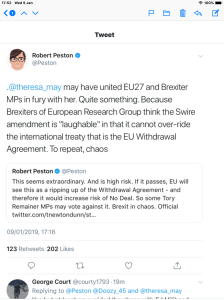
Swire Brexit intervention “flimsy rubbish” says Brexiteer MP

“In normal times, a PM’s ‘late’ decision to adopt a backbench amendment can swing the ten or so rebels needed to win a vote. However, the new normal on Brexit is that battle-hardened backbenchers are less likely than ever to cave to such tactics. The string of ‘concessions’ announced by Brexit secretary Steve Barclay and pushed by No10 yesterday met with a collective shrug at best and ridicule at worst.

The Hugo Swire amendment, to give MPs a final say on the ‘backstop’ or the transition period, was burned off by Brexiteer Steve Baker as “flimsy rubbish which will only persuade those who have decided to be persuaded”.

The DUP’s Nigel Dodds said the plan – which No.10 insiders admit would involve the UK struggling to meet its international obligations – was ‘meaningless and cosmetic’ “

Source: The Waugh Zone, Huffington Post

Many local authorities not providing value for money

“The number of public bodies in England failing to provide value for money is “unacceptably high” and increasing, the public spending watchdog has warned.

Of the nearly 1,000 councils, police, fire and NHS bodies across England, 208 (22%) were found to have “significant weaknesses” in securing value for money in 2017-18, a National Audit Office report out today revealed.

This was higher than the 170 (18%) of public bodies awarded a ‘qualified’ audit conclusion – signifying the significant weaknesses – in 2015-16.

“This increase varies between local government and NHS sectors”, the report found – with NHS bodies seemingly faring worse than other public bodies….

Financial performance issues that can lead to a qualified conclusion, include failure to meet financial targets, such as annual spending limits or delivering planned savings.

The NAO report said: “Qualified conclusions on arrangements to secure value for money locally are both unacceptably high and increasing.”

It continued: “The proportion of local public bodies whose plans for keeping spending within budget are not fit-for-purpose, or who have significant weaknesses in their governance, is too high. This is a risk to public money and undermines confidence in how well local services are managed.” …

The report also suggested that a large proportion of local bodies may not fully understand the purpose of an auditor’s conclusion on arrangements to secure value for money.

Of 61 local public bodies that responded to the NAO, 82% said auditors identified issues they were already aware of, but the NAO stressed that the auditor’s report is to provide public assurance on the adequacy of arrangements in place, not to uncover new issues.

While 95% of respondents said they had plans in place to address issues in the auditor’s report, only 5% said had already dealt with their auditor’s concerns.

Rob Whiteman, CIPFA chief executive, said: “Value for money conclusions should be treated as a cornerstone on which local bodies can show their dedication to transparency and accountability, crucial aspects of good governance in the public sector.

“Local auditors, councillors and directors should exercise their powers to hold executives to account, especially where local bodies are not taking sufficient action to address issues raised.

Meg Hillier, chair of the Public Accounts Committee, said: “It is deeply concerning that local auditors are raising increasing numbers of concerns about local bodies’ arrangements to secure value for money, but these are often not being listened to and there is no consequence for the local bodies themselves.

“With ever stretched public services, citizens deserve to know that there are effective arrangements in place to make sure they are getting value for money.

“Local auditors should be using the full range of their powers and local bodies should be acting on their findings transparently, with departments holding them to account.”

https://www.publicfinance.co.uk/news/2019/01/more-public-bodies-failing-provide-value-money-says-nao

“County Council leader tells me he ‘hasn’t got a clue yet’ about No Deal Brexit planning” says EDA Independent Councillor

At yesterday’s DCC Cabinet meeting, Leader John Hart answered three questions I had put in writing about estimated risks from Theresa May’s Brexit and No Deal, about help to businesses for No Deal, and emergency planning for disruption to fuel, food and medical supplies in Devon as a result of No Deal.

The questions and answers are attached. It will be seen that Cllr Hart did not answer any of the questions. When I asked when he would answer them, he said ‘We haven’t got a clue yet’ about what is going to happen, and that there would be a meeting next week, with just 10 weeks left to when the UK will crash out of the EU with No Deal if no change is made.

It can be seen that there are no protections in place to protect Devon from the effects of a No Deal. Economy Cabinet member Cllr Rufus Gilbert said ‘we can’t plan for a hypothetical’ but at the moment No Deal is the default scenario for 29th March.

This is why Devon and Dorset MPs like Ben Bradshaw, Sarah Wollaston and Oliver Letwin are absolutely right to try to block No Deal. I told Cabinet it was irresponsible of them not to support these moves.

Martin Shaw
Independent East Devon Alliance County Councillor for Seaton & Colyton”

dcc leader’s replies on no deal brexit 9.1.19

The Knowle “Flog It” scandal rumbles on

Recent Freedom of Information request:

“Dear East Devon District Council,

The following is a request in accordance with the Freedom of Information Act 2000.

Recently an email from a Conservative counsellor was released into the public domain regarding the purchase of a “very large table in the members room” as a result of “an auction of council furniture, chattels, etc” to the benefit of members and EDDC staff.

The email went on to state “I have been told that I have been successful in my bid so the table along with the 8’ extension is heading back to Exmouth to sit in (address of councillor), Exmouth in its rightful Town (some may say)” and then stated arrangements for its removal date in order that it could be used for the Councillor’s Christmas dinner for 22 family members.

Subsequently on 21st December 2018, the Leader of the Council made a statement about the disposal of a range of items, including this table. He said the large table “attracted little professional interest with one valuer estimate of just £50”.

I would like to know:

If one valuer’s estimate was £50, what were the other estimates?

What are the names of the valuers who gave estimates for the table?

Does EDDC audit not require a range and record of estimates for the disposal of council assets, as well as a record of disposals?

EDDC, like other councils, should have a written policy and procedure for the disposal of assets such as used equipment, furniture and other plant, What is that policy and procedure?

Who was the Councillor that successfully bid for “the very large table in the members room”?

How much did the Councillor pay?

Was the ornate clock on the mantel piece (as shown on the cover of the Residents Magazine, December 2018) part of this disposal process?

If so, what was the valuation given?

What price was paid?

Who bought this clock?

The Leader of the Council referred to proceeds of this sale and other sales going to the Chairman’s Civic Fund.

How much money was raised from this sale of “items of sentimental interest or practical use”?

What are the “other sales” Councillor Thomas refers to?

How much money was raised from each of these “other sales”?

What is the total now of the Chairman’s Civic Fund?

Information about the Chairman’s Civic Fund is not easily accessible on the EDDC website; a word search on the site produces “no result”. Where can details of this fund and its administration be found?

Yours faithfully,”

https://www.whatdotheyknow.com/request/auction_of_council_furniture_cha

“NHS and councils full of financial problems, says watchdog”

“National Audit Office shocked by state of bodies including police and fire authorities.

The number of NHS and local government bodies with significant financial weaknesses in their ability to give value for money is unacceptably high and increasing, according to Whitehall’s spending watchdog.

The National Audit Office has examined the financial statements from nearly 937 local health authorities, councils, police and local fire bodies which are responsible for about £154bn of net revenue spending every year.

Auditors conclude in a report published on Wednesday that the number of local bodies with significant weaknesses increased from 170 (18%) in 2015-16 to 208 (22%) in 2017-18.

It follows the publication of an International Monetary Fund report in October which found that the UK’s public finances were among the weakest in the world after the 2008 financial crash.

Sir Amyas Morse, the head of the NAO, said he was shocked by the persistent high level of qualified audit reports at local public bodies.

“A qualification is a judgment that something is seriously wrong, but despite these continued warnings, the number of bodies receiving qualifications is trending upwards,” he said.

“Let us hear no cries of: ‘Where were the auditors?’ when things go wrong. The answer will be: ‘They did the job, but you weren’t listening.’

“This is not good enough. Local bodies need to address their weaknesses, and departments across government should ensure they are challenging local bodies to demonstrate how they are responding.”

Each year, local auditors give an opinion on whether local public bodies have produced financial statements which comply with reporting requirements and are error-free, and conclude whether local public bodies have arrangements to manage their business and finances.

Wednesday’s report examined accounts from 495 local authorities, local police and local fire bodies in England; and 442 local local NHS bodies in England, which include clinical commissioning groups, NHS trusts and NHS foundation trusts.

In the NHS, the number receiving qualified accounts rose from 130 (29%) to 168 (38%) across the same period. The number of local government bodies receiving qualified conclusions was 40 (8%) in 2015-16, but 18% of single-tier local authorities and county councils received a qualification in 2017-18.

Meg Hillier, the chair of parliament’s public accounts committee, said: “It is deeply concerning that local auditors are raising increasing numbers of concerns about local bodies’ arrangements to secure value for money, but these are often not being listened to and there is no consequence for the local bodies themselves.

“With ever-stretched public services, citizens deserve to know that there are effective arrangements in place to make sure they are getting value for money.

“Local auditors should be using the full range of their powers and local bodies should be acting on their findings transparently, with departments holding them to account.”

https://www.theguardian.com/society/2019/jan/10/nhs-and-councils-full-of-financial-problems-says-watchdog

“MPs want hunger minister role introduced”

This is a cross-party group of MPs, not just opposition MPs. Truly shameful. But it seems only Brexit can enrage the general population these terrible days.

“A group of MPs wants the government to introduce a Minister for Hunger to respond to a growth in food insecurity in the UK – especially among children.

The Environmental Audit Committee highlighted 2017 Unicef figures showing 19% of children under 15 in the UK live with adults who struggle to buy food.

It says ministers have failed to recognise and respond to the problem.
The government says the number of children living in workless households is at a record low.

But MPs say the number of people without reliable access to affordable, nutritious food – or food insecure – is “significant and growing”, with the unemployed, sick or those with children most likely to be affected.
The committee wants to see the appointment of a new minister with “responsibility and accountability for combating hunger and food insecurity within the UK”.

The job would involve exploring the scale, causes and impact of hunger, food insecurity and malnutrition and implementing strategies to improve the situation. …”

https://www.bbc.co.uk/news/education-46810707

Swire boasts he is mentioned in a book – objecting to excessive motor bike noise

Good to see Swire keeping his eye on the important balls:
https://m.facebook.com/permalink.php?id=251482645358785&story_fbid=513581455815568

Update on Seaton ex-Mayor Peter Burrows situation

As reported here:

https://eastdevonwatch.org/2019/01/07/breaking-news-seaton-mayor-peter-burrows-resigns-after-bringing-the-office-into-disrepute/

Owl hears that the aggrieved party has made a formal complaint to the EDDC Monitoring Officer and is taking legal advice on possible further action.

Owl is awaiting an official statement from Seaton Town Council, which would be usual in these circumstances.

“‘Secret’ £75m Brexit contracts [to management consultants] facing investigation”

“The government has quietly awarded £75m of Brexit-related contracts to some of the world’s biggest consultancy firms, Sky News can reveal.

The deals, uncovered today for the first time, were never publicly announced.

They were given to nine high-profile international companies, including familiar names such as Deloitte, Accenture and PwC.

Each company received a contract worth between £5m and £10m.

Three of the contracts – together worth £25m – went to the American firms Bain, McKinsey and Boston Consulting.

All nine agreements are described as contracts for “the supply of Cabinet Office consultancy support for EU Exit”.

Each is due to run until 30 April 2019, but with the option for them to be renewed for a further year at the same cost.

Details of the plans were placed on an unobtrusive part of the government website just before Christmas, eight months after they had come into action.

But despite each including contracts running to more than 200 pages, crucial facts were removed – such as who in the government signed off the agreements and what work was actually involved.

In addition, the contracts were awarded under a framework titled “Health and Community” – but are, in fact, entirely focused upon preparations for Brexit.

That process, which restricted selection to companies which had already passed a “vetting process” all but ended the chance of smaller, Brexit-specific consultancies winning any of these contracts.

The chair of the public affairs committee, Meg Hillier, condemned the secrecy and delay as “ridiculous” and said the contracts would now be referred for investigation by the National Audit Office. …..

…. Joe Owen, association director of the Institute of Government, is researching Whitehall preparations for Brexit. He told me that “febrile politics” had changed the way in which information is being shared.

He said: “We’ve not had a huge amount of transparency with regards to much on Brexit over the last few years, particularly not the kind of preparations that are going on for no deal.

“There’s definitely been an increase in secrecy more generally across the civil service as a result of Brexit, just because of how politically difficult it’s been for many reasons.

“There are the divisions inside the country, the government, parliament, the cabinet and that’s kind of fed into this level of secrecy.”

Sky News has contacted all the companies involved. So far six have replied – all saying they could not comment on matters involving clients.

These are the details of the nine contracts, each for consultancy support:

:: The Boston Consulting Group – £10m

:: Bain & Company Inc. United Kingdom – £10m

:: McKinsey and Company, Inc. United Kingdom – £5m

:: Accenture (UK) Limited – £5m

:: Deloitte LLP – £10m

:: Ernst & Young LLP – £10m

:: Mott Macdonald Limited – £5m

:: PA Consulting Services Limited – £10m

:: Pricewaterhousecoopers LLP – £10m”

https://news.sky.com/story/secret-75m-brexit-contracts-facing-investigation-11603001

NHS: the REAL cost of privatisation

“The biggest emergencies-only hospital in Europe will take three years longer than expected to build and cost nearly twice its original budget.

The Midland Metropolitan Hospital was intended to treat 170,000 A&E patients a year from this summer but will not open until 2022. It will also cost at least £605 million, despite originally being priced at £350 million.

The problems were highlighted after Theresa May unveiled a ten-year strategy for the health service that included a £20 billion spending boost by 2023. The delay and increased costs were caused by the collapse a year ago of the construction company Carillion, halting building under the private finance initiative. The failure forced the NHS to implement contingency plans in 14 hospitals to maintain essential services delivered by Carillion.

The new 670-bed hospital in Smethwick, West Midlands, is meant to replace large parts of Sandwell Hospital and City Hospital, Birmingham. Carillion was paid £205 million towards the project before the firm’s collapse.

Toby Lewis, chief executive of the Sandwell and West Birmingham Hospitals NHS Trust, told its board last month that more than £400 million would be spent completing the hospital and keeping emergency services running at the Birmingham hospital.

The trust is paying Balfour Beatty, the construction company, £10 million to “winter-proof” the new hospital, which was left open to the elements. It is poised to seek bids from companies to complete the building, although some have already made clear that they are not interested.

John Spellar, Labour MP for Warley, said that outlay on maintaining existing hospital facilities had been cut in anticipation of the new building and that the delay was affecting recruitment and training. He said that civil servants were to blame for transferring too much risk to the private sector when they had “no concept what it actually means”.

A parliamentary inquiry into the failure of the multinational contractor with liabilities of almost £7 billion found that its “business model was an unsustainable dash for cash. The mystery is not that it collapsed but how it kept going for so long”.

Carillion was also building the Royal Liverpool Hospital, which features in a BBC Two documentary to be broadcast tomorrow. Aidan Kehoe, chief executive of the Royal Liverpool, tells the Hospitalprogramme: “I am very angry at the way Carillion have behaved. To leave us in this position is, I think, just unacceptable. These people are taking huge bonuses that they are not paying back and they are leaving the people waiting years more for a hospital. Serious questions have to be asked about the way Carillion have behaved.”

The £500 million Liverpool hospital building was due to be finished two years ago but is not expected to be completed until next year.

Jayne Halloran, an associate director at the Royal Liverpool and Broadgreen University Hospital Trust, said that it was expensive to maintain the partially built hospital, where 14 staff work full time turning taps on and off to stop legionella bacteria from growing. “It takes six days to complete that for the whole building,” Ms Halloran said.”

Source: Times, pay wall

“14 MPs turn up to discuss UN report on 14 million people living in poverty”

“The UN’s report on poverty in Britain is at risk of being swept under the carpet after just 14 MPs turned up to debate the issue in parliament yesterday.”

https://www.thelondoneconomic.com/news/14-mps-turn-up-to-discuss-un-report-on-14-million-people-living-in-poverty/08/01/

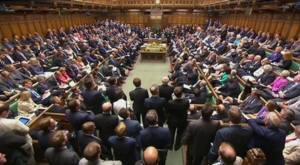
Meanwhile for the debate on increasing MPs pay:

“Sixty-four-metre ‘fatberg’ discovered in English seaside resort” [Sidmouth]

[The article has a particularly gruesome picture of the fatberg!]

Owl wonders if this sort of thing will increase or decrease when the luxury PegasusLife elderly housing facility replaces EDDC’s Knowle HQ!

“Eight weeks needed to remove mass of fat, oil and wet-wipes from sewer in Sidmouth, Devon.

A block of hardened fat, oil and wet-wipes longer than six double-decker buses has been discovered in a sewer metres from the sea in a popular Devon resort town.

It will take workers eight weeks to cut up and remove the 64-metre “fatberg” from the sewer beneath The Esplanade in Sidmouth.

South West Water is also planning to open a pop-up shop in the town to inform people about the unwanted visitor and to urge them not to “feed” fatbergs by pouring fat, oil, grease and wet-pipes into the system.

The company’s director of wastewater, Andrew Roantree, said: “It shows how this key environmental issue is not just facing the UK’s cities, but right here in our coastal towns.

“It is the largest discovered in our service history and it will take our sewer team around eight weeks to dissect this monster in exceptionally challenging work conditions.

“Thankfully it has been identified in good time with no risk to bathing waters. If you keep just one new year’s resolution this year, let it be to not pour fats, oil or grease down the drain, or flush wet-wipes down the loo. Put your pipes on a diet and don’t feed the fatberg.”

South West Water says a fatberg forms like a snowball – wet-wipes flushed down toilets congeal with fats, oil and grease, gradually forming a hard mass. The removal, which will be carried out by workers in full breathing apparatus, is due to begin next month but could be delayed if there is heavy rain.

Nearby businesses will not be affected by the removal and The Esplanade will remain fully accessible.

The fatberg was discovered during routine checks.”

https://www.theguardian.com/environment/2019/jan/08/sixty-four-metre-fatberg-discovered-in-english-seaside-resort-sidmouth-devon

“”England ‘needs millions of homes to solve housing crisis’ “

“Three million new social homes must be built in England over 20 years to solve the “housing crisis”, a report says.

Housing charity Shelter says upfront costs of £11bn a year could come from housing benefit savings by moving tenants from high-cost privately rented homes to social housing. … ”

https://www.bbc.co.uk/news/uk-england-46788530

“Andrew Lansley law that forced hospitals to compete could be axed”

Note: this 10-year plan does not tackle the crisis in social care nor the bigger crises of not having enough staff for either service.

[Andrew Lansley’s 2012 act made local GP groups “customers” to buy services from competing hospitals]

“Implementing the new ten-year plan could involve the reversal of market-based reforms introduced in 2012 by the former health secretary Andrew Lansley.

More than 100 local bodies would be merged under proposals to move away from internal health service competition and make parts of the NHS work more closely together.

The request for new laws by Simon Stevens, head of NHS England, sets the government up for a battle in the Commons. The reversal of the reforms is also likely to prove embarrassing for the Conservatives. Labour has already demanded an apology for a “bureaucratic disaster” that it says wasted billions.

The Health and Social Care Act 2012 made local GP groups “customers” to buy services from competing hospitals and other providers. It provoked opposition from health unions who said that it would fragment care. Senior Tories came to regard it as the coalition government’s biggest mistake.

Ministers will seek to present the changes as commonsense tidying up measures requested by the NHS. They hope that this will avoid a divisive political battle, but while opposition to privatisation was a key Labour objection to the act the party is unlikely to back a Conservative NHS reform.

In the ten-year plan Mr Stevens argues that there are too many NHS institutions working autonomously when they need to work together to join up care for patients. While arguing that his plan could be achieved in current structures, he said that changes to the law “would support more rapid progress”.

Matt Hancock, the health secretary, said: “We want to foster a culture of ambition and innovation in the way our health sector organises the services it delivers. I am prepared to make the changes necessary for this to become a reality, including changing the law.”

Jonathan Ashworth, the shadow health secretary, said: “The fact NHS bosses are now proposing significant changes to the Health and Social Care Act confirms what a wasteful, bureaucratic disaster it was in the first place.”

Source: The Times (paywall)

“370,000 More Families Hit By Tory Child Benefit Cuts, Institute For Fiscal Studies Reveals”

“The number of families hit by child benefit cuts has soared by 370,000 thanks to Tory ‘stealth’ tax changes, a leading think tank has revealed.

The Institute for Fiscal Studies found that George Osborne’s decision to freeze income eligibility thresholds will leave one in five families facing the loss of all or some of the payments.

Six years to the day since the former Chancellor introduced his austerity crackdown, the number of those affected has surged by a third, the IFS analysis discovered.

Labour’s John McDonnell pounced on the figures as proof of the continuing impact of Osborne’s cuts programme, telling HuffPost UK that it was further evidence for the need to back Labour’s Budget amendment on Tuesday to review child poverty and equality levels.

Child benefit was a ‘universal’ benefit until the Tories decided in 2012 to severely restrict eligibility to exclude any household with someone earning above £50,000 a year.

But the IFS study found that failing to increase the threshold in line with inflation – while increasing higher rate tax thresholds – has dragged many more middle income families into the cuts.

“For the first time, significant numbers of families without a higher-rate taxpayer will lose some Child Benefit,” it said.

Based on current earnings growth, it estimates that 60,000 families without anyone earning £50,000 will lose out in 2021–22, doubling to 120,000 such families in 2022–23.

Child benefit is currently worth £1,079 per year for the first child and £714 for each subsequent one.

The IFS said that in its first full financial year of operation (2013-14), the new policy meant that 13% of families with children, or around a million, lost at least some of the benefit as a result of the policy, with around 700,000 losing all of it.

In 2019-20, it estimates that the share of families with children who are affected will be 18%, or 1.4 million, of whom a million will have lost all of their entitlement.

“In other words, the number of families with children who are affected will have risen by about 36%, or 370,000, in just six years.

“What cannot be justified is to have an ever-increasing proportion of families exposed to the policy over time, with the increase determined by the rise in prices since 2013.

“The cumulative impact it has in raising taxes or reducing benefits by stealth can do nothing for trust in government….”

https://www.huffingtonpost.co.uk/entry/14-million-families-will-be-hit-by-tory-child-benefit-cuts-institute-for-fiscal-studies-reveals_uk_5c33d1e7e4b05d4e96bb243a

BREAKING NEWS: Seaton Mayor Peter Burrows resigns after “bringing the office into disrepute”

The audio file below is taken from tonight’s Seaton Town Council meeting where Mayor Peter Burrows resigns after saying he brought the office into disrepute with an “offensive” remark (since deleted) where he criticised a local (un-named) business using his official title.

Seaton Town Council had advertised this as a public meeting and as such “it could be filmed or recorded by broadcasters, the media or members of the public” and the statement is therefore legitimately in the public domain:

“Nearly 5,000 schools in England not given promised cash – union”

“England’s biggest teaching union has accused the government of breaking its promise to provide a modest cash boost to every school in England, claiming figures reveal that nearly 5,000 schools have received no extra funds or have even had their funding cut.

In the wake of mounting concern among teachers and parents about a school budget crisis, the education secretary, Damian Hinds, told MPs last year that a new national funding formula would guarantee each school “at least a small cash increase”, a pledge repeated by the prime minister in the Commons last May.

The National Education Union argued the offer was inadequate given the scale of the school funding squeeze, but its analysis of recent government figures subsequently revealed that 4,819 schools had either received no extra funds or had had their budget cut.

“This is yet another failure and another broken promise by government on school funding,” said Kevin Courtney, NEU joint general secretary. “The fact remains that schools were never going to manage on the money promised by government.

“However, headteachers, teachers, school staff and parents will be dismayed that even the meagre amounts of funds supposedly allocated to schools will not be received by everyone. Parents and school staff simply cannot trust what the government says on education funding.”

The NEU compared the schools block funding allocations for 2017-18 and 2018-19 and found that a quarter of primary schools (25%) and one in six secondary schools (17%) either received no cash increase or suffered an actual cut to their funding.

Responding to the NEU analysis, a Department for Education (DfE) spokesperson said that since 2017 the government had given every local authority more money for every pupil in every school in order to ensure fairer funding across the country.

“Government provides this money to local authorities and they have the freedom to work with schools to allocate their budgets in a way that best suits local needs,” the spokesperson said.

“While there is more money going into our schools than ever before, we do recognise the budgeting challenges schools face and that we are asking them to do more. That’s why we’re supporting schools and headteachers, and their local authorities, to make the most of every pound.”

According to the Institute for Fiscal Studies, total school spending per pupil in England has fallen by about 8% in real terms between 2009-10 and 2017-18. …”

https://www.theguardian.com/education/2019/jan/07/nearly-5000-schools-in-england-not-given-promised-cash-union

“Need to sign on? You’ll have to walk 24 miles to the jobcentre”

A lesson for all rural dwellers unlucky enough to lose a jobm

“Twenty-four miles there and back is one hell of a hike to your local jobcentre. But when Ray Taylor, 56, had his benefits cut for 13 weeks after illness meant he missed an appointment to sign on, he had no option but to get out his walking shoes. He doesn’t have friends with cars to give him a lift, and with no money coming in, he couldn’t pay the £7 bus fare from the small Cambridgeshire town of Ramsey to Huntingdon, where he is registered for benefits. And if he missed signing on again, he would be sanctioned again.

Taylor, a former electrician – he couldn’t afford to update his qualifications after being made redundant and going freelance – is remarkably stoical about what could be a weekly trek. “If you’ve got a 9 o’clock appointment, you have to set off in the early hours to make sure you get there,” he says. There have been “quite a few times” he has set off at two in the morning to avoid penalties for lateness. (“Sanctions” can involve benefits being reduced – or stopped entirely.)

A pre-dawn start in the pitch-black of rural Cambridgeshire with cars and farm lorries rumbling along pavement-less roads doesn’t sound all that safe. Taylor, who survived being homeless in Cambridge for seven years before being housed in Ramsey, smiles as his eyes stream from the cold. “There’ve been a few moments.” The police have picked him up a couple of times and taken him home to ensure his safety, he recalls.

Come the end of March, other Ramsey residents may have to embark on this trudge that is nearly the length of a marathon. That is because the No 30 bus that is the sole public transport link between Ramsey and Huntingdon is due to be cut. The only alternative for anyone without a car will be to beg lifts from friends or family, cycle or find the £40 round-trip taxi fare. It is an impossible sum for anyone on a low income, and even most working people couldn’t find it five days a week.

To experience the route Taylor has walked “oh, maybe 20 or 30 times”, we meet at the more civilised hour of 8am by the decorative wrought-iron bus shelter next to Ramsey’s clocktower. The night before, driving across Cambridgeshire, gusts of wind hurling rain across my windscreen, I begin to dread the walk to come. Morning, however, has dawned bright but chilly. Hoiking our rucksacks on our backs, we pull our hats down and head south out of town. We are accompanied by Steve Corney, the town council’s new mayor, and Jane Sills, the chair of the Ramsey Million Big Local residents group, which has campaigned for the past 18 months against the cutting of the No 30 bus.

“For the people here, the bus means everything,” says Corney over the noise of traffic streaming out of Ramsey. There are no big employers in the town, so there is a daily exodus. “It’s frustrating because when you see it, there’s a lot of people on it.” Corney notes too that housing development means Ramsey’s population of 8,000 is expanding.

We pick up the pace as we reach the edge of town, where Corney peels off. As we march past a long-abandoned RAF station, it is the isolation suffered by older people and teenagers in cut-off rural areas that is on Jane Sills’ mind. James Palmer, the mayor of the new Cambridgeshire and Peterborough combined authority, which is reviewing all the area’s bus routes, will visit Ramsey later this month, and Sills’ group of residents intends to lobby him hard. “He should know by now just how important it is for people on low incomes and for young people that they’re not trapped in a small town with their life chances inhibited,” she says.

Sills has a strong card up her sleeve. As well as marshalling a petition that gained more than 1,000 signatures – and secured a short-term stay of execution for the route – members of her group decided to use some of the Big Local Lottery money they had been awarded to strengthen their case. A report commissioned from the Campaign for Better Transport revealed that the local authority subsidy paid to the bus operator Stagecoach to run the No 30 bus is the lowest of any on the list of proposed route closures in Cambridgeshire.

The report also showed, Sills says, “how Ramsey already compares poorly to other parts of the county” in terms of its access to buses.

If Cambridgeshire’s long-term transport strategy is ratified later this year – it is the new Cambridgeshire and Peterborough combined authority, not Ramsey town council, that will set commissioning policy until 2031 – Ramsey will be cut off from the new “hub and spoke” public transport system. There will be no buses in or out at all.

Ramsey’s residents, of course, are not alone in their plight. The Campaign for Better Transport calculates that since 2010, councils in England and Wales have cut £182m – 45% – from the support they give to bus routes that would otherwise be unsustainable. Some areas have seen particularly harsh cuts: Somerset by 50%, Leicestershire by 72%, North Yorkshire by 81%. In the past year alone, according to the charity’s recent Buses in Crisis report, more than 300 routes have been reduced or withdrawn in England and Wales, and 3,347 since 2010.

“Whole areas are now transport deserts,” says the charity’s chief executive, Darren Shirley. “The people who are the most impacted are those who are most in need of public transport. Jobseekers who are reliant on public transport to get to work. People in poor health who need it to get to hospital.” Buses, he points out, are the only form of transport in England not to have a long-term investment strategy. …”

https://www.theguardian.com/uk-news/2019/jan/07/need-to-sign-on-youll-have-to-walk-24-miles-to-jobcentre