Exeter Council (2028) new wards – has Labour any hope of running the show?

The new warding arrangements have been released for “Greater Exeter”.

Looks to Owl as if Exeter Leader Cllr. Phil Bialyk has overplayed his hand, being too greedy in his land grab.

Despite Exeter keeping all its wards and councillors, parity rules mean Exeter councillors will be outnumbered 36 to 50 by councillors from old Devon Districts and likely to be led from outside the city walls.

Here is the map of the new warding arrangements:
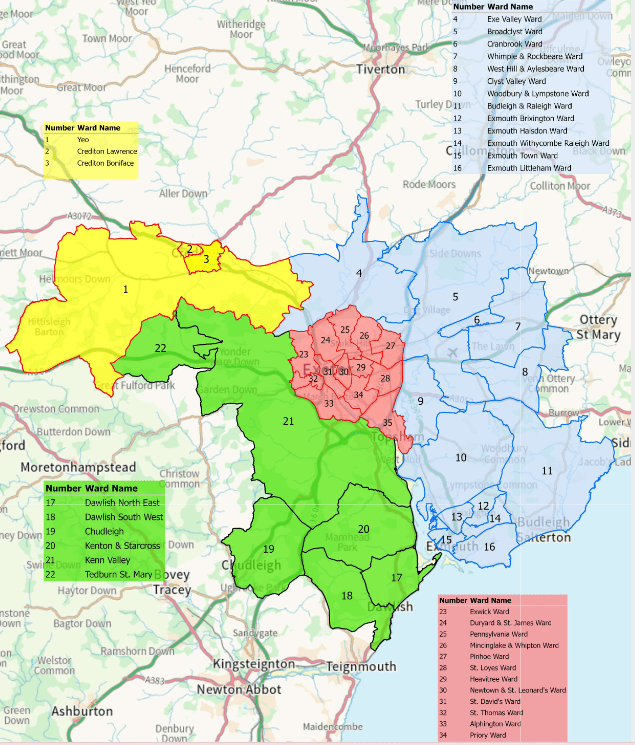
The key take-away from all this is that Exeter has had to make no change, retaining all its 36 councillors and ward structure with three councillors per ward elected on a rotational basis. Indeed it looks as if the whole of the Devon carve up has been designed to satisfy Exeter.

The remaining 50 seats (to retain parity) will have to be divvied up between the 22 wards carved out of the surrounding districts, an average of two and a bit councillor each.

Are you ready for a hybrid electoral system?

Are we going to have a hybrid electoral system where:

Wards with three councillors elect one councillor in each of the three active years, with no election in the fourth (fallow) year. (Exeter) 

And the rest where:

Wards with two councillors elect one councillor in two of the active years.

Wards with one councillor elect their single representative in only one of the active years?

How is this going to work?

Owl doubts that it will pass muster with the electoral commission.

Details

From former Mid Devon

3 new wards

  • Yeo
  • Crediton Lawrence
  • Crediton Boniface

From former Teignbridge

6 new wards

  • Dawlish North East
  • Dawlish South West
  • Chudleigh
  • Kenton & Starcross
  • Kenn Valley
  • Tedburn St Mary

From former East Devon

13 new wards

  • Exe Valley
  • Broadclyst
  • Cranbrook
  • Whimple & Rockbeare
  • West Hill & Aylesbeare
  • Clyst Valley
  • Woodbury & Lympstone
  • Budleigh & Raleigh
  • Exmouth Brixington
  • Exmouth Halsdon
  • Exmouth Withycombe Raleigh
  • Exmouth Town
  • Exmouth Littleham

From former Exeter City – no change

12 Wards

  • Exwick
  • Duryard & St. James
  • Pennsylvania
  • Mincinglake & Whipton
  • Pinhoe
  • St. Loyes
  • Heavitree
  • Newtown & St. Leornard’s
  • St. David’s
  • St. Thomas
  • Alphington
  • Priory

Despite all this gerrymandering Exeter councillors will still be outnumbered 36 to 50 from the rest.

Is this democracy: 2,200 electors for one councillor in Exeter but 3,500 in the Rural Rump?

Local government reorganisation – Rural rump councillors to represent 60% more electors than their counterparts in Expanded Exeter.

Here are the stark numbers (Source)

Exeter

  • Electors: 188,449
  • Members: 86
  • Ratio: 1:2,191 [Rounded 1:2,200]

Devon (Coast and Countryside)

  • Electors: 359,906
  • Members: 103
  • Ratio: 1:3,494 [Rounded 1:3,500] i.e. 1,300 (or 60%) more electors than an Exeter councillor.

Whilst there are strict rules to retain parity between wards within a single authority, there are no rules governing the need for parity between separate authorities.  However, parity will still have to be maintained between parliamentary constituencies.

So one effect of creating unitary authorities is to enable the government to make major shifts in representation between rural and urban areas.

But is it fair?

Is this the real reason Andy Burnham only met Exeter Council Leader Cllr. Phil Bialyk on his “visit” to Devon? 

Special DCC meeting (LGR) cabinet

The government has required councils affected by reorganisation to respond by 17 August. (In a hurry during the holiday season.)

At a special meeting of the (LGR) cabinet convened by Devon County on 14 August:

The Leader MOVED the following motion which was duly SECONDED by Councillor Buczkowski;

            That Cabinet

(a) note, but due to the democratic deficit it creates, do not endorse the response to be submitted by Devon County Council to Government, by the 17th August 2026, regarding interim warding arrangements for the proposed successor authorities arising from Local Government Reorganisation in Devon, Plymouth and Torbay and Exeter; and

(b) that it be further noted that final decisions on councillor numbers, initial electoral arrangements and the content of the Structural Changes Order rest with the Secretary of State and Parliament.

The MOTION was put to the vote and declared CARRIED.

Footnote

Elsewhere Owl has written that it looks as if the whole of the Devon carve up has been done to satisfy Exeter.

The City  has had to make no changes to its wards or representation, retaining all its 36 councillors and ward structure with three councillors per ward elected on a rotational basis. Compared to Plymouth and the rest of Devon it has a generous allocation of councillors.

The result is not only inequity. This generosity has wiped out any chance of making savings by significant reductions in councillors.