‘It has been a good news, bad news kind of week’

Paul Arnott www.exmouthjournal.co.uk

Readers may have seen that East Devon District Council is setting up a new drive to support the amazing work of volunteers across East Devon, using funds from the UK Shared Prosperity Fund.

Often such schemes are loaded with acronyms which stand in the way of understanding what is really being facilitated. Who amongst us really knows what the VCSE sector is? The answer: the wonderful groups leading work in the Voluntary, Community and Social Enterprise area.

The best way to illustrate it is to look at the well-established work of the agency EDDC is partnering with to deliver the scheme, Devon Communities Together (DCT), whose website at http://www.devoncommunities.org.uk tells their story.

In essence, DCT tries to identify gaps in our response to making Devon communities sustainable, in an area where there are often hidden semi-rural and rural problems in small communities. This can be anything from advice for people trapped using oil for heating in the current crisis to advising on grant funding for emergency planning. Having seen the terrible effect of flash flooding in Newton Poppleford and Tipton St John recently, it is clear that many communities in East Devon do not have a resilience plan in place.

In other areas of their work, DCT encourage small business start-ups facing Devon-specific challenges, and were advisers to village halls and community centres last winter as they strove to provide warm hubs. They have also been a central agency recently supporting the organisation of the redistribution of surplus food to individuals, households and groups in order to reduce food waste, feed people and build community capacity and resilience.

It is completely pointless to get political about why this work is more crucial now than ever. You are a very lucky person indeed if you do not now personally know someone struggling with soaring mortgage interest rates, private rental charges or food inflation around essentials. What matters now is less about blaming the government and more about seeing how we can collectively respond.

Unfortunately, there is also worrying local news which I discovered on Monday this week is far from unique when I was told of a Hilton Hotel near Bristol Airport that has been housing migrants awaiting the processing of their applications for leave to remain in the UK for many years. My source was a Somerset-based chef and volunteer who was appalled that the residents in the hotel have no access to proper cooking facilities.

I was stupefied to hear about this, because that is precisely the problem recently reported by residents and professional and volunteer visitors to the hotel near Exeter Airport which is being run along exactly the same lines. Marooned miles from a shop, with little cash in hand, the residents have been rendered dependant on ready meals driven down the M5 from as far away as Birmingham.

I have heard convincing worries from educational professionals who deal with the children of these families – by basically feeding them at schools with no extra government support – that malnutrition is becoming an evident problem. Malnutrition.

Socially the effect is completely demoralising. Both the Bristol hotel and Exeter hotels have professional kitchens, yet residents are lucky to get access to a microwave. Cooking binds families together as much abroad as it does here.

This time I will get political. Government through the Home Office has turned its back on all of this, leaving private companies, a melange of local authorities and the unfortunate residents to muddle through.

I cannot unhear what I have heard. This is now a major Safeguarding issue, and I’m sending up the distress flare. Action, please, central government. Now. I’m pretty sure volunteers would come forward in their dozens to help supervise access to the kitchens.

What a surprise – Simon Jupp’s NHS pledge is filmed outside the only hospital where the Tories didn’t remove the beds

So Simon Jupp, the chicken-run Tory MP for Exmouth who’s now standing for the new Honiton & Sidmouth constituency, is trying to counter Richard Foord’s pledge to support community hospitals. He’s done a photo-op outside Sidmouth Community Hospital- the only one in the new constituency that hasn’t had its beds ripped out by the Tories. Funny he didn’t come to Seaton, Axminster, Honiton or Ottery St Mary, isn’t it? – Martin Shaw seatonmatters.org 

‘I will always fight to protect our local NHS’

Simon Jupp, MP www.exmouthjournal.co.uk  (and other local news papers)

For many, going to the local GP surgery is the front door to our NHS.

The latest figures show GPs are seeing on average 20 additional patients every working day compared to before the pandemic.

More staff than ever are working tirelessly to deliver that. Numbers are up by a quarter since 2019.

And more money is going into primary care than ever before. Funding is up by a fifth compared to seven years ago, even when taking inflation into account.

But we should be honest that the pandemic placed unprecedented pressures on healthcare services which led to treatment delays.

One of the Prime Minister’s priorities is to cut NHS waiting lists. And rightly so.

By the end of the year, patients who need prescription medication will be able to get it directly from a pharmacy, without a GP appointment, for things like earache, sore throat, and other infections.

By expanding the role of pharmacies with a £645 million investment over two years, fewer people will need to see their GP by default – freeing up appointments and lessening the ‘8am rush’ to get one.

We should also acknowledge that some pharmacies in East Devon are stretched. In Parliament, I’ve pressed Ministers to get funding to our pharmacies as quickly as possible. I visited Morton’s Pharmacy in Axminster last week and I’ll be relaying the feeling from the front line in my regular discussions with Health Ministers.

Money is going in to tackle NHS waiting lists at our hospitals. The multi-million-pound Exeter Nightingale Hospital has been kept open to help diagnose conditions and take pressure off the RD&E.

In Exmouth, I had the pleasure of visiting the hospital recently to see the £1.5 million for refurbishment that’s come from public funding and the hospital’s League of Friends. In Sidmouth, £353,000 of capital investment has been spent to improve facilities in the last year. 

These investments acknowledge the key role that community hospitals like Sidmouth, Exmouth, Ottery St Mary, Seaton, Axminster & Honiton play in caring for people closer to their homes. I will always fight to protect our local NHS.

MP calls for Devon school rebuild

The Environment Agency (EA) declared in 2015 that there is a ‘risk to life’ of the children attending the hub and that it must be rebuilt outside of the flood zone.

However, a  £3.5million bid to the Priority Schools Building Programme was rejected in the same year.

The upcoming election focusses minds! – Owl

Senior government officials will visit Tipton St John to help speed up plans for a site to be found for a new school, following recent flash flooding which led to the evacuation of Tipton St John Primary School.

Radio Exe News www.radioexe.co.uk

After Simon Jupp MP held an urgent meeting with Education Minister Baroness Barran in the days after the flooding, Department for Education officials will be visiting prospective sites in the coming weeks to consider appropriate locations for the new school.

The village of Tipton St John was severely impacted when intense rainfall of up to 130mm fell across a few hours, leading to the evacuation of children and staff from the local primary school who had to be rescued by the fire service.

Working with the Department for Education, Diocese of Exeter, Devon County Council and the local school leadership team, East Devon’s MP has called for a new school to be built in a safe location as soon as possible. In December, the Department for Education confirmed funding would come from the School Rebuilding Programme to build a new school to replace Tipton St John Primary.

Today in Parliament, Simon Jupp MP called for building work to be prioritised to protect pupils and staff and has secured a further meeting with Ministers.

Simon Jupp, MP for East Devon, said; “Children and staff had to be rescued by the fire service after Tipton St John Primary School flooded recently, and it’s clear action is needed now more than ever. Since being elected, I’ve raised the school’s situation in Parliament, regularly met with Ministers at the Department for Education, visited the school many times, and worked with the Diocese of Exeter and Devon County Council to secure its long-term future. Last December, I was pleased to confirm the government would fund the building of a new school. Since then, work to assess every possible option to keep the school in the village has continued and I’m looking forward to welcoming senior government officials to Tipton St John in the coming weeks. I’ll continue to press for the urgent relocation of the school as the safety of children and staff must come first.”

Nick Gibb MP, Minister of State for Schools, said in Parliament today; “I was sorry to hear about the flash flooding and the impact that this has had on the school and the local community. Tipton St John Primary School was selected for the School Rebuilding Programme in December which will ensure a long-term solution for the school, protecting children and staff from flooding in the future. Officials are working with the Diocese of Exeter, Devon County Council, and my Honourable Friend to identify and secure a new site for the school, and I thank him for his support to help make this happen as quickly as possible.”

Look out for the sea turning green in Exmouth this week

Fluorescent dye will be added to the water at Exmouth beach after the community called for an investigation into a sewage outlet.

Fluorescent dye test for the water off Exmouth beach aims to address pollution fears

Becca Gliddon eastdevonnews.co.uk

South West Water (SWW) has announced it is dye testing water off Maer Rocks,  Exmouth, from 8.30am on Wednesday, June 14, after residents raised concerns about black sewage seen on the beach.

Exmouth Town Council, backing the testing, said the aim of the dye testing was to ‘demonstrate the water company’s commitment to openness and transparency’, pinpoint the location of the storm overflow pipe – where extra rainwater or wastewater is released into rivers or seas – and to ‘create confidence’ through showing how the set-up works.

SWW said the yellow-green florescent dye was harmless to water quality and wildlife and would ‘take some time’ to move through the water network.

A South West Water spokesperson said: “On 14 June, we will be carrying out investigative work at Maer Rocks in Exmouth involving dye testing.

“The work follows a request from the local community for us to confirm the location of the discharge point from our outfall pipe.

“As a result, customers may notice some yellow/green discolouration to the sea near Maer Rocks on Wednesday morning.

“We would like to reassure local residents and visitors that the dye is harmless and other than a temporary colouring, will not affect bathing water quality or the wider ecology of the beach or Exe estuary.

“We thank customers for their patience while we carry out this work.”

Exmouth Town Council said the timing of the test had been planned to ensure optimum tidal conditions for the process to take place.

It said the testing would prompt the council to push for a simpler alarm system, because there was ‘much confusion’ over the current method.

Councillor Olly Davey, town mayor, said: “ We are really pleased that South West Water has agreed to carry out the dye testing.

“This will go a long way to reassure the local community and help with understanding the issues involved.

“We will also be pushing for the alert system to be clarified and possibly simplified as there is much confusion over when a discharge actually takes place.”

The town council said recent reports of sewage, turning sand black in the the area of Maer Rocks, was found to be rotting seaweed.

A town council spokeswoman said: “South West Water internal tests and the Environment Agency’s independent investigation have conclusively shown that the reported incidents were unrelated to South West Water’s infrastructure or sewage systems.

“However, in an effort to address any concerns from residents and demonstrate its commitment to openness and transparency, South West Water have decided to conduct dye testing in the area.”

Minister refuses to back Hancock Covid claim of ‘protective ring’ for care homes

Further vindication for Cathy Gardner. – Owl

The care minister, Helen Whately, has declined to back Matt Hancock’s claim that the government threw a “protective ring around care homes” at the start of the pandemic.

Robert Booth www.theguardian.com 

Whately worked under the former health secretary in the first 18 months of Covid, but she avoided endorsing her former boss’s assertion, which will be tested at the public inquiry which starts in earnest this week.

Asked whether Hancock was right in May 2020 when he told parliament “we absolutely did throw a protective ring around social care”, Whately told the Guardian she wanted to “use my own words which is that I look back on doing everything I felt that we could to help care homes and social care more broadly at an incredibly difficult time”.

In the first wave of the pandemic there were almost 27,000 “excess deaths” in care homes in England and Wales compared with the 2015–19 average. The virus penetrated care homes so widely and spread so fast that 13 homes in England saw two dozen or more Covid deaths each in just 11 weeks at the start of the pandemic, official figures have revealed.

Evidence sessions examining the UK’s preparedness for the pandemic start this week and Hancock, who resigned from the government in June 2021 after breaking lockdown rules, is due to give evidence this month.

Lawyers for trade unions are expected to highlight the chronic underfunding of social care and its fragmented provision in an opening statement to the inquiry this week. Government policy at the start of the pandemic of not requiring the isolation of untested hospital patients discharged into care homes has already been ruled illegal in the high court, where judges described it as “irrational”.

“I look back on it, how hard it was at that time when we were trying to get PPE out to social care,” Whately said. “We had so few tests available.”

She added: “I know looking back on it, it was very hard in the early days … We were really doing all that we possibly could. Still, it was really hard because people who were living in care homes were particularly vulnerable to Covid, as we know.”

Labour’s Liz Kendall, the shadow care minister, seized on the comments as an admission by the Conservatives of “what the country could see: their ‘protective ring’ was an insult to the staff, families and care home residents who were not only vulnerable but voiceless”.

She said: “For the 43,000 families mourning the loss of a care home resident, nothing will bring their loved one back. But they will be looking to the inquiry for answers and lessons to be learned.”

Leaked WhatsApp messages have already revealed Whately warned Hancock against restricting visits to care homes in October 2020 saying it would be “inhumane” and some elderly people were “just giving up”. Earlier, on 8 April 2020 she urged Hancock: “We should be testing all care home residents and staff who have had Covid contact, irrespective of symptoms.”

However, care homes were not able to start testing residents or staff without symptoms until the end of April. She also complained to Hancock that PPE supplies were “all over the place” and that discharging hospital patients into care homes was “my biggest concern”.

The chancellor, Jeremy Hunt, who preceded Hancock as health secretary, has also been called as a witness in the module starting this week on pandemic preparedness, alongside David Cameron and George Osborne, who are set to be asked about the impact of their austerity policies from 2010 onwards on the nation’s readiness.

The module on care homes is not due to start hearing from witnesses until spring 2025.

Broader government handling of social care, which looks after over a million people in England, has been widely criticised.

It is estimated that an extra 480,000 care workers are needed in England by 2035 and there are already 165,000 vacancies. In 2020 when Hunt was out of government under Boris Johnson and chaired the Commons health and social care select committee, he said the annual social care budget must rise by £7bn by the end of 2024. The Health Foundation charity estimates the funding gap will be £9.3bn by next year but last autumn the government raised spending by equivalent to £3.75bn a year.

Whately told the Guardian there had been “big, big workforce challenges” over “many years”.

“The thing that I hear from the frontline is we need to be able to pay the care workforce better,” she said. “And for that, we need better funding to come through from local authorities for the care rates.”

Asked if the latest £7.5bn increase in central government funding over two years was the right amount, she said: “I want to see social care really well funded, but I’m not making the decisions for how all of government is funded. I will argue the corner for my sector.”

Today in England about 10,000 people live in the worst inadequate care homes, where problems are often caused by lack of staff. Asked if she accepted staff shortages were causing pain and suffering, she said: “You’ll understand if I choose my own words, but I know … for some providers, staffing is one of their big challenges. Really good care homes have staff there for a long time but others are finding it really difficult. I think we’ll see quality of care improve if we can help providers retain staff.”

She said increasing recruitment of care staff from overseas by adding them to the shortage occupations visa list was helping in the short term, but it was not a long-term answer.

“I want everyone to be in a good, if not outstanding, care home,” she said. “That is why I think the workforce reforms and the funding for social care are really, really important. But I don’t think anybody sitting in my position could come in and fix it in 24 hours. This is a long-term problem.”

Planning applications validated by EDDC for week beginning 29 May

Martin Shaw: Politics Matters

Martin Shaw, whose regular opinion column in the local press has been cancelled, has agreed to write a column for East Devon Watch. 

Martin will not stick to a rigid timetable but respond to issues as they arise. 

Here is the first.

A historic opportunity for East Devon

Just 12 months ago, East Devon voters helped topple Boris Johnson in a by-election after the tractor-porn MP, Neil Parish, resigned. Now Johnson himself has resigned as an MP (because he knew he’d lose a by-election in his London constituency), it feels as though what we started last year is coming to fruition.

Richard Foord, our new Lib Dem MP, has certainly hit the ground running. Having stood for election myself to save the community hospitals threatened with closure in 2017, I was especially pleased to see his new campaign to bring the beds back into Axminster, Honiton, Ottery and Seaton hospitals. The need for these wards was amply demonstrated during the pandemic, when Devon NHS was reduced to commandeering hotels to cope with the extra patients.

I’m sure Richard would agree that this will be just one part of restoring the NHS to a state where we can all be sure of the right care. It will require massive investment in nurses and doctors, which realistically is only likely to come from a Labour government under Keir Starmer. Although he is playing down the issue, it’s obvious that Labour will have to put in huge extra funds as Tony Blair did after Margaret Thatcher and John Major ran down the NHS in the ‘80s and ‘90s.

How can we in East Devon help the big national change which is needed? Our first priority must be to keep Richard as our MP in the election which is due in 2024. The constituency boundaries have changed and reading between the lines it looks likely that he will stand in the new Honiton & Sidmouth constituency. Here he will be up against the Tories’ Simon Jupp, who has done a chicken run from the new Exmouth & East Exeter constituency (where 78 per cent of the people he currently represents live).

Jupp’s shift testifies to the fact that on paper, Honiton & Sidmouth is the safer Tory seat. By the same token, all of us who want to keep the Tories out must rally behind Richard, assuming he is the Lib Dem candidate. It was great in the local elections to be able to vote Independent, Lib Dem, Green or Labour, and see a good mixture of candidates elected. In the general election, it will be a different kettle of fish. Many Tories who stayed at home in the by-election will come out and put their cross against Jupp. If anything, Richard will be the underdog, and he will need absolutely every vote.

Keeping our first non-Tory MP will be an enormous achievement for the area and a boost for the Lib Dem-Independent-Green alliance which runs EDDC. It will also help to ensure that when Starmer takes over from Sunak, we have an independent voice to put our concerns to the new Labour government. Keeping our Lib Dem MP will be a win-win.

It’s time too to start thinking seriously about the General Election options in Exmouth & East Exeter. Jupp is fleeing this seat precisely because it’s a better option for a strong anti-Tory candidate – Independent candidate Claire Wright made it a marginal and was just 5,000 votes behind last time. With Claire out of the picture, it’s important that a single strong challenger emerges to replace her.

I don’t know who that will be, but the worst possible outcome would be a close contest between the Lib Dem and Labour candidates which lets the Tory squeak through the middle. Historically the Lib Dems have been stronger in this seat and they need to choose a credible candidate who can continue where Claire left off. In 2024, both East Devon constituencies could elect progressive MPs. It’s a historic opportunity and we must not let it slip.

Freeports are costing a fortune. Why aren’t they being monitored?

“The Plymouth and South Devon Freeport will supercharge the South West economy by building on our region’s unique national capabilities in marine, defence and space to form globally impactful clusters and a UK Innovation Superpower.” – Owl

Darren Jones MP, the Labour chair of the business and trade committee, has secured for himself a place on the shortlist for what I’m going to call the “Wait, What?” award for June.

James Moore www.independent.co.uk 

I shall bestow this on those who say things in otherwise anodyne-looking press releases that immediately pull you up.

Here’s his quote on the subject of freeports, one of Rishi Sunak’s flagship economic policies, something we have repeatedly been told will be a major benefit of Brexit. If that’s not an oxymoron. (PS: it is.)

“The government hopes that freeports and investment zones will transform regional economies, but we don’t yet have an agreement on how success should be measured.”

Wait, What? Think about what Jones said for a moment. These are government-certified big deals that the then little-known Sunak extolled the virtues of in a report for the Centre for Policy Studies, a right-wing think tank, way back in 2016.

Boris Johnson would happily bang on about them to anyone who cared to listen. And yet, here is Jones, announcing the terms of an inquiry into them, telling us there’s no agreement on how the policy should be assessed.

This matters. These specialised zones offer a series of generous concessions to the businesses operating within them.

There are eight in England, with two more given the go-ahead in Wales. Scotland has its own take on the wheeze, having announced two “green” freeports, which had to include plans for lowering emissions in the bidding process although they don’t face hard requirements to actually deliver on saving the planet.

The lot of them sit outside the UK’s main tax and tariff rules and enjoy lower regulation. But they have many critics. The TUC has, for example, expressed fears that they will serve as a “Trojan horse” which will usher in lower standards to the detriment of people working within them.

They aren’t cheap. The Office for Budget Responsibility thinks they will cost £50m a year from the current financial year, with the largest costs arising from employer national insurance contribution relief and business rate incentives they grant.

The OBR, however, admits that its estimate is a shaky one for a variety of reasons. The extent to which the various tax reliefs will be taken up is not known. Another outstanding question is how much freeport activity will be genuinely new investment and how much will simply be displaced from other parts of the UK by businesses seeking to take advantage of the tax breaks.

Critics of them see this displacement as another major problem.

It’s not as if they’re really new. A number of them were set up in the 1980s but the Conservative-led coalition government led by David Cameron phased them out in 2012 because their success was strictly limited.

Ah, but this time it’s different, say their proponents, such as Sunak. Now we’re outside the EU we can do all sorts of exciting things with them.

Well, we’ll see, shall we? The government does indeed have more flexibility than it had. The EU has been taking an increasingly dim view of the 80 within its member states because of some of the failings they are accused of. Here’s some more: critics say they facilitate money laundering and tax avoidance.

If the UK ones get too exciting in terms of incentives (and subsidies), the EU may very well take umbrage and levy retaliatory tariffs. There’s no such thing as a (tax) free lunch. We ought to have realised that by now.

With all those concerns, you would think a framework for measuring the success of this important and expensive economic policy would have been constructed, agreed and signed off years ago, but apparently not.

A cynic might suggest that this is because it isn’t just a big chunk of taxpayers’ money that is being invested in these things. An even more substantial amount of political capital has been pumped into them.

It would therefore be quite inconvenient if our putative framework were to adjudge them a white elephant at best, and a venue for the realisation of critics’ fears at worst.

Over to Jones’s committee, which will seek to measure the impact that freeports are having on business and trade and to consider where the cash lavished on them has been spent and whether it has been well spent.

Thank goodness someone is looking into this.

Sidmouth: Lethal metal poles stick out of sand at beauty spot

Beachgoers at a Devon beauty spots have been warned of what lurks beneath after what looks like scaffolding metal poles have been spotted sticking out of the sand. The scaffolding poles were pictured by Devon Arborists who took the picture above as a warning to dog walkers and swimmers enjoying Jacob’s Ladder in Sidmouth.

Olivier Vergnault www.devonlive.com

Jacob’s Ladder is one of the town’s two large beaches. An expanse of sand and shingle, the beach gets its name from the series of wooden steps that lead down from Connaught Gardens.

Over the past few weeks parts of the promenade have been fenced off as work is underway to repair it. People who have commented on the Devon Arborists’ post on Facebook have branded the metal poles sticking out of the sand a “horrific accident waiting to happen”.

Commenting on the post which was reposted by the Sidmouth Community for the people group, Leitch David said it was vital people going to the beach checked out where they swim before diving in as “you never know what lurks beneath”.

Samantha Day added: “Goodness, that’s a horrible accident waiting to happen, especially when the tide is in and you can’t see them.”

Richard Davey agreed, adding: “Absolutely lethal and horrible to think someone may have had a serious head or facial injury. Well done for bringing it to our attention.” Roger Hamilton-Kendall couldn’t agree more, adding: “Need to remove that sort of thing. Dread to imagine someone diving into the sea.”

Deborah Milward said: “Can it be removed ASAP as children or dogs could really have nasty accidents on those dread to think?”

Devon devolution deal could be offered by the autumn

Will this make the Local Enterprise Partnership, Heart of the South West (HotSW), and all the other unelected, business led bodies trying to bid for central government strategic regional funding redundant? – Owl

Ollie Heptinstall www.devonlive.com 

A devolution deal for the whole of Devon is progressing and could be offered to the county by the autumn. Outline approval was given in March to transfer new money and powers to local leaders – part of ‘levelling-up’ proposals by the government.

The ‘level two’ deal does not require an elected mayor, nor change the established council structure. Instead, a combined board would be created with the leaders of Devon County, Torbay and Plymouth councils, as well as district representatives.

The South West Local Enterprise Partnership’s scrutiny committee was told on Thursday [8 June] that work is now underway on the formalities, with six areas of greater powers being focussed on. These include more say on housing, devolution of adult education funding and more control of public transport commissioning.

Phill Adams from Devon County Council, who updated the committee, said the government is also open to exploring other areas for devolution, including innovation, tourism and culture. The planned combined authority will be “standalone from existing councils” according to Mr Adams.

“It would be led by the three upper-tier councils in conjunction with the districts in Devon … a business voice and some partners – most likely education.”

The combined board would be chaired by one of the three upper tier leaders – Cllrs John Hart (Conservative), David Thomas (Conservative) or Tudor Evans (Labour).

“It doesn’t replace anything,” Mr Adams stressed. “It’s not taking over. It’s not a super council or anything like that. This is purely around local government having a body to work through some of these functions that come down from government together. It’s very different from a mayoral approach. This is very much around developing what we’ve got.”

Once the deal has been offered by the government, it will then be subject to approval by local councils and a formal consultation process.

A cautionary tale of a council’s reckless regeneration vision

Woking has a council tax income on a similar scale to EDDC’s.

On an annual council tax take of £11m, it  is now paying £62m a year to service £1.8bn in loans on assets worth £600m less than what was paid for them.

A local resident “”armchair auditor” has been writing warning letters for years that have been ignored.

A picture is now emerging of: “Municipal recklessness, non-compliance with financial rules, over-optimism, egomania, incompetence, lack of transparency and regulatory neglect.”

A Tory council out of control – who could believe such a thing? – Owl

‘Eye-watering’: how Woking council’s glittering dream turned to dust

Patrick Butler www.theguardian.com 

In the autumn of 2020, the Tory leader of Woking council announced he was stepping down. In his valedictory speech, David Bittleston insisted Woking was not merely the best council in the country but was going places. “Ahead of us, this borough has an exciting future,” he declared.

Bittleston’s self-congratulatory boosterism was par for the course. He and the town’s municipal leaders were signed up to a grandiose high-rise vision that would transform the modest commuter town in leafy Surrey into a glittering modern city, Singapore-style economic hub and “premier global business location”.

This week Woking filed for effective bankruptcy after running up a deficit of £1.2bn on a series of risky property and regeneration deals. The place perhaps best known as the inspiration for The Jam’s hit song Town Called Malice has become the biggest financial basket case in UK local government history.

The epic scale of the council’s collapse has sent shock waves through local government. As auditors sift through the wreckage, an astonishing picture is emerging of municipal recklessness, non-compliance with financial rules, over-optimism, egomania, incompetence, lack of transparency and regulatory neglect.

The numbers involved are staggering. Tiny Woking, with an annual council tax take of £11m, is paying £62m a year to service £1.8bn in loans on assets worth £600m less than what was paid for them. “It’s simply eye-watering,” said Rob Whiteman, the chief executive of Cipfa, the public sector accountants body. “It is almost impossible to comprehend.”

No one seems quite sure about how to fix the problem. Woking could put up council tax bills by 15%, sell off all its assets and cut local services to a skeletal legal minimum, and it may still not bridge the deficit. Experts say the government, which approved Woking’s debt pile, must now decide whether to write off the loans.

It is not just Woking council’s head-spinning profligacy – the skyscraper developments, the hundreds of millions pumped into town centre regeneration, the £11m loan to a local private school, the purchase of pubs and farmland – that is coming into focus. It is how, despite warnings, things were allowed to spin out of control.

One local politician who had questioned the plans said: “There were no controls, no proper project management, no financial risk assessment. Just this naive idea that it was cheap money and what could possibly go wrong … You had this magic money tree, and they started playing Monopoly.”

The blame game is in full swing. The ruling Liberal Democrats, who took power in May 2022, say the Tories, who had controlled or led the council for the previous decade, are entirely culpable. The Conservatives claim the Lib Dems supported all of the key investment decisions at the time.

Some point to the role of Woking’s former chief executive Ray Morgan, the most senior official at the council between 2006 and 2021, when he retired. Made an OBE in 2007 for services to local government, people who know him say he was outspoken, cocky and ebullient with a reputation for getting his way. “A big fish in a small pool,” according to one source.

A key architect of the regeneration vision, Morgan overreached his brief, some suggest. “All roads lead to Ray,” one local politician said. Morgan has always insisted decisions were taken collectively. “Various people accuse me of being a megalomaniac,” he told a public meeting in 2013. “But at the end of the day I do what the council decides.”

Morgan was perhaps uncharacteristically unforthcoming when approached about the council’s collapse this week. In a statement to the local news website Surrey Live on Thursday, he said: “I am no longer employed by the council, I do not think it appropriate for me to engage in a public discussion when I am no longer in possession of the facts of the matter.”

What is not in dispute is that Woking had become the most highly leveraged council in the country, with the debt levels of a major city. Yet as a government review revealed last month, it lacked commercial expertise, took major decisions without proper risk assessment or business cases and breached Treasury borrowing rules.

This week’s section 114 notice declaring the council’s insolvency said there was a high probability that much of the internal financial advice that underpinned the council’s investment decisions contained “inaccuracies and misassumptions”. Had these issues been understood earlier, the report suggested, Woking would have struggled to remain solvent as far back as 2018.

Why did the problems not come to light before? In the past three years, Anthony Fraser, a local resident, retired operations director and “armchair auditor” with a keen interest in local government finance, wrote a series of detailed letters to the council, its auditors and ministers at the Department for Levelling Up, Housing and Communities warning of the dire risks Woking faced.

Trawling through the council’s published financial documents, Fraser explained how it had become drastically overexposed, had failed to set aside money to service its borrowing and was in effect using Treasury loans to enable its struggling partner companies to meet day-to-day costs, in contravention of government rules.

The town’s borrowing was out of all proportion to its core ability to repay, putting its solvency at risk, he told Woking’s auditors, BDO, in 2021. “In effect, financially we are a relatively small town tacked on to and heavily dependent on the fortunes of a group of big development companies.”

That letter was not answered. Others were politely batted away. It was frustrating, he said, that no one was prepared to listen. Fraser’s concerns were largely borne out by this week’s section 114 report. “You spell it out to the people responsible for overseeing it, and it gets ignored,” he said.

Some still quietly insist the council was right to be ambitious. One local political figure said the dream of town centre regeneration, affordable housebuilding and green belt protection was basically sound, and would have prevailed had it not been for the pandemic. Over time, they said, Woking would be proved right.

But such optimism is rare. Many see Woking’s crash as a consequence of austerity and laissez-faire policies. Councils were hit by huge cuts in funding, and ministers encouraged town halls to be entrepreneurial and find alternative income streams. Government provided councils with billions in cheap capital loans while cutting core audit oversight of their finances.

Woking joins Thurrock, Croydon and Slough on the list of recent local government bankruptcies. All had borrowed heavily from the Treasury to invest in property and regeneration projects. Whitehall is closely monitoring several more highly indebted councils.

Before Covid, Woking’s financial wheeler-dealing brought in £22m a year to fund services, insulating it from the chilliest winds of austerity. Despite a 40% cut in funding since 2010, the council insisted its commercial prowess meant it had not had to close any frontline services for local residents.

Now, however, its future looks very different. The council’s interim director of finance, Brendan Arnold, signalled this week that things had changed. “The enriched service suite that the borough has enjoyed over a number of years will need to be removed,” he wrote.

In plain language, it means Woking faces a fire sale of assets, unprecedented budget cuts and council tax rises. Municipal austerity has finally arrived.

Income from holiday lets overtakes buy-to-let

The number of people making money from renting out holiday lets has risen by nearly 40 per cent in a decade, as data shows holiday homes have now become more profitable than buy-to-let investments.

David Byers www.thetimes.co.uk

Figures released by HMRC after a Freedom of Information request show that 63,000 individuals received income from 65,000 furnished holiday let properties in the UK according to the latest data available — up from 46,000 making money from 50,000 properties in 2011-12.

Further statistics show the increasing profitability of owning a holiday let compared with the diminishing returns of being a landlord, with holiday let income rising by an average of 63 per cent in the past decade compared with just 5 per cent for buy-to-let. The average annual holiday let income actually exceeded buy-to-let income for the first time in 2020-21 — reaching £15,600 compared with £13,400 for buy-to-let. A decade ago, holiday lets generated an annual average of £9,600 compared with £12,800 for buy-to-let.

Critics say the figures further illustrate why tax rules that incentivise investing in holiday properties, while turning people against being traditional landlords, are driving up prices in rural hotspots such as the Lake District while simultaneously creating a chronic shortage of rental properties in cities.

For holiday lets, if your property qualifies as a self-catered holiday let — meaning that in England it must be let for at least 70 nights a year and available for at least 140 — you can switch from paying council tax to business rates. However, if your annual business-rates bill is less than £12,000 and you only rent out one property, you are exempt and will pay no tax. In Wales the rules are tighter — properties not let out for at least 182 nights a year and available for 252 are classed as a second home and the council tax bill is doubled. You can also get tax relief on mortgage interest payments, and tax relief on expenses such as furniture.

On the other hand, buy-to-let owners used to be able to deduct borrowing costs and some property management costs from their rental income before paying tax on it, but that has been phased out, ending completely in 2020.

The Freedom of Information figures on holiday lets relate only to those people declaring income in personal names, and therefore excludes anything in a company structure.

David Fell, a senior analyst at Hamptons, who submitted the request, says the number of people investing in holiday lets rose dramatically during the pandemic because so many more people were confined to staycations as a result of international travel restrictions. “While Covid undoubtedly distorted the market, the longer term upward trend in revenue predates Covid, and it’s a trend the government has been increasingly worried about.”

Tim Farron: ‘Short-term lets are a catastrophe in the countryside’

I am incredibly privileged to represent the most beautiful constituency in the United Kingdom. Westmorland and Lonsdale is home to the Lake District National Park, the Yorkshire Dales National Park, the Arnside and Silverdale area of outstanding natural beauty, the Cartmel peninsula and the rolling hills of south Cumbria.

But I’m very sad to say that wonderful and iconic towns and villages here face an existential crisis — a housing catastrophe, which means fewer and fewer homes for people to live in.

There are three principal causes: a lack of genuinely affordable homes being built; excessive numbers of second homes displacing full-time residential accommodation; and a short-term rented sector that has gobbled up the long-term private rented sector.

On the first, I have been proud to support affordable housing developments in every corner of my constituency, but we desperately need more of them.

On the second, this has been an issue I’ve been campaigning on since I became an MP in 2005. People are of course entitled to own a second home — and in many ways you certainly can’t blame them from wanting to own a home somewhere as stunning as here — but it means so many streets and hamlets stand empty for so much of the year.

On the third, this has been a more recent and startling development. Just after the pandemic, we saw a 32 per cent rise in holiday lets in just one year, and that is in the Lake District where there were already a huge number of them.

Those new holiday lets were until recently the homes of local people, who were evicted so their landlord can go to a short-term let, normally an Airbnb, and therefore cash in. There are no other places for those people to go and live so their kids are uprooted from the local school, and they have to give up their jobs and move many miles away, robbing our communities of life and of a workforce. We saw this largely because the government failed to scrap section 21 evictions at the time they said they would.

The consequences are huge and human. I think of the couple with two small children in Ambleside, she a teaching assistant and he a chef. They were evicted from their flat because the landlord wanted to go to Airbnb. They had literally nowhere else to go, so the children were taken out of school, a teaching assistant was lost to the local primary school and a chef lost to a local hotel. They had to move 25 miles away and out of the area.

I think of a mum and her 15-year-old son, who lived their entire lives in a village just outside Grange-over-Sands before they were evicted. Again, there was nowhere they could remain within the community. When people are evicted in communities like ours, there is nowhere else to go.

The holiday lets boom in places like Windermere in the Lake District means that many employees in the tourism industry can’t find anywhere affordable to live, Tim Farron says

Holiday lets obviously bring huge economic benefits to the tourism hotspots like the Lake District and the Yorkshire Dales. However, it’s gone too far. So many bars, cafés, restaurants and shops in that industry are struggling to recruit the staff they need to operate largely because their potential employees can’t find anywhere affordable to live.

It is not just the tourism economy that is affected, but the care sector and other professions. At one stage, earlier this year, 32 per cent of hospital beds in my local NHS Trust were blocked. Why? The bottom line is that we cannot get people out of hospital because there are not enough carers, because there is nowhere for them to live.

This week a consultation closed on the government’s plans to introduce a separate category of planning use for short-term lets. This is a move I have long been campaigning for and I remember putting it to Rishi Sunak in a debate I led in parliament back in 2019 when he was junior housing minister.

By doing this, we can give local planning authorities the power to put a lid on new short-term lets and instead ensure those homes remain for local people who can raise a family here and contribute to the economy and community life.

I really hope the government don’t waste any more time, crack on and put this into action, so we can start to turn the tide on Britain’s housing catastrophe.


Tim Farron is Liberal Democrat MP for Westmorland, Furness and Eden www.thetimes.co.uk

High levels of drugs found in sea off south England coast

A study looking at water pollution on the south coast of England has revealed high levels of potentially harmful chemicals including recreational drugs and antidepressants.

Harriet Grant www.theguardian.com 

Scientists involved in the research say marine life is being harmed by human drugs, pointing to evidence that oestrogen in water can feminise male fish through biological changes.

Bianca Carr, the co-founder of the Clean Harbour Partnership (CHP) that coordinated the work, said: “We need to go beyond talking about poo in the water – now we are looking at what’s in that human waste? Now we know the chemicals that are in it, the next step will be to look across the UK at what cocaine and other human drugs are doing to our water, to our food chain.”

Campaigners in Hampshire and Sussex joined forces with Portsmouth and Brunel University London to analyse hundreds of water samples across Chichester and Langstone harbours.

In more than 288 samples, researchers have so far detected more than 50 compounds across 22 sites. These include pharmaceuticals and diabetes medicines as well as a chemical produced by the liver after cocaine use.

The team also discovered pesticides, including some that are banned in the UK.

Prof Alex Ford, from the University of Portsmouth’s school of biological sciences, said: “We know there are billions of litres of sewage discharges annually around the UK but the impact of these discharges are not clearly understood.

“This project is enabling us to determine what chemical contaminants are in our marine life and coastal waters. We have found a large variety of prescribed and illegal drugs plus a variety of pesticides in coastal waters and marine organisms, such as crabs and oysters.

“This is important, because we know that aquatic ecosystems are under threat from pharmaceuticals and farming practices, such as biocides and fertilisers.”

Ford has previously published research showing that even tiny quantities of antidepressants in water can affect wildlife, such as crustaceans and molluscs. Drugs will affect the behaviour and biological makeup of these creatures, including causing them to change colour or reproduce in a different way.

Ford said: “There is a staggering list of prescription drugs passed from humans to wastewater treatment plants and into receiving streams, estuaries, or oceans by direct consumption, metabolism and excretion or by toilet flushing of old prescriptions.

“The release of human pharmaceuticals into aquatic ecosystems is an environmental problem we should consider seriously.”

The study also found E coli bacteria at high levels. A post-storm seawater sample taken from near an outflow pipe from Budds Farm sewage treatment works, near Langstone showed a reading of 380,000 colony forming units per 100ml of E coli, which is 760 times the safe levels set out under the European bathing water directive.

The work is part of growing efforts around England’s coast to highlight the dangers of water pollution. CHP’s co-founder, Rob Bailey, said: “Thanks to community funding, we are starting to get an insight into the cocktail of chemicals polluting our seawater and their sources. Some pesticides seem to have been lingering for several years and the presence of partly digested antidepressants, drugs for type 2 diabetes and bladder infections is concerning. So little is known about their impact on marine life.”

Campaigners have been highlighting the amount of sewage entering Britain’s seas in recent months. In April, figures from an analysis of Environment Agency data done by the Liberal Democrats showed that some popular beaches, including in Sussex, are affected particularly badly.

One of the worst-hit was Brighton beach in East Sussex, where Southern Water discharged sewage 45 times last year, over more than 107 hours. At Meadfoot beach in Torquay, Devon, there were 79 dumps lasting 946 hours.

Southern Water said removing chemical substances from wastewater was not asked for by the Environment Agency.

The director of wastewater operations, John Penicud, said: “Tackling chemicals and impurities, especially ‘forever chemicals’, is a global challenge that requires close collaboration of industry, agriculture and other sectors, including water companies and regulators.

“Our treatment processes already comply with stringent Environment Agency rules relating to the removal of contaminants, and we are working with partners to explore how we can go further – through the use of cutting-edge technology and science, and investing in our network to improve treatment.”

Nuclear weapon secrets in the bathroom: five revelations from Trump’s unsealed indictment

Donald Trump took classified documents including information on nuclear weapons in the US and secret plans to attack a foreign country, according to a 49-page federal indictment unsealed Friday afternoon.

www.theguardian.com 

The former US president, alongside a military valet, now faces a sweeping 37-count felony indictment related to the mishandling of classified documents.

Here are some of the most shocking revelations in the indictment.

Trump took nuclear documents out of the White House

Upon leaving the White House in January 2021, Trump took with him boxes of classified documents, including information regarding US nuclear capabilities, as well as those of a foreign country.

One classified document from June 2020 contained information “​​concerning nuclear capabilities of a foreign country”. Investigators found another undated document “concerning nuclear weaponry of the United States”.

Boxes of records stored in a bathroom and shower in the Lake Room at Trump’s Mar-a-Lago estate in Palm Beach, Florida. Photograph: AP

Trump stored classified documents in the shower, among other places

The former president stored boxes of classified documents in various locations at Mar-a-Lago, including an office space, his bedroom, a storage room, a bathroom, a ballroom and in the shower, according to the unsealed indictment.

On 5 April 2021, a Trump employee texted a colleague to ask whether boxes in the business center could be moved to make room for staff to use it as an office.

The employee responded, “We can definitely make it work if we move his papers into the lake room?”

First employee: “There is still a little room in the shower where his other stuff is. Is it only his papers he cares about? Theres some other stuff in there that are not papers. Could that go to storage? Or does he want everything in there on property?”

After that text exchange, some boxes containing documents were moved from the business center to a bathroom and shower in a space at the Mar-a-Lago club known as the Lake Room.

Trump conspired with his valet to hide documents from attorneys

Trump’s valet, Waltine Nauta, was indicted alongside his former boss for conspiring to hide classified documents from attorneys searching for them. Nauta faces six federal charges, including concealing evidence and conspiracy to obstruct justice.

According to the indictment, Trump directed Nauta, who is currently a personal aide to the former president, to move boxes containing documents in order to hide them from his attorneys, the FBI and a grand jury.

When questioned under oath, Nauta said he was unaware Trump held on to boxes with classified documents. That was a lie, prosecutors found during their investigation, as Trump had instructed Nauta to move them from the White House to his Mar-a-Lago resort.

In July 2021, Trump shared unauthorized information about his desire as president to attack a certain country and a classified conversation with a senior military official during an interview with an unnamed writer and their publisher.

“Look what I found, this was [the Senior Military Official’s] plan of attack, read it and just show … it’s interesting,” Trump told the writer, the publisher and two members of his staff, acknowledging he held on to classified documents detailing the plans. None of those he spoke with had security clearances to know that information.

“See as president I could have declassified it,” Trump said. “Now I can’t, you know, but this is still a secret.”

“Now we have a problem,” said a staffer.

Trump: “Isn’t that interesting?

Trump suggested attorneys lie to DoJ about having no documents

The indictment suggests when lawyers for Trump met with him to discuss how to respond to a May 2022 subpoena seeking documents marked as classified at Mar-a-Lago, Trump allegedly suggested they should tell the justice department that they had no materials that needed to be turned over.

The indictment stated that Trump said: “I don’t want anybody looking, I don’t want anybody looking through my boxes, I really don’t, I don’t want you looking through my boxes.”

He allegedly added: “What happens if we just don’t respond at all or don’t play ball with them?” and “Wouldn’t it be better if we just told them we don’t have anything here?”

Devon council accused of ‘massive scandal’

Mid Devon District Council has been accused of a “massive scandal” over Three Rivers Development’s Ltd (3RDL). 3RDL is a company wholly owned by Mid Devon District Council and is behind projects such as St George’s Court, the development behind Tiverton Town Hall.

Lewis Clarke www.devonlive.com

Speaking during the democratic period at a council meeting on Wednesday, May 24, member of the public Goff Welchman spoke about a “massive scandal with criminal prosecution potential created by the previous administration”.

Mr Welchman was prevented from asking his question, being told it was not in relation to anything on the agenda for the evening’s meeting.

However, Mr Welchman continued his questions saying: “Although it was a problem created by the previous administration, it’s now down to this council to sort it out, even though they weren’t involved in the creation with it.

“The problem was handled with a lot of secrecy, behind closed doors, the public were not given information, and what has transpired is the elephant in the room, which is Three Rivers Development’s Limited, and the potential for criminal prosecution, and I want to know why, when 3RDL has absorbed vast summed of money, possibly approaching £20million of council tax payer’s money, has filed late accounts which are riddled with potential inaccuracies, why is this matter high on the agenda?

“The public is sick and tired of secrecy, and this council needs to demonstrate a line is going to be drawn under this whole, sorry affair.”

Councillor Frank Letch (Crediton Lawrence, Liberal Democrats) the newly elected chairman of the council responded: “This is the annual general meeting where we set the administration and appoint to various bodies. I’m sure this is a very serious issue, but may I suggest you bring this up at the next full council meeting and you discuss it with the new leader, new cabinet, and new team.

“This is not the right meeting.”

Tim Bridger, a member of Tiverton Town Council then asked: “Which of the committees will be tasked with investigating what has happened in relation to 3RDL and how has the competence of the people appointed to that, been discussed and will we be able to question that at a later date if we find out the people appointed to such committee do not have the relevant skills in order to take that role.”

Cllr Letch responded: “Again, I think you’ll have to wait and discuss with the new leader and then you’ll be able to put your thoughts forward. It looks to me it will go to audit and scrutiny.”

Councillor Luke Taylor, MDDC’s leader said: “I can assure those who have asked questions regarding 3RDL that I and my cabinet will be quickly looking at this, and setting meetings immediately with relevant officers and directors and we understand the concerns you have raised.”

You “stayed at home” while those who partied are honoured

“This government will have integrity, professionalism and accountability at every level.”

Why didn’t Rishi Sunak bin Boris Johnson’s disgraceful honours list?

Sunak approves Boris Johnson honours list including aides linked to Partygate

Rowena Mason www.theguardian.com 

Rishi Sunak has been accused of allowing Boris Johnson to hand out rewards to those involved in the Partygate scandal, including more than 40 honours and peerages for his closest allies at the time.

The prime minister faced criticism for approving the list despite police looking at fresh potential evidence of rule-breaking in Downing Street and Chequers during lockdown, as well as an ongoing parliamentary inquiry into whether Johnson misled the Commons.

Hours before Johnson announced he was quitting as an MP accusing the investigation of trying to “drive him out”, his long-awaited honours list was published.

Awards went to Johnson’s closest aides from the Covid era including an Order of the Bath for his former principal private secretary Martin Reynolds, who oversaw a garden party during lockdown restrictions in 2020.

He also gave a peerage to his chief of staff, Dan Rosenfield, and a CBE to Jack Doyle, his former director of communications, both of whom were in office during some of the Partygate era of controversy within No 10 and the investigations into the scandal.

Doyle was one of those in charge of formulating the response to the Mirror’s initial investigations about rule-breaking, saying to another official at the time: “I don’t know what we say about the flat … Ignore the Xmas quiz bullshit, who cares. Just be robust and they’ll get bored.”

Shelley Williams-Walker, who reportedly was the DJ in charge of the playlist at a Downing Street gathering on the eve of Prince Philip’s funeral, was made a dame, while Rosie Bate-Williams, a former press adviser, who issued some of the denials about rule-breaking, was made a CBE, alongside an OBE for Sarah Vaughan-Brown, a press adviser to Johnson’s wife.

Labour said the list amounted to “rewards for those who tried to cover up rule-breaking”, while the Lib Dems said it was “gongs for Johnson’s Partygate pals” and described it as “corruption pure and simple”.

No 10 insisted that Sunak had only been following “convention” by approving the list but he faced criticism for refusing to block it in its entirety.

The prime minister vetoed the inclusion of four sitting Conservative MPs, Nadine Dorries, Alok Sharma, Nigel Adams, and Alister Jack. However, Dorries resigned anyway on Friday, triggering a difficult byelection for the Conservatives in Mid Bedfordshire. Labour sources highlighted a poll showing them only three points behind in the seat.

Johnson’s proposal of a knighthood for his father, Stanley, was rejected, and widespread speculation about peerages for donors and other family members was also wide of the mark.

However, almost 40 honours and seven peerages made it through the vetting process. Political aides, Ross Kempsell and Charlotte Owen, were put forward for peerages and will be two of the youngest members of the House of Lords. Kempsell now works for Johnson as a media adviser.

Johnson also gave a knighthood to Ben Elliot, the former chair of the Conservative party, who faced controversy over the mingling of his political and business interests, and Jacob Rees-Mogg, while his former home secretary, Priti Patel, received a damehood. Other MPs to get knighthoods include Johnson allies Michael Fabricant, Conor Burns and Simon Clarke, while there were damehoods for Andrea Jenkyns and Amanda Milling.

Shaun Bailey, the former London mayoral candidate, also received a peerage, while former adviser Ben Mallet, a friend of Johnson’s wife, was given an OBE. Both men were pictured at a Conservative HQ for a buffet-style Christmas party during lockdown restrictions, which was investigated by police but ultimately no action was taken.

Two more aides to be rewarded with peerages were Johnson’s long-term aide Ben Gascoigne, and a former city hall adviser Kulveer Ranger. Ben Houchen, the Tees Valley mayor, was given a peerage despite him battling a controversy over the Teeswork project.

Ray Lewis, a former deputy mayor of London who resigned after a Guardian investigation into his conduct in 2008, was made a CBE. Other aides to get honours included the former communications director Guto Harri, who has launched a tell-all podcast-memoir about his time in No 10, Johnson’s personal assistant, Ann Sindall, who is to be made a dame and a longstanding House of Commons hairdresser Kelly Jo Dodge who gets an OBE.

Sunak faced an outpouring of criticism from within his own party for allowing Johnson’s list. One formerly loyal Johnson aide said it was a “list of bullies, sycophants”.

“Boris has slammed the door shut on the prospect of any return to the frontline of British politics and trashed what remained of his legacy,” they said. A second former senior Tory aide said it was “rewards for failure”.

A government source accused Johnson’s resignation honours of “dragging the whole thing into the gutter”, while a former cabinet minister called it “put out the trash day”.

A senior Tory said: “Let us hope this ghastly list brings down the final curtain on the Boris embarrassment.”

NHS waiting lists continue to grow

The latest figures show that there are now 220,000 more people waiting for treatment than when Rishi Sunak made cutting waiting lists one of his five priorities!

(Ben Zaranko, Senior Research Economist, Institute for Fiscal Studies.)

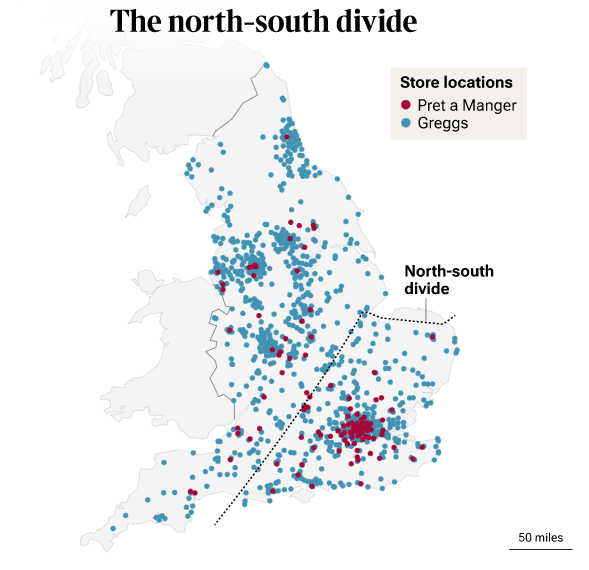
Mathematicians work out the north-south divide: where Greggs meets Pret

[Makes us, in the SW peninsula, “northerners”]

Or should it be where Morrisons meets Waitrose? 

[Categorising us as “southerners”]

This tongue-in-cheek analysis aims to highlight more serious factors highlighting the North-South divide, such as life expectancy, education, and poverty.

(See original article: a Machine Learning analysis of consumer habits as a metric for the socio-economic North-South divide in England) – Owl

Some say it’s the Watford Gap services, some say it’s the Severn-Wash line — but isn’t the true marker of arrival in the north the moment you reach a place where you can’t get a smashed avocado and roasted pepper baguette but can get an impressive variety of sausage rolls?

Tom Whipple www.thetimes.co.uk 

That is the contention of mathematicians, who have calculated the location where the writ of poncey southern Pret a Manger sandwiches ends and the rule of honest northern Greggs pies begins — and they have declared it the north-south divide.

And, lest the analysis seems flimsy, they have strengthened it by augmenting it with a separate set of strongly correlated data: the Waitrose-Morrisons Index.

As far as Sophie Maclean, from King’s College London, is concerned, this study ends a discussion that arguably began with William the Conqueror, who noticed that the residents in the north of his kingdom were more unruly and, “In mad fury . . . descended on the English of the north like a raging lion.”

Which were these recalcitrant northerners who resisted the raging lion? Where was their unruly land? “There’s a lot of debate but thankfully mathematicians have worked this out,” said Maclean, speaking at the Cheltenham Science Festival. “Really there is only one way to judge what’s north and what’s south and that is by looking at the distribution of Pret and Greggs.”

The analysis, published in the preprint journal ArXiv, used machine learning to define the optimal north-south boundary, seeking to divide the country in two according to the ratio of Prets to Greggs and, separately, Waitroses to Morrisons. Then, researchers combined the two.

This produced a line that cut off the top of Norfolk and all of Cornwall and Bristol, decreeing these traditionally southern regions spiritually and culinarily northern.

Part of this may be explained by the metric failing in the west country. While most of the country has a preponderance of one of the fast-food chains or another, Cornwall is low on Prets, possibly on socioeconomic grounds, but also resists Greggs, on grounds of pasty-purism.

Less controversially, further east the line confirmed conventional intuition — passing close to the Watford Gap.

Dr Robin Smith, from Sheffield Hallam University, led the study, adapting machine-learning techniques normally used to look at nuclear reactions. He said that in an inevitably subjective area, this analysis was as good as any. “The food we eat is a very good indicator of whether someone is northern or southern. Greggs is very popular in the north, where people do seem to prefer a steak bake.”

The new definition will nevertheless provoke some disquiet, possibly vigorously so. Cheltenham residents, for instance, who like little better than meeting on a Saturday morning in Waitrose to pick up “essential” parmigiano reggiano, might at the very least argue the case they are an exclave of the south.

Maclean conceded there would always be anomalies, but then the same goes for any other measure. There was even sometimes a pathos to the data, where you can see the anomalies in action — for instance in the few individuals trying to eke out a sophisticated culinary lifestyle amid the pastry-based wastelands of the north.

“You could imagine the single Pret in Newcastle surrounded by a swarm of Greggs,” she said. Whereas, she added, “In London, they say you’re never more than 6m from a rat, or a Pret.”

How long this might still be the case, though, is unclear. Smith said there were signs the usefulness of the metric might change. Already, Greggs has begun a southern invasion, with an appeal to more liberal metropolitan tastes. “Since Greggs produced the vegan sausage roll, it has become more popular in the south, so this might not be a marker of northernness for that much longer.”