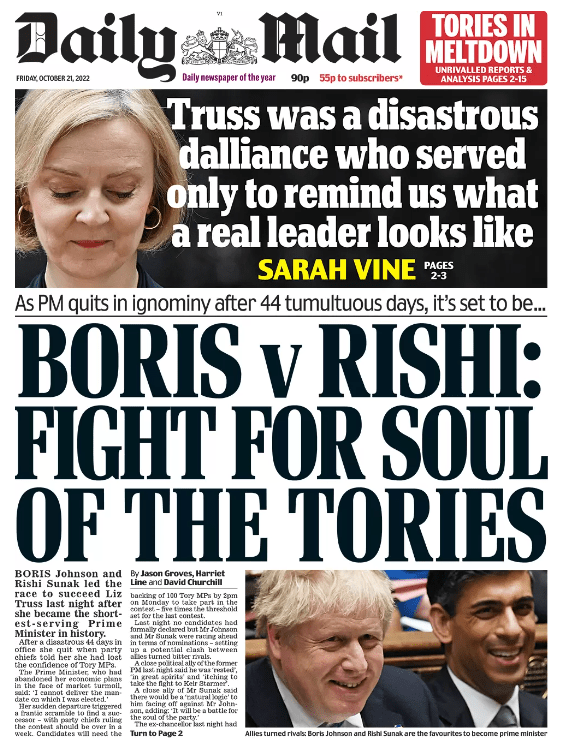
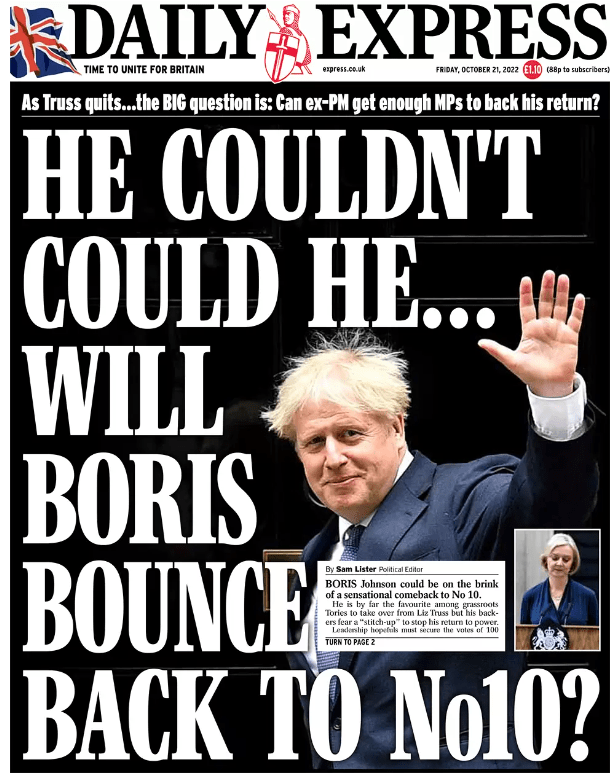
Starmer joins calls for Truss to decline ex-PMs’ £115,000 annual grant

Not to mention the “resignation honours”.

Did she ever pass her probation period? – Owl

Keir Starmer has joined calls for Liz Truss to decline the allowance of up to £115,000 a year she will be entitled to as a former prime minister.

Ben Quinn www.theguardian.com 

The Labour leader told ITV’s Good Morning Britain on Friday: “She should turn it down. I think that’s the right thing to do. She’s done 44 days in office, she’s not really entitled to it, she should turn it down and not take it.”

The Liberal Democrat leader, Ed Davey, also said she should turn down the allowance.

The political leaders’ remarks come after a trade union representing civil servants hit out at the entitlement to the perk amid a mounting squeeze on public services and the cost of living crisis.

Mark Serwotka, the general secretary of the Public and Commercial Services Union, said: “At a time when one in five civil servants are using food banks and 35% have skipped meals because they have no food, it’s grotesque that Liz Truss can walk away with what is effectively a £115,000 bonus.

“The next prime minister must give civil servants, who work hard on essential services, an above-inflation pay rise.”

Truss can claim the funding under the public duty costs allowance (PDCA), which was introduced by the then cabinet secretary, Sir Robin Butler, after Margaret Thatcher’s resignation. Government guidance states that the PDCA was introduced to assist former prime ministers still active in public life.

The former prime ministers are entitled to claim for necessary office and secretarial costs arising from their special position in public life. In 2020-21, John Major and Tony Blair claimed the maximum allowance; Gordon Brown claimed £114,712; David Cameron claimed £113,423 and Theresa May £57,832.

Mike Clancy, General Secretary of Prospect, whose membership includes large numbers of civil servants, said: “The government are in a chaotic merry go round of ministers, with huge redundancy costs for the taxpayer. At the same time, they want to cut public servants pay in real terms and erode their redundancy conditions. It’s one rule for ministers another for hard working public servants. This is wrong.”

Jo Grady, the general secretary of the University and College Union, also joined calls for Truss to give up the allowance. She said: “Millions of public sector workers, including those who transform lives in education, are in the grips of a devastating cost of living crisis. Low pay leaves thousands upon thousands skipping meals and restricting energy use.

“They will be appalled to see the soon to be former prime minister rewarded for such catastrophic failings. She should do the right thing and give up the money.”

Steven Littlewood, the assistant general secretary of the FDA, which represents senior civil servants, said: “The hypocrisy is astounding. This year, the government has offered a real-terms pay cut and once again tried to attack the redundancy terms of the civil servants who are keeping this country running while we move from one prime minister to another.

“After all of that, it beggars belief that the prime minister would accept £115k a year for just six weeks in the job.”

Joe Davies, a local organiser in Brixton with the Don’t Pay group, which is demanding a reduction in bills, said: “It’s a slap in the face even as a name. We’re picking up the tab for her ‘public duty’ from our pockets, our stomachs and in our heating bills this winter.”

Truss’s pension will not receive any extra boost from her time in Downing Street. Since 2013, prime ministers have been part of the regular ministerial pension scheme, paying in a certain proportion of their salary while the government also contributes.

Blair is understood to have been the last prime minister to avail of a special prime minister’s pension. Brown and Cameron decided to forgo the scheme and join the general scheme, before doing so became law in 2013.

There is also a severance payment, which amounts to a one-off payment of 25% of the annual salary for the post that ministers have left. For prime ministers it is about £19,000 (25% of £79,000 annual salary).

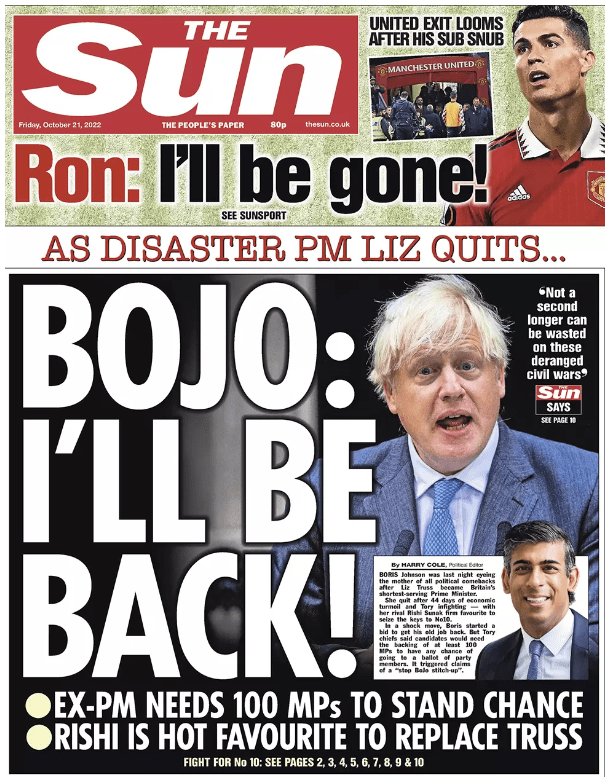
Boris Johnson return would alarm markets, former Bank of England chief warns

Too late, looks like the markets are spooked already. – Owl 

The return of Boris Johnson would worry financial markets, a former Bank of England deputy governor is warning – even as borrowing costs begin to rise as the prospect looms.

Rob Merrick www.independent.co.uk

Charlie Bean predicted “concern” that the extraordinary re-election of the former prime minister – tipped to have the backing of more than 100 Tory MPs – would bring fresh disarray to Downing Street.

Asked if it might “spook” the markets, he said: “There might be some concern about whether this was going to be a stable government again, given the instability that we had at the end of Johnson’s term as prime minister.

‘I think market participants might be concerned that, even if the fiscal statement coming up imminently goes off OK, there might be issues further down the road.”

The warning came as the interest rate demanded by investors buying government gilts rose sharply after Mr Johnson was installed as the bookies’ favourite to succeed Liz Truss.

It was soaring borrowing costs after Kwasi Kwarteng’s disastrous mini-Budget that forced the Bank of England into an emergency rescue – instability only brought to an end by dramatic U-turns on tax cuts.

Professor Bean said the Treasury must find £30bn of spending cuts or tax hikes to claim convincingly that it has a plan to get a grip on borrowing and debt.

Even if the savings are found, “there will then be a question of whether they can get a fractious Conservative Party to support all the measures”, he told BBC Radio 4.

The warning comes after a former cabinet secretary advised that the new prime minister must be in place by Tuesday to avoid the risk of a market backlash and higher interest rates.

A former Johnson aide and now critic of the former leader has said he is enjoying a surge in support among Tory MPs and has a “very” good chance of returning to No 10.

If he wins the support of 100 MPs and enters the race on Monday, it also increases the likelihood that it will last the week and go to a ballot of Tory members.

Meanwhile, Penny Mordaunt became the first Tory leadership contender to confirm she is running for No 10, promising she can deliver a “fresh start” for the party.

The Commons leader, who finished third in July’s leadership race, is likely to face Rishi Sunak and possibly Mr Johnson, but neither has made an announcement yet.

Ms Mordaunt is believed to have told Jeremy Hunt he will remain as chancellor, and that there will be no delay to his de facto Budget planned for 31 October.

We pay the price as “Loony Tories” set to trash the economy again

UK Government is now seen by the rest of the world as unstable. Not only is it embarrassing but each and every one of us will pay the price.

The UK’s economic outlook has been lowered to “negative” by ratings agency Moody’s due to political instability and high inflation.

By Michael Race www.bbc.co.uk

Moody’s changed the UK’s outlook – which is a marker of how likely it is to pay back debts – from “stable”.

Rating agencies, in essence, rate a country on the strength of its economy.

Moody’s along with another of the big credit rating agencies Standard & Poor’s (S&P) maintained their assessments of the UK’s credit rating.

Rating agencies give governments (or large companies) a score on how likely they are to pay back their debt.

The rating affects how much it costs governments to borrow money in the international financial markets. In theory, a high credit rating means a lower interest rate (and vice versa).

Each agency gives countries around the world a specific credit rating score. These range from a top mark of “AAA”, which stands for “prime”, down to the lowest reading of “D”, which stands for “in default”.

Moody’s said there were “risks to the UK’s debt affordability”, but kept its rating of Aa3, the fourth-highest level on its scale.

Meanwhile, S&P maintained the UK’s rating of AA – its third highest rating level – and maintained its previously-changed outlook from stable to negative.

The reports published on Friday do not mean the UK’s credit rating has been downgraded, but a negative outlook indicates it could be downgraded at a later date. The other outlooks countries can be given are positive, or stable, and any outlook period typically lasts 12 to 18 months.

Moody’s said there were two “drivers” behind its decision to change the UK’s economic outlook.

It said the first was “the increased risk to the UK’s credit profile from the heightened unpredictability in policymaking amid a volatile domestic political landscape”.

Moody’s said this challenged the UK’s “ability to manage the shock arising from weaker growth prospects and high inflation”.

The rating’s agency said it viewed the government’s mini-budget, the reversal of the majority of the policies in it, and the change in prime minister as a “continuing reflection of the weakening predictability of fiscal policymaking seen in previous years”.

Moody’s assessment comes after government borrowing costs rose sharply in the aftermath of the mini-budget in September when investors became spooked by the then chancellor Kwasi Kwarteng pledging huge tax cuts without saying how the government would pay for them.

The current chancellor, Jeremy Hunt, reversed the majority of the tax cuts from the mini-budget on Monday in attempt to calm the markets, but the resignation of Prime Minister Liz Truss means economic policies are on hold.

“The government’s initial inability to deliver a credible policy response to address investor concerns around this unfunded stimulus further weakened the UK’s policy credibility, which is unlikely to be fully restored by the subsequent decision to reverse most of the tax cuts,” Moody’s said.

Moody’s said the second driver of its decision to change the outlook was the “heightened risks to the UK’s debt affordability from likely higher borrowing and the risk of more persistent inflation”.

Government borrowing costs rose on Friday, while the pound sank as investors reacted to gloomy economic data amid the political turmoil.

The interest rate – or yield – on bonds due to be repaid in 30 years’ time rose back above 4%, making government borrowing more expensive. They had hit 5.17% in the aftermath of the mini-budget.

Meanwhile, the yield on bonds due to be repaid in five years’ time, which underpins the cost of new five-year fixed rate mortgages, rose to 4.09%.


Jupp on becoming Truss PPS: “I wanted it to work. Unfortunately, it didn’t.”

Now he’s flip flopped back to Sunak.

PS PPS, fantasy economics were never going to work.

Simon do you possess any “nouse” at all? – Owl

Conservative MP for East Devon Simon Jupp, whose constituency includes Sidmouth, has backed former chancellor Rishi Sunak to become the next prime minister.

sidmouth.nub.news 

However, it is not yet certain at the time of writing whether Mr Sunak will enter the leadership race.

Mr Jupp also supported Sunak earlier this year in the Tory leadership contest to replace Boris Johnson.

It comes after the resignation of Prime Minister Liz Truss yesterday (Thursday 20 October), which the East Devon MP described as “the right and honourable step given the situation”.

Jupp had also accepted a position in the Department for Levelling Up, Housing and Communities as a parliamentary private secretary before Ms Truss’ resignation.

Simon Jupp MP said: “I accepted a position in government because I wanted it to work. Unfortunately, it didn’t.

“Rishi Sunak has already set out his stall to the nation. He’s got the experience needed to lead the nation and the knowledge to restore economic credibility.

“I’m backing Rishi Sunak for PM.”

Candidates who want to put themselves forward in the leadership race to become the next prime minister must get the support of at least 100 MPs by 2pm on Monday 24 October.


More on: it could get worse

Conservative leadership hopefuls are hitting the phones this morning in a desperate bid to secure the 100 nominations needed for a shot at replacing Liz Truss as prime minister. But the all-too-real prospect of Boris Johnson making a jaw-dropping return to Downing Street has unnerved scores of MPs and left the party teetering on the brink of a historic split. The disgraced/much-missed (delete as appropriate) former PM was neck and neck with Sunak on nominations last night, prompting some critical MPs to threaten an immediate revolt if he regains the keys to No. 10. The drama is only just beginning, and as a Gen-Z knucklehead might put it: this lightspeed leadership race is going to be *fire*. 

From Politico Newsletter

East Devon has a ‘secret airport’ very few people know about

Guess what, it never had planning permission! – Owl

Everyone knows about Exeter Airport, and Devon also has airfields at Branscombe and Dunkeswell Airport. But Devon has a ‘secret’ airport that very few people know about.

Daniel Clark www.devonlive.com

Farway Common Airfield was established 36 years ago and it was originally operated under the ’28 day rule’. The Airfield consists of two runways, but despite being an ‘airport’ for the last 36 years, technically the site doesn’t have planning permission.

However, for over 20 years, the airfield has operated significantly in excess of 28 days, and has always been available 365 days a year to both resident and visiting aircraft, had the details of the airfield published specifically to assist in the conduct of safe and considerate flying, and had aircraft owned and operated by the owner of Moorlands Farm, just outside Sidbury in East Devon.

The new owner of the land has now applied for a Certificate of lawful development for the 30 acres used as an aerodrome. This involves taking off, landing and manoeuvring of aeroplanes on the ground, and would allow operation 365 days per year – and regularising the use that currently takes place.

The Town & Country Planning Act 1990: Section 191 as amended by section 10 of the Planning & Compensation Act 1991 states that the local authority has a period of up to 10 years to take enforcement action against breaches of planning control. After the time limit has passed, the development becomes lawful, in terms of planning.

In the statement with the application, the applicant, James Hortop, states: “The airfield is used by both aircraft based on site and those visiting. This has occurred for more than 28 days per year continuously for over 20 years. The airfield has been available to aircraft 365 days per year to both based and visiting aircraft during this time.

“The hangar and outside parking areas are used by aircraft for both short and long term storage. These uses have been continuous since the establishment of the airfield 36 years ago.

“A flying school, of which employment and a commercial business depends is based at Farway Common Airfield. This use has been established for over 10 years. Slots for lessons are available 365 days per year as training has to coincide with different types of weather conditions and student/instructor availability.”

Farway Common Airfield

It adds: “James Hortop, the owner of Moorlands Farm/Farway Common Airfield also bases his aircraft in the hangar. His locally based business supports the UK emergency services and defence industry. He uses his aircraft for a regular commuting to offices on the Isle of Wight, Poole and Manchester; the aircraft is also used for travelling to business meetings around the UK and Europe. James’ business is dependent on his ability to quickly and effectively get to sites to meet urgent customer requirements.

“For example, during COVID, his business delivered 500 x COVID vaccination and test vehicles in just three months – his ability to move equipment, people and himself depended on the aircraft – restrictions in use at Farway would have a dramatic effect on his business.”

The airfield, located 9nm east of Exeter, closed in 2021 after the death of the previous owner. Farway Common Airfield has now reopened under the new owners.

Farway Common is a private airfield located in East Devon. The Airfield consists of two runways, orientation North/South & East/West of 550m each with a large parking area. “Our goal is to make Farway a haven for those who are passionate about flying,” a statement on their website says.

Farway Common now operates under a Letter of Agreement with Border Force which allows departures and arrivals to countries outside of the UK. This is provided that PPR has been obtained and the appropriate GAR and flight plan have been lodged.

The statement concludes: “The land has had an established change of use to that of an Aerodrom available for use throughout the year. The use of a building as a hangar for the parking of aircraft and the use of land for the parking of aircraft has been established for more than ten years.

“Historically the land was used as an airfield under planning permitted development rights. The use of the land as an airfield continuosly over the last 20 years for in excess of 28 days shows that a change of use has occurred and that it has now has a legal, established, use as an Airfield. The documentary evidence demonstrates that the change in use has occurred and is indeed lawful.”

East Devon District Council will determine the fate of the Certificate of lawful development at a later date.

Simon “fracker”Jupp MP PPS breaks his silence

“The Prime Minister has taken the right and honourable step given the situation. The Conservative Party must now quickly unite around a new leader to continue to deliver for our great country.”

Deliver what exactly more chaos, more austerity?

So why did you take a job as PPS the other week?

How Devon’s Tory MPs voted on fracking, the whole lot, except for Sir Geoffrey Cox

(Probably on business or hols in the Caribbean)

For what did these “frackers” trash their green and net zero credentials?

It appears we still don’t really know the true voting numbers, such was the chaos on Wednesday night. – Owl

The motion to secure Commons time to consider legislation to ban fracking, as put forward by Labour, was defeated by 230 votes to 326, majority 96.

Bertie Adam www.devonlive.com

The numbers announced in the chamber did not match the numbers on the division list released by the Commons authorities.

The list released after the Commons vote contained 228 names in the ayes and 319 names in the noes.

It may be updated further by parliamentary officials to include any missing names to ensure the numbers match the ones announced in the chamber, or it could be a counting error by the whips.

The division list showed 36 Conservative MPs in total did not take part in the fracking vote, although this does not automatically equate to an abstention – but in many cases will be.

Here is a list of all MPs across Cornwall, Devon, Plymouth, Dorset, Somerset, Bath, Gloucestershire and Wiltshire. Have a look how they all voted:

Ayes

Devon

Ben Bradshaw (Exeter)

Richard Foord (Tiverton and Honiton)

Bristol

Kerry McCarthy (Bristol East)

Thangam Debbonaire (Bristol West)

Somerset

Wera Hobhouse (Bath)

Nays

Cornwall

George Eustice (Camborne & Redruth)

Scott Mann (North Cornwall)

Sheryll Murray (South East Cornwall)

Steve Double (St Austell and Newquay)

Derek Thomas (St Ives)

Cherilyn Mackrory (Truro and Falmouth)

Devon

Simon Jupp (East Devon)

Anthony Mangnall (Totnes)

Anne Marie Morris (Newton Abbot)

Selaine Saxby (North Devon)

Gary Streeter (South West Devon)

Mel Stride (Central Devon)

Johnny Mercer (Plymouth, Moor View)

Somerset

Rebecca Pow (Taunton Deane)

Ian Liddell-Grainger (Bridgwater and West Somerset)

Jacob Rees-Mogg (North East Somerset)

Liam Fox (North Somerset)

John Penrose (Weston-super-Mare)

Marcus Fysh (Yeovil)

James Heappey (Wells)

Dorset

Tobias Ellwood (Bournemouth East)

Christopher Chope (Christchurch)

Michael Tomlinson (Mid Dorset and North Poole)

Simon Hoare (North Dorset)

Robert Syms (Poole)

Richard Drax (South Dorset)

Gloucestershire

Richard Graham (Gloucester)

Laurence Robertson (Tewkesbury)

Geoffrey Clifton-Brown (The Cotswolds)

Alex Chalk (Cheltenham)

Mark Harper (Forest of Dean)

Luke Hall (Thornbury and Yate)

Chris Skidmore (Kingswood)

Jack Lopresti (Filton and Bradley Stoke)

Wiltshire

Andrew Murrison (South West Wiltshire)

John Glen (Salisbury)

Danny Kruger (Devizes)

Robert Buckland (South Swindon)

Justin Tomlinson (North Swindon)

James Gray (North Wiltshire)

No vote

Geoffrey Cox (Torridge and West Devon)

David Warburton (Somerton and Frome)

Conor Burns (Bournemouth West)

Chris Loder (West Dorset)

Siobhan Baillie (Stroud)

Darren Jones (Bristol North West)

Karin Smyth (Bristol South)

UK hospitality sector declines at fastest pace since lockdown

Tourism and recreation experienced the fastest fall in output of any UK business sector last month, the latest data shows.

Well done hospitality spokesman and champion, Simon JUpp. – Owl 

Mabel Banfield-Nwachi www.theguardian.com 

Output in the sector, which includes pubs, hotels and restaurants, declined at the fastest pace since February 2021, when the UK was last in lockdown, with a tracker score of 36.3 in September, according to the Lloyds Bank UK Recovery Tracker. Any reading below 50 indicates contraction.

The drop was caused by demand falling for a fourth consecutive month – to a tracker score of 38.5 last month – as consumers reined in spending amid rising inflation.

However, five of the 14 UK sectors that make up the tracker reported faster growth in output in September, compared with just three the previous month. A tracker reading above 50 indicates expansion.

Output growth was highest among software service providers at 55.8, down from 63.1 in August, followed by healthcare firms, rising to 53.6 from 47.8.

The tracker showed that overall input cost inflation for businesses intensified in September for the first time since May. The increase was driven by rising energy prices for manufacturers, which exceeded a previous peak during the 2008 oil price shock.

Jeavon Lolay, the head of economics and market insight for commercial banking at Lloyds, said: “While we expect UK inflation to remain stubbornly high in the coming months, there are clear signs of an easing in pipeline cost pressures in our latest UK Sector Tracker report.”

Between the second and third quarters this year, the average pace of input cost inflation slowed in all 14 sectors monitored by the tracker. This was supported by easing wage and shipping cost pressures – with reports of higher shipping costs reaching a 21-month low in September. The pace of inflation in prices charged to customers slowed in 12 sectors.

“That’s not to say that businesses won’t continue to face intense cost pressures, but suggests that peak inflation is near,” said Lolay. “This will be welcome news for both businesses and consumers.”

However, he said the recent news that the energy price guarantee scheme from April would prioritise support for the most vulnerable means that what happens to wholesale energy prices will, again, have a significant bearing on UK inflation from then on.

“The Bank of England will need to assess carefully prospects for both inflation and growth as it considers just how much more tightening is needed,” he added.

Fracking farce

Labour dig a Heffalump trap in plain sight.

What do the Heffalumps do? 

Walk straight into it.

(Careerist Jupp does his duty). – Owl

Peter Walker www.theguardian.com 

A crunch Commons vote on the future of fracking has descended into mayhem after more than 40 Conservative MPs failed to back Liz Truss’s government, with MPs alleging ministers physically pulled some wavering Tories into the voting lobbies. [The chaos was great that even the voting numbers remain unclear Pippa Crerar now writes: Initially it looked like Liz Truss herself had missed the vote, but we’re told she did in fact vote… just forgot to swipe her pass.

Shortly after the vote, there were reports that the chief whip, Wendy Morton, and her deputy, Craig Whittaker, had lost their jobs. However, Downing Street later cleared up the rumours by saying the pair “remain in post”.

The government victory, by 326 votes opposing the Labour motion to 230 backing it, was marred by claims of intimidation and bullying on a turbulent night in the Commons.

While ministers successfully defeated the Labour motion, which sought to set up a vote which would formally ban drilling for shale gas in England, a total of 40 Tory MPs failed to support the government.

While some, like Boris Johnson, are simply away, the rebels included Tory MPs who had promised to defy a three-line whip, including Chris Skidmore, the former minister who heads up Truss’s review into net zero policies.

Other confirmed rebels included another former minister Tracey Crouch and MPs including William Wragg and Angela Richardson. No Tories voted directly with Labour.

Tory whips had written to MPs in the morning to warn that the vote was being seen as confidence measure, meaning the government would collapse if it lost and rebels would lose the whip.

However, near the end of the debate, with several MPs saying they would risk losing the whip, the climate minister, Graham Stuart, told the Commons: “Quite clearly this is not a confidence vote.”

Shortly after the vote, the Labour MP Chris Bryant used a point of order to tell the Commons that he saw Tory MPs being “physically manhandled” into the government voting lobby. He asked for a formal investigation.

In the wake of the chaos, Penny Mordaunt, the Commons leader, was seen trying to calm a group of mostly female MPs who had gathered to discuss what they witnessed. Mordaunt was seen encouraging witnesses to send her evidence or further details on WhatsApp.

One Tory backbencher said it was “the most bullying, screaming and shouting” they had seen in the voting lobbies, with Morton and Whittaker being engaged in a “full-blown shouting match”.

Another said Whittaker had been seen telling colleagues: “I am fucking furious and I don’t give a fuck any more.”

Afterwards, whips were said to have been gathered for an urgent meeting, with several parliamentary private secretaries deciding they would tell Morton and Whittaker to go.

Veteran Tory backbencher Charles Walker, who is due to step down as an MP at the next election, said the scenes on Wednesday were “inexcusable”. “I think it’s a shambles and a disgrace,” a visibly shaken Walker told the BBC, before railing at the “talentless” people in the cabinet.

He added: “I’m livid and I really shouldn’t say this but all those people that put Liz Truss in No 10, I hope it was worth it, it was worth it for the ministerial red box, as it was worth it to sit round the cabinet table, because the damage they have done to our party is extraordinary.”

However, Jacob Rees-Mogg, the business and energy secretary, disputed this, pointing to the government’s majority in the vote. He said: “This is a government that is functioning well.”

The bedlam risks obscuring a potentially even more significant Tory fracture over the disquiet of many government MPs about Truss’s decision to overturn the moratorium on fracking in England.

Skidmore, a leading voice of green Tories, said earlier he was willing to “face the consequences of my decision” to not back the government, even if this meant losing the whip.

“As the former energy minister who signed net zero into law, for the sake of our environment and climate I cannot personally vote tonight to support fracking and undermine the pledges I made at the 2019 general election,” he tweeted.

Crouch retweeted Skidmore’s message with the added word, “Ditto”, as did Richardson.

Despite efforts by Rees-Mogg to quell MPs’ fury by setting up a public consultation on fracking, a series of other Tories had told the debate that they were furious about the change of policy.

A number said they would only support the government because they felt Labour were trying to “play politics” with a motion that would give the opposition control of the order paper.

Ruth Edwards, the Rushcliffe MP, castigated the Tory frontbench for, she said, forcing her and colleagues “to choose between voting against our manifesto and voting to lose the whip”.

She added: “They should take a look at the faces of colleagues behind them, colleagues who have fracking sites in their constituencies, and they should hang their heads in shame. A Conservative government will always have my confidence, but its leadership today has severely tested my trust and the trust of many colleagues and I would advise them not to do so again.”

Simon Hoare, the North Dorset MP, said he would have rebelled but wanted to keep his “voice and vote” as a Tory. He warned, however, that fracking was doomed as a project. “It’s not going to happen. These are bald men fighting over a comb. No local community is going to grant consent,” he said.

Ed Miliband, the shadow climate and net zero secretary, said the government was pursuing a “frack me or sack me strategy”, saying fracking was “one of the most unpopular causes in the country”.

He added: “In normal times such an idiotic idea would have been dismissed out of hand but these are not normal times. But I say to the house and I say to members opposite, they all know that the prime minister will be gone in a matter of weeks, if not days, if not hours.”

The Conservatives’ 2019 manifesto promised to maintain a moratorium on fracking unless there was new evidence on the risk of earthquakes from the practice. But Truss’s government changed this last month.

In a message to all MPs on Wednesday morning, Whittaker had said: “The second debate is the main event today and it is a 100% hard three-line whip. This is not a motion on fracking. This is a confidence motion in the government.”

Labour sources said Tory whips had walked into a trap set for them, and that although they did not expect to win the vote, the opposition had online adverts ready to go targeting every Tory MP who backed fracking.

Extract from Simon Jupp’s diary: Tuesday 18 October – meeting with Liz Truss this morning

It has been widely reported (BBC and Telegraph) that Liz Truss held a meeting with her “parliamentary private secretaries” (PPSs) on Tuesday morning, one indicating that it was billed as a “breakfast meeting” and only involved 20.

In the dying days of Boris Johnson’s premiership, a large number of PPSs resigned, hastening his departure. So keeping them “on side” in Team Truss would be vital. Could this be the reason for the meeting?

Many of these PPSs were first elected in 2019 and could be under serious threat of losing their seats the next time the UK goes to the polls.

Another source, London Playbook on Wednesday, claimed a senior Tory set out pretty much the worst kind of intel that No. 10 could hope to hear. “Every single MP I’ve spoken to basically says she’s got to go, apart from fanatics and the careerists,” they said. Even some moderates who had accepted jobs under Truss are “schmoozing up to colleagues all of a sudden because they know which way the wind is blowing.” Outreach in the party was summed up as “mega shit” and whipping in the division lobbies “invisible.”

Although the role of PPS is unpaid, it’s considered an important stepping stone for ambitious MPs.

So is Simon a plotter, fanatic or careerist?

Last night we learned that he is a “fracker” so we can rule out the first possibility. – Owl

Government failings bringing us down – Martin Shaw

Chair, East Devon Alliance, writes in the Herald:

As the Conservative government disintegrates, they are bringing the country down with them. The shambolic failures of Liz Truss, like Boris Johnson’s lying and cheating, will have serious consequences for people in Devon. Whether or not Truss is still in office when you read this – she is so obviously a disaster that many MPs are actively trying to get rid of her – if this government clings on, we face a grim two years.

The appointment of Jeremy Hunt fills me with foreboding. As Health Secretary, he presided over a long decline in the NHS. It was Hunt’s cuts that led Devon health bosses to close community hospital beds in Axminster, Honiton, Ottery and Seaton, the folly of which became apparent when there was nowhere to send patients when the main hospitals overflowed in the pandemic (and Hunt had shelved the UK’s pandemic plans). Hunt’s aim of selling off ‘surplus’ NHS buildings encouraged managers to dispose of some of the sites, and only community protests stopped this happening.

Hunt’s warning of a new round of ‘efficiency savings’ (spending cuts to you and me) confirms that, as Chancellor, he will be Mr Austerity once again. It is not just the NHS, with chronic staff shortages, a failing ambulance service and 7 million people waiting for operations, which simply cannot be allowed to face new cuts. The vulnerable cannot live without an inflation-matching rise in benefits. Hard-pressed schools cannot cope with declining real funding. Councils desperately need real increases to look after vulnerable children and old people.

Hunt will tell us that there is no alternative (after Truss’s budget has made government borrowing more expensive). But Britain is still a rich country and new resources can be found: close down tax havens; end ‘non-dom’ status; introduce a proper windfall tax on oil and gas firms; tax wealth as well as income; and raise tax well above 45 per cent for the bankers with their bumper bonuses and the other people who receive hundreds of thousands or millions each year.

The truth is that cuts are a political choice from a government which is in denial about the damage it has done. Truss or her successor may drone on about ‘growth’, but she and Hunt have each been ministers while Britain has stagnated over the last 12 years. George Osborne’s austerity took the wind out of the recovery from the financial crisis, just as

Hunt’s threatens to end the UK’s recovery from the pandemic.

The biggest harm has come from Brexit, the red-tape bonanza which has strangled trade with the UK’s largest market, sacrificed our farmers, and deprived our NHS of European doctors and nurses. Even some Daily Telegraph writers now accept that the warnings against Brexit were right, but Brexit ideology – of which Truss’s ‘trickle-down’ economics is a part – is now the religion of the Conservative Party. They seem more likely to abolish the monarchy than abandon this failed experiment.

Despite all this, Devon Tories remain in thrall to their leaders. Last week Hugo Swire, the former East Devon MP who bailed out rather than face Claire Wright at the last election, jumped back on the gravy train by taking a seat in the Lords (courtesy of Boris Johnson’s resignation ‘honours’ list), while his successor Simon Jupp accepted a bag-carrier role in Truss’s government. I thought rats were supposed to leave sinking ships!

In this situation, it’s timely that Richard Foord, the Liberal Democrat who won June’s by-election, is speaking about his first months as an MP at an open meeting in Axminster Guildhall this Saturday (22nd) at 10.30 am. He will be interviewed by my fellow-columnist Paul Arnott, the Independent East Devon Alliance leader of East Devon District Council. This will be a valuable opportunity for us to discuss the future without Conservative rule, and I very much hope to see readers there.

PPS: Simon Jupp now living in a parallel universe

A few weeks ago, in his weekly news column, Simon was promoting Kwasi Kwarteng and Liz Truss’ unfunded, tax cutting, “growth” “mini-budget.

In this week’s Exmouth Journal, published today, he rides on the coat-tails of EDDC’s announcement of its successful bid for £500K to help support the homeless and returns to his recent attack on EDDC for continuing to hold virtual meetings.

No mention of the fact that the budget he supported a few weeks ago has been scrapped and the country plunged into austerity 2.0 by one of the architects of austerity 1.0 and by the reckless actions of the government in which he plays a minor part. Obviously no apology either.

Today inflation has risen to levels not seen for 40 years, driven by increases in food prices. People are yet to feel the increases in mortgage rates coming down the tracks.

What’s the point of an MP who is “not free to speak” and “not free to act”?

Can someone give him sight of a newspaper? – Owl

Breaking: UK inflation rises to 10.1% as energy bills and food prices increase

Figure returns to double digits in September, with households under pressure from cost of living crisis

(The September figures are the ones normally used for the inflation uplift to pensions and benefits, though Liz Truss is flip flopping on this manifesto pledge – Owl)

Richard Partington www.theguardian.com 

Inflation in the UK has risen above 10% for the second time this year as households come under mounting pressure from sky-high energy bills and rising food prices amid the cost of living crisis.

The Office for National Statistics said the consumer prices index rose to 10.1% in September, returning to double digits after a slight dip to 9.9% in August. The figure was last higher in 1982.

City economists had forecast a modest increase to 10%.

South West “worst” for ambulance response

Ambulances in the South West operated by the South Western Ambulance Service NHS Foundation Trust (SWASFT) took an average of 11 minutes and 10 seconds to respond to category one calls during September.

From today’s Western Morning News

Such calls are the most serious, for life-threatening conditions and injuries. The average was down from 11 minutes and 27 seconds in August, but was far longer than the target of seven minutes set by the NHS. It is also the longest wait for category one calls of any ambulance service in England.

Category two calls, which cover conditions like strokes, were responded to by SWASFT in an average of one hour eight minutes, well short of the 18 minute target and up from 59 minutes and 45 seconds the month before. It is the second-longest wait across England.

Category three calls, meanwhile, were responded to by SWASFT in an average of two hours 50 minutes, compared to a target of two hours, and category four calls were responded to within an average of three hours 22 minutes, compared to a target of three hours.

Response times vary across England. While SWASFT had the slowest response to category one calls, in London they were responded to in an average of seven minutes and 14 seconds.

A spokesperson for SWASFT said: “Our ambulance clinicians strive every day to give their best to patients, but our performance has not returned to pre-pandemic levels, partly due to handover delays at emergency departments.

“Health and social care services are under enormous pressure. We are working with our partners to ensure our ambulance clinicians can get back out on the road as quickly as possible, to respond to other 999 calls within the community.”

For category one incidents, the average response time across England is nine minutes, 19 seconds. The best performing region is the North East, at seven minutes 14 seconds, and the worst is the South West, at 11 minutes 10 seconds.

East of England Ambulance service has the worst record for category two calls. Those calls should be responded to within 18 minutes, but in the east they take an average of one hour and 14 minutes. SWASFT had the second-longest wait time, at one hour, eight minutes and 53 seconds.

The England average was just under 48 minutes for a category two call. The East Midlands arrived in 53 minutes and four seconds, East of England in one hour 14 minutes and 12 seconds, with London, the North East, North West, South Central and South East Coast all around 40 minutes. 

£500k grant will help tackle rough sleeping in East Devon

A grant for more than half a million pounds has been awarded to help tackle rough sleeping across East Devon has been.

eastdevon.gov.uk 

Rough sleeper, homeless

East Devon District Council (EDDC) has successfully bid for funding from the Department for Levelling Up, Housing and Communities through the Rough Sleeper Initiative.

A total of £568,074 has been given to the district to tackle rough sleeping and contribute towards EDDC’s ambition to end rough sleeping in the district, over the next three years.

The money has helped to provide a more stable platform allowing EDDC to finance and hire officers in the following posts:

  • Two ‘Rough Sleeper Navigators’ who undertake outreach sessions to follow up new reports of rough sleepers and work with existing rough sleepers with the aim of helping them to obtain suitable accommodation options.
  • One ‘Housing Officer’ dedicated to providing wraparound support to former rough sleepers accommodated through the ‘Housing First’ programme.
  • One ‘Private Sector Liaison Officer’ working with homeless applicants, and former rough sleepers, to access accommodation within the private sector through the council’s rent deposit and bond scheme.

Several positive outcomes for former rough sleepers have been achieved over the past few years, within a very challenging housing environment, through this funding stream which has played a major part in enabling the council to work towards its aim to end rough sleeping in the district.

There were 159 reports of new rough sleepers within the district in 2021/22, and a further 122 over the last six months between April and September, 2022/23.

In the past 12 months, between September 2021 and September 2022, the number of verified rough sleepers at any one time in East Devon has varied from three to 14 – with August, September and October seeing the highest numbers (between 11 and 14) and February, March and April seeing the lowest numbers (with three).

Councillor Dan Ledger, EDDC’s portfolio holder sustainable homes and communities, said:

With the cost-of-living crisis that we are currently facing as well as other winter pressures on the horizon, this funding is really welcomed.

We acknowledge that some of our residents will struggle in the coming months and as a Council we wish to help wherever possible.

These additional posts will ensure that the council is able to offer full assistance to anyone requiring it, giving timely help, advice and support to our residents who need it most.

This will hopefully keep as many people as possible off our streets over the next few years and help to achieve positive outcomes in securing long term sustainable accommodation for those individuals and families.

Planning applications validated by EDDC for week beginning 3 October

‘Nowhere for them to live’: the Devon families pushed out by Airbnb

Hardship and heartbreak as Devon families lose homes to Airbnb lets.

Some of those who have been evicted are living in camper vans, caravans, even on boats. There are families who have been booted out of their homes crammed together in holiday park chalets or single rooms while others have had no choice but to give up and leave the area completely.

Steven Morris www.theguardian.com 

The dramatic rise of short-term holiday lets in Woolacombe and neighbouring villages and towns in north Devon is causing hardship, heartache and anger as landlords and investors cash in and local people are squeezed out.

“It’s really dire,” said Emma Hookway, a founder of the North Devon and Torridge Housing Crisis campaign group. “I constantly come across people in tears after they have been kicked out of rented accommodation because landlords want to turn places into holiday lets.”

Hookway, a 43-year-old cleaner, began the group after she and her young son were forced to leave their rented house. They eventually found a flat above a working men’s club. “It felt soul-destroying moving back into a small flat in my 40s. But I had to suck it up and now I realise that, actually, we are the lucky ones.

“Tourism here has boomed, especially since Covid. Landlords who were making £1,000 a month renting to a tenant can make that in a week now and investors are snapping up properties to make money out of them. It’s easy money for them.”

Renting out through Airbnb in the area is lucrative. Two-bedroom flats in the modern Oceanpoint and Narracott developments in Woolacombe will cost about £1,200 a week this autumn. A small studio above the Tides Inn is almost £100 a night.

But there is, undoubtedly, a price to pay for the community.

Another member of the campaign group, Graham Bell, who works at a local hospital, said key workers were being forced out. “We lose nurses and teachers who grew up here because they can’t find anywhere to live. They move to Exeter, Bristol or further afield. Families are being pushed into holiday parks, hotels, B&Bs. Children are having to sit their exams while living in caravan parks. Education and life chances are being affected.”

One emergency worker in his 30s, who asked not to be named, described how he and his partner were evicted from their flat in Woolacombe and now lived in a van on a campsite. “We’re making that work for now but it’s not ideal. It’s not what we want long term. It feels like a downward spiral for the area. How are they going to find people to staff the hospitals, the fire station, the shops if nothing is done?”

A woman with a small child who is being compelled to move out of her Woolacombe home this winter after almost a decade summed up her feelings as “heartbroken, scared and helpless”. Another parent who has been given notice to leave said she was “genuinely terrified” at the prospect of becoming homeless.

Dan Stokes, 40, who works as a chef in Woolacombe, has struggled to find stable accommodation. “There are dozens of applications for every rented place.” It means there are acute staff shortages in hospitality. “Probably most businesses have 60 or 70% of the staff they need because there’s nowhere for them to live.”

Stokes said he knew of a hospitality worker who lived in a camper van in Woolacombe and a family of three – two parents and a grownup son – who shared one room. “Something has got to be done.”

The feel of the place is changing. Locals say they cannot afford the “London prices” charged in many pubs, bars and restaurants and there are frequently complaints about the behaviour of short-let visitors – loud music, excessive drinking, antisocial behaviour (often when hot tubs are involved).

According to North Devon council’s figures, 47% of places in the Mortehoe parish, which includes Woolacombe, are second homes or holiday lets. The figure for the nearby village of Georgeham is 45%. In 2020-21, the number of section 21 eviction notices issued by landlords to tenants in north Devon was 39; in 2021-22 it was 103.

The council’s chief executive, Ken Miles, has been busy drafting a report in response to the UK government’s call for evidence on holiday lets. The draft report says the council is “particularly concerned about community cohesion in areas where there is a high intensity of short-term holiday lets”.

Examples Miles cites include a primary school struggling to maintain enough pupil numbers to remain viable and he points out a road in Georgeham where only one dwelling is occupied in the winter. “Communities cannot be sustained with that level of holiday use,” the draft report says.

It goes on to highlight the case of a senior college worker in north Devon who has to live 40 miles away and an employee of a local care home who had to give up her job when she was evicted.

The report says that in recent years “the nature of the tourist accommodation offer has changed with the rise in prominence of sites such as Airbnb”. It suggests consideration of a licensing scheme for holiday lets and perhaps the requirement to apply for planning consent for change of use where residential premises are converted to holiday lets to allow more control.

Malcolm Wilkinson, the council’s lead member for coastal communities and a resident of Woolacombe for half a century, said there was some good news. A community land trust has been formed to build 21 affordable homes for local people next to the village hall. “We hope that will help a little,” he said.

Tensions are surfacing. One second-home owner, who rents her place out when she and her partner are not there, said a guest recently left early because they did not feel welcome by local people. “They were told that tourists weren’t wanted,” she said.

The owner, who asked not to be named, said she did not make huge profits and employed a local cleaner and used local companies for laundry and building work.

She argued that Woolacombe had long been a tourist destination. “Our guests use local attractions, cafes, restaurants and shops. I don’t know what would happen to the place if there weren’t any visitors.”