Whoops, sorry!

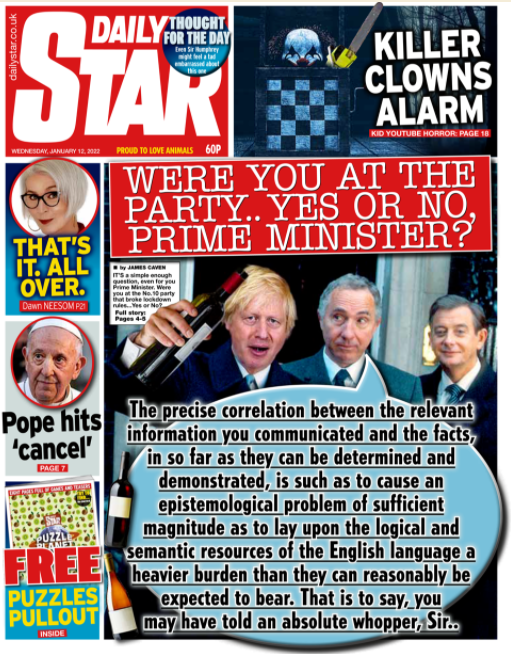
Poem from Mike Temple, posted as comment but deserving a post in its own right

The Lion with the golden mane
Had just been caught out yet again.
He’s said he’d not done such a thing,
Such conduct unfit for a King.
But evidence had now come out
To call his former words in doubt.
The Lion-King had now been caught
But here is what the Big Beast thought:

“If I were me I would advise
To grovel and apologise
(Another way of telling lies
And, of course, I needn’t worry
It’s easy to say the word “sorry”.)
For me, therefore, a quick apology
Is a branch of escapology,
For I’ll insist that I was right –
(My flatterers’ll say I was contrite)
And I can also kick the can
Down the road, my cunning plan:
My servant can compile a dossier
Of all that happened on the way
And I will be the judge of that report
And say that I did nothing of the sort.
I’ll show that laws made for my underlings
Simply don’t apply to Lion-Kings.
(The only thing I’m sorry about
Is that at last I’ve been caught out.)

Energy firms boosted by gas price spikes paid £200bn to shareholders since 2010

Whilst France forces EDF to take €8.4bn hit with energy bill cap (who will foot the bill for the shortfall?), our government, having rejected an opposition motion to scrap the VAT for starters, has yet to come up with a plan for easing household energy bills.

Time is running out. – Owl

www.theguardian.com 

Phillip Inman

Oil and gas companies have handed shareholders almost £200bn since 2010 and should be hit with a windfall tax to cap heating bills that are set to rise by as much as £500 a year, according to a report on the finances of the UK’s energy sector.

Shell and BP are among companies that have seen their profits boosted in the last year as wholesale gas prices rose by as much as nine times and petrol prices jumped to record highs, leading to calls for them to help limit a £20bn bill faced by UK households.

A report for the left-of-centre thinktank Common Wealth found that Shell and BP channelled £147bn to shareholders via dividends and share buybacks over the past decade, with North Sea producers and the big six energy suppliers contributing another £47bn.

Business secretary Kwasi Kwarteng told MPs last September the government was considering a plan for a £2.6bn windfall tax on generators and energy traders that stood to gain from the energy crisis.

It is understood Rishi Sunak, the chancellor, is still considering measures to limit rising bills, including a windfall tax, but with two weeks until the regulator, Ofgem, announces how much a cap on energy bills will rise in April, he has yet to settle on a final package.

The chancellor, accused of being “missing in action” while energy costs soar, is under pressure from Tory MPs to cut state spending and reduce Britain’s debts. He is known to favour a loan scheme for energy suppliers, giving them the funds to cushion the blow this year, with the addition of a small subsidy to the poorest households using the Warm Home Discount Scheme.

Several prominent energy bosses are known to have promoted a loan scheme as the best way to limit rising bills in a series of meetings at the Treasury last week.

However, gas prices could remain high for several years, increasing the size of the energy sector’s debts and forcing suppliers to keep household bills up for the rest of the decade, while they make repayments.

Ofgem is expected to announce on 5 February how much bills will increase in the next financial year. About 30 energy suppliers have gone bust in the last year, blaming the energy price cap for their fall into bankruptcy.

Most rich nation governments have already put in place financial support, including a €4.5bn subsidy by the Italian government to limit bill increases. Ministers in Paris said last week they will force EDF, the 80% state-owned energy giant, to take an €8.4bn (£7bn) financial hit to protect households in a move that will limit energy bill increases to 4% this year.

The Biden administration has ramped up grant payments for poorer US households to cover the rising cost of gas, while in Germany, the government has slashed a surcharge on bills used to support renewable energy schemes, which will instead receive extra state subsidies drawn from higher carbon taxes.Labour said it was fair that the oil and gas producers benefiting most from the energy crisis ‘“play their part in helping families through the cost of living crisis”. Ed Miliband, the shadow secretary of state of climate change and net zero, said: “When the head of BP describes the crisis as a ‘cash machine’ for his company and fossil-fuel producers pay out billions in share buybacks, it is a clear indication of the scale of windfall profits they are making.”

Torsten Bell, the director of the Resolution Foundation, said a windfall tax should be part of the package of measures that included subsidies for poorer households. “It must be sensible for those companies making money from this crisis to cover a share of the costs,” he said.

The Institute for Fiscal Studies recently said an additional £3bn needed pumping into the welfare system in response to soaring energy bills and mounting inflationary pressure.

The report’s authors, Joseph Baines of King’s College London and Dr Sandy Hager of City University, said Centrica and SSE, which operate in the North Sea, had seen the sharpest increase in profit margins. They said that as oil and gas companies often made losses during periods of low wholesale gas and oil prices, they paid almost all their income to shareholders in more profitable periods.

“BP’s shareholder payout commitments have been so large that they cover 98.3% of their pre-tax income and are 2.5 times larger than their tax payments for the same period,” the report said. “The findings may be combined with the insights on fossil-fuel subsidies offered by a recent Common Wealth report which identified an average of £12bn a year of taxpayer support for fossil fuels in the last five years,” they added.

Oil traders could also be forced to pay a windfall tax, but the major firms – Vitol, Glencore, Trafigura, Mercuria and Gunvor – were not part of the study.

Energy bills: flat dwellers face massive rise despite price cap

Does this apply to Cranbrook’s community heating system?  – Owl

Miles Brignall www.theguardian.com 

Hundreds of thousands of people living in flats are facing “completely unaffordable” increases to their energy bills because their communal heating system’s supply is not protected by the government’s price cap.

While households with conventional heating systems have been told they could face 50%-plus increases to gas and electricity bills when the cap is increased on 1 April, people who bought or rent apartments in one of the 17,000 blocks in the UK that rely on communal heating and hot water systems are facing fourfold increases as suppliers pass on the huge wholesale price increases unchecked.

It is thought that up to 500,000 people live in developments where at least some of the heating or hot water is provided by a centrally controlled system, usually administered by the company that manages the estate.

Apartments in these developments are all supplied by a single energy supplier, and because this is classified as a commercial deal rather than domestic supply, the residents have not had bills protected by Ofgem’s price cap.

Among those affected are residents of the high-profile Chips building in the New Islington area of Manchester who have seen some of their energy charges triple after the building’s energy supplier collapsed in November.

Those living in the nine-storey building have control over their heating in their individual flats and how much energy they use but not over who supplies the power and what tariff they are on. All of their hot water is provided centrally from a green boiler.

One resident has described finding neighbours in tears after they were all sent enormous bills on 21 December.

In some cases, the bills, which are based on usage rather than estimates, have more than trebled. One owner of a two-bedroom flat saw bills rise from £80 in November to £260 for December. Others have received even higher bills, as the unit gas price has tripled, alongside rising electricity charges.

“The cost of our energy has tripled overnight,” says Magdalena, an academic who lives in the block, who declined to give her surname.

“The gas supplier we had previously went bust and Ofgem appointed a new supplier. As the building I live in has a community heating system we (the residents) are not allowed to change supplier.

“Lots of people in the building, which is a mix of owners, rent-to-buy and tenants, simply can’t afford this sudden huge cost increase. It’s so bad that some have started looking for alternative accommodation, while others are simply not using their heating.

“People are saying that they will have to move out as paying thousands of pounds for heating is just not an option. This has all been done by the management company, with the residents seemingly powerless to stop it, or even have a say … It feels incredibly unfair,” she says.

Switch2 Energy, the billing service provider for the Chips scheme, and the building’s new energy supplier, Pozitive Energy, say the increases experienced by residents stem from the failure of the previous supplier, and reflect the rise in wholesale prices.

Chris Wright*, who lives in the Deptford Landings complex in south-east London, which also features a communal hot water system, contacted Guardian Money to say that he and other residents on the huge site have been told that their hot water charges are about to rise by 464%.

“For some families in the block who use more hot water than we do, this is going to be a big financial blow. How is it that everyone else has their bills capped but flat dwellers like us don’t?” he asks.

Lisa Gregory, who runs the Birmingham-based consultancy Ginger Energy, which is a big player in the sector, says this “truly dreadful” situation is an injustice that will have serious consequences for those affected.

“It is highly likely that many will struggle to pay the new costs and will then get into a debt situation,” she says. “We are about to have to tell the residents of some blocks that they will be paying four times the previous unit charge for their energy. While normal residential consumers are protected – at least for a period – through the price cap, the consumers in these blocks are fully exposed to the market changes.”

She says the classification dates back to a 2012 decision made by the industry regulator Ofgem and predates the current turbulent market conditions and the price cap.

“We are requesting an entire review of the price cap. It doesn’t include our residents; it doesn’t work for suppliers. The system is completely broken,” she says.

In late December, the government announced that it wants Ofgem to take over as the regulator for heat networks, as they are termed. However, it looks as though it will be months if not years before this is enabled as it will require legislation. In the meantime, those living in the unregulated homes could face years of paying higher bills than if their building had a conventional heating system.

This week the boss of British Gas’s parent firm warned that the problem of high energy bills could remain for a further two years.

Stephen Knight, a director of Heat Trust, the national consumer protection scheme for heat networks, says legislation to protect consumers who rely on communal heating schemes is long overdue.

“We welcome the government’s commitment to regulating heat networks and the news that Ofgem will have new powers to oversee the sector. In the absence of regulation, a growing number of consumers are being left unprotected. As the reliance of the country on heat networks grows, so will the scrutiny of their performance and service standards. To avoid any further delays, we need the government to commit to the legislation in May’s Queen’s speech,” he says.

Ofgem said it was committed to taking over the regulation of heat networks but said the timings were outside its control.

Mark Thomas, the chief executive of Communal Energy Partners, which provides energy to Deptford Landings, says suppliers have no choice to pass on the rise in wholesale costs.

“I would ask the government and the regulator to help smooth out the cost to the customer through company loans, or removing green levies or VAT from bills. This would all be very welcome,” he says.

“We totally understand this is a worrying time for Chips residents,” Switch2 says in a statement. “The new tariff reflects the market increases experienced over the last 12 months, which have seen the wholesale gas price increase fivefold since January 2021.”

RMG, the managing agent for the Chips building, told the Manchester Evening News that it had no “involvement in the procurement or placement of utilities contracts”.

Pozitive Energy said it had huge sympathy for the residents but said it inherited the contract and was therefore forced to buy gas to supply the building at the current market rate.

Heat networks are considered by ministers as a proven, cost-effective way of providing reliable low-carbon heat at a fair price to consumers. The UK government has said it is working towards growing the heat networks sector, which provides roughly 2% of UK heat demand but could meet about a fifth by 2050.

* Not his real name

‘Creepy faces’ appear in Devon cliffs

New photographs show the affects of erosion along East Devon’s red cliffs as they continue to crumble.

Chloe Parkman www.devonlive.com

The striking images were taken near Budleigh Salterton by Lance Mangold, formerly a Scientific Photographer for Oxford University.

The hollowing cliffs appear to show a number of eerie gothic and ghoulish faces – which follows a number of cliff falls within the area over the last 18 months.

It’s all up for interpretation of course and we’d love to know what you can see.

Lance said: “The Victorians used to come from afar to see these sculpted cliffs, so its a shame the rockfall has removed some of the ‘sculptures’.

Last week, East Devon’s notorious red cliffs hit the headlines after drone images captured the aftermath of a cliff fall near a holiday park.

A fascinating shot of the cliffs as erosion transforms the landscape (Image: Lance Mangold)

The pictures, which were captured by Ziggy Austin at Rock Solid Coasteering, were taken near Sandy Bay caravan park – and they captured the extent of East Devon’s notorious crumbling cliffs.

Over the last 18 months, there have been a number of cliff falls in the area with some of the most notable taking place in Exmouth and Sidmouth.

The pictures, which were taken on Monday, show some caravans are now just metres away from the edge of the cliff.

Lance says the hollowed rock appear to looks like a gothic face (Image: Lance Mangold)

Back in August, the stretch of cliff saw five massive falls in one morning.

Crumbling clay tumbled from the cliffs between Sidmouth and Salcombe Mouth, which sparked a warning from Beer Coastguard Rescue Team.

In a statement made on Facebook last year, a spokesperson said: “Cliff falls this morning, please stay away from the base of cliffs and take note of the signs, they are there for a reason.”

Lance said: “I think this one was the most interesting, it looks like a rock painting, and the colours are striking.” (Image: Lance Mangold)

Downing Street parties: all your questions answered.

Owl thought this might help Neil Parish by explaining the limits of Sue Gray’s report. Questions examined include:

What can Sue Gray’s report cover and rule on?

Could an invitation go out without PM’s permission?

Could Mr Johnson really not have known about other parties under his own roof?

How many wine bottles can you fit in a suitcase?

By Kate Whannel www.bbc.co.uk

Hardly a day goes by without another revelation about Downing Street parties during the Covid lockdowns. Each new bombshell leaves another crater of questions about what was going on, how it was allowed to happen, who knew and what happens next?

Below, we attempt to answer these questions and others:

Why are we only learning of the parties now?

The earliest allegation of a government lockdown gathering (so far) dates back to 15 May 2020. But reports of the parties only started appearing in the media in the winter of 2021.

The Daily Mirror’s Pippa Crerar – who first broke the news about two parties, in November, – said she first heard rumours of Christmas parties back in January 2021 but wasn’t able to substantiate them until months later.

People leak stories to journalists for all sorts of reasons – to damage a political rival, for revenge, for fun. But without knowing the identity of the first leaker, it is hard to say why they leaked and why they waited so long.

What we do know is that the Mirror’s first story in November encouraged others to come forward with their own party experiences and almost a month later new tales are still emerging.

Were these parties work or social events?

Some were social events – including the 20 May 2020 drinks attended by the prime minister, that led to his public apology this week. How do we know? Because ITV obtained the email that had invited staff to “bring your own booze” to “socially distanced drinks in the No 10 garden”.

However, Boris Johnson has insisted he believed “implicitly that this was a work event” arguing that the No 10 garden was often used “as an extension of the office”.

There have also been questions about the nature of an event on 15 May 2020. A picture published by the Guardian shows about 19 people, including Mr Johnson and his wife, sitting in the garden with bottles of wine and a cheeseboard. The prime minister said this picture showed “people at work, talking about work”.

Will we hear about more parties?

The number of stories swirling around have led some to wonder if there was a single day during the pandemic when a party wasn’t taking place in No 10. At least 10 alleged gatherings, in Downing Street or government departments, have come to light so far. If you’re a details person, here’s the full list

Will there be more? If the last month is anything to go by, then probably.

What can Sue Gray’s report cover and rule on?

Following the first few reports of parties, the prime minister ordered an investigation to establish the facts.

Many Conservative MPs have said they will wait for the results of that inquiry – being led by senior civil servant Sue Gray – before passing judgement on the prime minister. Ms Gray’s report is likely to be a largely factual account of parties held in Downing Street.

Catherine Haddon, of the Institute for Government think tank, says Ms Gray is unlikely to assign individual blame, but her report “might refer disciplinary action to others”. It may touch on the role of the prime minister, but it is not Ms Gray’s place to judge his behaviour, she adds, although the “bare facts alone” may be damning.

Did the prime minister or others break the law?

Sue Gray cannot rule on whether lockdown laws were broken – but the question is key to the prime minister’s future. If the inquiry uncovers evidence of behaviour that is potentially a criminal offence, it will be referred to the Metropolitan Police and the inquiry will be paused, according to its terms of reference.

What is Dominic Cummings’ role in all of this?

The PM’s senior ex-aide-turned-massive-thorn-in-his-side was one of the first government figures to be accused of breaking Covid rules. He drove from London to County Durham at the height of the first lockdown, later arguing that the move was prompted by security concerns.

More recently he has been making allegations about rule-breaking in No 10 during the pandemic – including writing in a blog about the drinks on 20 May 2020.

Mr Cummings says he warned at the time that the event “seemed to be against the rules”.

Who was invited to the garden drinks on 20 May?

An email from Mr Johnson’s principal private secretary, Martin Reynolds, inviting people to “make the most of the lovely weather”, was sent to a distribution list of around 100 people. But the full list of recipients has not been published.

So why does it matter who was on the list?

Well, the names will show who knew about the party taking place.

Could an invitation go out without PM’s permission?

Downing Street has said Mr Johnson did not see the email inviting staff to the drinks.

But many Westminster-watchers are sceptical.

On Tuesday, Caroline Slocock, who worked in the private offices of Margaret Thatcher and John Major, told BBC Radio 4 it was “inconceivable” the PM wasn’t aware of such an invite, especially one from a close staff member using the word “we”.

Hannah White, of the Institute for Government think tank – a former secretary to the Committee on Standards in Public Life, said she believed the PM “had to have” known about the event.

Who else attended the party?

One of the next steps is to find out who went to the gathering, despite the lockdown . The BBC has been told from sources at the garden drinks that around 30 people were present, alongside the PM and his wife.

Who went to the party will be key for the same reason as the invite list, showing who knew about the event.

But more importantly, the attendee list will show who decided to break the rules – and perhaps the law – individually.

Could Mr Johnson really not have known about other parties under his own roof?

Downing Street itself is a complex series of interconnected houses turned, over the years, into an unusual combination of living and working spaces.

Chancellor Rishi Sunak lives in the flat above No 10 Downing Street. Mr Johnson, wife Carrie and their two young children live in the larger flat above No 11.

Is it plausible that both men would have been unaware of gatherings in the building that is both their home and their place of work?

Are Downing Street staff allowed to drink at work?

The civil servant management code doesn’t mention alcohol or prohibit drinking in the office.

Peter Caldwell – who worked as a government special adviser between 2016 and 2020 – told the BBC News that before the pandemic he would often have a drink in Downing Street on Friday evenings.

BBC political correspondent Ben Wright, who has written a book about the drinking culture in Westminster, says alcohol “has sloshed through the history of political life for centuries”.

“Drink enhances the exhilaration of political success and numbs its disappointments. It unknots in moderation and unbalances in excess.

“Prime ministers have grappled with this for years, from the port-dependent William Pitt the Younger, through to Herbert Asquith, Winston Churchill, Wilson and even Tony Blair, who described alcohol as a “prop” in his memoir.”

How many wine bottles can you fit in a suitcase?

The latest revelation – published by the Telegraph – includes the detail that staff were reportedly sent to a nearby shop with a suitcase, that was brought back “filled with bottles of wine”.

How many might that be? Following a very unscientific experiment – how big is a suitcase, after all – we found we could fit roughly around 30 bottles, or possibly one Nebuchadnezzar, in a medium-to-large suitcase.

Although it would be less if you wanted to pad out the bottles to avoid breakage.

And would there be room for snacks? Do you sacrifice a bottle of wine for a family-sized pack of crisps?

New Clause 1 – Members of local authorities: disqualification relating to drink and drug driving offences (England)

On Jan 14 Sir Christopher Chope MP sought to introduce a new clause during the third reading of the Local Government (Disqualification) Bill which would, amongst other things, ban those with a drink driving offence from being a local councillor. 

The Local Government (Disqualification) Bill is a private member’s bill. The core purpose of this legislation is to prevent those convicted of sexual offences from having a role as a local elected official that could include access to children and vulnerable adults, and the length of their disqualification would be the length of time that they are subject to the notification requirement.

www.theyworkforyou.com /debates/

This struck Owl as interesting in the light of local Conservative recent preoccupation on DBS checks. It is also interesting because Owl can think of at least one “Senior” Tory Councillor who would be disqualified from office by the amendment clause, were it to become law.

 Sir Christopher’s reasoning for his amendment was a follows:

“My view, reflected in new clause 1, is that councillors who fall below the standards expected in relation to drink and drug driving offences should be included in the category of those who are disqualified from being able to serve as councillors and mayors. I think that they fall four-square within the Government’s definition of having been convicted of behaviour which everyone in a right-minded society would say was intolerable. Why should people who are in that position be allowed to continue as councillors while other councillors who have been convicted of a different set of antisocial offences are excluded? That is the essence of new clause 1. If someone is convicted of driving or being in charge of a motor vehicle with excess alcohol or a controlled drug, they should not be able to hold office as an elected councillor in this country.”

In fact, after debate, Sir Christopher withdrew the amendment.  

With the cry of victim blaming is Downing Street in denial?

26 May 1868 was the date of the last public execution in UK. Are we about to witness a series of senior advisers and staff being thrown under a Boris Bus in Whitehall to save his skin?

Nothing to do with the pervading culture at the top. – Owl

Operation Save Big Dog: Johnson’s plan for others to take fall over partygate

www.independent.co.uk

Boris Johnson is drawing up a list of officials to offer resignations over Partygate in a bid to salvage his premiership, The Independent has learned.

Dubbed “Operation Save Big Dog” by the prime minister himself, the blueprint includes a drive to work out which heads should roll following the publication of senior official Sue Gray’s findings, as well as highlighting the prime minister’s achievements, according to sources. Officials have also started using the code name, The Independent understands.

Dan Rosenfield, Boris Johnson’s chief of staff, and Martin Reynolds, his private secretary and author of the “BYOB” email, are thought to be possible candidates for departure.

While putting names to the plan is a matter of hot debate, a more broadly accepted idea is that at least one senior political appointee and a senior official must be seen to leave Downing Street over the affair, as both groups share blame, two Whitehall sources said.

A former Tory cabinet minister told The Independent that, although they backed Mr Johnson, they believed a “root and branch” overhaul of No 10 and parts of the Cabinet Office would prove essential to move on from Partygate. It would be a “bare minimum to translate contrition into action”, they said.

The “save big dog” plan includes a communications “grid” in the lead up to the investigation’s conclusion and beyond. This comprises lines for supportive ministers to take in press interviews, emphasising a contrite prime minister and listing his achievements amid the difficult choices posed by the pandemic.

The operation also includes sounding out support among backbenchers for possible leadership rivals including chancellor Rishi Sunak, foreign secretary Liz Truss and even former health secretary Jeremy Hunt.

Mr Hunt is unlikely to command enough support to win the leadership, but No 10 aides believe could play an important role in any leadership contest.

The plan reflects how precarious the position of Downing Street and the Cabinet Office has become following a slew of highly detailed reports on parties amid Covid-19 restrictions.

On Friday, the former director general of the government’s Covid taskforce posted an apology on social media for holding leaving drinks in the Cabinet Office during coronavirus restrictions days before Christmas in 2020.

Kate Josephs, chief executive of Sheffield City Council, said she was cooperating with a probe by senior civil servant Sue Gray and admitted to a “gathering … with drinks, in our office”.

It followed an apology from Downing Street to Buckingham Palace after reports from The Daily Telegraph of two No 10 parties held on the eve of Prince Philip’s socially distanced funeral.

Officials have refused to confirm or deny if Boris Johnson was aware of these parties, after he admitted to attending at least one drinks party and was pictured at a second. On Friday the prime minister’s spokesman said: “It is deeply regrettable that this took place at a time of national mourning and No 10 has apologised to the palace.”

It is not clear if Downing Street admitted, in its apology to the palace, to having breached Covid rules with a social gathering. One of the gatherings was a leaving party for Mr Johnson’s director of communications, James Slack, who said on Friday that the “event should not have happened at the time that it did”.

Downing Street also refused to comment on the existence of a plan to save Mr Johnson, but when asked about the name “Operation Save Big Dog”, a spokesperson said: “We absolutely do not recognise this phrase.”

Polling for The Independent revealed voters are deserting Mr Johnson over the party scandal, with 70 per cent calling for him to quit and almost as many dismissing his Commons apology as bogus.

The survey, by Savanta, found that just 21 per cent backed the prime minister to stay in power.

Just as worryingly for the embattled leader, 68 per cent did not consider his apology – in which he claimed he did not realise a “bring your own booze” gathering in his garden was a party – to be genuine.

Backlash over move to turn Devon farms into homes

A long-running campaign to save two farms in Teigbridge from being turned into new housing developments is continuing to be fought.

Anita Merritt www.devonlive.com

In 2018, both Manor Farm and Markhams Farm were submitted by Devon County Council’s (DCC) land agent as possible sites for housing development, to the local authority Teignbridge District Council.

Markhams Farm, which lies between Ide and Alphington, has been earmarked in the Teignbridge Draft Local Plan as a huge housing plot where a total of 727 houses could be built.

The site is currently a working farm and part of the county council’s tenant farm estate.

Grade I agricultural farmland at Markhams Farm is one of more than 100 sites across Teignbridge identified as places where future housing could be provided.

Manor Farm at Holcombe, near Dawlish, is also listed as a site that has been submitted as an option for development by the landowner, DCC. It is also a successful working farm.

A campaign led by town and district councillor Alison Foden has been launched to save them for future generations of farmers.

An online petition calling for both farms to be withdrawn as sites for housing development has now been signed by more than 1,500 people.

Markhams Farm overlooking Exeter

Markhams Farm overlooking Exeter

Cllr Foden said: “How can Devon County Council justify throwing away the equivalent acreage of farmland to that which it purchased in 2009 in order to make Markhams Farm more viable?

“Arable and agricultural quality land should not ‘be disposed of’ in a piecemeal fashion, in order to ‘generate capital receipts’ for investment by the council in the capital programme, and ‘enable land to be replenished.

“Farms cannot be established like jigsaw pieces. Moving 80 acres of land from Markhams Farm to generate income to buy more land elsewhere will remove the viability from Markhams Farm which DCC sought to benefit in 2009 when it purchased an additional 85 acres of land there.

“How can DCC declare a climate and ecological emergency, and yet pay no regard farming sustainability, nor care for the current and next generations of farmers in our Devon, by selling off county farmland here and there?

“Why is DCC planning and working to sell off county farmland in order to generate capital receipts, when that county farmland can generate capital receipts for the council?

“Has DCC not considered the effects that the selling off parcels of county farmland must have on the mental health and wellbeing of the county farm tenants and the effects that the threatened sale must have on tenant farmers, their feelings for the farm security, and their farm work plans for the future?

“It is worrying that both sites at Markham Farm and at Manor Farm are proposed for house building at a time when the need for sustainable farming and encouragement for local farming is crucial at this time of climate and biodiversity emergency.”

Markhams Farm Exeter

Markhams Farm Exeter (Image: Teignbridge District Council)

A public consultation run by the district council has already ended.

The petitioners hope that by putting pressure on the county council the land will be withdrawn as a potential location for housing.

Devon County Council were approached for a comment.

Social care for elderly and vulnerable rationed as Covid hits staff

More than half of councils in England are resorting to exceptional measures to ration social care, a survey has found.

www.independent.co.uk 

The Omicron variant of Covid-19 is forcing so many staff to take sick leave or self-isolate that the systems can no longer cope with rising demand, according to council chiefs.

They dubbed the situation “a worsening national emergency”.

Carers have increased the hours of homecare delivered to older people to record levels, councils report – but they still cannot keep up with the numbers requiring care.  

More than half of directors of social services who responded to the survey said that in at least some cases they were having to temporarily limit the care normally provided, leave people without their usual social contact or ask families to step in to help.  

Stephen Chandler, president of the Association of Directors of Adults Social Services (Adass), said: “We warned before Christmas that we were heading into a national emergency for social care. The sobering reality of that is now becoming starkly clear.  

“Every council is taking extraordinary steps and a majority say they are having to prioritise the most basic and essential care in at least some areas for some of the time.” 

A previous survey by the charity suggested that councils had increased the amount of homecare being provided by 15 per cent in just three months last year.

But more than 400,000 people were waiting for assessment or review of their care needs or for packages of support to be provided.  

The rapid spread of the coronavirus and pay rises in other sectors have worsened a shortage of workers, with more than 100,000 vacancies nationwide.

Agencies that employ them say that on average 14 per cent of their staff are off sick or isolating.  

The new survey found that 49 councils are taking at least one exceptional measure to prioritise care and assess risk for at least some of their area for some of the time.

Council chiefs said the shortages mean, for instance, prioritising life-sustaining care such as supporting someone to eat and remain hydrated over supporting someone to get out of bed or complete other activities.

In some cases staff are unable to review risks and are forced to leave people with dementia, learning disabilities or poor mental health isolated or alone for longer periods than usual.

Mr Chandler said: “These are decisions that no-one wants to take, and many are unacceptable. They are drastic measures and must not become, the norm.   

“Opportunities were repeatedly missed to ensure that adult social care would be robust enough to withstand the challenges posed by Omicron.

“Any money that has been forthcoming, though welcome, has been too little, too late.”  

The association is calling for the government to promise at least £7bn extra a year, rising to £9bn by 2024-25, and a social care minimum wage equal to that paid by the NHS for similar work.

It says a larger share from the new health and social care levy due to be added to national insurance from April should go to social care.

The government said it was doing everything possible to support care staff.

A Department of Health and Social Care spokesman said: “Care staff are working incredibly hard and we are doing everything we can to support them, including with a £462.5m recruitment fund, expanding the Health and Care (Worker) visa scheme, and our ‘Made with Care’ recruitment campaign.

“Over the course of the pandemic, we have made available more than £2.9bn in specific funding for adult social care.

“More than 50 million PCR and 142 million LFD kits have been delivered to care homes and we have invested a further £478m to support safe and timely hospital discharges to get patients into the best place for their care and support to continue.”

Exmouth is getting serious investment to help keep the community safe

How is this “investment” when part of the site is being sold off for development? – Owl

Simon Jupp www.devonlive.com

Exmouth, one of Devon’s largest towns with thousands of visitors every year, will get a brand new police station fit for the future. It’s truly fantastic news for the town I am very proud to represent.

I have been working closely with Alison Hernandez, the Police and Crime Commissioner for Devon, Cornwall and the Isles of Scilly since I was elected in December 2019. And now, Exmouth is getting serious investment to help keep the community safe with a new state-of-the-art police station.

Let’s be honest, the current police station is an ageing eyesore. I certainly won’t miss it. Neither will nearby residents nor our local police officers who deserve a far better place to work from.

Given the government’s on-going success towards achieving its commitment to recruit 20,000 new police officers, coupled with a clear desire from local residents to have a proper police station in Exmouth, I was able to work closely with the Police & Crime Commissioner and Chief Constable to look again at how we deliver policing locally.

We are set to have a record number of police officers across Devon & Cornwall. Numbers are due to hit 3,610 in the financial year from April. This is 110 more than the area’s previous high of 3,500 in 2009/2010 under the previous Labour government.

New officers will join experienced staff at the new police station in Exmouth. The current site will be redeveloped with part of the land sold to help fund the construction of the new police station on the existing site . A new project team has now been set up to design and deliver the new station. The team tasked with designing the new building will include an area for face-to-face contact between the police and the public.

As well as being one of the largest towns in Devon, Exmouth, along with other coastal communities in the county, has a range of specific challenges when it comes to policing compared to cites or towns in more urban areas.

As we know, Exmouth sees a large increase in population throughout the summer months due to visitors and tourism because so many people want to enjoy our superb beach, restaurants, leisure facilities and pubs. This can be quite a challenge for our local coppers and police staff, so it’s vital they have a modern local base from which to serve the needs of our community throughout the year.

This is the second major investment in local policing in the East Devon constituency since I was elected. I also look after Topsham and St Loyes in Exeter. In April 2020, the city also got a brand-new police station on Sidmouth Road, next to Devon and Cornwall Police’s Middlemoor headquarters. At a cost of £29m, this replaced the ageing Heavitree station.

All this investment is part of the Police and Crime Commissioner’s ongoing multi-million-pound modernisation programme and I am in no doubt that the new Exmouth policing base will further strengthen policing in the town.

Policing is constantly changing as our local populations increase and there are growing demands on our officers. Last year in Exmouth, the Town Council launched a new CCTV system at various locations in the town because the old system was no longer fit for purpose.

I have sat in the control room of this CCTV network and the technology is amazing in terms of what can be seen and where. Whilst chiefly acting as a deterrent, it allows the police to look at footage from across town following any reported incidents. It’s working really well, with many success stories already!

With a new police station for Exmouth, more officers in Devon and Cornwall than ever before, and a state-of-the-art CCTV system now up and running in Exmouth, it demonstrates significant investment in our town, the right resources to keep us safe and a real commitment to law and order in East Devon.

Neil Parish MP calls for ‘full truth’ on party

“Full truth” from/about Boris Johnson? Don’t hold your breath Neil, it’s an oxymoron. – Owl

As the Evening Standard writes:

The Government’s current “line to take”, that it must wait for senior civil servant Sue Gray’s investigation, is unsustainable and cannot possibly survive the bear pit of Prime Minister’s Questions. [Or another week of public ridicule? – Owl]

Johnson does not require an impartial inquiry in order to know whether he and 30 colleagues attended a bring-your-own-booze jamboree in his own garden at No 10….

…And while No 10 staffers were working long hours throughout the pandemic, so were many essential workers, not least in the NHS. They did not behave in this way, and they certainly were not simultaneously drafting laws and going on television to tell people how to behave.

This is long past being a Westminster village story. It has cut through in the polls because of its rank hypocrisy and disrespect to the public. Sue Gray is a highly respected public servant, but we do not need her to tell us what we can see with our own eyes.

Edward Oldfield www.devonlive.com (Extract)

Senior Devon MP Neil Parish has called for the “full truth” to be revealed about the lockdown party in Downing Street.

The Conservative MP for Tiverton and Honiton said the Prime Minister was right to apologise to the nation “for attending what may prove to be a rule-breaking event”.

He said the inquiry by a senior civil servant will establish what happened, and he was awaiting the outcome.

Mr Parish’s comments came on Thursday morning following Boris Johnson’s statement to the House of Commons.

The prime minister is facing calls for his resignation after he admitted attending the ‘bring your own booze’ event on May 20, 2020, in the garden of Downing Street.

Mr Parish, chair of the Environment, Food and Rural Affairs Committee, said: “We need the full truth to be aired about the Prime Minister’s involvement, and to know exactly what happened. The inquiry by the senior Cabinet Office civil servant, Sue Gray, will determine that.

“However, as we await its outcome, the Prime Minister has rightly apologised to the House of Commons and to the nation for attending what may prove to be a rule-breaking event.

“Once the inquiry is concluded, the Prime Minister must return to the House of Commons and respond to its findings.

“I await the outcome of the inquiry, and what action the Prime Minister will take in response, if indeed he broke the rules.”

Devon backbencher Sir Gary Streeter says he is reserving judgement on Mr Johnson’s future as Prime Minister.

The Conservative MP for South West Devon says he is waiting for the outcome of the inquiry.

Sir Gary said: “As is the right thing to do, I am awaiting the outcome of the Gray enquiry before reaching a considered conclusion.”

Owl What were the Covid rules on 20 May 2020?

The UK went into lockdown on March 23, 2020.

From May 13, 2020, guidance was eased from only allowing people to leave the house for food, medical supplies and daily exercise.

The new guidance allowed people to meet up outdoors with only one other person from outside their household and two metres social distancing, needed to be in place.

You were not allowed to visit friends and family at their homes and gardens and Covid support bubbles had not been introduced.

Any shop deemed non-essential was closed. 

Rules at this time still encouraged working from home, however those in essential jobs including civil servants, were able to work in their place of employment.

In May, Boris Johnston announced that those who were unable to work from home could ‘speak to their employer about going back to work.’

But, workplace activities were restricted to working only, with social distance measures in place, socialising with work colleagues at this time was not allowed.

Although all this looks clear, the Johnson defence (and defence of Johnson) seems to rely on drawing a distinction between what were legally enforceable regulations, and what was “just” guidance (the difference between must and should). All along the Prime Minister has been reluctant to draw hard lines.  Retrospectively, it’s quite hard to disentangle the two. So there’s plenty of wriggle room for the legally minded.

Boris Johnson finds new enthusiasm for COBRA meetings, having missed the first five in 2020 

During January and February 2020 Boris Johnson failed to attend the first five COBRA meetings discussing how to respond to the  emerging national threat posed by Covid -19.

His first appearance was at the March 2 meeting.

Good to see his enthusiasm for attending Cobra meetings had returned by May.

No 10 exploited massive benefit from Brexit

“I’m very proud that thanks to Brexit and the end of metric tyranny we are finally able to serve wine by the suitcase once again.

“These are the ancient liberties Nelson and Wellington sought to defend.”

(Tweet from David Clark former aide to Robin Cook)        

Devon’s SEN funding system is ‘broken’

Council’s told to put overspends into separate accounts for three years

Ollie Heptinstall, local democracy reporter www.radioexe.co.uk

The funding system for special educational needs is “broken,” the boss of Devon County Council says, with the authority’s total overspend on the service set to rise to almost £90 million.

The government has told councils to put overspends for supporting children with special educational needs and disabilities (SEND) into separate accounts for three years until April 2023, while it develops a new plan to fund provision.

It means Devon’s effective debt on the service – currently forecast to reach £88 million by April – does not currently count towards its main revenue figures, However, the council is concerned about what will happen when the ring-fencing arrangement ends next year.

At this week’s council cabinet, Councillors were told that discussions with the Department for Education were ongoing, and a deal could be reached by the end of March.

The county council entered the current financial year with an overspend of £49 million in its SEND account. It expects to add a further £39 million to the debt for 2021/2, according to the latest budget report presented to the meeting.

Speaking on the issue, chief executive Phil Norrey said: “We don’t know whether it will come back [onto the balance sheet] at that point or not, or how it will be dealt with.”

“But the expectation is that those local authorities with a deficit, or a significant deficit, will have to work with government to try and reduce that before whatever happens next to that lump of money.”

Describing it as a “national problem,” Dr Norrey added: “It’s not only right of the top of the agenda of the DfE, but it’s up there with the treasury and the Department for Levelling Up, Housing and Communities.”

He expects the government will soon publish a consultation paper on changing the system, “based on the experience of the fact that this is a broken system. It doesn’t actually work. It doesn’t deliver what parents and carers want and financially it is unsustainable across the country.”

The high cost of independent specialist provision was cited as one of the main reasons why Devon was spending so much. Dr Norrey told councillors the cost per youngster was £47,000, compared to £12,000 in a maintained special school.

“That gives you an indication of the fact that somehow we’ve got to recalibrate the system,” he said.

“We’ve got to get more youngsters flourishing in mainstream settings in the first instance, more youngsters being supported in maintained special schools locally and fewer in very expensive independent specialist provision. That’s going to take a long time to do.”

Director of children’s services Melissa Caslake said there was an “action plan” to tackle the SEND overspend, including investment and plans to increase special school places provided by the council.

“That will reduce the amount of children that we are having at the moment to place in independent special schools including some in residential special schools as well – the cost of those are far beyond the cost of us effectively providing our own special school places,” she said.

“That will have a significant impact, but obviously those places in different schools, different locations, will be coming on stream at different times over the next few years.”

Ms Caslake hopes a deal with the Department for Education, billed as a ‘safety valve intervention programme,’ will be finalised by the end of March.

A report for the cabinet on the budget says a “package of reform” will bring the overspend under control.

Leader of the council John Hart (Bickleigh & Wembury) said: “Devon is not an outlier. Every local authority with SEND responsibility has got the same problem.

“Others have got a bigger problem because they did not have the money that we actually had in our coffers for the rainy day and whatever way you want to look at this, it is a budget line that is off-budget.

“In private practice, if you decided to put a set of accounts up and you actually had this kind of money offset and not being shown as a liability to your company, you’d be done for fraud.

“It is a serious issue as far as local government is concerned, but we’ve had to spend the money to pay the bills and we do need at some stage government clarity and hopefully government reimbursement for that money.”

At the start of the debate, Councillor Alan Connett (Lib Dem, Exminster & Haldon), leader of the opposition, expressed concern about the debt figure, warning: “£88.1 million is more than 50 per cent of the council’s free reserves – it is a significant deficit that the council is carrying.”

“I think the council needs to be aware of what the precise actions are that bring that into balance because I’m reading the euphemism to mean there will need to be cuts somewhere – you may call them savings in other services …or there’s going to be some kind of management on the provision of services for the people who rely on these high needs.”

He said some parents were saying it was taking a “rather long time” to get through the process for provision and that they were “beginning to believe that this is being managed to stall provision of services for children with special needs.” This was denied by Ms Caslake.

Cllr Connett called for a plan “that should be set out for all councillors and the public about how this very significant deficit is going to be dealt with.

“[We need to know] what it actually means in reality, how the savings are going to be made to bring it back into balance? Because I think what we’re hearing is that there is not going to be a significant grant from government to balance the books for the chronic under funding, which has led to this deficit.”

Councillor Rob Hannaford (Exwick & St Thomas), leader of the Labour group, agreed for the need for a “proper report,” but said: “It is my understanding, I believe, that we are in negotiations with the government to pay this back in various instalments, so I hope that will give some comfort.”

“However, what I will say is I would still put on the record that it’s very unjust that we are having to pay back this money to any great extent because we were given these responsibilities by the government.

“It’s things that we should be doing for those children that need this work, but nevertheless, it should have come with a proper package of funding from central government, and I’m still concerned as part of those negotiations and paybacks that it will mean cuts to other services.”

18 times Boris Johnson was accused of breaking rules – and got away with it

Boris Johnson is facing calls to resign after he admitted attending a lockdown party in Downing Street during the pandemic.

Seth Thévoz www.opendemocracy.net

But it is far from the first time the prime minister has been caught seemingly breaking the rules with impunity.

Johnson claims the “bring your own booze” event held at Number 10 on 20 May 2020 did not “technically” break the strict rules in place at the time. Lawyers, fact-checkers and even some of his own MPs disagree.

The prime minister told Parliament yesterday: “I must take responsibility.” But his record suggests he rarely, if ever, does so.

Here are some of his most egregious breaches – or alleged breaches – that have resulted in little more than a slap on the wrist; and, in some cases, nothing at all.

‘Unlawful’ suspension of Parliament

In the lead up to Brexit, Boris Johnson prorogued Parliament in 2019, marking one of the most controversial chapters of his premiership. The move was later ruled unlawful and unanimously struck down by the Supreme Court. Judges declined to speculate on Johnson’s motives, but the Scottish Court of Sessions said Johnson’s advice to the Queen was “motivated by the improper purpose of stymying Parliament”.

Sanction: None for Johnson. Prorogation overturned by Supreme Court.

Jennifer Arcuri

When Johnson was mayor of London, he arranged £126,000 of taxpayer money in grants for the American tech entrepreneur, Jennifer Arcuri. He also arranged for her to accompany him on overseas trips. But Arcuri has since released a diary claiming the pair had a four-year affair. She alleges that he offered at the time: “How can I be the thrust – the throttle – your mere footstep as you make your career? Tell me: how I can help you? [sic]” Johnson has never declared their relationship in any register of interests, as would be required. Nor has he explicitly denied the affair took place, although he has repeatedly said he did nothing wrong.

Sanction: Investigations ongoing.

The Downing Street refurb

Amid reports of expensive work to Johnson’s flat, he told MPs: “I paid for [the] Downing Street refurbishment personally.” In reality, it had initially been paid with a secret £52,000 loan from Conservative Party funds in 2020, then with an unlawful, undeclared donation from Lord Brownlow, which prompted a £17,800 fine for the party.

Johnson reimbursed the cost only in 2021, after news reports exposed the secret deal. For eight months, he repeatedly broke the ministerial code, by leaving the source of the money undeclared.

Sanction: None for Johnson. Conservative Party fined £17,800.

Great Exhibition 2 ‘corruption’

Johnson spent more than a year obfuscating his “lost”’ WhatsApp messages to Tory donor Lord Brownlow. In them, Johnson asked for tens of thousands of pounds’ worth of flat redecorations, whilst encouraging Brownlow’s “great exhibition plan”. Labour’s Angela Rayner has called it a clear example of “corruption”.

Sanction: None.

Lying to Parliament over partygate?

It seems likely that Johnson lied to the House of Commons over partygate – which is a breach of parliamentary rules. Last month, he claimed: “I have been repeatedly assured since these allegations emerged that there was no party and that no COVID rules were broken.” Reports have since emerged of at least nine Downing Street parties in lockdown, and Johnson has admitted he attended at least one himself. Just 6% of British people think he has told the truth.

Sanction: Investigations ongoing.

Changing the rules

Johnson made a botched attempt to change the entire system for disciplining MPs, so as to save his friend Owen Paterson from being suspended as an MP after a lobbying scandal. Lord Evans, chair of the committee on standards in public life, accused him of failing to uphold the key principles of public life, saying it was a “very serious and damaging moment for Parliament”.

Sanction: None. The government later quietly dropped the plans.

The undeclared food

Over eight months in 2020, Johnson secretly received £27,000 of luxury organic food, hand-delivered on a bike by the butler of a Tory donor, Lord Bamford. The prime minister paid for it at ‘cost price’ – £18,900 – with the discount being a donation from Bamford’s wife. Johnson never declared the £8,100 gift, in another apparent breach of transparency rules.

Sanction: None.

‘Cash for peerages’

The prime minister was accused of presiding over a ‘cash for peerages’ scandal last year, following an investigation by openDemocracy and The Sunday Times. A former party chair explained: “Once you pay your £3m, you get your peerage.” Some £54m has been raised from 22 major Tory donors in 11 years – all of whom have subsequently gone to the Lords. MPs called for a criminal investigation, but the Met Police declined.

Sanction: None.

Overruling his last ethics adviser

Johnson’s previous ethics adviser, Alex Allan, found home secretary Priti Patel guilty of bullying her staff. But Johnson disliked the findings and simply reversed them, clearing his close ally Patel. Allan, a widely respected career civil servant, resigned in disgust.

Sanction: None. The High Court upheld Allan’s advice but said Johnson had not broken rules.

Putting his entire government in breach of the Ministerial Code

Amid controversy over the Downing Street refurb last year, openDemocracy revealed that Boris Johnson seemingly attempted to quash the scandal by simply not appointing a new ethics adviser – so no one could oversee the list of ministers’ interests. This meant the post remained vacant for six months and left every single member of his government in breach of the Ministerial Code, which says a twice-yearly list of interests should be published.

Sanction: None.

Obstructing his own ethics adviser

When Johnson was first accused of breaking rules over the Downing Street refurb in 2021, he commissioned his new ethics adviser, Lord Geidt, to investigate. Geidt’s report cleared the prime minister, but he has since seriously criticised Johnson for withholding “highly material” WhatsApp messages – something Geidt realised only after watching the news seven months later. Geidt retaliated by publishing the embarrassing WhatsApp messages in full.

Sanction: Apology.

Holiday in Mustique

Johnson was rapped on the knuckles by the parliamentary standards commissioner over a luxury holiday. He had wrongly declared the £15,000 Mustique getaway in 2020, organised by a Tory donor David Ross. The commissioner found that the PM had been so chaotic that she was still “unable to conclude what Mr Johnson’s register entry should have contained” and criticised him for resisting giving more details.

Sanction: Criticised by a watchdog, but cleared of breaching rules.

Simply ignoring the regulator

The House of Lords Appointments Commission vets all nominees to the House of Lords and can veto “unsuitable” candidates. This happened in 2020, when it tried to block a peerage for Johnson’s friend, the billionaire Tory donor Peter Cruddas. But Johnson simply ignored the veto and appointed Cruddas anyway. No prime minister has ever done this before. Cruddas denies any wrongdoing.

Sanction: None.

Plans to breach international law

In the rush to secure a Brexit deal, Boris Johnson announced plans to breach international law in the case of a ‘no-deal Brexit’. His government admitted the measures would have been unlawful in a “specific and limited way”. The president of the Law Society of England and Wales responded, saying: “The rule of law is not negotiable.”

Sanction: None. The plans were overturned and a Brexit deal was agreed.

Property dealings

If MPs deal in any property worth over £100,000, they have to declare it within 28 days. Johnson acquired a 20% share in a Somerset farm in 2018, but waited a whole year to register it. He claimed he “misunderstood” the rules; but the Committee on Standards was less than impressed, pointing out he had only just been reprimanded over a separate rule-breaking incident.

Sanction: Apology and briefing about the rules.

Nine breaches of Parliamentary rules

In 2018, the parliamentary standards commissioner rebuked Johnson for nine different breaches of parliamentary rules in one year, after he was late to declare financial interests. These included an extra £52,000 in income and joint ownership of a London property.

Sanction: Apology.

Telegraph column

When he quit as foreign secretary in 2018, Johnson resumed his lucrative Telegraph column just days later. He was accused of breaking the ministerial code – because ministers are meant to wait at least three months after leaving government before taking up a business appointment.

Sanction: None.

London appointments

The Evening Standard championed Boris Johnson’s election as mayor of London. He later tried to appoint the paper’s former editor to run the Arts Council in London – despite the judging panel saying she was not qualified. He was accused of breaching rules on public appointments.

Sanction: None.

‘We need a long-term NHS with capacity to help’

Paul Millar www.exmouthjournal.co.uk

I recently went for my booster jab on a quiet weekday morning at my local GP surgery situated in the Ward I represent. 

I thank all the doctors, nurses and support staff at the Raleigh Surgery, for the huge amount of work they’ve done and are doing to facilitate walk-in appointments while keeping the rest of the show on the road. Their resilience is quite unbelievable. 

What I found out from a nurse while there was that take-up for the booster has been lower than hoped. We speculated that this could be because people didn’t want to deal with unpleasant side effects during the Christmas break. What has shaken their morale is that their surgery has been under capacity to make room for booster jobs for people many of whom never came, meaning other important appointments and treatments have been delayed. 

For many workers in the NHS, the heroes of the pandemic, morale is now rock bottom – I regularly think of the usually very placid nurse I know who lives in my Ward and works at the RD&E who in a recent conversation expressed his rage following the stories of parties at 10 Downing Street and the sense that the government can do what they like. 

The sacrifice NHS workers have made, for a derisory 2% annual pay rise, is far greater than government. No wonder the NHS vacancies – they are not valued.

I am in the Labour Party because, despite their faults, they see well-funded public services and a strong economy as two sides of the same coin. They respect our public services. 

Since Labour lost power in 2010 following years of investment in the NHS, fixing the roof while the sun was shining, the Tories have cut things to the bone. We have a recruitment crisis because of the removal nursing bursaries. 

While it’s not racist to be concerned about net migration, the rhetoric used by some Tory spokespeople – the ‘Go Home’ vans for example – has led to good doctors and nurses emigrating. 

The Tory-led top-down reorganisation a decade ago has left GPs surgeries in crisis. Try getting a GP appointment now – it is certainly not a fault of the GPs. 

Following a series of debilitating lockdowns in which many people have lived more unhealthy and solitary lives, we more than ever, need a long-term NHS with the capacity to help us.

Although lockdowns have saved many lives, we may come to reflect on the first global pandemic for over a century and lessons we can learn. There was no digital communication or remote working during the Spanish Flu. I think of the majorly damaging effects on physical and mental health of not at least keeping some exercise facilities open throughout.

Regular social exercise is a hugely significant contributor to us maintaining a good quality of life and preventing loneliness, obesity and heart disease. 

I believe all outdoor sports, as well as indoor activities where social distancing is possible, should never have been stopped for this reason. Tennis, rugby, golf, football, badminton and group exercise classes would have been valuable to many during these difficult times, including myself. 

I have realised this since these facilites reopened. Regaining my fitness and playing my favourite sports have restored a sense of self-worth, hope and zest for life.

Many of our local sport and exercise facilities are jointly owned and funded by the council and the excellent charity Leisure East Devon. 

One of my favourite roles on the council is as vice chair of the council’s LED forum where we are working to create a new strategy which makes it more affordable for local people to use our facilities and improve the ones we have. 

Unfortunately, the last local strategy was allowed to run out of date by the previous Conservative Council, voted out in May 2019 (a fact, not spin).

Now, sport and exercise is front and centre of our priorities of the local council, with a new, improved and deliverable Playing Pitch Strategy on its way too. 

Nationally, for as long as he remains Prime Minister, Boris Johnson must help us by committing to more investment into local exercise facilities and grassroots sport.

Situation fluid: Neil Parish and Simon Jupp appear to be sitting on the fence

Full list of Tories calling for Boris Johnson to resign – and those still backing the PM

www.telegraph.co.uk

Boris Johnson faced a barrage of criticism from his own MPs on Wednesday over his attendance at a Downing Street garden party at the height of lockdown last year. 

Speaking in the Commons, Mr Johnson acknowledged the public’s “rage” over the party on May 20 2020, but insisted that he thought the event could technically have been within the rules. 

He told MPs he went to the gathering for around 25 minutes to “thank groups of staff”, adding that he “believed implicitly that this was a work event”. 

However, his apology appears to have done little to quell mounting anger among Tory politicians over the incident, and a number of MPs and MSPs across the nation have called on him to resign. 

The prominent call for his resignation came from Douglass Ross, the leader of the Scottish Tories, who said that the Prime Minister’s position was “no longer tenable”. A host of MSPs followed Mr Ross’s lead in calling for Mr Johnson to go.

But a number of Cabinet ministers also rallied behind the Prime Minister on Wednesday evening to publicly shore up his support.

Below is the full list of Tory MPs who have called on Mr Johnson to stand down so far: 

1. Douglas Ross, Leader of the Scottish Tories

“I said, yesterday, if the Prime Minister attended this gathering, event in Downing Street on May 20 2020, he could not continue as Prime Minister so, regretfully, I have to say his position is no longer tenable,” Mr Ross said on Wednesday. 

“There was one simple question to answer yesterday, indeed, from Monday night when we saw this invitation which was to more than 100 people asking them to join others in the Downing Street garden and bring their own booze.

“If the Prime Minister was there, and he accepted today that he was, then I felt he could not continue.

“What we also heard from the Prime Minister today was an apology and he said with hindsight he would have done things differently, which for me is an acceptance from the Prime Minister that it was wrong and therefore, I don’t want to be in this position, but I am in this position now, where I don’t think he can continue as leader of the Conservatives.”

2. William Wragg – MP, vice chairman of the 1922 Committee 

Mr Wragg suggested Mr Johnson should take the decision to resign himself. He told the BBC that it was “a tragedy things have come to pass in this way”, adding: “Unfortunately, I wasn’t reassured. I fear this is simply going to be a continuing distraction to the good governance of the country.”

He said it would be “preferable” for Mr Johnson to offer his resignation himself as MPs were “tired” and “frankly worn out of defending what is invariably indefensible”.

“I don’t believe it should be left to the findings of a civil servant to determine the future of the Prime Minister and indeed who governs this country. I think it is for the Conservative Party, if not the Prime Minister, in fact, to make that decision, and to realise what is in the best interest, so that we can move forward both as a party and a country,” he said. 

He added that “no doubt the Prime Minister is reflecting deeply on what has happened, but I cannot in all sincerity see a way where these issues go away”.

“It is deeply unfortunate, but I’m afraid it is… the inevitable conclusion is the only way to do that is with a change,” he said.

3. Sir Roger Gale – MP

“I’m sorry, you don’t have ‘bring a bottle’ work events in Downing Street, so far as I’m aware. And you don’t have ‘bring a bottle’ work events that are advertised or invited by the Prime Minister’s private secretary,” he said. 

“The Prime Minister said on Dec 8 from the despatch box that he was reliably assured that there were no parties – well, we now know there was at least one party and probably more, and that at least one of them, the one he spent at least 25 minutes at, he attended.

“So he knew there was a party, so he misled the House. He said he believed there were no parties but he attended one – how do you square that circle?”

He added: “I think the time has come for either the Prime Minister to go with dignity as his choice, or for the 1922 Committee to intervene.”

4. Caroline Nokes – MP

Ms Nokes, the MP for Romsey and Southampton North, on Wednesday night become the fourth Tory MP to call for Boris Johnson to resign.

She told ITV’s Peston the PM had “put himself in an impossible position”, and added: “The message I’ve had from my constituents is they feel let down they feel disappointed, and I know how hard they worked through the pandemic to abide by the rules.”

She said: “They now see that the Prime Minister wasn’t in it together with them, that the rules were being broken in Downing Street, and that’s very serious.”

Ms Nokes said she recognised Mr Johnson “did a fantastic job” at the 2019 election, but she said: “Now regretfully, he looks like a liability, and I think he either goes now, or he goes in three years’ time at a general election, and it’s up to the party to decide which way around that’s going to be. I know my thoughts are is that he’s damaging us now.”

5. Andrew Bridgen – MP

Andrew Bridgen, who backed Mr Johnson to be leader in June 2019, said he should stand aside within three months.

Writing for The Telegraph, Mr Bridgen warned of “a moral vacuum at the heart of our Government” in the wake of the “partygate” revelations, adding: “Sadly, the Prime Minister’s position has become untenable.

The  Tory MSPs who have echoed Douglas Ross’s calls for Boris Johnson to go:

Miles Briggs, Alexander Burnett, Donald Cameron, Jackson Carlaw, Russell Findlay, Maurice Golden, Meghan Gallacher, Jamie Halcro-Johnston, Craig Hoy, Liam Kerr, Stephen Kerr, Murdo Fraser, Douglas Lumsden, Liz Smith, Sue Webber, Annie Wells, Brian Whittle, Edward Mountain, Sharon Dowey and Finlay Carson.

Tory MPs who have voiced support for Mr Johnson:

1. Rishi Sunak, Chancellor (Jan 12,  8.11pm)

The PM was right to apologise and I support his request for patience while Sue Gray carries out her enquiry,” he wrote on Twitter. 

2. Nadine Dorries, Culture Secretary (Jan 12, 3.04pm, and Jan 13, 8.37am)

“PM was right to personally apologise earlier. People are hurt and angry at what happened and he has taken full responsibility for that. The inquiry should now be allowed to its work and establish the full facts of what happened,” she wrote on Twitter. 

The following morning, Ms Dorries added: “[The Prime Minister has] constantly taken the right decisions. More people jabbed, more antivirals and testing than the rest of EU is giving us the most open and fastest-growing economy.

“400,000 more [are] back in work than at the start of the pandemic. [We] kept jobs with furlough, self-employed grants and industries standing.

“This despite every doomster and gloomster party political prediction from Labour that decisions taken by Government throughout pandemic would result in mass unemployment and a tanking economy. They were wrong throughout the pandemic at every juncture. They are wrong now.”

3. Liz Truss, Foreign Secretary (Jan 12, 9.14pm)

“The Prime Minister is delivering for Britain – from Brexit to the booster programme to economic growth. I stand behind the Prime Minister 100 per cent as he takes our country forward,” she tweeted. 

4. Dominic Raab, Justice Secretary and Deputy Prime Minister (Jan 12, 3.15pm)

“I’m fully supportive of this Prime Minister and I’m sure he will continue for many years to come,” he said, adding that it was a “daft question” when asked whether he would run for the Tory leadership. 

5. Sajid Javid, Health Secretary (Jan 12, 4.43pm)

“I completely understand why people feel let down. The PM did the right thing by apologising,” he said. 

“Now we need to let the investigation complete its work. We have so much to get on with including rolling out boosters, testing and antivirals – so we can live with Covid.”

6. Grant Shapps, Transport Secretary (Jan 12, 6.45pm)

“I think the Prime Minister was very contrite today, he apologised and he took full responsibility,” he told Times Radio. 

7. Jacob Rees-Mogg, Leader of the House of Commons (Jan 12, 5.40pm)

“I think the Prime Minister has got things right again and again and again,” he said. 

“But like us all, he accepts that during a two-and-a-half-year period, there will be things that with hindsight would have been done differently.”

8. George Eustice, Environment Secretary (Jan 12, 5.30pm)

Asked if the Prime Minister will resign if Sue Gray’s report found wrongdoing, Mr Eustice said: “I don’t think we should get ahead of ourselves here. We should take this a step at a time.”

9. Steve Barclay, Chancellor of the Duchy of Lancaster (Jan 12, 8.32pm)

“The PM did the right thing by apologising in Parliament. We should now let the investigation complete its work and I support the PM’s request for patience so that Sue Gray is able to do so,” he said. 

10. Therese Coffey, Work and Pensions Secretary (Jan 12, 6.53pm)

“I agree with Nadine. I was at PMQs today. I saw how sincere the PM was and I know how he has worked tirelessly to tackle coronavirus, striving to protect lives and livelihoods,” she wrote. 

11. Nadhim Zahawi, Education Secretary (Jan 12, 6.25pm)

Retweeted Nadine Dorries’s initial statement

12. Oliver Dowden, Conservative Party chairman (Jan 12, 5.03pm)

“Worth watching important apology from PM today. Let’s allow Sue Gray to do her job while we get on with ours – rolling out the vaccine, keeping the economy open and driving jobs recovery,” he wrote. 

13. Suella Braverman, Attorney General (Jan 12, 8.07pm)

“Got Brexit done. World-beating vaccine roll-out. 400,000 more jobs than pre-Covid. Keeping schools open & children learning. Building back better for all. All thanks to the leadership of Boris Johnson,” she wrote. 

14. Alok Sharma, Cop26 President (Jan 12, 6.28pm)

“The Prime Minister was right to apologise. We now need to let Sue Gray complete her investigation,” he wrote. 

15. Kwasi Kwarteng, Business Secretary (Jan 12, 6.28pm)

Mr Kwarteng backed Mr Johnson in a WhatsApp group of MPs, saying he had been “absolutely right to apologise” and a focus was needed on “top priorities” such as Brexit dividends and levelling-up.

16. Anne-Marie Trevelyan, International Trade Secretary (Jan 12, 5.25pm)

Ms Trevelyan described the Prime Minister’s apology as “needed and heard” but insisted Boris Johnson had been “relentless in [his] determination to protect us” against Covid.

17. Ben Wallace, Defence Secretary (Jan 12, 7.12pm)

18. Priti Patel, Home Secretary (Jan 12, 3.39pm)

19. Brandon Lewis, Northern Ireland Secretary (Jan 12, 10.05pm)

20. Michael Gove, Housing and Levelling Up Secretary (Jan 12, 3.22pm)

21. Simon Hart, Wales Secretary (Jan 12, 10.13pm)

22. Simon Clarke, Chief Secretary to the Treasury (Jan 12, 5.47pm)

23. Michael Fabricant, MP for Lichfield (Jan 13, 9.01am)

“I confess to voting against John Major and Theresa May in votes of no confidence – so I am no loyalist,” Mr Fabricant, a veteran Tory MP, tweeted. “But Boris delivered Brexit, the best vaccination programme in Europe and first in the world, and in England is likely soon to leave Covid behind. He delivers and has my full support.”

24. Stuart Anderson, MP for Wolverhampton South West (Jan 13, 8.45am)

Mr Anderson tweeted his agreement with Brandon Lewis that Boris Johnson “will win the next election”.

25. Michelle Donelan, MP for Chippenham (Jan 12, 9.54pm)

Ms Donelan, the universities minister, wrote: “PM was right to personally apologise today – so many made sacrifices sometimes heart wrenching ones so understandably people are angry and hurting which is why as the Prime Minister said we need to let the inquiry take place.”

26. James Cleverly, MP for Braintree and former Tory chairman (Jan 12, 8.05pm)

“As I said earlier today to the press in Brussels, the PM was absolutely right to make an apology today and explain what happened,” Mr Cleverly said. “It is now right to await Sue Gray’s findings.”

27. Nigel Adams, minister without portfolio (Jan 12, 7.09pm)

Mr Adams said Nadine Dorries’s comments were “spot on”.

28. Kit Malthouse, policing minister (Jan 12, 6.37pm)

“In the short time he has been PM, Boris Johnson has delivered on the people’s vote on Brexit, created a new electoral coalition and steered the country through Covid so we are likely to be the first major economy to emerge from the pandemic,” Mr Malthouse tweeted.

29. Mark Jenkinson, MP for Workington (Jan 12, 4.37pm)

“Boris Johnson continues to have my support as Prime Minister and leader of the Conservative Party. He also maintains the support of the parliamentary party, and of the majority of my constituents… they see this as an exciting period for Britain.”

30. Chris Philp, technology minister (Jan 12, 3.37pm)

Mr Philp said Nadine Dorries was “right” in saying the Prime Minister had been correct to apologise.

31. Damian Collins, MP for Folkestone and Hythe (Jan 12, 3.16pm)

“The PM was right to apologise today for not stopping the event in the garden of Number 10.”

“We apologise for any inconvenience caused”

Oh dear, Rishi Sunak must have experienced a mobile dead spot during his visit to North Devon, how annoying for him! – Owl

www.independent.co.uk (Extract)

Downing Street has insisted that Boris Johnson has the “full support” of his cabinet, despite the long delay on Wednesday before Rishi Sunak and Liz Truss publicly voiced their backing following his dramatic apology over Downing Street parties.

Mr Sunak’s absence from the House of Commons for prime minister’s questions sparked speculation in Westminster that he was distancing himself from Mr Johnson, fuelled by the far from full-throated wording of his eventual tweet…..

…Mr Sunak’s decision to spend the day in Devon discussing a government jobs initiative had already raised eyebrows at Westminster.

And his eventual tweet at 8.11pm appeared to suggest that he was withholding a final decision on his attitude towards the PM until after the report by civil servant Sue Gray into the parties.

“I’ve been on a visit all day today continuing work on our #PlanforJobs as well as meeting MPs to discuss the energy situation,” rote the chancellor. “The PM was right to apologise and I support his request for patience while Sue Gray carries out her enquiry.”