Dry rot hell at luxury newly-built (but long delayed) Exeter home

“Caveat emptor” from Grenadier – Owl

Anita Merritt www.devonlive.com

A prestigious development of a former private school into luxury homes has been hailed ‘a nightmare’ by a homeowner who says he has been left to foot a £50,000 dry rot bill.

Simon Firth and his family were the first to move into St Margaret’s Residence in St Leonard’s in September 2019, and ever since he says they have endured numerous problems with their four-bedroom property.

Exeter-based developer Grenadier was granted planning permission for the site to be turned into housing in 2014. However, it took years before it finally started work to build an ‘exclusive development’ of 35 apartments and four townhouses with the first phase finally ready in late 2019.

Just a month after moving into their three-storey home, Simon says the ground floor flooded when its main water inlet disconnected. Simon claims the fault was due to it not being fitted properly and there was no stopcock inside the property to initially stem the flow of the water.

The damage and issue was rectified and paid for by Grenadier but three weeks after the incident during a spell of heavy rainfall, water began seeping in through the front walls of all floors of the property.

Grenadier rendered the whole property to solve the problem but then had to return to the property when there were further problems with its pipework.

A series of problems have been encountered by the first family who moved into St Margaret's Residence in Exeter

A series of problems have been encountered by the first family who moved into St Margaret’s Residence in Exeter (Image: Simon Firth)

Simon, a father-of-two, says that holes in the walls still remain since and form part of a snagging list that remains unsolved.

However, the biggest issue with the property that came to light earlier this year is dry rot.

Simon said: “The developers were given a quote of £50,000 to put it right but then another issue came to light; the developer’s insurance – which should have been in place – was never activated as they did not provide the right documents to the insurance company.

“I don’t think it would have covered dry rot anyway. We were told to sort it out through our insurance, but we were reliant on the developer’s insurance and the chances are it wouldn’t have covered it anyway.

“I’m having to look into getting the money to do it ourselves because the developer has now completely walked away from us as is giving us no support whatsoever.

The damaged ceiling of Simon Firth's home at St Margarets Residence in Exeter

The damaged ceiling of Simon Firth’s home at St Margarets Residence in Exeter (Image: Simon Firth)

“It’s a lovely property, but there have been major issues that don’t just arrive overnight and they are not cheap houses. Grenadier is award-winning but has offered no contribution to it.

“The experts say the dry rot has been there for a while. It needs water to develop and we have had quite a lot of that in the property in the last two years.

“Grenadier’s legal team do not think they have legal liability and we will have to test that, but it will take months, perhaps years. We think they at least have a moral liability to help given the circumstances.”

In hindsight, Simon says he does have some regrets.

He said: “We did not have a full structural survey when buying our home. Was that a mistake? Probably yes because it might have picked up some of the issues we have experienced.”

St Margaret’s Residences was recently awarded Residential Development of the Year and Grenadier was named Best Developer 2021 at the Exeter Property Awards. It recently achieved a UK First for achieving an Energy Performance Certification (EPC) ‘A’ on a Grade II listed building.

A spokesperson for Grenadier said: “At Grenadier we pride ourselves on providing sustainable, high-quality homes with exceptional customer service.

“As for any well-established property developer, we provide snagging services and work to fulfil these quickly.

“Grenadier continues working closely with the property residents to support them with snagging.”

Originally built as single houses, the site was acquired by St Margaret’s and converted into a school in the 1920s.

The Grade II listed building has been redeveloped into new energy-efficient homes with an emphasis on preserving and restoring features within the buildings such as elegant staircases, old marble fireplaces, Edwardian stained-glass windows and ornate ironwork banisters.

Major housing plans for South Hams village outlined – 30% affordables 

Plans to build 120 homes – including plenty of affordable properties – in a Devon village have been unveiled by developers.

These are detailed plans, following outline planing consent. Can the developer be held to these numbers of affordables? – Owl

Lewis Clarke www.devonlive.com 

Newton Abbot-based housebuilder Baker Estates has submitted detailed plans to South Hams District Council for sites in Dartington. The two sites – at Broom Park and Sawmills – were granted outline planning consent in April 2020.

The developer has completed a period of consultation on both sites, including a public exhibition, which was hosted to provide the community with the opportunity to comment and express its views on the proposals.

In total 80 homes are proposed at Broom Park with a further 40 at Sawmills and, in both cases, 30 per cent would be affordable and available to local families either for shared ownership or affordable rent.

The inclusion of the affordable homes in the village, which has a population of around 870, has been welcomed by local officials.

Cllr Judy Pearce, executive member for housing and leader of South Hams District Council, said: “The lack of affordable homes in our area has reached crisis point but it is not enough to simply build more houses – we need high quality homes that respect our local heritage and the natural environment too.

“The best way to build homes that meet our local needs is to get the community involved and listen carefully to what local people want.

“This suite of national awards won is testament to the fact that Baker Estates are achieving high quality results because of their approach to engaging with communities, customer service, and build quality – and I congratulate them thoroughly.”

Devon housebuilder submits detailed plans for two new housing developments in Dartington

A range of one, two, three, four and five bedroom homes including apartments and bungalows will feature in the plans.

Mark Edwards, head of development at Baker Estates, said: “An extensive public consultation exercise is at the very heart of how we have moved forward with our designs and local people were keen to offer their views on how our planning application should be shaped.

“Opinion was diverse on key topics such as sustainable living, architectural styles and landscape plans, with many differing views expressed as to the right approach.

“However, there was broad support for the provision of land allotments at Broom Park and for the woodland to be publicly accessible.

“We are also pleased to have been able to respond directly to comments about the need for green spaces on both schemes. This is particularly evident at Broom Park with inclusion of orchard planting.”

The starting point which has shaped both schemes is ecology, with the retention and protection of important bat flyways around the edge of each site.

This has led the design team to incorporate extensive areas of green open space into both schemes, ensuring that 10m and 20m bat corridors have been embedded into the layout at the outset whilst balancing recreational requirements and sensitively responding to the environment and neighbouring properties.

A different design approach has been taken for each site, with a contemporary approach for Sawmills reflecting the adjacent development and a more traditional design feel for Broom Park with cottage style windows and some barn style units.

Graham Hutton, development director at Baker Estates, added: “Overall, we believe our proposal represents a sensible proposition in an established and sustainable location.

“If approved by South Hams District Council, this will be an outstanding housing scheme for the area.

“We now have a number of legacy developments in Devon which have won regional and national awards and we aim to deliver homes of similar quality for the Dartington community.”

Devon business leader urges PM to ‘get a grip’

“Anyone with half a brain can see what’s going to happen. But stop making these fluffy announcements and be clear so that businesses can make the right decisions and survive.”

Colleen Smith www.devonlive.com

A Devon business leader has called on the Government to “get a grip” and start taking decisive measures – including a new lockdown and a furlough scheme for businesses.

It comes as Prime Minister Boris Johnson confirmed that no further Covid restrictions will be put in place before Christmas, saying there is currently not enough evidence on the severity of Omicron, the hospitalisation rate and the impact of the booster rollout to justify tougher measures ahead of December 25.

Earlier today, the Chancellor Rishi Sunak unveiled £6,000 one-off bailout loans to pubs and restaurants who have seen their Christmas trade wiped out as people stay away to avoid fast-rising Covid numbers.

Hospitality firms had been begging the Government for more support as dire warnings over the spread of Omicron had seen pubs, restaurants and music venues hit with “lockdown by stealth”.

Susie Colley, the chairman of the Torquay Chamber of Trade, has now called on Prime Minister Boris Johnson to “take the flak” from his own party and do what’s best for the country as a whole.

She said: “This new Omicron surge is already affecting businesses badly.

“Are the Government going to come back and furlough people? Loans are no good – people will never be able to repay them.

“The Government need to be clear and concise and yes they need to lockdown and save lives and save the NHS from collapse.

“Yes, it will push the country further into the red – but at least we will be alive to come out the other end.

“I desperately want to see my daughter – but I would rather wait and see her in the summer, if I’m alive and she’s alive. If we carry on the way we’re going, that’s not going to happen.

“If you’re the leader of the country, you’re not there to make friends or keep businesses happy. You have to steer the boat through this huge storm which could go on into 2023.

“Stop vacillating. Stop being woolly. The decisions have to be made now and a great leader will be prepared to take the flak from his own party.

“Get a grip Boris. The scientists are telling us that because of the virulent nature of Omicron it’s doubling every one and a half days.

“Anyone with half a brain can see what’s going to happen. But stop making these fluffy announcements and be clear so that businesses can make the right decisions and survive.”

Bars and restaurants are quiet as people fear the spread of Omicron in the run-up to Christmas.

The Chancellor has today come forward with additional help for the hospitality and leisure sectors in England following days of urgent lobbying from MPs, firms and industry officials.

It includes one-off grants of up to £6,000 per premises for businesses in the affected sectors in England, which the Treasury expects will be administered by local authorities and to be available in the coming weeks.

The Government also intends to use taxpayers’ cash to cover the cost of statutory sick pay for Covid-related absences for firms with fewer than 250 employees.

Cultural organisations in England can also access a further £30 million funding during the winter via the culture recovery fund, the Treasury said.

Cabinet ministers are at loggerheads over post-Christmas restrictions, with a two-hour meeting of the Prime Minister’s top team reportedly exploding into a row yesterday.

Mr Sunak’s announcement has been branded as a “holding package” by opposition leaders, who have accused the Government of being indecisive.

Labour’s Shadow Chief Secretary to the Treasury, Pat McFadden said: “This is a holding package from a Government caught in a holding position.

“The Prime Minister is a prisoner of divisions inside his party and within the Cabinet about whether any further measures are needed and whether they will get past Tory backbenchers. That is not the way that crucial public health decisions should be taken.

“Labour has been calling for an economic support plan for businesses affected by a wave of pre-Christmas cancellations.

“Support is welcome to see but we will be going through the details of this announcement to see which business and workers are included and excluded.

“Business support should have been announced when the Plan B changes were voted on last week but it has only happened after the Chancellor was dragged back from California to focus on the plight facing businesses and workers here in the UK.

“The real question after yesterday’s indecisive Cabinet meeting is what will happen next, when will the country be informed of that and will support for businesses and workers be placed alongside any further public health measures that might be announced.”

The trade body Hospitality UK has reported that many businesses have lost 40% to 60% of their December trade – at what is usually firms’ busiest month.

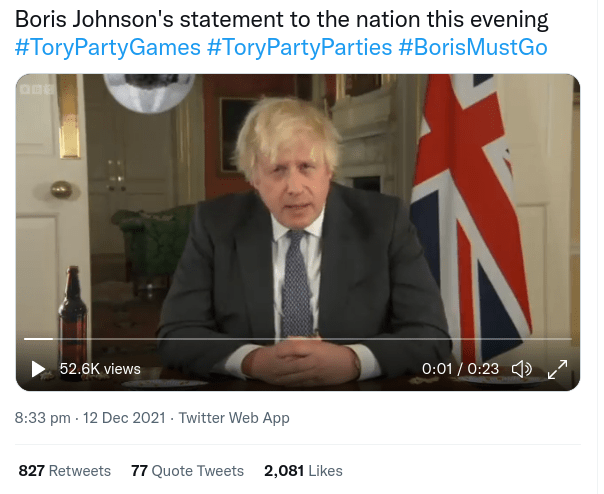
Speaking in a pre-recorded message to the nation which was released at 5pm today, Mr Johnson said: “There is no doubt that Omicron continues to surge with a speed unlike anything we’ve seen before.

“The situation remains extremely difficult but I also recognise that people have been waiting to hear whether their Christmas plans are going to be affected.

“So what I can say tonight, is that naturally we can’t rule out any further measures after Christmas – and we’re going to keep a constant eye on the data, and we’ll do whatever it takes to protect public health.

“But in view of the continuing uncertainty about several things – the severity of Omicron, uncertainty about the hospitalisation rate or the impact of the vaccine rollout or the boosters, we don’t think today that there is enough evidence to justify any tougher measures before Christmas.

“We continue to monitor Omicron very closely and if the situation deteriorates we will be ready to take action if needed.”

“Madcap” Exmouth development approved

The legacy of the Conservative “Old Guard” still comes to haunt the “New Guard”

The road layout of a “madcap” 300 home development on the edge of Exmouth is to be changed following a vote by East Devon District Council (EDDC).

The 16 affordable homes promised by the developers described as “scandalously low.” 

Joe Ives, local democracy reporter www.radioexe.co.uk

New homes going here (courtesy: Google Maps)

300 new homes, but councillors not happy.

The corner at Goodmores Farm housing development at Hulham Road will now have a simplified road layout. 

Instead of the southwestern portion having two looping roads, it will now just have one, to reduce the risk of flooding through surface water runoff. As a result of the changes the number of homes planned has been reduced by one, to 298.

The Goodmores Farm scheme, put forward by 3West Developments Ltd, a Woodbury-based developer, has divisided opinion for years. 

The principle of the development was granted planning permission in 2014 – a decision that has since tied the council’s hands.  As a result, despite concerns over the small number of affordable homes proposed by developers, full outline permission was given for plans in 2018. 

Although nothing can be done to stop the project now, many councillors feel it is a major mistake in the making.

When first proposed, the development was meant to have 350 houses, a school, open green space, a communal commercial area, and employment land.  A viability assessment submitted by the developer argued that in order to provide some of these facilities it could only afford to make five per cent of the new buildings affordable – a far cry from the council’s normal 25 per cent requirement.

There are concerns too about future residents having to rely on cars, and its alleged poor public transport and cycle links.

In comments submitted before the latest planning meeting, Councillor Paul Millar (Labour, Exmouth Halsden) said: “I continue to object to this planning application along the same lines as Exmouth Town Council, and will do everything I can to delay and frustrate this intellectually incoherent and madcap scheme which ought never have been approved at outline”

Speaking at the planning committee, Cllr Paul Millar described the 16 affordable homes promised by the developers as “scandalously low.” 

Previous road layout for Goodmores Farm, Exmouth (courtesy: ARA Architects)

East Devon is facing an affordable housing crisis. A report by Devon Home Choice says more than 2,700 households in the district are in housing need. 

Nevertheless, with outline approval granted by a previous EDDC administration, there is little that can be done to significantly alter the plans now. 

Commenting on the ‘reserved matters’ application for the road layout changes, Councillor Bruce De Saram (Conservative, Exmouth Littleham) said: “With great reluctance – and I stress with great reluctance – I will have to support approval.”

Councillor Olly Davey (Green, Exmouth Town) welcomed the reduction in the amount of tarmac that will be laid as a result of the road changes. However, he reiterated arguments made previously about the plans, saying: “This is a twentieth-century development and not really fit for the twenty-first century.” 

The reserved matters application was passed unanimously by EDDC’s planning committee. 

Australia trade deal to cause £94m hit to UK farming, forestry and fishing, Government study reveals

The post-Brexit trade deal signed with Australia last week will see British agriculture, forestry and fishing take a £94m hit, the Government’s own impact assessment shows.

By Arj SinghDeputy Political Editor inews.co.uk 

There is also an expected £225m hit to the semi-processed food sector, which includes tinned products, as part of a “reallocation of resources within the economy”.

The impact assessment refers to Australia as a “large, competitive producer of agricultural products”, making clear the “potential for the deal to result in lower output for some agricultural sectors [in the UK] as a result”.

It goes on to warn that the sector is expected “to contract” as a result of increased competition as tariffs are lifted on Australian imports to the UK, compared to if the deal had not been struck.

It comes after then-trade secretary Liz Truss won a Cabinet row with George Eustice over the deal in spring, with the Environment Secretary reportedly concerned about the damage cheap Ausralian lamb and beef imports could do to domestic farmers.

Manufacturing sectors, in particular the manufacture of motor vehicles and the manufacfture of machinery and equipment will benefit from the deal, the impact assessment published alongside the final trade deal on Friday showed.

The Liberal Democrats warned farmers were being “sold down the river” by the Conservatives as a result of the deal.

It came after Boris Johnson’s party suffered a humiliating by-election defeat to the Lib Dems in the largely rural seat of North Shropshire.

Lib Dem environment spokesman Tim Farron said: “This impact assessment proves what so many feared.

“Buried in the small print is a £100m hit to our farming and fishing sectors that will hit rural communities hardest.

“Boris Johnson has sold farmers down the river to make a quick buck in a misguided trade deal with Australia.

“Now the reality of what’s on the table is clear, it’s vital that Parliament is given a vote on the deal.

“Last week’s political earthquake in North Shropshire shows that Boris Johnson’s Conservatives can’t afford to take farmers for granted any longer.”

The Department for Intenraitonal Trade said it had secured safeguards to protect the most sensitive farmers, including tariffs on imports above a certain quota in the first decade of the deal.

From years 11 to 15, 20 per cent tariffs will apply on beef and sheepmeat above a certain quota level.

And a general safeguard will provide a safety net for industries that face “serious injury” from increased imports.

A DIT spokesman said: “The deal is expected to increase trade with Australia by 53 per cent, boost the economy by £2.3bn and add £900m to household wages each year in the long-run. It will also play an important role in levelling up the UK, delivering benefits for towns, cities and rural areas throughout the country.

“Maintaining our high standards is a red line in all our trade negotiations. That is why this deal contains safeguards to support the most sensitive parts of the UK farming community, including a gradual removal of tariffs over 10 years and a safety net that allows tariffs or restrictions to be reimposed if the industry faces serious harm.”

Exposing the Immensa testing scandal: update – Good Law Project

goodlawproject.org

The Omicron variant is creating another season of Christmas chaos and a country-wide shortage of PCR testing has once again revealed shortcomings in the Government’s Covid-19 response.

Amid this, our work to address the failings at the Immensa lab in Wolverhampton is more important than ever. An estimated 43,000 people with Covid-19 were mistakenly given negative PCR results by the lab. They thought they were in the clear, but were actually positive for Covid-19. This contributed to soaring rates of infection across the South West and Wales.

Amber Marshall told the BBC that she believes her grandmother Pam died in October as a result of Immensa’s errors, having caught Covid-19 from a member of staff at Stinchcombe Manor Care Home. The staff member had been given a false negative result and thought it was safe for her to go to work.

Without a proper account of what happened, how can people trust the system won’t fail to protect them and their families and friends again?

We posed a series of questions to the Government, to try and get justice for the families involved and assurances that the situation is now under control, but their responses were vague and wholly inadequate.

We’ve now filed Judicial Review proceedings to ensure the Government reckons with the multiple failures in their oversight of the Immensa lab.

We believe their failure to set up and enforce a proper system to monitor and supervise the accuracy of PCR testing at private labs like Immensa breaches both their duty to protect life under the NHS Act 2006 and the human rights of the thousands of people affected.

It took the Government almost a month to identify the issue and to stop sending PCR tests there. And they didn’t even announce what had happened or start contacting affected individuals until three days after that.

It’s hard to say just how much further the virus spread in that time, but the effects of this mismanagement are potentially huge. As far as we know the Government hasn’t actually investigated or confirmed the true number. Professor Deepti Gurdasani, a senior lecturer in epidemiology at Queen Mary University, estimates that the false negatives may have caused up to 200,000 further Covid-19 infections, and more than 1,000 avoidable deaths.

Many of the people given false negative PCR results have been left deeply distressed. One woman told us that, without a positive PCR result, she missed out on support that she’d otherwise have been entitled to: “I couldn’t believe it when I got the message from Test and Trace. I was so angry. I am 71 years old, and I was completely on my own. I could have died in my flat and no one would have known.”

We’re asking the Court to compel the Government to put in place proper safety checks at private labs to prevent this ever happening again and to acknowledge that people’s human rights were breached. We will keep you updated.

You can learn more about the facts and grounds of this case here. And read the Government’s response to our questions here.


Good Law Project only exists thanks to donations from people across the UK. If you’re in a position to support our work, you can do so here.

Covid restrictions unlikely before Christmas but PM watching data ‘hour by hour’

Boris Johnson has lost control, and potential successors such as Rishi Sunak are looking over their shoulders at the “bonkers” recovery and research groups. 

How to crash the economy and wreck the NHS without really trying  – Owl 

Aubrey Allegretti www.theguardian.com 

New Covid restrictions are unlikely to be imposed before Christmas amid deep cabinet divisions but Boris Johnson warned further measures remain on the table, with data on the threat of Omicron monitored “hour by hour”.

The prime minister was accused of failing to follow scientists’ advice on the need for immediate restrictions while leaving millions of people and businesses in limbo after a two-hour cabinet meeting ended with no decision on Monday.

During the meeting, scientific advisers briefed ministers on the latest data including a steep rise in hospitalisations in London, with the UK’s highest number of Omicron cases, while 91,743 people tested positive for Covid on Monday across the UK.

Afterwards, the prime minister said the arguments for and against stricter measures were “finely balanced” and the situation was “extremely difficult”.

With some people having already departed on Christmas breaks, government sources told the Guardian that fresh curbs were unlikely to be imposed before 25 December – though an announcement could be made in coming days on rules to be brought in before New Year’s Eve.

Measures under consideration include limits on households mixing indoors, social distancing and curfews for the hospitality sector. Parliamentary authorities are preparing for a possible request for the Commons to be recalled on Tuesday 28 December for a vote on any new measures.

Among cabinet ministers pushing for swift action were Sajid Javid, the health secretary, and Nadine Dorries, the culture secretary. However, the chancellor, Rishi Sunak, the foreign secretary, Liz Truss, and the education secretary, Nadhim Zahawi, were said to be holding out for “incontrovertible evidence” that a plan C for tackling Omicron was needed.

Among the plans considered by cabinet on Monday was a return to “stage two” of England’s roadmap out of lockdown, which came into effect on 12 April. People were only allowed to socialise indoors with members of their own household or support bubble, while outdoor socialising was limited to the rule of six or two households.

Johnson said hospitalisations were rising “quite steeply” in London, where Omicron has hit hardest so far, adding that while he understood the strain on hospitality firms, the current plan B restrictions “can be very helpful to us and the country” at slowing the spread of the variant.

The mayor of London, Sadiq Khan, announced the cancellation of the capital’s New Year’s Eve celebration in Trafalgar Square “in the interests of public safety” on Monday. The event had been due to be attended by 6,500 people.

The number of UK vaccines administered within 24 hours broke 1m for the first time this weekend, it was confirmed. Just over 50% of over-12s have now also received a booster dose.

Prof Christina Pagel, the director of University College London’s clinical operational research unit, said that waiting for more definitive evidence of Omicron’s spread could cause the NHS to be overwhelmed and may mean it is too late to avert a crisis.

She urged ministers to “follow Sage advice and return to step two of the roadmap immediately to prevent thousands of infections over the coming days and then monitor the situation hour by hour so that measures can be lifted as quickly as possible, hopefully even in time to enable limited household mixing over Christmas weekend”.

A Department of Health source stressed that while Javid believed responding as early as possible to threats like Omicron was still the best way forward, the possibility of new restrictions remained unclear.

They said: “We want to be as open with people as we can, but it’s not easy. There is new data coming in all the time that we have to look at, from several places. We’re basically scouring for a signal within the noise.”

A former minister said Johnson appeared to be hamstrung by some of his top team. They said: “I don’t really see how it is scientifically defensible [not to act immediately] but it also feels about right in political and publicly-possible terms. The data about transmission points inexorably towards an approach that says ‘better safe than sorry for the sake of the NHS’. But it would also be unforgivable to be too cautious.”

A Tory MP resistant to new restrictions vowed to go ahead with their Christmas and New Year plans regardless of any new rules. They said: “If he tries to push ahead with new restrictions without convincing evidence, Boris is a dead man walking.” Another backbencher, Esther McVey, said ministers had “for once pushed back on the scaremongering by the lockdown fanatics”.

After the cabinet meeting ended with no certainty on restrictions, Labour accused Johnson of being “too weak” to stand up to his own MPs. Wes Streeting, the shadow health secretary, said: “While businesses across the country wonder if they can continue to trade, and families make frantic calls about whether they will see each other this Christmas, true to form the prime minister has put his party before the public.

“Rather than set out a clear plan for the country, he has chosen to protect himself from his own MPs by simply not saying anything. Boris Johnson is unfit to lead.”

Kate Nicholls, the head of UKHospitality, said the industry needed notice of any restrictions that were to be placed on it next week, with financial support crucial. She said firms were in limbo, having lost up to 60% of their trade while still having big rent and rate bills as well as staff wages.

Greg Parmley, the chief executive of Live, which represents live music companies, said the government’s stance was “merely an excuse to withhold desperately needed financial support as sectors like live music and entertainment buckle under the weight of the latest Covid wave”.

Dehenna Davison, the Conservative MP for Bishop Auckland, said: “In the last two days, I’ve had pubs and restaurants contact me asking if they should place food and drinks orders. I’ve had emails from people asking if they should postpone their wedding for the fifth time, or if they can see their mum on Christmas. We really need some certainty.”

Planning applications validated by EDDC for week beginning 6 December

Omicron is terrifying – so why won’t we learn from past mistakes? 

Across the country, even before Omicron admissions have started to rise, the bed occupancy in our hospitals is 94%.

“The secret consultant” www.theguardian.com 

That seems a luxury to me; it is quite a while since I saw an empty bed in mine. Our bed occupancy hovers around 100% and has done so for some weeks.

There is nothing unusual in this, however. Successive decades and serial A&E closures, combined with rising healthcare demands from an elderly and growing population, have meant our bed provision is far too small for our area. Even in a normal winter, critical bed crises are a common problem, with operations cancelled and patient care often compromised as a result. The whole system has been slowly gutted to the point that there is not even enough capacity to deal with routine fluctuations in demand.

This, however, is not shaping up to be a normal winter. The Omicron variant is spreading with a speed that is terrifying to me, even after all I have seen and done over the past months.

I don’t even need to look at the figures to know this; the evidence is all around me. Friends and family, even the careful ones, have started testing positive and having to isolate. There are multiple outbreaks in schools again. Football matches are being cancelled. And there are already many colleagues unable to attend work, leaving rota gaps that we are already struggling to cover.

And the worst of it is yet to come.

Extrapolating from the current figures, it looks like within our local area we will have infections in the tens of thousands by the middle of next week. And here comes the biggest unknown.

Is this variant really, as we all hope, less virulent than its predecessors? Will our vaccines and immunity be enough to keep people out of hospital? Even with a hopelessly optimistic low rate of hospitalisations, it still looks like there will be far too many patients for us to look after.

A small proportion of a very large number is still a large number. Remembering also that there is a lag of a week or two between infection rates rising and people becoming unwell enough to present to hospital, this means the potential point of maximum pressure comes around Christmas and New Year, when many of us were hoping, finally, to take a few days off, and many more will be sick or isolating with Covid.

And we have significant other pressures working against us. GPs are scaling back the routine care they offer in favour of vaccinations. Some hospitals are also cancelling elective care so that their consultants can join in the jabbing.

Despite this, the new variant has some power to evade the vaccine, meaning that even the current heroic effort may not put the requisite protections in place in time. Vaccinated patients are unlikely to get critically ill, but even relatively well patients coming into hospital could overwhelm us.

The reduction in usual care is likely to result in more patients seeking help in hospitals, despite best efforts.

One glimmer of hope is the new treatments for Covid now available for patients who are particularly vulnerable, with the aim of stopping the disease progressing and reducing the need for hospitalisations.

The first centres for this went live this week, using staff redeployed from other vital work. The problem is, however, that these were set up and resourced based on numbers calculated from the Delta variant. Within the first 24 hours of opening it became clear that the numbers now identified for treatment already exceeded capacity fivefold and are rising exponentially.

So even this hope must be tempered with realism: how much will these really be able to hold back the tide?

I find myself grudgingly admiring the Covid-19 virus, that with all our modern medicine and incredible science, it is still managing to confound us even 20 months on. It is a fearsome opponent.

So why, yet again, do we seem to be underestimating it? Why do we not learn from our mistakes?

For a healthcare system already strained beyond capacity the potential threat that Omicron poses is obvious, even though its virulence is yet unknown.

Why not therefore take at least some sensible precautions to try to hold back the spread, to buy us time to vaccinate some more and make sure we are set up to give all the therapies at our disposal?

Plan B will make very little difference to a strain this infectious. In any case, these measures take time to work.

By the time that hospitalisations start to rise, it will be too late. Surely it would be better to make the mistake of introducing early restrictions unnecessarily than to make the mistake of not doing so and causing unnecessary deaths?

Boris Johnson “know[s] the pressures on everyone in our NHS”. But does he really? Has he got any idea of the exhaustion, burnout and low morale that I see and feel every day? The dread that my colleagues and I express as we talk about what this winter holds in store, again? How it feels to be potentially facing yet another wave?

And yet still we sit on the fence, pretending we can vaccinate our way out of this while carrying on with life as normal. Talk of shielding the NHS rings hollow in the face of this inaction.

And while we have been working on throughout to keep people safe, it seems that in Downing Street they found the time to have unmasked quizzes and after-hours gatherings. How nice.

It really is hard to put into words exactly how shameful, deceitful, and hypocritical this is.

In medicine we sign up to a “duty of candour” that we all owe to our patients, whereby if mistakes are made we admit them, apologise, do our best to make amends. It is a basic thing that even the most junior medical student knows about. Too basic, it seems, for some important people to be concerned with.

What we have achieved in the NHS over the past year is little short of amazing. And now we are being asked to make another “extraordinary effort” by leaders who show themselves to be above such things yet too cowardly to admit it.

Yet without measures to protect us, will it be enough?

The science is clear: the case for more Covid restrictions is overwhelming

Don’t you worry your little head over this Simon, just carry on partying. – Owl

Ian Sample www.theguardian.com

For a variant that came to light less than a month ago, the evidence for Omicron’s potential to wreak havoc has mounted at breakneck speed. What studies have emerged are rapid first takes, but the message they convey is now loud and clear: the scientific case for more restrictions is overwhelming. Without hard and swift action to curb transmission, the NHS faces a battering.

The first red flag came in late November when scientists in southern Africa shared early genomes of what became known as Omicron. Soon after they landed, Tom Peacock, a virologist at Imperial College London, highlighted the “awful” mutations that marked it out as a fast-spreading, vaccine-dodging variant. On receiving a text about Peacock’s tweet, Dr Susan Hopkins, the chief medical adviser to the UK Health Security Agency (UKHSA), conceded it filled her with gloom.

The warning spurred research around the clock to nail down the extent of the threat. One of the first to report was Dr Alex Sigal at the University of KwaZulu-Natal in Durban. His team confirmed that Omicron largely escaped antibodies from vaccines or past infection, with antibodies following the Pfizer shot 41 times less effective against Omicron than the original Covid-19 virus. Other data from South Africa, and soon from around the world, showed that Omicron spread like wildfire, doubling every two to three days. As Prof Chris Whitty, England’s chief medical officer, phrased it: “There are several things we don’t know, but all the things that we do know are bad.”

As the infection spread, the UKHSA crunched early numbers to show that two doses of Covid vaccine did little to prevent symptomatic infection, though a booster kicked protection up to about 70%. On Friday, two reports from Prof Neil Ferguson’s group at Imperial College rounded out the picture. Their findings are tentative, but suggest a booster provides 80-86% protection against hospitalisation from Omicron. That is good from an individual perspective, but compares with 95% for Delta. The upshot is that hospitalisation rates for boosted people could be four times higher with Omicron.

Further analysis from the Imperial team shed light on the single most important unknown: how severe can Omicron infections be? Data from South Africa gave some cause for hope, with hospitalisations down on previous waves, but the researchers found no evidence Omicron was milder than Delta.

There are still hints of good news, however. Lab work led by Prof Ravi Gupta at Cambridge University suggests that Omicron may be less effective at attacking the lungs than Delta. The finding chimes with University of Hong Kong research that found Omicron replicated 70 times faster than older variants in the bronchial tubes, but is less likely to infect the lungs. The hope is this could make the variant spread fast but cause less severe disease.

But in documents released by the Sage committee on Saturday – after they pored over updated outbreak modelling from Warwick University and the London School of Hygiene and Tropical Medicine – the assessment is frank. England is “highly likely” to have 1,000 to 2,000 daily hospitalisations by the end of December. Many of these are already baked in and will arrive at hospital doors in the next week or so, regardless of actions taken now. With no further restrictions beyond “plan B”, models point to at least 3,000 daily hospitalisations at the peak of the wave next month. “To prevent such a wave of hospitalisations, more stringent measures would need to be implemented before 2022,” the scientists wrote. That would prevent hospitalisations, not just delay them, as it would give more time for boosters to take effect.

Throughout the epidemic, scientists have stressed the importance of moving fast when cases take off. This is doubly true with a virus spreading as fast as Omicron, according to an assessment released by the environmental modelling and behavioural science groups that feed into Sage. If taken soon enough – within days – restrictions like those in place after step one or step two of the roadmap in England need not be in place for more than a few weeks, the experts write.

“The timing of such measures is crucial,” they add.

Sidmouth: Councillors agree Sidford Business Park building heights ‘through gritted teeth’

Remember that Cllr Stuart Hughes claimed that this business park within the AONB had been deleted, when it hadn’t’, during the last iteration of the Local Plan. – Owl

Joe Ives, Local Democracy Reporter sidmouth.nub.news 

The size of buildings at a controversial business park to be built in Sidford has been agreed by East Devon District Council (EDDC) “through gritted teeth.”

The development, which was rejected by EDDC’s planning committee before being approved on appeal by the government’s Planning Inspectorate in August 2019, has been a source of contention for both the council and local residents.

The council had previously refused an outline application for the eight-square-kilometre business park because of concerns over dangers from increased HGV traffic through Sidbury and Sidford as a result of the development. There are also worries about the visual impact, as it is in an ‘Area of Outstanding Natural Beauty.’

When the Planning Inspectorate’s decision was announced in 2019, Sidmouth and Sidford councillor Stuart Hughes (Conservative) described the judgment as “basically a two fingers up to the Sid Valley” – a sentiment which is still widely felt.

When making its decision, the inspectorate pointed to the 250 new jobs expected to be created as one of its reasons for approval.

Either way, with the inspectorate’s 2019 decision the council had little choice but to support the proposals for the final details of the height of the buildings.

Sidford already struggles to get large vehicles through its roads (Credit: Daniel Clark/LDRS)

EDDC’s planning committee voted in favour of the ‘reserved matters’ application for the size of the buildings from the applicant, 0G Holdings Retirement Benefit Scheme.

It means the industrial estate will mainly consist of six-metre tall buildings. There will be two 7.5-metre-high buildings, roughly two storeys in height, next to the entrance at Two Bridges Road. The developer says the visual impact of these buildings will be partly mitigated by new trees.

A letter of objection from a local resident was read to the planning committee. It said: “There comes a point in time when somebody has to say enough is enough. This development has nothing to do with local economic benefit or creation of opportunities.”

They said the scheme had driven them “beyond anger.”

In 2019 The ‘Say NO To Sidford Business Park’ campaign collected 1,500 signatures in a petition.

However, given the decision of the Planning Inspectorate, EDDC can do little except approve the specific details as presented to the government.

Each councillor who voted for approval expressed their reluctance before doing so. Councillor Olly Davey (Green Party, Exmouth Town) and Cllr Richard Lawrence abstained. Councillor Geoff Pratt (Independent, Ottery St Mary) voted against approval. But in the end, the vote was carried.

Councillor Mike Howell sympathised with the objections raised by members of the public but stated there were no grounds for refusal, given the 2019 decision of the planning inspectorate. He said: “It is purely scale we are talking about and this is exactly the same as the proposal that went to appeal. The scale is set.

“We are really struggling with this and I wish I could see any hope of amending, changing – doing anything. As far as I can see there is no hope in hell. In fact, I would say if we did vote against it we would have costs awarded against us for acting ‘unreasonable.’”

Councillor Richard Lawrence (Conservative, Whimple and Rockbeare) said: “We are between a rock and a hard place and there is very little we can do about this.

“I can’t understand why the inspector gave these decisions but at the end of the day we’re faced with them and we must comply with them.”

Councillor Joe Whibley (Independent, Exmouth Town) said: “I would like the people who have objected to this to know that we do this [the reserved matters approval] through gritted teeth. This is not something that we’re all happy just to wave through.

“It’s incredibly frustrating.”

The proposed final appearance of the buildings will be voted on by the planning committee at a later date.

The Tories call it electoral reform. Looks more like a bid to rig the system 

Showing you papers before you vote, surely this is something our “libertarian” Simon Jupp MP will have to oppose? – Owl

Nick Cohen www.theguardian.com

Picture the chaos at the next general election. Officials refuse to allow voters into polling stations because the Johnson government has denied democratic rights to everyone who cannot or will not produce photo ID.

Some are angry because they don’t have the required documents. Others sound paranoid as they tell reporters they don’t want to show passports and driving licences because they fear state surveillance. If nothing else, Covid has taught us the extent of the conspiratorial mentality. On election day the government reveals it is content to encourage a climate of paranoia, if it will give the Conservatives an advantage. Trust in the integrity of the election withers as the scale of voter suppression becomes apparent.

Last Monday, the Commons public administration and constitutional affairs committee, chaired, I must emphasise, by a Conservative MP, William Wragg, said that if Northern Ireland were a guide, ID checks would cause turnout to drop by 2.3%. On this measure, the Tories would disfranchise about one million of the 47.6 million people registered to vote.

Unlike Northern Ireland, the rest of the UK has no record of sectarian gerrymandering and civil war to justify controls. The facts of recent history do not concern Michael Gove. He has pursued vote rigging with Gollum-like obsessiveness since 2019. His oppressive intent is evident in the failure to produce proof that frauds are turning up at polling stations and stealing the identities of honest citizens. The protests of people denied the ballot would be everywhere in the media if that scare story were true. As it is, there was only one conviction for impersonation after the 2019 election, and the Commons committee described the government’s pretence that there was a hidden epidemic of voter fraud as “simply not good enough”.

It is evident in the speed with which the government is forcing its elections bill through parliament. It is evident in the lack of public consultation and bipartisan support. It is evident, above all, in the government’s choice of targets.

In a satirical twist, the Conservatives have assigned the task of ending the level playing field of free and fair elections to Gove’s Department for Levelling Up. They believe people without driving licences or passports will be poor and less likely to vote Conservative. I wouldn’t count on that in every Leaver town, and nor do ministers. They are leaving nothing to chance. Expats, who are more likely than not to be Tories, will be able to vote, however long they have lived abroad. All foreign nationals will be denied the vote, however long they have lived in the UK. People over 60, who disproportionately vote Conservative, will be able to use their travel passes as photo ID. The young, who don’t, won’t.

If this were happening in Hungary or Zimbabwe, we would know what to say: a corrupt clique was bending the rules to maintain its power. We don’t know what to say when election rigging happens in our own country because a self-satisfaction born of the UK’s lucky history holds that “it can’t happen here”. Even when it is happening here. Protests about the elections bill are confined to a nerdish group of politicians, journalists and academics.

The fate of the Electoral Commission ought to shake the complacent. Boris Johnson is threatening the independence of the referee that protects against corruption. The elections bill allows ministers to set the “strategy and policy” the commission must follow. The government claims it has been forced to act because of loss of confidence in the commission. The Commons investigation said there was no more evidence that the public had lost faith in the commission than there was of hordes of frauds at polling stations.

It warned instead of the danger of the government abusing its power to help it stay in office, even if abuse means undermining “public confidence in the effective and independent regulation of the electoral system”.

We risk becoming like the US where every vote is disputed by the losing side, and impartial arbiters are replaced with political lackeys. Indeed, we are already on that path. Whether in the courts, broadcasting or the regulatory system, undermining checks and balances has been the modus operandi of this government.

The scandal that led to the Conservatives losing North Shropshire began when the cabinet organised an assault on Kathryn Stone, the parliamentary commissioner for standards. She found against Owen Paterson for promoting companies that were paying him £110,000 a year for his bespoke services. Johnson, himself the subject of Stone’s inquiries, wanted the rules changed to give him and his colleagues more freedom to sponge at will. Kwasi Kwarteng, the business secretary, showed his unfitness for public office by saying he found it “difficult” to see how Stone’s career could survive such an impertinence.

Stone saw off her enemies. By contrast, Lord Geidt, Johnson’s ministerial standards adviser, now cuts a pathetic figure. The credulous man actually believed the prime minister when he said he knew nothing about a businessman buddy, Lord Brownlow, paying for the refurbishment of his Downing Street flat until the media mentioned it in February 2021. A scrupulous investigation by the electoral commission found Johnson was tapping Brownlow for money in November 2020. Now Johnson wants to punish the Electoral Commission.

On Tuesday, Wragg wrote to Geidt to ask how he was independent when he did not appear to have the power to conduct proper investigations. “What steps are open to you if you feel that, in the course of an investigation, you may have been misled?”

The answer this government wants to hear is “none”, and not only from Geidt.

Once cautious Conservatives worried that, if they used their majority in parliament to hound their enemies, their opponents would one day turn the weapons they forged on the right.

Perhaps today’s Conservatives believe there will never be a Labour government that treats the Tory press the way they treat the BBC, or twist the rule of law and regulation of elections to suit the Labour rather than the Tory cause. After the revival of Labour and Liberal Democrat fortunes, you might find it ludicrous for Conservatives to think they can be in power for ever. If so, I urge you to look at how they are playing with electoral law to give themselves the best possible chance of doing just that.

Boris Johnson and staff pictured with wine in Downing Street garden in May 2020

Boris Johnson has been pictured with wine and cheese alongside his wife and up to 17 staff in the Downing Street garden during lockdown, raising questions over No 10’s insistence a “work meeting” was taking place.

Dear reader, how good were your social contacts in May 2020, did you have wine and nibbles with 17 in your garden when social mixing between households was limited to two people? – Owl

Rowena Mason www.theguardian.com 

The photograph was shared with the Guardian following No 10’s denial last week that there was a social event on Friday 15 May 2020 including wine, spirits and pizza inside and outside the building. Johnson’s spokesman said Downing Street staff were working in the garden in the afternoon and evening.

However, the picture raises questions over that assertion. Bottles of wine are in evidence, there is a lack of social distancing and 19 people are gathered in groups across the Downing Street terrace and lawn.

At the time social mixing between households was limited to two people, who could only meet outdoors and at a distance of at least 2 metres. In workplaces, guidance said in-person meetings should only take place if “absolutely necessary”.

Angela Rayner, the deputy leader of the Labour party, described the picture as “a slap in the face of the British public”, adding: “The prime minister consistently shows us he has no regard for the rules he puts in place for the rest of us. Alleged drinking and partying late into the evening [at No 10] when the rest of us were only recently getting one daily walk.”

The prime minister has faced a string of allegations of partying and socialising in No 10 while Covid restrictions were in place. He was forced to order a civil service inquiry, though its head stepped down on Friday over allegations of his own Christmas party.

The past week has been described as the worst of the prime minister’s premiership, with a major rebellion by Conservative MPs over Covid regulations followed by a historic byelection defeat and the shock departure of the Brexit minister, David Frost.

In the new image shared with the Guardian, Boris Johnson and Carrie, who appears to be holding their newborn baby, are seen sitting around a table with a cheeseboard and wine, along with two people believed to be a civil servant and an aide. Last week No 10 said Johnson was working in the garden before retiring to his flat at 7pm.

On that day Matt Hancock, then health secretary, had given a 5pm press conference urging people to stick to the rules and not take advantage of the good weather over the May weekend to socialise in groups.

At the time schools were still shut and pubs and restaurants were closed, with strict controls on social mixing. More people had been allowed to return to their workplaces, but guidance said social distancing of 2 metres should be followed at all times and “only absolutely necessary participants should attend meetings and should maintain 2-metre separation throughout”.

The Guardian reported last week, as part of a joint investigation with the Independent, that Johnson had been present for an alleged social gathering in Downing Street on 15 May 2020. Sources said the prime minister had spent about 15 minutes with staff, telling an aide inside No 10 that they deserved a drink for “beating back” coronavirus.

Insiders claimed about 20 staff drank wine and spirits and ate pizza following a press conference on that day, some in offices inside No 10 and others going into the garden. Some staff stayed drinking until late into the evening, they alleged. The sources described the event as having a “celebratory” feel given the initial loosening of some restrictions and the good weather in London that day.

In response, No 10 said Johnson and staff had been working in the garden and made no reference to the allegations of drinking alcohol and socialising. The prime minister’s official spokesperson said last week: “In the summer months Downing Street staff regularly use the garden for some meetings. On 15 May 2020 the prime minister held a series of meetings throughout the afternoon, including briefly with the then health and care secretary and his team in the garden following a press conference.

“The prime minister went to his residence shortly after 7pm. A small number of staff required to be in work remained in the Downing Street garden for part of the afternoon and evening.”

Hancock, who was health secretary before he had to resign after breaking social distancing rules with his aide, Gina Coladangelo, said it was “not true” that he was involved in a social gathering. “After the press conference, which finished at approximately 5.53pm, Matt debriefed his own team, then went to the Downing Street garden to debrief the prime minister. He left Downing Street at 6.32pm and went back to the Department for Health and Social Care,” Hancock’s spokesperson said. There is no suggestion he was drinking or stayed late.

In light of the new picture, it is understood No 10 maintains that people drinking at work was not against regulations at the time. A Downing Street spokesperson said on Sunday: “As we said last week, work meetings often take place in the Downing Street garden in the summer months. On this occasion there were staff meetings after a No 10 press conference.

“Downing Street is the prime minister’s home as well as his workplace. The prime minister’s wife lives in No 10 and therefore also legitimately uses the garden.”

There have been a string of accusations that Downing Street staff broke rules by having Christmas parties, with the prime minister presiding over a Zoom quiz and giving a speech at a leaving do.

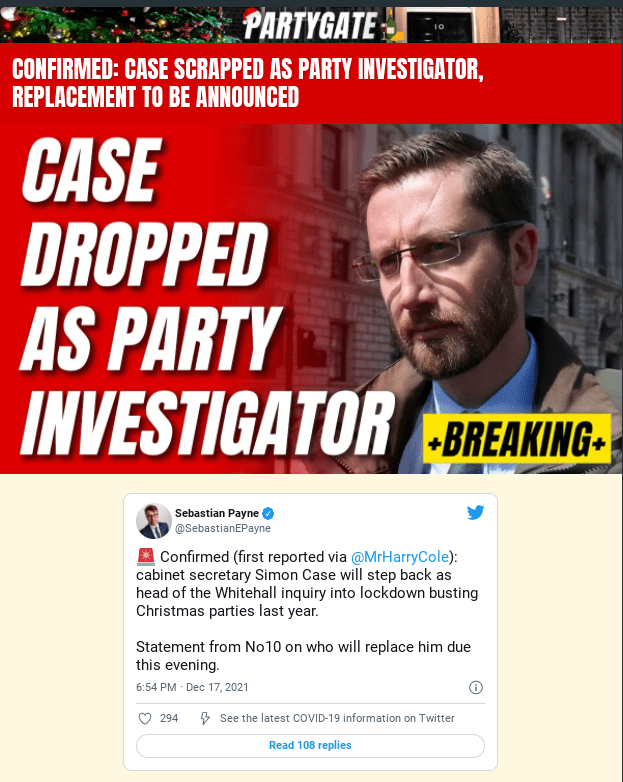
Johnson ordered an investigation after a video was leaked to ITV showing aides laughing about a Christmas party with wine and cheese, and suggesting passing it off as a business meeting. Simon Case, the cabinet secretary, stepped down from leading that investigation after it emerged his own office had held a Christmas party, and has been replaced by another senior civil servant, Sue Gray.

Rayner said: “This picture is utterly heartbreaking to see for the people that spent the first wave of the pandemic on the frontline of our health service, desperately missing their loved ones, enduring loneliness, missing funerals … Every day that passes seems to add another event to Sue Gray’s growing list of investigations into alleged unlawful gatherings in Downing Street.”

“Boris Johnson’s government is run with the attitude that it is one rule for them, and another for everyone else. He is totally unfit to lead our country.”

Nadine Dorries ousted from Conservative WhatsApp group for praising PM

Owl would be interested to know whether Simon Jupp is one of the over 100 Tory MPs (now minus Nadine Dorries) who make up the “Clean Global Brexit” group. 

Were the Tories to oust Boris how long before Steve Baker MP formed a splinter group to oppose his successor?

Are we about return to 1997 headlines such as: “Tories fighting like ferrets in a sack” ?

Culture Secretary Nadine Dorries has been kicked out of a Conservative WhatsApp group after urging MPs to show the prime minister “a bit of loyalty”.

www.bbc.co.uk

Tory WhatsApp group

Messages shot around the “Clean Global Brexit” group – made up of over 100 Tory MPs – following the resignation of Brexit Minister Lord Frost on Saturday.

After claims his exit was a “disaster” and a “hammer blow” for Boris Johnson, Ms Dorries called the PM “a hero”.

But former minister Steve Baker removed her, saying: “Enough is enough.”

The prime minister is facing growing criticism from a section of his backbenches, especially over the introduction of further Covid measures to tackle the Omicron variant.

He faced the biggest rebellion of his premiership on Tuesday when 100 of his own MPs voted down Plan B restrictions for England, including the introduction of Covid passports for certain venues.

But the measures passed after Labour decided to vote in favour of the plan.

Since then, the UK has reported days of record breaking case numbers, with Saturday’s coming in at 90,418.

And despite upset from his own party, Health Secretary Sajid Javid refused to rule out further Covid restrictions, telling the BBC’s Andrew Marr programme there were “no guarantees in this pandemic”.

On Saturday night, the resignation of Lord Frost – who had planned to leave in January – was leaked to the Mail on Sunday, speeding up his departure from government.

In his letter to the PM, he highlighted his “concerns about the current direction of travel” in No 10, and warned Mr Johnson “not be tempted by the kind of coercive measures we have seen elsewhere” to tackle coronavirus.

Tory MPs began reacting to the news in the WhatsApp group, calling Lord Frost a “hero” and saying his views were echoed by most of the party’s MPs.

But Ms Dorries – who was promoted to cabinet in the last reshuffle – responded by saying: “The hero is the prime minister who delivered Brexit.”

She added: “I’m aware as someone said today that regicide is in the DNA of [the] Conservative Party, but a bit of loyalty to the person who won an 83 [seat] majority and delivered Brexit wouldn’t go amiss.”

Her colleague Conor Burns said she was “absolutely right”, adding: “Memory seems to be very short.”

But before his post had even come through, Mr Baker removed Ms Dorries from the group, with another MP thanking him for the move.

He said there were two “critical” reasons for Mr Johnson’s large win in the December 2019 election – his Brexit deal being rejected by Parliament and the fact “someone (ahem) but not him persuaded [Nigel] Farage not to run against incumbents”.

But Mr Baker urged other members not to argue, posting: “We have troubles enough in our immediate future.”

Omicron wave yet to reach Devon and Cornwall, expert warns

We are still experiencing the tail-end Delta surge from the large summer events such as Boardmasters!

Have you got that, Simon? – Owl

Evie Townend www.devonlive.com

An expert has warned that Devon and Cornwall are yet to experience the wave of Omicron that is gripping the rest of the country.

Dr David Strain, a senior clinical lecturer at the University of Exeter, said that the region is experiencing the tail-end of the Delta-variant surge that was caused by large events such as Boardmasters at the end of summer.

While the overall Covid numbers across the region appear to be falling, he says this is due to the Delta washing out while the Omicron hit is still to come.

David said: “Bizarrely as numbers are climbing nationally, the overall numbers in the South West appear to be waning but that’s more because we are coming out of a late wave of the Delta variant spread from the end of the Boardmasters peak that we saw in summer.

“We still have lots of Delta variant patients with only around 12 to 13% Omicron cases in the South West but I suspect that what’s been seen nationally with Omicron rising tremendously, I’m expecting it will hit us next week.”

While the severity of the Omicron variant is not entirely known, David said that its rapid transmission within the vaccinated population is a large cause for concern.

He said: “There are a few cases of the Omicron variant in hospital but the bigger problem that we’re seeing with Omicron is how quickly it’s spreading even within populations that are vaccinated.

“From a staffing point of view, across the whole of the health service, you can’t be going to work if you’re carrying the virus that will spread to the compromised patients that you’re looking after.

“So one of the big things we’re very worried about is the impact that this is going to have on our ability to continue to provide a health service in the next few months.”

David said he hoped that there would be some sort of circuit-break lockdown in the near future, however he felt “the government had made it very clear that they were not going to interfere with Christmas.”

Instead, he said that along with cancelling super-spreader events, extending school holidays or reintroducing remote schooling was a sensible option that could be a “half-way house” between a full two-week lockdown with the potential to “nip the variant in the bud.”

He said: “What we saw in October, particularly stark across Devon and Cornwall, was a massive reduction in transmission when the kids were on half term and that was actually a lot more than we could have hoped for.

“It was the same in the summer, with the so-called ‘freedom day’, everyone thought it would go catastrophic but it turns out that children are acting much more as vectors than anyone was expecting.

“Kids are about to start holidays and so actually what I would suggest the most sensible thing at the moment would be to extend the school holidays by a week or so.

“If they extend the Christmas holidays by a week or two that means that any covid within the family unit will stay there as more people will have to work from home or got out, it sort of becomes a lockdown by default.

“A week or two extra weeks of kids not mixing at school, which is where most of the spread of the delta variant spread, could be enough to nip Omicron in the bud.”

Lord Frost resigns from government in fresh crisis for Boris Johnson

Brexit minister David Frost has resigned from Boris Johnson’s cabinet in protest at “the direction of travel,” triggering a fresh crisis inside Downing Street after an already turbulent week for the prime minister.

www.independent.co.uk

Lord Frost – one of the most popular members of the cabinet among the Conservative faithful – handed in his resignation a week ago and had been persuaded to stay in his post until January but last night said he would step down “with immediate effect.”

His resignation represents a major political blow for the prime minister who is already facing a series of crises over “gatherings” in No 10 during Covid restrictions, growing discontent on the Tory backbenches over his leadership and this week’s historic loss in the North Shropshire by-election – a seat held by the party since 1832.

In his resignation letter, Lord Frost told the prime minister he was disappointed about Covid restrictions, warning him not to be “tempted by the kind of coercive measures we have seen elsewhere,” but also hinted at other concerns, saying: “You know my concerns about the current direction of travel.”

The cabinet minister, who Mr Johnson had elevated to the Lords, helped negotiate the Brexit agreement and in recent months has been instrumental in negotiations with the EU over the Northern Ireland protocol.

His departure will fuel speculation about the future of Mr Johnson’s leadership, but in his letter Lord Frost was careful to express “confidence” in the PM. On Friday, Tory MPs put Mr Johnson on notice while one backbencher revealed he had submitted a letter of no confidence in the prime minister to the chair of the 1922 committee of backbench Conservative MPs.

Jenny Chapman, the shadow Brexit secretary, said: “As if we didn’t already know, Lord Frost resigning shows the government’s in chaos.

“The country needs leadership not a lame duck PM whose MPs and cabinet have lost faith in him. Boris Johnson needs to apologise to the public and explain what his plan is for the next few weeks.”

The Liberal Democrat foreign affairs spokesperson, Layla Moran, added: “This shock resignation is a sign of the chaos and confusion at the heart of this Conservative government. The rats are fleeing Boris Johnson’s sinking ship as he lurches from crisis to crisis.

“Even the prime minister’s once-loyal supporters are now abandoning him, just as lifelong Conservative voters are switching in their droves to the Liberal Democrats.

“At a time we need strong leadership to get us through the pandemic we instead have a weak prime minister who has lost the support of his allies and the trust of the British people.”

On Friday, it had also emerged the UK had abandoned its attempt to strip EU judges of the power to oversee the Northern Ireland protocol – despite repeated pledges by Lord Frost and the government to “remove” the role of the European Court of Justice (ECJ).

In October, Lord Frost travelled to Lisbon and vowed the ECJ would not be allowed to have a remit, but new UK proposals would see it interpret matters of EU law.

Disputes would be settled by an independent arbitration panel, rather than the European Commission, a model offered to Brussels by Switzerland. At a Brussels press conference, Maros Sefcovic, the commission vice-president, said the UK signed up to the ECJ’s existing remit, so it was “a topic we are not ready to include in our discussions”.

Describing Lord Frost’s decision to leave the cabinet as “enormous”, Arlene Foster, the former first minister of Northern Ireland, said: “The resignation of Lord Frost from the Cabinet is a big moment for the government but enormous for those of us who believed he would deliver for NI.’’

In a recent speech to the Centre of Policy Studies, the Brexit minister said he agreed with Rishi Sunak, the chancellor, that the Conservatives’ “goal must be to reduce taxes” and said Brexit won’t succeed if “all we do is import the European social model”.

He was also effusive in his praise of the lack of Covid restrictions during the 23 November speech, saying: “Unavoidably, we have had a lot of state direction and control during the pandemic.

“That cannot and must not last for ever, and I am glad that it is not. I am very happy that free Britain, or at least merry England, is probably now the free-est country in the world as regards Covid restrictions. No mask rules, no vaccine passports – and long may it remain so.”

Devon covid down again but figures pre-date Omicron concerns

Covid infections across Devon have fallen in the latest seven-day period, but  the numbers don’t yet reflect the surge in Omicron cases hitting the nation.

Joe Ives, local democracy reporter www.radioexe.co.uk

The latest weekly statistics run to Sunday, 12 December.  On that single day alone, the UK  recorded 50,149 cases. By Friday, 17 December that number had nearly doubled to 93,045, the highest daily figure since the start of the pandemic.

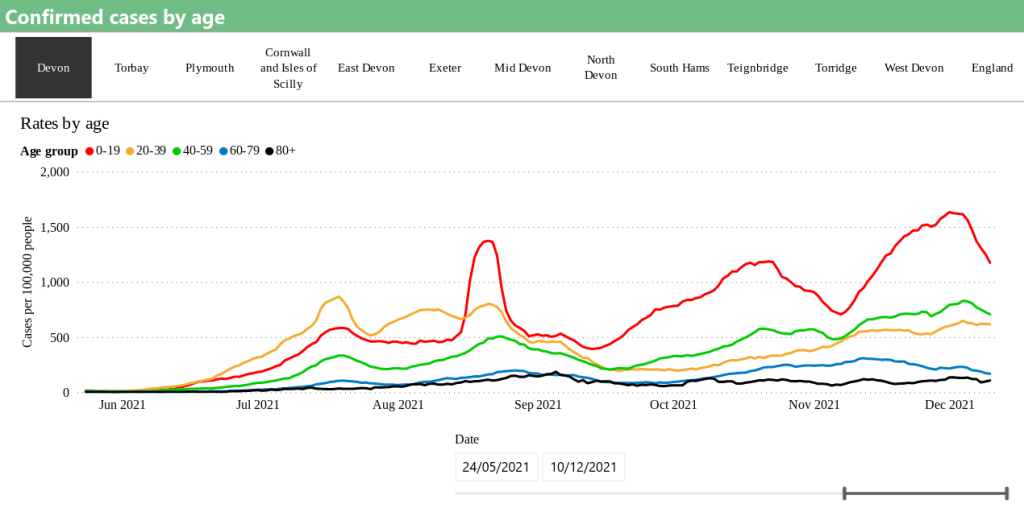
Nevertheless, before Omicron took hold, infections in Devon dropped. Now the new weekly figures to 12 December show 7,591 new cases, 1,412 (16 per cent) fewer than the previous week. On that day, the county’s infection rate was 662 per 100,000 of the population, still higher than the national average of 536.

Cases fell in every council area in Devon apart from Plymouth, where infections rose three per cent. The 2,206 new cases in the city was 56 (3 per cent) more than the previous week. During this period, Plymouth had an infection rate of 839 per 100,000 of the population.

The Devon County Council area, which excludes Plymouth and Torbay, saw cases drop 22 per cent, with 1,331 fewer. The rate of infection across ts seven districts stood at 567 per 100,000.

After having the highest rates of infection of anywhere in the country in late November, Torridge welcomed a drop in cases for the second consecutive week. The number of people contracting covid was down a third (36 per cent), with 408 new infections, down from 226 the week before, and a rate of 594 per 100,000.

Torbay recorded 791 new cases, down 146. The 16 per cent drop takes the Bay’s rate of infection to 581 per 100,000.

Hospitalisations

The most recent data (from Tuesday, 7 December) shows 160 patients in Devon’s hospitals with covid, an increase of 12 from the previous week.

Sixty-nine are at Derriford Hospital in Plymouth, 36 at the RD&E, 30 in Torbay, 22 in North Devon and three at Devon Partnership mental health sites.

Of the total number of patients, 16 are in ventilation beds.

Deaths

Seventeen people died within 28 days of receiving a positive covid test across Devon in the most recent complete seven-day period (up to Sunday, 12 December) – six more than in the previous week.

Ten people died in the Devon County Council area, which excludes Plymouth and Torbay. Six deaths were recorded in Plymouth. One death was  in Torbay.

Across Devon, a total of 1,389 people have now died within 28 days of a positive covid test.

Vaccinations

Eighty-seven per cent of people aged 12 and above have had their first dose of a vaccine in the Devon County Council area, excluding Plymouth and Torbay, with 81 per cent receiving both doses. Forty-nine per cent have now had their ‘booster’ dose.

In Plymouth, 84 per cent have had one dose, while 77 per cent have had both. Thirty-eight per cent have had the booster.

In Torbay, 85 per cent have received one dose, while 79 per cent have had both jabs. Fifty-one per cent have had their third vaccine.

The national rates are 89, 82 and 45 per cent respectively.

On Friday,  17 December, promising early research was shared which suggests that booster vaccines could be 85 per cent effective in preventing severe illness from the Omicron variant.

The modelling, from Imperial College London, is based on limited information on Omicron.

The researchers say there is a high degree of uncertainty until more real-world information is gathered.

Imperial researchers Prof Azra Ghani said: “One remaining uncertainty is how severe the disease caused by the Omicron variant is compared to disease caused by previous variants.

“Whilst it may take several weeks to fully understand this, governments will need to put in place plans now to mitigate any potential impact.

“Our results demonstrate the importance of delivering booster doses as part of the wider public health response.”

Dr Clive Dix, former chair of the UK Vaccine Taskforce, said: “There is a huge amount of uncertainty in these modelled estimates and we can only be confident about the impact of boosters against Omicron when we have another month of real-world data on hospitalisation, ICU [intensive care] numbers and deaths.

“It remains the case that we still need to get vaccines current and future to the whole world.”