More questions about two more failing privatised public services

EDUCATION:

“Parents are being “left in the dark” over who really runs schools in England, according to parliament’s education committee. It has called for the government to overhaul the oversight of academy chains after a string of high-profile failures.

Robert Halfon, the Conservative MP who chairs the committee, signalled to the the new education secretary, Damian Hinds, that the system of regulation had created overlaps and confusion, allowing some multi-academy trusts (Mats) to escape oversight.

“We are particularly concerned by the extent to which failing trusts are stripping assets from their schools. It is not clear to us that all schools are benefiting from joining Mats, or that trusts are providing value for money,” Halfon said in a letter to Lord Agnew, the academies minister.”

https://www.theguardian.com/education/2018/jan/17/mps-call-for-overhaul-in-oversight-of-england-academy-school-chains

PROBATION SERVICE:

“Private probation companies responsible for supervising more than 200,000 offenders in England and Wales face total losses of more than £100m, even after a £342m “bailout” by the Ministry of Justice, MPs have been told.

Ministry of Justice officials acknowledged on Wednesday that 14 of the 21 community rehabilitation companies were expected to make losses ranging from £2.3m to £43m by 2021-22, partly due to a sharp fall in the number of offenders being sentenced to community punishments.

Details of the state of the part-privatisation of the probation service – introduced by Chris Grayling when he was justice secretary in 2015 – were revealed during a Commons public accounts committee session. MoJ officials declined to comment on whether outsourcing was “an appropriate model” for probation services when pressed by Labour MPs, saying that it was a political question.”

https://www.theguardian.com/society/2018/jan/17/private-probation-companies-face-huge-losses-despite-342m-bailout

“The habitable homes bill could transform lives. MPs must back it”

“This coming Friday, 19 January, a bill is to be debated in parliament that could hugely improve the lives of many people in England.

“The Homes (Fitness for Human Habitation) Bill would give private and social tenants the ability to take landlords to court if their home is unsafe. Over a million homes are thought to pose a serious threat to the health or safety of the people living there. This classification, also known as a “category 1 hazard”, covers 795,000 private tenancies – one in six of the privately rented homes in the country.

The government announced support for the bill on 14 January – a relief for those of us who have campaigned for years on this. But the battle is not over yet. Even with government support, if fewer than 100 supporters show up on the day, a single MP could “talk the bill to death” – delivering a speech so long that there would be no time to vote on it.

The bill is necessary. Currently, if a landlord doesn’t respond to a request for repairs, it is up to the council to enforce the law. That entails a visit from environmental health officers to check for hazards under the Housing Health and Safety Rating System (HHSRS), such as mould, excess cold and fire risks. If any are found, they can compel the landlord to address them by issuing a formal enforcement notice – if flouted, prosecution awaits. …

… Incredibly, Friday’s bill proposes changes to a law that has existed since 1885. But there is one huge drawback: it is based on rent levels that haven’t been raised since 1957. So you have an option to take action only if you pay annual rent of less than £80 in London or £52 elsewhere. Average weekly rents in London are now £362 a week.

Buck’s bill would abolish the rent cap, enabling tenants to bring civil proceedings in the county court when a property is unfit for habitation under the Housing Act 2004. The landlord may even be made to pay compensation for the period for which the property was unfit.”

https://www.theguardian.com/housing-network/2018/jan/17/government-support-fit-homes-habitation-wont-pass-bill

“PEDIGREE CHUM”

Owl says: due diligence (lack of) and “chumocracy” – we know a LOT about that in East Devon!

“More than a week after Toby Young quit from the Office for Student Regulator, it has emerged that ministers turned down three other ‘appointable’ candidates in order to give the provocateur-journo his post. Labour MP Kevin Brennan, who got the facts in a Parliamentary answer, accuses ministers of ‘jiggery-pokery’.

Tory MP Robert Halfon said the appointment of Young “smacks of the elite” and was the “chumocracy at work”. There are concerns over the due diligence failures in the case and how more ‘suitable’ candidates were overlooked. It’s unclear when Young’s replacement will be chosen.”

Source: Huffington Post, “The Waugh Zone” online

Unemployed men with big families should have vasectomies says Tory MP tasked with increasing yourh vote

“A new Tory MP has apologised after he suggested unemployed people should have vasectomies to cut costs to the taxpayer.

Ben Bradley – who is tasked with building the Conservatives’ youth vote – made the comments in a blog post in 2012, unearthed by BuzzFeed News.

The Mansfield MP, who was made a party vice-chair in last week’s cabinet reshuffle, wrote that the UK was “drowning in a vast sea of unemployed wasters” because people on benefits were having too many children, and said he supported Iain Duncan Smith’s proposal at the time to introduce a benefit cap.

He went on: “It’s horrendous that there are families out there that can make vastly more than the average wage, (or in some cases more than a bloody good wage) just because they have 10 kids. Sorry but how many children you have is a choice; if you can’t afford them, stop having them! Vasectomies are free.

“There are hundreds of families in the UK who earn over £60,000 in benefits without lifting a finger because they have so many kids (and for the rest of us that’s a wage of over £90,000 before tax!).” …

https://t.co/F4e9uUyJzE

EDDC councillor desperately tries to justify expansion of Greendale and Hill Barton – going against Village Built Up Area requirements

Owl says: what a lot of help Greendale and Hill Barton are getting from (some) EDDC councillors! Hurriedly arranged meetings, a desperate race to find loopholes to allow expansion and now this. Is it a personal comment? Well, an awful lot of “we” in there!!! And quoting 2012 consultant’s views in 2018 – astonishing! AND playing down their own industrial sites (too big for small businesses) – REALLY!

“Mike Allen comment to Inspector on Hill Barton and Greendale issues

(The Lead Councillor for Business and Employment in East Devon District Council (EDDC) and past Chair of the Local Plan Forum which developed the current EDDC Local Plan)

EDDC welcomes proposals for business investment and the creation of units for small and medium sized enterprises across the East Devon area subject to NPPF and Local Plan criteria.

We appreciate that cumulative development along the A3052 road corridor has the potential to negatively impact upon existing communities and infrastructure and the operations of existing businesses. The lack of objection from Highways England on a recent nearby planning application is significant Hill Barton (HB) and Greendale Business Park (GBP) are situated near recently approved (on appeal) Yeo Business Park. This determination is of direct material significance in considering further proposed development.

I will examine four main areas of consideration for Economic development in respect of this SPD for Business Parks:

1) It could be reasonably assumed that the Planning Inspector’s view that employment space proposals of a ‘relatively small-scale development that would provide jobs for local people’ would be applicable to the current plans for Business Parks in the area. It is similarly likely that this location would also be deemed a suitable location for small scale business units at appeal.

2) Greendale and Hill Barton Business Parks are larger scale and vitally important to the economic expansion of East Devon outside of the Science Park and Skypark areas.

3) The lack of residential neighbours means no loss of amenity.

4) There is clear demand for the facilities at Hill Barton and Greendale, without which business expansion would not be accommodated elsewhere. The medium quality, flexibility and appeal of the industrial storage space and units for larger growing businesses in the district is essential.

To be clear, we have no economic basis on which to challenge further development within the perimeters set in the Villages DPD.

5) EDDC’s Economic Development team have reviewed the Draft Villages Plan as well as the Sustainability Appraisal. Having also reviewed Strategy 27 and Policy E7 of the adopted Local Plan, in addition to material evidence in respect of employment land delivery below, I recommend that the Greendale (GD) and Hill Barton (HB) employment sites be removed from this Villages Development Plan.
Approval of this draft Villages DPD with GD and HB included will exacerbate the undersupply of employment premises we are already experiencing through non-delivery of our employment allocations in the adopted Local Plan.

The Council’s strategic drive is to prioritise the development of employment land in the west of the district. Any applicants are advised to examine the potential suitability of our Enterprise Zone sites (Inc. the Exeter Airport Business Park Expansion site; Cranbrook Town Centre; Skypark & Science Park), all of which benefit from infrastructure investment in excess of £25 million and include enhanced transport corridor infrastructure, rail stations and employment site infrastructure as well as being immediately adjacent to Exeter Airport and A30 and M5 junctions.

However, we are aware of some businesses feeding back a view that sites, such those examined above are aimed predominantly at the medium to large scale employers with scientific and professional or transport accommodation requirements in excess of 5,000 sq. ft. This can fail to meet the needs of many new and growing local medium sized manufacturing / B2 class businesses many of which would not be welcome in proximity to residential areas or on Science Parks.

In 2012 East Devon District Council Commissioned Professor Nigel Jump of Strategic Economics Ltd to carry out an independent assessment of the economic impact of the two strategic employment sites in East Devon. His conclusions were clear in that investment in these locations has unlocked valuable employment and economic growth in the district.

Moreover, these sites have the potential to make further economic net benefits (job creation, added GVA and inward investment) throughout challenging economic periods
to come. The report concludes that when social and environmental factors are considered, there remains a net positive impact of extended capacity at these sites which are yet to run their full course.

In light of this EDDC commissioned evidence, inclusion of Greendale and Hill Barton within the Villages DPD is unwarranted, contrary to the specialist advice we have commissioned and would cause demonstrable harm to the district.

These findings are echoed in 3 subsequent studies of demand for industrial and commercial space in East Devon which formed the overall economic element of the EDDC Local Plan which placed great weight on the sustainable balance of social, economic and environmental issues as the “Golden thread” which ran through the Local Plan and the NPPF

The proposals for the development of medium sized businesses of B2/B8 category fit well with a large number of B use premises enquires received by Economic Development in the last 2 years,

The filling out and redevelopment of Greendale and Hill Barton will complement the demand for larger B use provision and remain a welcome addition to the diverse mix of commercial accommodation required to facilitate indigenous business growth as well as the district’s ability to meet the needs of potential inward investors seeking to become established or grow their operations in East Devon.

Having recently reviewed B use premises demand across the district, the following updates can be cited: –

In Exmouth, B use accommodation at Liverton Business Park is in high demand. We have seen speculative build in this location with all but their final unit now let. They are unable to accommodate further demand

Across Clinton Devon Estate’s whole East Devon portfolio of commercial property; they have no other vacant B use premises available, representing a significant shortage of supply.

The Exeter and Heart of Devon Commercial Premises Register has received 43 separate enquiries for B1 Office accommodation in the District in the last 3 months

Greendale have received more than 80 B use premises enquiries in the last 12 months totalling more than 850,000 sq. ft.

Also, west of the Enterprise Zone, land is being brought forward for speculative development of small, flexible B use units.

Recently, as part of their Business Plan for the use of the Owen Building, Rolle Exmouth Ltd provided details of 59 separate businesses, social enterprises, individuals, groups/classes, education & training providers who have declared an interest in finding small SME commercial premises in Exmouth
Lastly, to curtail the provision of good jobs at Hill Barton and Greendale would be to consciously, selectively and actively undermine our stated (and adopted) Local Plan ambition of delivering one job per new dwelling. This target has not yet been realised, resulting in an unsustainable imbalance between the provision of new homes and new, quality jobs in East Devon.

We cannot continue to overlook this imbalance as our young teens and twenties leave to pursue careers elsewhere and the economically inactive grow as a proportion of our aging population.

We continue to receive inward investment enquires of differing scales and different employment use classes, including from the Dept. for International Trade (DIT, formerly UKTI).

These request a diverse mix of investment formats and much needed employment opportunities from outside the district. However, it is often difficult to identify suitable available employment premises.

Maintaining a diverse mix of development land and premises is key to securing these investments and associated local economic benefit.

The increased density of employment possible on Greendale and Hill Barton sites for B1/B2/B8 use is a clear benefit to our established local supply chains and producers/providers served by these developments.

Finally – I am concerned about an issue of prejudice: I believe that it would be prejudicial to the economic development of East Devon to consider the imposition of Strategy 7 (Greenfield) on Hill Barton on Greendale since the sites are clearly well used industrial sites which are in the right location for the type of businesses they serve.

The two sites have been afforded a specific exception in Policy E7 – ‘Extensions to
Existing Employment Sites’ of our adopted Local Plan (See Pg. 196 “This policy will not apply at Hill Barton and Greendale business Parks”). While for landscape and other reasons we might wish to limit the further expansion of the sites, I believe it would be prejudicial to single out these two sites rather than the 50 other smaller industrial sites for special treatment.

The criteria already laid down within the Local Plan are fully sufficient to control and promote the appropriate development on these sites.

Recommendation

I recommend that the Greendale (GBP) and Hill Barton (HB) employment sites be removed from this Villages Development Plan. I recommend that any application of strategy 7 within the perimeters already agreed should not occur but that other Planning Policies on Industrial Land development should be applied on the basis of equity and equality with other industrial sites in East Devon.

Approval of this draft Villages DPD with GD and HB included and subject to strategy 7 will exacerbate the undersupply of employment premises we are already experiencing through non-delivery of our employment allocations in the adopted Local Plan.”

“Electoral Commission clears Remain campaign over allegations from Conservative MP”

The complaint was made by ex-Tory Minister Priti Patel, who was fired from (sorry “resigned from”) Theresa May’s Cabinet for having had numerous unauthorised meetings with Israeli politicians while “on holiday” in the country.

”Claims by Conservative MP and high-profile Leave campaigner Priti Patel that the Remain campaign broke the law during the European referendum have fallen apart under investigation from the Electoral Commission:

Former Cabinet minister and Brexiteer Priti Patel had … alleged that Britain Stronger in Europe failed to report joint spending with Labour, the Lib Dems and the Tories.

But the Electoral Commission said it did not have “reasonable grounds” to believe the official Britain Stronger in Europe (BSiE) group exceeded its spending limits and would not be opening an investigation.

In a letter to Ms Patel, the commission’s head of regulation Louise Edwards said: “Following examination we are satisfied that while liaison took place there is no evidence of joint spending as a result.

“The evidence indicates that the meetings were advisory in nature, focused on communications and did not involve or result in decisions on referendum spending, or the coordination of campaign activities across campaigners, as part of a common plan or other arrangement.” [Daily Mirror]

What has, however, stood up to scrutiny is a long list of rule breaking by anti-EU campaigners:

Nigel Farage fined half his salary
Brexit campaigners fined for sending 500,000 spam SMS
Record £12,000 fine for Brexit campaigner
Brexit campaigner fined £1,500
Two Brexit campaigners fined £1,000 each
11 anti-EU campaign groups struck off”

The full, very strongly worded letter from the Electoral Commission to Ms Patel is here:

https://www.markpack.org.uk/153854/priti-patel-remain-campaign/

Tomorrow last day for comments on EDDC’s “planning application” for Exmouth seafront

The words “planning application” appear in quotes because it barely meets the requirement for an outline planning application, let alone a full one!

More haste … more money?

The planning application reference is 17/2944/FUL and must be quoted at all times.

You may write, email or login to the planning portal

http://eastdevon.gov.uk/planning/view-planning-applications-enforcements-and-planning-appeals/

to place your objections. If you wish to speak to someone in planning the number is 01395 516551.

Please note that your objections must be to EDDC by 17th January so it is too late to write.

Accountable Care Organisations: what the former Medical Director of the NHS thinks you should know

Dr Graham Winyard is a former medical director of the NHS and deputy chief medical officer. This is his view on “Accountable Care Organisations” one of which is planned for Devon:

“Brexit’s dominance of media coverage and parliamentary time is providing the perfect cover for controversial reform of the NHS by stealth.

Jeremy Hunt and NHS England’s latest big idea is Accountable Care Organisations (ACOs). These bodies would be allowed to make most decisions about how to allocate resources and design care for people in certain areas.

At the moment, that’s done by public bodies whose governance is regulated by statute, set up by parliament after wide consultation and sometimes fierce debate. ACOs, by contrast, can be private and for-profit bodies. They are not mentioned in any current legislation and would have no statutory functions. They are not subject to the statutory duties imposed on other parts of the NHS.

Although NHS England plan to get several ACOs up and running this year, no detailed policy proposals have been presented to parliament or the public. Indeed, details are so sparse that the House of Commons library briefing is forced to use definitions provided by the King’s Fund, a health think tank.

Hunt is planning to lay a raft of secondary legislation – which doesn’t require a full parliamentary vote – in February, so that the first ones can be up and running by April 1st.

The ACOs are going to be given long-term commercial contracts of between ten and 15 years. We know these are difficult to get right and expensive to get out of. Think of Virgin and the East Coast Main Line or the private finance initiative, which has left the NHS paying hundreds of millions to offshore finance companies for hospitals that cannot now be afforded. Warnings about risks of PFI were once brushed aside as alarmist, often by the same people who now dismiss criticism of ACOs in similar terms.

I’m working with four colleagues to challenge these proposals through judicial review. Our case is not concerned with whether ACOs are a good or bad idea. That’s for parliament and the public to decide, not the courts. Our case is that such a radical and significant change cannot lawfully be introduced and implemented without public consultation, parliamentary scrutiny and primary legislation. The case was filed on December 11th and clearly struck a chord with the public. They’ve provided £176,000 through crowd funding in over 6,000 donations.

We are also deeply concerned that by using contracts instead of statute to allow ACOs to operate, the government is exposing the NHS to major risks.

We’re concerned that ACOs will be governed only by company and contract law, yet can be given “full responsibility” for NHS and adult social services. Because they span free health care and means-tested social care, ACOs will be able to decide on the boundary of what care is free and what has to be paid for. They can include private companies – including private insurance and property companies – which will make money from charging. Their accountability is unclear, in spite of their name, yet they will be given long-term contracts and be allowed to make “most decisions” about how to allocate NHS resources and design care for the local population. They will have control over the allocation of huge amounts of taxpayers’ money, yet their accountability for spending it and their obligations to the public would be under commercial contracts instead of statutes. The parallel with railway franchises seems inescapable. And by establishing them this way, it’ll be harder to exclude ACOs from free trade deals.

Lots of serious people are genuinely worried and object to their fears being brushed aside. If ACOs are not opening the door to greater privatisation of the NHS, why is their detailed documentation so explicit that they can indeed be private bodies?

We are not zealots opposed to change. We’re simply people who care about the founding principles of the NHS, have taken the trouble to read the small print and have the experience and knowledge to understand its implications.

If ACOs are now seen as being central to the delivery of effective health and social care, they should be set up as proper public bodies with clear democratic accountability. This would require a detailed explanation, proper public debate and the kind of parliamentary scrutiny that primary legislation demands.

https://t.co/wKr3bYTMEQ

Is it the Conservatives we are supposed to trust with business?

“[John Manzoni the civil service chief executive]said [to the Public Accounts Committee] that it was not until November that officials “really started to notice” the problems at Carillion, whose chairman, Philip Green, is an adviser to the prime minister on corporate responsibility.

Between July and November, Carillion issued three major profits warnings and its shares crashed by 91%.”

https://www.theguardian.com/business/2018/jan/15/carillion-fallout-deepens-as-workers-face-pay-being-stopped-in-48-hours

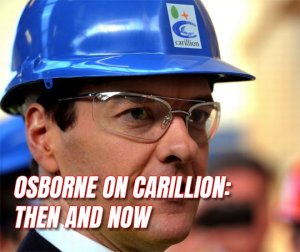
Osborne and Carillion then and now

“George Osborne’s Evening Standard editorial on Carillion today: “Why has the state found itself so dependent on a few very large outsourcing firms? The failure to use a variety of smaller, mid-size companies undermines innovation and leaves services hostage when things go wrong.”

George Osborne, signing off on another Carillion contract as Chancellor in 2014: “It is great to see successful companies like Carillion winning contracts around the world. This deal, the first in a pipeline of many, will help us reverse the age-old trend of not exporting enough, boosting growth and creating jobs.”

He even wore their hat…”

https://order-order.com/2018/01/15/osborne-on-carillion-then-and-now/

Lessons to learn BEFORE Accountable Care Organisations are operating

Professor John Colley of Warwick Business School says Carillion was sunk by two serious mistakes:

“Too many contracts were taken at poor margins and terms, which prevented any subsequent profitability under competitive pressure. Some were allocated during the recession when it was win work at all costs.

“The other key issue is project accounting, which tends to recognise losses late in the project, effectively when the project starts to run out of money. There will no doubt be serious retrospective scrutiny of the accounting.”

and

Guardian columnist Simon Jenkins:

What the Carillion saga demonstrates is the rampant indiscipline in the contracts themselves. The company’s demise is attributable to favouritism, cost escalation, excessive risk, obscene remuneration and reckless indebtedness. Carillion and its bankers clearly thought it too big to fail. Whitehall behaved accordingly. It was like a pre-2008 bank.

There must now be a review of how privatisation is working. Its so-called parastatal companies are not true private entities. They depend on the state, and the state depends on them. Their lobbyists develop an unholy relationship with ministers and officials – witness the uncontrolled revolving door between Whitehall and the boardrooms.

and

Peter Kitson, Partner at law firm Russell-Cooke, says Carillion may have caused its own demise by pitching its services at an uncompetitively low rate – to win business.

”The procurement rules (the Public Contracts Regulations) which govern public sector procurement are central to understanding what has happened here. Almost all Carillion contracts have been competitively tendered under those procurement rules.

The rules require public sector clients to investigate and possibly to exclude any tenderer whose bid is ‘abnormally low’. One contributory factor here may be that Carillion has tendered at very low margins, possibly unsustainably low, in order to win these huge volumes of work.

If such bids have succeeded, that can only mean either than the Regulations themselves are ineffective or that public sector clients lack the confidence or the expertise properly to enforce those rules.

Following this morning’s announcement, I am sure that many of those public sector clients will be seeking advice on the extent to which those same procurement rules allow short term emergency replacement contracts to be let without formal procurement.”

https://www.theguardian.com/business/live/2018/jan/15/carillion-crisis-liquidation-last-ditch-talks-fail-business-live

“Devon schools worse off than those in London by more than £500 per pupil”

When our MPs tell us that we in Devon are receiving an extra £7.5 for education, perhaps point this out to them:

“The Government’s new national funding formula will mean an extra £7.5million for schools in Devon next year.

But they will still be left £268 per pupil short of the national average, say Devon County Council. …”

http://www.devonlive.com/news/devon-news/devon-schools-worse-those-london-1067723

Fair?

“Exmouth Town Council opposes plan for temporary attractions on seafront – again”

Owl says: Amazing how some district councillors can change their attitudes when EDDC development is in THEIR town’s back yard!

“Town councillors have again refused to support an application for temporary attractions on Exmouth seafront.

Planning committee members decided not to support the proposal to install pop-up food outlets and a large to screen to show live sport, such as World Cup football matches, at the former fun park site in Queen’s Drive.

If given the go-ahead, East Devon District Council’s (EDDC) plan could also see the former boating lake filled in for a hard or soft seating area and a fenced-off children’s play zone created.

The current proposal is a full application and town councillors have suggested that it should be reverted to an outline plan. They say it could progress to a full proposal, with more detail, later.

The amended plans now include a letter intended to dispel previous objections over the lack of information in the application and the permanent infilling of the boating lake.

EDDC says the lack of detail was due to a ‘tight timescale’ and there is no ‘specific engineering solution’ for how the infilling will take place.

Objecting to the installation of the big screen, Nick Hookway, chairman of campaign group Save Exmouth Seafront, pointed out that an extensive environmental monitoring programme had previously been recommended for the site.

He said: “I think that the presence of a large number of people on that site will be highly damaging to that site itself.

“Will this present application prevent damage to the site or merely get the public to do the council’s work?

“Will this application have the same environmental mitigation conditions that the reserve matters application had?”

Exmouth Town Council Planning Committee members voted to oppose the amended proposals, saying the blueprint has not answered their original concerns and the plan should come back as an outline application.

In the additional information, EDDC says it wants the application to be decided on by its development management committee in March.

Councillor Bill Nash said: “March is plenty of time for this application to come back in to this committee as an outline application, which I think would be considered properly and probably be acceptable.”

http://www.exmouthjournal.co.uk/news/exmouth-town-council-opposes-seafront-temporary-attraction-plan-1-5351548

Accountable Care Organisations: spot the difference between them and Carillion!

Carillion bid for, and got, many big contracts to offer privatised services in every part of the UK. While it was making profits, these were creamed off first by directors and then by shareholders with a good slice for donations to the Tory party and as little as possible to taxation.

Directors changed its rules to eliminate or vastly reduce their risks (see below). When it went bust, it was “too big to fail” so now the Tory government – which believes, or so it says, in the “free market” and DEFINITELY NOT in nationalisation – picks up the tab and we, the taxpayers, pay for its failure.

Can anyone tell Owl the difference between Carillion and Accountable Care Organisations for the NHS? Big contracts to be offered to privatised services such as Virgin Care, to offer their privatised services all over the UK, where once again, directors cream off the first layer of profits and shareholders the rest. Though in the case of Branson and Virgin HE pays no tax.

What incentive do they have to keep costs down and quality up. when, if they fail, we pick up the tab?

Imagine if this was happening under Corbyn. Who would the Conservatives be blaming? What would they be saying if his government was picking up the bills.

This is NOT a homily to Corbyn – just saying!

Bernie Sanders on wealth and inequality

Bernie Sanders lost to Hillary Clinton to be Democratic nomination for the US presidential election:

“… Difficult as it is to comprehend, the fact is that the six richest people on Earth now own more wealth than the bottom half of the world’s population – 3.7 billion people. Further, the top 1% now have more money than the bottom 99%. Meanwhile, as the billionaires flaunt their opulence, nearly one in seven people struggle to survive on less than $1.25 (90p) a day and – horrifyingly – some 29,000 children die daily from entirely preventable causes such as diarrhoea, malaria and pneumonia.

At the same time, all over the world corrupt elites, oligarchs and anachronistic monarchies spend billions on the most absurd extravagances. The Sultan of Brunei owns some 500 Rolls-Royces and lives in one of the world’s largest palaces, a building with 1,788 rooms once valued at $350m. In the Middle East, which boasts five of the world’s 10 richest monarchs, young royals jet-set around the globe while the region suffers from the highest youth unemployment rate in the world, and at least 29 million children are living in poverty without access to decent housing, safe water or nutritious food. Moreover, while hundreds of millions of people live in abysmal conditions, the arms merchants of the world grow increasingly rich as governments spend trillions of dollars on weapons.

In the United States, Jeff Bezos – founder of Amazon, and currently the world’s wealthiest person – has a net worth of more than $100bn. He owns at least four mansions, together worth many tens of millions of dollars. As if that weren’t enough, he is spending $42m on the construction of a clock inside a mountain in Texas that will supposedly run for 10,000 years. But, in Amazon warehouses across the country, his employees often work long, gruelling hours and earn wages so low they rely on Medicaid, food stamps and public housing paid for by US taxpayers.

Not only that, but at a time of massive wealth and income inequality, people all over the world are losing their faith in democracy – government by the people, for the people and of the people. They increasingly recognise that the global economy has been rigged to reward those at the top at the expense of everyone else, and they are angry.

Millions of people are working longer hours for lower wages than they did 40 years ago, in both the United States and many other countries. They look on, feeling helpless in the face of a powerful few who buy elections, and a political and economic elite that grows wealthier, even as their own children’s future grows dimmer.

In the midst of all of this economic disparity, the world is witnessing an alarming rise in authoritarianism and rightwing extremism – which feeds off, exploits and amplifies the resentments of those left behind, and fans the flames of ethnic and racial hatred. …

… Taking on the greed of Wall Street, the power of gigantic multinational corporations and the influence of the global billionaire class is not only the moral thing to do – it is a strategic geopolitical imperative. Research by the United Nations development programme has shown that citizens’ perceptions of inequality, corruption and exclusion are among the most consistent predictors of whether communities will support rightwing extremism and violent groups. When people feel that the cards are stacked against them and see no way forward for legitimate recourse, they are more likely to turn to damaging solutions that only exacerbate the problem.

This is a pivotal moment in world history. With the explosion in advanced technology and the breakthroughs this has brought, we now have the capability to substantially increase global wealth fairly. The means are at our disposal to eliminate poverty, increase life expectancy and create an inexpensive and non-polluting global energy system.

This is what we can do if we have the courage to stand together and take on the powerful special interests who simply want more and more for themselves. This is what we must do for the sake of our children, grandchildren and the future of our planet.”

https://www.theguardian.com/commentisfree/2018/jan/14/power-billionaires-bernie-sanders-poverty-life-expectancy-climate-change

How much more sleazy can the Carillion privatisation mess get?h

This is from the Daily Mail “This is Money” on 12 September 2017:

“Troubled engineer Carillion introduced tougher rules that protect bonuses paid to bosses – just months before it was embroiled in an accounting crisis that wiped £600million off its shares.

The firm changed the wording of its pay policy to make it harder for investors to claw back bonuses paid to executives in the event it ran into financial difficulty.

In recent days Carillion has been under pressure from investors to recoup some of the millions of pounds in bonuses paid to former chief executive Richard Howson and ex-finance chief Richard Adam when they were in charge.
A probe by the Mail has found that previously bosses could have been forced to hand back their annual bonus and share awards in ‘circumstances of corporate failure’.

But in the group’s 2016 annual report this wording was tightened.
It says deferred bonuses may be reduced in circumstances of corporate failure but goes on to say the so-called ‘malus’ and ‘clawback’ provisions can be applied in two circumstances: if results have been misstated or the participant is guilty of gross misconduct.

The changes to clawback rules, if interpreted as being a higher bar, could save bosses millions.

Howson, 49, stepped down from his role as chief executive on the day of the disastrous trading update. He had been in the post since 2009.

He is still with the company as chief operating officer but is due to leave next year. He has made £1.9 million in cash and share bonuses during his tenure, only not getting an award in 2012, according to Mail calculations.
Last year he pocketed a £245,000 bonus in cash and shares as well as a £346,000 long-term incentive award.

Adam, 59, has had up to £2.6million in extra cash and shares since starting in 2006, according to Mail calculations.

Last year he was handed a bonus of £140,000 and long-term incentive awards worth £278,000.

After leaving Carillion in December 2016, he faced a revolt from shareholders at First Group when he joined the transport company’s board. More than a fifth opposed his appointment.

Carillion is still one of the most shorted stocks on the market, suggesting investors are expecting worse to come. But shares closed up 3.7 per cent yesterday, or 1.6p, at 44.76p.

The company declined to comment.”

http://www.thisismoney.co.uk/money/markets/article-4873710/Carillion-protected-bosses-4m-bonuses-crisis.html

Devon consultants write to PM about A and E crisis

As posted on the blog of DCC East Devon Alliance Independent Councillor Martin Shaw – three Devon A and E consultants write to the PM to tell it as it is – and it’s not good at all:

https://www.scribd.com/document/368914596/Final-Letter

Source:
Three Devon emergency consultants sign letter to Theresa May on ‘intolerable safety compromises’ in A&E winter crisis

Sunday Telegraph: “NHS crisis fuelled by closure of 1,000 care homes”

“The growing NHS crisis has been fuelled by the closure of almost 1,000 care homes housing more than 30,000 pensioners, research suggests.

It comes as NHS figures show the worst Accident & Emergency crisis on record, amid a 37 per cent rise in the numbers stuck in hospital for want of social care, since 2010.

Experts said hospitals were being overwhelmed by the spread of flu because they had almost no spare capacity to cope with surges in demand.

The report by industry analysts shows that in the last decade, 929 care homes housing 31,201 pensioners have closed, at a time when the population is ageing rapidly.

The research from LaingBuisson show care homes going out of business at an ever increasing rate, with 224 care homes closed between March 2016 and March 2017, amounting to more than 2,000 beds. …”

The article (behind a pay wall) goes on to say that blocked beds have risen by 37% in 7 years … charities accused successive governments of “failure of leadership” … a senior researcher at the King’s Fund said it was “chickens coming home to roost” after underfunding.

http://www.telegraph.co.uk/news/2018/01/13/nhs-crisis-fuelled-closure-1000-care-homes-housing-30000-pensioners/

Two whipping Tories – or just one?

Anyone notice how Brandon Lewis (Chairman, Conservative Party – whose new job is to whip the ageing party’s members into better digital shape) looks and sounds just like EDDC Conservative Councillor Phil Twiss (the man who is their Chief Whip but assures us he has never whipped anyone ever and who has been in charge of EDDC’s digital policies).

Has anyone ever seen them in the same room together!

A GP speaks from the very, very sharp end with shocking information

A Devon GP shared this on the Save our Hospitals website:

“I put this post on my constituency [Labour] womens FB group.

I am an NHS GP- ex partner at ELM surgery- went off with burnout 2014- locuming since 2015 including at 2 practices that have handed back their contracts one has closed and the other in merging with Mount Gould.

I went to an important meeting last night- Arranged by GPs worried about the situation in Primary care in Plymouth and looking for a way forward.

About 30-40 GPs turned up (not bad for a short notice meeting on a Friday night which started when most of us would normally be at work!) We also had some patients representing their practices’ Patient participation groups and someone from Health Education England (responsible for workforce planning in the future/training GPs etc). Luke Pollard- Labour MP was the only MP to turn up. I know it was short notice (I think the venue was only confirmed on 2/1/18) but even so you would have thought may be the potential collapse of Primary Care in your constituency may be quite important to any MP?

It was a great opportunity for us to share issues and think about what could solve them and this is the summary:

Firstly – our wonderful NHS is one of the more cost-effective, safe and efficient health systems in the World and GPs are very cheap and cost effective within that.

Primary Care throughout the UK is being overstretched because of major cuts to services that support particularly our most vulnerable patients- cuts to: Mental Health Teams for adults and children, MIND and other charities, Drug and Alcohol services, Probation, Health visiting, School nurses, District nurses (40% vacancy rates in Plymouth), Social Care and unfair benefit cuts and sanctions etcetc.

Plymouth has a population with higher levels of deprivation than the UK average. These cuts are therefore more severely affecting our Primary care services (but there are similar problems in many similar areas).

Secondly: The NHS and Social Care have been severely underfunded for the past 7 years and now this has reached a tipping point.

GPs are working longer hours, seeing more patients and trying to continue to provide excellent, cost-effective care but are becoming burnt out and demoralised and therefore are retiring early, leaving permanent positions or leaving the UK or medicine.

It is also harder to recruit practice nurses as there is a massive shortage of nurses nationally. As practices are becoming more short staffed the remaining clinicians become even more pressurised and eventually become ill or leave or hand back their contracts.

Now 12-13% of Plymouth patients are from “failed practices”. We have a shortfall of between 26 (LMC figures) and 35 (Healthwatch figures) Full time equivalent GPs in Plymouth. Caretaker organisations – which look after these patient populations until new providers are found- are paid much more per patient than GPs are- I have heard unsubstantiated quotes of £300 per annum compared with GPs £115 per annum if we tick all the Government’s boxes and claim everything we can.

This works sort of as an insurance system where those that need little care sort of subsidise us for the patients that need a lot of care. Yet there is no money or help from NHS England forthcoming to go to practices before they fold. Also neighbouring practices are being put under extreme pressure because NHS England is not allowing any planning for the new patients. Adjoining practices must just keep their lists open without any inkling of how many patients could ultimately join their list. (my friend’s practice may have to take between 0 and 1800 patients within the next 3 months as an adjacent practices closes- when a similar thing happened in 2006 they were allowed to have a planned list of patients and recruit staff to serve those extra patients, WELL in advance)

We are also not allowed to move notes direct to the adjoining practice and Capita is taking 6 months to move notes between practices (much less when NHS run) and the GP2GP computer transfer is only working for 1 in 3 patients. Most patients who move before their practice closes are the ones that require the most care and are the most complex. The other patients, who maybe only see a GP every few years do not move until they need care again therefore effectively financially disadvantaging the new practice too.”