Half of Parliament’s sleaze watchdog panel have themselves breached its code!

“Half of the members of a sifting panel for the appointment of a new Commons sleaze watchdog have themselves broken parliamentary rules. …

The disclosure prompted fresh concerns last night for the appointments process for the role and the principle of MPs “marking their own homework …”

Sunday Times (paywall)

“UK, Romania and Poland: fewest doctors in EU”

“The UK has the third-lowest number of hospital beds per person in the European Union as well as the third-lowest number of doctors, with only Romania and Poland worse off, a European Commission report has found.

The report, which compared the 28 EU countries, warned that hospitals will struggle to cope with the winter crisis predicted by many doctors and NHS managers as intensive care beds were full even during the summer.

It warned of the UK’s “limited capacity to absorb shocks”, adding: “Difficulties finding beds have introduced inefficiencies.”

Ian Eardley, vice-president of the Royal College of Surgeons, said Britain’s low ranking in the report should act as “a wake-up call for NHS leaders” and that the cuts have “now gone too far”.

He said: “Bed shortages lead to cancelled operations and patients waiting longer for treatment. Some will find themselves in pain for longer, possibly unable to go about their daily life. In the worst cases their condition may deteriorate while they wait.”

Last week doctors in intensive care units (ICUs) — where the sickest patients are given life support — said they were also nervous about the coming weeks.

Dr Christopher Bassford, a consultant in intensive care at University Hospitals Coventry and Warwickshire NHS Trust, said: “At our intensive care unit we have operated at 100% capacity or over for most of the summer. This winter we are anxious.”

Dr Gary Masterson, president of the Intensive Care Society, added: “It does feel as if we are on the cusp. This [bed occupancy at 100%] is the norm for many ICUs. It is right to worry about ability to cope should we have a busy winter.”

Bed occupancy runs at over 100% when more than one patient uses the bed during a 24-hour period.

Dr Nick Scriven, president of the Society for Acute Medicine, recently warned that doctors would need to make drips out of coat hangers this winter because of the anticipated shortage of beds and equipment.

While the number of doctors working in the NHS has increased, the report also found the UK still near the bottom of the EU league table. It said: “There have been steady increases in recent decades, despite which the number of doctors per 1,000 of the population was the third lowest in the EU.”

NHS England said: “These figures show our NHS is much more efficient than other countries such as France or Germany in helping patients avoid emergency hospitalisations, and we do so despite spending less and having fewer nurses and doctors than they do.”

Sunday Times (pay wall)

Social mobility? Forget it

“The board of the government’s Social Mobility Commission has stood down in protest at the lack of progress towards a “fairer Britain”.

Ex-Labour minister Alan Milburn, who chairs the commission, said he had “little hope” the current government could make the “necessary progress”.
Tory former cabinet minister Baroness Shephard is among three others to quit.

In a resignation letter first reported by the Observer, Mr Milburn said ministers were preoccupied with Brexit.

He said that meant the government “does not have the necessary bandwidth to ensure the rhetoric of healing social division is matched with the reality”.
Mr Milburn added: “It seems unable to commit to the future of the commission as an independent body or to give due priority to the social mobility challenge facing our nation.”

He took up his role with the commission, which monitors progress towards improving social mobility in the UK, and promotes social mobility in England, in July 2012.

‘Unable to commit’

The resignations come as Theresa May, who entered Downing Street in July 2016 promising to tackle the “burning injustices” that hold back poorer people, faces questions over the future of senior minister Damian Green – who is effectively her second in command – and is under pressure as Brexit talks continue.

In his resignation letter addressed to Mrs May, Mr Milburn said he was standing down with “much sadness” and was “deeply proud of the work the commission has done”.

He said: “All the main political parties now espouse a Britain that is less elitist and more equal, while growing numbers of employers, universities, colleges, schools and councils have developed a shared determination to create a level playing field of opportunity in our country.”

Mr Milburn added: “Individual ministers such as the secretary of state for education have shown a deep commitment to the issue.

“But it has become obvious that the government as a whole is unable to commit the same level of support…

“I do not doubt your personal belief in social justice, but I see little evidence of that being translated into meaningful action.”

http://www.bbc.co.uk/news/uk-politics-42212270

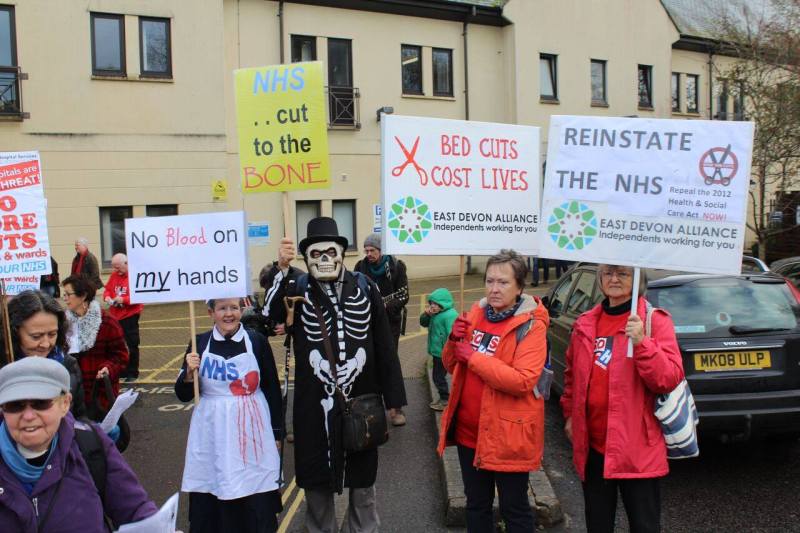
Who fights for our NHS? Independents fight for it!

Photos from demo in Totnes today with a few local faces you will probably recognise.

No Tories from East Devon then?

Thought not!

“David Cameron admits ‘we didn’t solve’ problem of funding social care for Britain’s ageing population”

Owl says: LOTS and LOTS of things Dave didn’t solve …..

“David Cameron has expressed regret he was unable to do more to deal with the “huge” challenge funding social care for Britain’s ageing population.

The former prime minister – who has since become president of Alzheimer’s Research UK – said a way had to be found to meet the “catastrophic” costs of caring for people with dementia.

“There is a huge social care funding challenge we have to answer, and I accept that we’ve made some steps forward, but we didn’t solve that problem,” Mr Cameron told the Financial Times.

“Everyone knows it’s a difficult conundrum. Lots of effort has been made to try and solve it but we haven’t got there yet.”

In office Mr Cameron sought to introduce a £72,000 cap on the costs an individual would have to pay towards care home charges with the state picking up any further bills.

Ministers had hoped insurance companies would develop products that would enable people to insure themselves against their care costs up to the £72,000 limit.

However the plans were put on hold in July 2015 after insurers proved reluctant to enter the market.

“The disappointment I had was I was hoping that a combination of the cap on care costs would help to deliver an insurer’s model, where a market would grow up where everyone could insure themselves against the cost of long-term care. And we just haven’t cracked that yet,” Mr Cameron said.

“I’m not in politics any more but we’ve got to find an answer. (Given) the catastrophic cost of care that people face from dementia, and I saw this with constituents, we’ve got to find a better answer there.”

http://www.independent.co.uk/news/uk/politics/david-cameron-regret-alzheimers-dementia-social-care-funding-a8088031.html

Middle-aged renters – must start saving £6,000 a year for their rent in retirement

Scottish Widows is the sort of unassuming pensions company that rarely likes to publicly criticise government policy. But an analysis it published this week is a stark warning about the ticking time bomb that will explode in 10 to 20 years’ time. And it’s not pension incomes that are the worry – it’s the fact that so many of tomorrow’s pensioners who never got on to the property ladder in the 2000s and 2010s will have to find huge amounts of money to pay ever-escalating rents to private landlords.

Scottish Widows skirts around the issue by suggesting that non-homeowners currently in their 50s should start saving an extra £6,000 a year now to be able to afford their rent in retirement. As if people on low incomes are going to find that sort of money. The reason they are renting is that they were never able to find the savings for a deposit on a house in the first place, or didn’t earn enough to qualify for a mortgage.

The reality is that these people are likely to retire with little more than the state pension plus a small bit of private pension. Maybe they will be picking up about £200 a week once they are 67. Given that the average rent in England and Wales is £845 a month – and in London it’s about £1,250 a month – then the whole lot will be gobbled up by the landlord. So the taxpayer will have no alternative but to step in and pay most of the rent, and we are then on the hook for payments going on for maybe 20 or 30 years. All so that the buy-to-let landlord with multiple properties can enjoy a lavish retirement themselves.

This is the lunacy of promoting buy to let as a long term form of tenure for millions of people. Even in developed countries where renting is common, such as Germany, most people are living in a home they own by the time they reach retirement. Renting all the way through retirement, funded by the taxpayer, to a landlord who has the power to evict without reason and at short notice, is the worst possible situation. And it’s one we are hurtling towards.

Make no mistake about the dramatic change in the retirement landscape that is coming. Scottish Widows projects that one in eight retirees will be renting by 2032 – treble today’s figure. After that it will continue rising. It says there is a £43bn gap between the income and savings people have now and what the rent bill will be in retirement. That’s more than one-third of the entire NHS budget for a year – to be squandered on rent.

Dan Wilson Craw of campaign group Generation Rent says: “The common perception is that retirees either own their home outright or have a council tenancy, so the government will be in for a nasty shock as more of us retire and continue to rent from a private landlord. Many renters relying on pensions will qualify for housing benefit which will put greater strain on the public finances.”

Aviva, the UK’s biggest pensions company, also publishes figures on Saturday on the colossal financial issues facing non-homeowners currently in their 50s. While those who have bought their homes feel pinched – and expect to use the equity in their home to pay for a better retirement – the outlook for non-homeowners is so grim that 20% believe their only hope is having a lottery win. Most non-homeowning workers aged above 50 say they have no money left after basic costs to put aside extra money for a pension.

There was some good news on pensions this week: the Resolution Foundation said that auto-enrolment schemes will mean tomorrow’s pensioners will enjoy a roughly similar income (about £300 a week) to today’s pensioners. But they didn’t account for the large number that will now have to pay rent out of that money.

The solution? Build more houses, of course. But even 300,000 a year won’t solve this problem if they are snapped up by landlords. That only leaves us with rent control and much higher taxes on buy to let.”

https://www.theguardian.com/money/blog/2017/dec/02/pensions-timebomb-rents-homeowners

Another new-build developer scam

Estate rent charges apply in Cranbrook:

Thousands of homeowners on private estates are facing unregulated and uncapped maintenance fees, amid allegations that developers have created a cash cow from charging for communal areas not maintained by the council.

Management contracts for “unadopted” private estates are frequently sold off to speculators and property management companies in the same way as freeholds and ground rents – leaving homeowners with spiralling fees and nowhere to turn.

If a new-build estate is “unadopted” it means communal areas such as roads, grass verges, pavements and playgrounds are retained by the developer. The developer then usually sub-contracts day-to-day management.

These companies then pass on the costs to homeowners (both freeholders and leaseholders) via a deed of transfer which obliges the homeowner, under the Law of Property Act 1925, to pay for maintenance of this land. This is often referred to as an “estate charge” or “service charge”. These are on top of full council tax – even though the council doesn’t maintain their street.

Critics say the system is open to abuse because management companies have no obligation to keep costs down or provide evidence the services they charge for are being carried out. Buyers may find the bills spiral as soon as a management contract is sold on.

Lynn Myers bought her two-bed leasehold house in Penrith, Cumbria, from developers Persimmon in September 2016. The sales agent told her the estate would be managed by Carleton Meadows Management Company with an estate charge of £100 a year per household for grass cutting.

When Gateway Property Management took over in July 2017 it tripled the fee to £308 a year – that’s £17,000 from the 55 residents. Myers alleges that the fee includes more than £3,000 “postage”.

“I am on a lower-end income and ploughed my late husband’s insurance money into this property,” says Myers. “I worry that I will be unable to afford this on top of full council tax etc, and also I will be unable to sell. I have been mis-led by Persimmon and the government.”

Persimmon says the initial costs had been miscalculated and that it was working with Gateway to resolve the issue.

Meanwhile, 40 miles away across the Lake District, residents in Church Meadows in Great Broughton are in a similar situation. Richard Elsworth moved into his Persimmon-built freehold property in May 2013. The estate’s 58 residents each pay Gateway a service charge of £125.53 a year, amounting to £7,281 to maintain about 600 square metres of grass.

But Gateway’s charges don’t stop there. When Elsworth’s neighbours sold their home, they were charged £360 for a “management pack” for the buyer, plus £144 for a deed of covenant.

“The only part of the pack that is relevant to the sale is a financial statement so that the service charge information is available to the prospective buyer. As the properties are freehold, Gateway has no responsibility whatsoever for the conveyancing process, other than to receive a deed of covenant from the conveyancing solicitors,” says Elsworth.

Gateway claims it provided an “often exhaustive” amount of information to purchasers’ solicitors when a sale takes place. It said it was common practice for managing agents to charge fees for sales packs and additional legal documentation. It says: “The information we are asked to provide varies from development to development and this is reflected in the amount we charge ranging from £150-£300 plus VAT.

“It is best-practice for the information to be prepared by professionally qualified staff because purchasers are reliant on information being accurate to enable the sale to proceed as smoothly as possible. Typically, a sales pack contains in excess of 25 pages and is tailored to the development.”

Privates estates were debated in parliament earlier this month. Kelly Tolhurst, Conservative MP for Rochester and Strood in Kent, told MPs how homeowners in Hoo bought from Taylor Wimpey and Bellway but are now in dispute with their property management company, SDL Bigwood.

Tolhurst went on to criticise Hyde Housing Association, and London and Quadrant. The latter tried to charge residents at Lodge Hill, Chattenden, for street lamps and street cleaning undertaken by Medway Council.

The Homeowners’ Rights Network (Hornets) is the campaign group fighting for a fairer deal for homeowners on private estates. Its main issue is a lack of a cap on charges and that homeowners don’t have a choice of provider. And, if homeowners have a dispute, there’s no resolution service in place.

Cathy Priestley, spokesperson for Hornets and a freeholder on a private estate, says the private estate model seems to be the norm for new-build estates. “We can only speculate as to why this has happened. The main benefactors are the plc developers who get to keep the estate land, don’t have to prepare it to adoption standards and don’t have to pay for its maintenance or the commuted sums for adoption,” she says. “All councils have to do, under planning, is to ensure there is a long-term sustainable arrangement to maintain the land (under the Town and Country Planning Act). They seem to readily accept assurances from the developers that the management company will deliver this. They don’t appear to have thought about how this affects homeowners.”

While leasehold owners have some (albeit limited) statutory protection, freeholders have very few options. They can take cases to court, but this can be expensive and time consuming. If they decide to simply not pay, they can ultimately lose their home. “Any arrears will normally be recoverable as a debt claim in the county court.

“However, homeowners should be cautious as the rent charge owner may have a number of options including the ability to take possession of the property,” says Adrian McClinton, associate solicitor at Coffin Mew.”

https://www.theguardian.com/money/2017/dec/02/homeowner-freehold-management-fees-unadopted?CMP=Share_iOSApp_Other

What you can get away with in business in a greedy, unregulated system

“Palmer & Harvey paid out £70m since 2008 despite ongoing losses.

UK’s biggest tobacco distributor called in administrators and ceased deliveries on Tuesday, making 2,500 people redundant.

Palmer & Harvey directors, former directors and other shareholders extracted about £70m in cash from the grocery wholesaler over the past nine years despite ongoing losses.

The company, where 2,500 people were made redundant earlier this week and a further 900 jobs are at risk, had been owned by dozens of private individuals via a complex web of equity and loans. The company supplied 90,000 stores including 50,000 independents that are now struggling to secure stocks of tobacco and groceries at one of the busiest times of the year.

The UK’s biggest tobacco distributor called in administrators and ceased deliveries on Tuesday after hitting “challenging trading conditions” while efforts to restructure the heavily indebted business were unsuccessful.

P&H was bought by its management team in 2008 in a deal that valued the company at £345m. The deal was largely funded by debt.

P&H (2008), the wholesaler’s parent company, has paid out more than £8m a year in dividends since 2009 to its shareholders despite making losses of about £10m a year or more in all but one year, 2014.

The company’s net debt hit £48.6m in April 2016 and has been above £29m every year since 2011.

Some former managers, including the former chairmen Christopher Adams and Christopher Etherington, hold special preference shares, according to the latest list of shareholders filed at Companies House. These “B preference” shares pay out a fixed dividend twice a year.

Etherington, who stepped down as chairman earlier this year, and his wife were entitled to an estimated £300,000 in dividends last year and Adams £941,000. Half of this payment was deferred under an agreement with shareholders which pledged that it could be repaid if and when the B preference shares were ultimately redeemed.

Etherington and his wife have together held the same number of these B shares since the takeover, entitling them to about £2.5m in dividends since 2009.

In 2009, Etherington also held another form of preference share, the “A preference”, that entitled him to an annual dividend. The latest annual report indicates he no longer owns those shares. He was able to redeem them for £1 each or £500,000, before dividends owed.

Accounts for Palmer & Harvey McLane (Holdings), another parent company of P&H, also show that Etherington received a £3.44m interest-free loan from the company’s employee benefit trust with which to fund his stake in the company. This was repayable on the sale of any shares held by him.

Only a handful of shareholders in P&H (2008), most of whom are former and current staff, retained their A preference shares at the time of the last Companies House filing. But their rights to redeem the shares were protected at the time of the 2008 buyout with ring-fenced cash of £42m held in a separate company, Buildtrue, in April 2016. That company is not part of the administration process and it is understood that the majority of A preference shareholders have cashed out in the past year, receiving funds from Buildtrue.

Administrators at PricewaterhouseCoopers declined to comment.”

https://www.theguardian.com/business/2017/dec/01/palmer-harvey-paid-out-70m-since-2008-despite-ongoing-loses

Want cleaner air? Your council tax must pay for it

Government criticised over plans to cut air pollution

The Government has been accused of passing responsibility to cut air pollution to councils. A Parliamentary inquiry into air quality heard that five cities and 23 local authorities have been selected in a plan to devise measures to reduce illegal levels of nitrogen dioxide by December 2018, but that the Government has refused to legislate for more clean air zones. Environment Minister Therese Coffey said the Government was working with councils to help draw up plans.

Source: LGA – Guardian p19

Budget favours men

“Jeremy Corbyn is leading a cross-party effort to force ministers to publish details of the impact of their policies broken down by gender, race, age, disability, class and region, after analysis showed women continue to bear the brunt of austerity.

The Labour leader has signed a letter with 126 other MPs, including members of his own party, the Lib Dems, SNP and Greens, calling for an immediate equality assessment of all government policies.

The letter to the education secretary, Justine Greening, whose brief covers equalities, accuses the government of failing in its duty to sufficiently consider the impact of its actions on all groups in society.

Labour said its analysis showed that men received 46% more spending in Philip Hammond’s autumn budget.

A financial model developed by Yvette Cooper, a senior Labour backbencher, and House of Commons library statisticians found that 86% of savings to the Treasury from tax and benefit changes since 2010 had come from women.

Labour said the latest budget did nothing to change that, meaning women had been hit six times harder by austerity measures than men since the Conservatives came to power in 2010.

The letter, co-signed by Corbyn, Dawn Butler, the shadow equalities secretary, Jo Swinson, the deputy Lib Dem leader, Angela Crawley, the SNP spokeswoman on equalities, and Caroline Lucas, the co-leader of the Greens, said: “If the government continues in this manner there can be no public confidence that the public sector equality duty is being fulfilled.

“We are calling on the government to undertake and publish a comprehensive cumulative equality impact assessment of all government policies. This assessment must include analysis of the impact of all its policies in relation to gender, race, age, disability, class and region. …”

https://www.theguardian.com/politics/2017/nov/30/labour-leads-drive-for-equality-impact-assessment-of-tory-policies

Watch EDA councillor Shaw and Budleigh resident David Daniel make most sense on LEP “strategy”

Jump to 2 hours into the meeting to see these two local people talk total sense to a bunch of mostly Tory councillors most of whom seem to understand beggar-all about why they are there!

Mr Daniel – a former government strategic analyst is at around 15 minutes into the meeting and speaks persuasively about why the Heart of the South West LEP strategy is totally unachievable. Independent East Devon Alliance DCC Councillor Martin Shaw (whose forensic report was totally accepted with one additional point added) is at around 2 hours into the meeting speaking on why the report before the councillors is style over substance and dangerous to go along with in its current form.

In Owl’s opinion, they run rings around the rest of the committee!

Although one councillor did make a point (Owl is paraphrasing here!} that this is an 18 year “strategy” and could well be redundant in a few years – when some other crazy idea might replace it!

https://devoncc.public-i.tv/core/portal/webcast_interactive/303464

Two more utility franchises cost taxpayers dear – very, very dear


VIRGIN EAST COAST

The East Coast rail franchise will be terminated three years early, avoiding the embarrassment of another private firm handing back the keys to the government but potentially forfeiting hundreds of millions in premiums due to the Treasury.

Under a rail strategy announced by the transport secretary, Chris Grayling, a new partnership model will replace the franchise contract of Virgin Trains East Coast (Vtec).

The train operator, a joint venture led by Stagecoach with Sir Richard Branson’s Virgin Group, had pledged to pay £3.3bn to run the service until 2023 when it was reprivatised in 2015 after six years in public hands.

Instead, Vtec is likely to pay a fraction of that sum, with the bulk of payments due in the final years of the franchise.

The firm signalled that it also expects its payments for the next three years to be cut. In the first full year of operation, it paid £204m. Shares in Stagecoach jumped 12% on the news.

Andy MacDonald, the shadow transport secretary, told the Commons that the strategy announcement was “a total smokescreen”. He said: “The real issue is that the East Coast franchise has failed again and the taxpayer will bail it out.”

Pointing to the share price rise, he said: “Markets don’t lie. The secretary of state has let Stagecoach off the hook for hundreds of millions of pounds. He’s tough on everyone except the private sector.”

GREAT WESTERN RAILWAY

More questions were raised by a separate decision to give First Group another contract to run Great Western Railway (GWR) up to 2024 after it was controversially allowed to continue running the service, despite dodging £800m due to the government in an original contract.

The franchise, which runs commuter services into London Paddington and long-distance trains to Wales and the south-west, is likely to be broken up, under plans published by the DfT. The biggest commuter franchise, Govia, which operates the Thameslink, Great Northern and troubled Southern services, will also be broken up.

DfT will extend First’s current GWR franchise contract by another year, to April 2020, and then give a direct award for two more years, with an option to double the tenure.

First has run the trains during the botched upgrade of the route by Network Rail, which has seen costs overrun to almost treble the original budget and stretches of the electrification project abandoned to save money.”

https://www.theguardian.com/uk-news/2017/nov/29/east-coast-rail-franchise-terminated-three-years-early-virgin-trains

Wrong Minister at wrong station, even though he stayed at a hotel directly opposite the right station in Exeter!

“They (the Government) sent the Roads Minister to talk to us about grand new plans for our rail network.

The press call was for 9am on Platform 6 at Exeter St David’s station.

Jesse Norman took the train to Exeter on Tuesday. He stayed in the Premier Inn, and strolled across to the station where he was due to meet Devon County Council leader John Hart and the media.

There was only one problem: Mr Norman went to Exeter Central, instead of to Exeter St David’s.

In the end he jumped into a cab to the right station, shaving a few minutes off an already tight interview schedule. …”

http://www.devonlive.com/news/devon-news/shambles-government-sends-wrong-minister-852341

Who benefits from rail changes?

Deutsche Bahn (Germany),  SNCF and Govia (France), Abellio (Netherlands), Renfe (Spain),  First MTR (part-owned Hong Kong), Trenitalia (Italy):


“Tories accused of trying to quietly re-privatise Britain’s rail infrastructure” (including south west)

The plan is for Great Western Railways to be split into two:

“The plans would create a new West of England rail franchise to provide long-distance services between London, Wiltshire, Somerset, Devon and Cornwall together with local and regional services across the south-west.”

https://www.gov.uk/government/news/the-future-of-the-great-western-franchise

“Transport secretary Chris Grayling says the government wants to break up the troubled [Great Western] Thameslink, Southern and Great Northern franchise when the current contract comes to an end, and look into reopening lines closed during the notorious Beeching cuts of the 1960s.

But the proposals also include publicly-owned Network Rail sharing its responsibility for running the tracks with private train operators.

Britain’s rail network – the tracks, bridges and infrastructure – was taken into public ownership after a bungled experiment with privatisation left it close to collapse.

Railtrack, the privatised franchise, went bankrupt after being hit with the cost of repairs and compensation from the Hatfield rail crash in 2000. …

… Mr Grayling denied that the plans amounted to the splitting up and privatising of Network Rail.

He told BBC Radio 4’s Today programme: “No, we’re not privatising Network Rail. Network Rail will remain in public ownership, but Network Rail is going to be devolved into a series of route businesses, it’s not going to be one big central blob, it’s going to be a series of locally-focused, or route-focused, operations around the country.”

http://www.mirror.co.uk/news/politics/tories-accused-trying-quietly-re-11606147

Two (of many) privatised water scandals

1. SOUTH WEST WATER

“A water firm has been slammed for handing more money to its owners than it spent on upgrading equipment.

South West Water paid a £213.1million dividend to its parent group Pennon last year, while investing £190million in drinking and wastewater operations.

Research group Corporate Watch said that over past ten years, it has paid £1.7billion to its owner and banks, and invested £1.4billion on upgrades.
Last December the firm was fined £1.7million by the regulator Ofwat for missing pollution targets.

Its minor spills increased from 222 to 252 during 2016, according to is latest annual report. The firm says 82m litres of water leak a day, within its target of 84m litres. …

http://www.thisismoney.co.uk/money/markets/article-5086339/South-West-Water-paid-owner-upgrading.html

THAMES WATER

Enough has been written about a Conservative government that knows its electoral success depends on Britain remaining a property-owning democracy, yet offers nothing beyond token gestures to stop the young being priced out of home ownership. Enough, too, has been said about graduates being overcharged, pensioners soaking up the largesse of the tax and benefit systems, the failure to upgrade infrastructure, the obesity crisis, and all the other problems that can’t be tackled because of half-thought-through Tory prejudices.

Allow me instead to concentrate on the scandal of the privatised water industry. Journalists and academics have been banging on for what feels like an age about an ‘organised rip-off’, to use the words of the usually sedate Financial Times. Few took notice, and that should not surprise you. Causes can appear marginal for years. Politicians see no need to address them. Then, with no warning to those who haven’t been paying attention, they explode.

Last week Michael Robinson of the BBC presented a superb documentary on what Thames Water had done to London and the southeast. Most infamously, the company poured 1.4 billion litres of sewage into the Thames near Marlow alone, destroying fish and fouling the home lives of river-side residents. The residents were also its customers. Not that Thames Water seemed to care. Water is a private monopoly. Why should it bother itself about the feelings of people who had nowhere else to go? After hearing how managers ignored warnings from workers about persistent equipment failures, Judge Francis Sheridan encapsulated their attitude when he said that the company had presided over ‘a shocking and disgraceful state of affairs’.

As shocking is the way that the former owners of Thames, the Australian bank Macquarie, was able to pass its costs on to the public. Macquarie took on £2.8 billion of debt to buy the company; it then loaded £2 billion of Cayman Islands debt on to Thames Water and its customers, despite giving assurances to the water regulator Ofwat that it would do no such thing. Macquarie has taken its profits. According to Martin Blaiklock, an infrastructure consultant, its investors received returns of 15 to 19 per cent over 11 years — twice the expected level. All it has left behind is a £2 billion debt and a very bad smell.

Now Thames Water is owned by a Kuwaiti investment fund and a Canadian pension fund. Its managers talk the soothing language of customer service and corporate responsibility. But when pressed by the BBC to say that they would not seek to imitate Macquarie and extract rapacious returns from a captive market, they refused to answer the question.

What interest do Kuwaiti and Canadian investment funds, Australian banks and Cayman Islands financiers have in ensuring the quality and affordability of our water? The hopeless regulators have no answers. Since Margaret Thatcher privatised English water companies in 1989, six out of the nine have pulled themselves off the stock market, meaning they do not have to release to their shareholders information that the regulators can scrutinise.

They promised to bring efficiency. Instead they have brought unsustainable levels of debt that, one way or another, the public will have to redeem. Researchers at Greenwich University say that in the past decade, the nine companies have made £18.8 billion of post-tax profits. Far from using the money to make the water system better, they have paid out £18.1 billion in dividends, and financed investment through loading £42 billion of debt on to consumers.

The university estimates the English are paying £2.3 billion more a year in water and sewerage bills than if the utility companies had remained in state ownership. These costs might have been bearable in good times, but as the Brexit-induced fall in the pound pushes real wages back down again, the prices of water, gas and electricity are bound to be political issues. Customers may not be overly keen to subsidise shareholders and lavishly overpaid managers.

I am not surprised that the Conservatives haven’t joined Labour in demanding the renationalisation of the water industry. It would cost about £70 billion, and in any case, Tories don’t nationalise. But why, after the Macquarie shambles, aren’t ministers and the regulators saying that secretive private equity and Middle East funds should not be allowed to control utilities? Why have they allowed Macquarie to move to the National Grid’s gas division? Ofwat is huffing that it has got tough, but it imposes no penalties on managers who break their commitments. After loading Thames Water with debt and flooding the Thames Valley with excrement, its then boss, the unimprovably named Martin Baggs, bagged a 60 per cent pay rise in 2015.

Conservatives claim to believe in the free market. If they did, they would view monopolies as Adam Smith viewed them — as conspiracies against the public interest. They would not care whether the monopolies were public or private. Both give consumers no choice. Both can put their customers’ interests last. But to the Tory mind, a distinction without a difference makes all the difference.

Because water companies are private monopolies, politicians and regulators back away from confronting them with the necessary anger and vigour. If a nationalised industry behaved as Thames Water has, they would be outraged. As it is, the mere fact that the monopolies are private is enough to persuade politicians to stand aside and let a scandal grow. No one will be more surprised than them when it explodes.”

https://www.spectator.co.uk/2017/09/even-the-tories-should-admit-that-its-time-to-renationalise-the-water-companies/

CEO and Head of Audit suspended after irregularities in voting at General Election

Here in East Devon there were numerous mistakes made by our election officers but, so far, they have avoided examination or censure.

Nothing will change till electoral officers have to legally submit budgets of exactly how much money they spent (or did not spend), how much extra they were paid to do the job (average £10-20,000 per election, some got much more) AND they come under the Freedom of Information spotlight (they are currently exempted).

“Almost 1,500 voters were unable to take part in a general election contest which was won by just 30 votes, an independent inquiry has concluded.

Two senior officials in Newcastle-under-Lyme were suspended today following damning investigation into the June 8 election.

Newcastle Borough Council chief executive John Sellgren and Elizabeth Dodd, head of audit and elections, have been criticised for a number of issues by the Association of Electoral Administrators.

It found 500 postal voters were disenfranchised, nearly 1,000 potential electors were not included on the voting register and two people were able to vote who were not eligible to.

Labour’s Paul Farrelly held off a charge from Tory Owen Meredith to hold Newcastle-under-Lyme with a reduced majority.

The election cannot be re-run because complaints about the running of a poll must be made within 21 days.

But the probe concluded the result could have been different if the wrongly excluded voters had been allowed to take part.

The investigators it was ‘impossible not to question the result’ and detailed a ‘complex picture of administrative mistakes around registration and postal voting processes’.

There was an ‘inadequate performance by inexperienced and under-resourced elections office staff’, the report found.

Mr Farrelly described the election arrangements as a ‘shambles’ in the aftermath of the poll.

Mr Meredith said today: ‘It is vital lessons are learnt from this experience and that the recommendations of the report are implemented in full.
‘Urgent action must be taken by Newcastle Borough Council to ensure the credibility of upcoming council by-elections in December and the all-out elections in May.

‘Voters will be rightly horrified by the details of the report’s findings and trust in the democratic process in Newcastle-under-Lyme has been badly undermined. Urgent action is needed to restore that trust.

‘Voters have been truly let down by the Council officers and leadership and those involved must consider their positions.’

Council leader Elizabeth Shenton, said: ‘I sincerely apologise on behalf of the council for that situation but we can’t turn the clock back and right any wrong that occurred at that time.’

An Electoral Commission spokesman said: ‘Good planning and open communication are vital to ensure voters can receive the quality of service they deserve.

‘Both our guidance and this independent report recognise these factors.
‘We will now consider this report’s findings as part of our assessment of how Returning Officers performed at June’s election.

‘The Commission will continue to support and challenge the performance of the electoral services department at Newcastle-under-Lyme Borough Council to ensure forthcoming elections are well-run.”

http://www.dailymail.co.uk/news/article-5125083/1-500-people-STOPPED-taking-election.html

Pockets of deprivation in affluent areas – coastal and rural communities have problems

“Children from deprived backgrounds face the worst prospects in some of the richest parts of the country, according to a damning new study that lays bare deep geographical divisions across Britain.

An annual report by the government’s own social mobility watchdog warns that while London and its suburbs are pulling away, rural, coastal and former industrial areas are being left behind.

The State of the Nation report finds that some of the wealthiest areas in England – including west Berkshire, the Cotswolds and Crawley, deliver worse outcomes for their disadvantaged children than places that are much poorer, such as Sunderland and Tower Hamlets. …

… Other findings include that:

51% of children on free school meals in London achieve A* to C grades in English and maths GCSE compared with a 36% average in all other regions.

There is a gulf between the highest figures of 63% in Westminster and the lowest, 27% on the Isle of the Wight

Meanwhile in Kensington and Chelsea, 50% of disadvantaged youngsters make it to university compared with just 10% in Hastings, Barnsley and Eastbourne

Some of the worst performing areas, such as Weymouth and Portland, and Allerdale, are rural not urban

In fact, in 71, largely rural areas, more than 30% of the people earn below the voluntary living wage – with average wages in west Somerset just £312 a week, less than half of the best performing areas

In Bolsover just 17% of residents are in jobs that are professional and managerial positions compared with 51% in Oxford

The study says that a critical factor in the best performing councils is the quality of teachers available, with secondary teachers 70% more likely to leave the profession in deprived areas.

Although richer parts of Britain do tend to outperform more deprived areas overall in the social mobility index designed by researchers, that isn’t always true. Some of the most affluent areas do worse for the poor kids than some of the least well off.

Coastal areas are a focus of the report, with warnings about schools being isolated. Recommendations include more collaboration between schools and subsidised travel for disadvantaged young people in isolated areas. The commission also calls for central government to fund a push for schools in rural and coastal areas to work together.

They also say that the government should rebalance the national transport budget to help tackle regional disparities. …

…. The report calls for the Department for Education’s £72m funding for opportunity areas to be matched by the Department for Business, Innovation and Skills in order to link up schooling and workplace opportunities.”

https://www.theguardian.com/society/2017/nov/28/disadvantaged-children-face-worse-outcomes-in-rich-areas-report-finds

“As Knowle Appeal Inquiry begins, FOI asks “what cost relocation?”

From Save Our Sidmouth website today:

“The cost of EDDC’s relocation project, originally stated to be “cost neutral” has been spiralling for years (see link below*).

The following Freedom Of Information (FOI) Request was lodged on 26th November 2017, and awaits a response:

Dear East Devon District Council,

I would like to make a formal request under the Freedom of Information Act 2000. I am also making this Request under the Environmental Impact Regulations 2004 which require disclosure on the part of Local Authorities.

Please let me have the costs to date of the Knowle relocation project, to include all preliminary pre “moving decision” costs, and subsequent costs of all work associated with the intended reallocation, including those at The Knowle, Manstone, the intended Honiton site and Exmouth Town Hall.

I should also like to know the current and projected costs of the Exmouth Town Hall move, (including all associated costs such as moving, staff compensation and travel costs and fitting out costs), and for Honiton and costs associated with the “mothballing” of various parts of the Knowle contingent upon the intended relocation of 90 staff to Exmouth.
Yours faithfully,
R Thurlow

You can monitor developments at this link:

Costs of Knowle relocation – a Freedom of Information request to East Devon District Council – WhatDoTheyKnow

Source:
As Knowle Appeal Inquiry begins, FOI asks “what cost relocation?”