More bad news for ineffective Local Enterprise Partnerships!

The Industrial Strategy is also offering what it calls “Sector Deals”. Partnerships between Government and groups of industries and businesses focussed on specific industrial sectors such as Nuclear Power.

To unlock Government money here are the sort of things Government will require (page 210):

“Deal proposals should have a demonstrable and analytically rigorous impact on the productivity and earning power of the sector.

We expect credible analysis of the impact of any proposals to accompany each specific proposal showing expected increase in GVA, employment or increases in skilled workers, exports or specific investments (including foreign direct investment) resulting from the deal. Tangible commitments are likely to be the most convincing.

Sector Deal proposals need to be realistic and achievable. We are looking for evidence that industry commitments can be delivered and that clear governance arrangements will be set up. Any arrangements should be proportionate to the scale of ambition of the deal itself and designed to ensure commitments will endure. To be credible, deal proposals should include specific delivery plans covering each component of the proposal.”

Click to access industrial-strategy-white-paper.pdf

Demonstrable and analytically rigorous impact on productivity; credible analysis; tangible commitments; realistic and achievable proposals; clear governance: specific delivery plans …

HotSW, our LEP, is going to have to up its game or we shall lose out on each and every one of these.

Government industrial strategy: Local Enterprise Partnerships have to pull up their socks

Unfortunately, we have heard this all before – words do not seem to get translated into actions:

Page 223:

“… We remain firmly committed to Local Enterprise Partnerships. From next year, the Prime Minister will chair a biannual ‘Council of Local Enterprise Partnership Chairs’. This will provide an opportunity for Local Enterprise Partnership leaders to inform national policy decisions.

While Local Enterprise Partnerships across the country have played an important role in supporting local growth, feedback suggests that their performance has varied.

We are reviewing the roles and responsibilities of Local Enterprise Partnerships and will bring forward reforms to leadership, governance, accountability, financial reporting and geographical boundaries. We will work with Local Enterprise Partnerships to set out a more clearly defined set of activities and objectives in early 2018. These will be driven by influential local leaders, acting as figureheads for their area’s economic success, and a clear strategy for local and national partnership.

We will agree and implement appropriate structures for holding Local Enterprise Partnerships to account. We will work with Local Enterprise Partnerships to review overlapping geographies and ensure people are clear as to who is responsible for driving growth in their area. We recognise that in order to deliver their role effectively, Local Enterprise Partnerships need financial support. We will make additional financial resources available to Local Enterprise Partnerships that demonstrate ambitious levels of reform following the review. …”

Click to access industrial-strategy-white-paper.pdf

Tory Minister refuses to give straight answer when asked to confirm his name!

A Tory minister was so reluctant to give straight answers to questions this morning that he wouldn’t even answer ‘yes or no’ to confirm his own name.

Business Secretary Greg Clark was given a thorough going over by Piers Morgan on this morning’s edition of Good Morning Britain.

He was doing a round of TV studios pushing the Government’s new industrial strategy, which he is launching today. But the minister became stuck in a series of Brexit questions – and his evasive answers appeared to frustrate Morgan.

Clark refused to answer whether he would vote for Brexit if there was another referendum, saying it was a “hypothetical question that I haven’t given a moment’s thought to.”

Host Susanna Reid asked him if Brexit was the best thing for the UK, he again failed to give a straight answer, saying: “I believe that we have to get the best deal through these negotiations and I think it’s possible to do that.”

Morgan asked him if that was a ‘yes’, to which he repeated: “I think we can get a good deal. It’s in everyone’s interests to get a good deal.”

Finally, Morgan challenged the Tory minister to give a straight, yes or no answer to one question – “the allegation that you are named Greg Clark.”

After some laughter, and a long, uncomfortable pause, Clark said: “Well, I think you’ve got that.”

Morgan seemed satisfied with his answer, saying: “We’ve established at least one convincing answer.”

But Reid was left unconvinced, adding: “I’m not sure we did. I think there was room for doubt there.” …”

http://www.mirror.co.uk/news/politics/tory-minister-wont-even-give-11594456

Housing: “Problems that are building up”

Linden Homes (see flying freehold problems post below) – again:

In the race to build as many new homes as cheaply as possible, developers have been accused of slipping standards. A survey this year by housing charity Shelter found that 51% of respondents discovered major faults after legal requirements for construction work to be checked at various stages were relaxed.

Currently, residents have little recourse when things go wrong. The Property Ombudsman has no remit over new-build. Instead, residents who discover faults within the first two years are left to haggle with the developer; after that, liability passes to the warranty provider chosen by the developer and only covers major structural work.

Although there is a dispute resolution scheme, CCHBAS, for homes insured by the three main warranty providers, it costs £120 to lodge a complaint and its decisions are not legally binding. A parliamentary enquiry last year found that it did not offer adequate redress.

As well as a boundary fiasco, Clare Reeve suffered leaks when roof tiles began slipping. She discovered battens had not been fixed properly to the dormer windows in her row of houses. “Because I’d bought over two years ago, Linden Homes washed its hands of it and referred me to NHBC [one of the UK’s largest warranty providers],” says Reeve, whose house is also affected by the boundary dispute [see post below]. “NHBC said it could only cover repairs over £1,500. Luckily, with scaffolding factored in, it came to more than that.”

Phil Waller, a former construction manager, set up campaign and advice website

brand-newhomes.co.uk

in response to declining standards. He is calling for a government-appointed ombudsman to investigate complaints. “We need as much pressure as we can generate to force government to wake up to the many scandals in this unregulated industry that is – quite frankly, in my opinion – defrauding its own customers.”

https://www.theguardian.com/money/2017/nov/26/house-problem-neighbours-own-half-bedroom-boundaries-wrong

“Housebuilder Persimmon’s boss in line for ‘outrageous’ £50m shares windfall despite Theresa May’s crackdown on fat-cat pay”

“The boss of one of Britain’s biggest housebuilders is in line for an ‘outrageous’ £50 million New Year shares windfall despite Theresa May’s crackdown on fat-cat pay.

Persimmon’s chief executive Jeff Fairburn will next month pocket the first chunk of a share bonus worth a total of about £130 million at the current share price, The Mail on Sunday can reveal.

The Persimmon incentive scheme, which will see 150 managers share a bonus pot of more than £800 million, is likely to make Fairburn the best-paid FTSE 100 chief executive. … “

http://www.thisismoney.co.uk/money/news/article-5116833/Persimmon-boss-set-outrageous-50m-shares-windfall.html

“Telegraph: Theresa May starts work on new DUP deal to stop Government collapsing in June 2019”

OUR money. To be spent on tourism in Northern Ireland and cushioning them from Brexit problems.

The first tranche of £1 billion earlier this year allowed Northern Ireland to increase its NHS spending by more than 5%.

Theresa May has started to work on a new deal worth hundreds of millions of pounds with the Democratic Unionist Party to stop her Government collapsing in just over 18 months’ time.

Mrs May’s Government will set out plans to cut Air Passenger Duty and VAT on hotels and restaurants in Northern Ireland in the new year.

The new cash will be on top of the £1billion which Mrs May agreed to spend in Northern Ireland after the DUP’s 10 MPs agree to support her minority administration.

The Treasury has promised to publish its response to the consultation at the next Budget in Autumn next year to allow the changes to be introduced in the 2019/20 tax year.

The talks were signalled in this week’s Budget Red Book, which said: “Early in 2018, the government will publish a call for evidence which will consider the impact of VAT and APD (air passenger duty) on tourism in Northern Ireland, to report at Budget 2018.”

http://www.telegraph.co.uk/news/2017/11/25/exclusive-theresa-may-starts-work-new-dup-deal-stop-government/

“Tory flagship childcare policy a flop as just 30,000 parents out of promised 415,000 helped”

“Tory plans for tax-free childcare are in disarray, with an uptake of less than eight per cent.

The flagship policy launched in 2013 was meant to help 415,000 parents by last month but only 30,000 signed up.

That means this year the Government has only spent £37million and saved £800million.

Budget documents out last week show next year’s spending forecast is being revised down by 90 per cent.

The low response is being blamed on ministers failing to give additional funding for nurseries and childminders. More than 500 wrote to Chancellor Philip Hammond before the Budget asking for more money – but in vain. …”

http://www.mirror.co.uk/news/politics/tory-flagship-childcare-policy-flop-11587487

Two councils, two very different approaches to retirement housing

It is interesting to compare the Millbrook development in Exeter with PegasusLife’s at the Knowle, Sidmouth.

At Millbrook [the retirement complex in Exeter, Exeter City Council being the planning authority] the development was considered to be C3 (dwelling houses) and therefore attracted affordable housing provision which consisted of a payment to the Council of £5.65 million plus the transfer of land at no cost to enable the Council to construct a public extra care facility on the site. In addition the developer contributed almost £300,000 towards sports facilities and £35,000 towards archeological recording.

And what are PegasusLife, who are backed by Oaktree, a billion-dollar equity giant with offshore tax-haven connnections, contributing?

Answer: nothing, whether the development is adjudged to be C2 (residential institution) or C3. Unless of course, you include an information board to tell you where the elegant lawn terraces in the public gardens used to be.

So how many “affordable” houses (or other provision) is East Devon losing out on?

Casino Capitalism comes to Sidmouth?

The recently-leaked ‘Paradise Papers’ on tax havens seem to have revealed an interesting side to the activities of the billion-dollar US equity giant behind Pegasus Life the developer currently appealing EDDC’s refusal to give it planning permission to build 113 luxury flats for old people at Knowle in Sidmouth.

As the Pegasus Life website proudly proclaims, Oaktree Capital Management founded the company in 2012:

https://www.pegasuslife.co.uk/?gclid=EAIaIQobChMIrLb85_bZ1wIVz7vtCh0bLAZkEAAYASAAEgKf3fD_BwE

The Paradise Papers suggest that, at about the same time, Oaktree was setting up a joint venture with Australian and Chinese billionaires to fund a 3.2 billion dollar casino in Macau through the offices of legal firm Appleby in the the British Virgin Islands tax haven:

http://www.abc.net.au/news/2017-11-10/paradise-papers-melco-crown-investment-money-laundering/9137232

Appleby became alarmed about the refusal of Oaktree and its partners to allow identity checks on its shareholders – the cornerstone of global efforts to stop money laundering and the financing of terrorism.

Oaktree and the others allegedly threatened to take their business elsewhere if Appleby insisted on the checks. Appleby didn’t, and the joint venture was duly incorporated in the British Virgin Isles with the shareholders remaining secret! The Casino opened in 2015.

All this is literally thousands of miles from the fond hope expressed by Philip Hammond in this week’s budget speech that local homes should be provided by small local companies with a real stake in their community.

Howard Phillips, current CEO of PegasusLife, was, until 31/08/2012, CEO of McCarthy & Stone. He led the restructuring of McCarthy & Stone’s £900M debt and under his watch the company is alleged to have engaged in the dubious practices exposed by Ch 4 Dispatches that year.

On 24 September 2012 a Channel 4 Dispatches programme on retirement leasehold was a brilliant example of television journalism that was extremely damaging to both McCarthy and Stone, and to Peverel, including their effect on this site:

https://www.betterretirementhousing.com/channel-four-dispatches-exposes-retirement-leasehold/

“Councils forced to use emergency cash to pay for social care as funding shortfall grows”

“Councils are being forced to spend billions of pounds of their emergency cash reserves on social care amid a significant funding shortfall, official documents reveal.

Analysis produced by the Office for Budget Responsibility (OBR) to accompany the Autumn Budget shows that English councils withdrew £1.4bn from emergency reserves last year.

They are forecast to have to draw down a further £1.7bn by 2020 – significantly more than the £0.9bn the OBR estimated in March.

Experts said relying on reserves to fund social care was “unsustainable” and “a crisis in the making”.

Because they have a legal duty to provide care to those who need it, councils have little choice but to find the cash to fund increasingly in-demand services or else risk breaking the law.

Many are therefore going significantly over their allocated budgets. More than half (53 per cent) of councils expect to overspend on adult social care this year, by an average of £21m.

Two-thirds of authorities that are currently overspending on social care plug the gap by utilising council reserves.

These funds are designed to safeguard councils from an event such as a recession and ensure they have enough resources to maintain services if circumstances change.

However, the funding gap in social care means many are being forced to use the funds to cover day-to-day spending, raising the prospect that they could be plunged into crisis in the face of an economic downturn or financial crisis.

In 2014, Eric Pickles, then the Communities Secretary, accused town halls of “pleading poverty” and told them to start spending the money set aside for a rainy day.

English councils currently have total reserves of around £23bn – down from £25bn two years ago.

However, MPs and local government leaders said the practice of using emergency funds to pay for regular spending was dangerous and “unsustainable”, as councils will eventually run out of cash.

Labour’s Clive Betts, chair of the Communities and Local Government Select Committee, told The Independent: “This is a matter of real concern.

“There was nothing in the Budget on social care. There is a crisis of funding for social care and drawing on reserves simply postpones the day the money runs out.

“This is not how councils should be funding social care. At some point the Government has to recognise this and put a proper funding regime in place.

“This is a crisis in the making. There’s a funding crisis in the here and now and this is just postponing the consequences.”

Mr Betts said the reliance on reserves also creates a postcode lottery because some councils have reserves they can draw on whereas others do not.

The OBR said councils are having to go over budget by more and more each year and rely increasingly on reserves.

Town halls have been overspending on children’s social services since 2010-11 and on adult social care since 2014-15.

Last year, councils in England overspent on their entire non-education budgets for the first time since the financial crisis, largely as a result of the cost of providing social care. Previously, under-spending elsewhere, such as on transport, made up for overspending on care services.

Amid growing concern over the funding shortfall, in March the Government announced a £2bn cash boost for social care. Town halls welcomed the increase but said it was not enough to meet demand.”

http://www.independent.co.uk/news/uk/politics/councils-cash-reserves-social-care-funding-crisis-health-budget-a8074911.html

DCC Health Scrutiny Committee – not fit for purpose

The DCC Health Scrutiny Committee lurches from poor practice to bad practice to utter chaos under the continued Chairmanship of Sarah Randall-Johnson

Can you imagine saying you will vote against questioning NHS Property Services about their intentions on the future of community hospitals which they now own “because they might not come”! And Randall-Johnson saying she is “not aware of any threat to any community hospital!!!

[CCGs have been offered match funding from the government for any properties sold in their areas]
http://www.mirror.co.uk/news/politics/naylor-plan-outline-sell-nhs-10544577
http://www.property.nhs.uk/asset-management/

Claire Wright’s Blog:

NHS Property Services will be invited to attend the next Health and Adult Care Scrutiny Committee in January.

But my simple request prompted a debate lasting over half an hour, at Tuesday’s meeting (21 November).

The lengthy and baffling discussion gave a poor impression of the committee in my view, with some Conservative councillors claiming confusion and dismissing the proposal several times as “premature.”

It all started off with a presentation to the committee by Independent councillor, Martin Shaw, under the final work plan agenda item.

Cllr Shaw rightly pointed out how many people were concerned about the potential loss of the hospital buildings, that they had put their own money into them and still there was no clarity over their future, yet NEW Devon CCG were (or at least would very soon be) paying large sums of money in rent each year when previously they owned the buildings outright.

NHS Property Services, a private company wholly owned by the Secretary of State for Health, set up under the Health and Social Care Act 2012, acquired the ownership of 12 community hospitals in Eastern Devon at the beginning of this year.

Given that the NEW Devon CCG is one of three most financially challenged health trusts in the country and must make huge cuts to try and stem a deficit of over £400m by 2020, people’s concerns about the future of the hospitals are very valid.

Following my proposal to invite NHS Property Services to the January meeting, chair, Sara Randall Johnson said there was a full agenda for the next meeting so it may not be possible to include it. She said that she was not aware that there was a threat to any community hospital.

Liberal Democrat, Brian Greenslade said NHS PS had been invited previously but questions had been remained unanswered and so should be invited again.

Conservative, Phil Twiss, who represents Honiton which has lost its own hospital beds, claimed in a number of long statements that it was “premature” to invite the company because the future of the buildings had not yet been decided.

He later added that they wouldn’t come anyway.

I replied that waiting until the March meeting was far too long and could mean that decisions were already made. Surely we need to talk to NHS PS and the CCG before their decisions?

I attempted to explain again why it was important we invited the company to the January meeting.

But apparently confusion reigned.

Conservative members became very fixated with the legacy issue, even though I had made it clear that it was about questioning NHS PS and the CCG about their plans on the future of community hospitals and the legacy issue was only part of that.

Chair, Sara Randall Johnson, suggested holding a meeting first to agree some questions to ask NHS PS. I have not seen this approach in my four and a half years as a member of the committee.

I had to make my proposal numerous times, while one or two persistent Conservative members continued to challenge it.

There was an amendment by Liberal Democrat, Nick Way, who wanted a spotlight review into the issue as well.

Phil Twiss then changed his tack and claimed there was no point in asking the company to attend as they wouldn’t come. He was in favour of a spotlight review instead (spotlight reviews are held in private).

But when the vote finally was taken, it was on the spotlight review amendment and not my original proposal to invite NHS PS to the next meeting …

I tried to intervene. Fortunately, the officers corrected matters… and then the majority of the committee voted in favour of my proposal. Finally.

My proposal couldn’t have been more straightforward or uncomplicated. It was entirely within the committee’s remit.

It was also within a couple of hours of hearing the county solicitor’s presentation about how scrutiny should do its job properly. Or be culpable. See this blogpost here – http://www.claire-wright.org/index.php/post/devon_county_council_solicitor_tells_health_scrutiny_committee_you_have_a_v

Here’s the webcast. It is the final item on the agenda – https://devoncc.public-i.tv/core/portal/webcast_interactive/302658

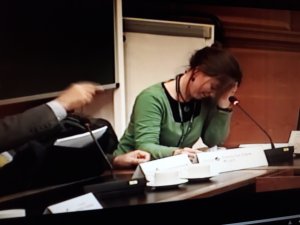
Pic: Me exasperated!”

http://www.claire-wright.org/index.php/post/nhs_property_services_will_be_invited_to_next_devon_county_council_health_s

Swire’s blog: is this satire?

“ … Despite all this [negative news for Tories – he mentions sexual harassment, Paradise Papers, Brexit shambles] A You Gov poll for the Times found 34% of voters want Theresa May to stay as Prime Minister, up one point from a month a go. It seems middle England, at least at the moment, cannot bear to contemplate the alternative!”

https://www.hugoswire.org.uk/news/view-westminster-difficult-month

Er, doesn’t that mean that up to 66% of people (he doesn’t specify what the choices were which might include “don’t knows”) DON’T want May as PM?

Grenfell Tower resident blogged that fire would be result of council’s deliberate neglect – local media refused to take up the story

Local media knew about this for YEARS but refused to take it up or investigate, leaving a lone Grenfell Tower blogger to document the unfolding disaster. One so-called “local” journalist was actually filing copy from Dorset!

“[Edward] Daffarn [a social worker who had lived in Grenfell Tower for 15 years] is understandably emotional when reflecting on the last few months, but more than that he is angry. Angry with the way he feels Grenfell residents were treated by the Kensington and Chelsea Tenant Management Organisation – the people who were entrusted to maintain the estate and keep its residents safe. Angry with the Royal Borough of Kensington and Chelsea Council, which was meant to scrutinise the KCTMO. Angry with a society which didn’t seem to care about people like him – people who live on housing estates – until it was too late.

“The reality is if you’re on a housing estate it’s indifference and neglect, two words that sum up everything about the way we were treated,” he says. “They weren’t interested in providing housing services, keeping us safe, maintaining the estate. They were just interested in themselves.”
It wasn’t for us to tell the council what they should be doing we were just trying to raise an alarm.

Edward Daffarn, Grenfell Action Group blog

Daffarn and fellow Grenfell resident Francis O’Connor had been blogging on behalf of the Grenfell Action Group since 2012. They wrote about issues that concerned their tight-knit community – air pollution, the closure of the local public library, and their fears that corners were being cut during the refurbishment of the tower.

“We wanted to record for history how a community on a housing estate in the fifth richest country in the world could be ignored, neglected, treated with indifference. We never thought we could make change. We just wanted to record what was happening,” he says.

Daffarn and O’Connor shared a theory that Kensington and Chelsea – a London borough more widely known for its museums, designer shops and flower shows – actually wanted its council estates to go into decline, so that the residents would leave and expensive flats could be built in this sought-after location. For this they were described as fantasists.

“We weren’t fantasists,” he says, visibly hurt. “We were trying to raise genuine concerns about how our community was being run down.”

The natural consequence, he concluded, would be loss of life. Which is why on 20 November 2016, frustrated and desperate, Edward wrote the blog post KCTMO – Playing with fire!

“It is a truly terrifying thought but the Grenfell Action Group firmly believe that only a catastrophic event will expose the ineptitude and incompetence of our landlord.”

A few months earlier a fire had ripped through five floors of a tower block in Shepherd’s Bush, just down the road. Edward was worried that if a fire broke out in his tower block residents wouldn’t know what to do. They had been given no proper fire safety instructions from the KCTMO. There were no instructions on individual floors on how residents should act in the event of a fire, there was only a recent newsletter saying residents should remain in their flats – advice which in the case of the Shepherd’s Bush fire would have led to fatalities.

There’s a lot of abusive behaviour evidenced forensically about what was happening to our community, but it wasn’t sexy so it never got picked up.

In March 2017 the KCTMO installed fire safety instruction notices in the entrance hallway to Grenfell Tower and outside the lifts on every floor of the building, again urging residents to “stay put” unless the fire was “in or affecting your flat”.

It wasn’t the first time the Grenfell blog’s authors had raised concerns about fire safety.

Before the blog began, when a school was built on the only green space the residents had, they wrote to the borough pointing out that access for fire and emergency vehicles had been compromised.

Later they blogged about the blocking of a fire exit with mattresses during the refurbishment and the power surges in 2013 that manifested in flickering lights, computers and stereos blowing up, and entire rooms filling with smoke. These continued for three weeks, Daffarn says.

“We were tenants we weren’t fire safety specialists but we were switched on enough to feel this was important and it was not being dealt with on our estate and that’s why we were blogging. It wasn’t for us to tell the council what they should be doing., We were just trying to raise an alarm.”

An alarm that went unanswered. The November 2016 blog post represented the last moment at which something might have been done to avert the disaster which followed six months later. But why didn’t anyone heed or investigate Daffarn’s claims?

Hidden within the story of the Grenfell blog is another story of the decline of local media. There simply was no local press on the ground in the borough of Kensington and Chelsea scrutinising the authorities and helping to amplify the voice of people like Edward Daffarn.

The last time he had the attention of a local journalist was in 2014 when Camilla Horrox, the reporter for the Kensington and Chelsea Chronicle ran front page stories about Grenfell residents’ concerns regarding the possible presence of asbestos on the site of the new school and about the power surges.

She had met Daffarn several times, and had been concerned about KCTMO’s dealings with the residents of the properties it managed.

But when the newspaper was closed down later that year Horrox was made redundant and all her Grenfell articles disappeared from the web. The Kensington and Chelsea Chronicle was incorporated into a website that reports on 29 west London districts.

Horrox’s replacement was expected to report on three boroughs – Kensington and Chelsea, Westminster and Hammersmith and Fulham – while based in Surrey, an hour’s drive away.

Some residents of the borough might have been under the mistaken impression that they did have a local newspaper. In 2015 a free paper, The Kensington and Chelsea News, was established to fill the gap left by the closing of the Chronicle.

But when I tracked down its reporter he explained that he was the sole reporter working on the paper, and on two other local newspapers – his salary was £500 a week and he did almost all his reporting from home in Dorset, 150 miles away. He made it to the borough only twice in two-and-a-half years, and the one story he ever published about Grenfell was from a council press release about the installation of the new cladding.

Though he always searched for a “good front page splash” for each of the three editions, he also made sure to find two pages of royal stories and two pages of entertainment stories.

Edward Daffarn didn’t take his concerns to the media in November 2016 because he no longer thought anyone would listen. But the blog was out there for everyone to see, he points out, if only they had been looking.

“We’d been blogging for three or four years and you go back over that time there’s a lot of abusive behaviour evidenced forensically about what was happening to our community, but it wasn’t sexy so it never got picked up.”
For Edward, what was going on at Grenfell wasn’t just a local story, but a national one. A story about invisible people in a society that cared more about celebrity and wealth than its most vulnerable residents.

Close to tears, he admonishes the nation’s journalists.

“If you look back now our whole community of North Kensington, the policy that the local authority was taking every public space and privatising it, that that could be missed by the BBC, by Channel Four, by these wider news agencies… The question should be for you, why did you miss it?
“Why aren’t our lives important enough for you?”

http://www.bbc.co.uk/news/stories-42072477

“Housing policy risks ‘sting in the tail’ as new HRA freedoms combine with Right to Buy pilot”

“Councils received mixed messages on housing in the 2017 budget – with borrowing freedoms to help build more homes accompanied by a renewed threat of forced sales.

There was a cautious welcome for the chancellor Philip Hammond’s announcement that the government will increase the Housing Revenue Account borrowing cap for a limited number of councils.

However, there was concern that the government is pushing ahead with a pilot to test the idea of forcing councils to sell high value homes to fund an extension of Right to Buy (RTB) to housing association tenants….

… Paul Dossett, head of local government at accountancy firm Grant Thornton, said: “It looks like a very small pot in total when compared to other housing initiatives announced in the budget and in other recent government announcements.”

He also called on the government to clarify what the government meant by areas of high affordability pressure.

“In our view the cap should be lifted for all housing authorities so they can plan holistically across the country to build the social housing that we need,” he said. …

… The chancellor also announced plans to press ahead with a £200m pilot extending the Right to Buy for housing association tenants in the Midlands.

Councils had hoped that the idea, along with many housing policy initiatives from former chancellor George Osborne, had been shelved after a scheduled pilot scheme failed to materialise.

But documents released alongside the budget by the Office for Budget Responsibility, said: “A small pilot scheme was due to run from January to May 2016 but was delayed to July due to the process of applications taking longer than expected and there being a longer lag between issuing instructions to solicitors and completions being achieved.

“A larger pilot was announced in Autumn Statement 2016 and was due to begin in April 2017. This did not take place. It has instead been replaced by a new pilot announced at this budget, due to run for one year from July 2018.”

http://www.room151.co.uk/funding/housing-policy-risks-sting-in-the-tail-as-new-hra-freedoms-combine-with-right-to-buy-pilot/

More political donor sleaze

“The publication of Northern Irish political donors’ identities has been postponed to the new year because of a delay by the government in putting the necessary legislation before parliament.

The Electoral Commission had planned to publish information on donors who had given money to parties registered in Northern Ireland for the first time on Thursday.

Ann Watt, the head of the commission in Northern Ireland, said it was “extremely disappointed that we are unable to provide the public with the information they expected on how political parties in Northern Ireland are funded”.

“The continuing secrecy only serves to undermine trust and confidence among the public in the democratic process,” she said. “We were consulted by the Northern Ireland Office several months ago on draft legislation and provided detailed comments.”

The non-disclosure of information on donors to political parties in Northern Ireland dates back to the Troubles. It means that while Northern Irish political parties have to divulge donor information to the Electoral Commission, it cannot publish information identifying those donors.

The provision came under intense scrutiny when it emerged earlier this year that the Democratic Unionist party had spent £425,000 in the run-up to the 2016 EU referendum campaigning for Brexit.

Following questions from the media, the DUP MP Sir Jeffrey Donaldson said the cash had come from the pro-union Constitutional Research Council, chaired by the former Scottish Conservative party vice-chairman Richard Cook. The CRC’s donors are unknown.

The majority of the money was used to pay for a wraparound advert in the Metro newspaper, which is not published in Northern Ireland, while £32,750 was paid to AggregateIQ, a social media political consultancy based in Canada, also heavily used by Vote Leave, the official leave campaign.

Earlier this week, the Electoral Commission announced an investigation into Vote Leave over whether it breached the £7m EU referendum spending limit. The official leave campaign spent £6.8m itself and donated £625,000 to a fashion student’s campaign called BeLeave. At issue is whether BeLeave was genuinely independent of Vote Leave: the money it received was sent directly to be spent on social media marketing for AggregateIQ.

A government spokesperson said: “There remains widespread support for full transparency among the people of Northern Ireland.

“In line with that aim, we have brought secondary legislation before parliament that would provide for the publication of all donations and loans received by Northern Ireland parties.”

The Electoral Commission then updated its position in a second statement from Watt: “We are pleased that the UK government has acted to make this important change a reality. Transparency in how our political parties are funded is key to ensuring public trust and confidence in the democratic process.”

https://www.theguardian.com/uk-news/2017/nov/23/publication-of-northern-ireland-party-donors-delayed-until-new-year?CMP=Share_iOSApp_Other

Some councillors on DCC scrutiny committee seem to have difficulty in grasping the concept of ………. scrutiny

Claire Wright’s blog:

Devon County Council’s solicitor, Jan Shadbolt, reminded the Health and Adult Care Scrutiny Committee of its legal responsibilities at Tuesday’s (21 November) meeting.

I had asked for this agenda item following a disastrous meeting in July where a referral to the Secretary of State for Health on the closure of 72 community hospital beds in Eastern Devon was thwarted by the Conservative members of the committee, resulting in over 20 complaints from members of the public.

Mrs Shadbolt read out a paragraph from the Mid Staffordshire NHS Foundation Trust Public Inquiry, led by Sir Robert Francis in 2013. Many people had tragically died there as a result of poor care.

The local council’s scrutiny committee was deemed to have failed in its duty to effectively scrutinise the local health trust and identify problems.

Mrs Shadbolt said it was the first time that non-executive members of a local authority were held to account because they were deemed to have failed in their duty.

New regulations were brought in afterwards to beef up the legal powers of health scrutiny committees. These were that health scrutiny committees can:
– Require a local officer to attend to answer questions
– Expect to be consulted by an NHS body or service provider on substantial developments (although there is no definition of substantial developments)
– Refer to the Secretary of State for Health (subject to a series of constraints)

The county solicitor told the committee that we had a “very powerful role to play within the community” and that we were “unique in scrutiny committees” on that basis.

Conservative, Phil Twiss wanted to know who “scrutinises the scrutineers.” The county solicitor replied that the ultimate scrutiny was being called to account over the failure of a service provider, but that generally speaking councillors were answerable to the community.

Cllr Twiss then wanted to know how the committee knew it was performing properly. Mrs Shadbolt said that the committee’s role was to ask pertinent questions, call any officer to present. She added that there are all sorts of bodies who can give information to help with this, such as Healthwatch.

Conservative councillor, Paul Crabbe, wanted to remind the committee that this agenda item had been added because “some members felt we failed to scrutinise correctly…” He went on to say that a “chap from south Devon was fizzing with excitement over the success and how about how wonderful his new system was” then they were later asked to vote that it was “rubbish.”

Cllr Crabbe said that this struck him as a nonsense then and still struck him as a nonsense and just because the committee voted against “someone’s particular view” it didn’t necessarily mean that the committee was not fulfilling its role.

Liberal Democrat, Cllr Brian Greenslade asked the county solicitor to remind councillors that scrutiny is not a normal committee of the council in that it is not supposed to be political. He said that he thought it was worth underlining this point…”

Here’s the webcast – https://devoncc.public-i.tv/core/portal/webcast_interactive/302658

At least one person hasn’t had a stagnant wage!

Paul Diviani has helped at least one “hard working person” to beat the trend – Chris Garcia, CEO of our Local Enterprise Partnership who got a whacking 26% increase in his salary last year as reportd here:

https://eastdevonwatch.org/2017/01/17/17562/

and here:

http://www.bbc.co.uk/news/uk-england-somerset-38648435

and here:

http://www.yeovilexpress.co.uk/news/15035937.Somerset_County_Council_leader_hits_out_at_proposed_pay_rise_for_quango_chief/

Nice work if you can get it (unless of course you happen to have a university vice-chancellorship in your back pocket!).

EDDC has difficulty explaining the difference between a gift and a loan

“… It follows a council document from 2015 about the Queen’s Drive development that says: “The people of Exmouth are being offered a gift of a new Watersports Centre that will operate as a community interest company (not a private facility) whereby a philanthropist is investing up to £4m of his own money in this national venue.”

But a council spokesman said that the debate is about what constituents a gift and that once the original investment without interest is recovered all income generated will be reinvested in Exmouth.

Save Exmouth Seafront spokesman Nick Hookway said: “We have a number of concerns about the arrangements that East Devon District Council has made with Grenadier.

“Grenadier is not gifting the Water Sports centre site to the people of Exmouth. Information supplied by both the developer and the Council shows that the cost of the project will initially be paid for by Grenadier. The whole cost of this development will then be paid back to Grenadier over a number of years with no interest except for the cost of inflation. Inflation is running at 3.9% as measured by the Retail Price Index. Wouldn’t it be nice if residents could get 3.9% on their savings accounts?

“In most people’s minds Grenadier is a making a loan not a gift. Why are Councillors unable to see this?”

But a council spokesman said: “Grenadier is investing £3m to £4m upfront in providing a water sports centre and we have seen the attractive plans that will enhance Exmouth’s seafront and attraction to visitors and residents.

“The developer is involved on a not for profit basis with a business model that involves recovery of their original investment (without interest). The water sports centre and associated facilities will then be operated by a non-profit making Community Interest Company. Income generated from that point on will be used to reinvest in Exmouth by the Community Interest Company.

“There seems to be some debate about what constitutes a ‘gift’. To be clear, the cost of building the asset will be paid upfront by Grenadier and this will be paid back to Grenadier by the CIC without interest using income derived from the operation of the facility.

“The specifics and priorities of that re-investment will be something that the Community Interest Company will decide and it will have local representation on the board. This varies considerably from the standard investment model that commercial developers would usually follow and, in fact, Grenadier has chosen not to make a profit on this project when they could have directed their funds elsewhere into a profit making venture as would normally be the case for a private developer.”

Questions were also raised by SES as to who exactly is behind the realignment of Queen’s Drive that will see the road move from its current position on the seafront to behind the proposed new watersports centre.

Mr Hookway said: “Why is the road being moved and who suggested this realignment? Grenadier has stated the realignment of the road was not something that they asked for. East Devon District Council will say that it was included in the Exmouth Masterplan which was adopted in 2011.

“However there was no explanation in the Masterplan for the proposed realignment, indeed recent changes to the design of the road are different from those proposed in the Masterplan. Save Exmouth Seafront wants to know why the road is being moved and who proposed these changes.”

But in response, the council spokesman said: “The road and car park move was recommended in the original masterplan and made a lot of sense in creating a new, accessible and safer space connected directly to the beach.

“There is no confusion here since the council marketed the site on that basis and Grenadier bid on the clear understanding that the road and car park were being moved. This was a council decision following the recommendation of the masterplan.”

Save Exmouth Seafront in response to the plans say that they would like the main buildings to be moved back eight metres from the current proposed location, is it necessary for it to be two storeys, and will there be a clearly displayed safety plan for kite surfers, but did say the consultation process funded by Grenadier was a most welcome change from the usual process of planning consultations.

A spokesman for Grenadier added: “We are currently reviewing all feedback received during the community consultation process. All comments are receiving our full attention and we will provide an update once we have completed our review. In the meantime we encourage the community to check back regularly at http://watersportscentreexmouth.co.uk/ for any updates.

http://www.devonlive.com/news/devon-news/public-havent-been-misled-over-822186