From Private Eye:
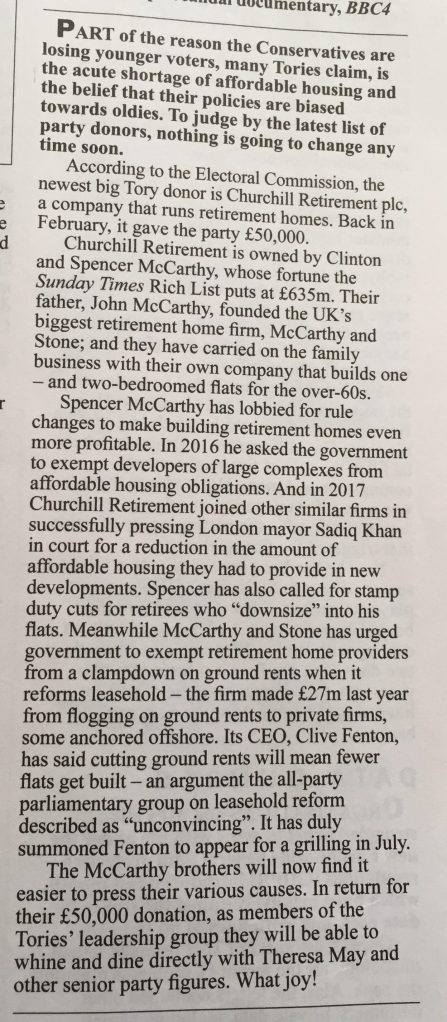

From Private Eye:
“Housing associations have made at least £82.3m from auctioning homes in five London boroughs since 2013, according to figures seen by the Guardian. Analysis by the Labour MP for Westminster North, Karen Buck, shows that Westminster, Brent, Camden, Hammersmith and Fulham, and Kensington and Chelsea sold 153 properties at auction through Savills estate agents – with more than half in Westminster where sales totalled £36.4m. The true figures are likely to be much higher as the data only covers sales made by one agency. The auctions are part of a wider trend of some housing associations selling off social housing in expensive central London to fund new developments, which tenants say are unaffordable or far removed from their families, schools and work.
Buck says: “I’m dealing with a family who are statutorily overcrowded and in the highest medical priority and I haven’t been able to get them moved in over eight years. That’s because housing associations [in general] say they don’t have the stock in the area and yet they’re still selling off homes.”
Nationally, sales of housing association social homes to the private sector have more than tripled since 2001, with 3,891 social homes sold in 2016. Overall, more than 150,000 homes for social rent have been lost since 2012. …”
Owl is puzzled. Our Local Enterprise Partnership says we need 50,000 new homes in the next 5 years (published in 2017 – so say until 2023):
Click to access SEP-Final-draft-31-03-14-website-1.pdf
(page 8)
Yet the Office for National Statistics says that the population of Devon will increase by just over 52,000 by 2026 (see below). Averaging a very low estimate of low 2 people per home that would mean we would need 26,000 new homes IN TOTAL in Devon in the next 8 years, not 50,000.
In fact, the same Office of National Statistics says average occupancy is 2.4 persons per household – so a more accurate figure would be 21,666 extra homes needed in Devon by 2026 – again NOT 50,000!
Someone has their sums badly wrong. 50,000 by 2023 or 21,666 by 2026.
Is it the Office of National Statistics or our LEP with its preponderance of developers and landowners?
“The population of Devon will increase by 52,100 by 2026, according to the Office for National Statistics.
In 2016 the population was 778,800. By 2026 it is expected to reach 830,900, a rise of 6.7%.
Every two years the ONS estimates how the population of England will change over the next 25 years.
Statisticians study birth and death rates, and look at how the county’s population is ageing.
In Devon the percentage of the population made up by pensioners is expected to rise from 24.8% in 2016 to 27.6% 10 years later. And by 2036 the ONS thinks over 65s will make up almost a third of the area’s residents. …”
https://www.devonlive.com/news/devon-news/population-devon-grow-52100-1667958
So sad that their profit margin has dropped from 20.3% to 18%! In 2017 Crest Nicholson’s chief executive, Stephen Stone, was set to receive a share bonus worth almost £812,000, on top of a salary of £541,158, while chief operating officer Patrick Bergin was set to net £562,500, in addition to pay of £375,000.
Maybe that’s where their profits are going … just a thought …
And better not anticipate any affordable housing in their “flat pack” developments!
“Housebuilder Crest Nicholson is feeling the pinch of rising construction costs and a slower housing market, prompting it to close its Central London office and expand production of so-called “flatpack” housing structures.
In its half-year results, Crest Nicholson said that it expects its margins to be around 18pc for the full year compared with 20.3pc last year – and at the lower end of its 18pc to 20pc range – due to the “generally flat” pricing environment.
Shares in the FTSE 250 housebuilder fell more than 7pc in morning trade. …”
https://www.telegraph.co.uk/business/2018/06/12/crest-nicholsons-margins-squeezed-rising-costs/
“Council homes are being sold off far more quickly than new social homes are being built, a new report has warned. The research into the government’s right-to-buy scheme, by the Local Government Association, finds that this has been the case since 2012: at no point has the social housebuilding rate matched, or come close to matching, the rate at which homes are being sold.
Right to buy was given a boost by the Conservatives after the 2010 election in an attempt to sell even more homes, since traditionally homeowners tend to vote Tory. In 2013, the then chancellor, George Osborne, announced the maximum discount available for those renting a council home in London would rise to £100,000. In effect he’d approved the asset-stripping of some of our most-needed council stock.
But right to buy needs to be viewed for its long-term effects, and not just with regard to how it helped those families who bought their council homes in the 1980s and 90s. Today, 40% of the homes sold under the scheme are rented privately at far higher rents than local authorities would ever charge. Right to buy has become right to buy to let.
Across the country, home ownership is in crisis, with renting exorbitantly expensive and young people especially – even those in professional jobs – being priced out of the market. Their earnings disappear into the pockets of private landlords, while the finances of local government are given a kicking.
Council housing works because it pays for itself relatively quickly: the rent paid by tenants covers the building costs in the long term, and eventually makes a profit for the local authority, which continues to invest in the local area. The money continues to circulate within the community rather than simply boosting the profits of landlords.
But with councils forced to sell to tenants through right to buy, then being obliged to give a chunk of the receipts straight to Whitehall, building becomes ever more difficult. And the property shortfall is expensive, as authorities struggle to house their homeless residents. Last year £8.4m was spent by 23 councils to rent 725 flats as temporary accommodation, the magazine Inside Housing found. A vast transfer of wealth has taken place from the public to the private sector, under the guise of helping the aspirational working class. Instead, we’ve just made it harder to provide housing for those most in need.
The folly of right to buy echoes the mess that is Britain’s rail system. In the mid-90s, John Major – echoing Margaret Thatcher’s disdain for the state a decade earlier – believed that breaking up British Rail would create competition, and that competition would ensure greater services and be far more efficient than control by the bloated state. Instead, the cost of train travel has become exorbitant, the service appalling almost everywhere you attempt to travel, and the state is constantly required to intervene – either because a franchise has collapsed, in the case of the east coast mainline, or because the rail service has become chaotic, witness recent weeks in the north and the south-east.
The long-term effects of privatising both rail and housing, aside from ensuring we live in a country of crumbling infrastructure (in contrast to mainland Europe), is one of diminished social and personal opportunities. Many people are unable to see friends and family as often as they’d like due to the cost of rail travel. Others are delaying having children, or wondering if they can afford them at all, since they cannot afford to buy a home and landlords can be hostile to children. Those with children are in no better position: well oOverMore than 100,000 children are living in temporary accommodation, usually due to eviction.
Right to buy was popular, but with 1.8m council homes having been sold off, there are now about 750,000 households paying far more than a local authority rent. Housing, not buying, should be a right – and available and affordable for all. Right to buy is devastating our housing system, just as rail privatisation has devastated our transport infrastructure.
Privatisation rarely works: we need new ideas, and far more public ownership of housing, infrastructure and utilities, if we wish to provide for our citizens.”
“Persimmon’s executive pay row was reignited on Wednesday after the head of the housebuilder’s remuneration committee said she did not know how much the average worker was paid by the firm.
MPs on the business, energy and industrial strategy (BEIS) committee were stunned by the admission from Marion Sears, who was giving evidence after Persimmon angered shareholders earlier in the year by handing its chief executive Jeff Fairburn a £75m bonus.
“The average … I don’t have that figure to my finger tips,” Sears told MPs, when asked by the committee chair, Rachel Reeves, what average pay was.
“You’re chair of the remuneration committee at Persimmon aren’t you? And you don’t know what average pay is, as chair of the remuneration committee?” asked an incredulous Reeves.
After the meeting had concluded, the Labour MP tweeted that Sears’ lack of knowledge was a disgrace.
She added in a statement: “Executive pay at Persimmon is a tale of corporate greed and incompetent pay management, financed on the back of a tax-payer funded housing scheme [help to buy].
“Persimmon paid out huge bonuses to the men at the top of the firm and yet this morning we have heard that Persimmon are unable to tell us how much average workers at the company are paid.”
A spokesman for the firm later confirmed the average salary at the firm is £35,600.
During the bruising session, Sears also appeared confused about the sum Fairburn received last year, at first answering “£675,000”. Prompted by Reeves to give the total pay figure, she said it was “about £45m”. The total figure shown in the 2017 annual report and accounts was £47.1m.
When asked by Reeves whether or not Persimmon was a living wage employer, Sears said yes, but then went on to clarify that the FTSE 100 firm was not accredited by the living wage foundation. …”
““Every single link in this chain is going to be found to be rotten and cancerous,” Daffern [the survivor who had lived there for 16 years and predicted the tragedy in his blog] said.
“The government didn’t implement the inquest recommendations after the Lakanal House fire where six people died in 2009. Had they done that Grenfell wouldn’t have happened. RBKC failed to carry out scrutiny of the TMO.
“The way the TMO [Tenant Management Organisation] operated, the handling of the contracts, the construction, through to the building regs, the materials that were used, the consultation process.”
When asked what links these failures, he said: “Greed, lack of respect, lack of humanity. It is the opposite of everything it should be. This is housing as a commodity to be exploited. It is not only in RBKC [Royal Borough of Kensington and Chelsea], it is what housing has become.”
… would you find an article with the headline:
“Small businesses at risk from house price fall”
about small business owners using their homes as collateral.
Might a headline in the Daily Mirror read:
“Small business owners forced to use houses as collateral as big banks fleece them with high interest rates and government fleeces them with high business rates”!
Oh, those poor, poor developers … less profit … that’s all this is about:
“Proposed changes to the National Planning Policy Framework could cause the cost of land to increase and exacerbate the housing crisis, the Home Builders Federation (HBF) has warned in a letter to the Government.
The industry body claimed that proposed changes, which would enable councils to base contributions towards affordable housing based on the existing value of land – rather than its projected sale value – would mean they would have to offer lower sums to landowners and therefore be able to build fewer homes.
A spokesman for the Ministry of Housing, Communities and Local Government said that proposed changes “will mean that developers know the contributions expected of them and local communities are clear about the infrastructure they will get alongside new homes. We are currently analysing responses to the consultation and will set out next steps in due course.”
Sources: Telegraph p1, Times p1 (pay walls)
“The survey of 121 Tory council leaders and heads of housing from across the country, funded by the Joseph Rowntree Foundation, found an overwhelming majority – 96% – wanted low-cost rented homes to form part of the solution.. …”
“The government’s flagship, multibillion pound scheme for helping people to buy a home is increasingly giving taxpayer-funded loans to higher earners, The Independent can reveal.
The Help to Buy initiative was designed to help cash-strapped buyers, but analysis reveals the average salary of people receiving equity loans has shot up since it was introduced.
Official government data reveals the average household income of people benefiting from the £8.3bn scheme is continuing to rise, and now stands at just under £50,000.
London, the figure is even higher, with the average recipient of a Help to Buy loan having a household income of almost £72,000….
Almost one in five Help to Buy beneficiaries are already homeowners, and on average these recipients are wealthier than first-time buyers, with an income £8,500 higher.
The Independent has previously revealed how millions of pounds of public funds are being loaned to people with an income of more than £100,000.
The latest figures reveal that more than 6,200 households with an income of more than £100,000 have benefited from taxpayer-funded loans.
The Department for Housing, Communities and Local Government has been contacted for comment.”
Source:Independent
“Million-pound sales have increased by 157%, with 7 sold in 2007 and 18 in 2017, with the most expensive sold for £3,100,000”
For comparison: In Exeter there were 55 homes over £1m sold since 2007, with the most expensive sold for £2,900,000
“One of the country’s top property developers has described the UK’s system of funding social housing as “nuts” and called for higher taxes to speed up building.
Roger Madelin, a member of the executive committee at British Land, told the Guardian the decades-old system of getting private developers to pay for affordable homes was “a stupid way of meeting this social need” and that the government should directly fund them.
“All companies should pay higher corporation tax,” he said. “This country needs to have more tax paid. If we did it like that we could get on and do it. It can’t work in the long term, you can’t expect developers to continue to produce for the population’s social needs at this level. It should come from general taxation.”
Madelin’s suggestion will raise eyebrows in the notoriously profit-driven property industry as it implies increased taxes on its profits. But he is a respected figure who led the regeneration of King’s Cross in London as well as Brindley place in Birmingham and his remarks reflect growing frustration that the system is not only failing to deliver enough cheap housing, it is also a drag on development.
He made his proposal as British Land submitted one of the UK’s largest planning applications for a £3bn regeneration of Surrey Quays in east London, with 3,000 homes, up to six skyscrapers and several new corporate headquarters on a site stretching across 53 acres – similar in size to the regeneration of King’s Cross. It is located about a 20 minutes’ tube journey from the City of London, between Shoreditch and Peckham, two rapidly gentrifying areas, on the London overground line. Some 35,000 people already live in the Rotherhithe peninsula, where the development will take place. …
Madelin believes that by avoiding the current haggling between council officers and developers about how much they should contribute to affordable homes, the government could regain control of how much and when much-needed affordable housing could be built.
“I find it nonsensical that we go through these viability assessments,” he said. ‘If you have a shortage of cars then you wouldn’t get motor manufacturers to subsidise people who can’t afford a decent car.” …”
PRESS RELEASE
“Civic Voice – the authoritative voice of the civic movement – has submitted its final response to the draft National Planning Policy Framework consultation. The response is available here:
Click to access Civic_Voice_NPPF_response_FINAL.pdf
Ian Harvey, Executive Director said: “If the report in Planning Magazine over the weekend is true and the Government’s Chief Planner did confirm that the Government has received over 27,000 responses to the draft consultation, we believe that this shows the breadth of feeling across the country about the importance of our planning system.”
Responding to the draft NPPF, Civic Voice is calling for:
1. Given our membership and reach nationwide, we are concerned by the London and South East-centric nature of the NPPF; a greater level of ambition for economic development to is vital to address the viability challenges in some parts of the country.
2. The draft NPPF says much about the importance of design, however, it is our fear that as drafted, high quality design could be seen as a ‘nice to have’ but ‘easy to ignore’ rather than as an essential dimension of good planning.
3. Civic Voice supports the emphasis on early and meaningful engagement with communities within the draft NPPF and we would welcome working with MCHLG to develop the accompanying Planning Practice Guidance on this.
Harvey added: “We agree with the Government that finding a solution to the housing crisis is essential and we really hope that this was not a tokenistic consultation. We must ask, if the Government intends to publish the final document before the end of July, can it realistically be expected to review the thousands of responses comprehensively within a matter of weeks? We look forward to seeing the final document when it is released as it is important that the Government gets this right, because the consequences of getting it wrong will be felt for many years to come.”
Civic Voice President, Griff Rhys Jones finished by saying: “Whilst the Government wants to see the ‘right homes in the right places’, if it doesn’t get this right, it is very likely to end up with the ‘wrong homes in the wrong places. We hope they listen to the voices of communities across England.”
Turning offices into flats does not require planning permission so no Section 106 payments towards affordable housing:
“Lack of investment and deregulation of planning were the main reasons given for hampering councils’ ability to help provide the number of homes needed in the UK, the report published by the not-for-profit Association for Public Service Excellence found.
Of 141 UK councils surveyed, 63% described the need for affordable housing as ‘severe’ while 35% describe their need as ‘moderate’.
Seventy per cent of 124 councils in England noted an increase in statutory homelessness in the last year, the survey revealed. It was researched and written by the campaigning organisation the Town and Country Planning Association on behalf of APSE and released last week.
Paul O’Brien, chief executive of APSE, said: “Investment in high quality social housing can also save public funds, such as through reducing poor physical and mental health outcomes that are currently experienced by those living in an unstable private rented sector or those in temporary accommodation.”
Kate Henderson, TCPA chief executive added: “We are not providing anywhere near enough genuinely affordable homes and homelessness is rising.
“Our latest research highlights that councils want to provide more affordable housing for their local communities, but their ability to do so is being undermined by planning deregulation.”
The report noted that while relaxing planning regulations allowing developers to convert offices into homes without the need for full planning permission had created more accommodation it had made it more difficult for councils to secure ‘affordable properties’. If development plans go through the full planning process local authorities can secure ‘affordable homes’ through section 106.
“Relaxing permitted development has led to tens of thousands of new homes being created without having to get full planning permission and this means that councils are unable to secure a contribution to affordable housing from the developer”, Henderson said.
The research by the TCPA showed that one in three councils in England believed these changes to permitted development had a negative impact on the delivery of affordable homes.
The report called on the change to be reversed and for planning powers to be given back to local authorities allowing them to make decisions to “reflect local circumstances”.
O’Brien said the report showed that insecure private rented sector tenancies had contributed to the rise in homelessness.
He said local authorities needed to bring “stability and capacity to the social rented sector, which in turn will help to stem these almost unprecedented rises in both statutory homelessness and rough sleeping”.
The government must be “bold and ambitious in challenging the shortfall of housing for hose in the most need in society,” O’Brien added.
It must also help councils return to their historic role as a provider of homes, he urged.
APSE is a non-profit membership organisation for local government officers.”
“Q Is anything ever likely to come of the starter homes initiative? It was launched amid much fanfare by George Osborne towards the end of 2014 but there has been little news since, beyond a few stories regarding funding concerns.
Meanwhile, the starter homes newsletter, which was getting increasingly infrequent and was only ever a series of adverts for developments (none of which contained starter homes) seems to have dried up, and the dedicated starter homes website simply links back to a generic new homes website, as it did when it was launched.
I had been holding off buying a house as the promised minimum discount of 20% sounds worth waiting for, but I’m beginning to question whether it was only ever a cynical attempt to woo millennial voters, to be abandoned at the first opportunity.
AB
A Given the dearth of news about the starter homes scheme, it’s tempting to think that it has been quietly shelved – not least because it was an initiative announced when the Tories were in coalition with the Lib Dems.
But in fact, shortly after the current government came to power, it was announced that the original target of 100,000 new starter homes to be built by 2020 would be doubled. So potentially 200,000 first-time buyers aged between 23 and 40 with a household income of £80,000 or less (£90,000 in London) will be able to buy new-build properties at a discount of at least 20% where the discounted price is less than £450,000 in London but £250,000 everywhere else in England. The starter homes will generally be built on underused or unviable brownfield land previously used for commercial or industrial purposes.
Those first-time buyers shouldn’t hold their breath, however, as no starter homes have yet been completed. And at the beginning of last year only 71 sites across England had received grants from the Starter Home Land Fund to enable local authorities to acquire and/or prepare suitable land for starter home developments. So a lot depends on where you live if you want to take advantage of the scheme. First-time buyers in Burnley won’t have to wait much longer as, in partnership with Barnfield Investment Properties, Burnley council started work on the first phase of residential apartments back in February 2017.
If you don’t happen to live in Burnley, finding out about starter home developments in your local area is hard and the new homes website you mention is no help at all. The alternative to waiting for a discounted starter home would be to look into the help-to-buy scheme where you get a loan of up to 20% from government towards the purchase of a new-build property.”
https://www.theguardian.com/money/2018/may/09/uk-starter-homes-initiative-theresa-may-target
“The government has spent £250m to boost starter home construction without a single property being built so far, it has emerged.
Dominic Raab, the housing minister, made the admission in response to a question from John Healey, the shadow housing secretary, who described the situation as “a betrayal of young Brits looking for help to buy a first home”.
In March 2016 the government announced a £1.2bn fund to help deliver “200,000 quality starter homes by 2020 exclusively for first-time buyers at a 20% discount on market value”. The promise was originally made in the Conservatives’ 2015 election manifesto.
The aim was to use the cash to support the purchase and cleanup of sites to guarantee the construction of starter homes. The policy recognised that the cost of making brownfield sites useable could make some places unviable for development. Ministers believed that targeted interventions could help increase housebuilding at the bottom of the market where the affordability crisis had bitten most deeply and particularly affected millennials.
In January 2017, Gavin Barwell, then housing minister, said the first homes would be built that year after partnership agreements with 30 local authorities.
He said: “This first wave of partnerships shows the strong local interest to build thousands of starter homes on hundreds of brownfield sites in the coming years. One in three councils has expressed an interest to work with us so far.”
However, after Raab confirmed that “£250m of the starter homes land fund has been spent to date”, a spokesman for his department said, adding: “At the moment no specific starter homes have been built yet.”
The government has now placed the operation of the flagship fund under review.
A spokesperson for the Ministry of Housing, Communities and Local Governmen, said: “We have spent £250m buying land to build affordable properties, and work is underway getting them ready for development. It is important we get starter homes right and we aim to introduce regulations on them alongside our new planning policy before building gets underway.” …”
Well, duh! No surprise there!
“Housing issues can make mental health problems worse or even cause them, according to a new study by the mental health charity Mind.
The charity surveyed 1,780 who described themselves as having mental health problems and nearly four in five of those said a housing situation had made their mental health worse.”…
Thomas Aubrey of the Centre for Progressive Policy:
“Our system favours landlords over communities. The PM must side with the many, not the few.
Theresa May is right. Britain’s housing market is broken and needs fixing. Homelessness and rough sleeping are rising and owner-occupation levels for the young have collapsed because homes have become unaffordable.
The average private rent in London accounts for more than a third of household income. The bill for housing benefit has risen eight-fold since the early 1980s after inflation is taken into account. House building has risen since the lows reached during the financial crisis of a decade ago but needs to almost double to hit the government’s target of 300,000 new homes a year by the middle of the next decade.
Yes, the housing market is broken all right and for the Conservatives, a party that sees itself as the party of the homeowner, it is a serious political headache.
A crisis has been brewing for decades – and left unattended the problem can only get worse. Britain has a rising population and the trend is for smaller households, both of which mean demand for housing will keep on rising. The weak growth figures for the first three months of 2018 will keep borrowing costs on hold for now but sooner or later the Bank of England will raise interest rates. That will make it still harder for people in their 20s to get a foot on the housing ladder.
Yet sketching out the problem is one thing. Coming up with solutions is trickier.
Replace a regressive council tax with a land value tax? Labour is thinking about a LVT but there is no chance the Conservatives will introduce what they have dubbed a “garden tax” that would hit millions.
How about giving some of the anonymous farmland in the green belt over to housing development? The thin end of a wedge that will result in the south-east being turned into one big urban sprawl.
Make prime residences eligible for capital gains tax? Are you kidding? Politicians know that Britain’s housing market is broken but mess with it at their peril.
The problem is so big, however, that changes have to come. London’s mayor, Sadiq Khan, wants to increase the supply of lower-cost homes in the capital, so under City Hall guidelines private development proposals where affordable units make up at least 35% of the total will be fast-tracked through the planning process. Under 35%, and developers can expect a much tougher time.
But as Daniel Bentley argues in a new pamphlet for the thinktank Civitas, the problem goes deeper than the planning system. Forcing councils to grant more planning permissions in high-demand areas doesn’t guarantee that the supply of new homes will markedly increase.
The reason for that, Bentley says, goes back to the 1961 Land Compensation Act passed by Harold Macmillan’s government. This enshrined in law the right of landowners, in the event of compulsory purchase, to be reimbursed not only for the value of their land as it stood but for its potential value if it were used for something else in the future.
A system so heavily weighted in favour of landowners had two consequences. First, it provided them with an incentive to wait, often for years, before selling their land for development because they would get a higher price. Second, house-builders had to recoup the costs of buying the land and did so by building more expensive properties that were drip-fed into the market to keep selling prices high.
If the aim is to build more affordable homes, this makes no sense. A site with planning permission for housing is worth more than a brownfield industrial site and 100 times more than agricultural land. Research by Thomas Aubrey of the Centre for Progressive Policy found that landowners made windfall profits of more than £9bn in 2014-15 on the sale of land. That meant for every home built that year, an average of £60,000 went to the landowner.
Bentley says the entitlement of landowners to this “hope value”, the prospect that it will be worth a lot more if used for something else, means public authorities are powerless to enforce development priorities that are in the interests of the community.
“This was not always the case. The new towns that were initiated before the 1961 act, and much of the local-authority output of the late 1940s and 1950s, was underpinned by a land values policy that meant landowners were compensated at values reflecting the existing use of the site,” he said.
“This meant land for new homes could be acquired at or close to its much lower agricultural or industrial use values. It also doused speculation and prevented the withholding of land.”
Reforming the 1961 act so that public-sector bodies can purchase land at less than its prospective residential use value makes sense because it would enable developers to get hold of land more cheaply and so build more affordable homes. Nor would it be an especially controversial move politically.
Judging by their 2017 manifestos, Labour and the Conservatives think the current system is weighted too heavily in favour of landowners, who see the value of their holdings increase not through their own efforts but through those of others.
Adam Smith and David Ricardo, darlings of the free-market right were critical of the “unearned increment” that landowners enjoyed. So was Henry George, who the left laud for coming up with the LVT.
May should seek bipartisan support for a rethink of the 1961 act. Sure, Conservative-supporting landowners would object but if the prime minister is to make good on her pledge to fix the housing market she has to side with the many not the few.”
https://www.theguardian.com/business/2018/apr/29/want-to-resolve-the-uks-housing-crisis-heres-how
 East Devon Watch