Majority of Ottery Town Council remarkably unconcerned about the future of their hospital

From the blog of Claire Wright. It seems remarkable that the abstaining councillors were so similar and united in their views.

“For the first time in many years, I left an Ottery Town Council meeting in pure frustration last night, at councillors arguing against the creation of a working group to help secure the future of Ottery St Mary Hospital.

A straightforward and uncontroversial proposal… or at least, so I thought!

A few weeks ago, I met with Cllr Geoff Pratt (EDDC ward member for Ottery Rural and Ottery Town Councillor), Margaret Hall (retired GP and chair of West Hill Parish Council), Elli Pang (Ottery Town Councillor and chair of the local Health and Care Team Forum) and her colleague, Leigh Edwards.

We discussed the risks facing Ottery St Mary Hospital and the risk of it being sold off for development by NHS Property Services – and how we might move things forward in a productive way.

Currently the hospital is less than 40 per cent occupied and a whopping £200,000 a year rent must be paid to the company, which is wholly owned by the Secretary of State for Health. The rent is mostly covered by NHS England at the moment, with some paid by the Royal Devon & Exeter Hospital, which runs the services there.

Cllr Pang said at this meeting and at the town council meeting last night that it was difficult to make progress on this for a number of reasons, namely trying unsuccessfully to engage key stakeholders and also having the clout to deal with NHS Property Services, which is well known for the aggressive way it deals with its tenants rents, often increasing the rent suddenly and significantly, without apparently caring whether or not the tenant can actually pay.

At the end of our meeting we agreed to ask Ottery Town Council to agree to setting up a working group specifically to move things forward, which would have the advantage of being part of a legally constituted body and one where other people from other areas could be invited onto it.

I am not a member of Ottery Town Council, I attend as the Devon County Council and to give my report. I asked to contribute to the debate, however, as the subject of the hospital is close to my heart and I have spent many years working to try and protect it and prevent the loss of beds.

As one councillor after another spoke it was clear, apart from Cllrs Geoff Pratt and Roger Giles, that the others were opposed to the working group being created.

Various spurious reasons were cited for being against the working group, including:

-There was already a working group set up (there was not)
-It would be better for such a group to be independent from the town council (it would have more clout and relevance to be part of the town council)
-It was duplication (no, it was building on the work of the Health and Care Team Forum)
-It might close down the Health and Care Team Forum (it would not)
-Our proposal was unclear (it was perfectly clear)
-We were insulting the Health and Care Team Forum (no one did this)

After trying to reason with the town council, and then hear several of them speak afterwards as though I had said nothing, I felt my frustrations boil over.

I couldn’t bear to hear any more utter nonsense on the subject, so I prepared to leave before the vote took place, as I could see which way it was going.

Before I left I told them that there was absolutely no reason whatsoever that the town council should not support the proposal and if Ottery Hospital was sold off to developers in a few years time, that each and every town councillor who voted against the proposal would need to examine their consciences.

After I left Cllr Giles asked for a recorded vote so that the minutes listed the way each councillor voted. This proposal was voted down.

I was informed later that after about an HOUR of debate, the vote took place. The councillors who objected to the working group all abstained, apparently on the assumption that their abstentions would result in the failure of the proposal. Instead the vote was carried with eight abstentions and three votes in favour. This was met with much debate and disbelief.

Several then councillors asked that it be recorded in the minutes that they abstained because the proposal was unclear.

On the way out I slammed the glass door, which I am told this morning, resulted in the glass fracturing. This is regrettable.

I have agreed to reimburse the council for the replacement glass, which will need to be in instalments.

A councillor (I am not clear who as the message was relayed by the clerk) has demanded I apologise for “storming out of the meeting.”

My reply was: “I will apologise when those town councillors who sought to obstruct the safeguarding of Ottery Hospital by arguing against setting up the working group and abstaining in the vote, apologise to the residents of Ottery.”

I now look forward to the first meeting and getting on with trying to safeguard our hospital.

Voting in favour of the working group were: Roger Giles, Geoff Pratt and Peter Faithfull.

Those abstaining were: Anne Edwards, Elli Pang, Paul Bartlett, Ian Holmes, Josefina Gori, Lyn Harding, Paul Carter and Glyn Dobson.”

http://www.claire-wright.org/index.php/post/just_three_ottery_town_councillors_back_a_working_group_to_protect_ottery_h

Security at EDDC buildings at Knowle, Exmouth Honiton and Cranbrook costs us £25,000 per year

“East Devon District Council is spending nearly £25,000 a year on private security firms to patrol or protect council owned property.

The figures were revealed at last week’s full council meeting following a question from Cllr Cathy Gardner.

She asked the leader of the council to confirm whether the council uses private security firms to patrol or protect council owned property, and if so where and at what cost.

In response, Cllr Ian Thomas, leader of the council, said: “We use two different security firms which are employed across the corporate stock.”

He said that the council spends £6,363.35 on security at The Knowle HQ in Sidmouth, £5,450.90 at Exmouth Town Hall, £7,200 at the Younghayes Centre in Cranbrook and £4,200 at the East Devon Business Centre in Honiton.”

https://www.bbc.co.uk/news/live/uk-england-devon-46042790

“Universal Credit forces Devon girl, 9, to beg for work after mum died and dad lost job”

“A nine-year-old girl begged for work to feed her family after delayed Universal Credit payments left her dad skint.

The girl made a heartbreaking plea on the phone to a charity, telling how her mum died and that her dad had recently lost his job as a lorry driver in Torbay.

And a five-week delay in her father’s first Universal Credit payment meant the family was left with barely and food.

She said: “I’ll do anything. I don’t mind cleaning floors, making beds,” The Mirror reports.

Ellie Waugh, who took the heartbreaking call yesterday, said the ­youngster was “really worried because her family didn’t have any money”.

She offered to do “any” job to help buy food and get her two younger siblings Christmas presents.

The little girl added: “I don’t want to let them down.”

Ellie said: “I can’t tell you how horrendous it was hearing a child beg for work in this day and age.

“She told me, ‘I don’t mind cleaning floors, making beds. My daddy has always worked and he says you have to work to get things. I’ll do anything I can so I can buy my brother and sister a Christmas present. I can cook and I don’t mind working on a Saturday and Sunday or after school.’ After the call I just cried. Hearing that is like we’ve gone back to Victorian times.”

The dad was raising the three children alone in Torbay after his wife died four years ago. The girl contacted Humanity Torbay, which provides food banks and support for the vulnerable.

CEO Ellie reassured the brave child she would not have to work. She called her dad, who wants to remain nameless, and promised food and support.

Ellie said: “He cried because he was embarrassed but because he is proud of her. Proud that she loved her brother and sister so much she wanted to help them. He said they were literally down to their last few bits in the freezer.”

Ellie and her volunteers visited the family with food parcels last night.

Offers of support also flooded in, with strangers donating Christmas turkeys and presents.

The dad said: “I’m very proud of my daughter and ­horrified I’ve been reduced to this. It’s humbling that people want to help us.”

Ellie has invited Theresa May and work and pensions secretary Esther McVey to visit her charity, but is yet to receive a response.

She said: “I want them to see the reality of what Universal Credit is doing, to see the look of ‘no hope’ in people’s eyes when they come asking for food.”

Lib Dem MP Christine Jardine said: “It is heartbreaking that a young girl was so worried about her family she begged a charity for work. Tory ­ministers cannot put their hands over their ears and pretend they can’t hear her.”

https://www.devonlive.com/news/devon-news/universal-credit-forces-devon-girl-2190936

“£600m underspend on tax-free childcare to return to Treasury”

“Labour has accused the government of failing to support hard-pressed families after it emerged that a £600m underspend on its tax-free childcare (TFC) scheme is to be returned to the Treasury.

The underspend on the troubled programme was uncovered by Labour analysis of data from the Office for Budget Responsibility (OBR), which showed that spending on TFC is projected to be £600m lower than expected over the next four years.

The TFC scheme has been struggling to improve levels of uptake among families. Earlier warnings from the OBR said the programme had helped less than 10% of the families originally predicted, and spending in the first year was just 5% of initial forecasts.

Instead of reallocating the £600m to support other childcare policies, however, the Conservatives said the leftover funds would go back to government, prompting fury from those working in the early years sector.

Childcare providers say they are struggling to try to deliver the Conservatives’ 30-hour free childcare promise to working parents. They say the Tories’ flagship policy is underfunded and poses a risk to the financial sustainability of early years providers.

Neil Leitch, chief executive of the Pre-school Learning Alliance, called on the government to re-invest the leftover funds.

“Given that childcare providers across the country have long been crying out for additional funding, the suggestion that government underspend on the tax-free childcare scheme is to be returned to the Treasury rather than used to support a sector in crisis beggars belief,” he said.

“Such a decision suggests that pre-schools, nurseries and childminders are being left to struggle not because the government simply doesn’t have the money for additional investment, but rather because it doesn’t believe that there is a true need for it in the childcare sector.”

The underspend confirms that uptake of tax-free childcare remains way below government projections, either because parents don’t understand their entitlement or they’re choosing not to take it up. …”

https://www.theguardian.com/money/2018/nov/06/600m-underspend-on-tax-free-childcare-to-return-to-treasury

Another council in trouble: East Sussex

Owl says: it makes you wonder how many other councils are sailing close to the wind and fast apperoaching the rocks.

But didn’t the Chancellor tell us last week that austerity is over?

“A cash-strapped council has warned it will not be able to afford to provide basic services unless it receives more government money.

Conservative-led East Sussex County Council (ESCC) said it needed to save more than £45m by 2021-22.

In its Core Offer document the council sets out a list of services it could provide as a “bare minimum”.

However, the chief executive said it was “unlikely” that even this reduced level of services could be sustained.

In August, ESCC set out plans to strip back services to the “legal minimum”, following fellow Tory-run Northamptonshire County Council’s proposed “radical service reductions” to tackle its financial crisis.

The Core Offer would result in cuts to training for social workers and doing less preventative work, saving £854,000.

Another £1.3m could be saved by doing less monitoring of school performances, the document added.

The council also said more than £500,000 could be saved by cutting library services and £884,000 cut from the road maintenance budget.

Analysis

By Ben Weisz, BBC Sussex

A “basic but decent” offer – that’s how the council leader Keith Glazier sees the Core Offer document, setting out East Sussex County Council’s view of the bare minimum it should provide to residents.

It combines those services the council must provide by law – like free bus passes, or adult social care – with other services the council feels it couldn’t do without.

And it sets out what the council would axe, too. So, no more funding for meals on wheels, more cuts to libraries and tips, and fewer families getting early help from social services.

This “bare minimum” would save the council £12m each year.

But unless there’s a big change to its financial situation, rising demand for its services and falling government grant means it needs to save £46m by 2022. Even the core offer isn’t affordable, as things stand.

Yes, it’s a way of asking residents what the council’s priorities should be. But it’s also a political statement, aimed squarely at the government.

The message is simple: “We won’t even be able to afford the bare minimum in a year or two. So either give us more money, or let us off some of our legal duties.”

Becky Shaw, the council’s chief executive, said: “The Core Offer will help us in our lobbying with government to set out the realistic level of funding we need to continue to serve local people adequately.

“The council is using its best endeavours to live within its means and is continuing to work to make sure it is making the best use of resources.

“It remains unlikely, however, that even the Core Offer will be sustainable by the end of the next three year planning period.”

The council said the document would form part of public consultation into the authority’s spending plans.

Council leader Keith Glazier said: “We’d all like to provide more than a core service because none of us came into politics to make cuts, but this proposal is presented as a realistic ambition in a time of austerity.

“We have a budget to deliver and we have to make best use of that. This is not about budget setting.”

The proposals are due to be discussed by the council’s full cabinet on 13 November and will be used to develop the budget for the next three years, a council spokesman said.”

https://www.bbc.co.uk/news/uk-england-sussex-46098749

“Headteacher acclaimed by Tories is banned from teaching”

“The headteacher of a high profile multi-academy trust, which won plaudits from former prime minister David Cameron and his then education secretary Michael Gove, has been banned from teaching indefinitely.

Liam Nolan, who was executive headteacher and chief executive of the now defunct Perry Beeches academy trust in Birmingham, was found guilty of “unacceptable professional conduct” after a hearing before the Teaching Regulation Agency (TRA).

Acknowledging Nolan’s contribution to the teaching profession, the TRA report said he should be allowed to apply to have the prohibition order lifted after a minimum two-year period, which would give him time to “reflect on his failings”.

The prohibition order against Nolan is the latest chapter in the demise of the Perry Beeches academy chain, which was stripped of its five schools after an investigation revealed financial irregularities at the trust, including third-party payments to Nolan, on top of his £120,000 salary as executive headteacher.

The Education Funding Agency investigation found nearly £1.3m in payments without contracts to a third-party supplier, a private company called Nexus. That company also subcontracted to a company named Liam Nolan Ltd, paying Nolan a second salary for his role as chief executive officer of the trust.

At the time, critics of the government’s academies policy, which takes schools out of local authority control, said the case should ring alarm bells over the accountability and financial management of academy chains and the government’s ability to police the system.

The TRA hearing found that Nolan failed to comply with recognised procedures and principles in relation to management of public funds and was in breach of the academies’ financial handbook, which sets out the financial management, control and reporting requirements for all academy trusts.

“Mr Nolan stated in his evidence that he was under pressure in developing the Perry Beeches schools and that it was against this background that he made what he described as mistakes,” the TRA report said. “However, the panel was not convinced this justified his lack of integrity in managing public finances. Although Mr Nolan apologised for some of his failings as accounting officer, there did not appear to be sufficient insight into the seriousness of those failings or his responsibility in that post.”

Cameron opened one of Perry Beeches’ new free schools in 2013, when the then prime minister praised the “brilliant team” at the trust. In 2012, Nolan addressed the Conservative party conference and appeared on stage with the then education secretary Michael Gove, who described Nolan as “wonderful”.

https://www.theguardian.com/education/2018/nov/05/headteacher-acclaimed-by-tories-is-banned-from-teaching

“Bus firms pay fat cats £1.5 BILLION – while prices go up 55% and routes are axed”

“Bus firms have paid shareholders £1.5billion in dividends in the past 10 years, while fares have soared and services have been axed.

Fares have gone up 55% on average since 2008, far outstripping pay growth. Some passengers have even been hit by increases of 100% and bus use is at a 12-year low.

Arriva, FirstGroup, Go-Ahead, National Express and Stagecoach carry 70% of all bus passengers and have paid an average £149million a year in dividends in the past 10 years.

The most recent company records show they paid out dividends amounting to £48,077,200 from profits in the South East, £23,521,200 in the North East, £18,460,700 in the North West, £13,767,700 in the Midlands and £27,309,700 in London.

Shadow Transport Secretary Andy McDonald said: “Our bus networks are being bled dry by greedy private operators. Labour will bring buses under public control and ownership in order to reverse bus cuts rather than fill the pockets of shareholders.

“It is an outrage that bus companies enjoy colossal profits as thousands of routes are cut or withdrawn. The bus network has shrunk to its smallest size in decades and passenger numbers are plummeting.

“A combination of privatisation and Tory cuts is killing local bus services.

“Labour would enhance and expand bus services, including providing free travel to under-25s.”

The research by campaign group Better Buses for Greater Manchester also found bus journeys had fallen by 40% in urban areas since the deregulation of services by the Tories 32 years ago.

In London, where deregulation did not apply, passenger journeys on the franchised network have doubled and bus companies’ profits are around 4%, compared to 8% in cities where services are deregulated.

The Better Buses for Greater Manchester findings are revealed as a campaign is launched today urging Greater Manchester Mayor Andy Burnham to re-regulate services, bringing buses under public control.

Pascale Robinson, of Better Buses for Greater Manchester, said: “The deregulation we have now means bus companies just run the routes they want to at a whim. They can charge what they like.

“This means the big five bus companies are cherry-picking the profitable routes, making a killing, and it is us in Greater Manchester who suffer infrequent, unreliable and expensive buses.”

Greater Manchester is one of the first cities to consider re-regulating its bus network, which would give the mayor the choice to put the public in control instead of the big firms.

Ms Robinson said: “By this method bus firms are given controlled contracts to run the services we need, services which are reliable and affordable.

“We call on Mr Burnham to be bold and give us the bus network we deserve. We can’t keep letting these companies run a Wild West, charging through the roof for a patchy service.

“For every pound of dividend given to shareholders in London, 82 journeys were taken. Elsewhere across the country, where buses are mostly deregulated except for a few small pockets, it was just under 20.”

In Greater Manchester, passengers have complained that changes to the 372 Hazel Grove-Stockport service means taking two different buses to do the same journey, which used to pass by the hospital.

They now need a £4.50 “day rider” ticket, adding £1 to each journey.

This summer the Mirror revealed how mum-of-nine Gemma Headley, 36, of Driffield, East Yorks, had to walk seven miles to get her daughters to infant school because of bus cuts. Department for Transport figures show the number of bus routes at a 28-year low.

The bus network has shrunk by 8% in the last decade. Since 2010, the Tories have almost halved funding for bus services in England and 3,347 routes have been axed or reduced.

Experts say investing in bus travel would bring benefits as people return to towns and cities to spend their money.

An analysis for Greener Journeys by auditors KPMG LLP shows that targeted investment to improve bus services would typically generate £3.32 of net economic benefit for each £1 spent.

Steve Chambers, of the Campaign for Better Transport, said: ”Across the country we are seeing the alarming impact this is having on communities, especially in rural areas, as people are being left isolated and unable to get to work, get to the shops, visit friends or access vital public services.

“The loss of bus services also has an adverse effect on congestion and air pollution as more people turn to cars, jamming up already congested roads.”

Mirror reader and retired lorry driver Michael Palmer, 74, tells how a half-hourly service from his home in the North Fitzwarren, Somerset, to Taunton, is now every two hours, finishing too early for workers returning home.

He said: “We are living in the 21st century, this is England, we should have the best public transport service in the world. Where did it all go wrong?”

A Department for Transport spokesman said: “We provide around £250million every year to support bus services and a further £1billion to support older and disabled people using the free bus pass scheme.”

The Confederation of Passenger Transport UK, which represents bus and coach operators, said the dividends paid were outweighed by investment, with Stagecoach investing £1billion on around 7, 000 new buses in 10 years.

How bus prices have risen over a decade…

All prices are for day tickets except London.

Birmingham
2008 – £3.30
2018 – £6.70
A 103% increase

Newcastle
2008 – £3.50
2018 – £5.20
A 49% increase

Manchester
2008 – £3.30
2018 – £5.60
A 70% increase

Leicester
2008 – £2.60
2018 – £5.20
A 100% increase

Derby
2008 – £3.20
2018 – £4.20
A 31% increase

Cornwall
(All day)
2008 – £8.20
2018 – £12
A 46% increase

Bath
2008 – £2.20
2018 – £4.50
A 105% increase

Liverpool
2008 – £3
2018 – £4.80
A 60% increase

Nottingham
2008 – £3.00
2018 – £4
A 33% increase

London
(No day tripper anymore)
Single journey 2008 – 90p
Single journey 2018 – £1.50
A 66% increase

Why ‘On the Buses’ loses comedic fun to big fares
By Paul Routledge

Maggie Thatcher may not, as legend says, have sneered that “any man over 26 who finds himself on a bus can count himself a failure”. As an inveterate user of public transport, I’m happy to be seen as a failure.

The bus is a traditional part of the British way of life. It’s a place for gossip, getting to the shops, the hospital and to see friends, a moving theatre of society.

No wonder On The Buses was so popular. The soap played to our affection for the bus. “Sit at the back for a longer ride!”

But it’s getting harder and harder. Thatcher’s deregulation and privatisation of the industry was a failure for would-be travellers of any age.

It brought fewer routes and higher fares – with profits and subsidies creamed off for investors, many of them foreign.

I hear grumbles galore from fellow passengers about late and cancelled services. But it’s not the crews’ fault that the system isn’t working.

The sell-off brought redundancies. The clippie went out with cost-saving one-man operation. Drivers face exhausting schedules.

The Tories cut local government funding, so councils slashed subsidies to the companies, who take it out on the passenger.

We’ve waited too long at the bus stop for an end to this rip-off.”

https://www.mirror.co.uk/news/politics/bus-firms-pay-fat-cats-13540251

“Theresa May’s flagship policy to solve housing crisis will deliver no new homes in half of England”

“Theresa May’s flagship policy for sparking a revival in council housebuilding will not deliver a single new home in more than half of the local authorities in England, The Independent can reveal.

Some of the most deprived towns and cities with the greatest need for new homes, including Liverpool, Bolton and Wakefield, are among areas that will miss out as a result of changes that will only benefit some councils.

The prime minister used her speech to the Conservatives’ annual conference last month to announce a major change that will see the government scrap restrictions on how much councils can borrow to fund housing.

She said: “Solving the housing crisis is the biggest domestic policy challenge of our generation. It doesn’t make sense to stop councils from playing their part in solving it.”

No 10 said the move would allow councils to build up to 10,000 new homes a year for low-income families, as councils scale up borrowing by £4.6bn.

However, ministers have admitted that less than half of councils have the type of account that will allow them to increase their borrowing.

Only 160 of the 326 councils in England with responsibility for housing have housing revenue accounts (HRAs), the Ministry of Housing, Communities and Local Government said.

The revelation will prompt fears that people in areas with a desperate need for new homes will lose out, while those in neighbouring areas could benefit from a boom in housebuilding.

Councils set to miss out on the potential funding boost include several with some of the longest housing waiting lists in the country.

Authorities that will be unable to borrow more include Bolton, where 25,600 households are on the council waiting list – the third highest in England – and Wakefield, the sixth highest with 20,600 families waiting for a home.

Liverpool, which has the 11th longest waiting list, totalling 16,500 households, will also miss out.

The Independent has revealed that the government spending watchdog believes the lifting of the HRA cap will deliver far fewer new homes than Downing Street claimed.

The Office for Budget Responsibility (OBR) said the move would result in fewer than 9,000 new homes over the next five and a half years – a fraction of the 10,000 per year predicted by ministers.

While it will allow councils to build 20,000 new homes – around 3,600 a year – the OBR said this would be offset by fewer homes being built by housing associations, meaning the net total is just 9,000.

Many councils have already transferred their housing stock to a housing association and closed their housing accounts, meaning they will miss out on the ability to use their increased borrowing powers to fund thousands of new homes.

In response to a parliamentary question from Labour, housing secretary James Brokenshire said: “There are 160 local housing authorities without a housing revenue account, as they have transferred their housing stock to a housing association.”

Governments have long encouraged councils to close their housing accounts and transfer their homes to a private body because, unlike council borrowing, housing association debt has traditionally not been included in national debt figures.

Under current rules, councils must own 200 homes before they are allowed to open a housing revenue account, creating an obstacle for many that might now wish to do so. Authorities are also likely to have lost their housing expertise when they transferred their properties to a housing association. …”

https://www.independent.co.uk/news/uk/politics/theresa-may-housing-policy-local-councils-rents-revenue-borrowing-half-england-a8617201.html

Essential medications after Brexit – a worrying silence

Guardian letters:

“Regarding Patrick Cosgrove’s letter (I don’t want to go blind due to Brexit, 29 October), I would like to make a similar case about type 1 diabetes.

Like Theresa May, I have type 1 diabetes and am insulin-dependent. I emailed Matt Hancock as I am concerned about how supplies of insulin will be ensured once we leave the EU. Diabetes patients may be interested in the response I received from the Department of Health and Social Care (and in knowing that Keith Vaz has emailed to say he will be taking my concerns further). The reply said the contingency plans include “precautionary stockpiling by suppliers, to ensure that the supply of insulin to patients is not disrupted”. This is worrying as insulin needs to be refrigerated and my understanding is that very little insulin is produced in this country. Perhaps Mrs May could give us some answers?
Lisa Parker
Nailsworth, Gloucestershire

• Patrick Cosgrove is not alone in trying, and failing, to find out about the availability of drugs on which he is dependent in the event of a no-deal Brexit. I am in a similar position. Over three months ago, I wrote to my MP (Julian Sturdy) and asked for “an informed comment on certainty of supply of pharmaceuticals in the event of a hard or ‘no deal’ Brexit”. Over six weeks later he replied, asking for details, which I supplied. Another six weeks have passed, 29 March looms, and I still have no information. I am coming to the frightening conclusion that no one actually has a clue about what will happen.
Steven Burkeman
York

• Patrick Cosgrove raises the pressing issue of medication availability post-Brexit. My own four daily doses are made variously in Austria, Germany, Spain and Slovenia. Without them I’m in trouble. But what about my son and all the other transplant patients who must have their anti-rejection meds? And those with diabetes? I await my MP’s advice, not very hopefully.

Any hope out there, anyone?
David Moore
Somerton, Somerset

• Like Patrick Cosgrove, I have hereditary glaucoma and have been prescribed Ganfort for many years. Three months ago my prescription was changed to preservative-free Ganfort. It is currently proving very difficult to obtain this due to the complexities of the pharmaceutical industry. Thanks to a diligent pharmacist, I’ve not been let down yet; my medicine has arrived monthly, but since the change in prescription it has been very delayed. I now need to order it earlier to ensure I am not left without. Last month it came via a Spanish source.

I don’t want to go blind for this “cause” either. To the government: open your eyes and see (unless you have glaucoma).
Gill Sellen
Corfe Castle, Dorset”

https://www.theguardian.com/politics/2018/nov/04/no-deal-fears-over-drug-supplies

“Terry is dying, and there’s no one to care for him: the real impacts of the NHS crisis”

“The doctors in my practice have well over 100 years of combined experience as GPs, so you’d think we’d seen pretty much everything. But last week we were confronted with a scenario we had never before encountered.

The patient concerned – a 42-year-old called Terry – has been battling a particularly nasty form of lymphoma for several years. He’s an unconventional person, and his life hasn’t featured much in the way of stable relationships, but he has an elderly aunt and uncle who have stuck by him as he’s sought alternative remedies for the disease that orthodox medicine has been unable to cure.

He’s now arrived at the end of the line. The lymphoma is overwhelming him, leaving him incapable of getting out of bed, let alone managing his daily needs for food, drink and hygiene. While he kept mainstream services at arm’s length during his exploration of complementary therapies, he’s now relying on us in what will be his final days.

What is required more than anything is help meeting his basic human needs. One of my partners spent quite some time on the phone, organising equipment at short notice, rapid hospice outreach support and an urgent social care assessment. The social worker came to an uncontentious conclusion: Terry needed care visits four times a day. But she was sorry, this wasn’t going to be possible. It wasn’t the funding – despite ongoing budget cuts, they still have money for cases like this. No, it was staff. There are not enough care workers. They simply have no one available to look after Terry.

This is unprecedented, and I actually couldn’t compute it when my colleague broke the news. A swift look at the figures, though, tells you everything you need to know. According to the training charity Skills for Care, there are now 110,000 vacancies in adult social care – that’s around 8 per cent of all positions unfilled. And this is an exponentially increasing trend – 22,000 of those posts have been added to the total over the past year. Job turnover in the sector is around 30 per cent.

The reasons for this crisis are multiple, and most can be laid squarely at the door of the current government. Years of austerity-driven spending cuts have piled stress and pressure on staff, many of whom have voted with their feet. Others have gone for different reasons: around one in six of our care workforce have traditionally come from EU countries; Brexit Britain has become a very unattractive proposition. Caps on non-EU, “low-skilled” immigrant numbers have choked off alternative sources. And as ever fewer staff struggle to cope with constantly increasing demand, stress and demoralisation mount further.

My partner spent another hour on the phone trying to find some way of getting Terry help. The service specifically set up to avoid “inappropriate” acute hospital admissions had no available cottage hospital or nursing home beds – the only solution they could offer was to throw in the towel and admit Terry to our local district general. As winter takes hold, and yet again you hear about patients who don’t need to be in hospital “blocking” beds, remember Terry’s story.

Terry did not want to die in a busy, noisy hospital ward. He is currently being supported by a rag-tag assembly consisting of his remaining elderly relatives, a hospice night-sitter, and some capacity that my partner eventually managed to beg from the community rehabilitation team.

The government’s response to the care crisis is to be a “national recruitment campaign”, due to be launched any time now. I predict it will be as successful as that aimed at attracting an extra 5,000 GPs by 2020 (numbers continue to fall). At some point, surely, someone has to wake up and accept that sparkly adverts won’t recruit and retain staff when services are so chronically underfunded and overstretched. By then, though, it will be too late for Terry, and for many others like him nationwide. ”

Phil Whitaker
https://www.newstatesman.com/politics/health/2018/10/terry-dying-and-there-s-no-one-care-him-real-impacts-nhs-crisis

“One-third of UK workers got pay rise of 1% or less last year” [again]

“More than 10 million workers received a pay rise of 1% or less last year, according to official figures that highlight the growing concentration of workers at the bottom of the pay scale.

The Office for National Statistics said almost 32% of Britain’s workforce of 32.5 million people were given an increase that was less than one-third of the inflation rate, which reached 3.1% in November 2017.

Most workers lost out last year, the ONS said, after it found the median gross weekly earnings for full-time employees grew by 2.2%.

Fuelling the debate about low-paid workers, the figures showed employers barely reacted to the inflation spike last year, when they paid employees much the same as in 2016, when inflation was below 2%, and in 2015, when inflation fell to almost zero.

Wages have climbed this year, according to the Bank of England. It estimates the rate of increase has reached 3%, though this is only marginally more than the consumer price index (CPI) measure of inflation, which is 2.4%

The ONS said much of the 1% cap affected the 5.3 million workers in the public sector, many of whom are better educated and higher paid than the average across the workforce. But millions of private sector workers were also affected by wage rises of 1% or less, leading to a greater concentration of workers on the bottom rungs of the pay ladder.

Many were protected by the “national living wage”, which increased by 4.2% on 1 April 2017 from £7.20 to £7.50. Workers on wages above this level, however, were among those to receive either no rises or low ones, leading to clustering around the minimum wage, according to the ONS.

A regional survey found the UK’s worst-affected area was Northern Ireland, with 13.1% of employees earning close to the NLW, compared with 5.9% in London. …”

https://www.theguardian.com/money/2018/nov/02/millions-of-uk-workers-received-pay-rise-of-1-or-less-last-year

Hernandez says police have no social responsibilities – NHS and councils should take them off police forces

Owl says: this would mean the NHS and local authorities would need to create a full 24-hour, 7 day a week totally responsive crisis service!

“Police officers are not social workers or mental health workers, yet spend far too much of their time dealing with issues that would be better handled by the NHS or local authorities. I don’t think policing should be the main point of contact for people having mental health crises, and our officers shouldn’t be the lead negotiators for suicidal people. It was refreshing to hear similar sentiments aired by a senior and well-regarded police officer.”

Alison Hernandez
Devon and Cornwall Police Commissioner

https://www.bbc.co.uk/news/live/uk-england-devon-45972475

Devon and Cornwall police force “on cliff edge”

“The Devon and Cornwall Police Federation has written to all MPs in the two counties saying the force is on “a cliff edge”.

Chair Andrew Berry said the problem was twofold.

He said: “The policing budget for our force has reduced by £15m in cash terms since 2010/11 and, during that time, we have lost 975 personnel, including 510 police officers – that is 15% less police officers.” ..”

https://www.bbc.co.uk/news/live/uk-england-devon-45972471

Those “little extras” in the education budget …

“Parents Are Contributing Money, Pens, Even Loo Roll To Their Kids’ Hard Up Schools:

Parents are coughing up an average of £11 a month to their children’s schools to help meet education funding shortfalls, a survey has shown, and many are being asked to provide items as basic as stationery and loo roll.

The parents and education charity Parentkind commissioned a survey of 1,500 parents and found that two in five are asked to contribute to a general school fund, to be used in whatever way the school needs.

The average monthly voluntary donation by parents has increased by more than a quarter in a year, rising from a reported £8.90 in 2017 to £11.35 in 2018.

Jo Murricane, 39, from Leeds, who has a four and seven-year-old, told HuffPost UK that her child’s school often asks parents to make monetary contributions. “Basically, the contributions cover all the things the school can’t afford, but that will really benefit the pupils and their learning,” she says, citing bakes sales and school trips. “I don’t really mind, but it’s hard to see the school struggle to make ends meet in this way, due to underfunding.”

https://www.huffingtonpost.co.uk/entry/parents-contributing-money-pens-loo-roll-to-schools_uk_5bd9c890e4b0da7bfc160c02

“More than 200 UK shopping centres ‘in crisis’ “

“More than 200 UK shopping centres are in danger of falling into administration, experts are warning.

Analyst Nelson Blackley said the demise of “major anchor stores” such as BHS and Toys R Us, and the rise of online retail, had caused a “downward spiral”.

Many of the at-risk centres are owned by US private equity firms under deals that will need refinancing.

“If centres close, particularly in small towns, it will be catastrophic,” Mr Blackley warned.

The Department for Communities said it was “committed to helping communities adapt”.

Mr Blackley, from the National Retail Research Knowledge Exchange Centre, said the UK had an excess of shopping centres with similar retail offerings.” …

https://www.bbc.co.uk/news/uk-england-45707529

“Budget 2018: Big housing plan will supply only 9,000 extra homes”

“Theresa May’s plan to solve the housing crisis will result in only 1,500 additional homes being built each year, the government’s budget watchdog has said.

The Office for Budget Responsibility (OBR) predicts that the decision to allow councils to borrow extra money to build more social housing, which was the centrepiece of the prime minister’s party conference speech, will result in no more than 9,000 extra homes by 2024. It said that the plan would “crowd out” private sector construction as local authorities were forced to poach skilled tradesmen from house builders.

The analysis is likely to anger the prime minister because it contradicts previous predictions that the policy will help the government to meet its target of 300,000 new homes a year. “

Source: The Times (pay wall)

“The High Streets that missed out on millions: The Chancellor’s got £1.6bn to help shops but councils failed to make full use of his last helping hand”

“Struggling High Street shops have missed out on millions of pounds of vital emergency funding following a series of shambolic blunders.

On Monday, Chancellor Philip Hammond announced a £1.6 billion lifeline for Britain’s High Streets, which included a £900 million relief package to help shops battling sky-high business rates.

It means that around 500,000 shops, pubs, restaurants and cafes are expected to see their rates bills cut by up to a third over the next two years.

The Treasury will also set aside £675 million to help councils rejuvenate their town centres.

But it is the Government’s second attempt at helping the High Street, after a £435 million business rates relief package was announced in 2017.

This was supposed to help businesses struggling to pay their business rates.

However, Money Mail can today reveal that millions of pounds from the first fund failed to reach the businesses it was intended to help, and was instead returned to Treasury coffers.

As many as three-quarters of councils failed to hand out their allocated cash to ailing local firms. In some cases, councils spent only an eighth of their budgets, while others helped as few as five shops.

One local authority failed to spend almost £800,000 of its extra funding.

Eighteen months ago, more than 500,000 shops, pubs and restaurants were hit by business rates hikes — a tax on bricks and mortar businesses.

Following a Money Mail campaign, ministers pledged to introduce a £300 million fund for councils to distribute to those worst affected over four years, as part of a wider £435 million business rates relief package.

Some £175 million of this had to be spent in the first 12 months — by the end of September — or be returned to the Government. But many councils misunderstood the rules, while others failed to promote the scheme or made it too complicated for small businesses to apply.

Some councils claim the Government did not give them enough time to distribute the money before it was lost.

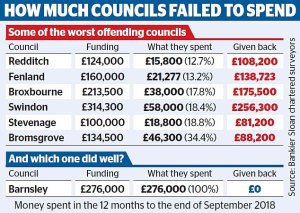
Embarrassingly, the council in former Communities Secretary Sajid Javid’s own constituency, Bromsgrove, Worcestershire, handed out only a third of the cash it had been given to help its High Street.

Mr Javid, now Home Secretary, was previously in charge of ensuring the fund was distributed by councils and had promised ‘absolutely no delay’ in doing so.

Yet figures collated by Retail Express and chartered surveyors Bankier Sloan reveal just £46,300 of the council’s £134,500 pot was given out in time — helping only 37 businesses.

Nearby Redditch Borough Council helped only 21 shops and spent just £15,800 out of £124,000, an eighth of its budget.

Stevenage Borough Council, Hertfordshire, gave cash to just five businesses in the town and awarded £18,800 out of a possible £100,000.

While Swindon Borough Council, Wiltshire, spent only £58,000 out of £314,300, helping 41 businesses — with more than a quarter of a million pounds leftover.

Fenland District Council, in Cambridgeshire, spent £21,277 out of almost £160,000, barely a seventh of its budget.

And Broxbourne Borough Council, in Hertfordshire, spent a fifth of its pot, distributing £38,000 out of £213,500 and helping only 31 shops.

Camden Council, North London, allocated 100 per cent of its fund, but said shop closures meant that, in the end, it was only able to hand out 86 per cent of it.

It meant that, despite distributing £4.84 million to businesses, it had £790,000 leftover.

By contrast, around 30 councils spent all of their funding. Barnsley Council, for example, spent every penny of its £276,000 and helped an incredible 2,135 businesses.

Jerry Schurder, head of business rates at consultancy Gerald Eve, branded the distribution of the grant ‘shambolic’.

He says: ‘It was a poorly designed fund by the Government and a knee-jerk response to the backlash against the rates revaluation.

‘It was then badly implemented by some councils which did not pay sufficient attention to the criteria.’

The fund was supposed to help the smallest businesses facing the greatest rises.

The Government decided how much money to allocate to each council by calculating the total increase in bills for firms facing a minimum 12.5 per cent rate rise and with a rateable value of less than £200,000 — the rental value on which business rates are based.

But many councils used this same rigid criteria when deciding which firms should receive cash —awarding it only to those hit by rate rises of more than 12.5 per cent.

In fact, councils had total freedom to spend the cash however they wished, as long as it went towards reducing business rates bills.

Some councils excluded businesses they felt did not need the cash as desperately, such as schools, banks and estate agents.

Meanwhile, multinational firms and Government bodies were typically excluded because they had exceeded state aid limits via other grants.

The Ministry of Housing, Communities and Local Government refused to say how much cash had not been spent.

But research by Retail Express suggests it was as much as £17.5 million — 10 per cent of the budget.

A series of Freedom of Information requests showed that 159 out of the 195 councils that replied had failed to spend all of their grant by the end of April.

The deadline to hand out the cash was actually September 30, but many councils stopped distributing the 2017/18 grant at the end of the financial year.

News editor of Retail Express, Jack Courtez, who led the research, says: ‘I think it is incredible that councils claim they are being squeezed by a lack of central Government funding, but when they do receive money they fail to distribute it.

‘Many councils have let down local businesses which depended on this funding.’

Chartered surveyor Ian Sloan, of Bankier Sloan, who contacted councils to warn them they faced a massive under-spend, says: ‘The distribution of this fund has been a mess. Local businesses have lost out on money they really needed and now the money is gone.’

Councillor Matt Dormer, leader of Redditch Borough Council, says that as the funding is drawn from general taxation, the council has ‘a duty to spend it in an appropriate manner, and not to simply seek to spend as much of it as possible.’

Bromsgrove Council says it had to bear in mind that ‘any relief given to people facing an increase in their rates gives them a competitive advantage.’

Broxbourne Borough Council said that ‘100 per cent of businesses who completed and returned application forms were granted the relief.’ Swindon Council says it had to award cash automatically when few firms applied.

Stevenage Borough Council said it has already granted £32,392 of the £36,000 it has been allocated for the coming year. And Fenland Council says it would give higher amounts to successful firms this year as a result of the low take-up of the relief in 2017/18.

Camden’s Councillor Richard Olszewski says the council awarded all of its funds but ‘due to businesses moving in and out of the borough and a substantial number of successful rating appeals’ it was then unable to distribute it all before the deadline. This year it has over-allocated funds to allow for business turnover.

A total of £175 million was supposed to have been handed out in 2017/18, followed by £85 million this year, then £35 million in 2019/20 and £5 million in 2020/2021.

A Government spokesman says: ‘To help local businesses thrive, we have introduced over £10 billion worth of business rates support so nearly a third of all business pay no rates at all.’ “

https://www.thisismoney.co.uk/money/news/article-6335101/The-Chancellors-got-1-6bn-help-shops-councils-failed-make-use-helping-hand.html

Why we need independent councillors

From the blog of Claire Wright. The review would NOT be happening without Claire’s dogged persistence (and similar action by EDA Independent Councillor Martin Shaw. Without them these issues would be kicked into the very, very long grass!

“A Devon wide review of how carers are coping will take place, following my successful proposal at last month’s Devon County Council Health and Adult Care Scrutiny Committee meeting.

I had been carrying out research into this area since January, when I asked for more information on a scrutiny report, which suggested that carers may be struggling.

I had a meeting with officers and asked for a report of a focus group that was carried out last autumn (2017). …

The results (which I was asked not to publish) were worrying. In almost all areas carers who took part indicated that they were worse off, or saw services being poorer.

What came out strongly to me that the three key areas of health, financial support and respite care, were all deemed as being poorer, according to the carers who took part.

I proposed a review at the June scrutiny committee meeting but chair, Sara Randall Johnson suggested a meeting with Devon Carers staff first, at the Westbank League of Friends. Devon Carers is commissioned to provide support for carers in the Devon County Council area.

This was a useful meeting. What emerged for me, among other issues, was that under the Care Act 2014, the bar has been raised by the government for both financial support and for respite care so it is now harder to access. I am quite certain that this is partly the reason that carers are finding things tougher.

I asked for a further agenda item for the September Health and Adult Care Scrutiny Committee meeting. I invited two carers who had asked for my help – Maureen Phillips and Mary Hyland, who gave powerful and moving presentations of their experiences of caring. Maureen, for her father and Mary for her partner.

Mary said there is no respite care available. And that overnight she became a carer, she was thrown into it, she knew nothing about it and had to give up her job. She has no support and finds it hard to even leave the house. Previously, she was a very outgoing person, even having her own programme on BBC Radio Devon. She said she was there on behalf of all local carers. Everyone is finding things hard.

The committee was silent.

Maureen said she had been the carer to her father for eight years. Life is exhausting, demanding, frustrating and isolating, she said. Maureen said specialist support workers are required. She said both she and her father need emotional support. She asked who she should turn to when things get tough. There is a shortage of care workers. In the last eight years she had one holiday. She had to take her father with her. Maureen said she had to fight for every bit of support. She has turned to the services of a solicitor in desperation.

When I made the proposal for a spotlight review at the September meeting, it was seconded by the chair and agreed by the committee. I hope to have a date for the first meeting soon.

We need your help! If you would like to take part by giving your story to the spotlight review, please get in touch at claire@claire-wright.org – many thanks

Here’s the webcast: You can see Mary’s and Maureen’s presentation under public participation – https://devoncc.public-i.tv/core/portal/webcast_interactive/359701

The agenda item itself is under number 12..”

http://www.claire-wright.org/index.php/post/scrutiny_review_to_take_place_into_how_devon_carers_are_coping

Richest households to gain 14 times more cash than poor households from budget

“… Despite the chancellor setting out £55bn in spending on Monday, the Resolution Foundation concluded that 84 per cent of the income tax cuts will go to the top half of the income distribution.

“The richest tenth of households are set to gain 14 times as much in cash terms next year from the income tax and benefit giveaways in the Budget as the poorest tenth of households,” its post-Budget report stated.

“Meanwhile, income tax cuts announced yesterday will overwhelmingly benefit richer households, with almost half of the long-term gains going to the top 10 per cent of households.” …

https://www.independent.co.uk/news/uk/politics/budget-2018-philip-hammond-income-tax-cuts-austerity-finance-economy-chancellor-statement-a8608231.html

Get your school toilet rolls here!

Yesterday’s budget promised “a one-off £400m “bonus” to help schools buy “the little extras they need” this year”.

Note that this CANNOT be used for staffing – only one-off purchases (such as toilet rolls which some schools have asked parents for help to buy).

https://www.independent.co.uk/news/education/education-news/school-funding-teachers-parents-national-education-union-neu-austerity-a8282236.html