If you don’t want the NHS to be a political weapon – depoliticise it!

NHS bosses have said that the NHS should not be used as a political weapon in the forthcoming general election:

https://www.bbc.co.uk/news/election-2019-50282333

But it will ALWAYS be used as a political weapon if it is given annual sums of money or has very short-term plans made by the political party currently in power, as is the case now.

The solution is to make the NHS independent of politics, have a long-term funding plan and have it run by non-politically appointed staff.

You can’t have it both ways.

“Super-rich prepare to leave UK ‘within minutes’ if Labour wins election”

Oh dear …austerity for the rich, that will be interesting!

https://www.theguardian.com/news/2019/nov/02/super-rich-leave-uk-labour-election-win-jeremy-corbyn-wealth-taxes?CMP=Share_iOSApp_Other

Screwed NHS more screwed: Tory bed cuts cause chaos

“The NHS needs thousands of extra beds to prevent patients being subjected to “corridor care” this winter, doctors have said.

The Royal College of Emergency Medicine (RCEM) analysed NHS data and found that 4,000 to 6,000 extra beds were needed to “keep emergency departments moving” by ensuring that patients could be accommodated.

Katherine Henderson, president of the college, said: “Our number one priority is to put an end to ‘corridor care’ this winter. To do this we will need at least 4,000 extra staffed beds.

“Emergency departments aim to have most patients treated and back home on the same day, but nearly a third of all patients who go to major A&Es needed to be admitted to a bed.

“A lack of beds means that many patients have to wait long times in undignified conditions, often on a trolley in a corridor. Last year nearly a third of a million people waited for over 12 hours. No patient should have to experience this for even a couple of hours, let alone for over half a day as some do.”

It is deemed unsafe if more than 85 per cent of available beds are occupied at any one time because this would leave hospitals unable to cope with surges in demand. Last winter occupancy rates hit an average of 93.5 per cent, Dr Henderson said, adding that more than 15,000 beds, or about one in ten, had been lost since 2010.

This summer was the worst ever in terms of the number of patients waiting more than 12 hours for a hospital bed, she said.

“This is a difficult position to be going into winter in. Without more beds, with appropriate nursing staffing, we fear we may be in for another record-breaking winter,” she added.

An NHS spokesman said: “The NHS will indeed be opening up thousands of beds over the next few months, based on the local availability of nurses and other staff. Hospitals will also be working closely with community health services and local authorities’ home care and care home services.”

A Department of Health and Social Care spokesman said: “We have invested £240 million in adult social care to ease pressures this winter by getting patients home quicker and freeing up hospital beds across England.”

Source:Times (paywall)

Water companies enraged that OFWAT is putting consumers before investors

“Top investors in the water industry have complained to the Treasury that the regulator Ofwat is being politicised and warned of a flood of appeals against its financial demands.

International investors that control suppliers including Anglian, Yorkshire, Affinity, South East and South Staffs led a delegation this month ahead of a crunch ruling on prices by Ofwat, due in December. They are reeling from the toughest draft settlement from the regulator in years and fearful of Labour’s pledge to renationalise the sector at a big discount to market value.

After years of taking huge dividends from water companies and piling debt onto them, while paying minimal corporation tax and overseeing scandals such as sewage spills and water leaks, utility investors have seen the industry and political environment turn toxic.

Ofwat, chaired by former Anglian Water boss Jonson Cox, stunned the sector in July when it rejected the spending plans of all but three companies and sent the other 14 back to the drawing board, demanding more efficiency, faster paydown of debt and better customer service. It will publish its final ruling on their 2020-25 spending plans in December.

The meeting on October 14 is believed to have included blue-chip investors such as German insurer Allianz, Singapore sovereign wealth fund GIC, Deutsche Bank’s wealth division and Australia’s IFM Investors. Among the issues raised was Ofwat’s independence and the dangers of it reacting to political pressure.

Cox has been on a crusade to clean up the sector. In an interview last year, Cox told The Sunday Times: “This industry still doesn’t accept that customers should be at the heart of this business. We are unwinding one of the last bits of the pre-crash bonanza: buying an asset and gearing it up.”

Investors also asked senior mandarins whether the Competition and Markets Authority had the resources to deal with simultaneous appeals against Ofwat’s financial stipulations. At least five suppliers are believed to considering appeals.

The funds called on the Treasury to assess the financial resilience of the sector, after companies including Thames and Northumbrian complained that Ofwat’s demands were “unfinanceable”.

Global investors have ploughed billions of pounds into former state-owned companies since the privatisation wave of the 1980s and 1990s, yet are increasingly reassessing whether the UK is still an attractive place to park their cash.

Ultra-low interest rates and the need for returns inflated asset values and led to a bidding war for infrastructure companies. However, the appetite for water companies has cooled over the past two years. The Sunday Times revealed in April that Labour planned to renationalise the industry at a big discount to market value, making deductions for “asset-stripping since privatisation”.

That and Ofwat’s clampdown have spooked local authority pension funds, which have belatedly begun pouring cash into infrastructure. GLIL, which invests the pensions of council staff, was among the attendees at the Treasury meeting.

Last month, Alain Carrier, European boss of the CAN$400bn (£239bn) Canada Pension Plan Investment Board, which owns a stake in Anglian, said: “It’s difficult for the regulator under the current political climate not to be seen to be very tough. The independence of the regulator is under some pressure.”

Ofwat said: “Our decision-making is independent from government and based on delivering the very best for customers. Investors have always made clear they value the independence of the regulatory regime.”

Source: Sunday Times (pay wall)

“£14 Billion ‘wasted’ by the government on ‘botched’ outsourcing”

“The government has wasted at least £14 billion between 2016 and 2019 on poorly managed outsourcing contracts finds a report from the Reform Think Tank.

The report is based on an analysis of investigations by the National Audit Office NAO), Parliamentary Select Committees and other statutory bodies. The total value of the contracts investigated was £71.1 billion.

The Ministry of Defence accounts for 27 per cent of this waste. This includes a 17 year delay in the full decommissioning of nuclear submarines and a poorly planned army recruitment programme. This saw soldiers forced into backoffice jobs to clear an IT backlog created by an untested IT system created in partnership between the army and Capita.

Other examples include the vastly expensive liquidation of Carrillion, which cost the government at least £148 million as well as involving the time and resources of 14 government departments and public bodies.

Also the Department for Education continued to give Learndirect £105 million after the programme was rated ‘inadequate’ by Ofsted. This should have led to the funding being withdrawn.

A third of the government’s annual budget is spent on outsourced services, at a total of ££292 Billion.

Reform is now calling for an independent regulator of the outsourcing sector which – unlike the NAO or Select Committees would have the power to enforce change and impose sanctions on failing providers.

Senior Researcher and Reform procurement lead, Dr Joshua Pritchard said “Our public services cannot function without outsourcing. But when it goes wrong, it’s taxpayers who end up footing the bill

“The £14.3 billion wasted as a result of poorly drawn up and managed government contracts is inexcusable.

“We need a new regulator with the power to prevent public money being squandered because of totally avoidable mistakes.”

£14 Billion ‘wasted’ by the government on ‘botched’ outsourcing

“Senior role in East Devon’s ruling cabinet has been axed”

So, the “transformation” role in Ben Ingham’s TiggerTory cabinet has been abolished by said leader.

How convenient – no more pesky questions about the Leader’s pre-election promise to move from a Cabinet system to a committee system, more representative of the diverse groups that now exist.

Councillor Millar, understandably, believed “transformation” meant changes to the way officers AND councillors would work. Instead it seems Leader Ingham sees “transformation” as applying to more commercialisation of council services and more revenue-boosting asset-sweating or selling. In other words, a continuation of the previous Tory policies – local government as business rather than public service.

More BOGOF (buy one, get one free) than transformation!

“… No reason for the decision of the leader of the council to not replace the portfolio holder position is stated in the papers ahead of the meeting. …

Instead, the cabinet collectively will take on responsibility for delivery of the Council Plan and the associated strategies of Fit for Purpose, Careful Choices and Commercialisation of Services.

The report says that Cllr Jess Bailey, Corporate Services Portfolio holder, will take on responsibility for Digital by Design and Systems Thinking, while Cllr Geoff Pook, Asset Management Portfolio holder, will now be responsible for Commercialisation of Assets rather than Revenue Generation.

… Next Wednesday’s meeting will also see changes made to committee membership as a result of the political balance of the council changes following Cllr Millar’s resignation from the Independent Group.

The council now consists of 19 members in the Independent Group, 19 Conservatives, 11 from the East Devon Alliance, eight Liberal Democrats, two Green Party members, and one Independent, Cllr Millar.

Sitting as an Independent, he is entitled to two seats across all the committees, and the full council is recommended to approve a proposal that would see the ruling Independent Group lose a seat on both the Overview Committee and the Licensing and Enforcement Committee.”

https://www.devonlive.com/news/devon-news/senior-role-east-devons-ruling-3442021

“New report reveals alarming shortage of country doctors”

“Hospitals in rural and coastal Britain are struggling to recruit senior medical staff, leaving many worryingly “under-doctored”, a major new report seen exclusively by the Observer reveals. Some hospitals in those areas appointed no consultants last year, raising fears that the NHS may become a two-tier service across the UK with care dependent on where people live.

Disclosure of the stark urban-rural split emerged in a census of consultant posts across the UK undertaken by the Royal College of Physicians (RCP), whose president, Andrew Goddard, has warned that patients’ lives may be at risk because some hospitals do not have enough senior doctors.

Just 13% of consultants appointed in England last year went to hospitals serving mainly rural or coastal areas, with the other 87% being hired by those with mainly urban populations.
…”

https://www.theguardian.com/society/2019/oct/13/nhs-consultant-shortage-rural-coastal-areas?CMP=Share_iOSApp_Other

“To save on teaching costs, school heads are increasingly busting the 30-child limit — illegal for pupils under seven” [including Broadclyst]

“Broadclyst school [photograph from article above]in Devon has a specially built classroom where 67 children are taught simultaneously. Though unions say such class sizes are detrimental to learning, the school’s head teacher insists pupils are offered an “excellent education”.

It looks more like a lecture theatre than a primary school classroom. Welcome to Broadclyst Community Primary School in Devon, where year 6 pupils are taught in a class of 67 — sometimes with just one teacher.

A Sunday Times investigation has found that cash-strapped primary schools are packing pupils into giant classes to boost their budgets. A school receives between £3,500 and £5,000 a year for each child. More than 559,000 primary pupils were taught in “super-size classes” averaging more than 30 children last year, compared with 501,000 five years earlier, according to our analysis of official data.

In parts of northwest England — including Oldham, Bury, Trafford and Tameside — a quarter of primary children are being taught in such big classes, as per-pupil funding encourages heads to fill their classrooms.

It is illegal to teach children under the age of seven in classes of more than 30 pupils, but there are no such rules for older children. But we have found that nearly 5% of pupils aged 5-7, roughly 73,000 children, were taught in classes of more than 30 last year. Some heads use just one teacher for occasional classes of more than 60 pupils. Broadclyst has one of the highest average class sizes, 42, and at times teaches 67 older children together in a specially built room.

Teaching unions and experts have always warned that such big class sizes damage children’s education. But this weekend Jonathan Bishop, Broadclyst’s head teacher, defended the policy, insisting that the school, about five miles northeast of Exeter, offered an excellent education, and class size “was not the big factor” in a good-quality education.

The school is rated as “outstanding” by the regulator Ofsted.

Bishop said: “I do not think 30 is a magic number to get better-quality education. It is not class size that dictates the quality of education. Our year 6 classroom has got 67 children in one room. There are times when one teacher teaches those 67 children. Is that wrong? Of course it is not wrong.

“Our year 6 classroom is designed like a lecture theatre: I can seat 67 children in there. I know I will be public enemy No 1 by saying this.”

Experts warned that the UK was moving inexorably towards the giant classes found in parts of Asia.”

Source: Times (pay wall)

AveragecUK earnings increase 2p per hour in two years – top 1% earnings go up £7 per hour in same period

“The top 1% of high earners in the UK have enjoyed a 7.6% real terms pay increase over the last two years, while the average worker’s pay rose by just 2p an hour.

A TUC analysis of government hourly pay data between 2016 and 2018 shows thatpay among the very top earners increased at a faster rate than any other group.

People in the top bracket saw their pay increase by an average of 7.6% from £58.73 in 2016 to £63.18 in 2018, according to the Office for National Statistics (ONS) annual survey of hours and earnings. Over the same period, the real terms pay of average workers rose by just 0.1% or 2p to from £12.71 to £12.73.

The TUC said that average pay in real terms, when adjusted for inflation, was still worth less in real terms than before the financial crisis continuing the biggest squeeze on wages since the end of the Napoleonic Wars.

Frances O’Grady, general secretary of the TUC, warned that the gap between the richest and everyone else will continue to widen under the prime minister, Boris Johnson’s planned tax cut for high earners, which will cost the Treasury £9.6bn a year, according to the Institute for Fiscal Studies (IFS).

“While millions struggle with Britain’s cost of living crisis, pay for those at top is back in the fast lane,” O’Grady said. “We need an economy that works for everyone, not just the richest 1%. Boris Johnson’s promised tax giveaway to high earners would only make things worse. The prime minister is focused on helping his wealthy mates and donors, not working people.” …

https://www.theguardian.com/money/2019/oct/12/average-uk-earners-gained-just-2p-per-hour-in-two-years-tuc-reveals?CMP=Share_iOSApp_Other

“Doctors fear winter crisis chaos is looming in Devon”

“Fears of a winter crisis chaos across hospitals have been raised after new figures have shown A&E waiting times in parts of Devon are already worse than would be expected during the hardest months of the year.

NHS figures show 72.8 per cent of people arriving at Royal Devon and Exeter NHS trust’s major A&Es waited less than four hours before being admitted, discharged or transferred.

It is the trust’s worst performance since A&E waiting times began to be measured on a monthly basis in June 2015. Performance has been deteriorating at the trust since March this year. The target is 95 per cent.

The RD&E says the reason is due to ‘very high’ patient demand, staffing pressures and shortages in the care sector.

The British Medical Association (BMA) has warned poor A&E performance in September meant the NHS was on a “collision course” for what is likely to be the worst winter ever.

Overall, 81.9 per cent of patients waited less than four hours at all A&Es and minor injury units run by the RD&E in September.

Across England, 77 per cent of people waited less than four hours in major A&Es in September before being admitted, discharged or transferred.

BMA council chair Dr Chaand Nagpaul said: “The NHS has just experienced its worst-ever summer. This is incredibly alarming and should be taken as a serious warning sign of the chaos that is likely to unfold in the NHS this coming winter.

“With summer performance now as bad as recent winters, we have reached a point of year-round crisis and the Government cannot continue to let this happen.

“September A&E waits were the worst performance record outside of winter since 2010 and trolley waits and referrals to treatment are worse than we have seen in the last decade.

“Patient care is suffering, NHS staff working tirelessly around the clock are suffering, and with Brexit on the horizon and early indicators of an extremely cold winter, we are on a collision course for what is likely to be the worst winter ever.

“This is a serious plea – we need to see investment across the board including community and social care, and resources such as more beds, reaching the frontline now.”

https://www.devonlive.com/news/devon-news/doctors-fear-winter-crisis-chaos-3419929

Such good timing: “Decision on whether fire stations will be axed delayed until just before Christmas”

“Devon residents [and firefighters Owl adds] could get an unwanted early Christmas present in the form of cuts to their fire service.

The Devon and Somerset Fire and Rescue Service has been consulting with the public on its Safer Together programme, which looks at how fire stations, engines and crews can be best deployed for the future needs of the two counties.

Among the proposed changes include Appledore, Ashburton, Budleigh Salterton, Colyton, Kingston, Porlock, Topsham, and Woolacombe fire stations closing.

A decision on which savings proposals would be taken forward and implemented was originally due to be taken by the fire authority in early-November.

The fire service confirmed that around 3,300 surveys had been completed during the 12-week consultation window, and it also received 700 written submissions and five petitions on the subject.

The responses are now being independently analysed by the Swansea-based firm Opinion Research Services, with formal proposals coming to the fire authority on December 18, rather than November 8 as originally hoped. ….”

https://www.devonlive.com/news/devon-news/decision-whether-fire-stations-axed-3410173

Nurse shortage now a serious Health and Safety issue for patients and nurses

“The Royal College of Nursing (RCN) has published a report today, called ‘Standing up for patient and public safety’, outlining the serious staffing crisis and its potential causes.

The report warns of the need for legal responsibilities regarding the supply and planning of the health and care workforce. It says they need ‘Investment, long-term solutions and legislation to futureproof the workforce’.

This comes after current NHS figures show that there are now a record 43,671 empty nursing positions in the NHS in England alone, with 12% of posts are now without a full time Registered Nurse (RN).

RCN have stated in the report that there must be clearer roles, responsibility and accountability with workforce planning and supply, clearly defined in law.

Since 2017, the number of nurses in England joining the professional register for the first time has consistently been lower than the number of people leaving the register,
Recent polling for the RCN pointed out that 80% of the public agrees that the Government should have a legal responsibility for ensuring there are enough nursing staff.

This issue is having a knock-on effect on patient care, with new analysis showing that wards working with less than 50% of the expected registered nurses were twice as likely to admit they had to compromise on care.

This is why RCN have said, it is no longer the time to be discussing whether we need law, but rather how we secure these vital changes in legislation.

Despite the fact that The Health and Social Care Act (2012) devolved many of the roles and responsibilities on this issue, the RCN report shows that the subsequent poor clarity across all parts of the health system has left parts of it in ‘limbo’ and limited any potential progress on the staffing the crisis.

Dame Donna Kinnair, chief executive and general secretary of the Royal College of Nursing said:

“Nurses are working harder than ever to deliver safe patient care but are being held back by a system that is legally lacking teeth. Despite the public, patients and nurses all agreeing that clarity is needed on responsibilities for delivering enough nurses, we have yet to see any government pledge anything of the like, and as a result are staring down the barrel at a record 43k empty nursing posts.

“We know how dangerous it can be when there aren’t enough nurses to provide care, but at present, almost all accountability rests with the frontline nurse working on the understaffed ward, rather than those responsible for the system they work in. We believe the time has come for change and that patient care was future-proofed by law, and that from the government down, decision makers are held to account.

“Without these bold changes, the public and staff within health and care services cannot be confident that safe and effective care can be delivered, risking the health of patients now and in the future.”

In September, after pressure from RCN members, NHS England and NHS Improvement stated that the issue of accountability for workforce planning and supply remains an area that needs be resolved.

The alarming new report indicates clearly why action is needed to tackle the current workforce crisis but also to ensure there is a sustained investment in the future workforce, at least £1bn per year, according to the RCN.”

http://www.nationalhealthexecutive.com/Health-Service-Focus/nursing-workforce-have-shrunk-at-an-alarming-rate-says-rcn-as-nursing-vacancies-rise-to-record-highs

“District bosses accused of neglecting Cranbrook – but they say authority faces its own finanical pressures”

“The district council has been accused of neglecting its duties to support Cranbrook compared to other towns across East Devon.

In two letters sent to East Devon District Council’s (EDDC) deputy CEO, Richard Cohen, Cranbrook Town Council chairman Les Bayliss urged the authority to integrate Cranbrook and provide it with the same level of support it gives other towns. Cllr Bayliss said: “If Cranbrook is to continue to flourish, the community needs the district council’s investment.”

The town council has asked EDDC to help cover sizeable ground maintenance costs for Cranbrook’s country park.

Cllr Bayliss said a ‘substantial’ amount of council tax in Cranbrook – which is the fifth-highest tax in England out of more than 10,000 parishes – goes towards maintaining the green space. Cllr Bayliss said the maintenance costs are in the region of £200,000 per annum, adding: “It is clearly unfair that the cost burden is carried by Cranbrook taxpayers alone.”

The town council has also demanded the district council provides 500m² of commercial space in Cranbrook’s eagerly-awaited town centre. Cllr Bayliss said: “The development of [the] town centre in Cranbrook has not commenced to date, despite discussion among various partner organisations for many years.”

However, in a letter in response to the concerns, EDDC CEO Mark Williams blamed the district council’s own financial difficulties it faces in the short to medium-term future for its perceived lack of support.

He said: “It will increasingly be the case that communities will have to expect to fund their own assets as principal councils are fundamentally compelled by the Government to focus on statutory services.”

Mr Williams also dismissed the town council’s request for help funding the country park maintenance cost.

He said: “Representatives of our countryside service held extensive discussions with Cranbrook Town Council on a management plan that we initially submitted to [Cranbrook] Consortium with our proposals and costs associated with managing and adopting the country park… I assume that in seeking transfer of the land to the town council, you will have assessed the cost of managing and maintaining the land and reflected this in the precept amount you are charging your residents.”

https://www.midweekherald.co.uk/news/cranbrook-funding-request-to-eddc-1-6298803

Promises about south-west economy? Let’s check some very recent onest first to see if they happen!

Four years ago, the current government made the following promises about what they would do for the south-west.

Check for yourself whether any of them have come to pass!

“The Prime Minister and Chancellor today (Monday 26 January 2015) set out their six point long term economic plan for the south-west showing what has been delivered, what is underway and what more can be done to support the regional economy in the long term.

At a speech at the National Aquarium in Plymouth the Chancellor set out the detailed plan as part of a day-long tour of the south-west, on which he was joined by the Prime Minister.

The plan includes six points:

1) increase the size of the regional economy by £6.4bn in real terms by 2030 – equivalent to over £1,000 per person – by increasing the long term growth rate of the south-west to at least the long term growth rate of the whole UK

2) create over 150,000 new jobs in the south-west by supporting private businesses, advanced manufacturing and skills to ensure we maintain the current high rate of job creation

3) deliver at least £7.2 billion of investment in transport in the south-west and deliver a step change in digital connectivity, supporting the complete dualling of key roads including the A303, and the full electrification of Brunel’s Great Western Main Line including brand new electric trains, together with exploring the feasibility of a dedicated rail franchise for the south-west and delivering 95% superfast connectivity by 2017 through the government’s superfast broadband programme

4) support the tourism sector to draw more people to the south-west’s beautiful countryside and coastlines, with the aim of increasing the number of annual overseas visits to the south-west to 3 million by 2020, creating around 7,000 more jobs

5) ensure the world class defence assets and cyber security industry of the south-west provide the maximum benefit to the local economy; this includes new plans to expand the economic benefits of the Royal Navy and Royal Marines in Devon, the Army at Salisbury Plain, and the defence industries near Bristol, so we sustain 59,000 defence industry, 36,500 military and 17,000 civilian defence jobs in the region.

6) build on the south-west’s existing reputation in life and agricultural sciences and boost science more broadly, supporting tech clusters, green energy, promoting skills development and an innovative rural economy

There are no quick fixes to achieving these important goals, so the Prime Minister and Chancellor are also setting out a specific timetable to deliver the key concepts of this plan over the five years of the next parliament, and the following decade.

As important next steps in the plan for the south-west, the pair announced a number of new measures to improve transport links, boost tourism, and invest in defence:

developing a comprehensive rail strategy for the south-west by setting up a south-west Peninsula Rail Task Force – this strategy will increase resilience, reduce journey times, and increase capacity, responding to the 3-point plan of the south-west Connectivity Study. It will also address the question of the potential re-opening the inland rail route between Exeter and Plymouth

Coastal Communities Fund (CCF): the Chancellor today announced the successful bids for the CCF, a £10m package which will support coastal communities and is estimated to bring over 75,000 visitors to the region. This investment will create over 860 new jobs (direct and indirect) and support over 225 businesses, generating over £12m in increased visitor spending

Chancellor announced a new £2m challenge fund as part of the GREAT Britain campaign to promote regions and cities including in the south-west, to international tourists, students and businesses. He also said that he wants to see government support for a Mayflower exhibition in Plymouth in the run up to the 400th anniversary in 2020

south-west will be a centre of operations for the Army, Navy, Royal Marines and cyber security. The Chancellor therefore today announced a £900m investment in the Salisbury Plain area to create new service and technical accommodation for the army. GCHQ will also continue to play a major role in supporting the cyber security industry in the region, including by recruiting over 400 cyber specialists, the majority of whom will work in the region

working with leading experts to support the south-west’s technology and skills base: Mark Walport and Sally Davies bring together leading figures from industry, the NHS and academia to explore the potential for new proposals for investment in life sciences in the south-west, with a particular focus on medical technologies

As both the Prime Minister and Chancellor have set out clearly, the only way for the UK’s recovery to be truly sustainable is for it to be truly national. While the challenge is significant, so is the prize ahead. By pursuing this plan, the Prime Minister and Chancellor, aim to achieve real outcomes for the people of the south-west who have already seen the fastest employment growth in the UK.

The Prime Minister and Chancellor will be visiting a variety of businesses and institutions across the south-west to hear how the government’s long term economic plan is delivering for them and what more can be done to support the region.

The Chancellor will started the day by visiting a local fishing business in Cornwall, before delivering a key note speech at one of the south-west’s best known tourist attractions.

He will go on to visit one of the south-west’s largest defence employers before being joined by the Prime Minister to visit a local college and successful small business that has benefitted from the region’s recovery under the government’s long term economic plan.

The Chancellor of the Exchequer, George Osborne said in his speech:

The south-west contains some of Britain’s greatest economic strengths. It should be as central to our nation’s future prosperity as any other part of these islands. And the Prime Minister and I are determined that it will be.

That’s why I am here today, to set out our long term economic plan for the south-west – and why the Prime Minister will be joining me later today to seek local support for it. The plan I set out is based on this insight. Over the last thirty or forty years our economy has become more imbalanced, with the gap growing between London and the rest of the country. Our ambition is to reverse that – and it can be achieved.

He added:

What we need is a coherent plan that identifies those strengths, makes them stronger still – and connects them to each other so that the whole is greater than the sum of its parts. If you look at the south-west, stretching from Wiltshire and Bristol, to Somerset and Dorset, down to Cornwall and Devon, of course, you see the differences – they all have a unique identity. But you also see the strengths they have in common.

What are they? There’s the beautiful countryside and coastline that makes this one of the most attractive parts of the UK, and one of the most visited. There’s the industries that thrive in this landscape – the agriculture, the fishing and the tourism – that are more important here than many places. But there’s also the great universities, the incredible science happening here, skills and high tech manufacturing associated with the strong relationship with our armed forces. Bring these ingredients together with better transport links and you have a very attractive place to invest, to grow a business and to build a life.

Speaking in Plymouth, he concluded:

So we have a long term economic plan for the south-west. It aims to create over a hundred and fifty thousand jobs. It seeks to add over £6 billion to the local economy – equivalent to over £1,000 per person. It will support the future of our defence forces and capitalise on their economic benefit. It will deliver the next step for national cyber intelligence, and other world leading scientific innovation. It will make the most of the countryside and coastal towns.

Our long term plan for the south-west is about recognising the value of both its natural beauty and the economic strengths nurtured by the people who live here. It says that we can only have a truly national recovery if we get behind the private sector, put in the transport, support the tourism, the science and the industries of the future. And it says that if we do that: the future is bright in the west. It is a commitment to you – and to your future. And with your help, we will help deliver it.

The Prime Minister, David Cameron said:

Our long-term economic plan for the south-west is about making life better for hardworking local people. It involves backing business to create more jobs, improving transport links and building on the region’s strengths to secure a brighter future.

For too long, people living in this part of the country have suffered from Britain’s unbalanced economy – from the growing gap between London and the rest. That is what this plan sets out to change – to ensure that Britain’s recovery really is a recovery for all

Further information: timetable for action and implementation in the south-west 2015-2030

2015

Connectivity
Road Investment Strategy announced at Autumn Statement 2014 will see £9.4bn committed to new schemes nationwide. £2bn of that will be spent in the south-west, including upgrading of the M5, M49, A303, A30, A358 and A417 to reduce bottlenecks and provide motorway quality journeys

establishment of a south-west Peninsula Rail task force to develop a comprehensive rail strategy for the south-west, which will address the question of potentially re-opening the inland rail link from Exeter to Plymouth via Okehampton and Tavistock that could improve local connectivity

Network Rail develops plans for western rail access to Heathrow, based on a link from the Great Western Main line, which could potentially deliver a 30 minute reduction in journey times between Heathrow, the Thames Valley and all points west for 12 million residents, benefitting the whole UK economy

government will explore the case for establishing a new dedicated Devon and Cornwall franchise for the south-west of England, bringing together parts of the current Great Western and south-west Trains franchises into a coherent whole to support better timetabling and provision of rail services to and within the south-west, not simply focused on journeys to London. Alongside this, government would like to encourage local government in the region to come together to form Rail south-west, with the long term aim of devolving the franchise to local decision makers (subject to the development of satisfactory capability to let and manage such contracts)
negotiations with First Group over the Great Western Main Line franchise will be completed, with the aim being to secure significant improvements to trains and journey times to the south-west

work under the Filton Four Tracks Programme will get underway to double the track between Bristol’s two main stations, reducing journey times and increasing passenger and freight services

contracts are being signed to take superfast broadband coverage to 95% by 2017. . Technology pilots, including one in Exmoor National Park, will test innovative ways to bring coverage to the final 5% of premises

Technology and innovation

Agri-Tech Catalyst programme will spend £70m (which will be matched by private sector funding) nationwide up to 2018/19, with funds already allocated to a number of projects amounting to almost £1m for firms and universities in the south-west and a further round of bids currently ongoing
ensuring that knowledge gained by research activity is transferred and applied in farm businesses to improve efficiency and competitiveness has been identified as a priority for £1.5m of funding from the Rural Development Programme (RDP) by the Cornwall and the Isles of Scilly LEP
completion of the conversion of Bristol Planetarium in a 3d Data Visualisation Dome by April 2015. This forms part of the Bristol R&D Testbed, a key component of the “Bristol is Open” initiative. The Testbed, which has received £4.3m of government funding, is a joint venture between the City and the University of Bristol and will create the world’s first Open Progammable city testbed, linking data from across the city so that companies can test equipment, applications and software in a real world environment

both the 3D Visualisation Dome and the R&D Testbed are already generating interest from researchers, companies and universities around the world

government is contributing £4m towards the £16.5m cost of the West of England University Enterprise Zone in Bristol, which will focus on robotics and health technologies. Construction will begin in March

first phase of the Met Office’s High Performance Computer in Exeter will be operational by September, helping to cement the UK’s position as a world leader in weather and climate prediction and potentially delivering £2bn of socio-economic benefits to the UK

business cases for ‘wind engineering’ project benefiting Bath and Exeter will be developed

Heart of the South West LEP has identified as a priority projects to provide advisory services and knowledge transfer around Agri Sciences; promote SME competitiveness through giving business skills support; bring superfast broadband to areas not covered by the Superfast Extension Roll-out; help rural businesses to understand how superfast broadband can support them and offer bespoke support to those businesses that will benefit the most; and encourage rural businesses to reach new markets, seeking £15.5m through the rural development programme

UKTI south-west will launch their Global Entrepreneur Programme, which will attract entrepreneur-led, innovation-rich businesses from all over the world

Tourism and housing

investment of £4.4m to refund up to 50,000 Chinese tourist visas in the financial year 2015/16 to encourage more Chinese tourists to visit the UK and visit regions outside of London
this parliament, £532m has already been allocated to Local Authorities to deliver 25,580 affordable homes and 7,783 households in the south-west have completed mortgages with the support of Help to Buy

Get Britain Building scheme has committed to an investment of £54.1m which has already seen 456 homes out of a total of 700 delivered in the south-west. The remaining homes will be completed by 2017

Large Sites Fund has committed £52m to sites in the South West with 914 homes (out of a total of 6500 for the site) already completed at Cranbrook and building of homes at Sherford expected to begin in May

decisions on proposals for eight Housing Zones in the south-west are expected by Budget. These zones have requested £29m in funding and, if supported, could provide over 11,500 homes
further building projects are being assessed in the south-west under the following schemes and, assuming they are approved, work will begin in 2015. The Builders Finance Fund is considering a shortlist of 19 projects with a potential total investment of £66.8m, which could deliver 1,299 units.

The Large Sites Infrastructure fund is considering a shortlist of ten projects with a potential total investment of £149m. The infrastructure being considered under this scheme has the potential to unlock 22,795 homes. Local Growth (housing infrastructure) fund is considering a shortlist of five projects with a potential total investment of £35.2m. The infrastructure being considered under this scheme has the potential to unlock 2,919 homes

Rural Economy

south-west will benefit from its share of the £3.5bn for investment up to 2020 under the Rural Development Programme (RDP) to boost farming, food, the rural economy and protect the natural environment; including £68m already allocated to be spent on local growth schemes in the region. Some of the projects that LEPs have prioritised for funding include £9.4m to support agriculture through diverse projects covering livestock and horticultural support through to farmer specific renewable technologies such as fuel generated from biogas plants, and £1.4m to roll out farm scale Anaerobic Digestion plants which could serve as heat distribution networks or energy storage in Cornwall and the Isles of Scilly

homes across the south-west will be better protected from floods thanks to an unprecedented six-year £2.3 billion flood defence programme, announced at Autumn Statement, providing better protection for at least 300,000 households by 2021. £149m of this will be invested in the South West with £19m being spent in financial year 2015/16. The programme will also support economic recovery and growth, working alongside partners including private companies, local planning authorities and Local Enterprise Partnerships (LEPs). Overall, the national programme will help avoid over £30bn in long-term economic damages. Some of the projects that are likely to see work started over the next 6 years are:
the £30.9m flood defence scheme in Exeter to protect 4149 properties in the area.

the £8.8m Dawlish Warren and Exmouth beach management scheme which will help protect almost 3000 homes and businesses.
the £4.4m Exmouth tidal defence scheme, protecting 1099 properties in the area.

the £3.4m Congresbury Yeo tidal banks project to protect 4,101 homes and businesses.

the £3.3m Parret Estuary at Cannington Bends to protect 1257 properties.

government will invest £535.4m through PFI credits in essential waste management infrastructure in the south-west over the next six years. This will amount to £74.1m in financial year 2015 to 2016.

Defence

£3.2bn is already being spent on the maintenance and repair of ships and yards, including HMNB Devonport, where it sustains 4000 jobs

second offshore patrol vessel built at Appledore shipyard is expected to be handed over to the Irish Navy

A400M is a multi-national tactical and strategic lift aircraft with over 170 ordered so far by partner countries. All the wings will be made in Filton, securing 8,000 jobs. 24 pairs of wings will be delivered to the MoD and customers in other partner nations in 2015

£15m contract to militarise the new Royal Fleet Auxiliary tankers awarded to A&P Engineering, based in Falmouth
investment in Salisbury Plain to create the new Army Basing Area for units returning from Germany – £900m to create service personnel accommodation and infrastructure, with the work being competed down the supply chain. In addition 1000 Service Families Homes to be built in this area by 2020
£1.4M of LIBOR fines will be used to improve childcare provision for service personnel in the South West. This will be spent on upgrading or opening new facilities across Tidworth, Warminster, Perham Down, Blandford, Bovington, Taunton, Collingwood and Bulford

£1M in LIBOR fines will be used for a Gurkha Homes project in Wiltshire which will build small clusters of homes for older Gurkha veterans and their partners

2016
Connectivity

electrification of rail lines from London to Bristol, Newbury and Oxford will be completed as part of an investment in 235miles of new electric lines, making journeys smoother and more comfortable for passengers and quieter for people living near railways

Bristol area rail improvements begin, including converting Filton Abbeywood station to four platforms, an extra platform at Bristol Parkway and two new platforms and major investment at Bristol Temple Meads plus a new junction will be created at Bristol East

Technology and Innovation

work completed on the West of England University Enterprise Zone, the first clients expected by July

Tourism and housing

Large Sites Infrastructure fund will issue contracts for further schemes by March

Rural economy

ongoing work on key flood defence works will see investment of £33.5m in financial year 2016 to 2017

ongoing investment in essential waste management infrastructure through PFI credits in the south-west will amount to £85.7m in financial year 2016 to 2017
Defence

28 pairs of wings for the A400M tactical and strategic lift aircraft will be delivered to UK and partner nations, safeguarding 8000 jobs building their wings in Filton
third maritime patrol vessel built at Appledore shipyard is expected to be handed over to the Irish Navy

2017

Connectivity

electrification of rail lines from London to Cardiff complete
first IEP super express trains will be introduced by Great Western, improving reliability and reducing environmental impacts

Superfast broadband coverage reaches 95%

Tourism and Housing

700 new homes will have been built in the south-west supported by £55m of investment through the Get Britain Building scheme

Rural economy

by the end of 2017, through the Priority School Building Programme, 16 schools will have been rebuilt or refurbished, with capacity for nearly 6,000 children

ongoing work on key flood defence works will see investment of £26.3m in financial year 2017 to 2018

ongoing investment in essential waste management infrastructure through PFI credits in the south-west will amount to £89.5m in financial year 2017 to 2018

Technology and Innovation

Met Office’s new High Performance Computer will be fully operational

‘Wind Engineering’ projects will commence.

government rollout of superfast broadband will reach 95% of premises nationwide.

Defence

26 pairs of wings for the A400m tactical and strategic lift aircraft will be delivered to partner nations

2018

Rural economy

ongoing work on key flood defence works will see investment of £20.7m in financial year 2018 to 2018
ongoing investment in essential waste management infrastructure through PFI credits in the south-west will amount to £91.8m in financial year 2018 to 2019.

Defence

first aircraft carrier with parts made in Devon begins initial trials and operations

28 pairs of wings for the A400m tactical and strategic lift aircraft will be delivered to partner nations. This includes the pair for the final UK aircraft

2019

Connectivity

if the business case is approved, work on the western rail access to Heathrow could begin as early as 2019
Rural economy

ongoing work on key flood defence works will see investment of £15.3m in financial year 2019 to 20

ongoing investment in essential waste management infrastructure through PFI credits in the south-west will amount to £94m in financial year 2019 to 20

Defence

28 pairs of wings for the A400m tactical and strategic lift aircraft will be delivered to partner nations

1000 Service Personnel homes and 3000 single living accommodation will be completed in the Salisbury Plain Area.

An extra 4600 service personnel will live and work around Salisbury Plain

2020

Connectivity

construction will begin on the Stonehenge tunnel

Rural economy

ongoing work on key flood defence works will see investment of £22m in financial year 2020 to 2021 with work completed to: protect 4149 properties through the flood defence scheme in Exeter; protect almost 3000 homes and businesses through the Dawlish Warren and Exmouth beach management scheme; protect 1099 properties through the Exmouth tidal defence scheme;

protect 4,101 homes and businesses through the Congresbury and Yeo tidal banks project;

protect 1257 properties through work on the Parret Estuary at Cannington Bends

ongoing investment in essential waste management

infrastructure in the south-west will amount to £100.4m in financial year 2020 to 2021

Defence

28 pairs of wings for the A400m tactical and strategic lift aircraft will be delivered to partner nations

first Scout vehicles will enter service with the British Army. The Scout was announced at the NATO summit in Cardiff last year and has received 589 orders. Part of it will be designed by Thales in Bristol

all British troops will have left Germany and be based at new locations around Salisbury Plain

2021-2025

Connectivity

if the business case is approved, work on the western rail access to Heathrow could be completed as early as 2023
work to upgrade the M5, M49, A303, A30, A358 and A417 under the road investment strategy complete by 2021″

https://www.gov.uk/government/news/long-term-economic-plan-for-the-south-west-unveiled

“Cuts to youth services to reach breaking point during critical time for youth community support”

Cuts to youth services to reach breaking point during critical time for youth community support

Tories massively borrow their way out of austerity with an election coming up

“A marked deterioration in the public finances means Sajid Javid will have to relax borrowing limits if the government is to boost spending and cut taxes before an early general election.

With the Treasury preparing for the the autumn budget, data from the Office for National Statistics (ONS) showed that the slowing economy and a series of accounting changes had made life more difficult for the chancellor.

Boris Johnson’s government has pledged higher spending for the NHS, schools and the police since it was formed in late July, but against the backdrop of an economy flirting with recession. The ONS said borrowing in the first five months of the financial year was up 28% on the same period a year ago, at more than £31bn.

In addition, changes to the way the ONS accounts for student debt and public sector pensions, together with new corporation tax data, means the size of the deficit in the last full financial year, 2018-19, has almost doubled. A deficit of £23.6bn has been revised up to £41.3bn.

Analysts said that if the trend for the first months of 2019-20 continued for the rest of the year the deficit would be close to £53bn, £12bn higher than the government’s fiscal watchdog, the Office for Budget Responsibility, estimated in March.

The government’s fiscal rules stipulate that borrowing in 2020-21 should be below 2% of national output after taking into account the state of the economy. Achieving that would require either spending cuts or tax increases amounting to 0.5% of gross domestic product – about £10bn.

Andrew Wishart, the UK economist at Capital Economics, said the existing fiscal target was “dead in the water”. …”

https://www.theguardian.com/politics/2019/sep/24/tories-increase-borrowing-by-28-as-possible-election-looms?CMP=Share_iOSApp_Other

East Devon Alliance DCC Councillor Shaw on disgraceful NHS Property Services

Press Release:

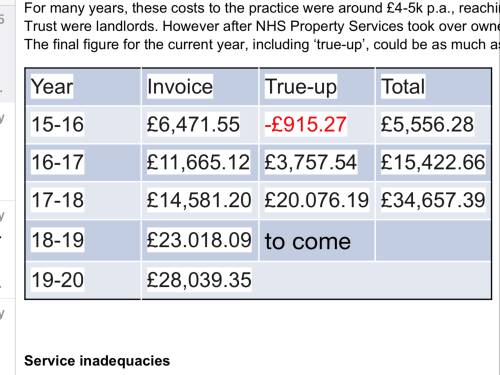
Summary: Since NHS Property Services was handed ownership of the small, single-story Health Centre (a building the size of a small bungalow) in Colyton in 2016, they have increased basic service charges to the Seaton and Colyton Medical Practice from £6471 to £23018 over 4 years (a 330 per cent increase).

Together with ‘true-up’ charges, the total charges demanded rose from £5556 to £34657 in just two years (a 560 per cent increase), and could top £40k this year.

At the same time the actual service provided has deteriorated. The Centre was without hot water for 3 months until earlier this month, as NHS PS failed to replace the boiler.

The practice is disputing all charges since 2016-17.
The practice has been attempting to negotiate with NHS PS but they have refused to reduce the charges to a reasonable level.

I have brought the matter to Health Scrutiny to ask them to investigate.

I have discovered that the BMA said earlier this year: ‘‘GP leaders have been warning since 2016 that huge extra costs imposed through service charge hikes could force practices to close if they were not reversed.’

I am worried that unless this issue is resolved, the 4000 people in Colyton, Colyford and surrounding rural area could lose the health centre which they rely on.

PAPER FOR DISCUSSION:

NHS Property Services and Colyton Health Centre

Colyton Health Centre is the only GP facility serving the town of Colyton and the surrounding rural area. Seaton and Colyton Medical Practice runs a busy branch surgery in the centre, with a GP and a nurse there all day Monday to Friday. The area has a growing and ageing population, with around 40 per cent over age 65. The Centre is located close to the heart of the town, within walking distance for most of its population.

The Centre maintenance charges

The Centre is a small, single storey building dating from 1960s which the Practice rents from NHS Property Services. The practice pays rent, together with 63 per cent of the costs of running the building.

For many years, these costs to the practice were around £4-5k p.a., reaching £5.5k in 2015-16, the final year with North Devon NHS Trust were landlords. However after NHS Property Services took over ownership of the property in 2016, they escalated enormously. The final figure for the current year, including ‘true-up’, could be as much as £40,000.

[Table here reproduced by photograph]

Service inadequacies

On top of this, the services the practice receives have deteriorated. NHS Property Services contract out the maintenance of the property to Mitie, and there have many examples of when jobs have been badly managed, the problem has been exacerbated rather than fixed, or the jobs have just not been carried out at all.

The Practice Manager states: ‘When preparing for a recent CQC inspection, we had to stick the floor in the nurses’ room down with duct tape as our request to replace it made 5 months previously had not been actioned.

We also discovered that basic fire checks had not been carried out. I have recently been approached by contractors wishing to carry out electrical work requested in 2016 but never actioned, the grass went uncut for most of the summer and in June the boiler was condemned so we have had no hot water or means to heat the building since then.’

The boiler was finally replaced last week but this has only uncovered more problems and the centre remains without hot water after more than 3 months.

Inappropriate charges

The practice has been attempting to negotiate with their landlords for over a year, and from information NHS Property Services have sent in the course of these negotiations they have realised that what they are being billed for is inaccurate.

They are charged over £2,500 per year for grounds maintenance including watering and maintaining of containers (they don’t have any), 4 hours of grass cutting every 2 weeks (they had a wild flower meadow in front of the surgery by July and since then contractors have been twice, each time for about 40 minutes) and fortnightly litter pick-ups (they have never seen anyone picking up litter.)
They have also been charged for the fitting of bed alarms for patients, but there are no beds in Colyton Health Centre (or anywhere else in the Axe Valley).

The unresolved issues

Charges for 2016-17 and 2017-18 remain in dispute, while the company has not yet provided a final figure for 2018-19.

After over a year of negotiations, the Practice has been unable to resolve these amounts or to persuade the company to agree a level of ongoing maintenance charges which would be appropriate to this small building.

The Practice Manager states: ‘We have spent an enormous amount of time as a practice attempting to achieve an acceptable solution which is fair and reflects the work carried out on the building, but so far to no avail. The maintenance is poor and impacts on staff and patients, while the astronomical rise in maintenance charges means we have to seriously consider the financial viability of continuing to operate from this site, something we definitely wish to do.’

Our requests to the Scrutiny Committee

I have brought this to the Committee because the Seaton and Colyton Medical Practice has been unsuccessful over an extended period of time in negotiating a reasonable level of charges and adequate delivery of the maintenance service.

They now feel it is appropriate that there should be public scrutiny of this situation, stating:

‘We appreciate your time in allowing us to bring this matter to your attention, and we would welcome the support of the committee in our attempt to resolve these issues in a satisfactory manner, which will allow us to focus on delivering healthcare to the people of Colyton and the surrounding area.’

As the County Councillor for Seaton and Colyton, representing not only the Practice but also the thousands of patients whom it serves, I hope the Committee will express its concern to NHS Property Services about this situation.

I also believe that the Committee should consider whether the way in which NHS Property Services has treated this practice raises issues about how the company manages properties across Devon.

County Councillor Martin Shaw”

“Funding for poorest pupils ‘cut by more than £220m’ in real terms since Tories came to power, figures reveal”

“Funding for the poorest children in England’s schools has been cut by more than £220m in real terms since the Conservatives came to power, analysis suggests.

Pupil premium money, which is given to schools to help support the most disadvantaged pupils, will have declined by 8.4 per cent in real terms by 2020, figures shared with The Independent show. …

The pupil premium, which is handed to schools for each child eligible for free school meals (FSM), will be worth £220m less by the end of this school year than in 2015, figures show. …”

It comes despite a manifesto commitment from the Conservatives to protect the pupil premium.”

https://www.independent.co.uk/news/education/education-news/pupil-premium-funding-schools-poorer-pupils-conservatives-austerity-a9113936.html

“25% of households at risk of homelessness are in work”

https://www.theguardian.com/society/2019/sep/15/25pc-households-at-risk-of-homelessness-are-in-work?CMP=Share_iOSApp_Other

“We can revive Britain’s high streets. But developers stand in the way”

“… there are just fewer and fewer drivers of footfall. You cannot get your hair cut online, so barbers – like nail bars, tattoo parlours and tanning salons – buck the downward trend. But we only need so many of these. Greggs and to-go food stores are buoyant; gyms and takeaways are the only sectors showing double-digit net growth, says PwC. But even that feels precarious. Delivery apps are driving growth in the takeaway sector but, if in-person purchases fall, these could quickly migrate to so-called dark kitchens on industrial estates.

“The reality is we may need fewer high streets in the future,” says a PwC spokesperson. “This opens opportunities to repurpose high street space, while [evolving] to meet consumer demand.”

But what will that look like? In 2011 Mary Portas, retail expert and Cameron-era government consultant, lobbied for an anti-clone-town drive to remodel high streets around independent shops. But bar a few niche fashion, gift or record shops, supermarkets marched relentlessly on. The butcher, baker and candlestick-maker now work in Tesco.

Consequently councils and property developers increasingly want to use food and drink to seed regeneration, many inspired by Altrincham’s Market House. In 2010, 30% of Altrincham’s shops lay empty. In 2014, the Market House opened – a communal dining hall of independent kitchens attached to a speciality market – and, since then, a remarkable ecology of bars, restaurants and coffee shops has evolved around it. Footfall has risen sharply, shop vacancy rates have fallen to 9.7% and brands such as JD Sports and Nando’s have moved into the town’s once-failing shopping area.

Market House’s operator, Nick Johnson, a former board member at property company Urban Splash, claims for the £635,000 it cost (£435,000 came from Trafford council, Johnson contributed the rest) : “It has probably delivered the greatest regeneration outputs of any project in 25 years.”

Little wonder councils love the idea: it allows them to cost-effectively reinvent one of the few central sites they still own, the market.

There are similar schemes in development countrywide. But it will be tough to repeat Altrincham’s success. First, it is a relatively affluent Greater Manchester town bordering Cheshire; and second, Johnson’s unorthodox curation of some exceptional foodie talent (like the artists on his friend Tony Wilson’s Factory records, none of the Altrincham traders have signed contracts) has provided an X factor that councils and developers will find hard to mimic.

There is also something about both the Portas and Altrincham models of handmade, artisan-roasted regeneration that, at their most crude, feel a bit myopically middle class. Mishandled, it can create silos of gentrification that alienate residents. Craft markets are great, but where does your nana buy a new washing line?

If town centres are to shrink and be redrawn, surely the ideal would be to intermingle viable businesses that attract different kinds of customers (in age and socioeconomic status), much as Trafford’s Stretford Mall is trying to blend hip new businesses into its established tenant mix. That fosters social cohesion but, commercially, there is strength in numbers, too – in making it easy to shop at Quality Save and Boots, Greggs and Stretford’s new Food Hall canteen, as mood or budget permits.

Not that this future should always have a commercial imperative. As town centres empty, there is a generational opportunity to reverse the gross monetisation of our public realm. This is a chance to make the principles of placemaking – creating inclusive public spaces where people can enjoy their leisure time without spending money – a reality. Nonprofit arts and cultural organisations forced out by high rents could, likewise, come back into empty shop units (long-term, not as a temporary gesture by developers), to re-engage local people with these spaces – and without it costing them £6 a pint.

But will any of this happen? The short answer is no. Councils do not have the money or the compulsory-purchase powers to radically intervene. Enlightened developers are rare. The patchwork of smaller private landlords who own peripheral space in town centres need to fill their properties, hence the fact that cool cottage industries tend to flourish there, in pockets. But the remote coalition of global property management, pension and investment funds that owns most shopping precincts or malls is, at best, distantly concerned with the local population.

Even if the retail property market crashes (in January, the Royal Institution of Chartered Surveyors warned unusually of “potential for significant changes in value”), such owners will consolidate, sell property, bulldoze it and redevelop, and if shopping centres can limp on, they will. Under new permitted development rights, closed high street retail units can now easily be turned into residential property.

Where will those new residents congregate? High streets may yet be reborn as the genuine heart of their communities, protected from commercial pressure, but don’t bet on it – and certainly not online.”

https://www.theguardian.com/commentisfree/2019/sep/14/britain-high-streets-developers-footfall?CMP=Share_iOSApp_Other