Draft Exe Estuary Management Plan 2016-2021 – public consultation today

THE PUBLIC CONSULTATION IS TODAY FROM 1pm – 8pm AT COUNTY HALL

WRITTEN RESPONSES BY 30 OCTOBER

“Draft Exe Estuary Management Plan 2016-2021

The draft Management Plan covering 2016-2021 for the Exe Estuary is now available through the link above for public consultation, for a six week period from 19th September to 30th October 2016. The plan has been reviewed since the Interim Management Plan 2012-2015, to take into consideration issues and changes that are highlighted in the updated State of the Exe Estuary 2014 report, and outlines policies, and five year objectives to ensure sustainable use of the Exe Estuary for the future.

A public consultation event will be held on Wenesday 5th October from 1pm to 8pm at County Hall, for those that would like to find out more about the Management Plan and offer their feedback. We will be able to offer guidance at the event on how you can best provide feedback during the consultation. In preparation, you may wish to consider these Guidance Questions.

The event will take place at the Council Chamber and Ante Chamber at County Hall, Topsham Road, Exeter, EX2 4QD. Travel information to the venue can be found here. I will be at the Council Chamber to enable access on the day.

If you are unable to make the workshop, please send your comments and observations via email to exeestua@devon.gov.uk. Please use the above Guidance Questions to help with your response, but we welcome comments on any aspects of the Management Plan. We strongly advise you to respond using ‘Track Changes’ within the document and state whether you are responding as an individual or on behalf of a group or organisation.

Your views are valuable to us and we appreciate your taking the time to read the document and make comments. We will endeavour to reply to everyone who takes part in the consultation (if we have contact details) and will consider all comments that are offered.”

https://www.exe-estuary.org/partnership-documents5

If devolution is the answer – what was the question?

Devolution doesn’t always mean taking back control

Since Tony Blair became prime minister in 1997, successive UK governments have fiddled around with ways of devolving power from Westminster and Whitehall. The most radical has been Scottish devolution, which continues to evolve. The least coherent has been the patchwork of schemes developed across England, ranging from a well-thought out arrangement for London, with a directly elected mayor and assembly, to the make-it-up-as-you-go-along “devolution deals” for the rest.

The coalition government of 2010-15 abolished – wisely – the regional governance bureaucracies. The first big replacement idea was Local Enterprise Partnerships (LEPs), intended as “business-led” mechanisms for spending public money. The areas covered by LEPs were in some cases obvious, based for example on established city regions or former metropolitan counties. In others the rationale was less clear, perhaps nowhere more so than the Heart of the South West (HotSW) LEP, covering a massive area from Plymouth to the south of Bristol [1]. It’s tempting to think that after Cornwall decided to go their own way and Bristol wasn’t having any truck with its Somerset neighbours, that HotSW was the “bit left over”.

The performance of these fundamentally secretive and undemocratic bodies is not the focus of this post [2]. They are relevant because the LEP areas have in some cases – including HotSW – formed the basis of the subsequent devolution proposals in England.

The government has been inviting groups of local authorities to submit proposals for devolving decision-making in certain functions, particularly infrastructure and economic development, but not limited to these.

The rationale behind this approach is that increasing productivity, a key goal of government policy, is best achieved by local targeting of support measures through local authorities and business interests working together.

The government has made it clear that access to some central funding is dependent on devolution deals being agreed. Invariably, local authorities across the area commit to setting up a “combined authority” to take the decisions. Unlike London, this would not be directly elected but would be made up of the leaders of the constituent councils plus non-elected representatives of the NHS and the LEP. Initially, agreement to having a directly-elected mayor was a condition of a devolution deal but the government now seems to be less rigid on this.

One of the problems with this approach is that it was designed for large urban areas. Greater Manchester, for example, has operated as a partnership of councils across a coherent area since the 1960s when Passenger Transport Authorities were set up. Manchester is the trail-blazer in the current devolution game, and it clearly works for them.

What is less clear is that the combined authority structure will work well in those areas of England that aren’t part of a conurbation. A pretentious-sounding body called The Independent Commission on Economic Growth and the Future of Public Services in Non-Metropolitan England produced a report last year arguing for devolution deals for the rest of England [3].

It does make the useful point that LEP areas do not in most cases coincide with functional economic areas (a conclusion which should be enough to discredit the whole idea of LEPs), but is otherwise a typical product of this debate in that it focusses on structures and “partnerships” from which communities are largely excluded.

The councils within the HotSW area have submitted a devolution bid to the government [4]. The bid identifies 6 challenges for the area (low productivity growth, limited labour market, patchy performance in innovation and enterprise, an ageing population, health and care integration, infrastructure and connectivity) and 6 “Golden Opportunities” for improving growth and productivity (marine, nuclear, aerospace and advanced engineering, data analytics, rural productivity, health and care). The bid has a wholly economic focus: other than in references to care, the word “social” does not appear in the document, and there is no acknowledgement of the impacts of the plans on the natural environment.

If the bid succeeds – and at least some of the councils are treating the whole exercise with a degree of caution – decision-making on the plans and services covered by the bid will be sucked upwards from the councils and the people they represent. How the combined authority will balance the interests of, say, Plymouth with those of people in the Mendips will be discussed in officer-led groups behind closed doors – because that is the only way “partnership” working can be made to operate in practice. The need to prepare for joint meetings gives authority officers huge influence over agendas and decisions because of the need to coordinate positions and identify common solutions in advance of meetings.

The combined authority itself will be made up of leaders of the constituent councils and others. It will not be directly elected. Trying to influence its decisions will be next to impossible for individuals and community groups. The bid’s economic focus ignores environmental and community questions completely, so being able to provide a counter-balance is hugely important. As it is, the bid’s environmental credentials are defined by the partnership’s LEP-led role as a cheerleader for the new Hinkley Point nuclear power station.

Other devolution bids across England generate similar challenges. At a time when disillusion with our politics is at an all-time high, it is puzzling – to put it mildly – that decision-making is to move even further away from the people most affected

NOTES:

[1] The map of LEP areas at http://www.lepnetwork.net/the-network-of-leps/ shows just how large the area is.

[2] An excellent House of Commons briefing note (July 2016) provides a concise guide to LEPs including reviews of their performance – see http://www.parliament.uk/briefing-papers/sn05651.pdf

[3] See http://www.local.gov.uk/non-met-commission

[4] The bid document is at https://new.devon.gov.uk/democracy/files/2016/01/Heart-of-the-South-West-Devolution-Prospectus.pdf

https://petercleasby.com/2016/09/30/devolution-is-not-control/

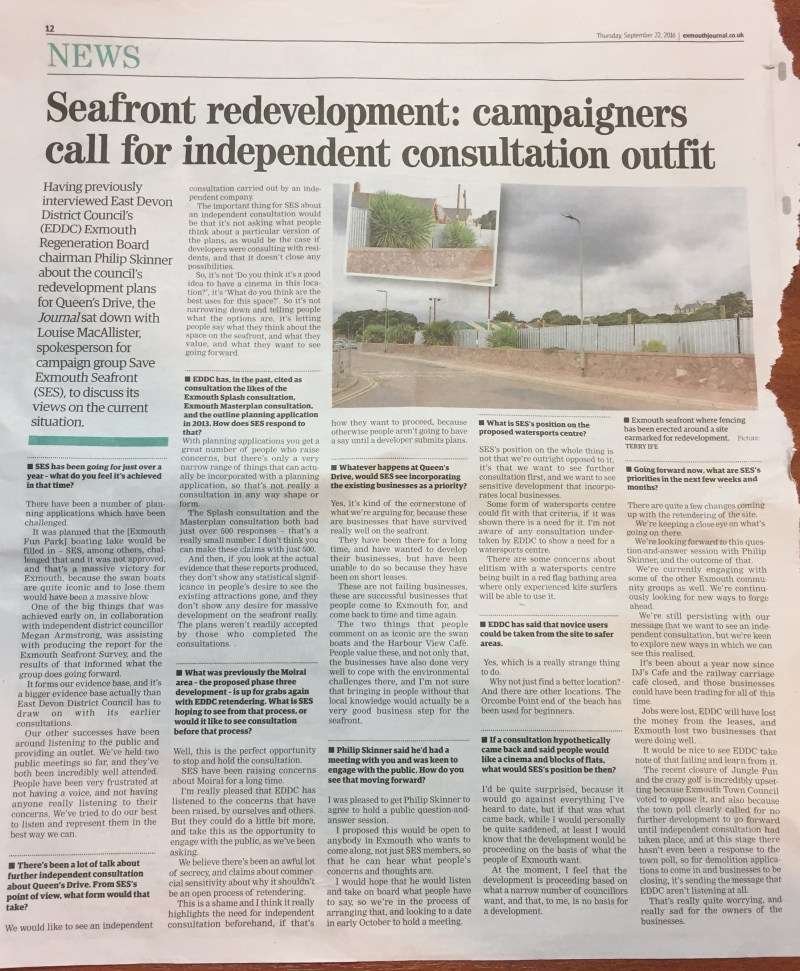
Exmouth seafront regeneration: an alternative view

In this week’s Exmouth Journal an interview with Dr Louise McAllister, spokesperson for Save our Seafront:

img_1304

Devolution “myths” not myths at all, says Devon County Councillor

From the Facebook page of Lib Dem Councillor for Totnes, Robert Vint:

“On Monday Devon County Councillors were presented with a “Myth Busting” training session on Devolution. On Thursday there was a repeat session for South Hams District Councillors.

The “Myths” they were attempting to “bust” were that the Devolution process was led by the LEP, was undemocratic, would result in local government reorganisation / centralisation etc.

The explanations – or non-explanations – only strengthened my concerns. It was confirmed that there would be no public consultation on the economic development plan but only on the Combined Authority proposal and that the LEP had played a central role.

I asked why the plan did not start by identifying local needs such as rural unemployment and affordable housing then consult communities and small businesses on how to tackle these problems. They said not to worry as this was an outline economic plan – but later they confirmed that there would be no consultation on the economic plan or any opportunity to change it.

We have a Devolution Prospectus written by the few big businesses in the LEP to serve their own needs rather than those of the wider community of Devon and Somerset. This has then been rubberstamped by local authorities who did not have the staff, time or vision to rewrite it to meet our real needs and who failed to consult residents and small and family businesses. As a result we will be subjected, without any opportunity to comment, to a local economic development strategy that will serve the wealthy rather than the majority and that will fail to provide jobs where they’re needed or houses to the people who need them most.

In contrast the RSA – Royal Society of Arts – outlines how we should be delivering genuine, fair and inclusive devolution (see below).

The UK’s economic status-quo has resulted in huge sections of our population being ‘left behind’. So the RSA are proposing a radical programme of devolution, inclusive industrial strategies and investment in human capital to create a more inclusive, equal society.

https://www.thersa.org/discover/publications-and-articles/rsa-blogs/2016/09/inclusive-growth-proposals

Honiton to lose all its hospital beds?

From the blog of Claire Wright, Independent councillor at Devon County Council and member of its Health Services committee.

Okehampton and Honiton Hospitals are set to lose all in-patient beds in a cost cutting exercise by local health services.

72 beds are to be cut from 143 in all, with four options that will be consulted on, although health bosses have a preferred option of keeping beds at Tiverton, Seaton and Exmouth.

Other hospitals at risk of losing all their inpatient beds are: Sidmouth and Whipton Hospital in Exeter

Health chiefs hope that the bed cuts will save £5-6m a year, with around 20 to 40 per cent of current running costs reinvested in creating health hubs and providing more care in people’s homes.

Some councillors had a briefing this afternoon from the chief executive of the “success regime” which has been drafted in by government to make significant cuts to counteract a deficit of around £430m by 2020.

We should remember that this area of Devon has already lost all inpatient beds at Ottery St Mary, Axminster, Crediton and Budleigh Salterton.

Discharging people from the RD&E in Exeter has never been more difficult.

Not only is there a funding crisis in the local NHS, there is also a funding crisis in social care locally, which is one of the reasons why people are unable to be discharged in a sensible length of time. This budget is hugely overspent at Devon County Council.

The consultation on the bed cuts is set to start on 7 October, with a decision made next February by the Northern, Eastern and Western Devon CCG (NEW Devon CCG). If agreed proposals will be implemented in March.

For my views on hospital bed losses see – http://www.claire-wright.org/index.php/post/health_scrutiny_committee_to_ask_to_health_select_committee_to_investigate

I was interviewed by BBC Spotlight about the cuts. Here’s how they reported the issue this evening, at 3 mins 43 – http://www.bbc.co.uk/iplayer/episode/b07v2gpz/spotlight-evening-news-21092016

For more detail see http://www.exeterexpressandecho.co.uk/where-will-72-community-hospital-beds-be-lost-in-devon/story-29738533-detail/story.html#R9PAwLxGj62bsWFV.99

The myth of local health consultations and “choices”

Our local health services are NOT overspent, they are underfunded.

We are NOT having to make “difficult choices” – we are being told what has been decided for us behind closed doors about the consequences of that underfunding.

“Public consultation” is far too little far too late. The decisions were made long ago about which services will suffer and we cannot reverse those decisions without a MASSIVE revolt against them, and even then concessions will be zero or minimal.

That is the reality.

If we want to change that most of us will have to vote out the people who brought us to this. Unpalatable for some, but the only course available to us.

Council record- keeping – an EDDC example

A recent comment on the original article:

“This finding should come as no surprise to EDDC.

In a decision published in January 2004, the Ombudsman found against EDDC in regard to a number of complaints concerning planning matters in Exmouth at Camperdown Terrace. The Ombudsman noted that

‘material relating to the application was misleading and gave no indication that the council was being asked to approve a 6.8 metre high metal boat racking system at the end of their small gardens, nor that the racks would be used for the storage of large motor boats which are moved around the site by a gigantic fork lift truck.‘

Consultees were not provided with sufficient information to make informed comments.

The Council’s record keeping was very poor and there was a failure to give adequate consideration to the points raised by the consultees and others who commented on the application. The Ombudsman found maladminstration causing injustice and recommended that …..

(g) “undertake a review of the record keeping by planning officers and the delegated decision making arrangemnents to ensure that proper records are kept and delegated decisions are made on the basis of written reports, so that those affected may see how a particular decision has been reached.”

The most striking sentence for me is “Consultees were not provided with sufficient information to make informed comments”. Anyone knowing anything about the Exmouth Masterplan consultation, in regard to Elizabeth Hall v Premier Inn, will appreciate how EDDC said one thing meant something quite different, how wanting to see the EH site improved was taken as meaning approval for a Premier Inn. EH is but one of very many examples.

Also, anyone who is familiar with EDDC’s answers to FOIs will be all too familiar with EDDC’s failure to keep proper records of decision making.

The record of this Ombudsman’s finding is no longer available online but I have the 24 page report should anyone want it.”

Straitgate Quarry: “environmental sabotage”

“Campaigners have hit out at final proposals for a potential quarry site on Ottery’s outskirts, which have been branded ‘environmental sabotage’.

The inclusion of Straitgate Farm as an earmarked area in the new Devon Minerals Plan (DMP) has received widespread opposition from residents, who are taking the chance to voice their objections as part of a public consultation.

Proposed modifications to the site exclude the stipulation of a one-metre ‘buffer zone’ originally included to safeguard water supplies – something campaigners fear will only increase the potential environmental damage.” …

http://www.sidmouthherald.co.uk/news/proposals_for_possible_quarry_site_in_ottery_st_mary_branded_environmental_sabotage_1_4653464

Local NHS “Success Regime” not succesful

“Criticisms have been made over how long it is taking to reach the public consultation stage of the Success Regime.

The national intervention programme is aimed at reducing Devon’s worrying massive health service debt.It has narrowed down its focus for cuts, but details of those are yet to be made public.

Assurances have been made there will be a public consultation as the programme is set to deliver significant changes and cuts to health services. However, despite hopes of a summer consultation, no date has yet been confirmed for when the information will be made public and when the consultation will begin. …”

http://www.exeterexpressandecho.co.uk/long-wait-continues-to-find-out-what-will-happen/story-29616016-detail/story.html

Exmouth regeneration: Spin, Skinner, Spin!

Q: When is an answer not an answer? A: when it is an EDDC senior councillor’s answer!

Transcribed from Exmouth Journal:

Q – We mentioned the visitor’s survey. If the outcome of the survey is that overwhelmingly visitors like the seafront the way it is and don’t want much to change, will that be the way the council then proceeds?

A – “The visitors’ survey doesn’t involve local people, it’s for visitors only. It will give us an indication of what visitors perceive is a visitor wish list when they go on holiday, what they like to see.

The interesting thing is this survey is being conducted by the South West Research Company, and we looked for a company from the South West because, when we talk about benchmarking Exmouth Against other seaside towns, it’s no good trying to compare Exmouth against Blackpool. We wanted to try and compare a South West offer with other South West seaside towns and resorts so we can see where we are.”

Umm…and the answer to the question is…?!

Sraitgate Quarry: time running out for views on modifications to plans

http://www.midweekherald.co.uk/news/final_chance_to_have_say_on_devon_s_future_quarry_plans_1_4646456

How to fail better in public services – be more honest and avoid superficial solutions

“The government must stop reaching for superficial solutions when explaining the failure of public services, according to an Institute for Government report released today.

In Failing Well, the Institute of Government analyses why organisations fail and makes recommendations on how to minimise the impact if and when things go wrong.

The report points to a raft of high-profile public service failures, such as Rotherham child services and Mid-Staffordshire Foundation Trust.

Within these and other examples, the institute found that cultures of denial, weak accountability and dysfunctional mechanisms for identifying failure “inhibited an effective response”.

It concluded that warning signs are often missed and that politicians routinely use “stock responses” to explain failures instead of seeking the root cause of the problem. …

… it was shown that the turnaround in performance [in case studies] was thanks to more honest reporting cultures, strong peer involvement, reinvigorated leadership and a shared ownership of failure. The tendency to restructure or lay blame, which is a standard organisational response to failure, was avoided. …

… “Failure is an ever-present threat in our public services – and the risks are increasing. Yet there are good and bad ways of responding to failure. Politicians too often use a superficial set of tools – restructuring a service or parceling out blame.

“But this won’t solve the problem: leadership, collaboration and transparency will,” she added. “Those overseeing turnarounds also need to hold their nerve and accept that performance can dip further as recovery begins.”

http://www.publicfinance.co.uk/news/2016/07/government-must-learn-fail-better-says-institute

EDDC “Communications”: pigs, flying, sky …. and ” avoiding the barking mad”!

Here is the introduction to EDDC’s new communications policy:

Communications Plan 2016-2020

… Purpose and scope of the communications plan

This plan aims to ensure we have good communications which improve residents’ lives, keep them informed and help them access services more easily.

This plan will help develop EDDC’s brand so that it becomes instantly recognisable and synonymous with our council plan priorities, values and key drivers of great customer service and value for money services in an outstanding place.

The more we involve and tell people about what we are doing and why, the better more informed they will feel. We have a great story to tell and we need to tell it well – this means effectively and consistently. …

Addressing local priorities

This plan aims to deliver effective communications to our customers. We strongly believe that customers who are informed about our services and benefits are more positive in their view of the Council than those who are not so informed.

Our Council Plan outlines that we will ‘continuously improve to be an outstanding council’ and that we will ‘prioritise keeping our residents informed’.

This communication plan will support the communication of the priorities and outcomes in the Council Plan:

 Encouraging communities to be outstanding
 Developing an outstanding local economy
 Delivering and promoting our outstanding environment
 Continuously improving to be an outstanding council

Principles underpinning this action plan:
 Communication and reputation management is a top-table issue

It’s about avoiding the ‘barking mad’ by thinking about everything we do and everything we say/don’t say from a reputation management perspective

 Stop talking about ‘they’ and start talking about ‘we’!

 We are all responsible for reputation management and communications.

 We think about different audiences: residents, members, officers, towns and
parishes, partners, business groups. …”

Click to access 280616-overview-agenda-combined.pdf

Whoops, big omission: they missed out developers from the last sentence!

Budleigh Salterton – onshore cable consultation to 5 September 2016 – questions to be answered

Here is the consultation letter and, below it, the maps showing the two possible routes that it might follow onshore.  Also details of where and when representatives of the project will be available for questioning.

Several points spring to mind:

How wide will trenches be?
Will roads need to be closed and, if so, for how long?
How big is the converter station?
Why are some of the cables put in fields, yet others are embedded in roads? Roads particularly affected are the B3178 disrupting Budleigh Salterton, East Budleigh and Colaton Raleigh and the B3184 to the airport, Many other key strategic routes will also be cut across and possibly interrupted, including the A30 and also the railway line.
The two routes out of Budleigh Salterton are very sensitive environmental areas – moleing underground was originally mentioned but seems to have been dropped

The consultation letter (followed by maps of alternative routes included with the letter)

I am writing to invite you to take part a public consultation on proposals to build a 220 kilometre underground and subsea electricity interconnector and converter station which will see power flowing between France, the Channel Island of Alderney, and East Devon.

The FAB Project has the approval of the UK energy regulator Ofgem to build the interconnector, linking the British electricity grid from the existing National Grid substation at Broadclyst to the French grid to help ensure the security of supply to both the UK and the continent. Alderney Renewable Energy (ARE) and Transmission Investment LLP formed a joint venture company, FAB Link, and FAB Link is working with the French grid company RTE – Reseau de Transport d’Electricite – to develop the FAB Project.

The project also intends to take advantage of proposed tidal generators in Alderney to provide reliable, sustainable and low-carbon electricity for consumers on both sides of the Channel, hence the FAB name, which stands for France-Alderney-Britain. It is also our intention to increase competition in electricity markets, cutting prices for consumers.

As shown in the enclosed maps, the cables would come ashore in Britain at Budleigh Salterton and thereafter would run underground between the coast and a new above-ground converter station.

The interconnector cables would run completely underground between the coast and a new above-ground converter station to be built near Exeter International Airport. From the converter station the high-voltage DC electricity transmitted through the interconnector would be converted to or from high-voltage AC current used by the National Grid. Further underground cables would then link up with the grid at Broadclyst. There will be no pylons associated with the FAB Project, and our intention is that we will leave the environment along the route exactly as we found it.

We are holding three public consultation events in East Devon and one public consultation event in Alderney where we will be able to explain our project in more detail. Each of the events is open to the public from 2pm to 8pm. They are:
• Tuesday, 26th July, 2016: Temple Methodist Church Hall, Budleigh Salterton;
• Wednesday, 27th July, 2016: Younghayes Centre, Cranbrook;
• Thursday, 28th July 2016: Woodbury Park Hotel, Woodbury;

The events will provide you with opportunities to express your views on the project. The opinions of all stakeholders will help to inform our proposals for the route of the interconnector and the construction of the converter station before the relevant planning applications are submitted to the relevant authorities at the end of 2016.

If you are not able to attend one of the events, please visit our website to learn more. Copies of the detailed plans, technical reports and environmental appraisals of the onshore and offshore proposals available at the public consultation events will also be available online at http://www.fablink.net from 25th July, and there will be opportunities to express your opinions via the website, phone or by post. The consultation will run until 5th September 2016.

If you do not have access to the internet the information will also be available to view at Budleigh Salterton Library in Station Road, Budleigh Salterton, EX9 6RH, from 25th July to 5th September during normal library opening hours, which are currently 09.30-18.00 on Mondays, 09.30-13.00 on Wednesdays, 09.30-17.30 on Thursdays, and 09.30-13.00 on Fridays and Saturdays. Please note the library is not open on Tuesdays or Sundays.

Route 1

8 x 10 in. (1)

Route 2:

8 x 10 in. (1)


Advice for the new Communities Minister on Devolution

So many instututions are now seeing what is wrong with devolution deals – but does the newly-constituted government care? Does it have the time or the will to care? Great words on inequality and a government that failed to understand ordinary people from Mrs May but will actions follow?

But the final sentence below on “networks and influence” is chilling, and just about negates the rest of the advice and may be pointing another, more worrying, way.

” … Grasp the democratic opportunity of devolution. With mayoral elections due next spring in the devolution deal areas, a more devolved system of governance will soon have new faces and voices, which will contribute to a shift in the political centre of gravity away from Westminster.

Yet democratic engagement through devolution should not begin and end with mayors. The speed of the process has created little space for democratic innovation to accompany reform, but there is an opportunity now for a richer democratic discussion, already being led by councillors, to take place. The next phase should be much more directly shaped by local people who need to feel more connected to the tangible opportunities reform can bring – open policymaking, citizens juries and using digital tools to reach people in new ways.

Above all, the new secretary of state shouldn’t think of devolution as giving power away, but as enhancing his own ability to get results. We live in an age that respects networks, not hierarchies. Some of the shocks convulsing through the institutions of Westminster and Brussels are the effects of this. The traditional clunking levers of Whitehall machinery struggle for impact in a complex, interdependent world. So use devolution as an opportunity to create a different model of governance – where influence and relationships are prime.

We look forward to seeing where Javid takes devolution next.”

http://www.publicfinance.co.uk/opinion/2016/07/five-priorities-new-communities-and-local-government-secretary

Does our Police and Crime Commissioner know East Devon is on her patch?

This is her official diary until the end of this year – Exeter and Tiverton seem to be the nearest she gets to us:

http://www.devonandcornwall-pcc.gov.uk/meetings-and-events/calendar/

Sidmouth: EDDC reasserts its authority over Port Royal

Probably stung by the popularity (and speed) of local residents who were able to organise and display interesting designs for Port Royal, EDDC has now announced funding for a scoping study (i.e. a PRE-study study) for the area. Not everyone is happy about the prospect:

EDDC deputy chief executive Richard Cohen added: “Good proposals, which are innovative as well as practically and financially possible, will be critical to the success of Port Royal’s development.

“Throughout the process, there will be a clear focus on consultation and collaboration with local people, businesses and organisations, to ensure that any future development is achieved with their understanding.

“The improvements that this scheme will bring about will help maintain Sidmouth as one of the UK’s premier seaside resorts.”

But concerns were voiced at Monday’s town council meeting.

Councillor Ian McKenzie-Edwards said: “A lot of funding in Seaton came from Tesco. OK, it funded Seaton Jurassic, but two of the businesses it replaced were in tourism. Seaton is at a pretty low ebb. Tesco is a hell of a way of getting funding.”

Cllr Louise Cole welcomed the opportunity to regenerate eastern town, but said: “There’s a massive issue of trust between EDDC and the community.

“People are very concerned their voices aren’t heard. The two latest developments [the Knowle redevelopment and plans for a business park in Sidford] have reaffirmed that. People are extremely angry.”

Cllr Turner countered that people had always been cynical and it was up to the councils to try to involve them in the process.”

Mr Cohen expects the £10,000 project to be completed by mid-November, with a decision on the next step before Christmas.

http://www.sidmouthherald.co.uk/news/councils_scoping_out_future_of_port_royal_1_4608377

Cabinet to rubber-stamp devolution deal with no consultation with members or public

“Heart of the South West Formal Devolution Bid (pages 52-56)

This report seeks approval to sign up ‘in principle’ to the pursuit of a Devolution Deal and the creation of a Combined Authority for the Heart of the South West sub- region to administer the powers devolved through the Deal. An ‘in principle’ agreement from all of the authorities, partners and MPs involved in the Heart of the South West devolution process will open up negotiations with Treasury to work towards a deal.”

Click to access cabinet130716combinedagenda.pdf

Cranbrook – “Virtual Town Council Consultation Group”

“VIRTUAL TOWN COUNCIL CONSULTATION GROUP

Do you have something to say, but don’t have the time to attend meetings?

Do you have ideas about how to improve Cranbrook?

Do you have ideas about how you would like to see services provided, changed or improved? …

Then join our Virtual Town Council Consultation Group – which we are setting up in response to residents who have indicated that they would like to be involved in the future of the town but are unable to attend meetings or are unable to become a councillor.

As a member of the Virtual Group we will send you emails asking you for your opinions on a range of topics which will help us and partner organisations make decisions. You decide how often and when you would like to answer.
By becoming a member you will help the Town Council to provide an accessible and responsive service and you will be amongst the first to hear about news and updates.”

If you want to be part of this exciting initiative please email us at clerk@cranbrooktowncouncil.gov.uk. https://www.youtube.com/watch?v=ZjO-2O5Hmj8

But no mention of what happens when the “Virtual Consultation Group” overwhelmingly disagrees with the councillors!

The legal requirements of consultation … watch out, EDDC!

“Clearly in austerity times the moment of reckoning approaches where traditional well tried strategies and tactics of keeping posts vacant, business process/organisation design, efficiencies, productivity improvement, mergers and outsourcing will not alone balance the budget and services will need to be rationed or cut entirely.

Furthermore take it as read if you are cutting a service that will have a detrimental effect on a current service user, it cannot be done without consulting those affected.

At the same time understandably your clients [written for lawyers dealing with local authorities] may be tempted to carry out a low-profile consultation for a number of reasons, not least the cost and fear of agitation of organised and political objections.

Well that’s local government.

[The paper goes on to set out current case law on consultation]

… what does this mean in a nutshell? It means that where there is a duty to consult going through the motions will not do. If there is a prescribed method such as set out in the primary or secondary legislation or by a code it must be followed and at the stage where the consultation feedback can be taken into account in the final decision making. Furthermore the case made clear that while there is no general common law duty to consult persons who may be affected by a measure before it is adopted an obligation to consult may arise because of the common law duty of fairness.

This year (February 2016) the Cabinet Office published guidelines on consultation. These are to be treated as expectations for local government too.

What this now means for consultation

The Courts have made a restatement as to who should be consulted and on what basis for consultation. This is of general application for all consultation. The key message is that consultations must be carried out fairly.

This can be summarised as Who, How, When, What and an Evidence Based Analysis:

1. Who do you consult? – In broad terms it is to let those who have a potential interest in the subject. In terms of who must be consulted the demands of fairness are expected to be somewhat higher when an authority contemplates depriving someone of an existing benefit or advantage than when the claimant is a bare applicant for a future benefit.

2. How? – So if a person is likely to lose something or be worse off, then they should be specifically identified and consulted. In Haringey all those affected were written to and the letters were hand delivered. This is considered to be sound practice. So if you know that an individual or household will be adversely affected an attempt must be made to contact them by preferably personal calling and hand delivered letters or by phone call and this be re-enforced by press releases and street and notice poster media.

Twitter “tweets” or council web pages augmented with Survey Monkey are not good enough on their own. If there are partners involved in the services such as health authorities or the third sector, get them involved and seek their view on the consultation and its message even if they may one day turn out to be objectors better you are on cordial or respectful terms with them.

3. When do you consult? – So when should consultation take place? You have to do it with sufficient time to let people know what you are thinking of doing, telling them what your options are and giving them time to reflect upon it and give their views to you that you can take them into account so:
Firstly – consultation must be at a time when proposals are still at a formative stage and give sufficient reasons for any proposal to permit a person to in the court’s words “give an intelligent consideration and response”.

Secondly – adequate time must be given for consideration and response, and,

Finally – the product of consultation must be conscientiously taken into account in finalising any statutory required proposals. This should be evidenced by a briefing document presented to the decision making body

4. On what basis? – The purpose of a statutory duty to consult is to ensure public participation in the local authority’s decision-making process. In order for the consultation to achieve that objective, it must fulfil certain minimum requirements.

Meaningful public participation in the decision-making process, in a context with which the general public cannot be expected to be familiar, requires that the consultees should be provided not only with information about proposals such as a draft scheme or policy, but also with an outline of the realistic alternatives, and an indication of the main reasons for the authority’s adoption of its preferred option.

The courts say that there is an obligation to let consultees know, “what the proposal is and exactly why it is under positive consideration”, and telling them enough (which may be a good deal) to enable them to make an intelligent response”.

5. An Evidence Based Analysis – Consultation will only be of use if the data collected from the consultation is properly handled and objectively managed.

This means there must be a sound methodology for data collection, processing and analysis. Responses must be clearly presented and not cherry picked so as to support a particular preferred approach.

This means the findings of a consultation are backed by evidence and where assumptions are made reasons for doing so are identified such as for example statistics supplied by other accredited organisations such as Government sources.

Consultation plans

What does this mean for services particularly in the context of austerity?

The key message is that the quantity and quality of information may need to be re-examined. Thus any strategy or policy likely to have an impact on the community needs to be founded on proper consultation. This is best done by drawing up a consultation plan.

Methodology of qualitative and quantitative collection handling and analysis needs to be stated. While judges are not expecting a full scale committee report to be sent to the public at large, effective consultation plans will need to have anyone likely to be affected specifically identified and targeted to receive information on the subject matter of the consultation and a strategy worked up on how they can be enabled to take part. …

http://localgovernmentlawyer.co.uk/index.php?option=com_content&view=article&id=27528%3Aconsultation-in-austerity-2016-a-practical-guide&catid=59&Itemid=27