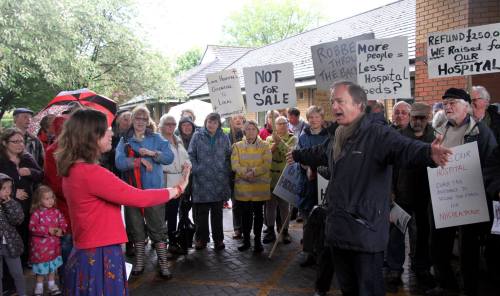
Claire Wright responds to Hugo Swire standing down at next election

“Independent parliamentary contender Claire Wright has said tonight she ‘stands ready to take on the issues’ important to people in East Devon after a shock announcement from her long time political opponent East Devon MP Sir Hugo Swire.

In a tweet sent out tonight the MP said he remained a supporter of Boris Johnson but will be standing down at the next General Election.

Nub News contacted Claire Wright, who came a close second in East Devon in the 2017 General Election, for her views on Sir Hugo’s announcement, she said:

“Party Politics is in turmoil. I stand ready to take on the issues that matter to people here in Devon East of health services straining to cope, underfunded schools and the irreparable damage to our environment under the watch of the current Conservative government which lurches from one crisis to another and has put narrow party political interest above the needs of local people.”

https://exmouth.nub.news/n/claire-wright-says-she-stands-ready-as-east-devon-mp-announces-departure?

“Claire Wright is ‘ready for the fight’ if general election called”

“It’s been an extraordinary and unprecedented few weeks in politics.

A man without scruple is now our prime minister, aided and abetted by a reckless adviser and the most hardline rightwing cabinet we have ever seen in this country.

In practice this means selling the soul of our country and the union, by morphing into the Brexit Party.

Expelling 21 moderate Conservatives on Tuesday evening, including Winston Churchill’s grandson and father of the house, Ken Clarke, has meant that the transition of the Conservative Party into the Brexit Party is already complete.

It was clear from the moment he took office that Mr Johnson’s plan was for a general election, to drive through a no deal Brexit, yet to try and dupe the electorate into thinking he wanted an amended withdrawal agreement from the EU.

He already knew his request for removal of the Irish backstop was firmly opposed by both the Irish government and by default the EU on peace grounds.

But more staggering than anything else has been the determination with which this government has lied, duped, schemed and plotted to achieve its nefarious aims.

Boris Johnson seems to be a man without principle. He has one aim. Power.

We also have a chancellor who is claiming austerity is over following a decade of cuts and misery, imposed by his own Conservative government.

£100m stripped from Devon County Council alone, which has hit children, the poorest, elderly and disabled people and those who don’t have a voice more than anyone else. I’ve seen the impacts of austerity on residents in my ward and it’s deeply disturbing.

But now, despite a no deal Brexit firmly on the table and the economic hit the country will take – around five per cent at least and a potential recession – Sajid Javid has launched an opportunistic vote grabbing budget, which implies that the austerity agenda was never more than a decision for a government determined to shrink the welfare state.

East Devon’s MP Hugo Swire is at the very heart of this government, robustly defending every move Mr Johnson makes.

A passionate supporter of a no deal Brexit, Mr Swire is now the epitome of the newly formed hardline rightwing Conservative-Brexit Party.

So a general election looms. Where does this leave me? Well my team and I have been preparing for a year and are on standby for battle.

This will be my third general election in four years, from a platform of over 21,000 votes in 2017.

I’m ready for the fight to come and I’m ready to enter parliament as a new MP, filled with hope and a desire to work to my best ability on behalf of the people of the East Devon constituency.

For me, there will be no party whip, no wish for a highly paid ministerial position. Just working alongside like minded MPs, representing local people on the issues they tell me are most important to them. I can’t wait!”

It’s been an extraordinary and unprecedented few weeks in politics. A man without scruple is now our prime minister, aided and abetted by a reckless adviser and the most hardline rightwing cabinet we have ever seen in this country. In practice this means selling the soul of our country and the union, by morphing into the Brexit Party.

Expelling 21 moderate Conservatives on Tuesday evening, including Winston Churchill’s grandson and father of the house, Ken Clarke, has meant that the transition of the Conservative Party into the Brexit Party is already complete.

It was clear from the moment he took office that Mr Johnson’s plan was for a general election, to drive through a no deal Brexit, yet to try and dupe the electorate into thinking he wanted an amended withdrawal agreement from the EU. He already knew his request for removal of the Irish backstop was firmly opposed by both the Irish government and by default the EU on peace grounds. But more staggering than anything else has been the determination with which this government has lied, duped, schemed and plotted to achieve its nefarious aims.

Boris Johnson seems to be a man without principle. He has one aim. Power. We also have a chancellor who is claiming austerity is over following a decade of cuts and misery, imposed by his own Conservative government.

£100m stripped from Devon County Council alone, which has hit children, the poorest, elderly and disabled people and those who don’t have a voice more than anyone else. I’ve seen the impacts of austerity on residents in my ward and it’s deeply disturbing.

But now, despite a no deal Brexit firmly on the table and the economic hit the country will take – around five per cent at least and a potential recession – Sajid Javid has launched an opportunistic vote grabbing budget, which implies that the austerity agenda was never more than a decision for a government determined to shrink the welfare state. East Devon’s MP Hugo Swire is at the very heart of this government, robustly defending every move Mr Johnson makes.

A passionate supporter of a no deal Brexit, Mr Swire is now the epitome of the newly formed hardline rightwing Conservative-Brexit Party. So a general election looms. Where does this leave me? Well my team and I have been preparing for a year and are on standby for battle.

This will be my third general election in four years, from a platform of over 21,000 votes in 2017. I’m ready for the fight to come and I’m ready to enter parliament as a new MP, filled with hope and a desire to work to my best ability on behalf of the people of the East Devon constituency. For me, there will be no party whip, no wish for a highly paid ministerial position. Just working alongside like minded MPs, representing local people on the issues they tell me are most important to them. I can’t wait!”

https://exmouth.nub.news/n/claire-wright-is-ready-for-the-fight-if-general-election-called?fbclid=IwAR3fluSS9OIrKYG-Tc-lp2Ng7KwjZQ-3AbO-Njut_sSgOvyy2Y0b3CfqFj0

Breathtaking hypocrisy of DCC Tories on Adult Health Scrutiny Committee

Below is a story about Sara Randall, Chair of the Adult Health Scrutiny Committee and a County Councillor for Broadclyst, Richard Scott, a committee member and Exmouth County Councillor and Phil Twiss, a committee member and Honiton County Councillor meeting with carers. Sue Younger-Ross and a DCC Officer Timothy Ridgeway were also attendance.

These are Tory councillors who have continuously and viciously thwarted the Herculean efforts of Independent Councillor Claire Wright to get a fair deal for carers, to investigate the county’s provision for health and social care and refused to discuss any aspect of Devon’s Clinical Commissioning Group’s massive funding cuts. A group which also refused to fight the closure of community hospitals in Axminster, Honiton, Seaton and Ottery St Mary, (though Twiss did make a very mild stand, knowing full well he would be outvoted by his pals).

It is a sure sign there is an election brewing and a breathtaking exercise in hypocrisy.

The article is here:

https://honiton.nub.news/n/honiton-carers-meet-the-county-councils-scrutiny-committee

“The Independent Group looks to European elections for breakthrough”

“At least 200 people have applied to stand as candidates for the new Independent Group if the UK takes part in European elections next month – amid growing signs that the contest could turn into a “proxy referendum” on whether to leave or remain in the EU.

The Observer has been told that one pro-EU former Tory cabinet minister and several former MPs and MEPs from the main parties have also put their names forward in the hope of being selected by TIG. If the UK has to extend its membership by several more months, the EU has made clear it will have to take part in elections to the Brussels and Strasbourg parliament on 23 May.

The Independent Group’s team of eight former Labour and three former Tory MPs – all strongly pro-Remain and in favour of a second referendum – have applied to the Electoral Commission to register as a party and take part in the elections under the name Change UK – The Independent Group.

They believe the May elections across the EU could serve as an ideal and timely electoral launchpad for their fledgling party, and plan to use the slogan #rulemakersnotruletakers.

They want to stand candidates for all 73 seats across the 12 UK regions and believe the contest, conducted under a regional-list system in which seats are allocated to parties in proportion to their share of the vote, could give them their first electoral successes, particularly in the Remain-dominated London and South East regions. …”

https://www.theguardian.com/politics/2019/apr/06/the-independent-group-looks-to-european-elections-for-breakthrough

Research shows Swire could lose his seat to Claire Wright!

“The Conservatives would win a working majority if a general election was held now, according to YouGov modelling.

Theresa May’s party was forecast to win 321 seats – up from 317 at the last election – while Labour would lose 12 seats, the research for The Times suggested.

The SNP and the Liberal Democrats were each predicted to gain four seats, while Ukip would again win nothing.

But the market research company, which correctly forecast the 2017 result, predicted the Tories would see a fall in their estimated vote share, from 43.4% in 2017 to 39.4%, if an election was called this month.

Jeremy Corbyn’s party would also see a drop, from 41% to 34.2%, while the Liberal Democrats and Ukip were forecast to see a rise in vote share.

YouGov polled 40,119 people between February 2 and 7.

The pollsters found Labour was most likely to lose Sheffield Hallam – Nick Clegg’s old seat which was won by Jared O’Mara in the last election – as well as disgraced ex-Labour MP Fiona Onasanya’s Peterborough seat.

The Conservatives would lose Zac Goldsmith’s Richmond Park seat and Sir Hugo Swire’s East Devon, according to the research.”

https://www.devonlive.com/news/devon-news/tories-would-lose-devon-seat-2533487?fbclid=IwAR2CUwiuUQjeXrf3u3C-_ldZ1JFFqfsoB7h6v0Fi7LrlgnsqVXvbblVhdY8

So many problems worrying the Electoral Reform Society …

Why it’s time to shine a light on ‘dark ads’ online:
https://www.electoral-reform.org.uk/why-its-time-to-shine-a-light-on-dark-ads-online/

In these divided times, a new consensus is emerging around our broken election laws:
https://www.electoral-reform.org.uk/in-these-divided-times-a-new-consensus-is-emerging-around-our-broken-election-laws/

Our democracy faces many threats – but the government has picked the wrong priority:
https://www.electoral-reform.org.uk/our-democracy-faces-many-threats-but-the-government-has-picked-the-wrong-priority/

Campaign regulation is needed now before all trust is gone:
https://www.electoral-reform.org.uk/campaign-regulation-is-needed-now-before-all-trust-is-gone/

Urgent action needed on political advertising

“Following a request by the Culture Media and Sport committee, Facebook released the adverts Vote Leave ran during the EU referendum.

The series of adverts targeted specific Facebook users – but in many it was not clear who had paid for them.

We know who sends us leaflets during elections – we should know who’s paying for online adverts too.

Openness and transparency should be the standard during election and referendum campaigns, not the exception.

Will you sign our petition for online imprints and to release all the official adverts from the EU referendum?”

Sign the petition:
https://action.electoral-reform.org.uk/page/28040/petition/1

Former MPs cannot be forced to repay debts to the taxpayer

“OUTRAGE erupted last night as parliamentary watchdogs revealed they have written off £35,000 of debt owed by MPs to the taxpayer.

The Sun can reveal that the Independent Parliamentary Standards Authority (Ipsa) has given up chasing expenses owed by 15 MPs who lost their seats in last year’s General Election – because of the legal costs in chasing them. …

The £35,000 of debt was 12 times as much as MPs owed the previous year.
In 2016/17 a total of £4,000 of debt owed by 10 MPs was written off. MPs owe the money from when they used their Parliament-issued credit card to claim personal or political purposes – such as hotels in London or for bills that fall outside strict spending rules. …

Ipsa can recover the money from their salary if MPs fail to repay the debt but that becomes harder after MPs are booted out by voters.

An Ipsa source said: “We’re no longer able to recover those costs and the cost of legal action doesn’t make it viable.”

Ipsa said it would only name and shame the former MPs in November.

But campaigners said it was scandalous that while ordinary Brits are harassed and put in prison for debt and unpaid taxes, MPs get away scot-free.”

http://flip.it/v0pvqW

“Revealed: Tory donors who paid £7m to socialise with Theresa May”

Owl says: hedge funds expect to make squillions from Brexit.k

Jacob Rees-Mogg’s business partner, Brexit backers and wife of Putin minister among benefactor

Jacob Rees-Mogg’s business partner, a string of Brexit backers and the wife of a former senior minister to President Putin are among the Conservative donors who have paid more than £7m to socialise with Theresa May since the general election.

Eighty-one party benefactors have paid a total of £7.4m to the Conservative party for access to the prime minister at dinners, post-prime minister’s questions’ lunches and drinks receptions since July 2017, records show.

Party insiders say the large amount raised over just nine months from a single revenue stream is evidence that the Tories are aiming to be “election ready” for the autumn.

At least 10 of the donors, who joined the Leader’s Group for £50,000 a head, are supporters of a hard Brexit.

Dominic Johnson, who attended two of the group’s events in 2017, is the co-founder of Somerset Capital Management – an investment firm set up with Rees-Mogg, a hard Brexiter and the chairman of the European Research Group [ERG].

Somerset was recently reported to be warning its clients about “considerable uncertainty” as a result of Brexit, and set up a fund in Ireland, which benefits from EU financial passporting rights.

Sir Michael Hintze, the hedge fund billionaire who gave £100,000 to Vote Leave, is a familiar figure in Conservative circles and attended at least one dinner in 2017 with the prime minister, sources said.

Hardy McLain, a retired US hedge fund manager living in London, attended events in 2017 and 2018. He previously donated £20,000 to the Vote Leave campaign.

It is the first time since July 2017 that any details of dinner guests of May’s Leader’s Group have emerged. Their identities have been quietly released by the Conservatives this week.

Receiving campaign donations is a routine activity for politicians. But each gift carries with it a potential conflict of interest if the prime minister’s policies appear to benefit those who made the donations.

Edmund Truell, who attended dinners in 2017 and 2018, owns a Swiss-listed private equity business called Disruptive Capital, whose mission statement is to “exploit market uncertainty” to generate returns.

Only two women are among the Leader’s Group donors disclosed in the documents.

Lubov Chernukhin, whose husband, Vladimir, was the deputy finance minister of the Russian president, Vladimir Putin, was given access to the prime minister between last July and September. She has given £626,500 to the Tories since 2012, including £160,000 to play tennis with Boris Johnson and £30,000 to dine with the defence secretary, Gavin Williamson.

Alisa Swidler, a US philanthropist and friend of Bill Clinton who has given £336,686 to the party, also attended an event with May.

The party’s chief executive, the mining tycoon Sir Mick Davis, told a meeting of donors in September that the party needed to raise an additional £6m through the parliamentary cycle if it was to win the next general election.

The party spent £18.5m on last year’s election, when the Conservatives lost their working majority, compared with £11m by Labour. Sources told the Guardian the Tories are aiming for a 40% annual increase in the party’s budget – money that will be spent on up to 100 local campaign co-ordinators.

Records show that Lord Ashcroft, the former Conservative party treasurer who gave millions to the party under William Hague’s leadership but stopped donating during Cameron’s premiership, appears to be back in the fold and is a member of May’s leader’s Group. He was joined by the former government adviser and investor in payday loans, Adrian Beecroft.

May appears to bring cabinet members to each event. She was joined by Amber Rudd and the party chairman, Brandon Lewis, at events between the election and the end of September; the chancellor, Philip Hammond, and Boris Johnson, the foreign secretary, accompanied her to Leader’s Group meetings in the autumn; between January and April this year, May was joined by Johnson, Michael Gove, Liam Fox and four other cabinet ministers.

The Conservatives had not updated details of donors who attended events since July 2017. Cameron pledged to release donors’ data following an outcry over the Leader’s Group dinners and whether they were allowing the rich and powerful to buy access to the cabinet.

The documents were spotted this week by campaigners for a second referendum on membership of the EU. Chris Bryant, the MP for Rhondda and supporter of the People’s Vote campaign, said: “People will rightly be angry to see the government listen to Brexit donors in return for donations to the Tory party while denying the British public a vote on their deal.”

https://www.theguardian.com/politics/2018/jul/20/revealed-tory-donors-who-paid-7m-to-socialise-with-theresa-may

“Dark money lurks at the heart of our political crisis”

“Democracy is threatened by organisations such the Institute of Economic Affairs that refuse to reveal who funds them.

A mere two millennia after Roman politicians paid mobs to riot on their behalf, we are beginning to understand the role of dark money in politics, and its perennial threat to democracy. Dark money is cash whose source is not made public, and which is spent to change political outcomes. The Facebook/Cambridge Analytica scandal, unearthed by Carole Cadwalladr, and the mysterious funds channelled through Northern Ireland’s Democratic Unionist party to the leave campaign in England and Scotland have helped to bring the concept to public attention. But these examples hint at a much wider problem. Dark money can be seen as the underlying corruption from which our immediate crises emerge: the collapse of public trust in politics, the rise of a demagogic anti-politics, and assaults on the living world, public health and civic society. Democracy is meaningless without transparency.

The techniques now being used to throw elections and referendums were developed by the tobacco industry, and refined by biotechnology, fossil fuel and junk food companies. Some of us have spent years exposing the fake grassroots campaigns they established, the false identities and bogus scientific controversies they created, and the way in which media outlets have been played by them. Our warnings went unheeded, while the ultra-rich learned how to buy the political system.

The problem is exemplified, in my view, by the Institute of Economic Affairs (IEA). In the latest reshuffle, two ministers with close links to the institute, Dominic Raab and Matthew Hancock, have been promoted to the frontbench, responsible for issues that obsess the IEA: Brexit and the NHS. Raab credits the IEA with supporting him “in waging the war of ideas”. Hancock, in his former role as cabinet office minister, notoriously ruled that charities receiving public funds should not be allowed to lobby the government. His department credited the IEA with the research that prompted the policy. This rule, in effect, granted a monopoly on lobbying to groups such as the IEA, which receive their money only from private sources. Hancock has received a total of £32,000 in political donations from the IEA’s chairman, Neil Record.

The IEA has lobbied consistently for a hard Brexit. A report it published on Monday as an alternative to Theresa May’s white paper calls for Brexit to be used to tear down the rules protecting agency workers, to deregulate finance, annul the rules on hazardous chemicals and weaken food labelling laws. Darren Grimes, who was fined by the Electoral Commission on Tuesday for spending offences during the leave campaign, now works as the IEA’s digital manager.

So what is this organisation, and on whose behalf does it speak? If only we knew. It is rated by the accountability group Transparify as “highly opaque”. All that distinguishes organisations such as the IEA from public relations companies such as Burson-Marsteller is that we don’t know who it is working for. The only hard information we have is that, for many years, it has been funded by British American Tobacco (BAT), Japan Tobacco International, Imperial Tobacco and Philip Morris International. When this funding was exposed, the IEA claimed that its campaigns against tobacco regulation were unrelated to the money it had received. Recently, it has been repeatedly dissing the NHS, which it wants to privatise; campaigning against controls on junk food; attacking trade unions; and defending zero-hour contracts, unpaid internships and tax havens. Its staff appear on the BBC promoting these positions, often several times a week. But never do interviewers ask the basic democratic questions: who funds you, and do they have a financial interest in these topics? …

While dark money has been used to influence elections, the role of groups such as the IEA is to reach much deeper into political life. As its current director, Mark Littlewood, explains, “We want to totally reframe the debate about the proper role of the state and civil society in our country … Our true mission is to change the climate of opinion.”

Astonishingly, the IEA is registered as an educational charity, with the official purpose of helping “the general public/mankind”. As a result it is exempted from the kind of taxes about which it complains so bitterly. Charity Commission rules state that “an organisation will not be charitable if its purposes are political”. How much more political can you get? In what sense is ripping down public protections and attacking the rights of workers charitable? Surely no organisation should be registered as a charity unless any funds it receives above a certain threshold (say £1,000) are declared.

The Charity Commission announced last week that it has decided to examine the role of the IEA, to see whether it has broken its rules. I don’t hold out much hope. In response to a complaint by Andrew Purkis, a former member of the Charity Commission’s board, its head of regulatory compliance, Anthony Blake, claimed that the IEA provides a “relatively uncontroversial perspective accepted by informed opinion”. If he sees hard Brexit, privatising the NHS and defending tax havens as uncontroversial, it makes you wonder what circles he moves in.

I see such organisations as insidious and corrupting. I see them as the means by which money comes to dominate public life without having to declare its hand. I see them as representing everything that has gone wrong with our politics.

• George Monbiot is a Guardian columnist”

https://www.theguardian.com/commentisfree/2018/jul/18/dark-money-democracy-political-crisis-institute-economic-affairs

New all-party push for proportional representation

This week is the first National Democracy Week – a rare moment to put the ‘nuts and bolts’ of democracy on the agenda.

The elections of the past year have shown that Westminster’s First Past the Post system is failing at the lowest democratic hurdle – allowing everyone to participate equally in our politics.

One in five people felt forced to ‘hold their nose’ and opt for a lesser evil rather than their preferred candidate in 2017’s General Election.

68% of votes had no impact on the result – going to either unsuccessful candidates or being ‘surplus to requirements’. Under the Westminster’s system, all that is required for victory is a majority of one.

And the system is exaggerating divisions in the UK – Labour secured 29% of the vote in the South East but got just 10% of seats, while the Conservatives won 34% of the North East vote but got just 9% of seats.

This isn’t some anomaly – this is built into a stone-age system where having one more cross in the box than the rest is all that counts: every other vote goes to waste.

But Westminster’s system can’t even do what it says on the tin – produce ‘strong’ single-party government. The Conservatives were required to make an agreement with the Democratic Unionist Party (DUP) to ensure it could govern with any degree of reliability.

These serious flaws in the Westminster system are why today, during the first National Democracy Week, we are marking the relaunch of the All Party Parliamentary Group for Proportional Representation.

This will see MPs from across the political spectrum meet to support a change in the voting system – to one which better matches seats in the House of Commons to how people actually voted.

It will be chaired by Labour MP Daniel Zeichner, joined by Martyn Day MP (SNP), Wera Hobhouse MP (Liberal Democrat), Jeremy Lefroy MP (Conservative), Caroline Lucas MP (Green), Lord Warner (Crossbench) and Hywel Williams MP (Plaid Cymru) as Vice-Chairs. This is a powerful cross-party coalition for change.

We know that while the existing Westminster system may be all that many voters in England have ever known, it is far from the only way. There are much better options.

Every new democratic institution created in the past two decades has, in fact, rejected First Past The Post. Voters in Wales, Scotland and Northern Ireland (and indeed, in most modern democracies) are all used to more proportional systems – seeing their voices properly and fairly reflected in the corridors of power, and with seats matching votes. (For more information on the alternatives see here)

Yet Westminster’s creaking voting system is stuck in the dark ages.

National Democracy Week has been launched with the noble intention that “regardless of who we are or where we are from, we must work together to ensure that every member of society has an equal chance to participate in our democracy and to have their say.”

Let us recognise that the ‘one-party-takes-all’ system does not achieve this. It was designed for another age – and doesn’t work today.

Let’s move towards a democratic system built for our time: where everyone’s voice is heard. That, surely, would be fitting progress to mark the first National Democracy Week.”

https://www.electoral-reform.org.uk/a-cross-party-group-of-mps-are-fighting-westminsters-broken-voting-system/

“Democracy Week” …. why it is undemocratic

Apparently, it’s “Democracy Week” …. Owl finds it hard to believe.

Here are 4 reasons from the Electoral Reform Society why it is anything but:

1. The first-past-the-post system of voting.

2. Inequality in the minimum voting age in England, Scotland, Wales and Northern Ireland.

3. “A House of Cronies” aka the gerrymandered House of Lords.

4. The political gender gap.

For more information, see:

https://www.electoral-reform.org.uk/four-ways-westminsters-politics-needs-fixing-this-democracy-week/

“UK democracy under threat and reform is urgent, says electoral regulator”

“The Electoral Commission has called for urgent reforms to electoral law after a series of online political campaign scandals, acknowledging concerns that British democracy “may be under threat”.

Following a series of revelations involving the likes of Cambridge Analytica, the elections regulator has asked Westminster and the devolved governments to change the law in order to combat misinformation, misuse of personal data and overseas interference in elections.

Among other recommendations, the Electoral Commission has called for:

A change in the law to require all digital political campaign material to state who paid for it, bringing online adverts in line with physical leaflets and adverts.

New legislation to make it clear that spending in UK elections and referendums by foreign organisations and individuals is not allowed.
An increase in the maximum fine, currently £20,000 per offence, that the Electoral Commission can impose on organisations and individuals who break the rules.

Tougher requirements for political campaigns to declare their spending soon after or during a campaign, rather than months later.

A requirement for all campaigners to provide more detailed paperwork on how they spent money online.

The intervention follows years of debate about the largely unregulated world of online political campaigning in the aftermath of the 2016 EU referendum and Donald Trump’s election as US president.

“Urgent action must be taken by the UK’s governments to ensure that the tools used to regulate political campaigning online continue to be fit for purpose in a digital age,” said Sir John Holmes, chair of the Electoral Commission.

“Implementing our package of recommendations will significantly increase transparency about who is seeking to influence voters online, and the money spent on this at UK elections and referendums.”

His organisation also backed proposals to publish a database of political advertisements that will enable the public “to see what adverts a campaigner has taken out and how much they paid”. Facebook is already due to launch such a facility for UK political adverts within the coming months.

The regulator, alluding to foreign governments such as Russia, also raised concerns that there is currently no explicit ban on overseas organisations buying online political ads aimed at a British audience. …

… A Cabinet Office spokesperson said: “The government is committed to increasing transparency in digital campaigning in order to maintain a fair and proportionate democratic process, and we will be consulting on proposals for new imprint requirements on electronic campaigning in due course.”

The Electoral Commission has also asked for the power to investigate individual political candidates if they have broken constituency spending limits in general elections. At the moment only the police can investigate such allegations, resulting in the long-running investigation into Tory candidates’ spending on battle buses, which was dropped by the Crown Prosecution Service due to insufficient evidence.

Other proposals include pushing political parties to count online advertising targeted at local constituencies within individual candidate spending limits – which can be as low as £10,000 – rather than as part of national campaigns which are allowed to spend up to £19.5m. During the 2017 general election the Conservatives were able to target Facebook ads regarding local issues at individuals in specific constituencies and count it as national spending – just so long as they didn’t mention the name of the local Tory candidate.

Both Labour and the Conservatives spent substantial sums of money on online promotions during the last general election, with digital spending accounting for more than 40% of all advertising spending by political parties in 2017. …”

https://www.theguardian.com/politics/2018/jun/26/uk-democracy-under-threat-and-reform-is-urgent-says-electoral-regulator

SWIPE – South West Independent Party for England! A pipe dream …?

A post from East Devon Watch August 2015 is recently seeing revived interest from readers. Here it is again – the points it makes no less relevant now:

“Following on from our post about how much the South-West loses out to other areas of Britain, particularly the South-East, we have been considering the suggestion that we should create in this region a party similar to (but definitely not the same as) the Scottish National Party – a party representing an area which finds itself time and again the poor relation to other areas.

One should recall that the South-West has had a long tradition of non-conformity. Indeed, search on the words “south west england” and “nonconformity” and a whole host of links will turn up. Devon County Council even has web pages for it:

http://www.devon.gov.uk/index/councildemocracy/record_office/north_record_office/leaflets/sources_for_history_of_nonconformity-2.htm

Admittedly, this refers specifically to religious non-conformity. But the South-West showed its independent thinking by being a hotbed of liberalism when liberalism was something more than Nick Clegg getting into bed with the Tories. From Yeovil to Cornwall, this area steadfastly refused to be buttonholed into conformity to the pendulum swings between Labour and Conservative.

So, given that the area is now so definitely politically blue, are we getting a better deal? The post from earlier this week shows very definitely that we are not:

https://eastdevonwatch.org/2015/07/31/is-it-time-the-west-country-had-its-own-party/

So, Owl thinks it is time we started thinking about alternatives.

Firstly, what is the South-West? Officially (for political and statistical purposes) it consists of nine official regions of England: Gloucestershire, Bristol, Wiltshire, Somerset, Dorset, Devon, Cornwall and the Isles of Scilly. The Owl thinks that we can discount Gloucestershire (hunting, shooting, fishing, the residences of Prince Charles and the Princes Royal and MI5 keep them firmly blue!) and Wiltshire seems just a little too close to the Home Counties and includes Swindon – definitely out. Dorset we dismiss too – they are totally conformist (see Letwin, Oliver and Grand Designs)!

That leaves Bristol, Somerset, Devon, Cornwall and the Isles of Scilly. Bristol has gone extremely green over recent years and are likely to remain so (hopefully) and the Isles of Scilly have always done their own thing and have never considered themselves part of mainland life, but they can have the option of joining us within Cornwall (as at present). This leaves Devon, Cornwall (including the Isles of Scilly if they so wish) and Somerset. These three counties have so much in common. Long sea coasts, poor infrastructure and transport links, large retirement communities, large number of second homes, tourism forming an important part of economic life, a history of being overlooked when the honey pot is being shared out.

Imagine a specific party for Devon, Somerset and Cornwall! Imagine what a group of people from this area who held the balance of power in Parliament could achieve. Imagine just how powerful that could be.

And the acronym: South West Independence Party England – SWIPE!

Take a SWIPE at London-centric politics – devolution for the Cornwall, Devon and Somerset region!

Alas, just a pipe dream – for now …”

https://eastdevonwatch.org/2015/08/02/swipe-south-west-independence-party-england/

Telegraph says East Devon constituency is a marginal seat

https://www.telegraph.co.uk/active/11527430/HTML-Constituency-Safe-Seats.html

Beware “Independents” with dubious intentions … next time around

We currently have VERY Independent Independents at EDDC.

But, given the “race to the bottom” that is happening in party politics at the moment, we can expect more of this sort of thing:

“Don’t let over 55s decide elections”

Owl says: With SO many over-55s in East Devon influencing voting, we certainly do need younger voices to be heard.

“Labour’s election campaign chief has expressed fears that Jeremy Corbyn’s army of young supporters may not turn out to vote in the local elections, meaning the party might fail to live up to high expectations.

Andrew Gwynne, who is also the shadow communities secretary, said there was a danger that the young voters who backed in Labour at the general election would stay at home.

“That’s why we’ve been trying to make the case that local councils have a big impact on young people’s lives,” he said. “It is so important for young people not to leave local elections just to the over-55s.”

https://www.theguardian.com/politics/2018/apr/19/dont-let-over-55s-settle-local-elections-urges-labour-campaign-chief

“Cambridge Analytica files spell out election tactics” – one of which was “persuade people NOT to vote”

The files were released by the UK’s Digital, Culture, Media and Sport Committee.

They detail some of the work undertaken by Cambridge Analytica and companies it has been linked with, including SCL Group, Global Science Research and Aggregate IQ.

“In one document, SCL said that encouraging people “not to vote” might be more effective than trying to motivate swing voters.

Describing its work in a Nigerian election, SCL Global said it had advised that “rather than trying to motivate swing voters to vote for our clients, a more effective strategy might be to persuade opposition voters not to vote at all”.

It said this had been achieved by “organising anti-election rallies on the day of polling in opposition strongholds” and using “local religious figures to maximise their appeal especially among the spiritual, rural communities”.

It boasted of devising a political graffiti campaign to create a youth “movement” in Trinidad and Tobago and of disseminating “campaign messages that, whilst ostensibly coming from the youth, were unattributable to any specific party”. It said as a result “a united youth movement was created”.
In Latvia, it said it had recognised that “unspoken ethnic tensions” were “at the heart of the election”.

“The locals secretly blamed the Russians for stealing their jobs… armed with this knowledge, SCL was able to reflect these real issues in its client’s messaging,” the document said.

The files spell out how SCL helped the UK’s Foreign and Commonwealth Office “in strategic planning to counter violent jihadism” in Pakistan.

“I wouldn’t only recommend them, I’d work with them again in an instant,” wrote an official, whose name has been redacted.”

http://www.bbc.co.uk/news/technology-43581892

How can you be trusted with the economy if you can’t get your election expenses right!

“Details of enforcement action relating to political parties

The Conservative Party, Green Party and the Labour Party are under investigation for submitting spending returns that were missing invoices and for submitting potentially inaccurate statements of payments made.

The Conservative Party and Liberal Democrats are under investigation for making multiple payments to suppliers where either the claim for payment was received past the 30 day deadline or it was paid after the 60 day deadline following the election. These deadlines are specified in law.

The Women’s Equality Party is under investigation for submitting a spending return that was inconsistent with its donation reports covering the same period.

Details of enforcement action relating to non-party campaigners:

Best for Britain is under investigation for submitting a spending return that was missing invoices. The campaigner is also under investigation for not returning a £25,000 donation from an impermissible donor within 30 days as required by PPERA.

The National Union for Teachers is under investigation for submitting a spending return that was missing an invoice.”

https://www.markpack.org.uk/154324/2017-general-election-expense-returns/

“The plan to cut MPs looks suspiciously like a power grab”

“Are we witnessing a power grab?

Six months ago, reports suggested that the Prime Minister had dropped plans to force through a cut in MPs, a cut linked with the ongoing review of constituency boundaries.

It turns out there has been a u-turn on the u-turn, with news emerging that the PM is set to reduce the number of MPs.

That’s despite the Public Administration and Constitutional Affairs Committee warning that moves to cut numbers to 600 are unlikely to secure the backing of MPs.

But why the fuss?

The issue comes down to a very ill-thought plan for new constituencies – alongside some clear democratic dangers when it comes to reducing voters’ representation.

The cut in MPs actually represents a cut in backbenchers if there are no plans to cap/cut the size of the executive or ‘payroll vote’ correspondingly.

Parliament will gain more powers after Brexit yet will have less capacity to scrutinise legislation. At the same time voters lose their representatives in Europe. That places a greater burden on the Commons and a lack of capacity poses significant risks.

The democratic dangers are clear. ERS research in 2016 showed that in a smaller, 600-seat Commons, nearly one in four (23%) MPs would be on the government payroll if the parties’ proportion of MPs – and the total number of ministers and whips – stayed the same – an all-time high, and up from the 21% at present (figures as of November 2016).

The more you look at it, the more cutting backbenchers at the same as bolstering the executive looks to many like a worrying power-grab.

But there’s another factor – the unelected Lords. It’s just common sense that the cut in democratically elected representatives cannot go ahead while the House of Lords remains the second largest chamber in the world, with around 800 members.

If the government are concerned about reducing the cost of politics, they would do well to deal with the over-sized second chamber.

Voters need real representation in the Commons to provide the essential scrutiny and capacity we need: both for now and when we gain new powers after Brexit.

But there are problems with the boundary changes regardless of the cut in MPs. For a start, the new boundaries will be based on highly incomplete as well as out of date data. For example, people who registered to vote for the EU referendum won’t be counted for the new boundaries – skewing representation.

At the same time, the government has set an arbitrary 5% maximum difference in the size of the new constituencies. That risks awkwardly splitting up communities or grafting very different towns/counties onto each other – just look at the controversial Devonwall proposals.

Finally, unregistered but eligible voters are not being considered when drawing up these constituency boundaries – even though they will still need support and representation from their MP. This disadvantages poorer constituencies – they end up with lower representation, often despite greater need.

Far from reducing political representation and weakening voters’ voices, the Prime Minister should cancel the proposed cut in MPs – and move forward with fair boundaries based on a properly resourced Commons.

Read the ERS’ full views on the boundary changes here:

https://www.electoral-reform.org.uk/campaigns/upgrading-our-democracy/fair-boundaries/ and here https://www.electoral-reform.org.uk/cutting-the-number-of-mps-will-have-consequences-lets-get-this-right/