Judicial review on “biased consultation” could be pointer for NHS consultation

“Ministers have been accused of launching an “unlawful” consultation on the second part of the Leveson inquiry meant to investigate corrupt dealings between the press and police, as well as new legal costs provisions.

Two victims of press intrusion and an investigative website have filed a claim for a judicial review of the decision to consult on two remaining aspects of the Leveson inquiry, set up in the wake of the phone-hacking scandal.

Former Crimewatch presenter Jacqui Hames, online news publisher Byline Media, and an anonymous phone-hacking victim have jointly filed the claim against the lawfulness of the consultation exercise, claiming to be “particularly affected by any decision to resile from the promises made”.

The claim against the culture, media and sport department and the Home Office states that the 10-week consultation seeking the public’s views is “misleading and unbalanced in fundamental ways, which render it plainly unfair”.

It argues that the consultation launched by the culture secretary, Karen Bradley, is unlawful because both Leveson part two and the controversial section 40 of the Crime and Courts Act 2013 concerning legal costs were previously promised, and because the consultation document itself is biased.

…Evan Harris, joint executive director of Hacked Off, said: “This legal challenge is no surprise, given the shameless conduct of the government in breaking its promises to victims, intervening to frustrate the will of parliament, and issuing a consultation paper so biased that it could have been written by the Daily Mail or the Sun.” …

https://www.theguardian.com/media/2016/dec/22/claim-for-judicial-review-of-unlawful-leveson-consultation-launched?CMP=Share_iOSApp_Other

Budleigh Salterton “Health Hub” – the “hospital” with no beds

A commentary moved to post:

So the Budleigh Hospital opens as a Hub – the first hospital in Devon to have no beds.

“A Hub, according to its website, is a term used to describe a place where many different services and organisations are based. This usually has a focus on a building, but can be virtual – internet or literature based.” [I don’t think they mean Jane Austen – just bumf].

“[At the Budleigh “health hub”] It is anticipated that a range of activities, such as arts, sport, dances and other social events will provide opportunities for people to socialise. There will also be an internet café, public WiFi and cinema space screening educational productions as well as films.”

“Staff at the centre will be able to refer people onto other services if required, meaning that waiting times are reduced, and you will be able to access support as and when you need it.”

According to the Oxford Dictionary a hospital is an institution providing medical and surgical treatment and nursing care for ill or injured people. Welcome to the brave new post truth world where words mean what you choose them to mean (Alice in Wonderland). [I bet “access support” doesn’t mean what you think either].

Oh and another thing – the Friends are reported to be donating c. £200K to pay the rent to NHS Property Services (a private limited company currently 100% owned by the S of S for Health) who are now charging economic rents for the property. But remember where this property came from. The Budleigh Hospital, like many others, started as a charity but was absorbed into the NHS in 1948. Looks like donors are having to pay twice over!

“The NHS is headed for a devolution iceberg – whilst MPs argue about deckchairs”

“…Under cover of Devolution, local authorities and Combined Authorities are gaining the freedom to take their own piece of the NHS pie and dish it out as they see fit. By 2020, there may be a patchwork of local health services, ushered in by local authorities, starting with the 10 Labour-controlled authorities in Greater Manchester’s Devo Manc deal, but potentially spreading across England. The real prospectus is a devolved, deregulated, local service, partly privatised, its social care component already 90% privatised, facing a meltdown in local authority finance, competing with other localities for patients and funds, with local pay and conditions for healthworkers, and all branded as “integrated”.

If so, those who want to rescue our National Health Service will need more than a repeal of the Health & Social Care Act (2012). The NHS will need renationalising in a truly integrated form, eliminating the internal market and restoring the legal responsibilities of the Secretary of State. The NHS Bill, backed by Jeremy Corbyn and Caroline Lucas but yet to win the endorsement of any major party, would do this. But there will be facts on the ground to confront as well. …”

https://www.opendemocracy.net/ournhs/greg-dropkin/nhs-is-headed-for-devolution-iceberg-whilst-mps-argue-about-deckchairs

Rural areas – beggared every which way

Rural funding screwed:
http://www.rsnonline.org.uk/services/rural-dismay-at-governments-funding-announcement

Rural carers overwhelmed:
http://www.rsnonline.org.uk/analysis/are-rural-carers-overwhelmed-by-need

Mobile coverage ‘worse than Albania’
http://www.rsnonline.org.uk/services/rural-mobile-coverage-worse-than-albania

Add reduced bus services, potholed roads, no social or affordable housing, fewer shops and post offices – and the countryside is no place for quality of life these days.

Social care: Peter being robbed to pay Paul

“Sajid Javid has announced a £240m transfer from the New Homes Bonus to adult social care funding and confirmed that councils would also be able to raise the council tax precept for care by 3% in the next two years.

In his statement to MPs on the local government funding settlement, Javid announced the changes would provide an additional nearly £900m to fund the social care system in the next two years.

This would be made up of a £240m transfer from the New Homes Bonus, which would reflect changes to ensure that councils only received money from the scheme for homes built above a 0.4% national housing growth baseline.

Around £208m extra will be raised by increasing the social care precept from 2% to 3% in 2017-18 and £444m in 2018-19. However, Javid’s statement confirmed that the net increase of the social care precept would need to remain at 6% over the next three financial years, meaning if councils chose to levy 3% in both 2017-18 and in 2018-19, they would not be able to raise a precept in 2019-20. …”

http://www.publicfinance.co.uk/news/2016/12/council-tax-precept-and-new-homes-bonus-deployed-stem-social-care-crisis

How many complaints about North Devon home care project? CCG doesn’t know!

The Freedom of Information request below asked how many complaints CCG had received relating to the home care project in North Devon.

They said they didn’t know.

In which case, how can they say whether the proposal to roll this out to rest of Devon is safe or not?

https://www.whatdotheyknow.com/request/375519/response/908878/attach/html/2/FOI1155%20Internal%20review%20final.pdf.html

https://www.whatdotheyknow.com/request/n_devon_area_complaints_about_th

Council finance officers say social care is under more budget pressure than housing

In CIPFA’s annual CFO confidence survey, 86% of chiefs polled identified adult social care as one of the three service areas under most pressure. Virtually the same percentage also named children’s social care (85%) as under the same pressure, while housing was the third biggest area (named by 41%).

The figures are published as reports indicate the government is set to allow local authorities in England to raise more though the social care precept, which is currently set at 2%.

Sean Nolan, CIPFA’s director of local government, said adult and children’s social care services were still facing the greatest budgetary pressures despite the introduction of the precept for 2016-17.

Powers to set a higher social care precept might come as a welcome relief to many councils, but there is concern that the benefits of the precept fall inconsistently, he added.

“[The] areas least able to raise revenue through council tax are often the areas that have the highest levels of need, and vice versa,” he highlighted. “The sticking plaster of the precept is, in any case, probably too little and too late to stop a major crisis in social care services.”

The survey also found that council finance chiefs are significantly less confident in the ability of their council to keep delivering services in the next financial year in comparison to this year. Over one third (38%) are ‘less confident’ in their organisation’s ability to deliver services in 2017-18, compared to 15% for 2016-17.

Nolan said the evidence CIPFA is receiving indicates that the continuing rise in spending on social care is putting a squeeze on other services.

“Councils can’t defy gravity, keep taking so much money out of the system, and expect all their services to stand up,” he warned.

“CIPFA believes that the government must take a strategic and long-term approach to funding levels for health and social care together, rather than continuing to rely on short-term financial fixes.”

CIPFA sent questionnaires to 443 local authorities in England. This includes councils, police and fire authorities, transport authorities, waste authorities and national parks. Overall, 227 questionnaires were returned giving a survey response rate of 51.2%.

http://www.publicfinance.co.uk/news/2016/12/cipfa-survey-council-cfos-highlight-social-care-pressures

Save Our Hospital Services Devon Press Release

DEVON COUNTY COUNCIL UNANIMOUS VOTE TO ‘HALT’ STP

At its meeting on 8 December Devon County Council (DCC) voted unanimously in favour of two motions put by Councillor Brian Greenslade and Councillor Frank Biederman which, together, expressed the deep concern of the council about the impact of proposed cuts to Devon’s Health Services as indicated in the Sustainability and Transformation Plan (STP) for Devon; a claim for fairer funding of these services and the need for local MPs to lobby government to this end.

Cllr. Greenslade points out that Devon County Council is the largest local authority in the South West and, alongside Cllr. Biederman insisted that they will “speak up for the people of Devon who are terrified by the implications of this flawed process…”

The Save Our Hospital Services Devon (SOHS Devon) campaign has been instrumental in bringing this issue to the Council Chamber via lobbying at town and district level, the Health and Well-Being Scrutiny Committee, public meetings and the Red Line and Devon Sees Red demonstrations in Barnstaple and Exeter.

In his address to the DCC on behalf of SOHS Devon Phillip Wearne said that the ‘Success Regime’ and the STP process headed by the same person in Angela Pedder, and operating with the same staff should be considered as one and the same. The ‘Success Regime’/NEW Devon Health Trust is “riddled with conflicts of interest and inherently unfair, especially for North Devon. In sum what is going on is an inside job.” He then explained where these conflicts of interest exist and added “The SOHS Devon campaign is committed to preventing any cuts in our hospital services.”

Liz Wood from the SOHS Devon campaign also addressed the council and identified the threat to acute services at North Devon District Hospital (NDDH), saying “In June Ruth Carnall came to Barnstaple armed with her contradictory and contestable Case for Change document – the product of her own independent healthcare consultancy. . . she and her ‘Success Regime/STP colleagues have stressed one thing: there are no red lines around any hospital services in Barnstaple. . . nothing is ruled out, they warn in concert. That ‘nothing’ includes all our acute services – consultant led maternity, paediatrics, neonatology and stroke.”

The full texts of both the above speeches are available on request.

On 5 December Oxford City Council also rejected this process, noting that the former Head of NHS England’s Commissioning Policy Unit, Julia Simon, has denounced the STP process as ‘shameful’, ‘mad’, ‘ridiculous’ and the plans as ‘full of lies’.

“Shock figures show Tory plans are ‘making social care worse’ “

The full extent of the crisis facing social care is revealed by an Observer investigation which demonstrates the government’s flagship policy to keep elderly people out of hospital is failing in most parts of the country.

The findings – amid claims from senior NHS figures that “we are going backwards in many places” – come as ministers face calls to provide an urgent injection of extra cash to local councils to avoid services buckling under increasing financial pressure.

The Tory chair of the Commons select committee on health, Sarah Wollaston, said ministers should act immediately to prevent more suffering for elderly people, their families and other patients.

She also demanded all-party talks on the future of the NHS and social care. “We are at a tipping point,” she said. “We are seeing indications of the great stresses in the system and these need addressing now.”

Underfunded and overstretched – the crisis in care for the elderly
The Observer’s investigation reveals that the landmark government scheme designed to relieve the strain on overcrowded hospitals – the Better Care Fund – is failing to deliver its aims of keeping older people healthy at home and so cutting “bedblocking”, despite £4bn a year being poured into it.

Theresa May and the health secretary, Jeremy Hunt, have repeatedly claimed that the fund, and a separate policy of allowing councils to raise more money for social care by increasing council tax, are jointly addressing the spiralling problems in social care.

Responses to freedom of information requests submitted to 151 local councils reveal that in England 58% of targets for improving care in people’s homes and local communities were missed.

In another blow to ministers, new figures from the King’s Fund think-tank show English councils will raise just a fraction of the sums required to plug gaps in their budgets by increasing council tax bills. …

https://www.theguardian.com/society/2016/dec/10/tory-plans-making-social-care-worse

Politics South West: pigs ears, economy with the truth and foxes

Click here

http://www.bbc.co.uk/iplayer/episode/b08401p5/sunday-politics-south-west-11122016

for more on the Bermuda … whoops … Golden Triangle LEP described by one MP as a “pig’s ear” … (with Sajid David denying saying something that it is shown he said)

Angela Peddar of the [Lack of] Success Regime saying that it has no plans to cut anything … and then talks about cutting services …

Bringing back fox-hunting (so important in this crisis-ridden world …

and more promises on rail lines and avoiding flooding.

Best get a stiff drink first … it isn’t pretty.

NHS [lack of] Success Regime rubbished by unanimous Devon County Council motion passed unanimously today

NHS Motion from Cllr Greenslade unanimously supported at DCC Council meeting today:

“‘County Council believes that the NHS Success Regime project for Devon is now flawed and accordingly [calls on] the Secretary of State for Health and NHS England to County Council [and] further calls on Government and NHS England to firstly address the issue of fair funding for our area and to ensure the general election promise of an extra £8 billion of funding for the NHS is taken into account when assessing the claimed deficit for Devon NHS services.

Until funding issues are addressed it is not possible to decide whether or not there is a local NHS budget deficit to be addressed. Unnecessary cuts to local NHS budgets must be avoided! Devon MP’s be asked to support this approach to protecting Devon NHS services.

The 30 [plus] questions to be answered BEFORE care at home is authorised

Owl has been passed a copy of the “30 [plus] questions” that must be asked BEFORE care at home can be implemented:

Pre-implementation

The model of care:

• Does the new model of care align with our overriding ambition to promote independence?
• Is there clinical and operational consensus by place on the functions of the model and configuration of community health and care teams incorporating primary care, personal care providers and the voluntary care sector?
• Is there a short term offer that promotes independence and community resilience?
• Is there a method for identifying people at highest risk based on risk stratification tool?
• Are the needs of people requiring palliative and terminal care identified and planned for?
• Are the needs of people with dementia identified and planned for?
• Is support to care homes and personal care providers, built into the community services specification?
• Is support for carers enhanced through community sector development support in each community?
• Has the health and care role of each part of the system been described?
• Have key performance indicators been identified, and is performance being tracked now to support post implementation evaluation, including impact on primary care and social care?

Workforce:
• Is there a clear understanding of the capacity and gaps in the locality and a baseline agreed for current levels and required levels to meet the expected outputs of the changed model of care?
• Is there a clear understanding of and plan for any changes required in ways of working:
o thinking
o behaviours
o risk tolerance
o promotion of independence, personal goal orientation

• Have the training needs of people undertaking new roles been identified, including ensuring they are able to meet the needs of patients with dementia?
• Do we have detailed knowledge with regards to investment, WTE and skill mix across the locality and a plan for achieving this?
• Are system-wide staff recruitment and retention issues adequately addressed with a comprehensive plan, and where there are known or expected difficulties have innovative staffing models been explored?

Governance, communications and engagement:
• Is there a robust operational managerial model and leadership to support the implementation?
• Has Council member engagement and appropriate scrutiny taken place?
• Is there an oversight and steering group in place and the process for readiness assessment agreed?
• Have providers, commissioners and service users and carers or their representative groups such as Healthwatch agreed a set of key outcome measures and described how these will be recorded and monitored?
• Is there a shared dashboard which describes outcomes, activity and productivity measures and provides evaluation measures?
• Is there an agreed roll out plan for implementation, which has due regard to the operational issues of managing change?
• Is there a comprehensive & joint communications and engagement plan agreed?
• Is there a need for a further Quality or Equality Impact Assessment?

Implementation
• Is there a clinical and operational consensus on the roles of each sector during the implementation phase including acute care, community health and care teams, mental health, primary care, social care, the voluntary care sector and independent sector care providers?
• Is there an implementation plan at individual patient level describing their new pathway, mapping affected patients into new services?
• Are the operational conditions necessary for safe implementation met?
• Have the risks of not implementing the change at this point been described and balanced against any residual risk of doing so?

Post Implementation
• Is there a description of the outcomes for individuals, their carers and communities?
• Are the mechanisms for engagement with staff, users of services and carers in place and any findings being addressed appropriately?
• Is there a process in place for immediate post implementation tracking of service performance including financial impact to all organisations?
• Is longer term performance and impact being tracked for comparison against pre-implementation performance?
• Have we captured user experience as part of the process, and have findings been addressed and recorded to inform the planning of future changes?
• Are there unintended consequences or impacts (e.g. on primary care or social care) which need to be addressed before any further change occurs?
• Is there a clear communication plan for providers and the Public describing the new system and retaining their involvement in community development?

Source: http://www.newdevonccg.nhs.uk/about-us/your-future-care/publications-and-evidence-sources/102085
( point 14, page 94)

Budleigh Salterton health hub – Swire proud to have pushed it forward

Delighted that the Budleigh Hub has been given the green light. Pleased to play my part in pushing this project forward.”

Hugo Swire, Twitter, 30 November 2016

Do remember this when, after doing your (private) art class, (private) yoga class and drinking your (private) juice you have your very public heart attack and wait for your overworked public ambulance crew to take you to your overcrowded public hospital, where you will wait for overworked staff to treat you.

http://www.midweekherald.co.uk/news/health_bosses_give_assurance_east_devon_hospital_beds_will_not_close_until_stringent_measures_in_place_1_4801160

and perhaps think about another post on his Twitter account:

@HugoSwire what are your thoughts on Budleigh LoF [League of Friends] needing to fundraise to cover not-for-profit rent of space. #NHSPS totally immoral.”

Hospital trolley waits enormously increased

And when, if you were to be in North Devon, after projected cuts, you might already have taken 1-3 hours to get to your nearest hospital:

“More than one in 10 patients in England face long delays for a hospital bed after emergency admission.

BBC analysis of NHS figures showed nearly 475,000 patients waited for more than four hours for a bed on a ward in 2015-16 – almost a five-fold increase since 2010-11. Hospitals reported using side rooms and corridors to cope with the growing number of “trolley waits”.

NHS bosses acknowledged problems, blaming “growing demand” on the system.
But doctors said hospitals were now dangerously overcrowded, with three quarters of hospitals reporting bed shortages as winter hits.

Bed occupancy is not meant to exceed 85% – to give staff time to clean beds, keep infections low and ensure patients who need beds can be found them quickly. But 130 out of 179 hospital trusts are reporting rates exceeding this for general hospital beds. Hospital managers said the problem was causing “deeply worrying” delays for these patients.

They are people who have already faced a wait to be seen in A&E but whose condition is deemed to be so serious they need to be admitted on to a ward.
About one in five people who come to A&E fall into this category and it includes the frail elderly and patients with chest pains, breathing problems and fractures.

The BBC analysed official NHS England figures and found 473,453 patients waited more than four hours for a bed between October 2015 and September 2016 – 11% of the 4.2 million patients admitted in total during the period. More than 1,400 of them faced delays of more than 12 hours.

It compares with 97,559 “trolley waits” in 2010-11 – although NHS England pointed out a small fraction of the rise could be attributed to a change in the way the waits were measured in December 2015. Directly comparable figures are not available for other parts of the UK, although data suggests there is an increasing strain on beds.

While the delays are known as “trolley waits” not all patients find themselves on one. Hospitals use all sorts of areas, including side rooms, seats in the A&E department and spare cubicles depending on what is available.

Rupert Nathan, 55, was rushed to hospital in an ambulance when he started suffering chest pains at home in June. He had previously had two angioplasties – one in 2000 and one in 2001 – because of angina and feared he was having a heart attack.

He was taken by ambulance to Barnet Hospital in north London and was given blood tests and an electrocardiogram. At that point, staff decided to admit him for further tests. But he spent more than five hours waiting for a bed.
“I was left in a waiting area with my girlfriend. I was in pain and really concerned. There was little contact with staff and it was after midnight when I was finally found a bed.”

He asked for morphine and was told he would undergo scans in the morning. But when morning came, he was in a much better state and was discharged.
“I was told the delays were because it was very busy. I could see that, but it’s still not acceptable.” Mr Nathan has made a complaint about his care. The hospital said it was looking into the case.

‘Too few beds’
Siva Anandaciva, of NHS Providers which represents hospitals, said: “These figures are deeply worrying. We are heading into winter in a more fragile state than I have seen in the past 10 years or so.

“Even the historically top-performing trusts are being challenged, which shows that this is an issue affecting all parts of health.

“No-one wants to see people waiting in corridors, side rooms and emergency bays when they should be admitted to a hospital bed. These patients are still under the care of doctors and nurses of course, but it is not ideal for them and we know overcrowding leads to worse outcomes.”
Dr Chris Moulton, of the Royal College of Emergency Medicine, echoed the concerns.

“Patients who are delayed like this are still being monitored by staff. But we know that the overcrowding we are seeing is dangerous. It leads to worse outcomes for patients – higher infection rates, patients ending up on the wrong wards and generally a negative experience.”

Dr Moulton believes there are too few beds. There are just over 100,000 general beds in England – a fall of 40,000 in the past 20 years. “We simply don’t have enough. If you compare us to other European countries we are really short and the demands being placed on the health service means we are now struggling to cope,” he added.

A spokesman for NHS England said “growing demand” was putting pressure on the system – the number of emergency admissions having risen by more than 500,000 in five years to 4.2 million.

But he added it was “a tribute to front-line staff” that the NHS was able to handle so many patients.

http://www.bbc.co.uk/news/health-38228411

“Save our Hospital Services” calls for abolitition of “Success Regime”

ON THE NATURE OF INDEPENDENCE AND IMPARTIALITY

The ‘Success Regime’/STP Team in Devon

Save Our Hospital Services Devon (SOHS) is today calling for the abolition of NHS England’s Sustainability and Transformation Plan (STP) for Wider Devon and the suspension of the so-called Success Regime for North, East and West Devon that is now an integral part.

“These two programmes are false, flawed and fraudulent,” says Dave Clinch, a spokesperson for SOHS in North Devon. “They are riddled with public-private, professional-personal conflicts of interest.”

SOHS Devon points out that the Case for Change document on which both the Success Regime and the STP are based was produced by a private-owned health service consultancy, Carnall Farrar. One of the consultancy’s founding partners, Dame Ruth Carnall, is now the ‘Independent’ Chair of the Success Regime pushing through the STP in Devon.

“SOHS Devon believes that there is a pre-determined agenda in Devon to cut services, limit access and reduce demand by redefining medical need to ensure that government cuts are carried out. How can Ms Carnall, who produced the blueprint for the STP, be considered remotely independent in assessing our needs or services to meet them?” asks Mr Clinch.

SOHS Devon points out that to push their agenda for cuts to NHS services and staff, the Success Regime/STP team will have been allocated £7.4 million between 2015 and 2017. Some of this funding has been used to recruit senior staff from those same services they plan to cut; for example, Andy Robinson, who left his role as Director of Finance at the Northern Devon Healthcare NHS Trust to join the Success Regime in Exeter. What is more, Mr Robinson happens to be the partner of the Chief Executive of the Trust, Alison Diamond.

“Professional or personal? How can this relationship avoid directly impacting on the life-and-death decisions now being made?” says Mr Clinch.

Meanwhile, the proposed relocation to Exeter of acute services based at North Devon District Hospital (NDDH) is being overseen by the Success Regime’s Lead Chief Executive Angela Pedder, the former CEO of the Royal Devon & Exeter Foundation Trust.

“How can she be considered unbiased given her former role?” says Mr Clinch. It’s no coincidence that RD&E needs to cover a much bigger deficit than NDDH in Barnstaple.”

On top of this, the two leads on the STP’s Acute Services Review programme are both from hospitals in South Devon, namely Derriford in Plymouth and Torbay in Torquay. SOHS Devon can find no evidence that they are talking to the clinicians working in acute services at NDDH. And the fact is, if the proposed acute services cuts go ahead, people here in North Devon will suffer and die.

ENDS

Church of England closes care home – cannot get staff

“… Over the past couple of years, we have found it increasingly difficult to recruit and retain nursing and care staff, and we are now reaching the point where we will be unable to staff the home in a way that meets the needs of our patients.”

The reliance on agency staff was “not sustainable in the longer term”, Spencer said.

According to a C of E source, as well as the considerable cost of using agency workers, there were concerns about turnover, consistency of care, and levels of safety and standards.

About 40 members of staff are expected to lose their jobs when the home closes. …

https://www.theguardian.com/world/2016/dec/06/church-of-england-closing-manormead-care-home-hindhead-surrey-lack-of-staff

GP slams secret health cuts

” … “The GP profession (alongside nurses, paramedics and so many others in the NHS) is struggling to recruit and retain its workforce – perhaps this has been the reason why we have not been asked to come to the table. We are imploding from workload and burnout. Shifting work into the community is already happening without an increased workforce and there’s no plan to increase dwindling GP numbers.

These plans are setting alarm bells ringing. Involving frontline staff or the public in any meaningful way is likely to pose delays for their implementation. And as NHS England states in its own guidance, due to financial challenges “we do not have the luxury of waiting until perfect plans are in place”. Certainly it could be argued that STP boards are trying to make the best out of the must-do mantras, rigid financial control and timescales stipulated by NHS England.

The greatest danger of STPs is that they become the focus not of improvement or innovation but of cost-cutting
Can there be any room for transformation at a time when many of the STP organisations are experiencing significant financial deficits? Can we moderate demand, promote self-care, roll out seven-day access, improve cancer and other health outcomes, reduce hospital and emergency nursing home occupancy and balance the books? The greatest danger of STPs is that they become the focus not of improvement or innovation but of cost-cutting: moving bottle-necks of demand from one setting to another and leading to poorer health.

Ultimately the level of NHS deficit will dictate how achievable these STPs become. In the end it seems that NHS England is asking local organisations to deliver a sugar-coated pill that may look ambitious and futuristic, but will nevertheless still be bitter to swallow.

https://www.theguardian.com/society/2016/dec/06/secret-plans-to-transform-nhs-zara-aziz

NHH hospital and bed cuts public meeting Sidmouth Parish Church Friday 7.30 pm

Chris East via 38 Degrees:

“I hope that some of you managed to get to the amazing “see red” rally in Exeter Princess Hay last Saturday.

This message gives notice of a public meeting this coming Friday in Sidmouth Parish church at 7.30 pm.

The “Your Future Care” consultation ends on 6 January. Please come to this local meeting and learn how it is not just a matter of proposed Sidmouth hospital bed cuts, or even just bed cuts, but cuts to many different NHS services in Devon wide, hidden under different project names, aimed at confusing us.

You can download a meeting leaflet from out East Devon campaign web site:

http://www.one-name.name/protect-east-devon-hospitals-campaign.html
Please spread notice of this meeting among your friends and neighbours.

Thanks

Chris East

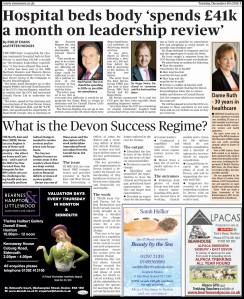
Local NHS – where our money goes – “leadership review” costs £41,000 per MONTH

80aa4a4d-c25c-4f2c-8fc5-7cb7f1be109b-2012-000001718f4e8194_tmp

THE NHS body responsible for closing community hospital beds in East Devon is spending £41,400 a month on “developing leadership capabilities,” it has been alleged this week.

A letter has been sent to the NHS Northern Eastern and Western Devon Clinical Commissioning Group by the East Devon Group of the Campaign to Protect Rural England.

The letter, dated December 1st, to Mrs Angela Pedder, the Lead Chief Executive of the CCG’s Success Regime, asked her to confirm that the CCG had instructed Carnall Farrar Ltd to undertake the work.

The letter, signed by the chairman and vice-chairman of the East Devon Group CPRE, Dr Margaret Hall, and Mr T.J.W. Hale, also questioned the impartiality of Dame Ruth Carnall, who is chairman of the Success Regime but also a director and shareholder of Carnall Farrar Ltd.

“This would appear to be a clear conflict of interest, affecting all parties, which alone could be sufficient to justify a judicial review of the outcome of this consultation,” said the letter.

The letter goes on to say that to overcome this difficulty it would be appropriate for Dame Ruth to resign as chairman and for Carnall Farrar Ltd’s contract to be terminated.

The Success Regime was set up as one of three areas in the UK where there were deep rooted financial problems in delivering health services.

It was introduced in Devon following a forecast of a £40 million deficit for 2014-15 increasing to £87 million in 2015-16 (see below).

The letter from the East Devon Group CPRE was also sent to East Devon MPs Neil Parish and Sir Hugo Swire.

Mr Parish commented: “It is vital the CCG gets the best value possible when spending taxpayers’ money.

“At a time when the CCG are consulting on closing community hospital beds across East Devon, they should be spending as little as possible on consultancy fees and ploughing as much money as possible into frontline care.”

Sir Hugo declined to comment until he had the opportunity to study the letter.

We have sought a response from the CCG but they failed to meet our deadline. We asked them to confirm the following:

  • That the monthly consultancy fee is £41,400?
  • How long has that monthly fee been paid?
  • How long will the monthly fee be paid?
  • Is there a conflict of interest with Dame Ruth Carnall chairing the Devon Success Regime when he is a shareholder and director of Carnall Farrar Ltd, the company which was awarded the contract?

We will be pleased to print the CCG’s responses to these questions in our next issue and on our website as soon as they are received.

Now Unison adds its voice on health care crisis

“Health reform plans being put together across England should be halted in order to allow for greater consultation on the planned changes, according to the trade union Unison.

Ahead of the publication of all 44 NHS sustainability and transformation plans, the union also called for greater staff involvement in the plans to help ensure they can be implemented and a government funding boost.

The STP areas bring together health and care leaders, organisations and communities to develop local blueprints for improved health, care and finances in regional areas known as footprints. It takes forward part of the NHS’ Five Year Forward View.

Concerns have already been raised that some plans are unrealistic and Unison said both the government and NHS England have failed to consult properly with the public and staff on these reforms, which are being pushed through too rapidly.

The union’s head of health Christina McAnea said health and social care had been ignored in the Autumn Statement at a time when both services desperately need more money.

“These new NHS plans will fail if the government doesn’t give the health service extra funds and staff are not on board,” she stated.

“Health and care organisations have had to show how they will make services less fragmented. But better integration is just wishful thinking without more funding.

“Unless more is done to reassure staff and the public the government will find it has little support for these plans.”

http://www.publicfinance.co.uk/news/2016/12/unison-calls-pause-stp-planning