Largest store in Axminster town centre to close

“Axminster’s biggest town centre shop is to close – with the loss of 19 jobs.

Trinity House department store is expected to cease trading towards the end of the year – probably in September.

Its owners – Goulds of Dorchester – say it is the victim of the nation’s changing shopping habits which have seen many people switch to on-line buying.

In statement they told The Herald: “As a result of an ongoing review the directors of Goulds (Dorchester) Ltd have announced their decision to cease trading at Trinity House.

“It is expected that the store will close at the end of September 2019, but the actual closing date is yet to be confirmed.

“The store was acquired on leasehold terms in November 2015 along with the premises known as TH2, which housed linens and housewares, until its replacement in 2017 by Costa Coffee.

“Despite having made a considerable investment in the business in an effort to make the Axminster store viable, current trading conditions, coupled with the continuing economic pressures on the department store sector, dictate that the business can no longer sustain an unprofitable branch store in Axminster.

“The company realise that this closure will be a major blow to the town. But even with sympathetic support from the local landlords it has been impossible to stem losses. In common with so many other retailers we are suffering the effects of on-line competition and a change in shopping habits.

“We are deeply sorry at having to take this action not least because our colleagues have done their utmost to help make the store successful and our regular customers will feel the disappointment of losing the only department store in town.”

Axminster county and district councillor Ian Hall said the closure would be a blow to the local economy.”

https://www.midweekherald.co.uk/news/trinity-house-is-a-victim-of-changing-shopping-habits-say-its-owners-1-5916167

“Ministers urged to provide rescue package for ailing high streets”

“The government should consider taxing online sales, deliveries or packaging and cutting property taxes for retailers as part of a package to help revive the UK’s ailing high streets, according to an influential group of MPs.

In a report published on Thursday, the housing communities and local government committee says local authorities need more help, including extra cash, to redevelop town centres. It also suggests an overhaul of planning regulations, including scrapping rules that allow developers to turn offices into flats without special permission.

Clive Betts MP, the chair of the committee, said it was likely that “the heyday of the high street primarily as a retail hub is at an end”. However, he added: “This need not be its death knell. Local authorities must get to grips with the fact that their town centres need to change; they need to innovate, setting out a long-term strategy for renewal, reconfiguring the town centre and finding new ways of using buildings and encouraging new independent retailers.”

Betts said dated planning policies and unfair business rates, which are a tax based on the value of property occupied by a business, were “stacking the odds against businesses with a high street presence and this must end”. …”

https://www.theguardian.com/business/2019/feb/21/ministers-urged-to-provide-rescue-package-for-ailing-high-streets

“Struggling retailers closed a record 18,355 stores in 2018”

“More shops closed down in 2018 than in any year on record, as the crisis on the high street deepened and retailers went into full retreat.

Analysis for The Sunday Telegraph by the Local Data Company shows that 18,355 stores brought their shutters down for the final time.

There were around 13,676 shop openings last year, producing a net loss of 4,679 retail outlets, up more than 1,600 on 2017 as retailers such Marks & Spencer scrapped expansion plans.

Including banks and restaurants the total number of consumer outlets that closed was 50,828, also a record. …”

https://www.telegraph.co.uk/business/2019/02/09/struggling-retailers-closed-record-18355-stores-2018/
(pay wall)

Exeter and Plymouth HMV stores close

When the new owner asked who would decide which 27 stores he would close, he said:

Landlords

In Exeter the House of Fraser store was saved by doing a deal with landlord Exeter City Council.

Princesshay is owned by The Crown Estate/TH Real Estate which had already pulled out of extending the shopping centre last year.

Somerset MP says Taunton is like a war-torn Syrian city!

Does a constituency REALLY get the MP it deserves? Well ….

“One is an English county town with an eighth-century castle, pleasant high street and national park right on its doorstep. The other is a Syrian city left in almost complete ruins after eight years of brutal civil war.

But these distinctions appear to have failed to register with the MP for Bridgwater and West Somerset, who chose to liken Taunton to Aleppo during a House of Commons debate on Thursday.

Ian Liddell-Grainger, whose own constituency neighbours the town, was attempting to draw attention to its boarded-up shops during a discussion about the high street.

The Tory said: “Exeter city has just brought out an excellent report looking 20 years ahead for the security and the growth of their city centre. Across the border, my county town Taunton is more like Aleppo than anything else.”

It is understood Mr Liddell-Grainger has never visited Syria’s second city but a quick perusal of pictures could have shown him it bears very little resemblance to the ancient Somerset town. …”

https://www.independent.co.uk/news/uk/home-news/taunton-aleppo-conservative-mp-ian-liddellgrainger-somerset-deane-council-a8758211.html

Budleigh Salterton and Tesco … accelerating high street decline

Tesco has announced it is cutting out butchers, fishmongers, bakeries and delis from its stores.

Spare a thought then for the poor traders of Budleigh Salterton High Street.
The Budleigh Salterton Journal of 23rd January reports that a variation of an approved planning application has been submitted to EDDC by Tesco because “a review has concluded that a smaller store could work better in this site than that of the approved plan”

Many inhabitants of the town are fearful, as before in 2014, that its wonderful delicatessens, butcher, greengrocer, florist, stationers and its 2 invaluable general stores would be put at risk of surviving with the opening of a Tesco. Locals had all dared to hope that the 5 years that this project had been gestating meant that it was no longer viable.

This move just doesn’t make sense when as Owl of 28th January highlights:

“TESCO is set to axe 15,000 jobs as part of £1.5bn cost-saving measure that will see fish, meat and deli counters across the country close down. Bakeries will also be overhauled, with the supermarket giant now ordering staff to use pre-frozen dough instead of making it on site. ..”

Many in Budleigh Salterton will not be happy to contribute to (last year’s) CEO Dave Lewis’ £4.87million pay packet and the chief executive’s short-term bonus of £2.28million on top of his base salary of £1.25million.

AND on top of that see the decimation of Budleigh Salterton’s High Street.

Will Tesco cuts revitalise high streets? Almost certainly not

“TESCO is set to axe 15,000 jobs as part of £1.5bn cost-saving measure that will see fish, meat and deli counters across the country close down.

Bakeries will also be overhauled, with the supermarket giant now ordering staff to use pre-frozen dough instead of making it on site. …”

https://www.thesun.co.uk/news/uknews/8288025/tesco-axe-15000-jobs-meat-fish-deli-counters/

After putting so many butchers, fishmongers, bakeries and delis out of business, will this revitalise high streets?

Owl thinks not. The killer combination of high business rates, increased town centre parking charges and poorer public transport makes it uneconomic for small businesses to return to high streets.

Sidmouth and Axminster branches of Santander bank to close

https://www.huffingtonpost.co.uk/entry/santander-branch-closures-spanish-owned-bank-confirms-1270-jobs-at-risk_uk_5c483cfee4b083c46d63e68d

EXCLUSIVE: Seaton Mayor resignation: business owner’s statement last night

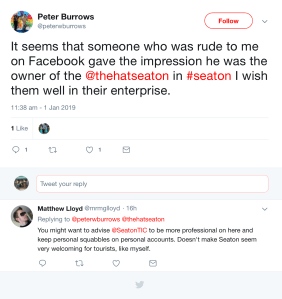
This is the full statement by Mr Gary Miller (owner, The Hat micropub) as given to Seaton Town Council last night, along with a screenshot and transcript of the now deleted tweets to which he refers:

THE TWEETS:

Transcript:
Twitter @peterburrows 1 January 2019 11.38 am
Burrows tweet:
It seems that someone who was rude to me on Facebook gave the impression that he was the owner of @thehatseaton in #seaton I wish them well in their enterprise.

Comment on above Tweet
Matthew Lloyd @matthewlloyd 16 hr
replying to @peterburrows @thehatseaton
You might want to advise @seatonTIC to be more professional on here and keep personal squabbles on personal accounts. Doesn’t make Seaton seem very welcoming to tourists like myself.

THE STATEMENT BY MR MILLER LAST NIGHT:
(verbatim)

“Good evening. I am Gary Millar, the sole owner of The Hat Micropub in Queen Street. I am addressing the issue of Mr. Peter Burrows, the then Mayor and current Councillor on both a local and district level, attacking my livelihood and business.

On the afternoon of New Year’s Day, Mr. Burrows had a very public argument about fox hunting with a private individual on the Facebook page ‘Seaton Views’. This escalated to a robust exchange of views between the two protagonists. (Amusingly both share the same perspective on the matter). Mr. Burrows, who is surely used to the rough and tumble of political debate, took exception to being called a very naughty word. His inexplicable reaction was to use his title of Seaton Mayor to make a direct attack on me, accusing me of being disparaging to the mayor, and to tell thousands of subscribers to a Twitter page called @SeatonTIC, to avoid my business. On the face of it this was the official Seaton Tourist Information Centre page.

This is a grossly stupid response from any public official in any circumstances. You could not make it up.

It is not at all clear why Mr. Burrows chose The Hat as opposed to the many other local businesses that his detractor frequents. Surely, as a public official involved in my various applications, he would have known who I was?

I do not use social media for anything other than professional reasons. If social media users followed the guidelines given in the Hat including “No nasty opinions” and “Be respectful and remember there are other people around you”, the internet would be a kinder place.

Both @SeatonTIC and Seaton Views are ostensibly neutral and exist for the benefit of the people of and visitors to Seaton. However, they are administered by Mr. Burrows which gives him the control over their content. Reportedly, other supposedly impartial social media sites revolving around Seaton are also administered by him. Personally, it disturbs me that a public official has such a domination of information without a clear declaration of interest.

For example – Mr. Burrows selectively deleted his unsavoury exchange on Seaton Views and blocked his detractor from the site. Yet he also closed the @SeatonTIC page entirely, not at the request from the Council as reported, but unilaterally overnight on the 1st/2nd January after legal action was threatened against the then unknown poster. This had two effects – first; we are unable to see how many people viewed his tweet to assess the damage caused. Secondly; imagine the impression given to thousands of potential holidaymakers following what they would reasonably have considered the formal Seaton Tourist Information Twitter page – A strange tweet from the town Mayor attacking a local small business, followed by an unexplained blackout.

This cannot be good for either my business nor the image of the town as a whole. Surely, directing subscribers to the official Tourist Information Site would at least have been a productive step.

I would argue that these actions were not a selfless act by Mr. Burrows, or in the interests of myself or Seaton, but a means of covering tracks. A clear case of canting.

I have yet to receive a proper apology from Mr. Burrows. His statement of resignation last week did not make it clear that I was not the person who insulted him, then he justified his actions, and finally boorishly he ended with him giving himself a pat on the back for a job well done. Unfortunately, any apology at this time now sounds hollow.

Mr. Burrows was high profile in his role as Mayor and councillor on both local and district levels. As such I view both the local and district councils legally culpable for his actions, regardless of these being rogue or not. I expect both the local and district council to do their legal duty and mitigate any damage against me. This includes a full and open investigation of Mr. Burrows conduct in office, including on social media, and disciplinary or legal action wherever possible. This motion of no confidence, and the complaint to the East Devon Monitoring Officer is a positive response by the Seaton Town Council.

Despite undoubted damage to my business, the support of my regulars, and other public support helps me believe that moving to Seaton to open up a new and innovative business was the right decision. My sincere thanks to you all and I hope to continue to serve you real ales, ciders and other fine beverages in a friendly environment for many years to come.

There is however still much to do from both Councils to support the current small traders and promote the opening of new dynamic, interesting small shops in Seaton. Encouraging visitors to move to the traditional trading area, now called The Cultural Quarter, from the lower end of town is an urgent requirement to start. Regrettably, after a year of trading in Seaton and having contributed in various forums, I have yet to see any concrete or effective steps to this end by the Council. This is an opportunity for both the Council and traders to reset and have a fresh start.

In conclusion I would urge all councillors to support this motion of no confidence. What most surprises me is that Mr. Burrows has not recognised his position as being untenable and has not resigned already on his own volition.

Thank you for your time and attention.”

“Taxpayer’s charity shop subsidy blamed for high street decline”

“Taxpayer support for charity shops has grown by more than £1 billion over the past decade, adding to concern that subsidies are increasing their number and spoiling high streets.

Figures from the Ministry of Housing, Communities and Local Government show the cost of offering charities an 80 per cent discount on business rates rose to almost £1.9 billion in 2017-18 from £850 million in 2008-09. Retail analysts say this is crowding out the independent shops, cafés, and leisure premises needed to revive town and city centres.

The number of charity shops in Britain has grown rapidly over the past 15 years to more than 11,000 today. Residents and retailers in some towns complain that their high street seems to be overrun by charity shops. Although the £1.9 billion cost of the rates relief is not all taken by charity shops, because the discount also applies to other charitable premises, the subsidy is certainly helping the shops to buck the general trend of high street decline.”

Source: The Times, pay wall

Business rates killing high street shops

“Leading retailers called for a major overhaul of business rates yesterday after Next suffered a sharp slump in store sales in the run up to Christmas.

With pressure mounting on ministers to reform the outdated tax, fashion chain Next said sales in its 500-plus stores fell 9.2 per cent over the crucial festive period.

In a clear sign of how shopping habits have shifted, the company said online sales soared 15.2 per cent in the same period, meaning overall revenues were up. …”

https://www.dailymail.co.uk/news/article-6556311/Retailers-demand-major-overhaul-business-rates-Christmas-sales-slump-9-2-cent.html

“Yvette Cooper: It’s time to boost Brit towns and not lock cash funds in cities”

“… Research done for the Labour Towns group of MPs and councillors found that overall job growth in towns since the last recession has only been half the rate of growth in cities.

The economic divide between cities and towns is growing and the Tory Government is making it worse. …

Austerity has hit towns and smaller cities hard, so it isn’t just retailers who have been leaving.

Often the libraries, police stations, council offices, magistrates courts, swimming pools, community centres, A&E or the maternity services have been closed, forcing people to travel to nearby cities instead. Lottery and arts funding is higher in cities too.

Manufacturing jobs in towns are being squeezed while new service or creative opportunities are concentrated in cities.

Meanwhile most of the transport money goes to London or other major hubs. Buses have been cut.

… It’s time to support Britain’s towns. Instead of making everyone travel to cities for public services, we need more in towns.

Instead of rolling out new broadband or 5G infrastructure in cities first, why not start in nearby towns? Instead of always using all the transport money on overruns for big city projects like HS2 or Crossrail, why not start by improving local trains and buses?

The Government seems to think if you only support cities, everything will just trickle down and out to the towns, but it hasn’t worked. Let’s have a fair deal to boost our towns and cities together. … “

https://www.mirror.co.uk/news/politics/yvette-cooper-its-time-boost-13768773

“Quarter of shop space in England and Wales lost after 2008 crash”

“More than a quarter of all retail floor space in England and Wales disappeared in the aftermath of the 2008 financial crisis, research has shown, as the industry struggled with the shift to online purchases.

The amount of shop space fell in all but five of 348 local authorities analysed in the study by academics at Northumbria University, Newcastle.

In 2008, there was more than 157m square metres of retail floor space in England in Wales. By 2015, the figure had dropped to just under 114m square metres, a 27.6% fall.

The analysis covers the period before the latest crisis to hit the UK retail sector, which has led to the collapse of high street brands including Toys R Us and Maplin. Many others including Marks & Spencer and Debenhams are closing stores and cutting staff.

Alongside the rapid rise of online shopping, retailers have been affected by consumers’ weak income growth.

The rateable value of retail property fell in two-thirds of the local authorities analysed during the period, despite the loss of a quarter of the total supply.

The figures illustrate a stark divide between regions. The value of central London locations surged during the period, with the biggest increase recorded in Westminster, where the average rateable value for retail premises grew by almost 80%.

In contrast, the value of retail property in south Wales slumped as areas such as Swansea, Port Talbot and Bridgend suffered from the decline of the steel industry. The local authorities on the south coast of Wales between Cardiff and Swansea all saw the rateable value of properties fall by more than 20% between 2008 and 2015.

The study compared the government’s data on business rates paid by companies on their property. The data was made available in the 2010 and 2017 rating lists.

The fall in the total rateable value of retail space could have significant implications for Britain’s model of funding local public services, said Paul Greenhalgh, a professor of real estate and regeneration at Northumbria, and a leader of the research.

Under changes to the funding formulae introduced by George Osborne as chancellor, local authorities keep more of the money collected from business rates. A fall in the total rateable value of properties in a local authority area could therefore leave the authority’s budget more exposed to price fluctuations in the property market.”

https://www.theguardian.com/business/2018/dec/03/quarter-of-shop-space-in-england-and-wales-lost-after-2008-crash

“More than 200 UK shopping centres ‘in crisis’ “

“More than 200 UK shopping centres are in danger of falling into administration, experts are warning.

Analyst Nelson Blackley said the demise of “major anchor stores” such as BHS and Toys R Us, and the rise of online retail, had caused a “downward spiral”.

Many of the at-risk centres are owned by US private equity firms under deals that will need refinancing.

“If centres close, particularly in small towns, it will be catastrophic,” Mr Blackley warned.

The Department for Communities said it was “committed to helping communities adapt”.

Mr Blackley, from the National Retail Research Knowledge Exchange Centre, said the UK had an excess of shopping centres with similar retail offerings.” …

https://www.bbc.co.uk/news/uk-england-45707529

“The High Streets that missed out on millions: The Chancellor’s got £1.6bn to help shops but councils failed to make full use of his last helping hand”

“Struggling High Street shops have missed out on millions of pounds of vital emergency funding following a series of shambolic blunders.

On Monday, Chancellor Philip Hammond announced a £1.6 billion lifeline for Britain’s High Streets, which included a £900 million relief package to help shops battling sky-high business rates.

It means that around 500,000 shops, pubs, restaurants and cafes are expected to see their rates bills cut by up to a third over the next two years.

The Treasury will also set aside £675 million to help councils rejuvenate their town centres.

But it is the Government’s second attempt at helping the High Street, after a £435 million business rates relief package was announced in 2017.

This was supposed to help businesses struggling to pay their business rates.

However, Money Mail can today reveal that millions of pounds from the first fund failed to reach the businesses it was intended to help, and was instead returned to Treasury coffers.

As many as three-quarters of councils failed to hand out their allocated cash to ailing local firms. In some cases, councils spent only an eighth of their budgets, while others helped as few as five shops.

One local authority failed to spend almost £800,000 of its extra funding.

Eighteen months ago, more than 500,000 shops, pubs and restaurants were hit by business rates hikes — a tax on bricks and mortar businesses.

Following a Money Mail campaign, ministers pledged to introduce a £300 million fund for councils to distribute to those worst affected over four years, as part of a wider £435 million business rates relief package.

Some £175 million of this had to be spent in the first 12 months — by the end of September — or be returned to the Government. But many councils misunderstood the rules, while others failed to promote the scheme or made it too complicated for small businesses to apply.

Some councils claim the Government did not give them enough time to distribute the money before it was lost.

Embarrassingly, the council in former Communities Secretary Sajid Javid’s own constituency, Bromsgrove, Worcestershire, handed out only a third of the cash it had been given to help its High Street.

Mr Javid, now Home Secretary, was previously in charge of ensuring the fund was distributed by councils and had promised ‘absolutely no delay’ in doing so.

Yet figures collated by Retail Express and chartered surveyors Bankier Sloan reveal just £46,300 of the council’s £134,500 pot was given out in time — helping only 37 businesses.
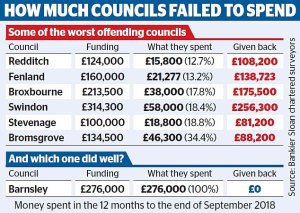
Nearby Redditch Borough Council helped only 21 shops and spent just £15,800 out of £124,000, an eighth of its budget.

Stevenage Borough Council, Hertfordshire, gave cash to just five businesses in the town and awarded £18,800 out of a possible £100,000.

While Swindon Borough Council, Wiltshire, spent only £58,000 out of £314,300, helping 41 businesses — with more than a quarter of a million pounds leftover.

Fenland District Council, in Cambridgeshire, spent £21,277 out of almost £160,000, barely a seventh of its budget.

And Broxbourne Borough Council, in Hertfordshire, spent a fifth of its pot, distributing £38,000 out of £213,500 and helping only 31 shops.

Camden Council, North London, allocated 100 per cent of its fund, but said shop closures meant that, in the end, it was only able to hand out 86 per cent of it.

It meant that, despite distributing £4.84 million to businesses, it had £790,000 leftover.

By contrast, around 30 councils spent all of their funding. Barnsley Council, for example, spent every penny of its £276,000 and helped an incredible 2,135 businesses.

Jerry Schurder, head of business rates at consultancy Gerald Eve, branded the distribution of the grant ‘shambolic’.

He says: ‘It was a poorly designed fund by the Government and a knee-jerk response to the backlash against the rates revaluation.

‘It was then badly implemented by some councils which did not pay sufficient attention to the criteria.’

The fund was supposed to help the smallest businesses facing the greatest rises.

The Government decided how much money to allocate to each council by calculating the total increase in bills for firms facing a minimum 12.5 per cent rate rise and with a rateable value of less than £200,000 — the rental value on which business rates are based.

But many councils used this same rigid criteria when deciding which firms should receive cash —awarding it only to those hit by rate rises of more than 12.5 per cent.

In fact, councils had total freedom to spend the cash however they wished, as long as it went towards reducing business rates bills.

Some councils excluded businesses they felt did not need the cash as desperately, such as schools, banks and estate agents.

Meanwhile, multinational firms and Government bodies were typically excluded because they had exceeded state aid limits via other grants.

The Ministry of Housing, Communities and Local Government refused to say how much cash had not been spent.

But research by Retail Express suggests it was as much as £17.5 million — 10 per cent of the budget.

A series of Freedom of Information requests showed that 159 out of the 195 councils that replied had failed to spend all of their grant by the end of April.

The deadline to hand out the cash was actually September 30, but many councils stopped distributing the 2017/18 grant at the end of the financial year.

News editor of Retail Express, Jack Courtez, who led the research, says: ‘I think it is incredible that councils claim they are being squeezed by a lack of central Government funding, but when they do receive money they fail to distribute it.

‘Many councils have let down local businesses which depended on this funding.’

Chartered surveyor Ian Sloan, of Bankier Sloan, who contacted councils to warn them they faced a massive under-spend, says: ‘The distribution of this fund has been a mess. Local businesses have lost out on money they really needed and now the money is gone.’

Councillor Matt Dormer, leader of Redditch Borough Council, says that as the funding is drawn from general taxation, the council has ‘a duty to spend it in an appropriate manner, and not to simply seek to spend as much of it as possible.’

Bromsgrove Council says it had to bear in mind that ‘any relief given to people facing an increase in their rates gives them a competitive advantage.’

Broxbourne Borough Council said that ‘100 per cent of businesses who completed and returned application forms were granted the relief.’ Swindon Council says it had to award cash automatically when few firms applied.

Stevenage Borough Council said it has already granted £32,392 of the £36,000 it has been allocated for the coming year. And Fenland Council says it would give higher amounts to successful firms this year as a result of the low take-up of the relief in 2017/18.

Camden’s Councillor Richard Olszewski says the council awarded all of its funds but ‘due to businesses moving in and out of the borough and a substantial number of successful rating appeals’ it was then unable to distribute it all before the deadline. This year it has over-allocated funds to allow for business turnover.

A total of £175 million was supposed to have been handed out in 2017/18, followed by £85 million this year, then £35 million in 2019/20 and £5 million in 2020/2021.

A Government spokesman says: ‘To help local businesses thrive, we have introduced over £10 billion worth of business rates support so nearly a third of all business pay no rates at all.’ “

https://www.thisismoney.co.uk/money/news/article-6335101/The-Chancellors-got-1-6bn-help-shops-councils-failed-make-use-helping-hand.html

Cranbrook town councillors attempt to block mobile catering vans is defeated

Owl says: This is what happens when you fail to build a proper centre in a new town.

“Members differed in their opinions when deciding whether to support a request for annual street trading consent from Richard Filby, who runs popular chip van Flippy Chippy.

Councillor Ray Bloxham said granting consent would go against Cranbrook’s ‘healthy’ image, as it is just one of ten sites selected to join NHS England’s national Healthy New Towns programme. He said: “We are trying to do something about the health of our town.

“We need to, at some stage, make a stand against this type of thing because it is not good.”

Cllr Bloxham said there is a ‘proliferation’ of mobile businesses coming into Cranbrook, which do not pay business rates and sell ‘unhealthy food’ to the community.

Cllr Sarah Gunn said a fish and chip shop is set to open in Cranbrook soon and the council needed to support it. She added: “It is not cheap rent or business rates – there are no concessions.

“A chip van up the road is going to make that very hard.”

Cllr Matt Osborne said Flippy Chippy is ‘well known and liked’ in Cranbrook, and had been involved with a lot of community events held in the town.

He said: “If we take that away when there is a chip shop opening, the backlash will be quite severe – because we are the reason people can not have fish and chips in town anymore.

“I think we will get some kind of movement against that.”

Cllr Bloxham proposed the council objects on the grounds that Cranbrook is a Healthy New Town and the council is ‘trying to promote healthy living’.

He added: “It is unfair competition for businesses trying to set up shop in the town. [Flippy Chippy] has no overheads apart from a bit of petrol.”

Cllr Bloxham’s proposal was defeated by four votes to three.

Cllr Les Bayliss said two other mobile companies sell food in Cranbrook and it would be unfair to object to Mr Filby’s request.

He proposed the council supports the trading consent request, but his motion was also defeated by three votes to two.”

Councillors finally agreed they would send their comments to East Devon District Council, which will decide whether to grant consent at a future date.

Mr Filby’s application is to trade from a catering van every Monday, from 4.30pm to 7.30pm, on Younghayes Road (by the country park).

http://www.midweekherald.co.uk/news/council-split-in-deciding-whether-to-support-street-trading-request-from-popular-flippy-chippy-food-van-1-5749353

First they changed offices to homes, now it’s shops

Will they be affordable ……….

… Experts believe that turning unused shops into houses could stop the decline of town centres – as well as bringing down sky-high property prices.

Mr Hammond is also under pressure to freeze business rates which are blamed by retailers for helping to hollow out the high street.

A spokesman for the Treasury said: “We don’t comment on Budget speculation.

https://www.thesun.co.uk/news/7556955/empty-shops-could-be-turned-into-homes-to-solve-britains-housing-crisis-and-make-property-cheaper/

“Politicians may finally be catching on: towns now hold the key to Britain’s future”

“… Everywhere we go, people talk about the fate of their town centres with amazing passion, and frustration. Obviously, the Altrincham model of regeneration will not suit everywhere, to say the least. Labour now has a five-point plan for high streets that takes in an end to ATM charges, free wifi, a new register of empty properties, free bus travel for under-25s and reform of business rates. It sounds promising, though perhaps evades something that is glaringly obvious: conventional chain-store retailing is dying fast and high streets need to find new uses. Until this sinks in, the mood of resentment and political disconnection that characterises many of our towns will fester on.

With good reason, the political debate about austerity tends to focus on cuts to such crucial services as adult and children’s social care, education, libraries and public transport. But there is also an overlooked ambient austerity manifested in streets festooned with rubbish and the decline and decay of public space – and it has a huge effect on how people feel about where they live and what politics has to offer them.

… Obviously, young people who are not happy in towns tend to leave. It is the older generations who stick around, and who feel the changes to town life more deeply. Despite the fashionable idea that Britain’s current malaise will be miraculously ended once they begin to die off, they are going to be around for some time to come.

Wherever we go, with good reason, most people we meet have no sense of which bit of government is responsible for this or that aspect of their lives – only that the forces making the decisions are remote, seemingly unaccountable and rarely interested in where they live. Many urban areas have been recently boosted by the creation of “city regions” governed by “metro mayors”; in Scotland and Wales, devolution has brought power closer to people’s lives. In most English towns, by contrast, systems of power and accountability are pretty much as they were 40 years ago.

… What this does to people’s connection with politics is clear. To quote a report by the recently founded thinktank the Centre for Towns, “on average, people living in cities are much less likely to believe that politicians don’t care about their area. Those living in towns are, in contrast, more likely to think politicians don’t care about their area – and won’t in the future.”

There lies the biggest issue of all. The future of our towns will only partly be decided by the high-octane rituals of Westminster debate, and general elections. What really matters is whether they might finally run a much greater share of their own affairs – and, to coin a memorable slogan, take back control.”

https://www.theguardian.com/cities/commentisfree/2018/oct/18/politicians-may-finally-be-catching-on-towns-now-hold-the-key-to-britains-future

More Sidmouth shops to close

“Coles gift shop, in the High Street, will close on Saturday, October 27, and The Rendezvous, in Fore Street, won’t be far behind.

The two businesses have joined a fast-growing list of shops which have left or have plans to because of rising costs and ‘unfair’ business rates. Since February Carinas, Hospiscare, NatWest and Sweet Temptations have closed.

New Look will cease trading on Saturday, October 20, Barclays on Friday, November 16, and Pure Indulgence will close April 2019 along with Govier’s of 
Sidmouth – which has gone online only. …”

http://www.sidmouthherald.co.uk/news/two-more-sidmouth-shops-to-close-for-good-1-5733147