Hotels being used as care facilities to relieve pressure on NHS

Wouldn’t it be a great idea to have community hospitals as “half way” accommodation … oh wait …

Robert Booth www.theguardian.com 

Hotels are being turned into temporary care facilities staffed with workers flown in from Spain and Greece to relieve rising pressure on NHS hospital beds.

Three hotels in the south of England are being used, including one in Plymouth into which 30 hospital patients have been discharged to be looked after by live-in carers. It is understood that the staff are staying on upper floors while patients are below.

At least three other health authorities are considering the move, which is partly driven by the severe shortage of domiciliary care workers able to look after people in their own homes, according to Anne-Marie Perry, chief executive of Abicare, a home care company contracted to set up the facilities. She said they were for people who are ready to be discharged to their homes but couldn’t be because care packages were not available.

“The hospitals are on their knees and we are being contacted fairly regularly by clinical commission groups,” said Perry. “The problem Plymouth have is there is not enough domiciliary care provision, so that’s one of the reasons why they can’t discharge patients.”

A similar tactic was used at the start of the pandemic in spring 2020, when hotels were used to help discharge tens of thousands of hospital patients in anticipation of hospitals being filled to breaking point with Covid cases. It happened again in some places in January this year.

Now, with similar warnings that the NHS faces being overwhelmed by the Omicron variant, Abicare said it has converted whole floors of hotels, and has recruited British nationals living in Greece and Spain, as well as some from the north of England, to staff them in a shift pattern of three weeks on and three weeks off.

On Monday, NHS Providers said bed occupancy in hospitals was at 94%–96%, and its chief executive, Chris Hopson, said on Sunday that the shortage of social care staff was a big driver of delayed discharges, with more than 10,000 beds last week occupied by medically fit patients.

Perry said the cost of care – around £300 a night – was well under half that of an NHS bed, but the move is likely to raise questions about levels of care, as hotels are not equipped with sluice rooms and other facilities normally available in care homes.

Jane Townson, the chief executive of the Homecare Association, described the move as “unacceptable” and said it “feels like [people] being warehoused”. She called for greater funding to boost the workforce that helps people in their own home.

Nadra Ahmed, executive chairman of the National Care Association, said she was shocked by the arrangement because hotels were not configured to deliver care and questioned the safety and wellbeing of residents if they need urgent medical assistance.

“Is home care so broken that we can’t support people in their own homes where they need to be?” she said. “This is another sticking plaster and the person being moved into the hotel is the person being let down.”

Abicare said it had been unable to find live-in care workers based in the UK so it was using expats. But has warned that with more health authorities approaching it to set up hotel facilities in the new year, it may not be able to find staff to meet much greater demand.

In January, NHS England issued guidance about using hotels for discharges which said it “should only be used as a short-term measure (days, rather than weeks) for the specific purpose of reducing length of stay for people in hospital and ensuring they are discharged when they no longer meet the ‘criteria to reside’ in a hospital.”

Abicare said it has previously worked with Holiday Inn and Best Western hotel groups. A spokesperson for NHS Devon clinical commissioning group said: “Thirty-two beds are currently available to support people who would be delayed in hospital waiting for support at home. Feedback from patients has been excellent and since March 2020 this has saved several thousand hospital bed days. This has freed beds for people who needed inpatient care in a hospital setting.”

NHS England has been approached for comment.

Skewering No 10 over Christmas parties has made Ros Atkins a BBC star

“Drinks, nibbles, games”: three words delivered in a studiously measured tone that have added to serious stress headaches at the heart of government and sparked nagging rumours of the prime minister’s exit.

Alexandra Topping www.theguardian.com 

The BBC’s Ros Atkins, who delivered the deadpan words in a video explainer of the “partygate” scandal that went viral, has become an unlikely star of the festive saga. Admirers from across the political divide – from Piers Morgan to James O’Brien – have praised his commitment to the cold, hard presentation of facts, while he has been credited with creating a “whole new genre of reporting”.

In a series of short explainers, the BBC News Channel’s Outside Source presenter has repeatedly skewered the Boris Johnson administration, while never coming within striking distance of seeming to have an opinion.

“Forensic, measured, factual, brilliant,” wrote veteran broadcaster Andrew Neil after Atkins’ explainer on 6 December. Two days later Morgan tweeted: “Ros once again brilliantly illustrating that the best journalism is often the simplest: just damn people with cool, calm, collected & utterly irrefutable facts.”

The first video on the Christmas parties was posted on 2 December, two days after the story broke, and two more have followed. In nine days the 3-4 minute clips – long for viral videos – have been watched over 11m times, far more than any other digital news series, with insiders in the BBC admitting that their popularity has confounded expectations about the desires of online news consumers.

Watch them here

The 47-year-old is no hotshot newcomer. He has been at the BBC for 20 years, joining the corporation weeks after 9/11. He started out as a producer on Simon Mayo’s 5 live show, before becoming a presenter on the BBC World Service in 2004.

Atkins, a former DJ who ran a club night in Brixton in the 2000s and performed at Womad, was part of the team that launched Outside Source, a daily show that curates news from wires, video feeds and social media on the News Channel and BBC World News, in 2014.

His explainers started with coverage of the Australia bush fires in late 2019, and earlier this year the BBC launched Ros Atkins On, promising 10 minutes of his “straight-talking style of analysis and explanation” on the biggest issues of the day on iPlayer, BBC Breakfast and the BBC’s news website.

His films, covering the heatwaves in the States and the Belarus migrant crisis as well as domestic political issues, “explain the background and context to current events in a scrupulously impartial, accessible way”, said Jamie Angus, senior controller, news output and commissioning, at BBC News. “He’s made this type of explainer his own, and it’s proved wildly popular with audiences across the world, and very shareable on social media,” he said.

The explainers, very much seen as Atkins’ baby, were created in an attempt to make live TV also work as an on-demand digital product, with one former BBC news executive describing their style as “assertive impartiality”.

“Ros is just brilliant at this,” the executive said. “If you look at what he’s done, it’s stripped down ‘this is what happened’ in three minutes flat – there’s no florid tedious language, there’s no self indulgence to it.”

Atkins’ unflinching presentation manages to get the viewer to raise an eyebrow through facts alone, said the former executive. “I think sometimes the BBC mistakes impartiality for sucking the life out of something. But Ros is human and has a personality, while never making it about him, or leaving himself open to accusations of bias.”

Colleagues say Atkins, who is married with two teenagers, is dedicated, rehearsing lines and tweaking scripts until he is sure they will have the greatest impact. One former colleague compared his approach to news to his love of squash. “He makes things look effortless but they’re not effortless. Just like being a very good squash player takes years of practice, being a really good TV craftsman takes a long time too – he works bloody hard to make it spot on.”

[The “BBC Outside Source” series of short explainers are well worth looking at – Owl]

Boostered: did Boris “bounce” the NHS with his vaccine booster speech?

[And would he have reasons other than Omicron to grab the headlines right now? – Owl]

Yesterday he announced the “Omicron Emergency Booster National Mission” to encourage everyone who is eligible to “get boosted now”.

Government discussing Covid Plans D and E

Possible Plans D and E are being discussed by the government should current measures fail to bring the Omicron variant under control, Whitehall insiders have said.

Meanwhile it’s the vote on Plan B tomorrow, Plan C possibly on December 21. – Owl

Clare Busch www.devonlive.com

The Mirror reports the tougher Covid-19 plans being discussed include another lockdown.

MPs have already been told they may have to return to Parliament for a vote on tougher restrictions should Omicron infections hit the expected million mark.

A vote on Tuesday, December 21 could move the current Plan B rules to Plan C, which would require masks in all indoor establishments and the use of Covid app for pubs and restaurants. Vaccine passports could be required for smaller venues.

Plan C would also include a return to table service only and a required self-isolation after contact with someone infectious.

The possible Plan D could mean all pubs and restaurants stopping indoors service with only outdoor service allowed.

A Plan E would see a return to lockdown with all pubs, cafes, restaurants and non-essential retail closed.

Individuals would only be able to leave their home for essential reasons such as work, medical appointments and to buy food.

Schools would be the last to close.

Plan B includes masks for public transport and most indoor settings, vaccine passports for large events and advice to work from home. The plan came into effect today (Monday, December 13) just as Boris Johnson confirmed the first death associated with Omicron in the UK.

The Prime Minister said at a vaccination clinic in west London: “Sadly yes Omicron is producing hospitalisations and sadly at least one patient has been confirmed to have died with Omicron.

“So I think the idea that this is somehow a milder version of the virus, I think that’s something we need to set on one side and just recognise the sheer pace at which it accelerates through the population. So the best thing we can do is all get our boosters.”

Boris Johnson said that Omicron now represents about 40% of coronavirus cases in London. He added: “tomorrow it’ll be the majority of the cases” there.

Plan B will stay in force for at least six weeks, with a review on January 5.

A Health Department source told the Mirror: “If you follow the science, we should really be doing Plan C now. The PM is gambling with the NHS to save his leadership.

“But we all know the PM can’t let anything hit Christmas. That really did him damage last time round. To do it again would be killer.”

Planning applications validated by EDDC for week beginning 29 November

Good Law Project threatens legal action against Met Police for its refusal to investigate No 10 parties

Good Law Project has today written to the Metropolitan Police asking it to justify its failure to investigate reports of an unlawful party being held at No 10 Downing Street on 18th December 2020 – and threatening legal proceedings if it fails to do so.

www.thelondoneconomic.com 

There have been multiple reports from people who say they were in attendance on the night that a party of 40 – 50 people took place in the prime minister’s own home. This would have been a clear breach of the “tier 3” restrictions in place at the time.

Yet – unbelievably – the Met claims there isn’t enough evidence to open a criminal investigation.

Apparently, this wasn’t even the only unlawful gathering held at Boris Johnson’s home during this period.

Further reports have now emerged alleging there were gatherings at the prime minister’s flat on 13th November 2020, a leaving party at No. 10 held on 27th November 2020 for former aide Cleo Watson, and a party at the Department for Education on 10th December 2020.

Good Law Project’s lawyers have today sent a pre-action protocol letter to the Met asking it to open an investigation, or to set out the full and detailed reasons behind its refusal to do so.

The pre-action protocol letter also asks the Met to provide details of its policy ‘not to investigate retrospective breaches of the covid regulations’, referred to in its statement of 8 December 2021.

If the Met refuses, Good Law Project will consider suing.

The Met is due to respond by 31st December 2021.

Jo Maugham, Director of Good Law Project said: “Now we know what Boris Johnson and his advisors think about the awful sacrifices people up and down the country have made. They think sacrifices are for the ‘small’ people – but not for ‘Great’ people like them.

“But the law says we are all equal. Great and small alike, subject to the same laws. That’s what the law says – and the Metropolitan Police need to apply it.”

EDDC Strategic Planning Committee to discuss Local Plan Consultation – Tomorrow

Agenda for Strategic Planning Committee on Tuesday, 14th December, 2021, 9.30 am

Online meeting to discuss:

Infrastructure Funding Statement PDF 336 KB

And:

Working draft of the proposed East Devon Local Plan 2020 – 2040 PDF 441 KB

Details here.

Number of healthy patients ‘stranded’ in English hospital wards rises by 80%

The number of patients stuck in hospital in England despite being medically fit to leave nearly doubled between February and November this year. The rise is worrying health experts, who say it is more evidence that the crisis in the adult care system is creating backlogs in the NHS.

Chaminda Jayanetti www.theguardian.com 

NHS England data shows that the number of times hospital trusts were unable to discharge a patient who no longer met the criteria to stay in hospital increased from 223,593 in February to 402,211 in November – a rise of almost 80%.

The data shows the extent of “stranded patients” – people who are clinically fit to leave hospital but cannot be discharged, often because of a lack of adult care or NHS community health provision. As a result, patients find themselves stuck in an environment where they pick up infections, while hospitals are unable to free up bed space for new admissions.

The Observer has also obtained data on “delayed transfers of care” (DTOC), which measures the number of days individual patients stayed in hospital after they were ready to be discharged.

NHS England stopped collecting DTOC statistics at the start of the pandemic, but a freedom of information request found 26 hospital trusts that are still recording these figures – with DTOC numbers rising by nearly 75% between February and October.

Miriam Deakin, director of policy and strategy at NHS Providers, the membership body for NHS trusts, said: “Trusts do all they can to reduce delayed transfers of care, given its impact on patients. However, with the latest performance figures showing more than one in 10 beds are occupied by patients who are medically fit to leave hospital, there is a pressing need to invest in social care and care in the community.

“In addition, urgent investment is needed in the social care sector including in home-care services – which is why we have called for retention payments to support people to remain within the care workforce over these critical winter months.”

University Hospitals Dorset NHS Foundation Trust saw acute care DTOC numbers increase from 2,701 on 1 April to 4,452 on 1 October. DTOC cases caused by problems securing care packages at home doubled in that time, while those arising from difficulties in finding beds in community hospitals more than doubled.

Dr Tristan Richardson, clinical director for medicine at University Hospitals Dorset NHS Foundation Trust, said: “If we have a patient who can’t leave hospital because a package of care is not available to support them at home, or there is not a place in a care home, for example, that means a patient can’t move from our emergency department on to a ward.”

He added that this “fills up our emergency department, which in turn means other patients are waiting to enter the emergency department in ambulances, and consequently those ambulances can’t then be attending an emergency in the community. The knock-on effect presents a clear compromise to all patients.”

A report from Dorset council in November described the link between the crisis in adult care and delayed discharges from hospitals: “The shortage of home care and therapy support is… having an adverse impact on the local hospitals; people are waiting for packages of care… to be available before they are discharged. Therefore increasing length of stay and decreasing hospital capacity.”

The report identified “significant gaps in workforce capacity such as the lack of home care and therapy workers”, and noted that the workload of hospital social work teams had tripled but that the “workforce has not increased to match the demand”.

David Fothergill, of the Local Government Association, said: “Councils and care providers are doing all they can to ensure people are able to safely return from hospital to their homes and communities as quickly as possible, despite multiple and ongoing pressures.

“These include, but is not limited to, significant shortages in the social care workforces, with more than 100,000 vacancies available on any given day, and extremely high turnover rates.

“Recent extra government funding for care workforce retention and recruitment will help, but this falls well short of enabling an immediate significant uplift in pay, which is the single biggest factor behind staffing shortages.”

NHS England did not respond to a request for comment.

Be ‘adult’ about who you mix with

Torbay health boss advises caution

Joe Ives, local democracy reporter www.radioexe.co.uk 

Torbay’s health boss wants residents to take an “adult,” risk-based approach to social activities as covid cases rise across the Bay.

Latest complete figures (the week to Sunday 5 December) show covid infection rates across Devon have risen for the fourth week in a row with all parts of the county having an infection rate higher than the UK average.

Torbay recorded 934 new cases, up 57 on the previous week. The seven per cent rise takes the infection rate in the Bay to 686 per 100,000 of the population – almost 30 per cent higher than the national average of 496.

With the rising cases and concerns over the new Omicron variant, Torbay’s director of public health Lincoln Sargeant advises residents to take precautions when meeting other people. 

He said: “I think rather than saying ‘don’t’ I think it’s a matter of people working through what kind of activity is it? How many people are involved? Are there any vulnerable people that are there? And based on those kind of questions, decide whether you should go ahead or not and if you’re going ahead [think about] how you’re going to make it as safe as possible – is there an option to meet outdoors for example? 

“As a standard, any meetings that we’re going to with people who are not in our household or general social circles that we’re already interacting with we should lateral flow tests done as a minimum, so I would say it’s more of people thinking about the measures they can take and how they can mitigate risk rather than saying ‘this’ or ‘that’ activity shouldn’t go ahead.

“Let’s be responsible and adult, and look at our activities, do the relevant risk assessments and act accordingly.”

Dr Sargeant will change his advice if infections start rising in the over sixties. He said that although this age group tends to be more prudent than younger ages, he will be keeping a careful eye on hospital admissions, especially as family groups of different generations meet up over Christmas.

He said: “The kinds of triggers to change the advice would be if we suddenly saw a spike in [hospital] admissions and if we began to see the over sixties’ rate of infection beginning to ratchet up. Then it might be a situation of saying we might want to tighten up on our advice and restrictions.”

Leader of Torbay council Steve Darling (Liberal Democrats, Barton with Watcombe) added: “The buck does stop with the government. It’s they who give the national guidance.”

More than five cases of the Omicron variant have been identified in Devon. This more transmissible form of the disease is expected to overtake Delta to become the dominant form of covid.

Health officials are encouraging eligible members of the public to take up ‘’booster’ shots when offered. Vaccination drives are expected in the Bay in the new year.

In Torbay, 85 per cent of residents aged 12 or over have received one dose of a covid vaccine, while 79 per cent have had both jabs. Forty-six per cent have had their third vaccine.

Across Devon, 1,372 people have now died within 28 days of a positive covid test. A total of 206 of these deaths were in Torbay.

People aged 30 and over can now book their booster jab two months after their second dose, a month before becoming eligible to receive the third injection.

“A man can be judged by the company he keeps”

Full list: the vaccine passport rebels

Coffee House www.spectator.co.uk

On Tuesday next week [tomorrow], a vote will be held on Boris Johnson’s new Covid restrictions to tackle the Omicron variant. They will include vaccine passports for large gatherings, compulsory face masks in more places,  and people being asked to work from home when they can (but told they can still go to parties).

When the health secretary Sajid Javid introduced the measures in the Commons this week, he was greeted with jeers and calls for him to ‘resign’ from his own party members. There is now a growing backbench rebellion against the government’s proposals, with several MPs publicly denouncing the winter restrictions, which they feel are a step too far in a society protected by what Boris Johnson once called the ‘huge wall of immunity’ from vaccines.

Below is the full list of Tory MPs who have so far promised or indicated they will vote against the measures next week. The list will be updated ahead of the vote. At present, it looks as if Johnson will need Labour’s support to pass his measures.

1. Steve Baker

2. Ben Bradley

3. Brendan Clarke-Smith

4. Graham Brady

5. Philip Davies 

6. Richard Drax

7. Simon Jupp

8. Stephen McPartland

9. John Redwood

10. Greg Smith

11. Dehenna Davison

12. Marcus Fysh

13. Gary Sambrook

14. Pauline Latham

15. William Wragg

16. Geoffrey Clifton-Brown

17. Iain Duncan Smith

18. Christopher Chope

19. Craig Tracey

20. Robert Syms

21. Anthony Mangnall

22. Greg Clark

23. Esther McVey

24. Liam Fox

25. David Davis

26. Mark Jenkinson

27. Alicia Kearns

28. Mark Harper

29. Darren Henry

30. Steve Brine

31. Craig Mackinlay

32. Simon Fell

33. Andrew Bowie

34. David Warburton

35. Siobhan Baillie

36. David Jones

37. Tom Randall

38. Ben Spencer

39. Andrew Rosindell

40. Charles Walker

41. Douglas Ross

42, Karl McCartney

43. Anne Marie Morris

44. Johnny Mercer

45. Tom Tugendhat

46. Richard Fuller

47. Giles Watling

48. Desmond Swayne

49. Andrew Bridgen

50. Andrew Lewer

51. Christian Wakeford

52. Adam Afriyie

53. Julian Sturdy

54. Peter Bone

55. Chris Grayling

56. Chris Green

57. Tim Loughton

58. Tracey Crouch

59. Miriam Cates

60. Jackie Doyle-Price

61. Lee Anderson

62. Jonathan Djanogly

63. Mark Francois

64. Jill Mortimer

65. Tobias Ellwood

66. Scott Benton

67. Henry Smith

68. Matt Vickers

From a Correspondent on Jupp

From a correspondent:

Owl should be wary of Jupp showing any independence of thought in forthcoming important votes in Parliament.  

Remember Jupp’s last job before he became an MP was as a “SPAD” (Special Political Adviser) to current Deputy Prime Minister and Justice Secretary, Dominic Raab – the Cabinet Minister currently tasked with ensuring that any laws the Government disagrees with can be overturned by the PM and also attempting to remove or water down the judicial review system.

It may also be worth checking out the promises Japp made to East Devonians while canvassing: 

The 34-year-old says he will be working hard for the constituency, aiming to attract more GPs to the area, protect the area’s healthcare services, and even, if it is possible, reopening a railway station.

Issues he would like to address include public transport, cycling routes, electric charging points, neighbourhood parking and broadband.

Mr Jupp pointed to his previous professional involvement in negotiations for funding to reopen the Portishead to Bristol line. Asked about Sidmouth, he said that ‘if there is any way we could reopen the train line to Sidmouth we should’.”

https://www.sidmouthherald.co.uk/news/general-election-2019-conservative-simon-jupp-s-east-devon-priorities-6166560

Simon Jupp will have three opportunities to rebel on Tuesday

Covid: Plan B vote to be split into three amid Tory rebellion

A vote to pass new Covid measures into law this week is expected to be split, as Boris Johnson faces a rebellion from about 60 Conservative MPs.

Sophie Gallagher www.bbc.co.uk

Government sources suggested the introduction of Plan B measures for England will be divided into three separate votes on Tuesday.

There will be a distinct vote for plans to introduce Covid passes in some venues, opposed by some Tories.

But Plan B is expected to become law as Labour is backing the government.

The BBC estimates that about 60 Tory MPs have said they will oppose the introduction of Covid passes – requiring proof of double jab or negative test – to access certain venues like nightclubs.

If replicated in the Commons on Tuesday, it would be the largest rebellion of his MPs that Mr Johnson has seen yet.

As a result, it is expected MPs will be asked to vote on this separately to other parts of the plan, our political correspondent Chris Mason reports.

1. There is likely to be one vote on the new facemask rules.

2. Another vote on whether a daily negative test result should allow those exposed to a positive case to avoid self-isolation.

3. And the third on Covid status certification, described by some as vaccine passports, but which can be obtained through a negative lateral flow test.

2px presentational grey line

Ministers will hate relying on Labour

Analysis box by Chris Mason, political correspondent

It’s important to untangle the real world consequences of the votes over measures to limit the spread of Omicron, coming on Tuesday, from the political consequences.

I’m told there will be three votes on introducing Plan B for England and one on making it compulsory for front line NHS staff in England to be fully jabbed.

Let’s be clear: it looks like all will pass easily, because Labour will back the government.

Three of the four votes will pass with minimal opposition. It’s the one on so-called Covid passports that will encounter a blast of turbulence.

About 60 Conservative MPs don’t like the idea.

That number of rebels would normally be enough to beat the current government with its big majority.

But with Sir Keir Starmer propping him up, Boris Johnson can still win.

So Covid passports are still likely to happen.

But governments hate relying on the opposition in order to win votes, because it leaves them looking feeble.

2px presentational grey line

In addition there is also expected to be a vote this week on mandatory vaccination for front line NHS staff in England.

Despite having previously been against it, the BBC understands that Labour will back the government’s plan to make jabs compulsory.

As recently as October, the Labour leader Sir Keir Starmer said he was opposed to the idea but it is understood the party has changed its mind after briefings from government scientific advisers.

That vote could come before Parliament as soon as Tuesday.

Earlier, Tory MP Steve Baker criticised the Department of Health and Social Care for promoting the new rules around Covid passes on Twitter before a vote had taken place.

Health Secretary Sajid Javid responded, saying: “No law is decided until Parliament votes on it. I’ve asked for this graphic to be deleted for implying otherwise.”

Although Plan B has not yet passed, there is already talk that the government might need to bring further measures in England as Omicron cases rise.

On Saturday, a further 633 Omicron cases were reported – although the real number is estimated to be much higher. Overall, a further 54,073 daily cases were recorded across the UK.

Meanwhile, a report by the London School of Hygiene and Tropical Medicine has suggested the UK will face a substantial wave of Omicron infections in January without further restrictions, beyond Plan B.

It also said the number of deaths could range from 25,000 to 75,000 between now and April.

Photos of No 10 “Gathering” confirmed

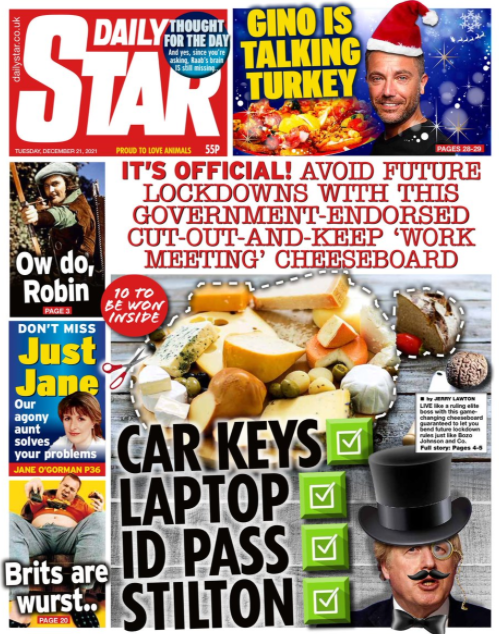
Boris Johnson took part in a Christmas quiz sitting between two colleagues in No 10 last year – while indoor household mixing was banned in London.

By Dulcie Lee www.bbc.co.uk

A photo of Boris Johnson next to two other people in an office

Image source, The Sunday Mirror

The Sunday Mirror has published a picture of Mr Johnson at the event, which it said was on 15 December.

Downing Street said the prime minister “briefly took part virtually in a quiz” to thank staff for their hard work during the pandemic.

Labour’s Angela Rayner said Mr Johnson was “unfit to lead this country”.

It comes after the government launched an investigation into three allegations of gatherings last Christmas – including two in Downing Street – despite Covid rules banning them.

In the photo, Mr Johnson is sitting in the No 10 library between a colleague wearing a tinsel scarf and another apparently in a Santa hat.

London was under Tier Two restrictions at the time, which banned mixing of households indoors – apart from support bubbles – and allowed a maximum of six people to meet outside.

Official guidance said: “Although there are exemptions for work purposes, you must not have a work Christmas lunch or party, where that is a primarily social activity and is not otherwise permitted by the rules in your tier.”

Responding to the photo, a No10 spokesperson said: “This was a virtual quiz. Downing Street staff were often required to be in the office to work on the pandemic response so those who were in the office for work may have attended virtually from their desks.”

A Downing Street source told the BBC the two people in the picture with Mr Johnson were members of his closer staff who had come in to help him with the technology.

But Labour’s deputy leader Ms Rayner said: “Boris Johnson really believes it’s one rule for him, another for everyone else.

“Despite repeated denials of parties in No 10, it now transpires that there were numerous parties, gatherings and the prime minister even took part in a festive quiz,” she said.

The Department for Work and Pensions has confirmed some of its staff drank alcohol and ate takeaways “late into the evening” on several occasions while Covid restrictions were in place.

On Friday 10 Downing Street cancelled its 2021 Christmas party amid growing anger over a different gathering on 18 December last year, after London had been put under Tier 3 restrictions banning gatherings of two or more people indoors unless it was “reasonably necessary” for work.

After criticism from opposition parties, the media and his own MPs, the prime minister asked Cabinet Secretary Simon Case to carry out an investigation into the 18 December party earlier this week.

The inquiry will also include finding out what happened at another Downing Street gathering on 27 November last year, and another at the Department for Education on 10 December.

Allegra Stratton quit her post as a government spokesperson on Wednesday after a backlash over a video she appeared in from last December, in which she joked about a Christmas party.

The row over Christmas parties continued to escalate as the government announced new rules in England to tackle the spread of Omicron.

Mr Johnson faces a rebellion from about 60 Conservative MPs when the measures are put to a vote in the Commons next week.

Government sources suggested the introduction of Plan B measures for England will be divided into three separate votes on Tuesday, including one on Covid passes which are opposed by some Tories.

But the measures are expected to become law as Labour is backing the government.

On Saturday, a further 633 Omicron cases were reported – although the real number is estimated to be much higher. Overall, a further 54,073 daily cases were recorded across the UK.

Meanwhile, a report by the London School of Hygiene and Tropical Medicine has suggested the UK will face a substantial wave of Omicron infections in January without further restrictions, beyond Plan B.

It also said the number of deaths could range from 25,000 to 75,000 between now and April.

Photo evidence exists of No 10 Christmas parties, claims Dominic Cummings

Boris Johnson’s former senior adviser Dominic Cummings has claimed there are photos of the festive parties held at Downing Street in the run-up to Christmas last year.

www.independent.co.uk

Pressure on the prime minister over the parties has stepped up after it emerged that his top communications adviser Jack Doyle handed out awards to staff at a gathering on 18 December.

Mr Cummings claimed Mr Johnson was “lying” about the gatherings and said photo evidence of the events – as well as invitations sent to people who do not work at No 10 – would soon be revealed.

“There’s lots of pictures of the parties which will inevitably get out. And invite lists beyond No 10, to other departments,” he tweeted on Friday.

The former strategist also said he thought Mr Johnson probably knew about the 18 December event at the centre of the scandal, and predicted the PM would “be gone before the next election … probably summer”.

In a question and answer event for subscribers to his blog, Mr Cummings also suggested that Mr Doyle would become the fall guy for the party scandal – claiming the press chief is a “gonner” (sic).

He claimed Mr Johnson “will be thinking ‘not now, gotta keep him as the sacrifice for Case’s inquiry then – I’m shocked, shocked I tell you to discover there was a party and I was misled’.”

Mr Cummings also suggested the PM – facing accusations that he lied to his own ethics adviser about donations spent on Downing Street flat redecorations – would “do a deal with Jack to keep all the wallpaper horror buried”.

Referring to the events of 18 December, Mr Cummings also suggested Mr Johnson may have known about the gathering of staff. “He knew but I think did not attend, though remember the geography – to get upstairs he has to walk past that area where he could see it – if he was not [at] Chequers.”

Mr Cummings also alleged that Mr Johnson, whom he refers to as the “trolley”, had been “lying” when answering questions about the alleged parties in recent days.

He claimed: “There were invites sent across Whitehall, it was an organised party. The trolley knows this and tried to lie his way out but was fck [sic] by the video.”

The former No 10 strategist also denied claims he was the source of the leaked video which showed adviser Allegra Stratton, who has since resigned, joking about a festive party. Asked if he obtained the clip and shared with ITV News, he replied: “No.”

Asked by subscribers how and when the Tories might replace Mr Johnson, Mr Cummings said: “The polls will lead it, plus his inevitable continued flat spin, plus officials kicking him off the ice, plus rivals strategically intervening.”

“He’s done, gone by this time next year, probably summer,” he said of Mr Johnson’s leadership – warning the 2019 intake of so-called red wall Tory MPs that they would be “toast” unless they replace him.

But Mr Cummings would not be drawn on who would be the next PM. “Don’t want to get into personalities now – [Liz] Truss and [Sajid] Javid are not solutions.” Asked if his former Vote Leave campaign ally Michael Gove was the answer, he said: “No.”

It comes as Tory peer Gavin Barwell said the party’s MPs are “definitely” having conversations on how to replace Mr Johnson. “His position depends on being seen as an electoral asset, and if over a period of time that goes then he really is in trouble.”

Mr Johnson’s troubles were made worse on Friday when it emerged that his ethics adviser Lord Geidt has restarted an investigation into the funding of the lavish flat refurb.

Lord Geidt contacted No 10 after Thursday’s Electoral Commission report appeared to show the prime minister “misled” the adviser on when exactly he knew about funding arrangements.

Some light relief: Short Stories and Tall Tales

Local author Philip Algar  15th book has just been published. It is a collection of short stories which, hopefully, can remind readers what our world and lives used to be before the damaging and cruel challenges of Covid.

He has ignored Covid-related restrictions to travel back in time and abroad to write a collection of short stories. He reveals what happens to a cabinet minister to whom truth is an alien concept. How did three schoolboys play a surprising role in the Second World War? What happened to the young man and the girl with a suede coat? How did following his newspaper’s advice change a sausage maker’s life and what did an employee tell senior management at his retirement function?

Some tales poke fun at big business, the media and politics and all offer an imaginative escape from today’s news.

The book is available from The Curious Otter Bookshop in Mill Street, Ottery and from Amazon.

Contact: Philip Algar on 01404 814157 or philipalgar@btinternet.com

Simon – Plan B could soon be toast anyway, will you be supporting Plan C?

Javid advised to take ‘stringent’ Covid measures within a week, leak reveals

Britain’s top public health officials have advised ministers that “stringent national measures” need to be imposed by 18 December to avoid Covid hospitalisations surpassing last winter’s peak, according to documents leaked to the Guardian.

Rowena Mason www.theguardian.com 

Sajid Javid, the health secretary, received a presentation from the UK Health and Security Agency (UKHSA) on Tuesday warning that even if the new Omicron variant leads to less serious disease than Delta, it risks overwhelming the NHS with 5,000 people admitted to hospital a day.

In an interview with the Guardian, the epidemiologist Prof Neil Ferguson said the total could be double that number.

No 10 insisted there were no imminent plans to bring in more measures after plan B measures were announced for England this week but cabinet minister Michael Gove, who chaired a Cobra meeting on Friday, said the government had been presented with some “very challenging information” about the speed of the spread.

The Guardian has seen leaked advice from UKHSA for Javid marked “official, sensitive” saying: “The key point is that under a range of plausible scenarios, stringent action is needed on or before 18 December 2021 if doubling times stay at 2.5 days. Even if doubling times rise to around 5 days, stringent action is likely still needed in December.”

It adds: “The rapid spread of Omicron means that action to limit pressures on the health system might have to come earlier than intuition suggests.” Its calculations suggest that even if Omicron causes a less severe hospitalisation rate of 1% or 0.5% compared with Delta’s 1.5%, then “stringent national measures’” would be needed by 18 December at the latest.

On the current trajectory of 2.5 days doubling time, and without any further restrictions, the document warns that Omicron cases could be at 248,000 cases a day by 19 December. It also stresses that the figures are not a projection but an estimate of Omicron prevalence and doubling times seen in the UK so far.

The document does not detail what the necessary curbs would be but defines “stringent national measures” as those that bring the R (reproduction) number below 1.

Boris Johnson triggered plan B this week including more wide-ranging mask mandates, asking people to work from home and Covid passports for big venues but a senior Whitehall source said few inside UKHSA believe this will have much effect on slowing the spread of the variant.

Further measures, now being referred to as plan C, could include stricter isolation requirements for contacts of Covid cases, masks in pubs, shutting hospitality entirely, more restrictions on visitors to care homes and hospitals or even the return of curbs on social contact.

As the ministers convened a Cobra meeting to discuss Omicron, the level of concern about the variant is rising among its scientific and public health advisers. There were more than 58,000 new confirmed UK daily cases of Covid on Friday – the highest level since January – with 120 deaths within 28 days of a positive test.

Cobra, which involved the four nations of the UK, was chaired by Gove, the levelling up secretary, as Johnson spent time with his family after the birth of his second child with his wife, Carrie Johnson.

He warned that evidence suggests Omicron is “more likely” than past Covid-19 variants to “potentially” lead to hospital admissions among the fully vaccinated.

Sturgeon warned of a “potential tsunami” of Omicron infections as the new variant brings “the fastest exponential growth we have seen in this pandemic so far”. At an unscheduled televised Covid update on Friday, the first minister said that “frankness” with the public was necessary, as the Scottish government published an evidence paper suggesting Omicron is “rising exponentially”.

It came as the Welsh government hinted at new restrictions on visiting people in care homes and hospitals to counter the impact of Omicron. The first minister, Mark Drakeford, also suggested it would be wise for businesses and public sector leaders to plan for the possibility of further clampdowns and even a new lockdown.

He said: “We will be issuing new guidance for visiting in care homes and hospitals. We want to do all we can to support visiting where it is safe to do so but, if we see a new wave of cases, some strengthened measures to protect patients and residents may be needed.”

A government spokesperson said: “There are no plans for further restrictions. Plan B is the proportionate approach given what we know at this stage about the Omicron variant.

“The government will continue to look closely at all the emerging data and we’ll keep our measures under review as we learn more about this variant.”

‘Cut our pay’ pleads East Devon Tory

Conservative councillors just sitting on their bums, doing nothing? – Owl

Councillors should be paid less because they’re working from home, an East Devon District Councillor has claimed, leading to condemnation from his colleagues.

Joe Ives, local democracy reporter www.radioexe.co.uk

‘We’re working harder than ever’ other councillors claim

Councillor Colin Brown (Dunkeswell and Otterhead) leader of the Conservative Group at East Devon District Council (EDDC), told a full council meeting that councillors are “taking taxpayers money for sitting at home rather than being held to account in public.”

He argued that councillors’ allowances should be cut, and that special responsibility allowances, an extra sum paid to senior councillors who have more work, be entirely withdrawn.

The comments, during a debate over continuing with virtual council meetings, drew the ire of many of his colleagues who say they have been working long hours throughout the pandemic. 

Councillor Geoff Jung said that it was a “no brainer” to continue to meet virtually, adding he was very upset “by the grotesque insinuation” that members were not earning their allowances simply because they were working from home.

He explained: “The covid emergency has meant that I and all cabinet members’ workload has actually increased dramatically.”

Cllr Jung told councillors he had been working six days a week with no holiday for two years. He added: “Rather than handing back any money I think we deserve a thank you from members of the public and other councillors.”

Councillor Jack Rowland (Independent East Devon Alliance, Democratic Alliance Group, Seaton) described Cllr Brown’s proposal to remove special responsibility allowances as “utter garbage” because, he said, the members receiving them are continuing to do extra hours, despite not meeting in person. 

Councillor Sarah Jackson (Independent East Devon Alliance, Democratic Alliance Group, Axminster) also criticised the Tory councillor’s arguments. “The implication of what he says seems to be that those members are not doing additional work above that of a basic level of councillor and that simply untrue,” she said.

“Meetings have continued and work has continued to go on by members of the cabinet, chairs of committees and officers. I don’t think what’s suggested [by Cllr Brown] is fair, reasonable or transparent because it gives the wrong impression of the work that councillors are doing.” 

Cllr Jackson said virtual meetings allow some members who are suffering from  long covid to carry out their council roles where they might otherwise have been unable to do so if obliged to meet in person.

All East Devon council meetings are currently streamed live on YouTube, arguably making meetings more accessible and thus easier for residents to scrutinise elected local politicians.

Cllr Jack Rowland said: “I actually think our democracy has been improved by what we’ve been doing because we’ve got a greater attendance through Zoom meetings. 

“It doesn’t detract from the public getting involved at all. In fact, I understand the public viewings of recordings of council meetings are higher than if we had face-to-face meetings in Blackdown House with the public attending.

Councillors did express an interest in creating hybrid meetings, where councillors can choose to meet in person or virtually. Plans for this are expected to be developed in the coming months. 

Councillor Steve Gazzard (Liberal Democrats, Democratic Alliance Group, Exmouth Withycombe Raleigh) said that although he had wished the council would meet in person again, it had to continue to prioritise safety. 

He said: “Not only must we think of ourselves. We’ve got to think of our families, our loved ones – and we have to think of all the staff that we employ. 

“It’s still a very dangerous situation that we find ourselves in at the moment.” 

in the face of rising covid cases and concerns over the Omicron variant, the councillors did eventually agree to continue with virtual meetings until at least 10 May next year. 

The decision was passed with 32 votes in favour, one against and seven abstentions.

Following a High Court ruling, most local councils have been meeting in person since 7 May. 

However, following an ‘extraordinary’ council meeting in July, East Devon councillors agreed to ‘consultative’ meetings until at least 17 January 2022 because of the pandemic.

This format will continue, with the council holding virtual meetings over Zoom that reach ‘indicative decisions’ which are then rubber-stamped by the chief executive or senior officers.

The only exception is the budget meeting in February 2022, for which EDDC is legally obliged to meet in person.

“I don’t support Plan B” – Simon Jupp MP

Dear Simon, 

Throughout the pandemic Boris Johnson’s boosterish approach can be characterised as either doing too little too late, as with the original lockdown, or doing too much too soon, as when he let the cork out of the bottle on  “freedom day”. “Eat out to help out” supercharged last autumn’s infection wave.

An approach Dominic Cummings described as like a ‘shopping trolley smashing between aisles’.

The public knows this and, from the start, have anticipated events, taking matters into their own hands. Many were locking down in early March 2020 before the official start date. Reports of cancellation of Christmas parties this year started well before the latest announcement about Plan B.

We also know from the experience of the last two years that action taken too late leads to the need to act more severely later on.

A very high proportion of your constituents feel vulnerable to this infection. Confidence in the way the pandemic is being handled is an essential prerequisite if the general population is to feel secure to venture out. It is lack of confidence that costs jobs.

Owl