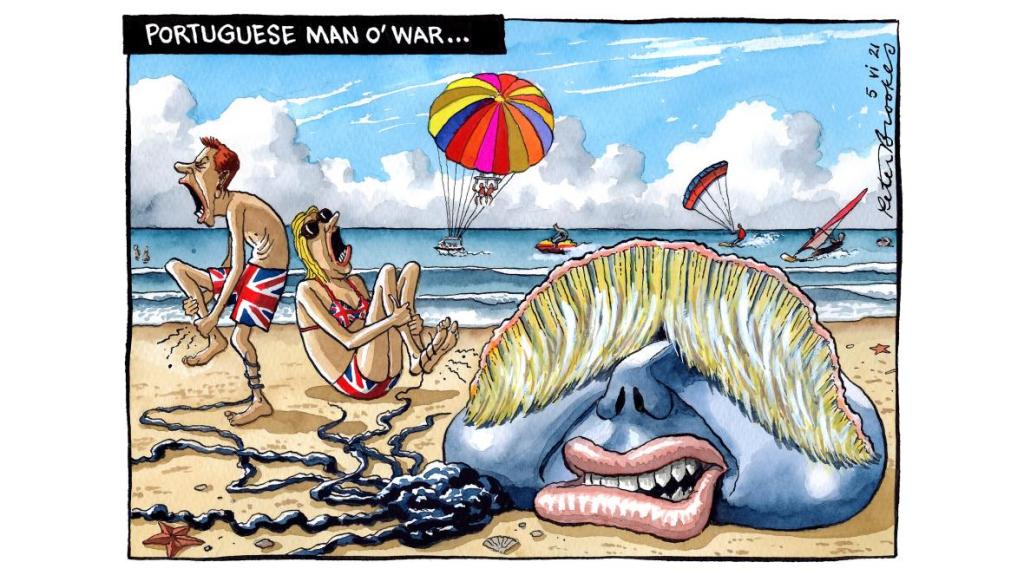
Lockdown lifting set to be delayed after update from Whitty and Vallance

Is June 21 “on” or “off”, “green” or “red”, “go” or “irreversibly stopped”?

Which has priority: business at all costs or people’s health?

Neil Shaw www.devonlive.com

England’s chief medical officer Professor Chris Whitty and chief scientific adviser Sir Patrick Vallance are reported to have given a ‘downbeat’ update on the state of coronavirus in the UK to ministers.

The briefing yesterday could mean lockdown lifting on June 21 being delayed.

That would mean easing of measures – such as permission for large events and the reopening of nightclubs – would not go ahead as planned.

Reports have suggested the final step in the Government’s road map could be delayed by two weeks, with The Times saying ministers were given a “downbeat” briefing on the latest data on Monday by chief medical officer Chris Whitty and chief scientific adviser Sir Patrick Vallance.

The Times reports that they emphasised concerns over the rate of transmission of new strains of Covid, including the Delta variant (first identified in India), and that vaccinations did not provide 100 per cent protection.

A cabinet source was reported to have said that they expected a delay of “between two weeks and a month” and that Chris Whitty and Sir Vallance had expressed reservations about the timetable.

“They emphasised again that the vaccine did not provide 100 per cent protection and there were real concerns about the transmissibility of the new variants,” the source said.

“I think you’re looking at a delay of between two weeks and a month. As long as we have fully opened things up by the school holidays then I don’t think the political damage will be too great.”

Another cabinet source described the mood in Whitehall as “downbeat” and one said the delay would make sense to avoid any “confusion” in the messaging.

Ministers are said to believe that the easing of restrictions may need to be delayed to ensure all over-50s are protected.

Mr Hancock said a decision on moving to Step 4 would be delayed as long as possible, with a final announcement to be made next Monday – a week before any changes could come into effect.

Downing Street said there was “nothing in the data” to suggest a delay would be needed.

Despite the uncertainty surrounding June 21, the Health Secretary said he was confident that “one day soon freedom will return”, with the latest data suggesting vaccines were protecting people against the Delta variant first identified in India.

And as the vaccination programme moved into its final stage – with under-30s the final cohort on the vaccine priority list – the NHS described the six-month anniversary as a “watershed moment”.

NHS England national medical director Stephen Powis said: “It is remarkable to think that just six months after that first jab back in Coventry in December – Maggie Keenan got it, remember – we have now vaccinated three-quarters of the adult population with their first dose and over half with their second dose.

“That really is a tremendous achievement and of course the vaccine programme is our way out of this pandemic, so it is crucial that when you get the invite for your jab, come and get it.”

As of June 6, England has delivered 23,710,646 second doses of Covid-19 vaccine, meaning the equivalent of 53.6% of its adult population is fully vaccinated, with 76.4% of adults having received one jab.

In Wales, the equivalent of 49.5% of its adult population is fully vaccinated, with 86.5% of adults having received a first jab, while in Scotland 50.8% of adults are fully vaccinated and 76.4% of adults have received a first dose.

The equivalent of 48.9% of Northern Ireland’s adult population is fully vaccinated, while a first dose has been given to 75.1% of adults.

All adults have already been called forward to get their vaccine in Northern Ireland and most of Wales, while people aged 18 to 29 in Scotland have been asked to register for their jab, with appointments starting in mid-June.

Mr Hancock said the Delta variant “made the race between the virus and this vaccination effort tighter” but the vaccine was breaking the previously “rock solid” link between infections and hospital admissions.

The variant is thought to be 40% more transmissible than the Alpha variant first seen in Kent which swept across the UK over the winter peak.

As of June 3, from 12,383 cases of the Delta variant 464 went on ,hospital.

Of those admitted, 83 were unvaccinated, 28 had received one dose and three had received both doses of the vaccine, Mr Hancock said.

The spread of the Delta variant has seen cases increase in almost all parts of north-west England, London and Scotland.

The rise in rates has yet to be mirrored by a steady increase in hospital cases. Latest data shows numbers have climbed slightly, with the seven-day average for patients in hospital reaching 912 on June 3 – the highest since May 26.

Nearly three-quarters of local areas of the UK (283 out of 380) recorded a week-on-week rise in Covid-19 case rates for the seven days to June 2, the highest proportion since January 6.

Downing Street said data emerging over the coming week will be “crucial” in deciding whether England’s legal coronavirus restrictions can end as hoped on June 21.

However:

Devon MPs urge Government to lift lockdown on June 21

Daniel Clark www.devonlive.com

Devon’s MPs from across the political spectrum have called for the Government to go ahead and lift all remaining Covid restrictions on June 21.

Step 4 of the roadmap out of lockdown, which is set to take place not before June 21, would remove all remaining legal limits on social contact, ease restrictions on large events and reopen premises such as nightclubs which have remained closed.

A review of social distancing and other long-term measures that have been put in place to cut transmission, such as wearing of face coverings and working from home, is also due to be completed with these restrictions also potentially removed.

But the relaxing of the remaining rules has been thrown into doubt by the recent rise in cases being confirmed, as well as the Delta variant, first seen in India, which is thought to be about 40 per cent more transmissible than the Alpha (Kent) strain.

However, with deaths and hospitalisations staying low, and with Devon having some of the lowest Covid rates in England, the county’s MPs have urged the Government not to delay the planned lifted of restrictions on June 21.

Latest figures show that there is just one person in hospital in Devon following a positive Covid-19 test, while there have been no deaths in the county since May 9, and infection rates are at 6.9/100,000, down 35 per cent week-on-week, and the lowest they have been since September 2.

Newton Abbot MP Anne Marie Morris, who has been a ‘lockdown sceptic’, and who voted against the third lockdown, has urged the Government not to delay the planned lifting of restrictions on June 21.

She said: “Given the specific situation we find ourselves presented with in Devon (both health-wise and economy-wise) I would urge the Government not to delay the planned lifting of restrictions on Jun 21st. While the latest steps have helped the local economy begin to get back on its feet, it won’t be until all restrictions are lifted that we will be able to enjoy the full freedom that we desperately all want.

“The vaccination rollout has been a stunning success and this should allow us to re-open with confidence. We cannot keep flinching at the slightest sign of every potential new variant. It’s damaging to physical and mental health and the economy.”

And Labour MP for Exeter Ben Bradshaw also joined the chorus of those calling for restrictions to go on June 21, saying that it should not be delayed in the county because ‘of a small number of hotter spots or because of fears about a theoretical new variant emerging’.

He added: “The data that matters now is on serious illness, hospitalisation and deaths and so far the evidence is that the vaccines protect against all currently known variants.

“There may be an argument for continuing with certain limited guidance that does not impact negatively on the economy, such as continuing to work from home if possible and wearing face protection in enclosed public spaces, but the June 21st date should not be delayed, particularly for low incidence areas like Exeter and Devon, because of a small number of hotter spots or because of fears about a theoretical new variant emerging.

“People have put up with unprecedented restrictions to their freedoms for long enough and with life returning to more or less normal across the rest of Europe, it would seem unreasonable for the Government here to impose unnecessary restrictions on the British for longer, particularly given our high vaccination rate, which the Government promised would deliver us a vaccine dividend.”

Central Devon Mel Stride MP said that the decision was ‘finely balanced’, but his hope and expectation was for June 21 to go ahead.

He said: “The decision on opening up fully is finely balanced at the moment. Hospitalisations and fatalities are obviously low but whilst many are vaccinated not all are and if the delta variant expands very rapidly over the next week then there may be a case for rowing back a little on fully opening. My hope and expectation however is that step 4 will be taken pretty much in full on the 21st.”

Sir Gary Streeter, MP for South West Devon, also added that the further release should go ahead.

He said: “I think it is finely balanced. Government said it would look at the date from the proceeding steps from lockdown and that is what they will do. There is a case for delaying full release until more people under 50 have been vaccinated, but my personal preference would be to proceed with the further release on the grounds that the vaccine is working and younger people tend not to get Covid seriously. The government has exercised terrific judgement on this in the last few months and I am happy to back their judgement whatever they decide.”

Selaine Saxby, MP for North Devon, said: “I very much hope the decision will be driven by the data, which in North Devon remains very positive. There are the four tests which need to be met for the next phase of unlocking to go ahead and the question about “variants of concern” is one that I am not privy to the data on at this time, but my understanding of the data I am able to see is that the other three are looking optimistic and very much hope that we will be able to progress to the next stage as planned.”

No decision on whether to proceed to step 4, or delay the step, will be taken until June 14 to allow for the full four weeks of data since the relaxation of step 3 on May 17 can be seen.

The Government says that the he decision will be based on four tests – that the vaccine deployment programme continues successfully, the evidence shows vaccines are sufficiently effective in reducing hospitalisations and deaths in those vaccinated, infection rates do not risk a surge in hospitalisations which would put unsustainable pressure on the NHS, and the assessment of the risks is not fundamentally changed by new variants of concern.

Meanwhile the traffic build up to the West doesn’t stop:

M5 and A38 experiencing heavy traffic delays – updates

Katie Timms, Eve Watson www.devonlive.com

There is heavy traffic across Devon and Cornwall this morning.

The M5 in Tiverton is partially blocked with heavy traffic due to a broken down vehicle, which has left the northbound exit slip road up to the roundabout is reportedly blocked.

Initial proposals for new parliamentary boundaries – consultation closes 2 August

Here is a link to the details

https://boundarycommissionforengland.independent.gov.uk/2023-review/

First impressions: major changes reflecting population growth.

New map of proposed local boundaries:

Existing boundaries (not to same scale):

Boris Johnson rapped for ‘taking parliament for granted’ over cuts to foreign aid

Prime minister spared potentially embarrassing defeat in a vote on overseas aid but gets harsh words from the Speaker.

[Owl now thinks that Neil Parish is one of the non-cut rebels but no idea about Simon Jupp.]

Esther Webber www.politico.eu 

LONDON — Tory rebels have vowed to fight on after Boris Johnson was spared a potentially embarrassing defeat in a vote on overseas aid ahead of the G7 summit. 

Funding for foreign aid was cut from 0.7 percent of national income to 0.5 percent at the beginning of the year, as Chancellor Rishi Sunak argued it was “difficult to justify” amid the coronavirus crisis.

Conservative Party rebels, with cross-party support, introduced an amendment that would have reintroduced the 0.7 percent target from next year, attaching it to a law setting up the U.K.’s new Advanced Research and Innovation Agency.

However, the Commons Speaker, Lindsay Hoyle, ruled on Monday that it was outside the scope of the bill and could not be voted on. 

In explaining his decision, Hoyle said he understood the “frustration” of those seeking a vote, adding: “This House should not continue to be taken for granted but we must do it in the right way… not only for this House but the country needs this to be debated and aired and an effective decision to be taken.”

The MPs who want to see the cut reversed interpreted this as a call for the government to bring forward legislation on the matter, which it has so far resisted. 

Johnson argued earlier this year that it was permissible for him to act without changing the law because the target can be temporarily missed in exceptional circumstances.

Andrew Mitchell, the former international development secretary who organized the amendment, accused the government of “riding roughshod” over parliament and of “seeking to thwart our democratic rights” after the Speaker’s statement.

The Speaker announced an emergency debate would be held on the issue, which would be held over three hours on Tuesday but would not be subject to a binding vote.

Anthony Mangnall, who coordinated the campaign alongside Mitchell, told POLITICO: “Today has only shown the strength of our argument and numbers. Tomorrow we will make that case. The Speaker made it clear that the government ought to bring forward legislation — an almost unheard-of request.”

Other would-be rebels acknowledged privately the emergency vote would need to be followed by legislation and there was not a clear route towards this. 

One commented: “The government holds most of the cards, alas.”

Cornwall’s homeless are moved out of hotels to make way for tourists

Cornwall is facing an accommodation “crisis” after it was revealed that about 130 people homeless people were asked to move out of hotels to make way for paying customers.

Lee Trewhela  www.cornwalllive.com 

The promise of a busy summer season, next week’s G7 Summit, a packed Bank Holiday weekend and half-term have all meant that hotel and B&B owners who have provided temporary and emergency accommodation for homeless people and families want to return to welcoming paying guests.

Olly Monk, Cornwall Council’s cabinet member for housing, told CornwallLive the situation was a “crisis” and the council needed to come up with solutions as quickly as possible.

He said: “Last week about 130 people left temporary and emergency accommodation that the council provides at hotel chains and B&Bs for the reason that people wanted to get back to the business of providing hotel accommodation for regular, paying guests.

“The good weather, the bank holiday and the end of lockdown on June 21, hopefully, has meant those businesses want to get back on a regular footing of providing regular accommodation.”

The Conservative councillor for Newquay Trenance said the council didn’t have any long-term contracts in place with hoteliers so the businesses had the flexibility to terminate the contracts.

“Cornwall Housing managed to rehouse pretty much all of them,” added the councillor. “A lot of them moved in with family or friends, some were rehoused in Plymouth.

“A very small number of people, discretionary claimants, who were housed in Cornwall during Covid who couldn’t get back to where they came from during the pandemic have been offered accommodation elsewhere.”

Mr Monk said he had not heard any reports of anyone being made homeless as a result of the move.

“This is a crisis and we need to come up with some innovative solutions to it very quickly,” he stressed. “Moving forward, the people we are homing in temporary and emergency accommodation are going to come under more pressure as the holiday season progresses and as landlords cash in on the AirB&B side of things.

“Long-term our administration is looking at providing more council housing and open market rented properties for the people of Cornwall. But right now we’ve got a problem with a lot of people in temporary accommodation that we need to house and provide that provision until we start building the council housing that people need.

“This is why I wanted the housing job, it’s something I feel passionate about – it’s a problem in Cornwall and I want to do my best to help.”

Another Cornwall councillor hopes that a legacy from the G7 will provide more accommodation for homeless people.

Jayne Kirkham, Labour councillor for Falmouth Penwerris, said: “The G7 and the encroaching holiday season has flagged up a real weakness in homelessness and housing provision in Cornwall.

“Trying to rehouse so many people at short notice in Cornwall in the summer with the place full due to the G7 is incredibly difficult and expensive. The worry is that some people will slip through the net and end up back on the streets. All the good work done engaging with the support services will be lost and they will go backwards.”

Cornwall Housing installed homeless ‘pods’ in Truro and Penzance last year and are planning a new homeless centre in Truro with 11 rooms. They also received money from the Next Steps Accommodation Fund to purchase accommodation and fund support workers.

Ms Kirkham added: “They have done a huge lot of work in the last year in trying to get ‘everybody in’. Despite the rough sleeper count in November 2019 showing there were only 24 people rough sleeping in Cornwall, 168 people were given emergency accommodation in the first few months of the pandemic.

“However, there is always more that could be done and the G7 and our summer holiday season have highlighted the current fragility of emergency housing provision in Cornwall. Particularly the part that is commissioned with national hotel chains and is incredibly expensive and hard to find at certain times of the year, due to our seasonal economy.

“Much is spoken of the ‘legacy’ the G7 may provide to Cornwall. I would suggest that the Government consider that the G7 has proven that we need extra support with our homelessness provision.

“I went up to Falmouth Rugby Club last night where there are 40 ‘pods’ for security staff to occupy during G7. These buildings were rented, but there will be similar across the Duchy. Maybe if some of these housing pods could stay in Cornwall after the G7 moves on, along with some extra funding for more permanent accommodation, it would go some way to help plug a gaping hole.

“We obviously need more reliable options than renewing room bookings at national hotel chains.”

Foreign aid: Aid cuts could see lives lost, warns senior Tory – How will Parish and Jupp vote?

If this goes to a vote tonight, how do you think our MPs Neil Parish and Simon Jupp will vote? Neither particularly noted for their “independence” – Owl

Children could die as a result of UK cuts to the overseas aid budget, a senior Conservative backbencher says.

By Hazel Shearing www.bbc.co.uk

The prime minister is facing a possible Commons defeat after cutting spending of national income on international development from 0.7% from 0.5%.

David Davis – among more than 30 Tories against the move – said some UK-backed schemes have already been cancelled and “morally, this is a devastating thing”.

The government’s supporters say the cut is temporary, necessary and popular.

The Conservative Party committed to spending 0.7% in its manifesto for the 2019 general election – but ministers say it is hard to justify given record levels of peacetime borrowing during the pandemic.

The cut amounts to almost £4bn, but the government said it will still spend more than £10bn on foreign aid in 2021.

Speaking at the start of a week in which the UK hosts the G7 summit in Cornwall, Mr Davis said: “Historically, I am a critic of aid spending but doing it this way is really so harmful.”

He told BBC Radio 4’s Today programme if the government were to offer a compromise of a short time frame for their cut to foreign aid spending, “it helps”.

But he said “if you’re a small child and suddenly you get dirty water, you get an infection from it and you die, temporary doesn’t mean much”.

Mr Davis added: “If you’re going to kill people with this, which I think is going to be the outcome in many areas, we need to reverse those immediately”.

Former Prime Minister Theresa May is one of the other Tory rebels hoping to achieve a U-turn with an amendment to the Advanced Research and Invention Agency (ARIA) Bill – a planned new law to set up a new agency designed to come up with innovative policy.

It would oblige the agency to make up any shortfall in aid spending if the government were to miss the 0.7% target.

The bill is due to be scrutinised in the Commons on Monday afternoon – but it will be up to Commons Speaker Sir Lindsay Hoyle to decide whether the rebels’ amendment should be put to a vote.

Voting on the bill will begin no later than 21:00 BST.

Former Labour Prime Minister Gordon Brown also criticised the cuts, telling BBC Breakfast it was “a life and death issue” and made “no economic or moral sense”.

Former International Development Secretary Andrew Mitchell, who is leading the rebellion, said the UK is the only member of the G7 group of advanced economies cutting aid this year – and that “contributing our fair share of aid is essential for a successful G7 summit” this week.

“The eyes of the world are truly upon us. But in this moment Britain is found wanting, because we have removed a foundational piece of our own global leadership,” he has written in the Guardian.

The aid reduction has meant millions of pounds less is being spent on supporting girls’ education, reproductive health, clean water, HIV/AIDS, the humanitarian crisis in Yemen and Syria, and hundreds of other projects.

media captionSir Bob Geldof: ”We don’t take the piece of bread from that child’s mouth in Yemen”

Dozens of charities said there was “no justifiable economic need” for them in a letter to Mr Johnson over the weekend, and Archbishop of Canterbury Justin Welby called the cuts “indefensible” on Twitter,.

The government has promised to restore spending to the 0.7% level “when the fiscal situation allows” – but has not specified a date.

Anti-poverty campaigner Sir Bob Geldof told the BBC’s Andrew Marr on Sunday that he feared they could become permanent.

Duty to ‘protect our citizens’

But Solicitor General Lucy Frazer said the government would return to spending 0.7% levels “when the fiscal situation allows”.

She said the UK was a big aid donor but added: “We have a duty to ensure we protect our citizens here as well as those in the rest of the world.”

A senior government source told BBC political correspondent Chris Mason that if the amendment were to go through, it would be the equivalent of putting up income tax by a penny for every pound earned.

And ex-Work and Pensions Secretary Esther McVey argued the UK shouldn’t “end up going into deeper debt in order to finance other countries”.

Writing in the Telegraph, she said the UK should instead help poorer countries “trade their way out of poverty”.

“If more and more aid was the solution, large parts of Africa would have escaped all poverty decades ago,” she added.

Planning applications validated by EDDC for week beginning 24 May

Got a staff shortage? Raising wages normally helps

Consequences of a low pay, low investment economy? 

Owl’s view has always been that moving to a high wage economy is the way to improve productivity (and improved standard of living).

Larry Elliott www.theguardian.com

From Michel Roux Jr to Tim Martin, from swanky Le Gavroche in London to Wetherspoons pubs, the message is the same: we need more staff. Labour shortages were not a problem envisaged when the UK was plunged into lockdown in the spring of 2020. Then, the fear was of massive job losses and the highest unemployment since the 1930s.

Now, the hospitality sector says a lack of chefs, bar staff and waiters is affecting trade. Roux has announced he is closing Le Gavroche at lunchtimes. At Wetherspoons, Brexit-supporting boss Martin has urged ministers to use their ability to set immigration laws to grant visas to EU citizens.

In part, the problem has been caused by the sudden surge in consumer demand as restrictions have been eased. Having been cooped up for so long over the winter, consumers have wanted to go out for a drink, a meal, or enjoy a weekend break. Lots of venues have been looking for staff at the same time.

The hospitality sector employs one in 10 workers in the UK – more than three million people in total – but has been particularly hard-hit by the repeated lockdowns of the last 15 months. Some of those employed in pubs, restaurants and hotels are still on furlough and not ready for a new job. Others have decided to change career or to stay on ine education rather than risk the vagaries of the labour market. Workers from the EU have returned to their own countries during lockdown and for a variety of reasons – health concerns and Brexit in particular – are not coming back.

There are solutions to this problem. The more unscrupulous employers might sweat their workforces harder, something made possible by the low level of union membership in the sector. They could decide – as Roux has done – to limit opening hours, although this is more feasible for businesses at the luxury end of the market than it is for high-volume outlets. A third option would be to attract more workers from overseas, which is what Tony Blair did when he welcomed people from the countries of eastern Europe after they joined the EU in 2004.

The only other solution is the most obvious one: make the jobs more attractive through higher pay.

There would be knock-on effects. The price of a pint would go up as employers passed on higher costs to their customers. Inflation would be a bit higher. Some businesses would close. Yet one of the basic tenets of economics is that raising the price of something – in this case the wages of a chef or a waiter – increases its supply.

The impact on labour shortages would almost certainly not be instant, because those attracted to a job in hospitality by the lure of higher wages may not have the necessary skills. But incentives would eventually make a difference in a sector notorious for its long hours and low pay.

Labour warns on next NHS England chief as Dido Harding expected to apply

The next chief executive of NHS England must be someone with “a proven track record”, Labour has said, after it emerged that the former test and trace chief Dido Harding was expected to stand.

Peter Walker www.theguardian.com 

It is understood that Harding, a Conservative peer, is considering formally applying to replace Sir Simon Stevens, who is leaving the job in July after seven years.

While Stevens’ whole career has been in healthcare and health management, Harding spent the bulk of her working life in areas such as supermarkets and telecoms, notably as head of the Talk Talk group.

Since 2017, she has chaired the board of NHS Improvement, an oversight arm of NHS England. Her first day-to-day management job in health came a year ago when she was appointed to lead the Covid test and trace service in England, with a budget that rose to £37bn.

Harding, who is married to the Conservative MP John Penrose, faced regular criticism over the service’s performance and has acknowledged failings in how it has operated, though allies argue she has been unfairly maligned.

Test and trace has been blamed by some for failing to better curb the spread of Covid variants, such as the highly transmissible Delta variant first identified in India, which has become dominant in the UK and is threatening plans to drop most lockdown restrictions this month.

In August, Harding was also made the interim chair of the new UK Health Security Agency, which integrates the work of test and trace and takes over from Public Health England. Jenny Harries, formerly England’s deputy chief medical officer, has now taken over the role.

The next head of NHS England will face the toll of disruption to non-Covid services, with one analysis saying more than 4.5 million people missed out on hospital treatment last year alone.

Labour did not comment directly on Harding, but made plain the party was sceptical at the idea of her taking on ultimate responsibility for about 1.3 million NHS staff and an annual budget of more than £115bn.

Jonathan Ashworth, the shadow health secretary, said NHS patients and workers “will be looking for a new chief executive able to out-manoeuvre [the chancellor] Rishi Sunak” and secure enough funding for the service.

He added: “Given the scale of the waiting list backlog including for cancer and mental health care, the NHS needs someone with a proven track record of improving services for patients.”

Speaking separately, Justin Madders, the junior shadow health minister, said: “We hope the recruitment process takes candidates’ recent achievements into account, but test and trace’s performance speaks for itself.”

Another key Covid-related appointee, Kate Bingham, who led the vaccines taskforce until the end of last year, is set to become a dame in this week’s Queen’s birthday honours, according to a report.

The award for Bingham will be among a series of honours given to people who have played a role in combating coronavirus, the Sunday Telegraph said. Bingham has been praised for the success of the UK’s vaccine programme after rapidly securing contracts for large numbers of jabs of different types.

Devon carers number 130,000+

More than 130,000 people in Devon are now carers, a figure that’s grown because of the coronavirus pandemic.

Daniel Clark, local democracy reporter www.radioexe.co.uk

But only 21,000 of them – roughly only one in every six – are said to be accessing vital information and support.

Next week is Carers Week, and Devon County Council, NHS Devon Clinical Commissioning Group (CCG) and Devon Carers are shining a light on it to encourage people who are carers for friends and family to recognise themselves as unpaid carers, and to come forward for help.

Devon Carers, which is commissioned by Devon County Council and NHS Devon, provides information, advice and support for people who care for others, whether they need help because they are ill, frail, disabled or have a mental health or a substance misuse problem and can’t manage independently without support.

Cllr James McInnes, Devon County Council’s cabinet member for adult care and health services, said: “Many people won’t even think of themselves as carers because the person they are looking after is a relative, but caring can bring a whole host of responsibilities and worries and which can often have a real impact on a carer’s health and wellbeing.”

Vera Tooke didn’t think she was a carer because Graham, who she cares for, is her husband.  He has Parkinson’s disease and Lewy-Body dementia. “There are people who need a little bit of help and those who need more,” she said.  “Looking after someone else is difficult, but I didn’t see myself as a ‘carer’.  The label didn’t feel right. I was coping with the physical aspects of looking after my husband, but dementia is something else. I felt I couldn’t leave Graham to do the things I needed to do. I felt guilty and worried when I did. He was very much against anyone else helping him, even family.

“I then admitted to myself that I was a carer and I contacted Devon Carers for a carer’s assessment. They were brilliant. A carers assessment has nothing to do with judging how you are functioning as a carer, it looks at your own needs as the carer.”

Vera is one of thousands of people across Devon working around the clock to help and care for relatives and friends who couldn’t manage on their own.

But while the coronavirus pandemic has meant even more people in Devon taking on caring responsibilities, Devon Carers saw a 50 per cent reduction in the number of people approaching them for support between April and June last year.

Support is available for adult carers at devoncarers.org.uk/support or support for young carers is available at https://www.westbank.org.uk/Pages/Category/young-carers or call 03456 434 435.

Street markets: Can councils get redevelopment right?

It’s lunch time at Preston Market. At one end of the large Victorian market hall, a generous pile of fried egg and chips will leave you with change from a fiver. Two friends have claimed the window seats and grin. “These are ours – we sit here every day.”

By Rebecca Wearn www.bbc.co.uk 

At the other end of the covered market it’s a different crowd and roasted halloumi in a fresh ciabatta will cost you a fraction or so more. A solicitor pops in for a latte: “It’s nice to have something here that’s modern, it’s trendy,” he says.

Both locations serve important purposes for local people. Street markets like this one in Lancashire are being revitalised across the country as part of urban regeneration plans.

The decline of British High Streets has put councils under pressure to draw new customers into town centres. However, The National Market Traders Federation says they must not forget their old customers, too.

The trade body wants these upgraded markets to maintain traditional, affordable stalls and produce.

Joe Harrison is chief executive of the NMTF and works alongside county councils and businesses to get the best of both worlds into any redevelopment plans.

“We’ll have swanky artisan markets – and that’s all that will exist. We need to make sure that we don’t take away from people that need access to that affordable food,” he says.

Preston’s newly glazed market hall is part of a £50m regeneration project. Alongside fruit and vegetable stalls are new coffee shops, mobile phone, and fashion stalls. Outside, traders of all kinds from the old market have new tables to sell their wares, ranging from toys, homemade soaps, and bric-a-brac.

Joe thinks the balance in Preston is right but is appealing to other councils to think carefully about existing customers and traders before they make changes.

Mother and daughter business team, Tracy and Becky Taylor, run Fresh and Fruity greengrocers inside the new trading hall. Their produce is high quality, fresh and popular.

They agree that selling affordable vegetables is still their staple trade but they’ve started offering more luxury or exotic items since the refurbishment now that new customers are picking up their shopping in the hall.

They believe they can walk that line because of their connections to local suppliers: “I think a big thing for us is local produce – because we can go straight to the growers and the farmers,” says Becky.

But for some it’s not so easy. “We’ve found that a lot of things the markets used to sell, they don’t sell anymore, like clothes,” adds Tracy.

Their views are supported by a research project, led by associate professor Sara Gonzalez from the University of Leeds, measuring the importance of markets to local communities.

“Markets tend to attract elderly people; people who are from low-income neighbourhoods; those with long-term illnesses, a disability, or people with young children, and migrants or [people from] ethnic minorities,” explains Prof Gonzalez.

“We worry that these more disadvantaged customers will be left aside.”

For three years she and her team have analysed indoor and outdoor markets in London, Newcastle and Leeds, to learn about the contribution they make to these local community groups.

Their value is not just about good produce at good prices to feed stomachs – it’s about regular human contact and interactions that feed the soul.

Prof Gonzalez says that people who shop regularly at local markets get something a supermarket could never give them – company – and that’s why many customers make a whole day out of a trip.

“They might have a haircut, they’ll have a cup of tea, they’ll meet with a friend, they’ll do some shopping. And it’s weather-proof, it’s warm,” she says.

Entrance market hall

Regeneration of older marketplaces is happening across the country

“But more than that, they get to speak to people they don’t know. That might be the only people they meet for the whole day, the whole week. So, they actually do develop friendships,” says Prof Gonzalez.

At the height of the pandemic, she spoke to traders in Newcastle’s Grainger Market, who had attended a regular customer’s funeral. While in Preston, bookstall holder Pete Burns delivered books to regulars he knew relied on the social connection.

“A lot of the die-hard regulars look at you as more of a friend than a trader,” he says.

Prof Gonzalez and her team fear these groups are being excluded from council redevelopment plans, because there’s no way to measure or make a profit from the valuable sociable interactions markets provide for local communities. Instead, regeneration plans have focused on higher-end, higher-priced offerings.

Citing examples like Borough Market in London or Altrincham Market, that offer late-night fine dining and artisan produce, she explains these can “alienate” many of the vulnerable groups she has worked with.

“We want local authorities to think about the market not as a property asset but as a community asset.”

Councils demand powers to take over empty houses to solve homelessness

Councils want powers to take over empty homes to tackle the housing crisis.

Chris McLaughlin www.mirror.co.uk 

They expect hundreds of thousands will need help after the ban on bailiff evictions imposed during the pandemic was lifted last week.

Official stats say 268,385 homes are empty for over six months.

And there were 280,000 people in temporary digs such as hostels and B&Bs even before the pandemic, according to Shelter.

The Local Government Association wants to move families into homes that have been empty for six months or more.

Its spokesman David Renard said: “Lifting the ban on evictions will leave some households on a cliff edge of becoming homeless.”

Ben Beadle, of the National Residential Landlords Association, added: “A quarter of those in arrears face court orders and damage to their credit score, which makes it harder for them to access new housing.

“We need an interest-free, government hardship loan for tenants.”

The Ministry of Housing said: “We have given councils tools to tackle empty homes, including the power to increase council tax by up to 300% on these properties, and take over the management of homes that have been empty for a long period.”

Nerves in the Commons as MPs await Boundary Commission report

Some time before midday on Monday, quite a lot of English MPs will start getting distinctly twitchy. It is then that they will first see the results of a major redrawing of parliamentary boundaries, with a number of seats set to change, even disappear.

Peter Walker www.theguardian.com 

The report by the Boundary Commission for England is the latest development in a decade-long process which has previously failed to change the parliamentary map. This time the expectation is it will go ahead, with new constituencies finalised in 2023.

The key difference is that rather than reducing the Commons to 600 seats, as planned in since-abandoned reviews from 2013 and 2018, this version keeps the current 650. It will instead reflect population changes by giving 10 more seats to England, with Wales losing eight and Scotland two.

Within this framework, the respective boundary commissions for the four UK nations will work out details, followed by long months of consultation, argument and wrangling. England is announced first, with proposed maps for Scotland, Wales and Northern Ireland – which keeps 18 seats – due by July.

The plan is based on trying to make every constituency within 5% either way of the average number of electors, just under 73,400, apart from a handful of “protected” seats.

These include the Scottish Western Isles constituency of Na h-Eileanan an Iar, the smallest by population, with just under 21,000 voters, and the Isle of Wight, which has 113,000 but will be split into two.

The overall picture is deeply complex and, especially for Conservative MPs, brings mixed news.

According to an analysis by Robert Hayward, the elections expert who is also a Tory peer, the new boundaries would have given his party between five and 10 extra seats at the 2019 general election, since most of the new constituencies are in Conservative-friendly areas such as England’s south-east, south-west and east – although Labour-dominated London will get two more.

But gaining a swathe of new seats in 2019 has created a bigger problem for the Conservatives than was the case, Hayward argued: “Having won seats in the north and the Midlands, and particularly in Wales, they now represent seats which are substantially smaller than seats they previously held.”

Labour had significant worries about the last boundary review, both the reduction in total seats and the plan to base it on a relatively old electoral register. This time the template will be the register from March 2020.

Cat Smith, Labour’s shadow Cabinet Office minister, whose brief covers electoral issues, said one worry was that the flexibility over populations had been set to 5% of the average, rather than 10%.

“That means less flexibility to keep communities together,” she said. “What we don’t want to see is new boundaries that cut across what people see as their community identities. It’s why the consultation process is so important.”

Such issues are likely to dominate the consultation process. In a media briefing this week, Tim Bowden, secretary to the English commission, said one possibility was a new constituency straddling the River Tamar – meaning it would include parts of both Devon and Cornwall.

While the proposed new boundaries will not be publicly announced before Monday night, MPs can collect information about their own area from Commons officials at midday. With many MPs still not in Westminster due to Covid, the information will also be emailed at 3pm.

The process was likely to be less tumultuous now the plan to trim 50 seats had been dropped, Hayward said: “Yes, up to a point – but redistribution always is contentious. Even an MP who has a majority of 20,000 gets neurotic if they might lose 4,000 of that, as they immediately assume it will be 10,000.”

The key questions Matt Hancock must answer on Covid this week

Michael Savage www.theguardian.com 

Did he mislead the prime minister over care homes?

In perhaps the most explosive allegation made during his seven hours of select committee evidence, Dominic Cummings said Hancock had assured Boris Johnson that all hospital patients heading back to care homes would be tested. He then said that, at a disputed meeting in May, the prime minister had demanded to know why this had not happened. Hancock has already denied these allegations and suggested that he only pledged to test all discharged hospital patients as soon as testing capacity allowed.

Did he interfere with the testing programme to meet his own targets?

Another key accusation from Cummings was that Hancock was telling officials to “down tools” on the test and trace system so that they could focus on meeting his target of carrying out 100,000 tests a day by the end of April 2020. “It was criminal, disgraceful behaviour that caused serious harm,” said Cummings. Hancock has said that building capacity was critical to achieving the ability to test, among others, returning care-home residents.

Was he too slow to react on PPE?

Cummings said he was astounded to find that Hancock’s department had accepted that crucial personal protective equipment would take time to arrive because they were still shipping it from China, rather than making use of aircraft grounded as a result of the collapse in international travel. He also said Hancock had falsely claimed PPE funding was blocked by the Treasury.

Did everyone who needed treatment get treatment?

Hancock said publicly that everyone who needed treatment for Covid would receive the care that they needed. That this happened has been disputed, with Cummings stating that people were left to die “in horrific circumstances”. The Cummings claim is that Hancock knew that not everyone had received the care they required, because he had been briefed to this effect internally.

Was Hancock complacent about having the right plan?

It has become clear that when Covid first emerged, the government thought its plans to deal with a flu pandemic would form the basis of its response, but the disease proved to behave very differently. Cummings said Hancock gave reassurances that plans were in place, stating: “We’ve got full plans up to and including pandemic levels regularly prepared and refreshed, CMOs [chief medical officers] and epidemiologists, we’re stress testing now, it’s our top-tier risk register.” Hancock has called all Cummings’s claims of dishonesty unsubstantiated and untrue.

Government plans to harvest patient data from GPs

Opt out deadline 23 June

This is the most urgent step; the deadline to get your form to your GP practice is 23 June 2021, according to NHS Digital.

Legal threat sharpens 

Caroline Molloy www.opendemocracy.net 

Today lawyers acting for openDemocracy and five other claimants have challenged the British government’s controversial plans to extract the medical records of everyone in England from their GP without proper consultation or informed consent – just as the doctors are reeling from coping with COVID-19.

openDemocracy has joined forces with Foxglove, a tech justice start-up, and other campaigners to issue an urgent legal challenge to the Department of Health and Social Care over its scheme to harvest the personal medical data into one massive database, which private corporations will be able to access.

The coalition’s legal letter to the government warns that unless the health department pauses the GP data grab – due to go ahead on 1 July – and seeks transparent patient consent, we will seek a court injunction to halt the scheme.

It’s the third time that openDemocracy has teamed up with Foxglove to protect patients’ rights to know – and have a say – about their data being shared with private corporations. This time we have joined forces with other campaigning organisations – Just Treatment, Doctors’ Association UK, The Citizens, and the National Pensioners Convention – and with David Davis MP.

The Conservative MP warned: “My constituents don’t expect when they sit down with their family GP that their sensitive health data is going to be able to be accessed by all and sundry. I support a future-fit NHS, but it’s got to be done in a way everyone can trust. The government must involve and inform patients so they have a meaningful chance to opt out before they progress any such policy.”

Unconvincing reassurances

Health data is both hugely sensitive and immensely valuable – to our health, and to big business. The UK’s NHS data has been valued at £10bn. And our GP data – with details of everything from diagnoses and medications to depression, abortions, sexually transmitted infections and addictions – is the most detailed, valuable and sensitive of all.

Back in 2013-14, openDemocracy was the first non-specialist news site to cover a similar, though less ambitious, project to upload and share GPs’ patient records – the care.data project – which was abandoned after two million people opted out amidst concerns about confidentiality and business use.

But on 12 May this year, health secretary Matt Hancock quietly issued a legal direction to every GP in England, instructing them to upload their patient records to a central database, with patients given just a few weeks to find out about the plans.

NHS Digital insists it’s not selling patient data – but then tells us that the data will be made available to third parties for a fee

During COVID, much health data was shared under extraordinary powers – including with private companies. But the government looks set to make this the ‘new normal’.

An NHS Digital spokesperson sought this week to justify its plans by arguing that “NHS data was vital in managing the response to COVID” – but relevant health data can already be shared in a public health emergency. Phil Booth of campaign group medConfidential told openDemocracy it was “very cynical for the government to be pointing to COVID purposes and using that to justify a data grab”.

The government says the data will be used only “for health and care planning and research purposes” as well as for “the development of health and care policy” – and that it will be used only “by organisations which can show they have an appropriate legal basis and a legitimate need to use it”.

The problem is, they’ve told us next to nothing about what would count as “research purposes” or a “legitimate need”.

Instead they’ve put out a succession of vague and inconsistent reassurances from NHS Digital, which give little confidence.

NHS Digital insists it’s not selling patient data – but then tells us that the data will be made available to third parties for a fee.

It tells us that it’s assessed the impact of its plans on our human rights and privacy – but that we aren’t yet allowed to see that assessment, less than three weeks before the data transfer is due to happen.

It tells us no data will be shared for “solely commercial reasons” – but few companies, particularly those operating in healthcare, claim to be motivated “solely” by their bottom line. The government itself has been generally sympathetic to companies’ claims of loftier goals. So that reassurance is a long way from watertight.

The government tells us that the data will be “de-identified” but acknowledges this process can be reversed and individuals re-identified “in certain circumstances, and where there is a valid legal reason” to do so. And it hasn’t made clear what those circumstances or reasons would be.

It tells us that companies accessing the data will be contractually banned from using other data sources to re-identify people, but we know companies don’t always play by the rules. Which is why new guidance just published by the Information Commissioner’s Office makes clear that de-identified data is still personal data, and can’t be shared with anyone else without meaningful, informed consent. Which is exactly what the government – so far – seems determined to evade.

It tells us it’s “engaged with the British Medical Association (BMA) [and the] Royal College of GPs (RCGP)” – but those organisations have pointedly not endorsed the current plans. The RCGP chair Martin Marshall said whilst the organisation supports improved data sharing in principle for “important healthcare planning and research”, it was “critical that this is transparent and that patients have confidence and trust in how the NHS and other bodies might use their information”. He added that they were “continuing to lobby NHS Digital to ensure appropriate safeguards are in place for how the data collected is used”.

The ‘mad rush’ for health data

GPs have pointed out that there’s a ‘safe setting’ for the medical data they hold that means researchers can access it without copies of our records being sent out to third parties – but the government is choosing not to use it. Why?

We know that access to NHS data is a key prize for the pharmaceutical and life sciences industries, as well as for the artificial intelligence firms. The latter, the Financial Times reported this week, are now a “mad rush” for health data, having seen their stock boom during the pandemic.

It’s also of interest to US health insurers and providers, who, as openDemocracy exposed, are already boasting of how they are “planting seeds” in England’s NHS. These firms are already advising the NHS on how to deal with more “expensive” patients, and what services could be cut. And openDemocracy has also covered how unfettered access to British data, including health data, is also a key demand for US trade negotiators.

Diarmaid McDonnell of medical campaign group Just Treatment said: “For many patients this is not just about their data – it’s about the future of the NHS. We’re sleepwalking into a health system where profits are prioritised over patients, with big tech and pharma corporations at the helm, shaping every decision about the care NHS patients receive.”

The largest public sector union, Unison, has called for the data upload to be delayed until there is greater transparency and consultation. The union called on the government to “harness the value” of our health data so that it can be “reinvested in health and social care”, rather than allowing access for next to nothing.

The government does not appear to have built in effective safeguards to protect the intellectual property arising from this precious data, meaning that the products and services corporations build from it could be sold back to the NHS for eye-watering sums.

Health data is extremely useful in the hands of medical researchers. But any involvement of private companies should be open to public scrutiny and debate. Without it, trust is damaged to the extent that legitimate researchers will be denied the kind of comprehensive data that could be most of use.

Indeed, mounting concerns about the government’s approach led to NHS Digital’s call centre “melting down” under the numbers of people calling them this week to request opt-out forms, with over half a million already having opted out, according to Phil Booth of medConfidential.

Meanwhile GPs – who are the legal guardians of patients’ confidential information – are deeply unhappy.

Rosie Sharpe, a GP at Doctors’ Association UK, said: “GPs were barely informed of this major change – how are patients expected to know about it?” and warned that the government’s approach made doctors’ lives “impossible”.

A growing number of GPs are refusing to hand over the data on 1 July, even if that means breaching a legally binding order from Matt Hancock.

Jan Shortt of the National Pensioners Convention said that the government’s approach had “excluded older people” and added the organisation was “very concerned about the lack of consultation and publicity about this except a lone government website. Most of our members have never heard of this.”

The race to get the scheme rolled out while the public and medical profession is still reeling from COVID means that there is little time for journalists and members of the public to use Freedom of Information laws to find out more about what’s going on – including how the government thinks its actions can possibly be compliant with the laws on data protection.

The government is hiding behind secrecy and ambiguity as it runs down the clock to 1 July.

So we’ve had no choice but to issue an urgent legal warning. Because we think the public urgently needs to know what the plans are for their personal information, and have the opportunity to consent – or not – before it’s too late.


The coalition is today launching a crowdfunder to cover the cost risk of the legal claim.

First-time buyers in England offered new homes at up to 50% off

But there are some catches – what happens if you have to sell to relocate? 

And it could lead to fewer homes being sold through cheaper alternative schemes such as Shared Ownership, and less social housing.

Here are two accounts of the scheme which expose different parts of the “small print” : 

First-time buyers in England offered new homes at up to 50% off

Rupert Jones www.theguardian.com

First-time buyers in England will be able to apply for a discount of up to 50% on a new-build home under a government scheme.

The First Homes initiative could save buyers £100,000 or more. But some experts say that with demand for these cut-price homes likely to exceed supply, it could spark a scramble for properties and add more fuel to the house price boom.

The government says the scheme is aimed at first-time buyers in the area where the homes are built, many of whom will be keyworkers such as NHS staff and those on the pandemic frontline such as delivery drivers and supermarket staff. It is aimed at helping them on to the property ladder by offering homes at a discount of at least 30% compared with the market price.

However, local authorities will be able to offer a bigger discount – either 40% or 50% – “if they can demonstrate a need for this”.

Crucially, the discount will be passed on with the sale of the property to future first-time buyers, meaning homes will always be sold below market value, thereby “benefiting local communities, keyworkers, and families for generations to come”, the government said.

“The scheme will support local people who struggle to afford market prices in their area, but want to stay in the communities where they live and work,” the housing ministry said.

First Homes is the latest initiative aimed at tackling the challenges of getting on the property ladder and follows a government guarantee scheme for 95% mortgages.

Years of rising prices have put home ownership out of reach for many and the current housing boom – fuelled by stamp duty tax breaks – has led to double-digit annual price growth, meaning that many would-be buyers have been left behind once again.

The scheme is for first-time buyers only; households with a combined annual income of more than £80,000 – or £90,000 in Greater London – cannot apply. Local councils will be able to bring in their own requirements such as prioritising keyworkers or local people.

There are also price caps: after the discount has been applied, the purchaser cannot be required to pay more than £250,000, or £420,000 in Greater London. However, councils will be able to make the case for imposing lower price caps.

The initial First Homes properties went on the market on Friday as part of the opening phase of an early delivery project in Bolsover, Derbyshire.

More new homes will be offered to first-time buyers under the scheme across the country in the coming weeks. The government said it would be funding a further 1,500 homes which will come on to the market from the autumn, and plans to have “at least 10,000 homes a year being delivered in the years ahead, and more if there is demand”.

Those who can afford to buy a First Home without a mortgage will not be eligible, and there are measures aimed at preventing people buying the homes purely as an investment.

With the property website Rightmove putting the current average asking price for first-time buyers in Great Britain at £205,925, some buyers using the scheme could save £100,000 or more.

However, Tim Bannister, Rightmove’s director of property data, said: “There’s likely to be a scramble for properties under this scheme as they become available, especially as we’ve already seen an influx of first-time buyers enter the market recently, helped by more lower deposit mortgages being available.”

Robert Jenrick, the housing secretary, said: “First Homes will offer a realistic and affordable route into home ownership for even more people who want to own their own home.”

First-time buyers may get 50% off new-build homes

www.thetimes.co.uk 

First-time buyers will be offered discounts of up to 50 per cent on new-build home under a government scheme.

Ministers hope to offer thousands of homes to key workers at reduced prices as part of the initiative, a feature of the government’s “levelling up” agenda. A trial has begun in Shirebrook, near Bolsover, Derbyshire, where the first 12 homes are being sold at 30 per cent under market rate.

The two to four-bedroom houses, built by the developer Keepmoat, will be sold at a discount to first-time buyers, with the saving passed on to any future buyers.

Prices start from £189,995, so buyers will save at least £59,998.50 on the purchase price.

A further 1,500 homes in England will go on sale at least 30 per cent below market value this autumn and there could be discounts up to 50 per cent off the sale price if local councils “can demonstrate a need for this”.

The Ministry of Housing, Communities and Local Government aims to sell at least 10,000 homes at a discount through the First Homes scheme in years to come if there is enough demand.

Robert Jenrick, the housing secretary, said he hoped that the scheme would make it easier for first-time buyers to stay in their local area rather than being forced out by rising house prices.

The UK average asking price is a record £333,564, the property website Rightmove said. According to its data, the average asking price for a home in Bolsover is £168,782, which is 28 per cent higher than five years ago.

Jenrick added: “First Homes will also support our fantastic key workers who are looking to get their first foot on the housing ladder – from front-line doctors and nurses to delivery drivers and supermarket staff – by giving many of them the chance to buy a home at a 30 per cent discount.”

Councils will be able to prioritise key workers and people with a local connection when deciding who is eligible for the scheme.

A number of regional and national lenders, including Nationwide and Lloyds, are working with the government to provide high loan-to-value mortgages for First Homes.

Tim Bannister, Rightmove’s director of property data, said: “There’s likely to be a scramble for properties under this scheme as they become available, especially as we’ve already seen an influx of first-time buyers enter the market recently, helped by more lower-deposit mortgages being available.”

He added: “Based on current available stock levels it’s unlikely there will be enough of these properties to satisfy the high levels of demand, so eligible buyers will need to get in quick to have the best chance of securing one.”

First Homes was praised as a “creative initiative” by Nathan Emerson at Propertymark, which represents estate agents in England, because it is only available on new homes. He says: “That is key because we have a very busy market right now, full of hungry buyers, and there is a danger that introducing more buyers without increasing supply could further push the supply and demand out of balance, meaning house prices would continue to rise.”

Emerson said the government now needed to incentivise older generations to downsize to address the shortage of family housing.

Under current proposals, 25 per cent of all affordable housing — homes sold or let at a discount — would be sold through First Homes, which critics argue could lead to fewer homes being sold through cheaper alternative schemes such as Shared Ownership, and less social housing.

A first-time buyer would have to earn £34,125 a year to buy the average 700 sq ft, two-bedroom flat using the First Homes scheme, according to analysis carried out last October by the estate agent Savills.

An NHS nurse would be priced out with an average annual income of £33,384. The starting salary for a nurse can be as low as £18,000.

Lawrence Bowles, a Savills research analyst, said: “Our modelling shows that Shared Ownership homes can offer people a route to home ownership with lower deposits and lower income requirements than First Homes.

“By restricting the supply of Shared Ownership, government risks raising the barriers to home ownership, not lowering them.”

‘One rule for you’: Michael Gove to avoid self-isolation, despite Covid app alert

Michael Gove is set to avoid self-isolation rules despite having come into contact with someone who tested positive for Covid-19.

By VMware www.thelondoneconomic.com 

As part of a new pilot scheme for workplaces, the chancellor of the Duchy of Lancaster will be able to skip the normal 10-day quarantine period, and instead take a Covid test every day for a week.

Gove received an alert from the NHS app less than a week after a trip to Portugal to attend the Champions League final, an event attended by more than 12,000 people.

It is believed that the former education secretary’s exposure to someone with the virus could have occurred during the match between Chelsea and Manchester City last weekend.

Due to meet the first ministers of Wales, Scotland and Northern Ireland, the Daily Mail reported Mr Gove had received the alert during a meeting at Downing Street with Boris Johnson, which he immediately left.

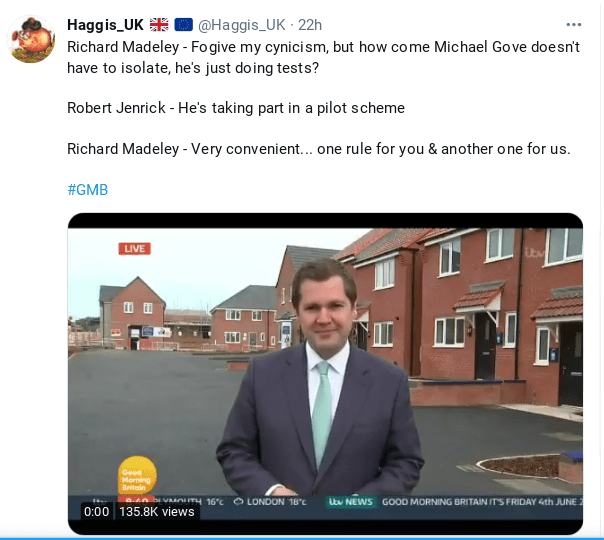
‘One rule for you’

During an interview with housing secretary Robert Jenrick, temporary Good Morning Britain host, Richard Madely, condemned Mr Gove’s inclusion in the new scheme, suggesting it amounted to “one rule for you, and another for us”.

Link to tweet and video

He said: “Forgive me for my cynicism, but you talk about caution – how is it your cabinet colleague Mr Gove has been pinged on track and trace and yet like the rest he doesn’t have to isolate, he’s just doing tests?

Mr Jenrick replied: “Well, I haven’t spoken to Michael so I don’t know all of the details exactly what’s happened to him.

“It sounds like the system worked. He went to a country on the green list, he then pinged, he’s self isolating and will be doing testing – so that’s encouraging.

But Mr Jenrick appeared unaware that Mr Gove was partaking in the workplace pilot scheme, telling BBC Breakfast that the chancellor of the Duchy of Lancaster was in fact “self-isolating and testing regularly.”

Only later did he tell Good Morning Britain that Mr Gove was in-fact involved in the pilot scheme.

“He’s taking part, as I understand it, in a pilot where people can have other circumstances to otherwise, but I’m sure he’s taking all the necessary cautions.”

The news has attracted a barrage of criticism on social media, with many branding it “one rule for them”.

Football

One user tweeted: “So, Michael Gove gets to take his son to the football in Portugal and Portugal is then added to the amber list once they’re home. Interesting.”

Another tweeted: “It’s one rule for us, and a completely different rule for any Tory MP. What a surprise!”

A football fan who returned to the UK on the same flight as Mr Gove told Sky News that he had also been contacted by the NHS app and was told to isolate until Sunday 6 June – 10 days after the final.

Holiday plans in flux

It comes on the same day as the government announced that Portugal will move from the green list to the amber list, a move that will see travellers returning from holiday destinations forced to quarantine upon entering the UK.

Speaking to BBC Breakfast, the transport secretary, Grant Shapps referenced rising cases and a new Covid strain identified in Portugal, adding that ministers did not want to take risks before the final easing of lockdown restrictions on 21 June.

The Department for Transport (DfT) said the measures are being implemented “to safeguard public health against variants of concern and protect our vaccine rollout.”

No new destinations were added to the green list in the first review of England’s traffic light list for international travel, which is due to be examined again on 28 June.

Meanwhile, seven countries – Afghanistan, Bahrain, Costa Rica, Egypt, Sri Lanka, Sudan and Trinidad and Tobaga – have been added to the red list from the amber list.

Two by-elections needed in East Devon following resignations

A pair of by-elections are set to be held in East Devon in July after the resignation of two councillors.

Daniel Clark www.devonlive.com

Vacancies on the council have arisen in the Feniton and the Honiton St Michaels ward, with polls pencilled in to take place on Thursday, July 8.

One of the Honiton St Michaels seats became available after Cllr Luke Jeffery [Lib Dem] stepped down to focus on his University course, while the Feniton seat is vacant following Cllr Susie Bond [Independent] having moved to Berkshire to be closer to family and the end of virtual meetings, plus the allowing of by-elections again, meaning it is no longer practical for her to carry on in the role.

The notice of elections for both seats have now been published by East Devon District Council, and assuming more than one nomination is received, voters in the two wards will go to the polls on July 8.

Anyone wishing to stand in the election must hand in their nomination papers to the Returning Officer at Blackdown House in Honiton by 4pm on Friday, June 11.

Following the two resignations, the composition of East Devon District Council consists of Conservatives (21), East Devon Alliance (13), Independents (12), Liberal Democrats (7), Cranbrook Voice (3), and Green Party (2), with two seats vacant.

The council is currently run by a coalition of the East Devon Alliance, Liberal Democrats, Greens, and some of the Independents.

[Owl understands that, a couple of weeks ago, Susie Bond voted for a Tory leader (did she come all the way from Berkshire to do so?); and last year she voted to stay in the Greater Exeter Strategic Plan- not a “New Guard” Indy, more a Ben Ingham one.

In fact she was chairman of the Strategic Planning Committee and Portfolio Holder of Strategic Development in Ben’s “independent” regime where much of the strategic development was run by “Build, build, build” Phillip Skinner.]

Conservatives fined £10,000 for sending unwanted emails

The Conservatives have been fined £10,000 by the data watchdog for sending marketing emails to 51 people who did not want to receive them.

BBC News www.bbc.co.uk

The messages were sent in the name of Boris Johnson in the eight days after he became prime minister in July 2019.

The party was also criticised by the Information Commissioner for a mailshot in December 2019 after concerns had been raised.

The Conservatives said they accepted the fine and had improved processes.

It is against the law to send direct marketing emails, unless the recipient has given their consent.

The Information Commissioner’s Office (ICO) said it would continue to take action against “nuisance marketing emails”.

Between 24 July and 31 July 2019, the Conservatives sent out more than a million marketing emails.

The ICO said some of the emails were “validly sent” but the party did not have the necessary consent from 51 of the recipients.

The watchdog said the problem resulted from the Conservatives’ failure to transfer records of who had unsubscribed from its marketing emails when the party switched its email provider.

Later that year, during the 2019 December general election, the Conservatives also sent out nearly 23 million emails – something the ICO says resulted in a further 95 complaints.

The watchdog expressed concern that the party had conducted the “industrial-scale marketing email exercise” while the ICO’s investigation was still ongoing.

Stephen Eckersley – director of investigations at the ICO – said: “It’s really concerning that such large scale processing occurred during the ICO’s ongoing investigation and before the Conservative Party had taken all the steps necessary to ensure that its processing, and database of people who would receive emails, was fully compliant with the data protection and electronic marketing regulations.

“Getting messages to potential voters is important in a healthy democracy but political parties must follow the law when doing so.

“The Conservative Party ought to have known this, but failed to comply with the law.”

The Information Commissioner’s Office also said its investigation had taken a long time because “the party repeatedly failed to provide responses within time periods set, even when those periods were extended”.

“The commissioner does not consider that this was satisfactory compliance with reasonable requests from the statutory regulator,” it said.

A Conservative Party spokesman said it accepted the fine and had since “reviewed and improved our processes and are fully compliant with all prevailing data protection and electronic marketing legislation”.

A disgraced Lord gave the Conservatives £500,000 days after his peerage was forced through by Boris Johnson

  • Disgraced Conservative Lord Peter Cruddas has donated more than £500,000 to Boris Johnson’s party after becoming a peer.
  • Cruddas resigned as party co-treasurer in 2012 after offering undercover reporters access to then Prime Minister David Cameron in exchange for £250,000 in donations.
  • He was subsequently nominated for a peerage by Boris Johnson despite the advice of the House of Lords Appointments Commission.

Henry Dyer www.businessinsider.com 

A Conservative member of the House of Lords, whose peerage was forced through last year by Boris Johnson despite his role in a cash-for-access scandal, has handed the prime minister’s party half a million pounds.

Lord Peter Cruddas donated £500,000 to the Conservative Party’s central office on 5 February 2021, only three days after he was introduced into the House of Lords where he now sits as a Conservative peer, the latest Electoral Commission records show.

Cruddas was nominated to become a member of the House of Lords by Boris Johnson in December 2020, despite objections from the House of Lords Appointments Commission, an independent group that vets nominations.

The Appointments Commission was unable to support the nomination owing to concerns over allegations made following an investigation by undercover reporters from the Sunday Times after he offered them access to the then Prime Minister David Cameron in exchange for £250,000 in donations.

Following the Sunday Times’s story, Cruddas stepped down as co-treasurer of the Conservative Party. He would go on to sue the Sunday Times for libel, initially winning £180,000 in damages. The Sunday Times then appealed the judgment, with judges in the court of appeal reducing the damages to £50,000, after they ruled that the paper’s central allegation of selling access to Cameron and other senior politicians were accurate.

The judges described Cruddas’s actions as “unacceptable, inappropriate and wrong”.

A letter from Boris Johnson to Lord Bew, the chair of the Appointments Commission, published by Downing Street in December along with the announcement of Cruddas’s peerage dismissed the Commission’s refusal to support the nomination.

He described the concerns as “historic” and assured Bew “that I see this case a clear and rare exception.” Johnson’s decision to overrule the Appointments Commission was the first time their advice had been overruled.

Johnson wrote: “The most serious accusations levelled at the time were found to be untrue and libellous. In order to avoid any ongoing concern, Mr Cruddas resigned from his post, and offered an apology for any impression of impropriety, and reflecting his particular concern for integrity in public life.

“An internal Conservative Party investigation subsequently found that there had been no intentional wrongdoing on Mr Cruddas’ part.”

Cruddas, a British businessman and philanthropist, donated a further £10,000 to the local Conservative association of Nickie Aitken, MP for the Cities of London and Westminster, a constituency which has voted for the Conservatives since its creation in 1950. He has given more than £3 million to the Conservatives since 2009.

Cruddas also gave £10,000 to Conservative Voice, which describes itself as “an exciting and dynamic group set up to unite all generations of the centre-Right of the party […] a place for the grassroots to make themselves heard”.

The opposition Labour party said the donation raised serious questions.

“The Conservative Party that brought us allegations of cash for access when Peter Cruddas was Treasurer seems to have turned its attention to peerages,” Anneliese Dodds MP, Labour Party Chair, said in a statement.

“Whether it’s handing out taxpayers’ money to their mates or giving peerages to disgraced donors, there is always one rule for the Conservatives and their chums and another for the rest of us.”

Professor Liz David-Barrett at the University of Sussex’s Centre for the Study of Corruption said: “This is yet another example of the Prime Minister disregarding advice from the public bodies that are there to uphold standards in public life, in this case ignoring the fact that Peter Cruddas is understood to have failed the vetting process. That completely undermines these public bodies and puts the UK on a very slippery slope of declining standards.

“We will never know whether there is a link between political donations and elevations to the Lords, because those conversations happen in secret. But in this case, the timing will lead people to draw the conclusion that there is a link.”