New threat to Judicial Review

Ominous communication from the Good Law Project

Tomorrow [Tuesday 23 Feb], the High Court will hear our application for a cost capping order in our judicial review of Government’s decision to award huge PPE contracts to questionable counterparties.

We have been forced to apply for the order, which would cap the costs of both sides, after Government revealed it planned to spend an eye-watering £1 million defending the case. If we lose, Good Law Project would be liable for these enormous costs. And Ayanda and Pestfix – the fortunate VIP lane recipients of vast contracts to supply PPE much of which we now know to be unusable – are also asking for huge and, we are advised, inflated sums in costs. We are a small not-for-profit, funded by donations from members of the public. We cannot bear this kind of existential risk. 

In an attempt to defend its costs bills, Government has stated that in the last ten years at least 126 judicial reviews have cost over £100k. This may be true. Yet they fail to explain that between 2010-2019, 10,692 judicial reviews were granted permission. In other words, judicial reviews that have cost over £100k represent a tiny fraction of all judicial reviews brought in this period. 

Notably, Government makes no attempt to explain how many judicial reviews have cost £1 million.

Nor do we know why its costs for the three procurement judicial reviews brought by Good Law Project for which we know the costs (two of which were one-day hearings) are for more than £200k, more than £500k, and £1 million.

But you might think it has something to do with the types of points we are making. Last Monday, our case against Michael Gove showed that Dominic Cummings awarded a lucrative public contract to those he admitted were his ‘friends’. Last Friday, the High Court ruled Government had acted unlawfully by failing to publish details of COVID-19 contracts. 

And our judicial review of PPE contracts has already generated an admission from Government that it purchased £155m worth of facemasks that can’t be used by the NHS, fuelled countless newspaper headlines in the UK and around the world, and prompted repeated scrutiny in the House of Commons. And it will get right to the heart of the highly troubling VIP lane largely populated by Ministerial contacts. And all of this before the case even reaches court.

Our litigation is exposing Government’s cronyism and failures to procure in the best interests of the British taxpayer. We want to continue. But we are a tiny organisation pitted against the resources of the state. Unless we are granted a cost capping order tomorrow we will not be able to. We will update you on the hearing and what that means for the PPE case in due course. 

Thank you, 

Jolyon Maugham QC

Director of Good Law Project

Fresh evidence prompts calls for probe into anti-Labour ‘dark money’ groups

The UK’s elections watchdog has been urged to investigate whether ‘non-party’ campaign groups collaborated to flood social media with anti-Labour attack ads.

Peter Geoghegan, 21 February 2021 www.opendemocracy.net

As openDemocracy recently revealed, a series of so-called ‘third-party’ campaign groups spent more than £700,000 attacking Jeremy Corbyn and Labour policies during the 2019 election campaign without declaring any of their donors.

Now new evidence has emerged raising questions about whether campaigners were working together behind the scenes.

Under British electoral law, campaigns are prohibited from joining forces to plan to get around legal spending limits.

A group run by Tory activist Jennifer Powers spent £65,000 on dozens of ads attacking Jeremy Corbyn and Labour on housing policy without declaring any donations.

Powers flatly denied collaborating with anyone else, telling the Daily Mirror she merely had an “amateur interest” in housing, and it was a “kitchen table” operation.

But emails obtained by openDemocracy and shared with the Daily Mirror reveal striking similarities with another campaign run by a former Boris Johnson aide.

The Fair Tax Campaign, founded by Alex Crowley, a former close aide of Boris Johnson, ran around 100 ads worth £63,105 across just two months leading up to the 2019 poll.

Emails sent to the Electoral Commission to formally register the groups were sent just a day apart in October 2019, and used almost identical language.

Both included the phrase: ”Having reviewed [my/our] budget I can confidently say that our campaign will comfortably exceed the spending threshold for registering a third party campaign…”

And added: “Given it would be reasonable and prudent to assume that a General Election is imminent, and therefore any issue campaigning will take place in the context of a live electoral contest….”

Screenshot 2021-02-21 at 15.53.57.png

Letter from Alex Crowley, Fair Tax Campaign, to Electoral Commission

Screenshot 2021-02-21 at 15.53.45.png

‘Near identical’ letter from Jennifer Powers to Electoral Commission

Asked about the similarities, Powers said: “Don’t remember them, never spoke to them.”

She added: “I did follow all the rules that are set out by the electoral commission.

“I just happen to have, I guess, an amateur interest in housing policy.”

Cowley said: “The Fair Tax Campaign complied with the strict rules set by the Electoral Commission, and Facebook’s advertising policies.”

Analysis of both campaigns’ websites revealed their privacy policies were more than 70% identical – but that the text appears on no other site online.

The website for Powers’s campaign has been taken offline but the site is still accessible on internet archives. Both Powers and Crowley’s campaigns stopped buying Facebook adverts immediately after the general election.

A former MP has written to the Electoral Commission calling on the watchdog to launch an inquiry, raising concerns about co-ordination between third-party campaign groups and the potential for US-style ‘Super PACs’ to anonymously fund British political campaigns.

In a letter to Electoral Commission chief Bob Posner, Unlock Democracy director Tom Brake wrote: “More than a dozen third-party campaigns that had spent heavily in the 2019 election reported that they had received no funding above the £7,500 threshold for declaring individual donations, and therefore did not have to supply details of any donor to the Electoral Commission.”

Brake, who lost his seat as a Liberal Democrat in the 2019 general election, added that “as a candidate in eight general elections who has had to fundraise for each of those elections, the sums raised (and then spent) by some of these groups in a very short period of time, without receiving a single donation above £7,500, is astounding.”

British electoral law has tight rules on coordination between political campaigns. Any coordinated campaigning must be declared as ‘joint working’ and campaigns involved have to declare their spending together.

In 2018, Dominic Cummings’s Vote Leave was found to have broken the law by failing to declare joint working during the Brexit referendum.

Mr Brake said the near-identical texts “could be a complete coincidence but I consider it would be in the public’s interest to seek to establish this.

“Particularly as joint-campaigning or coordination in other areas, over messaging for instance, needs to be accurately reported.”

In 2019 it was reported Crowley, who left Number 10 just a month before the election was called, had worked on a fake grassroots campaign pushing for a no-deal Brexit.

The Guardian reported Crowley had overseen the “Mainstream Network” Facebook campaign alongside employees of the lobbying firm run by Lynton Crosby, the Australian political strategist who helped run three Conservative general election campaigns.

In November 2019 one of the Fair Tax Campaign’s ads was banned by Facebook, after the campaign failed to properly declare it as a political message.

Planning applications validated by EDDC week for beginning 8 Feb

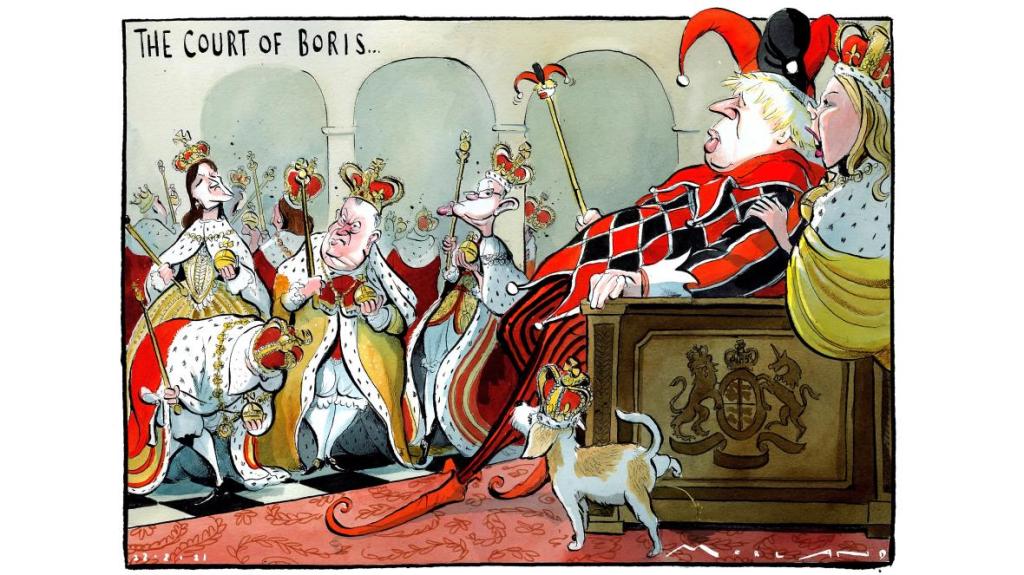
In the court of “King Henry”

The atmosphere in No 10 is becoming increasingly febrile as competing groups vie for Boris Johnson’s attention and patronage. Carrie Symonds’ allies get key roles. www.thetimes.co.uk

Morten Morland’s Times cartoon: February 22, 2021

New breed of local food halls in UK towns offer grub and a hub

Ideas for the post-Covid future – Owl

Food halls were springing up in town and city centres before the pandemic but now smaller community versions, with an extra dimension such as a cinema screen or co-working space, could be arriving on a high street near you.

Zoe Wood www.theguardian.com

There is potential for up to 120 of these community food halls across the UK, a new report has found, as big shifts in consumer spending and attitudes caused by the coronavirus pandemic – including a newfound appreciation of local community – prompt investors to consider piling in.

“These community hubs will give people pride in their town centres again,” said Thomas Rose, a co-founder of the real estate consultancy P-Three, of a new generation of food halls. “This move towards being a loyal supporter of your high street is not going to go away.

“We have spoken to a handful of private equity groups who are looking to invest in this type of concept because they see the consumer wants this,” Rose said. “Local authorities love the concept too.”

There are around 40 food halls in the UK, from flagship venues such as Seven Dials Market in central London to smaller ones in market towns.

Maba street food venue at the The Cutlery Works in Sheffield.

Maba street food venue at the The Cutlery Works in Sheffield. Photograph: Cutlery Works

While P-Three’s analysis also sees scope for a further 50 flagships to open in cities such as Glasgow, Birmingham and Bristol once the pandemic is over, the community model offers something for smaller catchments, hard hit by retail closures but where more money is now being spent.

A former Poundland store in Lewisham, south London, is now Catford Mews, where locals can eat or watch a film or comedy gig. Another example is Cutlery Works in Sheffield where a food hall now fills a former cutlery factory.

When Catford Mews opened in 2019, Preston Benson, the managing director of Really Local Group which is behind the venue, said locals’ jaws were “hitting the floor”.

“They were saying: ‘Oh my God I can’t believe there’s something like this where I live,’” said Benson. “Everyone deserves to have nice, convenient things where they live.”

The Catford Mews entertainment venue

Inside Catford Mews Photograph: Catford Mews

Really Local Group’s other projects include turning the site of a former Blockbuster shop on Sidcup high street in south-east London into Storyhouse, a complex with a cafe, cinema and library. “This is gonna be an all-singing, all-dancing community hub,” said Benson.

Urban regeneration has historically been retail-led, but with high streets battered by a crisis that has led to household names such as Topshop and Debenhams collapsing and online sales rocketing, no one thinks more shopping is the answer any more.

“The danger in real estate is that people are too often just trying to fill space,” said Rose, who says community food halls could provide alternative anchors. “We advise people to put the right tenants in the right buildings, to make sure it is sustainable.

“There will definitely be some stores which can be converted [into food halls] but a 1970s department store isn’t always the best building.”

In Darlington, County Durham, which lost two landmark stores from its main shopping thoroughfare when Marks & Spencer and House of Fraser closed, the historic indoor market is being overhauled to create a food hall, bar, events stage and temperate garden.

Despite the shadow of Covid-19, Dan Warne, a former managing director of Deliveroo, whose first venue Shelter Hall in Brighton opened in the summer, has raised significant new capital as investors recognise “clear trends in the market”.

“We’ve seen a huge increase in people wanting to support local and ensure the businesses they love survive,” said Warne. “Our food halls give an opportunity for small food businesses to expand without the usual risk of finding a premises.”

With more people regularly working from home, community food halls with an average size of around 12,500 square feet are “modest but effective” redevelopments, with the potential to draw sustainable visitor numbers in urban neighbourhoods or towns of more than 50,000 people, P-Three’s report found.

“The regular footfall and spend will act as a catalyst for local regeneration as well as adding value to neighbouring properties making the proposition particularly attractive to both private and public sector landowners and investors,” said Rose.

Sheffield’s Cutlery Works demonstrates the strength of the community model, as it has been a success despite being located in a place that is neither central nor affluent. “If food halls are based on location, location, location, we picked the worst one,” jokes the founder Matt Bigland of the area once inhabited by the city’s cutlery-makers.

The Boozehound craft beer bar at the Cutlery Works in Sheffield, a food hall placed in a former cutlery foundry and works.

The Boozehound craft beer bar at the Cutlery Works in Sheffield, a food hall placed in a former cutlery foundry and works. Photograph: Handout

But Sheffield people “love to champion independents”, says Bigland and instead of office workers and shoppers, Cutlery Works has built a regular clientele that runs the gamut from millennial hot-deskers to grandparents.

He thinks that after the pandemic “food halls are going to come back stronger than ever. I think people have a pent-up energy to get back out and be sociable.”

Coronavirus: Case rates in Devon and Cornwall

Here are the latest rates of cases of Covid-19 in Devon and Cornwall.

BBC News www.bbc.co.uk

The figures are the number of coronavirus cases per 100,000 people in the seven days up to and including 15 February, with the week before shown in brackets for comparison.

The breakdown of the figures by local authority area is:

  • Cornwall – 47 (down from 82.5)
  • Plymouth – 44.6 (down from 64.5)
  • Exeter – 73.8 (up from 37.3)
  • Mid Devon – 60.7 (down from 145.8)
  • East Devon – 63.6 (up from 58.8)
  • Torbay – 88.1 (down from 106.4)
  • Teignbridge – 47.7 (down from 78.3)
  • South Hams – 23 (down from 50.6)
  • West Devon – 19.7 (down from 37.6)
  • North Devon – 22.6 (down from 26.8)
  • Torridge – 14.6 (down from 16.1)

For comparison, the figure for England is 133.2

For a more detailed look at coronavirus where you live, use the BBC’s postcode checker: [see online article]

Better Education for Devon Event Will Listen to Public Views – Wednesday

A Devon education “listening” event will take place on Wednesday 24th February, organised by Cllr Su Aves (St Sidwells and St James) of Devon’s Children’s Scrutiny Committee with Hannah Packham, the National Education Union (NEU)’s Regional Secretary. The discussion will bring together Devon teachers, school staff, parents, students and everyone with an interest in education to focus on priorities and aspirations for the county, both during and after the COVID pandemic.

After brief introductions from the panel, participants will be asked to break out into smaller groups by area of interest to focus on their biggest concerns, and the questions they would like answered from Westminster policymakers. Topics will include primary, secondary, further education and universities, as well as Special Education Needs, and protecting the pre-school sector.

Cllr Su Aves says “We really want as many parents, teachers, governors and other residents to come so we can make sure the whole diversity of Devon educational experiences and ideas form part of our policy understanding. As well hoping to create opportunities for positive changes in Devon, we will be communicating the key findings to Shadow Secretary for Education, Kate Green, at a public event we are putting together for Wednesday 17th March.”

Event panellist Cllr Rob Hannaford (Exwick and St Thomas), who is Chair of the Children’s Scrutiny Committee, added, “COVID has flagged all kinds of issues for Devon, including major inequalities between different families’ home experiences, between schools, social development, and exam results. Teachers, parents and students have dealt heroically with home-schooling, in some cases under unimaginable strain. Our job in Children’s Scrutiny is to build awareness, shine a light on what’s working well and sort out what’s going wrong, and this is an opportunity for us to do more, in more parts of Devon.”

“Equal access to education, the broken assessment and accountability system, cuts and escalating workloads are ongoing priorities for the NEU,” says Hannah Packham, “After COVID-19 we also need reform of our assessment and exams systems to make them fit for the future.”

Devon residents are invited to register at the following link https://www.eventbrite.co.uk/e/138193964869 for the event, which will be hosted by Devon Labour.

Education secretary snubs Devon

Too busy feeding his Tarantula ro respond? – Owl

Daniel Clark, www.radioexe.co.uk 

Education secretary Gavin Williamson has failed to respond to Devon’s calls to him to encourage schools to capture the voice of children and young people and their responses to the Black Lives Matter movement.

Devon County Council in October voted for a motion to write to the secretary of state to encourage him to ensure that schools allow students to see themselves reflected and reflect on how they challenge persisting racist ideas.

But four months later, the council heard that Mr Williamson hadn’t responded to the letter, let alone enacted any of the requests made.

Cllr James McInnes, cabinet member for education, said that it was very disappointing that a response from the secretary of state has not been received, but regardless of this, in Devon they have moved forward the educational aspects that they can influence.

Cllr Claire Wright said: “Does the cabinet member think it is acceptable for ministers to ignore Devon County Council on such an important subject, and given that racist hate crime had increased and the minister has ignored the motion, will you continue to press for the answer on this issue?”

Cllr McInnes replied: “It is disappointing that a response from the secretary of state has not been received but regardless of this in Devon we have moved forward the educational aspects in line with the motion agreed at council. We have already contacted the department for a reply and a reminder, so it is important we do get a reply.

“But we need to look at what we are doing in Devon and we are being proactive and taking it seriously.

“In addition to the work already in place before the council meeting, education teams and schools have been developing their curriculum to challenge historic and persisting racist ideas & celebrate the diversity in Devon, increasing awareness and sensitivity to what racism looks like in Devon and how we can all challenge racism and ensuring that race equality policies are shared (and updated) regularly by schools, parents, children.

“We have also been appealing to school’s pragmatic motives and their principled motives and equipping all young people with an appropriate education, free from racist myths and to provide a safe and affirming educational experience for minority ethnic pupils.

“Additionally, we have eight bi-lingual support workers who have been incredibly active during the lockdown, supporting children and families and providing support in accessing the curriculum and even the school itself.”

In the letter sent to Gavin Williamson secretary of state for education, Cllr McInnes, on behalf of the council, had said: “The point of my letter is to ask you if the Government will also take action nationally and urge schools to capture the voice of children and young people and their responses to the Black Lives Matter movement, ensure that the school environment and curriculum allows all students to see themselves reflected and included and reflect on how they challenge historic and persisting racist ideas and how they celebrate diversity.

“My council believes these actions would certainly help to develop a more understanding and inclusive society that promotes racial equality for everyone.”

Councillor who successfully ended “sexist banter” in EDDC resigns

The article below describes how Cllr Kathy McLauchlan successfully obtained full council backing last October to end “sexist banter” and ditch a freeze on allowances for representatives on maternity leave. 

But various correspondents have drawn Owl’s attention to the EDDC web site which shows Independent Progressive Councillor McLauchlan, a specialist palliative care nurse, listed as a councillor until 17 February (i.e. indicating she must have just resigned). 

If this is the case, then Owl assumes a by-election will be held, possibly in May.

Kathy McLauchlan won the Whimple and Rockbeare ward comfortably in May 2019, taking it from the Conservatives (702 votes to 234). 

In the 2011 election Martin Gammell won the seat for the Lib Dems but it was retaken by the Conservatives in 2015. A by-election followed in 2017 and Martin came within 36 votes of re-taking it.

So not obviously a centre of deep Conservatism. Yet Whimple is the home of staunch Conservative Sarah Randall-Johnson (see this post and many others) who not only is County Councillor for Broadclyst but is also on the Whimple Parish Council.

Call to consign sexism on East Devon District Council to ‘dustbin of history’

Daniel Clark   25th October 2020 eastdevonnews.co.uk 

A call to end ‘sexist banter’ and ditch a freeze on allowances for representatives on maternity leave has been overwhelmingly backed by East Devon councillors. 

Members also backed swapping the term ‘chairman’ for ‘chair’ following a motion tabled by Whimple and Rockbeare representative Kathy McLauchlan.

Councillor McLauchlan, an Independent, wants to ‘end the sexist treatment of woman which was treated as banter’.

She said: “Sexism is commonplace and 38 per cent of councillors have received sexist comments in their own party.

“Sexism is viewed and tolerated as a part of political life, but this has to change and local government should be a safe and secure place for all.

“This is a chance to the right thing for current and prospective members of the council.”

Cllr McLauchlan added that government policy is to write in gender-neutral language and her motion also expressed disappointment that women make up just 30 per cent of members on East Devon District Council (EDDC).

The national average of 35 per cent.

She added: “Woman make up 51 per cent of the population so we have to make working as a councillor easier for them, and the lack of maternity support is a barrier and holds them back as a councillor.”

Exmouth Halsdon representative Cllr Paul Millar seconded the motion.

He added: “Why is it fair that a woman looking after a newborn should be removed from their position?

“As that is what the policy states, and it deserves to be thrown into the dustbin of history never to rear its ugly head again.

“The motion seeks to empower the role of women and younger women in local government, to encourage them to take up senior positions without the fear that starting a family will see them removed from the position, as wanting to start a family should never be a disadvantage.

“This, plus the clause in the code conduct about sexism, will be a safeguard against the minority with dinosaur-like tendencies.”

Cllr Eleanor Rylance said of using the term ‘chair’ instead of ‘chairman’: “It may seem a minor detail to those unaffected by it, but if you are a young girl and don’t see anyone like you or can relate to on a council, you will be put off applying.

“To continue addressing a role as chairman is putting people off applying and a step back before a step forward.

“It’s 2020, not 1970 – you don’t get away with casual sexism anymore.”

EDDC leader Cllr Paul Arnott said that ‘chairman’ alienates people who are sensitive to gender and diversity issues.

Conservative Group leader Cllr Andrew Moulding, who has sat on the authority for 33 years, told the meeting the term ‘chairman’ had long been used it will be difficult for him to change his ways.

“But change my ways I shall do, and I apologise if I forget to call a person by an inanimate object,” he added.

“It will be difficult for me and it will take some getting used to, but I will vote for it, and I am 100 per cent in favour of the matters around maternity, rebuking sexism, and encouraging more female councillors.”

Cllr Helen Parr said: “The most important parts of this are that we bring in proper maternity allowances and that as many women who want to stand are encouraged to and can do.

“It doesn’t matter to me if you call someone chair or chairman, but if people want this in the constitution, I am sure it will be agreed, but it is unimportant compared to the rest of the motion.”

The motion called for members to address the head of any committees, panels, forums or groups as ‘chair’ rather than ‘chairman’.

While EDDC has a policy for maternity pay for representatives without extended roles, its current allowances scheme does not extend to maternity pay for councillors with ‘special responsibilities’.

A report will now be formulated on how to adopt the Fawcett Society’s recommendation of having maternity pay for councillors with extended roles.

New clauses in the council’s code of conduct against sexism will also be introduced, as will a commitment to ensuring gender-neutral language is used.

The motion was supported by 43 votes to zero at a full meeting of EDDC on Wednesday, October 21 – with abstentions from Cllrs Peter Faithfull and Fred Caygill.

Essential reading for a wet weekend: National Model Design Code

The Government is “consulting” on important changes to the NPPF to incorporate ideas in the “Living with Beauty” report (see below) and on its ideas for design codes. If it sounds too good to be true, we all want good design don’t we, it probably is!

This comes from a Civic Voice newsletter which conveniently has links to all the documents. It emphasise to Owl the need for as many as possible to take EDDC’s consultation on the Local Plan – Options and Approaches seriously and respond to it. Closing date 15 March.

National Planning Policy Framework and National Model Design Code: consultation proposals

In response to the Building Better, Building Beautiful Commission report, the government has launched a consultation to seek views on draft revisions to the National Planning Policy Framework. The text has been revised to implement policy changes in response to the Building Better Building Beautiful Commission “Living with Beauty” report.

In response to the Building Better, Building Beautiful Commission report, the Government has announced:

• It will publish a draft national design code setting out clear parameters of good design and a simple process for local communities to define what buildings in their areas should look like
• Create an Office for Place within the next year which will pioneer design and beauty within the planning system
• Provide £4 million for the community-led housing fund, in addition to extra funding for successful areas under the heritage campaign
• Propose changes to the planning framework to place greater emphasis on beauty and placemaking

A number of other changes to the text of the Framework are also set out and explained in this consultation document, but at the time of sending this update, we do not believe that government is proposing a review of the National Planning Policy Framework in its entirety at this stage. A fuller review of the Framework is likely to be required in due course, depending on the implementation of the government’s proposals for wider reform of the planning system.

In addition to the NPPF consultation, the government has published a new National Model Design Code that outlines the design standards new developments are expected to meet. This provides a checklist that will guide local councils to create their own, unique, local design code.  This consultation is also seeking views on the draft National Model Design Code, which provides detailed guidance on the production of design codes, guides and policies to promote successful design.

Key items:

  • The press notice can be found here
  • The consultation can be found here
  • The draft National Model Design Code can be found here

The National Model Design Code guidance notes can be found here

Commenting on a planning application? Here’s some advice

A correspondent, interested in matters involving East Budleigh, sends this note of caution.

If you write a comment on a planning application to EDDC please, in your first sentence, say if your comment is neutral, in support or an objection.

Comments which are obviously objections have not included this and have been classified as “neutral”.

We’re not capable of making the medicines we require any more

But as we get ready to put out the bunting and pat ourselves on the back there is another truth: Britain now has no large-scale facilities manufacturing modern, complex medicines (apart from some producing vaccines).

www.independent.co.uk

We may lead the world in R&D, as the Covid vaccine triumph has proved, but when it comes to actually making medicines our standing is woeful. As a result, thousands of highly-skilled, well-paid manufacturing jobs have simply disappeared, along with factories that have now been given over to retail parks and housing estates.

I’ve been looking into this as the closure of another pharmaceutical plant has been announced, by GSK at Ulverston in Cumbria. There’s been a factory on the site since 1948. Eight years ago, the then prime minister, David Cameron and GSK chief Andrew Witty paid a joint visit and announced a £350m expansion with the creation of 1,000 new jobs. Cue much celebration. Forget the expansion. Now GSK, under a different chief, Dame Emma Walmsley, is scrapping the entire facility and pulling out altogether.

The pandemic has brought home to the government our dire weakness in this area. While Oxford scientists were racing to find a vaccine, Downing Street was being made all too aware of shortages in the supply of other medicines and equipment. They were being made elsewhere and other countries were holding back their stocks.

This prompted Johnson to launch an initiative across Whitehall, in May 2020, called “Project Defend” to shift our national security focus to include resilience in supply lines of essential non-foods. The goal is for the UK, post-pandemic, to be no longer dependant on imports of vital goods. As well as healthcare it’s also taking in other sectors, including the technology industry.

The progress of Project Defend, which is being run out of the Foreign Office, is shrouded in mystery – but put it this way, the campaign has not prevented GSK from shutting another base. Ulverston manufactures antibiotics and they have been sold to Sandoz. That company will transfer the making of those products to their location in Austria. This follows the announcement last year of a joint investment between Sandoz and the Austrian government of more than €150m to boost the long-term competitiveness of its antibiotic manufacturing site and to guarantee the long-term supply of antibiotics.

While Austria improves and strengthens, we’re reducing and growing weaker still. We’re not capable any more of making the medicines we require. The medical world is shifting towards monoclonal antibody therapies. To give some idea about their complexity: aspirin has 21 atoms in a molecule; growth hormone has 3,000 atoms; monoclonal antibody 25,000 atoms. The global biopharma market for these modern treatments is more than $300bn (£214bn) and growing at about 7 per cent a year. Where is the UK in this? Nowhere.

According to industry figures, at the last count in late October 2020, there were 1,700 biopharmaceutical manufacturing facilities in the world. These are the sites capable of producing modern medicines such as the much sought-after monoclonal antibodies. The US has 565, China 220, India 113, Germany 84, Japan 52, France 39, Ireland 23, and the UK nought. That’s right, zero.

This year is the first year when the UK is facing a balance of payments deficit on pharmaceuticals – 10 years ago it was one of the few industries that had a strong surplus. The shortfall is due to the lack of manufacturing – as brilliant and as headline-grabbing as it is, R&D does not help with the balance of payments.

It’s not only the lack of factories. We have now got half the number of people employed in pharmaceuticals than France, and only one-third compared to Germany. We just about compete in numbers employed with Switzerland and Spain. Again, not so long ago we were at the top of the tree and given the lack of investment this picture will only get worse.

Our expertise is being snapped up by foreign companies. A young chemical engineer graduating in the UK today really has no choice but to go overseas for a decent career. The US in particular, is awash with our best talent.

Successive UK governments have stood back and watched this happen. Our industry bodies, too – the record of the CBI in this area is lamentable. It’s a deplorable state of affairs.

Forget HS2 and tunnels across the Irish Sea – we’re talking about vital supplies. Do we really want to be reliant on the US, China, India, Germany and the rest? The pandemic has shown that when crisis hits, countries put the health of their citizens first. Other national and regional governments have made it their business to encourage enormous levels of investment. They are building and preparing; we’re closing and reducing. They will have the products they require; we will be hoping and pleading.

Facilitate free postal deliveries for candidates in May elections?

Can’t have a level playing field so let’s kick the proposal into the long grass.

Time to Change the Guard at Devon County Council – Owl

Daniel Clark www.devonlive.com 

Debate over whether the Government should facilitate free postal delivery of leaflets for each council election candidate in the May local elections has been ‘stifled’.

Cllr Martin Shaw, East Devon Alliance councillor for Seaton and Colyton, had put forward a motion to Thursday’s Devon County Council full council meeting calling for discussions to be held as to how the elections can be made safer following the decision that they will go ahead as planned.

The regularly scheduled 2021 Devon County Council elections will take place May 6 as per usual, despite the ongoing coronavirus pandemic.

Cllr Shaw had asked the council to discuss and debate his call for the Government to facilitate online registration for postal voting, and a free postal delivery of leaflets for each council election candidate on the day, rather than the usual process of referring it to cabinet before returning back to full council, as by the next council meeting, it would be out of date.

He said: “This is an urgent matter, and the Government only recently decided to hold the election and the rules for it. The next meeting is after the elections so if it is referred to the cabinet so will be out of date.

“We are in a pandemic and voting in person cannot be guaranteed as safe, but the Government is doing nothing to make postal voting easier, and banning leafleting by candidates won’t help the less well-off candidates.

“I would hope you would welcome the opportunity to discuss how to make the elections safer but if you don’t like the wording of the motion, you can amend it or you can vote it down, but don’t stifle debate.”

However, councillors voted 32 votes to 11, with four abstentions, against debating the motion on the day and instead referring it to Cabinet, a decision Cllr Shaw said was ‘disappointing’.

A second motion around elections from Cllr Shaw, calling for councils to be able choose to change their voting system from the first-past-the-post system to the proportional Single Transferable Vote system, which is already used for local elections in Scotland and Northern Ireland, was also referred to the cabinet, but in accordance with the wishes of Cllr Shaw.

The judgment is in – Matt Hancock “acted unlawfully”

One down, a few more to go. 

Worth also following link in penultimate paragraph [in bold] to see the follow up proposals the Good Law Project has made to restore public confidence in health procurement. – Owl

goodlawproject.org 

The High Court has ruled “The Secretary of State acted unlawfully by failing to comply with the Transparency Policy” and that “there is now no dispute that, in a substantial number of cases, the Secretary of State breached his legal obligation to publish Contract Award Notices within 30 days of the award of contracts.” We have won the judicial review we brought alongside Debbie Abrahams MP, Caroline Lucas MP, and Layla Moran MP.

In handing down the judgment, Judge Chamberlain brought into sharp focus why this case was so important. “The Secretary of State spent vast quantities of public money on pandemic-related procurements during 2020. The public were entitled to see who this money was going to, what it was being spent on and how the relevant contracts were awarded.”

The Judge went on to say that if Government had complied with its legal obligations we “would have been able to scrutinise CANs and contract provisions, ask questions about them and raise any issues with oversight bodies such as the NAO or via MPs in Parliament.”  When Government eschews transparency, it evades accountability. 

Government’s behaviour came under criticism in the judgment. If it had admitted to being in breach of the law when we first raised our concerns, it would have never been necessary to take this judicial review to its conclusion. Instead, they chose a path of obfuscation, racking up over £200,000 of legal costs as a result.  

We shouldn’t be forced to rely on litigation to keep those in power honest, but in this case it’s clear that our challenge pushed Government to comply with its legal obligations. Judge Chamberlain stated that the admission of breach by Government was “secured as a result of this litigation and at a late stage of it” and “I have no doubt that this claim has speeded up compliance”. It begs the question, if we hadn’t brought this legal challenge, what other contract details would have remained hidden from view? 

And whilst Government always sought to dismiss our challenge by claiming we needed to be an ‘economic operator’ to have standing, the judgment states that it is unrealistic that economic operators would have challenged Government’s breach of the law in these circumstances. In other words, if we hadn’t taken this case, there are not many others who could have done so. 

This judgment, which can be found here, is a victory for all of us concerned with proper governance and proof of the power of litigation to hold Government to account. But there is still a long way to go before the Government’s house is in order. We have now written to the Secretary of State for Health and Social Care detailing what needs to be done to improve procurement processes and ensure value for British taxpayers.

But for now, we can take a moment to celebrate this win. Thank you, as ever, for all your support.   

Sickness lasts longer with UK variant, study suggests

The increased infectiousness of the UK coronavirus variant could be because people stay sicker for longer, a small study has suggested.

Tom Whipple, Science Editor www.thetimes.co.uk

The research, conducted using data from 65 US basketball players and staff who had contracted Covid-19, found that the seven infected with the new variant were ill for about 13 days, compared with eight days for the 58 who contracted the old variant.

If confirmed, the study may also mean that countries need to extend the length of time that people self-isolate.

“We thought [the UK variant’s] increased infectiousness was due to higher viral load,” Eric Topol, director of the Scripps Research Translational Institute, said. The new data, he said, “suggests it’s related to . . . longer duration of infections”.

However, scientists caution that the findings come from a small sample.

The study, by researchers from Harvard University, was only possible because of regular testing in the US National Basketball Association. People typically only get a test when they are symptomatic, and after testing positive take no further tests, meaning it is possible to chart neither the beginning nor end of the infection. The NBA, however, tests daily, and — unusually — continues to do so when players test positive, meaning the full course of the infection can be monitored.

Those infected with the old variant took two days from the detection of the virus to reach peak viral load. It then took six days until the virus was undetectable. Among those with the new variant, the duration was five and eight days respectively.

Dr Jenny Rohn of University College London said that a larger study was needed, but that the findings would explain the strain’s infectiousness. “The study also has serious implications for the current quarantine period of ten days, given that the Kent variant was shown to be at large in the infected person for an average of 13 days,” she said.

Dr Simon Clarke of Reading University said that it hinted at why the variant was more deadly, speculating that the increased time “gives greater opportunity for the immune system to overreact and kill the patient”.

Budleigh TIC plea for website funding

If tourism is so important to the local economy, why doesn’t the “sector” support Tourist Information Centres (TICs) ?

Owl understands that the rise in airbnb has resulted in a catastrophic fall in commissions that used to be earned by TICs in taking b&b bookings.

Daniel Wilkins​ www.exmouthjournal.co.uk

A plea has been made to help fund a new-look website for the town’s tourist information centre which would help attract visitors and tour operators to Budleigh Salterton. 

The TIC’s current website http://www.visitbudleigh.com is not ‘fit for purpose’ according to trustee Helen Warren and a drop in revenue from advertisers is partly due to the current state of the site. 

Estimates for a new web page are in the region of between £2,500 and £3,500 with East Devon AONB (Area of Outstanding Natural Beauty) pledging £1,000 towards the TIC. 

The centre is currently in the process of applying to become a not-for-profit organisation and is appealing for organisations or individuals who might be prepared to help meet the funding shortfall. 

Mrs Warren, who is also chairman of the chamber of commerce, said the TIC, which is currently closed due to the coronavirus restrictions, is completely self-funded and relies on advertising revenue to keep going. 

She added: “It (the current site) is very difficult to navigate and the graphics are poor. 

“Our neighbouring towns of Sidmouth and Exmouth both have modern websites that have been fully funded by their town councils. 

“Sadly, this is not the case for Budleigh and so the centre needs to raise money in order to create a website of equal merit. 

“A modern, dynamic website with good visuals and links will help to promote Budleigh as a destination town worth visiting.  

“It would promote its independent shops and cafes, beach and water sports, walking and cycling routes, wildlife, community events , drama and Internationally acclaimed festivals, which will in turn benefit the local economy and provide community engagement. 

“By promoting sustainable tourism the information centre hopes to be able to persuade sufficient local businesses to think that this is a useful website that will promote their interests and encour-age visitors into the area.” 

The website also needs to be populated with good quality photographs of the area and events that take place throughout the year.  

If anyone can supply some suitable images, they can be credited with their name. 

For more information on supporting the Tourist Information Centre, ring Helen on 01395 442600/07902 128104 or email helenlouisewarren@gmail.com  

Continuing the theme: Parish councils need to be reformed urgently

 Letter www.theguardian.com 

The recent Handforth parish council meeting (Editorial, 8 February) highlights the ongoing issue of dealing with bullying by councillors. The scrutiny of councils set out in the Localism Act 2011 sadly does not apply to parish councils. The government’s preferred approach is to leave complaints to be remedied through the ballot box but, with elections every four years, this is not a solution. Beleaguered councillors and residents have nowhere to go. Complaints may be made to the monitoring officer of the district or unitary authority, but they have no teeth to deal with bad conduct.

The government is aware of this problem. In 2015, a consultation on extending the remit of the local government ombudsman to larger parish and town councils was held, but the results were never published. In 2016, the draft public service ombudsman bill, in which all parish councils were to be included in the scheme, was drafted but not presented to parliament. Apparently, now it is not fit for purpose. In February 2019, a government briefing paper (No 04827) again highlighted the need for reform, but still nothing has been done.

In the meantime, good councillors are resigning following unacceptable behaviour from fellow councillors, and trying to recruit new ones is next to impossible in such a toxic environment. Parish councils are at the coalface of local government and communities. Only reform can solve this serious failing in local democracy.

Jane Brook

Former parish councillor, Northaw, Hertfordshire

After the Handforth melt down, Honiton Town Council says “Hold my beer…”

This article in West Country Bylines explains the background to the “goings on” in Honiton Town Council chronicled in the Watch. 

This has led to the foundation of “Honiton Forward” and Owl wonders what impact that might have on the Conservative grip on the Honiton and surrounding Divisions in the May County Council elections.

John Burgess westcountrybylines.co.uk 

If you thought Handforth Council was bad, let me introduce you to Honiton. In the last three years, two successive town clerks and 17 councillors have resigned. Two council employees were more or less driven out of their jobs. £75,000 was wasted on staffing issues, and employment tribunals are pending. A barrage of complaints was sent to the Monitoring Officer, with a hearing due in March. £88,000 was spent on legal fees with no result, so a total of £163,000 of taxpayers’ money has gone down the drain.

Voters were so disgusted by this catalogue of failure that a non-political organisation, Honiton Forward, was formed to bring pressure to bear on the council. It gathered 600 signatures on a petition calling for all councillors to resign, so that an election could be held to form a new council.

The petition was presented in a volatile council meeting last March, attended by 60 members of the public. The vote on the motion was split 50:50 between the reformers on the council and those who had been largely responsible for its disastrous policies. The Mayor, chief instigator of the policies, cast his vote against the petition. All the reformers subsequently resigned, leaving a rump of just seven active members.

Honiton Forward launched a second petition calling on East Devon District Council (EDDC) to undertake a Governance Review of the council. This device is used for forming new councils or where ward boundaries have been changed, making it necessary to hold fresh elections. It has never (yet) been used to remove an existing council. Over 1400 signatures were obtained from the electorate – well over the 10 per cent required. The petition was presented to EDDC in December. We await its outcome.

However, change could come as soon as May, when by-elections will be held to fill the ten vacancies on the council caused by a spate of resignations last year. If Honiton Forward can field ten candidates and win all the seats, they will have a majority to bring about vital reform.

The history of the mess in Honiton goes back to 2012, when the council voted by 12 votes to 3 to build The Beehive, a new community and arts centre. This facility was something the town had desperately needed. The building opened in 2014, providing Honiton with a cinema, theatre, live music venue and a centre for many local organisations. With an annual footfall of 60,000, it has been a great success and was voted Devon Community Centre of The Year for 2017.

You would think the council would be pleased that this major project was going so well, and would do all it could to ensure continuing success, but you would be wrong.

There was a split on two big issues: first, an overspend on the build of almost £100,000 meant the council had to increase its mortgage on the building to plug the gap; and secondly, the council decided to operate The Beehive by leasing most of the building to a charity set up by the council for that purpose.

A faction on the council, led by the current mayor, strongly opposed leasing to a charity as the council would have no control, and this same faction also argued the overspend should be reclaimed from the architects of The Beehive who had overseen the build. Following resignations of six Beehive-supporting councillors, the ‘anti-Beehive’ faction became the dominant force and began disputes against the architects and against the charity, which led to legal action. Conflicts arose with council members and council staff, with accusations of bullying, resignations of councillors and the resignation of a Town Clerk.

So incensed were users of The Beehive that a council meeting attracted over 150 townspeople demanding that the council come to an agreement with the charity out of court.

Several issues with the way councils operate have become painfully apparent over the years of this sorry saga.

Because councils are sovereign bodies, there is no way to hold a council to account save through the election cycle. But if there is no election, what then? In the council elections in East Devon in May 2019, 67 wards out of 84 were uncontested, including the two Honiton Wards. No election meant no change.

Shockingly, there is zero redress for the ratepayers if the council wastes their money. Honiton council has blown £88,000 on two failed legal disputes, and wasted another £75,000 on issues caused by staff suffering work-related stress and having to take sick leave. No councillor has resigned, no councillor has apologised, and no one is held to account for this huge waste of money.

There is a growing recognition that councils do not reflect the diversity of the populations they serve. Six of the seven remaining active councillors in Honiton are retired, three first joined the council 12 years ago and one has been a member for over 30 years. Yet, nine of the ten members who resigned last year were in their 30s, 40s or 50s with full-time jobs, and took their relative youth, energy and ideas with them.

So what is to be done? There needs to be some means of holding a council to account, perhaps through a Council Ombudsman to whom the public can appeal if the council loses the confidence of the electorate. There should also be some external oversight of potential legal disputes to assess the risk to public money.

Most voters have little idea of who their councillors are or what they do. This makes an election where a voter has to choose, say, nine from a list of 16 candidates, simply a lottery; good candidates are not elected whilst poor ones are.

Candidates for council elections should be required to publish their manifestos on the council website, so the public have at least some idea who they are voting for. Once elected, councillors should also be required to report back to the public on a regular basis, say bi-monthly, on their council work, and to justify their decisions. Councillors should also be limited to two or three terms, and steps taken to help councils reflect the diversity of their communities. Honiton will have the added challenge of overcoming the damage done by this unhappy and very public spat.

Local councils have an important role in the local community, but their work is largely unknown and unappreciated. They can provide a stepping-stone into public decision-making for aspiring politicians, and an opportunity for retired people to bring their experience to bear. But they are also open to an abuse of power, and it is time to look at how they operate and find ways to improve transparency, scrutiny and accountability.

Trump’s failed Atlantic City casino demolished before cheering crowd

The fall of a leader with authoritarian instincts is usually symbolised by toppled statues and looted palaces. For Donald Trump, perhaps inevitably, it was the demolition of a failed casino.

David Smith www.theguardian.com

On Wednesday the former Trump Plaza Hotel and Casino in Atlantic City, New Jersey, was reduced to rubble in 20 seconds by 3,000 sticks of dynamite. It had fallen into such disrepair that chunks of the building had been tumbling to ground……

(see online article for video)