Chumocracy first in line as ministers splash Covid cash

As a former head of MI5, Lord Evans of Weardale spent a career defending British democracy against immediate threats. Last week he warned against a more insidious danger to public life.

Gabriel Pogrund and Tom Calver www.thetimes.co.uk

Evans was making a speech in his role as chairman of the committee on standards in public life — the anti-corruption watchdog — on whether the country was now in a “post-Nolan age”.

That refers to Lord Nolan, first holder of the position, who was drafted in to clean up Westminster 25 years ago when it emerged that MPs had been bribed in cash to ask questions in parliament.

The verdict given by Evans at a virtual conference was damning. “Quite simply,” he said, “the perception is taking root that too many in public life, including some in our political leadership, are choosing to disregard the norms of ethics and propriety that have explicitly governed public life for the last 25 years and that, when contraventions of ethical standards occur, nothing happens”.

Those warnings are given new urgency this weekend as it is revealed that the government has awarded £1.5bn of taxpayers’ money to companies linked to the Conservative Party during the coronavirus pandemic. None of the firms were prominent government suppliers before this year.

In normal times, ministers must advertise contracts for privately provided services so that any company has a chance of securing the work. A person’s connections are not supposed to help.

The government is also legally required to publish details of awarded contracts within 30 days, so the public knows how its money is being spent.

During the pandemic, neither has happened. Facing a sudden need to deliver millions of items of PPE, test kits and vaccines, ministers used emergency procedures to award work directly.

According to Tussell, a data provider on official spending, Whitehall departments have taken an average of 72 days to publicise who has received money, meaning public debate has often moved on before decisions can be scrutinised.

It is a less straightforward situation than the bribery or “cash-for-questions” scandal investigated by Nolan. As the government mounted a war effort to combat Covid-19, it has instead resembled more of a “chumocracy”.

This is a world in which ministers have turned to friends with links to the Conservatives because of a mixture of trust, convenience and a panicked need to deliver, rather than a desire to benefit themselves financially.

STN.HANCOCK.15.11.20.R

The end result, however, is arguably similar: friends of the Conservatives have played a central role in responding to the pandemic, securing high-profile positions and contracts along the way.

This pattern of conduct became visible in May, with Britain in lockdown, when Boris Johnson and the health secretary Matt Hancock turned to trusted contacts to run parts of the pandemic response.

Baroness Harding, a Conservative peer and the wife of John Penrose, a Tory MP, was appointed to run NHS Test and Trace. The former TalkTalk executive, 53, had spent a career in the private sector before Hancock awarded her the position, announcing it in a tweet.

In the same month Kate Bingham, a family friend of Johnson’s whose husband, Jesse Norman, is a Tory MP and Treasury minister, was appointed to oversee the vaccines taskforce. She accepted the position after decades in venture capital, having received a personal call from the prime minister.

According to a speech that Bingham, 55, gave to a group of US venture capitalists, she responded to Johnson’s offer by saying: “I’m not a vaccine expert, why should I be the right person?”

Then there is the layer of “chums” who have been brought in as advisers and intermediaries between Whitehall and outside companies. Some have sat in on meetings with ministers and contacts who go on to secure lucrative contracts.

In March, for example, Lord Feldman of Elstree, former chairman of the Conservative Party, was quietly appointed as an unpaid adviser to Lord Bethell, a hereditary peer and nightclub baron turned health minister.

According to a government source, Feldman’s role, which was never announced publicly, was to assist Bethell, 53, in his “work with industry” during the pandemic.

That included sitting in on a phone call on April 6 between Bethell and Meller Designs, which supplies high-street shops with home and beauty products. It is owned by David Meller, who would have been a familiar face to Feldman.

Meller, 60, is a Tory donor who has given more than £63,000. Most of that came during Feldman’s spell as chairman, when he was responsible for fundraising. Meller Designs later secured £163m in PPE contracts.

Government transparency data suggests such coincidences are not unusual.

Three days later, on April 9, Owen Paterson, a Conservative MP and former secretary of state for Northern Ireland, took part in a phone call with Bethell and Randox, a Northern Irish diagnostics company. Randox pays Paterson £100,000 a year as a consultant.

It is also linked to Harding, who sits on the board of the Jockey Club, the horse racing body. Its biggest annual event, the Grand National, is sponsored by the company. Paterson’s late wife, Rose, also sat on the Jockey Club board.

It is unclear why Paterson, 64, was on the call, but government sources say it was a “courtesy call” to discuss testing and the MP was involved because of his role for Randox. The company has received £479m in government testing contracts this year, acquiring more orders even after it had to recall half a million tests because of safety concerns.

Whole organisations have achieved remarkable penetration within Whitehall during the pandemic, often under the cloak of secrecy. They include Portland Communications, a political lobbying firm whose clients include HSBC, Pfizer and BAE Systems. It employs a number of former Tory advisers.

In March its chairman, George Pascoe-Watson, was parachuted into government, again without any announcement, to advise Harding and Bethell on strategy and communications.

It is understood that Pascoe-Watson, a former political editor of The Sun, participated in their daily calls, prompting civil servants to raise concerns about “appropriate channels”. A source said: “Nothing happened. They loved him.”

Pascoe-Watson appears to have made the most of his access, sending advance information about policy to paying clients. He also defended the government against criticism on social media, while failing to disclose his role.

For instance, when The Sunday Times revealed that Bingham had charged the taxpayer £670,000 for boutique PR consultants last week, he responded on Twitter: “Only in this country could we shaft a true hero.”

He also said that Bingham and Harding, whom he advises, should be cherished. “We should celebrate that two highly distinguished women are in critical roles in this country,” he said.

For months, Pascoe-Watson was joined by Lord O’Shaughnessy, a Tory peer who served as David Cameron’s policy chief. Today it can be revealed that he was both a paid “external adviser” to the Department of Health and Social Care (DHSC) and a paid Portland adviser at the same time.

The apparent conflict of interest went further when, in May, O’Shaughnessy took part in a call with Bethell and Boston Consulting Group (BCG), a client of Portland’s. BCG has received £21m in Covid-19 contracts, with some of its advisers paid £7,000 a day.

Over the past month, a number of ministers appear to have acknowledged that some contracts have not given value for money.

Lord Agnew, the Cabinet Office minister, has expressed frustration with the amount spent on consultants, writing in a leaked letter that Whitehall had become “infantilised” by reliance on outside professionals. He even floated the idea of creating an in-house consultancy of civil servants, called Crown Consultancy.

Yet when it comes to those who have received high-profile roles, or large contracts, the government has been outwardly defensive. Last week, Johnson himself wrote in support of Bingham.

Hancock has rewarded Harding for her work on NHS Test and Trace, which Sage advisers say has had a “minimal impact” on Covid-19 transmission, by appointing her as head of the National Institute for Health Protection, the successor body to Public Health England.

When details of Feldman’s role emerged, the government thanked him.

Such conduct might help to explain why Evans last week added: “It is not unusual or wrong for governments to want to appoint people who share their views, and political activity is not a bar, but it cannot be a reason for appointment. Merit must be at the heart of the system, not cronyism or patronage.”

He added: “The government’s ability to lead the country through the coronavirus crisis will be strengthened, rather than undermined, by an adherence to high standards.”

Last night the DHSC said: “As part of an unprecedented response to this global pandemic we rightly have drawn on the expertise of a number of private sector partners who provided advice and expertise to assist in the vital work.

“As a result of public and private sector organisations working together at pace, we were able to strengthen our response to the pandemic.”

Pascoe-Watson said: “I was honoured to be asked to serve the NHS Test and Trace service in my personal capacity as an unpaid adviser. I fully declared my role and responsibilities at Portland Communications to the DHSC.”

O’Shaughnessy said he was proud to be involved, adding: “This role, which involved providing policy advice to DHSC ministers and officials around testing innovation, was approved by the permanent secretary and declared in my register of interests.”

INSIDE TRACK: THE LOBBYIST

EMAIL 1

Pascoe Watson to clients — 12.30pm, 15 October

All,

I have been privately advised that tier 2 restrictions will be imposed on London until at least the spring of next year. This will be subject to review every few weeks. But the decision-makers have told me personally that spring is likely to be the first opportunity to lift the restrictions (1). The impact of this is clear. No meeting of people from different households INSIDE (a house, a bar, a restaurant) and essential travel only. Offices and schools remain exempt although the advice is to wfh rather than travel.

1 “The decision-makers have told me personally that spring is likely to be the first opportunity to lift the restrictions”

Publicly, ministers had refused to be drawn on when London’s tier 2 restrictions might be eased. The health secretary, Matt Hancock, said the situation would be “reviewed fortnightly”

EMAIL 2

GPW

George Pascoe Watson, chairman of Portland

Portland to clients —29 October

From a senior partner at Portland

National restrictions

We are told that as it stands, it is likely that the PM will announce next week that he is prepared to “sacrifice November to save December” (1)

● This would mean London and the South joining the rest of the country in tier 3 restrictions

● There are discussions ongoing about whether this should be extended to a new tier 4 which would be closer to national lockdown (2) (and could include closures of non-essential retail)

● If no action is taken, the whole country will be in tier 3 restrictions by Dec 11 anyway, which means Christmas will happen with no social contact 6 So it seems inevitable there will be fresh restrictions on London and the South in November

● Should it be tier 3 — that means bars and pubs to close (unless they serve full meals) and restrictions on travel. They could go further but the PM would not countenance a French system of carrying papers

● The PM hopes that if this strategy is implemented then he will be able to lift restrictions in December for the sake of the economy and for families to enjoy Christmas

● He particularly wants hospitality and retail to benefit from the Christmas period (3)

● They are then weighing up a week’s break from restrictions over Christmas — during which people will have to take responsibility for their own behaviour and they will be warned to be very careful about who and how they mix with others

This debate in ongoing for the next few days but as it stands, a decision is due by the middle of next week.

1 “We are told that as it stands, it is likely that the PM will announce next week that he is prepared to ‘sacrifice November to save December’ ”

On October 31 — two days after the email was sent — Johnson announced a lockdown lasting until December 2. He later said the country would “open up again in December” if the measures worked.

2 “There are discussions ongoing about whether this should be extended to a new tier 4, which would be closer to national lockdown”

The day the email was sent, the communities secretary, Robert Jenrick, said the government was doing “everything in [its] power to avoid a blanket national lockdown”. Two days later the stricter measures were announced.

3 “He particularly wants hospitality and retail to benefit from the Christmas period”

On October 31 , Johnson said that he wanted to “give people the chance of some shopping and economic activity in the weeks … up to Christmas and beyond”.
Covid ‘clusters’ in EVERY East Devon ward – with 217 cases in a week

Coronavirus ‘clusters’ have been identified in every ward in East Devon – with 217 new cases confirmed across the district in the past week.

East Devon Reporter eastdevonnews.co.uk

 All 20 wards in the area – spanning Exmouth, Honiton, Sidmouth, Budleigh Salterton, Ottery St Mary, Seaton, Axminster and Cranbrook – currently have three or more Covid infections.

The highest numbers are in Exmouth Town (22) and Ottery and West Hill (18).

And the new cases recorded in East Devon in the last week represent an increase of ten when compared to the previous seven-day period.

There were 189 new cases in Exeter – a small week-on-week decrease.

A total of 1,130 Covid-19 cases have now been confirmed in East Devon and 2,279 in Exeter.

Some 2,068 new coronavirus cases have been recorded in the last seven days across Devon and Cornwall – the highest weekly number yet.

The previous seven days (October 31 – November 5) had seen 1,946 cases recorded.

A total of 14,071 cases have been confirmed in both counties since the beginning of the pandemic.

‘Clusters’ in 20 East Devon areas

 Twenty ‘clusters’ – where three or more Covid cases have been confirmed – have been identified in all of East Devon’s wards:

  • Exmouth Town (22 cases);
  • Ottery St Mary and West Hill (18);
  • Cranbrook, Broadclyst and Stoke Canon (17);
  • Exmouth Littleham (17);
  • Exmouth Withycombe Raleigh (15);
  • Newton Poppleford, Otterton and Woodbury (15);
  • Feniton and Whimple (15);
  • Clyst, Exton and Lympstone (13);
  • Honiton South and West (12);
  • Honiton North and East (nine);
  • Budleigh Salterton (eight);
  • Seaton (eight);
  • Exmouth Halsdon (eight);
  • Sidmouth Town (seven);
  • Axminster (seven);
  • Exmouth Brixington (five);
  • Sidbury, Offwell and Beer (five);
  • Kilmington, Colyton and Uplyme (five);
  • Dunkeswell, Upottery and Stockland (four);
  • Sidmouth Sidford (four).

The ‘clusters’ data, last updated yesterday afternoon (Friday, November 13), is based on a rolling rate of new cases by specimen date ending on November 8.

Figures are based on Middle Super Output Areas (MSOA) in England – broken down into zones of around 7,200 people.

‘Clusters’ have also been identified in all of Exeter’s 15 wards:

  • Pennsylvania and University (28 cases);
  • St James Park and Hoopern (26);
  • Wonford and St Loye’s (20);
  • Central Exeter (16);
  • St Leonard’s (16);
  • Middlemoor and Sowton (14);
  • Pinhoe and Whipton North (14);
  • Heavitree West and Polsloe (12);
  • Countess Wear and Topsham (ten);
  • Mincinglake and Beacon Heath (ten);
  • Heavitree East and Whipton South (nine);
  • Alphington and Marsh Barton (seven);
  • St Thomas West (five);
  • Exwick and Foxhayes (five);
  • St Thomas East (three).

New cases across Devon

Of the 2,068 new coronavirus cases confirmed in Devon and Cornwall since November 6, 217 were in East Devon and 189 in Exeter.

There were 67 in Mid Devon; 108 in North Devon; 496 in Plymouth; 73 in the South Hams; 100 in Teignbridge; 270 in Torbay; 52 in Torridge, 56 in West Devon; and 440 in Cornwall.

Of the 2,068 new cases across Devon and Cornwall, 1,558 had a specimen date between November 6 – 12.

And of these 165 were in East Devon, 147 in Exeter, 53 in Mid Devon, 78 in North Devon, 348 in Plymouth, 58 in the South Hams, 71 in Teignbridge, 200 in Torbay, 46 in Torridge and 43 in West Devon.

There were 349 cases in Cornwall.

Total Covid cases

A total of 1,130 Covid-19 cases have now been confirmed in East Devon and 2,279 in Exeter.

Torridge has had 263 positive cases; West Devon 327; with 502 in the South Hams; 559 in Mid Devon; 586 in North Devon; 827 in Teignbridge; 1,530 in Torbay; 2,984 in Plymouth; and 3,084 in Cornwall and the Isles of Scilly.

Covid-related deaths

No coronavirus-related deaths were recorded in East Devon and Exeter in the latest weekly figures.

It means the district has gone a fortnight without a fatality due to the virus and the city four months.

Weekly Office for National Statistics (ONS) figures published on Tuesday (November 10) show 11 Covid-related deaths have been logged across all of Devon.

Six of these were in Torbay, two in Plymouth, and one in each of Mid Devon, the South Hams, and Torridge.

The data relates to deaths that occurred during the week of October 24 – 30, but were registered up to November 7.

Across Devon, Exeter has gone 20 weeks without a coronavirus-related death, West Devon eight weeks, East Devon two weeks, and North Devon and Teignbridge one.

Cornwall had gone three weeks.

In total, 50 Covid-19 deaths have been registered in East Devon; 19 of them in hospital, 29 in care homes and two at home.

The total for Exeter is 39; 16 of them in hospital, 21 in care homes and two at home.

Some 624 coronavirus-related deaths have been registered across Devon and Cornwall; 332 in hospitals, 245 in care homes, 46 at home, one in a hospice, and one ‘elsewhere’.

Of these, 106 have been in Plymouth, 77 in Torbay, 35 in Teignbridge, 27 in North Devon, 22 in Torridge, 21 in Mid Devon, 19 in West Devon, and 14 in the South Hams

A total of 213 deaths due to the virus have been registered in Cornwall.

The ONS figures for Devon and Cornwall include people who have died at home, in hospital, in care homes, hospices, ‘other’ communal places, or ‘elsewhere’.

They are broken down by the local authority area in which the deaths were registered.

Hospital admissions

The number of people in hospital in the South West has risen to 759 from 514 from last week, but admissions data has stopped rising.

And the most recent day of data available was the lowest since October 30, while there are currently 58 people on a mechanical ventilator, down from 67 as of last Friday.

NHS England figures show that, as of Tuesday morning (November 10), there were 220 patients in hospital across Devon and Cornwall after a positive Covid-19 test.

Of them, 69 were in the Royal Devon and Exeter Hospital (up from 38); 43 in Torbay Hospital (38), 19 in North Devon District Hospital (16), 76 in Derriford Hospital in Plymouth (64), three in Cornish Partnership Trust hospitals (0), and four at the Royal Cornwall Hospital (down from six).

The number of patients in mechanical ventilation beds has fallen from 18 to 17 in the last seven days (as of November 10).

Two of these were at the RD&E, one was at Torbay Hospital, five in Derriford Hospital, and nine in North Devon District Hospital.

‘Fewer people are out and about’

Devon County Council leader John Hart has thanked residents for responding positively to the national lockdown restrictions.

Councillor Hart said: “The figures suggest that fewer people are out and about, and making journeys only if and when they’re necessary.

“That’s what we need to see. I want to thank our residents for the positive way that they have so far responded to this second national lockdown.

“Even with the welcome announcement this week of a vaccine, we must not become complacent.

“While that of course is an excellent breakthrough, we must not relax our efforts. We must continue to follow the national rules around Space, Face and Hands.”

Flybe revival hopes hit by Irish contract miss

Flybe’s hopes of returning to the skies have been dealt a blow after missing out on a key contract to run flights to Ireland.

By Oliver Gill 15 November 2020 www.telegraph.co.uk 

Aer Lingus sprung a surprise over the weekend by handing control of its regional operations to Emerald Airlines, a new carrier set up by to Irish businessman Conor McCarthy.

Hedge fund Cyrus Capital, Flybe’s former owner, announced plans in October to restart the airline next year.

Flybe was one of a number of regional carriers bidding to run the Aer Lingus Regional franchise, The Telegraph understands.

Others are believed to have included Loganair and Stobart Air, which had run services on behalf of Aer Lingus for the past decade.

Stobart Air has been put up for sale by its listed parent, who also owns Southend airport. Boss Warwick Brady was hopeful earlier this month that a deal could be struck to continue running services for Aer Lingus for another 10 years.

Mr McCarthy was Stobart Air’s chairman between 2018 and 2019. He previously worked for Aer Lingus and Ryanair, and set up Dublin Aerospace, an engineering firm that has maintenance contracts with the likes of Lufthansa and Saudi Airlines.

Flybe collapsed into administration in March after ministers rejected a plea by its owners, which also included Sir Richard Branson’s Virgin Atlantic, for a bailout of up to £100m.

Cyrus Capital relaunched the carrier last month after acquiring Flybe’s brand, stock and equipment from administrator EY.

At the time, Flybe’s new owner warned the relanch was subject to “certain confidential conditions” and was hoping to convince the UK’s aviation regulator to grant it a new operating licence.

Mr Brady said: “Whilst a disappointing decision by Aer Lingus, we believe that Stobart Air is a strategic and attractive asset for a potential buyer with a number of options open to it in terms of continued operations beyond its current franchise agreement with Aer Lingus.”

Flybe declined to comment.

‘Half a million victims of long Covid’ to be cared for in mini-hospitals

The NHS is to set up more than 40 mini-hospitals to treat “long Covid” patients, amid concerns that up to 500,000 may be suffering lasting effects.

Would these be like the “community hospitals” that our CCG has spent so much energy getting rid of? – Owl

Andrew Gregory, Health Editor www.thetimes.co.uk 

The centres will offer care to those displaying persistent symptoms such as breathlessness, chronic fatigue, brain fog, anxiety and stress. Experts believe a significant proportion of patients cannot shake off some of the serious negative effects of the disease many months after falling ill.

Sir Simon Stevens, chief executive of NHS England, said the health service needed to mobilise to help long Covid patients in the same way that it rapidly reorganised to deal with acute Covid-19 infections earlier this year.

“Long Covid is already having a very serious impact on many people’s lives and could well go on to affect hundreds of thousands,” Stevens said.

The development follows the recent official recognition of long Covid by the National Institute for Health and Care Excellence (NICE), the body that determines which treatments and drugs NHS patients are entitled to.

About one in 20 people experience symptoms including fatigue, breathlessness, muscle pain and loss of taste and smell for 12 weeks or more after contracting the virus, a recent study found. This rises to one in 10 people under the age of 50, the research by King’s College London revealed. Different features of long Covid may emerge and overlap as the illness progresses.

There are no precise figures for how many people in total are affected. However, MPs have been told that up to 500,000 people in Britain are living with the long-term effects.

More than 230,000 patients have used an NHS online service launched in July called Your Covid Recovery, which gives patients general information and advice on living with long Covid.

NHS England has provided £10m to fund the specialist centres, which will see patients who have been in hospital, officially diagnosed after a test or who reasonably believe they had Covid earlier in the year before testing was widely available. Some will be mini-hospitals set up inside large hospitals, while others will be based at standalone NHS sites or launched as clinics at GP surgeries.

Ten sites will open in the Midlands, seven in the northeast of England, six in the east, six in the southwest, six in the southeast, five in London and three in the northwest. Of the 43 sites, 13 are already open. The rest are due to start work by the end of this month.

Each of the specialist centres will bring together new teams of doctors, nurses, therapists and other NHS staff to conduct physical and psychological assessments of those patients experiencing enduring symptoms.

Nice is examining which drugs and other therapies improve long Covid patients’ physical and mental health and how best to provide long-term recovery and rehabilitation services.

There is mounting concern that some of the worst affected by long Covid are younger adults and particularly those who in normal times were fit and active.

Dan Scoble, 23, a personal trainer from Oxford, used to breeze through 10-mile runs, but said in June that he was stunned to find himself bed-bound months after contracting Covid-19. Five months later, he said he was still suffering from the effects of the virus. He presumed it would eventually blow over, but he is not back to normal. “I still can’t go for a walk,” he said this weekend.

“I can’t cook for myself — I can shower and dress myself but that’s about it.”

Scoble still suffers from crippling fatigue, migraines and a persistent sore throat, as well as abdominal and musculoskeletal pain. Months of ill-health have taken their toll. “My body was strong going through the hard times, but now it’s weak,” he said.

“Psychologically, it’s bloody tough. The only thing I can control is the controllable — which is my mindset. I’ve been doing two hours of meditation a day to keep me going.”

Scoble said he welcomed the launch of long Covid clinics in the NHS, but the help had come too late for him: “I ended up going private. I do think the NHS is starting to recognise the scale and seriousness of the problem, but I couldn’t wait.”

More than two-thirds of patients hospitalised because of the coronavirus continue to suffer from debilitating symptoms more than seven weeks after being discharged, according to a study in the medical journal Thorax last week.

Researchers found that 54 days after discharge, 69% of patients were still experiencing fatigue and 53% were suffering from persistent breathlessness. They also found that 34% still had a cough and 15% reported depression.

In addition, 38% of lung x-rays remained abnormal and 9% were getting worse, according to the study done in collaboration with the Royal Free London and University College London (UCL) Hospitals NHS Trust.

Dr Swapna Mandal, an honorary clinical associate professor at UCL division of medicine, said the data proved that long Covid was a real phenomenon. Colleague Professor John Hurst said: “Understanding long Covid is critical in helping people who have been through this life-changing experience return to health.”

@AndrewGregory

George Pascoe-Watson among lobbyists given secret access to Covid meetings

One of Britain’s most influential lobbyists secretly served as an adviser to a health minister for six months — before sending sensitive information on lockdown policy to paying clients.

[More on “Chumoracy” – Owl]

Gabriel Pogrund, Whitehall Correspondent www.thetimes.co.uk 

George Pascoe-Watson is chairman of Portland Communications, a lobbying firm that represents pharmaceutical companies, weapons manufacturers and banks.

The Department of Health and Social Care (DHSC) appointed Pascoe-Watson, 55, a former journalist, as an adviser during the pandemic’s first wave on April 9 without announcing the move.

He participated in daily strategic discussions chaired by Lord Bethell, a hereditary peer and former lobbyist who serves as test and trace minister, for six months. Bethell, 53, was a surprise appointment in March having chaired Matt Hancock’s leadership campaign in 2019 and giving a £5,000 donation. Hancock, the health secretary, and Baroness Harding, the head of test and trace, are understood to have joined calls including Pascoe-Watson and senior officials about how to communicate announcements and policy.

The disclosures will reignite the row over “chumocracy”. Pascoe-Watson is the latest person to have been given a role and access to Whitehall without any public process or announcement.

Civil servants expressed concerns about Pascoe-Watson’s role — which was unpaid — but he remained until October 7. On October 15, he emailed clients revealing he had been “privately advised” that restrictions in London launched that day would run to spring 2021, adding: “Decision-makers have told me personally.”

A fortnight later, Portland partners wrote to clients informing them that Boris Johnson was considering a national lockdown — and that he was likely to “announce next week that he is prepared to ‘sacrifice November to save December’”. The note came three days before details appeared in newspapers, prompting the PM to order a leak inquiry.

Whitehall sources insist Pascoe-Watson had no warning of the second lockdown, which was not discussed formally until after the October 29 email was sent.

Lord Feldman, a lobbyist and former chairman of the Conservative Party, also advised Bethell between March and May, a role that was not declared either.

Sir Alistair Graham, former chairman of the committee on standards in public life, said Pascoe-Watson’s appointment was “incomprehensible”. He said: “I think the public interest requires that appointments to public office should go through a public process.” Labour’s deputy leader, Angela Rayner, described it as an “insult to the British people” and called for an inquiry.

The DHSC and Pascoe-Watson declined to say whether he signed a confidentiality agreement. A friend said his role involved giving his thoughts on the “media landscape”.

Another Portland consultant and Tory peer, Lord O’Shaughnessy, was paid by the government for his work as an “external adviser” until August. O’Shaughnessy, 44, took part in a phone call with Bethell and Boston Consulting Group, a Portland client that has gone onto receive more than £20m in government contracts.

Portland has a number of former Tory advisers on its staff. It is owned by Omnicom, a New York media company with annual revenue of $15bn. Recent clients include Pfizer, Barclays and HSBC.

The DHSC said: “We have drawn on the expertise of a number of private sector partners who provided advice and expertise to assist in vital work.”

Pascoe-Watson said: “I fully declared my role and responsibilities at Portland Communications to the DHSC … the information shared with clients on October 15 and 29 was in no way connected to the test and trace calls, in which I was no longer a participant.”

O’Shaughnessy said his role had been approved by the DHSC and declared in his register of interests.

‘My Little Crony’ map shows deals between Government, MPs and Tory donors

Jacob Rees-Mogg is asked about My Little Crony interactive map in the Commons. [Watch video on metro web site and investigate the “my Little Crony”  interactive map, link below – Owl]

Sian Elvin metro.co.uk

An MP has called for a public inquiry after a web of connections between Tory politicians and companies being awarded Government contracts was uncovered.

The ‘My Little Crony’ map shows how large numbers of contracts have been handed out to Conservative Party political donors, family members and employers during the coronavirus pandemic.

It uses reporting from the Byline Times, openDemocracy and other outlets to visually reveal what it calls the ‘scale of cronyism’ in Number 10.

For example, it was reported in September that Globus (Shetland) Limited, which has donated more than £400,000 to the Conservatives since 2016, won a £93.8 million Government contract for the supply of respirator face masks.

Shadow Commons leader and Walsall South Labour MP, Valerie Vaz, called on the Government to publicly investigate the contracts awarded and their connections to the Tories.

Ms Vaz said: ‘I don’t know if [Mr Rees-Mogg] is aware of the interactive map “My Little Crony”, which has been created by Sophie Hill.

‘I raised all of the contracts that have been handed out to those connected to the Tory party last week and I didn’t get an answer – but it is well worth a look.

‘Because [Mr Rees-Mogg] will know that I think it might be time for a public inquiry, particularly on the £670,000 that has been allocated by the vaccine tsar for public relations.

The ‘My Little Crony’ map shows a web of contracts between the UK Government, the Conservative Party, MPs and family members.


Illustrative detail

Shadow Commons leader Valerie Vaz has called for a public inquiry into the contracts awarded by the Conservative Party.

‘Now if you look at the “My Little Crony” interactive map, it will link directly to the special, special adviser’s relation.’

She is referring to the news this week that head of the Vaccine Taskforce, Kate Bingham, spent £670,000 of taxpayers’ money hiring PR consultants through a firm called Admiral Associates.

And the secretary of the firm is a long-time business associate of chief advisor Dominic Cummings’ father-in-law.

‘It is interesting to know what they do because they are actually based in BEIS (the Department for Business, Energy and Industrial Strategy) of which there are 100 communications staff,’ Ms Vaz added.

‘But if it is something about a vaccine, I’d rather [deputy chief medical officer] Dr [Jonathan] Van-Tam tell me about it than a public relations so-called expert.’

Boris Johnson’s chief advisor, Dominic Cummings, reportedly has personal links to those who have won Government-awarded contracts.

Sophie Hill, a British PhD student in Government at Harvard University, created the map.

She wrote on Twitter: ‘The cronyism in this Tory government is so out-of-control that I honestly couldn’t keep track… so I combined my two main skills (puns and Rstats) to create this interactive visualisation.

‘We all understand that the Government had to act quickly during the pandemic. But that is no excuse for cronyism and incompetence.’

She told Metro.co.uk: ‘I created “My Little Crony” because I couldn’t keep up with all the news stories about Government outsourcing during the pandemic.

‘I hope people will explore the map and decide for themselves about whether this government is acting in the best interests of the country.’

A Government spokesperson said in response to the map: ‘Our sole focus has been to deliver vitally needed medical supplies and keep the public informed throughout the pandemic.

‘As part of an unprecedented response, the Government has drawn on the expertise and resources of a number of public and private sector partners.’

They did not respond to Metro.co.uk’s query about whether a public inquiry would be held into the matter.

Globus Limited reached out to Metro.co.uk to add it has also been awarded contracts by Nicola Sturgeon’s SNP-led Government to produce PPE for Scotland, and the Department of Health and Social Care.

A spokesperson said: ‘Globus Group has over 25 years’ experience producing PPE for healthcare workers and across industry and is among Britain’s biggest manufacturers in the sector.

Boris Johnson’s Government has been accused of offering a number of pandemic-related contracts to political donors and others connected to the Conservative Party.

‘We’re proud to be doing our bit to help NHS frontline staff fighting Covid-19 across Scotland and England do their jobs safely.

‘In both cases we followed the bidding process we were asked to follow. We are comfortable with any tendering process that Scottish or English Government choose to put in place because we are confident in our 25 years’ PPE experience and long track record for delivering quality and value for all of our customers.’

They added the firm has created ‘hundreds of new jobs’ as a result of the contracts, and all its political donations are ‘fully, transparently and properly’ declared.

‘Corruption and cronyism’

It comes after last month, Labour MP for Liverpool Walton Dan Carden accused the Government of ‘corruption’ and ‘cronyism’ in a powerful speech.

He said: ‘The anger and frustration isn’t just that the response is failing, but that it’s failing because the Government refused to enable and invest in local authorities and public health teams and instead chose to pump billions into scandal-ridden Government contractors that have a record of failure.

‘Under the cover of this pandemic, billions of public money handed to faceless corporations, including Tory-linked firms, without competition or transparency, without democratic accountability, or any accountability for that matter, to the public.

‘This is money that should’ve been invested into our National Health Service, that should’ve left a legacy for the British people by building up properly-funded public services that we can all rely on in the future.

‘But instead it was siphoned off.’

At the time, health secretary Matt Hancock defended the use of private firms like Serco, saying ‘private companies have been absolutely critical’ in operating the contract tracing system.

‘The test and trace system at a national level makes the immediate and very rapid first attempt at contact and if no contact is made then the local teams can go in. It’s the combination of the two that works best,’ he said in the Commons.

‘But I really think the opposition is making a mistake trying to divide people between public and private whereas actually people are working very hard to deliver, and to deliver the control of this virus.’

Mr Hancock added: ‘The private companies have been absolutely critical in the working and making sure the whole testing system can be built at the scale that it has.’

Labour Party leader Keir Starmer further slammed Boris Johnson at Prime Minister’s Questions on Wednesday, claiming £130 million has been spent on Government PR while charities have been struggling during the pandemic.

Planning algorithm to be overhauled by Government amid rebellion threat by Tory MPs

Plans to unleash a new generation of homes across England using an “ill conceived” algorithm are being overhauled amid the threat of a seismic rebellion by Conservative MPs.

By Edward Malnick, Sunday Political Editor  www.telegraph.co.uk

The Sunday Telegraph understands that a formula used to produce targets for each area is being “rebalanced” to focus on building homes in urban areas, following a major backlash by senior Tories, including Theresa May.

The move represents a significant climbdown by Boris Johnson and Robert Jenrick, the Housing Secretary.

Mrs May had warned that the proposed building formula “flies in the face” of the Government’s ‘levelling up’ agenda and would lead to more investment in London and the South East.

Analysis suggested that many of the homes needed to meet the annual target of 330,000 would be built in Conservative heartlands such as Surrey and Kent.

Separately, this newspaper understands that Mr Jenrick is planning to move a proportion of the Ministry of Housing to the West Midlands, as part of an attempt to shift government focus away from the South.

The change to the planned formula is expected to be announced within weeks. Sources said the shift was designed to help the Government to “re-imagine” town and city centres hit by the Covid-19 pandemic.

“Covid has been driving the biggest change in city centres since the end of the Second World War and there are massive opportunities for the repurposing of office and retail buildings for mixed use,” said one source.

It comes after Mr Jenrick said there was “scope for compromise” on where the target of 330,000 homes are built each year.

A Ministry of Housing source said: “The Prime Minister and the Housing Secretary have been listening to Conservative colleagues.

“We are working on a fairer formula, which still meets our housing targets but is rebalanced so that more homes are built in urban areas, particularly in the Midlands and the North.

“We are going to revitalise these town and city centres and make them great places to live and work, driving investment and new jobs.”

Mr Jenrick is understood to have pinpointed Wolverhampton as a possible base for a Midlands branch of the Ministry of Housing, which would include offices in which the department’s ministers and senior officials would be expected to spend a proportion of each week.

Those seeking an appointment with the Housing Secretary would then be “just as likely” to see the minister in Wolverhampton as Whitehall.

Uproar at council chief’s beauty-spot home

If you want to build your dream home in an idyllic spot overlooking a pristine beach, first try joining the local council. Even better, be the chairman.

[All sounds very familiar but is this really “normal” for Cornwall? – Owl]

Ben Webster, Environment Editor, The Times, Saturday

That is the suggestion of conservationists in Cornwall, who are bringing a High Court challenge against Chris Wilton, a parish council chairman and farmer, and the permission he has been granted to build a house at Rame Head overlooking Whitsand Bay.

Rame Head, to the west of Plymouth, is an area of outstanding natural beauty, which normally makes planning permission out of the question.

Mr Wilton has won approval for his plans by arguing that he needed to build an “agricultural worker’s dwelling”. Campaigners say that a home of potentially six bedrooms, three bathrooms and double garage is “certainly not a normal agricultural dwelling”.

More than 250 people, including a visitor from Canada, have given £11,000 for a legal challenge over the decision.

A High Court judge ruled this week that there were grounds for a judicial review into claims by the Rame Protection Group that the county council had breached its duty to give adequate reasons for its decision, and failed to demonstrate that the home accorded with its development plan.

County councillors, who have the final say on the proposal, voted seven to six to approve the home, despite the officer for Rame Head area of outstanding natural beauty and the principal planning officer recommending it was refused because of the negative impact on the protected landscape. New homes in open countryside in Cornwall are permitted only in “special circumstances”, including when a farm worker has to live in a specific location.

Rame Protection Group said: “If this is allowed, there will be nothing to stop any farmer who owns a plot of land in a beauty spot using this case as a precedent to secure permission to build in any of Cornwall’s beautiful locations, regardless of protective landscape and environmental legislation.”

Mr Wilton expects the home to cost £120,000 to build but the group said that it could be worth up to £1 million. The group claimed that Maker with Rame parish council had shown “favouritism” to Mr Wilton by not holding a public meeting before expressing support for his plans.

Mr Wilton, 46, said that campaigners were motivated partly by envy. “Unfortunately it stems from jealousy … the location has lovely views.” He claimed that most were green campaigners who resented he had voted against a proposal for the parish council to declare a climate emergency. He said the council was not allowed to consult the public owing to coronavirus restrictions.

Maker with Rame council said it had “reached an unbiased decision on the application as the councillors felt the impact to the AONB was minimal”.

Cornwall council said that the decision would be “robustly defended”.

Revolt in PM’s own constituency over planning reforms

Boris Johnson may want to build back better but he better not build in his own backyard, Conservatives in his constituency have warned.

George Grylls, The Times, Saturday 14

The prime minister and Robert Jenrick, the housing secretary, are facing revolts over plans to give developers approval to build huge numbers of new homes. Tory councillors responsible for planning in Uxbridge and South Ruislip, Mr Johnson’s constituency, and Newark, Mr Jenrick’s seat, have said the reforms are “worryingly naive”. One said that he initially thought the proposals were a joke.

About 80 Tory MPs plan to oppose the reforms, which will limit the ability of residents to block developments. They have denounced a “mutant algorithm” which allocates where homes will be built. The formula demands increases in housebuilding in rural areas and London, while development in many northern cities will shrink.

Keith Burrows, head of planning at Hillingdon council, in Mr Johnson’s constituency, said that the plan was “one of the worst pieces of planning legislation we’ve had for a long time”. He added: “We always have legislation come out of central government and some of it makes sense. Unfortunately, this one doesn’t. This one is so out of the field, I don’t know whether the person [who came up with it] was just bored.”

Mr Burrows said that when he was presented with the plans “I actually thought somebody was pulling my leg”.

Under the reforms 446 new homes a year will need to be built in Mr John son’s west London constituency. Mr Johnson has previously been critical of housebuilding in the area. Last year he objected to a scheme for 514 flats.

In Mr Jenrick’s constituency Roger Blaney, of Newark and Sherwood district council’s planning committee, said that the algorithm’s focus on the southeast contradicted the government’s “declared intention of levelling up”.

A housing ministry spokesman said: “We’re reforming the country’s planning system to deliver the high-quality, sustainable homes communities need.”

What has Dominic Cummings actually achieved in No 10?

Dominic Cummings arrived in Downing Street with big plans, and the stated intention to only stay long enough to get them rolling. So what has Boris Johnson’s chief adviser and policy touchstone actually achieved?

Peter Walker www.theguardian.com

Reforming the civil service

Perhaps Cummings’ most resonant quote from No 10 – albeit delivered at second hand – was the idea of a “hard rain” landing on complacent civil servants. Revolutionising a hugely complex organisation of more than 400,000 people was never going to be simple, especially within a year of a pandemic. The main changes have been at the top, with a series of permanent secretaries – the lead official in a department – being ousted, along with Mark Sedwill, the cabinet secretary and head of the civil service.

Verdict: not achieved.

Centralising authority in Downing Street

Many of the Conservative MPs who cheered the news of Cummings’ departure in the hope it will result in a more open No 10 would certainly agree this has happened. Much of the tighter grip has been based on centralising advisers, all of whom had to report to Cummings, an innovation that led to Sajid Javid resignation as chancellor. Given this revamped operation has presided over a series of mishaps and U-turns, whether it can be deemed a success, or will last, is another matter.

Verdict: yes, but at a cost – and could be reversed by a successor.

A data-led government

Another obsession of Cummings, who – while a history graduate – is known for lamenting the grip of dilettante generalists on government. In an unusual recruitment drive, Cummings used his personal blog in January to appeal for data scientists and other “assorted weirdos” to sign up. Government data is yet another area brought into No 10 under Cummings, and in July it advertised for a data expert to set up a largely autonomous data “skunkworks”.

Verdict: some change achieved.

Finalise Brexit

As one of several Vote Leave veterans inside No 10, Cummings had arguably less direct impact here than in other areas, instead being more part of a consensus. It is fair to say that his presence helped keep Johnson’s feet to the fire in terms of threatening Brussels over a UK walkout without concessions on a trade deal from the EU, even if the PM’s allies argue this would have happened anyway. Could Cummings’ departure see Johnson again achieve a deal by suddenly giving ground but nonetheless claiming a great victory? Perhaps – but then again, this might have happened anyway.

Verdict: he has played a role in the UK’s tough Brexit stance

Operation Moonshot

Allies of Cummings say that the main reason he is staying at No 10 until Christmas is to oversee the rollout of mass coronavirus testing, based around innovative and near-instant tests. The most ambitious iteration of this would see millions of daily tests, meaning that even before the mass rollout of a vaccine, people could be certified Covid-free before going to work, or mass events such as at sports stadiums. A first try-out, in Salford, was some way from being a success, but ministers are more bullish about the new version, kicking off in Liverpool.

Verdict: needs work – and could be overtaken by a vaccine.

Planning reforms

While successive government have talked up the need to liberate planning processes so more homes can be built, they have generally done little. Cummings’ experience illustrates why. A planned change to the system, based on an algorithm to allocate new homes to certain areas, has prompted open revolt among many Tory MPs, who argue the scheme is overly blunt and will dump large numbers of badly-built homes in the wrong places. Nimbyism is ubiquitous in planning matters, but the Cummings proposal has prompted genuine anger, and would very possibly struggle to get through parliament.

Verdict: unlikely to happen, as it stands.

Dominic Cummings exits Number 10 with parting shot at Boris Johnson

Chief aide accuses Prime Minister of ‘dithering’ as he is ordered out of Downing Street.

[Torygraph source so Owl gives this “great weight”]

By Gordon Rayner, Political Editor 13 November 2020 • 9:00pm www.telegraph.co.uk

Dominic Cummings was ordered out of Downing Street for good on Friday night after being accused of briefing against the Prime Minister.

Mr Cummings, until now regarded as Boris Johnson’s most trusted adviser, left with a broadside against his boss, telling allies Mr Johnson was “indecisive” and that he and Lee Cain – who resigned as director of communications earlier in the week – had to rely on the Cabinet Office minister, Michael Gove, to make decisions.

Mr Johnson’s chief adviser cleared his desk after a lunchtime meeting in Number 10 and left the building for the last time carrying his possessions in a cardboard box. Mr Cain was also asked to leave in the same meeting. 

Both men had intended to stay in Number 10 until the end of the year to see out the Brexit project that had brought them and Mr Johnson together, but the last straw reportedly came after Mr Johnson heard claims that the faction headed by Mr Cummings and Mr Cain was briefing against him and his fiancee, Carrie Symonds.

They will remain employed until mid-December, with Mr Cummings expected to complete some work on mass testing, but neither is expected to set foot in Number 10 again.

Multiple sources claimed Mr Johnson had accused the two men of being behind negative briefings, but Mr Cummings called the claims “invention”, adding: “We had a laugh together.”

Mr Cain described the meeting as “warm” and said Mr Johnson had said it would be better for “morale” if there was a clean break. He later posted a picture on social media of a pair of Brexit boxing gloves he said the Prime Minister signed for him after the meeting.

It came after a fortnight of highly damaging leaks and poisonous briefings that have culminated in an ongoing Cabinet Office inquiry into who passed secrets of discussions about the second coronavirus lockdown to the media.

After Mr Cummings resigned on Thursday evening, allies had complained of “dithering” by Mr Johnson, saying they had to go round him to Mr Gove to get decisions made.

They are also known to have spread rumours that Mr Johnson had lost his powers of concentration after being hospitalised with coronavirus earlier in the year, and that Ms Symonds “bombards” him with texts setting out her opinions on policy up to 25 times per hour.

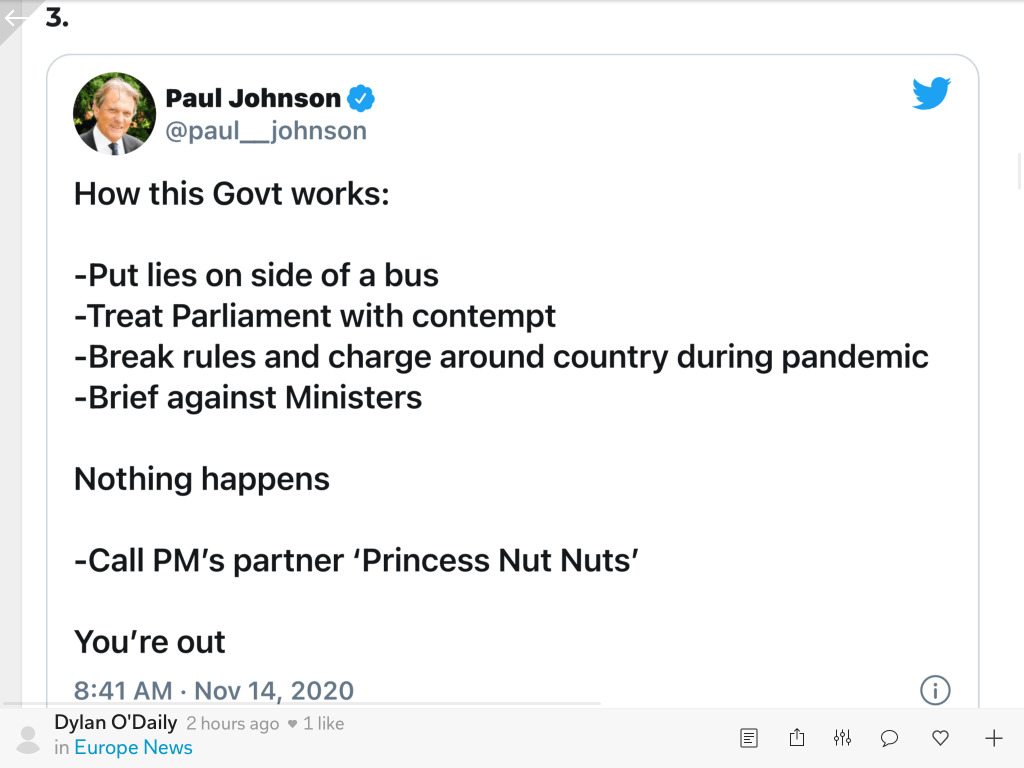
Sources said Mr Johnson was particularly riled by newspaper reports of Ms Symonds being referred to by nicknames including “Princess nut nuts” by Cummings loyalists.

Sources loyal to the Prime Minister accused Mr Cummings of “trying to blame everyone but himself” for his demise, saying his complaints of dithering by Mr Johnson were simply “the occasions when the PM won’t do what he wants him to”.

One source said: “The truth is that Dom will pay no attention to something for months, then he will get interested in it and expect it to happen in two or three days. That’s not how Government works. When he says Boris is indecisive, what he actually means is that Boris won’t do something he wants. That’s not the same thing – it’s just the Prime Minister saying no to him.”

Mr Cummings had formally resigned on Thursday, a day after his closest ally Mr Cain had also handed in his notice. It came after Ms Symonds and Allegra Stratton, Mr Johnson’s press secretary, vetoed the promotion of Mr Cain to chief of staff.

The departure of the Prime Minister’s two most long-standing aides marks not only the rancorous end to a relationship forged in the Vote Leave campaign five years ago but also a new beginning for Mr Johnson’s premiership.

Lord Udny-Lister, his chief strategic adviser, was on Friday installed as interim chief of staff while Mr Johnson searches for a permanent incumbent for a job originally offered to Mr Cain.

Whoever becomes his permanent right-hand man or woman will play a major role in shaping the Johnson Government between now and the next general election, while Ms Stratton wants a “reset” of Downing Street’s relationship with the public and the media.

Ms Stratton, who emerged as the winner in a bitter power struggle with Mr Cain, is determined to soften the image of the Government and supports Ms Symonds’ determination to push the green agenda alongside the core aim of “levelling up” the country.

Mr Johnson’s decision to keep Mr Cummings and Mr Cain employed until mid-December means he will still exert some measure of control over them while the Brexit trade negotiations play out.

Dominic Cummings walks along Downing Street after leaving Number 10 Credit: Yui Mok/PA

There had been fears among some of the Prime Minister’s supporters that Vote Leave alumni could attack the Government from the sidelines if a Brexit trade deal that they do not agree with is signed.

It is also likely to mean the Cabinet Office will retain access to both men if they want to take evidence from them for the ongoing leak inquiry. Mr Cain is understood to have been cleared of blame for the leaking of the Government’s plan for a second lockdown, but the inquiry continues.

Although both men are expected to do some work from home in their final weeks of employment by Number 10, one source said: “We don’t expect to see them back in the building.”

On Friday, Downing Street hit back at suggestions that the Prime Minister’s Brexit stance would soften in the final days of trade negotiations as a result of Mr Cummings and Mr Cain leaving Number 10.

The Prime Minister’s official spokesman said: “Absolutely not. The Government’s position in relation to the future trade agreement has not changed. We want to reach a deal, but it has to be one that fully respects the sovereignty of the United Kingdom.

“Time is in very short supply. We are clear the transition period will end on December 31, there’s no doubt about it. We would like to get a deal. If we’re not able to reach a free trade agreement, then we will leave on Australian-style terms.”

Years of cuts, a £500m shopping centre loan, then Covid pushed Croydon over the edge

The new reality is that, in the middle of a pandemic, Labour-run Croydon has become only the second council in 20 years to issue a section 114 notice – meaning it is in effect insolvent. It has a £67m hole in its budget, and a projected overspend next year of £47m. It has just £10m in reserves, and holds almost £2bn in capital loans – many tied up in risky property investments.

Patrick Butler www.theguardian.com 

As beleaguered Croydon council declared effective bankruptcy on Wednesday afternoon, its interim chief executive, Katharine Kerswell, sent an ominous wake-up-call memo to staff: “Too many of us are still operating like business as usual,” she warned, “and are not facing up to our new reality that we are actually in a financial crisis.”

The methodical drip-drip erosion of council budgets in recent years had maybe inured some to the scale of the challenge now facing the south London borough. Bankruptcy came suddenly, but the origins of the council’s woes go back years, driven by heady dreams of making Croydon a major housing developer, and hampered by a culture of lax financial controls and poor governance.

The new reality is that, in the middle of a pandemic, Labour-run Croydon has become only the second council in 20 years to issue a section 114 notice – meaning it is in effect insolvent. It has a £67m hole in its budget, and a projected overspend next year of £47m. It has just £10m in reserves, and holds almost £2bn in capital loans – many tied up in risky property investments.

It now faces the ignominy of having to implement its own drastic mini-austerity programme to meet its legal obligation to balance the books. “We will need to make decisions that will be very difficult, very challenging, and will have implications [for staff and services], no question,” the new leader of the council, Cllr Hamida Ali, told the Guardian.

Despite the shock of the section 114 notice, observers say Croydon had been teetering on the edge of bankruptcy for months. In August its former chief executive Jo Negrini left, allegedly with a £440,000 severance package. Weeks later, the council’s finance director drafted a section 114 notice but it was never issued. The council leader, Cllr Tony Newman, resigned in mid-October after six years in charge.

In late October, a devastating report by the council’s own auditors, Grant Thornton, savaged the council for “collective corporate blindness”. There were lax financial controls, despite a series of formal audit warnings, and a corporate culture of failing to challenge or scrutinise financial decisions made by the leadership.

The auditor’s report said Croydon’s finances had been deteriorating for years. The huge costs of overhauling the council’s failing children’s services after a critical Ofsted report in 2017 had resulted in huge rolling budget overspends that had never been properly addressed – and indeed their impact had been masked by accounting tricks.

At the same time, Croydon borrowed £545m over the last three years to buy a shopping centre and a hotel and to set up a property development business. Corporate oversight of these deals was feeble, the auditors said, and despite the vast sums invested, the council has yet to receive any significant return. Servicing the loans is said to cost millions a year.

The final straw seems to have been the coronavirus pandemic. As costs spiralled, Croydon’s income from council tax and business rates collapsed. Government compensation schemes failed to cover outgoings. “The council’s fragile financial position and weak underlying arrangements have been ruthlessly exposed by the impact of the Covid-19 pandemic,” noted Grant Thornton.

The council’s public services – already battered by a decade of austerity funding cuts – face another hammering as it tries to bring its finances back on track. All non-essential spending has been frozen, more job losses are expected, and there are rumours of staff being put on to a four-day week. The future of so-called non-core services, from libraries to parks, looks fragile.

Ali and her cabinet will present a fresh budget to the council in three weeks that she hopes will stabilise the finances over the next two years. She will not say what services will be cut or shrunk but she does not seek to downplay the seriousness of what is required. “We are looking at everything,” said Ali.

Steven Downes, the editor of the independent Inside Croydon website, which has reported the council’s financial woes in forensic detail, said the savings are likely to be painful. “Two-thirds of Croydon’s libraries have been closed since March because of Covid. It may be they never reopen. They have got rid of most of the ‘nice-to-have’ services in recent years. The parks service is already basically two men and a dog.”

The council has been forced to go cap in hand to the government for a financial bailout to see it through the next two years. The secretary of state for housing, communities and local government, Robert Jenrick – who accused Croydon’s ruling Labour group of being “dysfunctional” – has already despatched a taskforce of experts to oversee the day-to-day running of the council.

Chris Philp, the Conservative MP for Croydon South, told the Guardian he believed the audit report showed the council’s downfall was down to its uniquely reckless leadership. “It’s not a government funding problem, it’s a problem manufactured by the Labour clique running the council.”

Steve Reed, Labour MP for Croydon North and the shadow secretary of state for communities and local government, disagreed: “Croydon council’s serious financial challenges have deep roots through a decade of austerity and administrations of different parties and have been greatly worsened by the impact of the Covid-19 pandemic”.

The council’s new leadership is under no illusions about its future. Ali has admitted that while austerity and Covid-19 have had a huge impact they do not excuse the failings highlighted by auditors. Mistakes were made, she said, and “swift and decisive action” will follow. For Croydon, she warned, there are “difficult decisions ahead”.

From secretive Covid contracts to town funds fiasco, government culture is rotten

There is something rotten in the government’s culture. Less than a year after Boris Johnson led his party to an 80-seat majority, ethical standards are routinely compromised and the principle of transparency is under attack.

Richard Vize www.theguardian.com

The mishandling by the communities secretary, Robert Jenrick, of the £3.6bn towns fund typifies this casual abuse of power – a shoddy piece of work that barely pays lip service to basic principles of openness and objectivity. Established in July 2019 to support the economies of struggling towns, the fund selected 101 places, 40 based on need and the other 61 chosen by ministers. Tory seats and targets were the big beneficiaries, leading to Labour concerns that the money was used to win votes.

An excoriating report by the cross-party Commons public accounts select committee accuses the Ministry of Housing, Communities and Local Government of dishing out billions based on vague justifications, scant evidence and sweeping assumptions. One town, Cheadle in Greater Manchester (Conservative, majority 2,336), was given cash despite being ranked by officials as the 535th priority out of 541 towns.

The department refused to disclose its reasons for selecting or excluding towns, offering risible excuses that have fuelled accusations of political bias and that has, according to the report, risked the civil service’s reputation for integrity and impartiality. The MPs were riled by the refusal of the permanent secretary, Jeremy Pocklington, to publish his formal assessment that the scheme met Treasury requirements for managing public money.

To deflect criticism over the summer, the department misrepresented an investigation by the National Audit Office by falsely claiming it had shown that the selection process had been “robust”. Pocklington said he did not know about these press statements.

Jenrick has not even explained what the towns fund is expected to achieve, how it fits with other government funding programmes, when he expects to see the benefits, and how he will measure success.

This comes just six months after Jenrick was forced into conceding that he had acted unlawfully in overruling Tower Hamlets council and the Planning Inspectorate to grant approval for a housing development by Tory donor Richard Desmond.

A culture of secrecy and denial is becoming pervasive. It is now established government practice simply not to publish documents that should be exposed to public scrutiny.

The same day as the PAC report, Lord Evans of Weardale, the former head of MI5 and now chair of the Committee on Standards in Public Life, called for the government to publish the investigation into allegations that the home secretary, Priti Patel, bullied staff, which Johnson has been sitting on for months. As the guardian of the Nolan Principles of standards in public life, Evans warned that the failure to publish could undermine public trust.

And just the day before, the Good Law Project accused the government of breaching its legal duties by failing to publish any information about £4.6bn of Covid-related contracts to private companies, with suspicions that a number have been secured through Tory contacts.

The failure to release the Patel report, the formal assessment of the towns fund or the details of the Covid contracts leaves more than a whiff of impropriety. If the government has nothing to hide, why not publish?

All this is within months of that massive election win. Johnson’s government hasn’t even troubled itself with good intentions.

In the runup to the 2010 election David Cameron talked about sunlight being the best disinfectant, while Tony Blair set himself up for a fall by stressing the importance of being “whiter than white”. The current administration has been twisting the rules from the beginning, and has compromised the integrity of the civil service along the way. If that is how far standards of integrity can fall in a year, how much further they could go in five.

  • Richard Vize is a public policy commentator and analyst

NHS needs extra £4bn next year because of Covid, Rishi Sunak told

Leaders say service needs cash to tackle surgery backlog and mental health demand

Denis Campbell www.theguardian.com

NHS leaders are urging Rishi Sunak to fulfil his pledge to give the service “whatever it needs” to respond to the coronavirus crisis, by boosting its budget by £4bn next year.

NHS services need the money to tackle the huge backlog of patients waiting for surgery and the sharp increase in people needing mental health care as a direct result of the pandemic.

Patients will suffer if the money for those problems does not arrive, they claim.

NHS Providers, which represents trusts in England, wants the chancellor to unveil a major financial boost for the service in his comprehensive spending review on 25 November. It will set departmental budgets across Whitehall for 2021-22 at a time when the government has committed to spend at least £210bn to deal with the Covid public health emergency.

The plea comes amid fears at high levels of the NHS that, with public finances under intense pressure because of the huge costs of the pandemic, it will not get as much money as it has been seeking. “We’re hearing that it’s not going to be as much as we need,” said one NHS source.

The letter to Sunak reminds him that on 11 March, as the pandemic was unfolding, he told the House of Commons that “whatever extra resources our NHS needs to cope with coronavirus, it will get … whether it’s millions of pounds or billions of pounds … whatever it needs, whatever it costs, we stand behind our NHS”.

NHS Providers’ letter acknowledges that “the current public expenditure position is difficult” and that the Treasury does not want to revisit the five-year funding deal which the then prime minister, Theresa May, unveiled in 2018 to mark the service’s 70th birthday.

However, it warns that two “urgent, new problems” – the many people unable to access care in the spring and the extra pressure on mental health services – require a rethink and the provision of an extra £3bn-4bn.

Acute hospitals need to pay for more diagnostic equipment, such as scanners, while mental health trusts need to increase their capacity to treat those in need, says the letter from Chris Hopson, the chief executive of NHS Providers, and Saffron Cordery, his deputy.

“Trust leaders are deeply concerned that if the spending review fails to allocate the extra money to fund this capacity in 2021-22, the health and wellbeing of hundreds of thousands of patients is at risk,” they add.

As a result of May’s deal, the budget for the Department of Health and Social Care was due to rise to £139.8bn this year, with NHS England getting £129.9bn of that. However, since then, the Treasury has had to spend £31.9bn more on the NHS than planned. Of that money, more than £15bn went on personal protective equipment for NHS staff, £10bn was earmarked for the controversy-mired test-and-trace programme and more than £1bn on extra ventilators. It has also allocated another £5.5bn to pay private hospitals to treat NHS patients.

A government spokesperson said: “This government has put never-before-seen levels of investment into our NHS, both before and during the pandemic.

“We confirmed £31.9bn extra in July for health services to tackle coronavirus, with £3bn specifically to support the NHS during winter and to upgrade A&E facilities.

“Alongside this we have provided £2.3bn of extra mental health investment a year by 2023-24 as part of the NHS long-term plan and £10.2m in funding to mental health charities to support adults and children affected by the pandemic.”

UK Wildlife habitats and nature reserves are no longer being adequately protected due to funding cuts

The government body has a legal duty to protect the environment, but says its standards have slipped because it is running out of money.

By Madeleine Cuff November 13, inews.co.uk

England’s most precious patches of wildlife habitat are being left unmonitored and unprotected due to a funding shortfall at the nature conservation body Natural England.  

Chair of the agency Tony Juniper revealed Natural England has been forced to dramatically scale back its conservation work because it has not been given enough money to run by government.  

The i newsletter latest news and analysis

Much of this conservation work, which includes regular monitoring of Sites of Special Scientific Interest (SSSI) and assessing the environmental impact of planning applications, is legally required of Natural England.  

“Natural England’s current funding is below the level required to deliver all of our statutory duties to a good standard,” Mr Juniper admitted today in a letter to MPs. He warned the agency could face legal challenges for its inaction.  

Natural England is now only doing the legal minimum to maintain National Nature Reserves, like this one in Northumberland (Photo: Geography Photos/Universal Images Group via Getty Images)

Crowdfunding for cash

Natural England has been in dire financial straits for some time. Its baseline grant from the government has been cut by 45 per cent since 2014. Last year it even set up a crowdfunding page for the public to make donations to fund its work, before the government stepped in earlier this year and awarded the body an additional £15m. 

Lack of cash means planning applications that could harm local wildlife or habitats are going unchecked and management of national nature reserves has been dramatically scaled back, Mr Juniper admitted.

Most seriously, the rarest natural habitats are not being regularly monitored, resulting in officials failing to spot serious problems like pollution or rapid population declines of rare wildlife.  

Mr Juniper said Natural England will struggle to carry out its duties effectively until it can get a long-term settlement generous enough to fund its essential activities. He estimates the body will need at least £322m next year and £389m the following year to fulfil its duties.  

“This is a vital moment for the natural environment,” he said. “There are some very encouraging signs to look towards for the future – things we know work and we know how to approach them. The ability to make a difference is within our grasp.”

A government spokesperson said: “We are currently assessing the budgets for our arm’s length bodies as part of the Spending Review process and will update on this in due course.

“This government is committed to restoring and enhancing nature, introducing the first new Environment Bill for 20 years and setting ambitious goals in our 25 Year Environment Plan.

“We recognise the ongoing pressures on the country’s biodiversity and many of our native species are in decline, which is why we must continue to act to restore and enhance nature.”

COVID declining across the UK

Latest ONS figures show “R” number falling but still above 1. The King’s College Covid symptom tracker is more optimistic. This app certainly correctly “called” the start of the turnaround at the peak of the first wave before anyone else.

covid.joinzoe.com

According to the ZOE COVID Symptom Study UK Infection Survey figures based on swab tests up to four days ago, the number of daily new COVID-19 cases is now declining across the UK.

Key findings from ZOE COVID Symptom Study UK Infection Survey this week: 

  • There are currently 35,963 daily new symptomatic cases of COVID in the UK on average over the two weeks up to 01 November (excluding care homes) 
  • This compares to 42,049 daily new symptomatic cases a week ago
  • The Midlands is the only region where the numbers are still going up, with the numbers now reaching the same levels are the North East and Yorkshire and overtaking the North West
  • The number of new cases in the worst affected area, the North West, is now at the same levels they were at the beginning of October and have an R value of 0.8
  • The number of daily new cases in the South East and South West have now stopped rising but have yet to start declining. These regions still have significantly less cases than the North West, North East and the Midlands (see full table of regional results and graph below)
  • The UK R value is 0.9 
  • Regional R values are: England, 0.9. Wales, 0.9. Scotland, 0.9.
  • Age: Again this week, infections nationally have stopped increasing in most age groups apart from modest increases in the over 60s group, which needs to be monitored closely (see graph below)

The ZOE COVID Symptom Study UK Infection Survey figures are based on around a million weekly reporters and the proportion of newly symptomatic users who have positive swab tests. The latest survey figures were based on the data from 13,460 recent swab tests done between 25 October to 08 November 2020. 

If you’d like to receive the full daily report for the ZOE COVID Symptom Study app head to: https://covid.joinzoe.com/your-contribution 

Tim Spector, Professor of Genetic Epidemiology at King’s College London, comments: 

“Having peaked at the end of October, cases coming down across most areas of the UK, is good news but the numbers are still high in most areas, and with a prevalence of over 500,000 infected people there is still a lot of virus in the population. Yesterday, we reported that the R value was below 1 across all UK nations for the first time and we need this trend to continue. A caution is that rates are still increasing in the Midlands for reasons that are unclear. We aren’t out of trouble yet, but with numbers falling and the news of a vaccine, it feels like the end is in sight.”

Redevelopers plough ahead with Honiton historic site demolition plans

An historic site with agricultural significance in the heart of Honiton could be demolished to make way for a multi-storey retirement home complex, if plans get the go-ahead.

Hannah Corfield honiton.nub.news

Honiton Livestock Market

Honiton Livestock Market

Architect illustration of the proposed development. Picture: Churchill Retirement Living

Architect illustration of the proposed development. Picture: Churchill Retirement Living

A redevelopment proposal for Honiton Livestock Market, located just off Silver Street, was submitted to planning authorities at East Devon District Council (EDDC) on November 6.

Churchill Retirement Living seeks permission for ‘demolition of existing buildings’ to build a block of ’57 retirement apartments including communal facilities, access, car parking and landscaping’.

It comes after Churchill held a public consultation in Mackarness Hall back in March of this year to speak to locals affected by the town centre redevelopment plans.

Many residents have expressed strong objections to the proposals; citing impractical vehicular access down a small one-way road and close proximity to a high school and sports facilities used by families, among other reasons.

Historic site

Planning documents include a description detailing the historic significance of the Cattle Market.

It states: “The site is located just outside the historic core of Honiton. Forming part of a wider agricultural hinterland from the medieval period onwards, its immediate environs were subject to industrial and residential expansion and development in the later post-medieval and modern periods.

“From the early twentieth century onwards the site was utilised as Honiton Livestock Market and it has been subject to several phases of reorganisation and development associated with this use.”

Objections

So far, three people have commented on the planning application posted on the EDDC website – all objecting to the proposals.

Mr Hennessey wrote: “The destruction of Holyshute House and the adjacent, historically important toll house should serve as a warning of what happens when large, aggressive retirement companies are not subject to proper planning process.”

Mrs Howe, highlighting the issue of traffic, said: “The one-way system of traffic from the High Street via Silver Street, St Cyres Road and Dowell Street is so constrained as to make this proposal utterly nonsensical.

“Although the proposal is for sheltered accommodation and one may assume that the residents will not be major car users, the staff, visiting services and relatives will present a considerable addition to the existing traffic.”

In support of the plans

Managing Director of Churchill Retirement Living in-house planning consultancy, Stuart Goodwill said: “There is a compelling overall housing need in Honiton, especially for older people.

“Our proposed development will go some way to increasing access to this type of housing for local residents.

“By meeting this rising demand, we can allow older people to downsize and free up under occupied houses in the local area for families.

“The site is excellently located on previously developed land within easy walking distance of the town centre.

“As well as meeting the need for high-quality retirement apartments, the development will bring benefits to the local economy.

“Owners will be within easy walking distance of shops, restaurants and other amenities in the town, helping to boost local businesses.”

Carrie Symonds takes back control from Dominic Cummings and ‘mad mullahs’ of Brexit

“If you’re going to be successful in politics you need to build alliances and bring people with you,” one ally said. “This lot just makes enemies.”

Oliver Wright | Steven Swinford www.thetimes.co.uk 

It is only a short walk down the stairs from Carrie Symonds’s Downing Street flat to the “shop” below where the prime minister’s advisers work but it may as well be a trip between different worlds.

Those worlds collided spectacularly this week as Ms Symonds helped to engineer the departure of Lee Cain, her fiancé’s communications chief. She also came close to claiming the scalp of Dominic Cummings, Boris Johnson’s chief adviser.

Allies of Ms Symonds have been known to refer to the prime minister’s political advisers as “the mad mullahs”, indicating the depths of the ructions that have divided No 10.

With a briefing war in full flow and dark threats of further resignations, such things can be dismissed as palace intrigue. But at its heart, it is an ideological as well as a personal and political battle for the direction of the government.

Ms Symonds’s allies insist that she is trying to free Mr Johnson from the overbearing influence of former Vote Leave operatives who hold many of the key posts in Downing Street. She blames them for isolating him from his own MPs, turning the media against the government and for overseeing a series of missteps on the pandemic that have squandered his political capital.

“If you’re going to be successful in politics you need to build alliances and bring people with you,” one ally said. “This lot just makes enemies.”

Those in the Vote Leave camp under Mr Cummings and Mr Cain insist that Ms Symonds is the destabilising influence, working on Mr Johnson to unpick decisions and trying to create a separate power structure in No 10.

“Part of the problem is that everyone comes to an agreement then he goes upstairs to No 11 at night and it all changes,” a source in the camp said. “He talks to Carrie, he talks to her friends, and his position moves.”

At the centre is the prime minister, who bounces between the two sides. At the same time, however, insiders say that Mr Johnson often changes his mind and puts off difficult decisions.

“Boris agrees with one group of people and says he is going to do one thing,” one insider said. “Then he agrees with another group of people that he’s going to do another thing. That’s difficult for everybody.”

The present ruction centres on the decision to install Allegra Stratton, the former ITV journalist and a former aide to Rishi Sunak, the chancellor, as the new public face of the government, fronting daily press briefings.

Mr Cain came up with the original idea for an on-screen personality. Ms Stratton did not even apply for the post.

Yet Mr Johnson approached her directly. He asked her to apply and then offered her the job. She agreed, but not without conditions.

She said that she would take the role but would answer only to the prime minister and not to Mr Cain as director of communications.

She wanted to set a different tone and did not want to be forced to defend positions set by Mr Cain over which she had no control. Mr Johnson agreed to all her terms.

Allies of Mr Cain saw the hand of Ms Symonds behind the whole operation and said that it left him in an impossible position.

“He felt undermined,” one friend said. “Allegra was imposed upon him and then he was told she wasn’t going to report to him. He felt he didn’t have a choice but to resign.”

The prime minister, trying to placate both sides, suggested a new role of chief of staff who would take a strategic overview of the entire Downing Street operation. But to Ms Stratton and Ms Symonds, herself a former Conservative Party director of communications, this merely exacerbated the existing problem. This was not a reset — it was an attempt by Mr Cain and Mr Cummings to exert even further control.

The leaked news of the potential appointment was widely attributed to Team Carrie as what turned out to be a successful attempt to prevent Mr Cain from taking the job. This version of events is disputed by allies of Ms Symonds, who have suggested that the news was leaked by her opponents as part of an attempt to bounce Mr Johnson into appointing Mr Cain.

Mr Cain resigned on Wednesday, resulting in a furious response from his Vote Leave allies. Several sources said that Mr Cummings came close to following him out the door and threatened to quit during a tense meeting with Mr Johnson that evening.

Ms Stratton has not commented publicly on the furore. On Wednesday, however, she ventured to Twitter to like a message by Susie Dent, the Countdown presenter. “Word discovery of the day is ‘stiffrump’,” Dent’s tweet said. “An obstinate and haughty individual who refuses to budge no matter what.”

Mr Cummings has chosen to stay but allies think it is likely that he will leave in the new year.

“He’s determined to complete Operation Moonshot [the mass testing programme] and get Brexit done,” an ally said. “But he’s very unhappy. Lee was his key in implementing his agenda. I would be surprised if he stays beyond Christmas.”

Mr Cummings is said to be pushing for Cleo Watson, a senior No 10 adviser with whom he worked in Vote Leave, to take the role of chief of staff.

There were suggestions that Lord Frost, the chief Brexit negotiator who worked with Mr Cain in the Foreign Office, could also quit. The peer is said to have gone “bananas” about the suggestion because of concerns that it could destabilise the final stages of talks with the European Union. He is believed to have met Mr Johnson last night and assured him that he had no plans to leave.

Oliver Lewis, Lord Frost’s deputy, is said to have seriously considered quitting, however. Mr Lewis worked alongside Mr Cain at Vote Leave. He also had a private meeting with Mr Johnson and decided to stay for the time being. “There are a lot of people who are very bruised,” one figure said.

“A lot of his team are very loyal to Lee and felt very strongly about the way he’s been treated. Dom has decided to stay for now because he is very involved in all the Operation Moonshot work but I don’t know how long that will last.”

Why does it matter? In short because the centre of gravity in Downing Street has shifted significantly. Relations between Mr Johnson and Mr Cummings are said to be tense and the prime minister now regards the whole Vote Leave team, on whom he used to rely, with a degree more suspicion.

“The PM has other people who he is depending on now,” one insider said. “He is using Allegra and others — that’s just the way he does business.”

Mr Johnson is understood to have suggested bringing Henry Newman, a senior aide to Michael Gove, into a senior policy role. “The prime minister really likes him,” a government source said. “He thinks there’s a role for him.”

Mr Newman is understood not to be aware of the approach and his friends have dismissed the claims as false, suggesting that they are part of a campaign to undermine him.

One source said that Mr Johnson wants to reset the government and make it less adversarial, ending the “culture wars” against institutions such as the BBC. The prime minister wants to focus on environmental issues, never a big priority for Brexiteers, and reset relations with his increasingly fractious parliamentary party.

Much will depend on who gets the job as chief of staff, which is the one thing that both sides can agree is badly needed to bring some sort of semblance of order to decision making.

Others are less than optimistic that the tensions will be resolved. One critic said: “The lack of decisiveness at the top . . . that’s the fundamental problem we’ve seen play out this year of indecision and flip flopping. If you can’t even stand by your most loyal trusted people and undermine them and box them in, in a way that they feel they have to go. It’s not good.”

Sir Jonathan Jones, the government’s former chief legal adviser, who resigned in September over Brexit, was even more caustic.

He posted a picture of a cocktail on Twitter with the caption: “This cocktail is bang up to date. No 10 gin. Highly corrosive acid (lime juice). More heat than light (ginger liqueur). Shake chaotically over shards of ice until meltdown. Add media froth (champagne). Garnish with tears and (wasted) thyme. Do suggest names.”