Sidmouth beach management plan … a new (and welcome) approach

9 October 2020 – Progress update on storm event protection discussed at Sidmouth and East Beach Management Plan meeting – East Devon

eastdevon.gov.uk 

Sidmouth and East Beach

For the first time since March, East Devon District Council hosted a Sidmouth Beach Management Plan (BMP) steering group of local organisations, interested parties and councillors to discuss the progress being made to protect the town and East Beach from flooding.

The meeting was a held ‘virtually’ due to Covid-19 restrictions and progress updates came from district council officers working on a proposed scheme.

Cllr Geoff Jung, the council’s portfolio holder for Coast, Country & the Environment, chaired the steering group meeting and explained that following policy changes of the council’s new administration that in future all meetings will be held in public and the minutes be published.

He also proposed that all the main project documents relating to the BMP will be published and the Frequently Asked Questions (FAQs) will be reviewed on the council’s website to demonstrate the new administration’s policy of openness and transparency.

The BMP’s terms of reference will be reviewed to reflect these changes and brought before the next meeting of the group for discussion in December. Councillor Jung also proposed that because of Covid -19 restrictions, the next few meetings will be held virtually via Zoom and future public meetings will be broadcast through the council’s YouTube channel when they are held every other month.

East Devon District Council’s Engineer Tom Buxton-Smith provided the steering group with an update and progress of the proposed scheme which includes a splash defence and recharged beach along the main town frontage along with a super groyne on East Beach. The steering group discussed options for carrying out a public exhibition on the scheme and splash defence options so that residents and businesses can give their views. With Covid-19 restrictions, the group will discuss this further at its next meeting.

The scheme is now fully funded and is estimated to cost £8.7m. The funding is dependent on the Environment Agency approving the submission of the council’s Outline Business Case. Following approval, consultants and contractors will be appointed to develop the final design during 2021. A planning application will be submitted with a proposed start to the long-awaited scheme in the Autumn 2022.

Following a number of cliff-falls at Pennington Point in early Spring a review had been undertaken to consider emergency measures to protect properties in the town from the perceived sea overtopping of the Sid river wall. However, the Environment Agency advised that the works did not meet the definition of emergency works. It was concluded that the emergency works could not proceed at this time and it would be kept under review. Engineers will provide a definition of ‘trigger’ points when it may be considered that emergency works were appropriate.

Following a proposal by Devon County Councillor Stuart Hughes to consider a “recurve” to be fitted to the esplanade sea wall, it was agreed that further evidence was required to understand if this would be providing extra protection for the town. It was concluded that an additional recurve would increase the impact load on the seawall and would probably not remove the need for a splash barrier, but further assessments will be undertaken.

Mr Buxton-Smith then discussed the need for the most controversial element to the whole scheme which was referred to in earlier reports as a ‘Splash Wall’. It had always been recognised that a 1-metre high wall would not be appropriate along such an important and historic esplanade of Sidmouth, so alternative solutions are under investigation. Glass panels, removable sections, benches with raising seats to act as barriers, together with flood gates are all being considered which will be part of the public exhibition and consultations prior to the planning application being submitted.

Sidmouth Chamber of Commerce has recently proposed that Offshore Rock Islands should again be considered. Mr Buxton-Smith reported that he was in discussions with their representative and awaiting on the pricing and engineering specifications to their proposal.

In the meantime, Mr Buxton-Smith has had costings produced for the large offshore breakwater based on engineering drawings costing £13.1m – more than the total funding available for the project making this proposal unviable. Mr Buxton-Smith said he would discuss the variance of the costings with the Chamber.

• Over the last few days, a fresh report made public by Plymouth University, is estimating future rates of coastal erosion over the next 100 years in the eastern half of the district.

– The report indicates that some parts of the coastline in East Devon will erode more quickly than had previously been estimated, while some will erode less than previously thought.

– However, the university research does not take into account the mitigating protection to be provided by schemes such as Sidmouth’s BMP, discussed by the BMP steering group.

– The university’s research also shows the reasonable worse-case scenario erosion rates, whereas the erosion rates in the council’s beach management plans are the most likely scenario.

– The council’s strategic planning committee will consider a planning policy briefing paper on the university’s findings related to coastal changes at its meeting later this month. The issue will also be discussed at the next BMP steering group meeting in December.

“Three Homes” Jenrick’s £25m government funding for his constituency – Part 3

Robert Jenrick admits approving funds for town in Jake Berry’s constituency

Rajeev Syal www.theguardian.com 

Robert Jenrick has admitted that he and a junior minister approved payments to towns in each other’s constituencies from a government fund earmarked for deprived areas.

The communities secretary confirmed that communities minister Jake Berry gave the go-ahead for Jenrick’s Newark constituency to be selected for a £25m fund award even though it was 270th on the list of the UK’s most deprived areas.

Jenrick said he signed off the decision for money to be allocated to Darwen, a town in Berry’s Rossendale and Darwen constituency.

On Sunday, Jenrick insisted there was a “robust and fair” methodology behind the government’s towns fund and dismissed as “completely baseless” allegations that he had any involvement in Newark’s selection.

Last year, Jenrick announced details of a £3.6bn towns fund to be shared between 101 left-behind areas.

Under the scheme, select towns were able to bid for up to £25m each from the Ministry of Housing, Communities and Local Government.

Jenrick and Berry, his junior minister, were allegedly responsible for choosing 61 of the towns.

At a hustings during the election last year, Jenrick told voters: “I helped to secure a £25m town deal which I hope will improve the public realm and make the town centre a more attractive place to spend time in.”

After the election, Jenrick sat on a board convened by Newark and Sherwood district council that petitioned his own department for the maximum amount available of £25m.

Jenrick told the BBC’s The Andrew Marr Show: “If the question you’re coming to is was I involved in selecting my own community, absolutely not. Ministers do not get involved in their own constituencies. That decision was made by another minister in my department.”

Asked which minister made the decision, Jenrick replied: “It was made by Jake Berry.”

When Marr pointed out that a town in Berry’s constituency also received money from the fund, Jenrick confirmed that he was the individual to have given that decision the go-ahead.

Earlier this year, Jenrick rebuffed calls for his resignation after he ensured a controversial housing development was agreed before a levy was introduced that would have cost its backer millions.

Documents showed that the former porn baron and Conservative party donor Richard Desmond urged Jenrick to approve his Westferry Printworks development in east London before a new community infrastructure levy was introduced, a move which, it is believed, would have saved Desmond £50m.

Desmond had given the Conservatives £12,000 two weeks after the scheme for 1,500 homes was approved, and the housing secretary had sat next to him at a fundraising event.

Jenrick denied any wrongdoing but expressed regrets for sitting next to Desmond and exchanging messages with him.

Labour is demanding an inquiry into the way money was allocated from the towns fund.

The shadow communities secretary, Steve Reed, has written to Simon Case, the head of the civil service, requesting a cabinet office investigation.

“Three Homes” Jenrick’s £25m government funding for his constituency – Part 2

Minister dismisses call for constituency fund probe

BBC News www.bbc.co.uk

Communities Secretary Robert Jenrick has dismissed Labour’s call for an investigation into the award of a £25m regeneration grant to his constituency.

He told BBC One’s Andrew Marr show the decision to give the money to Newark, Nottinghamshire, had been taken by fellow minister Jake Berry.

Mr Jenrick said he had himself decided to grant funds to a town in Mr Berry’s constituency under the same scheme.

He called this “perfectly normal” and accused Labour of “distraction”.

But Labour described the allocation of the money “murky” and urged Mr Jenrick to submit himself to a “full” investigation.

The £25m was awarded to Newark under the Ministry of Housing, Communities and Local Government’s £3.6bn Towns Fund, set up last year to help places that had “not always benefitted from economic growth in the same way as more prosperous areas”.

Newark and Sherwood District Council submitted its town investment plan – including better transport, training and digital connectivity – in July.

Mr Jenrick, Conservative MP for Newark since 2014, supported the bid.

For Labour, shadow work and pensions secretary Jonathan Reynolds told Sky News’s Ridge on Sunday: “The whole question has always been quite a murky one as to how this money was allocated.

“The secretary of state has questions to answer and an investigation is the right way forwards.”

‘Robust system’

But Mr Jenrick said the government had a “robust” system in place for choosing which places would benefit from the Towns Fund and that the rules had been created before he became communities secretary.

He added that Mr Berry, who oversees local growth in England as a minister within Mr Jenrick’s department, had made the decision following advice from civil servants.

Darwen, a town in Mr Berry’s Rossendale and Darwen constituency, was also allocated money from the Towns Fund.

The decision, Mr Jenrick said, had been “made by myself”.

He added: “This is perfectly normal. Ministers don’t get involved in making decisions for their own constituency.

“But neither should their constituencies be victims of the fact that their MP is a minister.”

Mr Jenrick also said: “The Labour Party front bench need to get beyond the M25 and see what’s happening in our constituencies.”

Earlier, he told Sky News that Labour’s accusations were “completely baseless”.

But, following the interviews, shadow communities secretary Steve Reed insisted that, if “Robert Jenrick has nothing to hide, he should submit himself to a full investigation”.

In August, Mr Jenrick said he regretted sitting next to property developer Richard Desmond at a Conservative Party fundraising event last year.

Mr Desmond donated £12,000 to the Conservatives in January, 12 days after the minister overruled government planning inspectors to approve a development at the former Westferry print works in east London.

Labour said this had raised suggestions of “cash for favours”.

But Mr Jenrick has always insisted he had no knowledge of the donation and was motivated by a desire to see more homes built.

“Three Homes” Jenrick’s £25m government funding for his constituency – Part 1

Labour demands probe into £25m government funding for housing secretary’s constituency

Shaun Connelly www.independent.co.uk 

Labour has demanded a top-level investigation into communities secretary Robert Jenrick, over how government funding was allocated to his Newark constituency.

Shadow communities secretary Steve Reed has written to the head of the civil service requesting a Cabinet Office investigation into Mr Jenrick, concerning how recipients of the multibillion-pound Towns Fund were decided.

The move comes in the wake of Mr Jenrick’s Newark constituency being selected for a £25m funding award.

It follows a report in The Times alleging Mr Jenrick helped select Newark for the allocation.

Mr Jenrick has insisted he was not part of the decision-making process regarding Newark as funding for the town was determined by another minister.

Labour wants an inquiry to see how Newark was chosen for inclusion in the Towns Fund, and whether officials advised against such a move.

Mr Reed also wants to know if Tory-held seats were prioritised under the initiative.

The £3.6bn Towns Fund was a high-profile government scheme in the run-up to the last general election, which ministers said was aimed at “levelling-up” so-called left behind towns.

Earlier this year Mr Jenrick rebuffed calls for his resignation after he ensured a controversial housing development was agreed before a new levy was introduced which would have cost millions for its backer.

Documents released after pressure from Labour showed multimillionaire Conservative Party donor Richard Desmond urged Mr Jenrick to approve his Westferry Printworks development in east London before a new community infrastructure levy was introduced which, it is believed, would have saved Mr Desmond £50m.

Mr Jenrick faced accusations of “cash for favours” after it emerged that Mr Desmond had given the Conservatives £12,000 two weeks after the scheme for 1,500 homes was approved, and that the housing secretary had sat next to him and viewed a video at a fundraising event.

The minister originally approved the development plan in January, overruling Tower Hamlets Council and a planning inspector.

Mr Reed said: “Hot on the heels of the Westferry scandal, Robert Jenrick yet again has serious questions to answer about allegations that he used the Towns Fund to channel public money to help Conservative Party candidates ahead of the general election.

“Mr Jenrick has made an unfortunate habit of overruling officials’s advice to get his own way, just as he did during the Westferry cash-for-favours scandal.

“Now he has done the same with this blatant example of pork-barrel politics, with public money making its way to help his own re-election campaign. Misuse of public funds is a very serious abuse of public trust.

“Robert Jenrick must come to the House urgently to make a statement on how this money was awarded and submit himself to a full Cabinet Office investigation.”

Mr Reed has called for the communities secretary to appear before the Commons on Monday to make a statement on the issue.

A spokesman for Mr Jenrick said: “This reporting is incorrect as the secretary of state did not select his constituency for Towns Fund money.

“To suggest otherwise is misleading, and another minister in the department is responsible for decisions around Newark’s Towns Fund bid, as is normal practice.

“As made clear in the National Audit Office report, the process was comprehensive, robust and fair – and the Towns Fund will help level up the country.

“Delivering the Towns Fund was a manifesto commitment that the Labour Party opposed and offered no alternative to, so it was not surprising that Conservative candidates mentioned it during their campaigns.

“Conservatives in government are investing in our towns to improve the life chances of local people, Labour are resorting to baseless political point-scoring.”

Lower Otter Restoration Project – the details

One of the most interesting and environmentally significant planning applications for decades appeared in the applications posted by Owl yesterday:

Proposed breach of the River Otter embankment, Little Bank and Big Bank to restore the historic floodplain creating intertidal saltmarsh, mudflats and freshwater habitat at Big Marsh, and new freshwater habitat at Little Marsh. Associated works including development of a new footbridge, realignment of South Farm Road, and creation of a new car park. (The Lower Otter Restoration Project) Open for comment icon151 Hectares Of Land Within The Parishes Of East Budleigh, Budleigh Salterton And Otterton From Lime Kiln Car Park (SY072819) To South Of Frogmore House (SY074850) (The Lower Otter Valley)Ref. No: 20/2089/MFUL | Validated: Mon 28 Sep 2020 | Status: Awaiting decision

The application comprises 128 documents, though “The Design and Access Statement” is the document to read to give the overall picture. The extract below gives a good summary of what is proposed. Other documents are likely to provide interesting supporting ecological and historical studies.

Before that, Owl copies a paragraph from the Planning Statement which discusses the motivation driving the project. This talks about the need to provide compensating habitat for losses in the Exe Estuary. Owl suggests these habitat losses haven’t occurred because of climate change, that’s for the future, but because of overdevelopment and increasing use of the estuary for leisure activities.

“The original motivation for the LORP arose from a desire by the landowner, Clinton Devon Estates (the Estate), to manage the lower Otter valley as sustainably as possible in the face of a rapidly changing climate. The Environment Agency’s involvement in the project arose from a statutory need to provide compensatory habitat for habitat losses in the Exe Estuary. The desire of these project partners is to improve the natural functioning, ecological health and environmental status of the river, demonstrate climate change adaptation and reduce risk to wildlife and public infrastructure under future climate change.”

Planning application 20/2089 MFUL Design and Access Statement

Submitted by the Environment Agency

The Lower Otter Restoration Project (LORP) will restore the historic floodplain of the River Otter to a condition similar to that found prior to the construction of the 19th century embankments alongside the river and within the floodplain. It will retain most of the embankments and create breaches in Little Bank, Big Bank and the River Otter embankment to allow water from the River Otter and Otter Estuary to inundate the site, creating intertidal saltmarsh and mudflats. South Farm Road will be raised, and the existing Budleigh Salterton Cricket Club moved off site to another location. Development of the new Budleigh Salterton Cricket Club has been approved by successful determination of a separate planning application (reference 19/1521/MFUL) due to a need to progress the cricket pitch sooner than the rest of the LORP. The Scheme includes the elements shown in Figure 1.1

Bishop’s Clyst Parish Council meeting on Winslade Manor – the outcome

From a participating correspondent:

“A number of residents dialled in to listen and spoke at the open session. Prior to the Open Session Peter Cain read a pre prepared statement to clarify his position. The Parish Council listened to what we had to say, both Mike Howe and Peter Cain declared an interest, correctly, and took part in the discussion. The Parish Council then unanimously agreed to submit the objection that Charlie Hopkins had written with two very minor amendments.” 

[EDDC will make the final decision.]

Councils argue about where they sit in new lockdown tiers

Councils are jostling to be moved up and down the government’s three-tier lockdown system as they fret over the conflicting demands of local jobs and public health.

Will the Government put Exeter into Tier 3 lockdown?

Andrew Gregory and David Collins www.thetimes.co.uk

With the number of virus infections surging, Boris Johnson plans to introduce the new measures this week to simplify the restrictions.

Millions of people have been subjected to local restrictions for weeks, but there are concerns that mixed messages and confusion over changes to the rules have limited their effectiveness.

Areas with relatively low infection levels will be placed in what is being described as tier 1. Only national restrictions such as the rule of six, the 10pm curfew on restaurants and pubs and existing rules on masks and social distancing will apply.

The next tier is likely to include bans on home visits and indoor socialising with other households in bars or restaurants.

Areas with the worst coronavirus outbreaks will be put in tier 3. Options being considered this weekend include the closure of all hospitality venues, a ban on overnight stays outside your own home and shutting leisure venues such as cinemas.

Tier 3 could see people ordered not to have social contact with anyone outside their household.

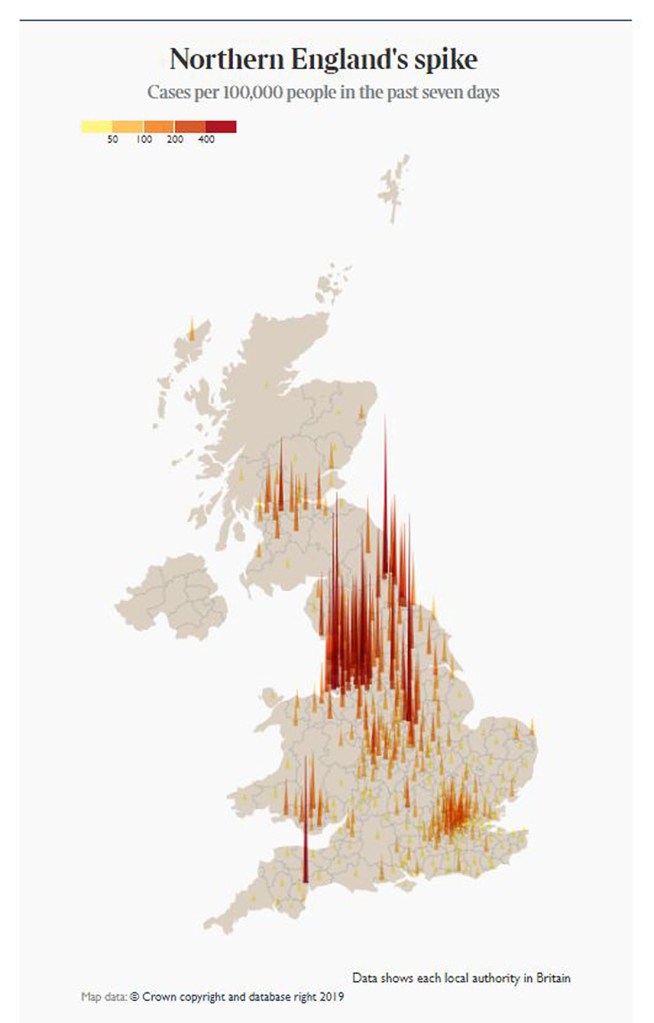
The move could see 7,171 pubs in the north of England temporarily shut, accounting for one in five of England’s 37,616 pubs. The region accounts for 18 of the 20 worst Covid hotspots. Liverpool, Manchester and parts of the northeast are all set to be put in tier 3.

But yesterday, an extraordinary lobbying race erupted with several councils scrambling to be placed in higher tiers than the levels they expect.

It is understood that some London boroughs want to be in tier 2 rather than the less strict tier 1, despite relatively low infection rates.

Officials said this was because councils fear they are only weeks behind the north of England.

At the same time, some councils are lobbying the government to be in tier 3 to win economic support.

Conversely, some councils in the Midlands and the north with higher infection rates want to be in a lower tier amid concerns that the tier-3 restrictions would “finish off” their economies.

The jostling is complicated by the fact that the prime minister had yesterday not decided on the final measures for each tier.

It is understood that while pubs and bars will be forced to shut in tier-3 areas, restaurants may be allowed to stay open until 10pm. There is debate over whether to shut hairdressers, leisure centres and gyms.

One option is an 11pm curfew in tier 1. It comes amid opposition to the national 10pm curfew, which will be voted on in the House of Commons on Tuesday.

Another idea is to extend the severe measures in tier-3 cities to their suburbs, even if virus infection levels there are lower.

The rules are expected to be reviewed after a month, a government official said. But questions remained about when and how local areas would move up or down tiers. Triggers could include the level of infection, the number of cases or the R figure.

“A key concern is getting trapped in one tier or another,” said a council official. “If you are in an area deemed low-risk, in tier 1, how quickly will you be allowed to move up a tier if infections suddenly take off?”

@AndrewGregory

Tier 1

Areas with the fewest coronavirus cases. Only national restrictions such as the rule of six and the 10pm curfew on restaurants and pubs will apply. Rules on mask-wearing and guidance on social distancing will still apply. One possibility is that varied curfew times could apply to different tiers. The curfew could be 11pm in tier 1 rather than 10pm

Tier 2

The same restrictions and rules as tier 1 apply but may also include bans on home visits and indoor socialising with other households in bars and restaurants

Tier 3

The parts of the country with the highest infection rates. These areas will have to observe all the restrictions in tier 1 and tier 2 but could also see the closure of all hospitality venues, a ban on overnight stays and the shutting of leisure venues. Tier 3 residents might be banned from any social contact with anyone outside their household. Hairdressers, cinemas, and gyms may also face closure

Cumbria’s ace test-and-tracers put Whitehall officials to shame

When it comes to tracking Covid-19, the Lake District proves it is best to go local.

Tom Calver, Gabriel Pogrund and Hannah Al-Othman www.thetimes.co.uk

In May, 10 days before the launch of the national test-and-trace scheme, Cumbria set up England’s first fully functioning local version.

Members of Cumbria county council’s sexual health team — more used to tracking cases of chlamydia — were drafted in for their contact-tracing skills. They work with housing officers, who often know where vulnerable people are.

“Often, we identify someone who tested positive, and someone on the local environmental health team will say, ‘Yes, we know that person’,” said Colin Cox, Cumbria’s director of public health. “The skill of the local district council teams in knowing the complexities of their patch is just phenomenal.”

The experiment appears to have paid off. At the time of its launch, Barrow-in-Furness — Cumbria’s second-biggest town — had the highest coronavirus infection rate in the country. Although cases have soared again in the northwest, Cumbria’s rate of 87 per 100,000 is the lowest in the region.

Before the pandemic, Emma Bundock, 43, was an environmental housing manager. Since May, she has led a three-person team tracing contacts for Allerdale, a district that includes Grasmoor and Workington.

“The officers who work on this live in the communities they’re trying to support,” Bundock said. “We’re passionate about the people we’re trying to help because ultimately, it could be one of your own.”

Most cases come from the national test-and-trace programme, 24 hours after call centre operatives have had a go at making contact.

Sometimes, said Bundock, “the national tracers have not asked the questions that make the person properly think about who they’ve been in touch with, what they’ve done, or who they’ve seen”.

Cumbria’s scheme was the first and there are now 93 local contact-tracing teams. “Complex” cases involving outbreaks in hospitals, care homes and prisons are automatically passed to local teams. In the week to September 30 they reached 97.1% of contacts, compared with just 62.4% by the national teams.

In many Covid-19 hotspots, the national system is faring even worse. Blackburn with Darwen, Bury and Manchester have some of the highest infection rates, but little more than half of all non-complex contacts are being identified. In Slough, the figure is 42%.

In August, the Department of Health said NHS Test and Trace would become “local by default”. “We’re still trying to figure out what that means,” said Cox.

The department said: “NHS Test and Trace is breaking chains of transmission thanks to local and national teams working hand in glove. Almost 700,000 people have been contacted and told to isolate.”

‘Everyone is fighting’ – how Downing Street lost its grip on a divided nation

When he addressed the nation on 23 March to announce a national lockdown, Boris Johnson knew he had most of the British people with him. “Each and every one of us is now obliged to join together to halt the spread of this disease,” the prime minister said in his TV broadcast. “We will beat the coronavirus and we will beat it together.”

Toby Helm, Political Editor www.theguardian.com 

Six and a half months on, as he prepares to announce the introduction of more restrictions and a new three-tier system across the country – at what ministers say is a “critical” moment – hospitals are filling up and death rates are rising once more.

Unlike March, however, calls for the British people to unite behind a response directed from No 10 no longer command the attention or respect they did then. The many changes in rules and regulations have left people confused and choosing to rely on their own instincts as much as on what politicians tell them.

Trust in the government to handle the pandemic, say local leaders who monitor the crisis daily, has been shot to pieces. “I would say that trust in authority has completely gone,” said one senior official at the heart of the fight against Covid-19 in the north of England on Saturday.

That crisis of confidence in central government is borne out in the latest Opinium poll for the Observer on Sunday. It shows that just 31% approve of the way the government has handled Covid-19. At the end of March the approval rate was above 60%.

National targets on testing have not been met. False expectations have been set. Rules have changed at dizzying speed. “One day people are told one thing, the next another to the point where they have stopped even trying to follow,” said one public health director.

This weekend, when unity is needed, the cabinet is split. Tory MPs are split. The media is split. Public opinion is split. And council and public health leaders in some of the biggest cities of the north and Midlands are in revolt. So what can be done?

On Friday the prime minister’s close adviser Edward Lister and senior civil servants were locked in long, tense virtual meetings with local health chiefs and council leaders, trying to get them to agree to the new three-tier approach.

After two hours of talks, one of those who took part said he and many other leaders in the north of England were so furious at what took place that they were thinking of issuing a statement refusing to comply with government orders.

“They say they are listening to us but they are not. What they seem to want to do is punish the north. The extra financial support announced by the chancellor is welcome but it is two-thirds of people’s wages, not 80% which it was before. This is not enough for people and the businesses which will have to close.” Another official involved in talks with the government over the weekend said: “It is toxic and everyone is fighting.”

The reason for the anger, on display at a press conference of northern mayors on Saturday, is twofold. First the mayors demand to know why the government will only pay two-thirds of the wages of people in businesses in their areas that have to close as a result of the latest decisions by No 10, whereas they paid for 80% under the national lockdown. This, they say, is “grossly unfair” and discriminatory. It will leave many in the hospitality sector earning way below the minimum wage and unable therefore to pay their rent through no fault of their own. Many will therefore face eviction in the run-up to Christmas. Second, they do not see why central government should have the power to shut their pubs and hospitality venues, when local politicians and health leaders could do so themselves if granted so-called “summary closure powers”. In essence they want the power to make those decisions themselves.

For months council leaders and mayors have been asking ministers to allow them to fight the pandemic locally, with their own test and trace systems, rather than having decisions dictated from the centre. Mayors such as Andy Burnham in Greater Manchester have also called for greater financial help for people on low incomes required to self-isolate, arguing that without it many would not do so as they would feel they could not afford to. Leaders in the regions wanted more central government help – but it had to be help to allow them to manage their own responses, tailored to local needs.

This is not what they were hearing from No 10 this weekend, however. “There are lots of warm words,” said one senior figure. “But they are not listening. They are telling us to agree what they want. There is no consultation. We have different factors in different areas. In some university cities like Newcastle and Nottingham the virus is mainly being spread among students and has yet to spread to older people. In other areas like Merseyside we hear it has spread to older people. We need the ability to respond locally.”

In some cases local leaders believe restrictions do not go far enough. Liverpool’s Labour mayor Joe Anderson saidon Saturday that he expected his city – where there are currently 600 cases per 100,000 people – to be placed in tier three, under the highest set of restrictions. This would mean closing all the city’s pubs from Wednesday, though not its restaurants. Anderson said, however, that government would be wrong to allow Liverpool’s bars and pubs to stay open until Wednesday because the infection was spreading so fast in the city. In Merseyside things are so serious there are suggestions that local hospitals are already resigned to cancelling all elective surgery in the coming days because Covid admissions are rising so fast. Anderson said his other worry was that the public no longer listened to diktats from London. “I’m not convinced people trust the government’s decisions.”

On Monday the prime minister hopes to be able to announce the new three-tier system to parliament and to have it voted on within days. Many of his own MPs are dubious that stricter lockdowns are necessary. To add to the confused picture Labour has said it will abstain in a vote expected early next week on extending the 10pm curfew for pubs across England.

It is not just the north and Midlands where tighter restrictions appear imminent. The mayor of London, Sadiq Khan, warned people to expect new measures to be announced in the capital this coming week. “My prediction is, there will be additional restrictions being brought in because we’ve got to make sure we don’t have a situation with the NHS being overwhelmed and lives being lost.”

Another local health director told the Observer that to make any of these restrictions stick, faith had to be restored in those announcing the changes: “The only way is to do that is locally with local decisions. It is too late to rebuild trust at national level.”

Honiton Forward serves remaining town councillors with final ultimatum

A community movement established in response to certain issues surrounding Honiton Town Council has publicly requested, for a second time, that all remaining councillors resign.

Hannah Corfield honiton.nub.news

Honiton Forward serves remaining town councillors with final ultimatum

According to a statement: “This is the last time Honiton Forward will respectfully ask you all to make your own decisions and do the right thing.”

Over a thousand electorates have now signed a petition calling for the current incumbents of Honiton Town Council to step down and allow for a re-election.

“If you continue to treat the people of Honiton with contempt then you will give us no option but to exercise the will of the community and seek to have you removed though the Community Governance Review.

“We write now to urge you one last time to please stop putting your personal interests before the interests of your community and stand down to allow a new election to be held and a fresh start to be made.”

The letter also mentions specific high-profile incidents which have blighted the council recently. Included in this are the yet to be resolved negotiations with The Beehive, legal costs racked up in the apparently failed litigation against Bailey Partnership, the recent announcement from Honiton Chamber of Commerce and allegations made by the former Town Clerk who is threatening legal action.

Individual councillors, of which seven – six active – remain, are addressed with a personal message to each.

Click here for the Honiton Forward Facebook page where the letter can be accessed in full.

Honiton Nub News has contacted Chair of Honiton Town Council for comment and is awaiting response.

Planning applications validated by EDDC week beginning 28 September

Joining forces to achieve results for benefit of others

Eileen Wragg, East Devon district councillor, writes for the Exmouth Journal.

EILEEN WRAGG www.exmouthjournal.co.uk 

It is sometimes surprising how people and groups from different sectors can, with commitment, join forces and work together, and achieve results which work for the benefit of others.

I recall becoming aware of the unfair charges levied on water customers following the privatisation of the water industry in 1989, when companies replaced the water authorities, issuing shares which ensured investment in the world of water supply and sewage treatment for good financial returns.

This was not good for the six per cent domestic customer base who were supplied with meters in the early 1990s, of which I was one, and I quickly realised that my water bill was almost double that of unmetered customers who could use limitless amounts of water for a fixed price, while I had to ration my family’s use.

I eventually began a campaign against South West Water’s (SWW) charges, which grew into a national movement, attracting huge press, radio and television coverage.

The results were surprising, SWW was receiving hostile publicity which was feared to be affecting its investors and share dividends, so it decided to set up a Devon and Cornwall Customer Consultative Group, of which I became chair, and then a Special Assistance Fund which helped customers in water debt – that later became WaterSure, now outsourced to Citizens Advice.

Along with other customers, we worked well together with the company, for the mutual benefit of both sides.

Now, customers are being offered the choice of shares in SWW, or a £20 discount on their bills.

What a long way we’ve come!

The outcome personally was that I was asked to stand for local elections in 1996, and the rest is history, albeit still in the making.

I am still a Liberal Democrat district councillor, and in the spring this year, the Democratic Alliance was formed with the East Devon Alliance, Greens, Lib Dems and an Independent joining together, breaking over 45 years of Tory rule at East Devon District Council.

I am delighted to report that we now have a healthy administration and work extremely well together in a truly harmonious way.

As the late MP Jo Cox said in her maiden speech: “There is far more that unites us, and we have more in common than things that divide.”

Matt Hancock makes tasteless Covid test joke in Commons bar as he ‘joined MPs flouting 10pm curfew’

“… the Health Secretary, ‘in trademark pantomime dame-style, cracked a gag about how he’d stand everybody a drink but as PHE was keeping a count, he’d never have to pay up. It did get quite a laugh’.”

By Brendan Carlin Glen Owen for The Mail on Sunday www.dailymail.co.uk 

Health Secretary Matt Hancock was last night accused of breaking his own Covid curfew by drinking in a Commons bar beyond 10pm – where he made a crass joke about the Government’s test and trace failings. 

Mr Hancock arrived at the bar just before a 9.40pm vote, ordered a glass of white wine and announced: ‘The drinks are on me – but Public Health England are in charge of the payment methodology so I will not be paying anything.’ 

His ill-conceived joke came after he had tried to explain to the Commons why the quango had lost nearly 16,000 positive coronavirus tests – a fiasco which Labour claimed had put ‘lives at risk’. 

A senior Tory MP told The Mail on Sunday that Mr Hancock remained in the Smoking Room bar until at least 10.25pm, despite Speaker Sir Lindsay Hoyle insisting that Commons venues must abide by the same 10pm drink-up-and-leave curfew as all English pubs. 

Health Secretary Matt Hancock was last night accused of breaking his own Covid curfew by drinking in a Commons bar beyond 10pm – where he made a crass joke about the Government’s test and trace failings

In a carefully worded statement last night, a spokesman for the Health Secretary said: ‘No rules have been broken. 

‘The Secretary of State was in the Smoking Room prior to the vote that evening. 

‘The Secretary of State left the Smoking Room to vote. The vote took place at 9:42pm. ‘The Secretary of State then departed the Parliamentary estate to go home.’ 

Asked whether Mr Hancock had returned to the bar after voting and before he went home, the spokesman failed to respond. 

The Health Secretary is seen as the leading pro-lockdown ‘dove’ in the Cabinet, enthusiastically backing the curfew measures. 

Mr Hancock arrived at the bar just before a 9.40pm vote and ordered a glass of white wine

This is increasingly angering ‘hawks’ such as Chancellor Rishi Sunak, who fear the lasting economic damage being caused by stringent Covid rules. 

Other Tory MPs present in the Smoking Room on Monday have privately admitted still being in the room with drinks on their table after 10pm. 

Last night, Charles Walker, the Tory MP overseeing Commons bars, promised an investigation into claims that the curfew was not being observed. 

Mr Walker, chairman of the Commons’ Administration Committee, told The Mail on Sunday that he would now be ‘talking to senior management within the catering department’. 

He insisted it was up to fellow MPs to obey the rules, not rely on staff to tell them. 

But he added that if alcoholic drinks ‘are being consumed in our bars after 10pm, then those instances need to stop’. 

Last night the Health Secretary was under pressure to apologise over his ‘tasteless’ joke about Public Health England (PHE). 

Munira Wilson, the Liberal Democrats’ Health spokesman, said: ‘If these tasteless remarks are accurate, he must apologise. Matt Hancock has no shame. 

‘Thanks to his incompetence, we have a failing test-and-trace system which has left thousands mourning loved ones and millions worrying about their livelihoods as they face yet further lockdown measures. 

‘Instead of taking responsibility, he’s making jokes at their expense and blaming everyone for his incompetence. The British public will not forget.’ 

Mr Hancock’s spokesman declined to comment on the remark, which came just a few hours after the Minister faced a barrage of questions in the Commons over PHE’s failure to report 15,841 positive coronavirus tests in England, and fears that it meant 50,000 potentially infectious people had failed to be reached by contract tracers. 

Mr Hancock admitted the blunder ‘should never have happened.’ 

The extraordinary allegations that he broke the curfew come as Boris Johnson faces a mounting Tory rebellion over the rules, which critics claim are ineffective and killing jobs and businesses without stopping the spread of the virus. 

Sources say Mr Hancock joined about 20 other MPs in the Smoking Room on Monday evening, where he ordered a glass of French sauvignon blanc and made his joke. 

One person present described how the Health Secretary, ‘in trademark pantomime dame-style, cracked a gag about how he’d stand everybody a drink but as PHE was keeping a count, he’d never have to pay up. It did get quite a laugh.’ 

Mr Hancock left the room for a 9.42pm vote, but one person present claimed that Mr Hancock had later returned and stayed beyond 10pm. 

Another, more junior, Minister ordered a bottle of wine at 9.59pm and stayed drinking it with colleagues, the source said. 

Mr Hancock is also said to have ordered a large glass of white wine not long before the bar shut at 10pm and then stayed on to drink it. 

‘He wasn’t the only one – some people were still ordering bottles of wine right up to the deadline,’ said one MP. 

‘However, it was extraordinary that at 10.25pm our Health Secretary – the man who maybe more than Boris himself has lectured the nation about respecting the Covid rules – was knocking back a glass of vino when out in the real world, drinkers and diners had been kicked out of pubs and restaurants across England. 

‘Everyone is panicking and trying to cover for Matt, but I know what I saw and I can tell the time.’

Britain set to be left without environment watchdog when Brexit transition period ends

Britain is set to be left without an environment watchdog to replace the EU’s at the end of the Brexit transition period, because of government “dither and delay” over legislation.

www.independent.co.uk

Ministers’ flagship Environment Bill was supposed to establish a new enforcement structure for environmental regulations in time for the end of December, when EU rules stop applying.

But repeated delays to the legislation mean there is no longer enough parliamentary time for the bill to pass into law before 1 January – leaving a gaping chasm in environmental enforcement.

Environmental groups said the bill was “the most important piece of environmental law of the last decade” and that the delays would likely lead to extra environmental harm.  

“Boris Johnson’s government seems to be treating the Environment Bill like an essay crisis,” said Rebecca Newsom, head of politics at Greenpeace UK.

“Delaying this vital piece of legislation until the last minute could lead to less scrutiny, fewer chances to improve it and a cliff edge in the environmental safeguards and their enforcement once EU rules no longer apply.”

She called for a “powerful, independent watchdog that can hold ministers’ feet to the fire when it comes to protecting the living world”.      

After the resumption of parliamentary business in the summer, bills on immigration, trade, pensions, and the Commonwealth Games were all brought back before MPs – but the environment bill has yet to be so.

The government has extended the bill’s timetable three times, and Labour says the latest schedule means MPs will not be able to give it detailed scrutiny until 1 December – the start of a process that takes months.

Luke Pollard, Labour’s shadow environment secretary, said: “The government’s dither and delay highlights a worrying lack of focus on the urgent need to protect our environment. We cannot afford any more government incompetence. Ministers need to act now.”

The government says it is committed to resuming passage of the bill. A Defra spokesperson said: “We are committed to a greener future, which is why we are setting ambitious goals for nature and biodiversity in our landmark Environment Bill, as well as introducing new ways to reward farmers for protecting the environment and investing £640m in the Nature for Climate Fund.

“We remain the first major economy to legislate for net zero, and as we build back greener from the coronavirus pandemic we are committed to shaping a cleaner and more resilient society.”

The UK left the EU earlier this year, but the Brexit transition period under which all EU rules continue to apply to Britain is set to end on 31 December. The EU and UK are trying to negotiate a free trade agreement before this date to facilitate trade. 

Learn lessons from the first wave? Johnson and co are far too busy for that

Meddling with Brexit, mulling a new leader – the Tories will do literally anything except reflect on their Covid response

Marina Hyde www.theguardian.com 

Another week, another opportunity to wonder if the country has slipped through a tear in the government-Covid continuum. It was back in March, you might recall, that Boris Johnson explained we would turn the tide on the coronavirus in 12 weeks, despite the fact that people as clinically clueless as even me could see that would not be the case. This was partly why so many Britons went into a deep psychiatric decline a fortnight ago, when Johnson suddenly dropped the “six months of restrictions” bomb. Given his history of hopelessly optimistic margins of error, that could mean we’ll be out of the woods as early as 2036.

Apologies for jumping around the timeline. Having forecast the tide-turning, Johnson then explained of the virus that he was “absolutely confident” that we could “send it packing in this country”. Strangely, it still appears to be with us. Then again, perhaps we and Johnson understand different things by the phrase “sent packing”. For many years, Johnson’s experience of being “sent packing” meant he was readmitted to the family home in fairly short order, allowing him to make some more promises to break when he next felt like it. If it helps, think of the virus as the sexually incontinent husband in the nation’s spare room. “You have to believe me, love – I’ve CHANGED.”

Anyhow, the prime minister’s next unforced decision to make himself a hostage to fortune came in July, when he announced we could be moving away from social-distancing measures by November, with “a more significant return to normality” possible in time for Christmas. And yet, as we approach the midpoint of October, and with apologies for sliding into epidemiological technicalese … are we bollocks.

On Thursday, Nadine Dorries – an absolute primo candidate for being against all restrictions were she not greasy-poleing it as junior health minster – warned that ICUs risk being overwhelmed in 10 days time, while some Sage members cast our current situation as equivalent to the crucial (and squandered) mid-March moment.

Nevertheless, the government dithers. Restrictions are coming, yet the restrictions have not quite come. We learn about the future from newspaper leaks, which is also where local mayors and authorities glean information as to what central government has decided for them. A totally self-defeating time-lag seems to be the government’s comfort zone. The decisive action that many believe is required is once again deferred, in order to manage aspects of the politics. Because of that, much more draconian measures than would otherwise have been necessary become unavoidable further down the line. Once again, we are behind the curve, falling between every stool.

Why does this keep happening? Unfortunately, we won’t know, because despite the entreaties from political friends as well as those on the other side of the divide, Johnson’s administration resisted absolutely all suggestions that it should hold a brisk inquiry into how we handled the first wave of coronavirus, in order that we might be better prepared going into the second.

This does seem a puzzle, given that it is supposed to be a highly sophisticated, data-driven government, at least according to that chief incel to the prime minister, Dominic Cummings. Indeed, without wishing to put the cat among the skunkworks, it’s almost as if the government can’t face any form of self-awareness. Analysis-wise, we’re on the level of the armchair football pundit whose verdict is that England just didn’t play with enough “passion” during the first wave. At the end of the day, the virus just wanted it more.

The period we might have used to interrogate the first-wave response was instead lavished on such things as relitigating even the bits of Brexit they had agreed to, and deciding to reorganise the civil service.

Perhaps displacement activities are cheaper by the dozen. Because the other topic of conversation in Westminster is the Tory succession – born of the fact that Johnson isn’t working out as some in his party had hoped. Remember: there is literally NO time the Conservative party would regard as “not really the moment, babe” for a discussion about who’s best placed to lead it next. There is honestly no horseman of the apocalypse who could be charging us down in a manner so ferocious it would preclude the discussion. A nuclear ash cloud could be falling and people would be going “in the tearoom, there is concern about whether Gove has that quality to reach beyond the nutter base”, or “Rishi gets it: he always returns calls and really seems to listen”.

Or to put it another way, you could be staring down the barrel of a deadly pandemic winter and people would still be volunteering opinions like, “I actually think it’ll play well for her that Priti always looks like a firstborn toddler unable to conceal her delight at having finally done it in the potty.”

At some level, you have to marvel at this Conservative unit’s regenerative capacity. No matter how badly it implodes, it somehow gets back up again and rebuilds itself while it’s walking back towards you, twice as pissed off as it was before. If only it applied the same urgency to protecting those it was elected to serve – but of course, one can’t have everything.

• Marina Hyde is a Guardian columnist

UPDATE: County Council responds amid uproar over Sidmouth Dairy Shop ‘street café’

Hannah Corfield sidmouth.nub.news 

A community-focussed café in Sidmouth’s town centre is disputing a decision to prohibit the continued use of a stretch of pavement for outdoor seating.

A temporary pavement licence was issued to The Dairy Shop on Church Street back in July, as a special measure to help the local hospitality sector reopen after lockdown.

Devon County Council Highways Management who hold responsibility for pavement licensing have rejected an application for the permit to be renewed.

Having relied on the extra seating for the past three months, the decision came as a shock to business owner, John Hammond, who told us: “Having tables and chairs outside of our small café space, in this current climate of fear around coronavirus, is crucial for us.

“The arrangement has worked perfectly well up to now – enabling us to stay afloat as a business – providing jobs and serving the local community throughout the pandemic.

“Sidmouth Town Council has also actively supported our cause and spoken out about the ‘unfair’ refusal.”

In response, a Devon County Council spokesperson said: “The footway in this location is restricted and it’s unusual to grant a licence on the opposite side of the road from a premises.

“But, because it was within social distancing measures being promoted by the Town Council, and had the support of the local member Councillor Stuart Hughes, we made an exception in this case and a provisional licence was granted until the end of September.

“Unfortunately, the applicant then placed additional seating outside the agreed area.

“We advised him that further breaches would lead to the licence being revoked and asked that the extra seating be removed.

“Then, outside of what was agreed, the removed seating was put back and additional parasols were added to the tables.

“This resulted in several complaints being received by the Authority, which impacted on adjacent businesses and effectively reduced the width of the highway.

“It is not a ‘right’ to occupy the highway, but a concession granted by the Highway Authority for community benefit.”

Rural West at risk from building boom

TOP STORY in Today’s Western Morning News:  The Westcountry stands to lose hundreds of acres of countryside under concrete if proposed Government changes to the way housing need is calculated go ahead, a rural pressure group warns today, reports Philip Bowern.

Countryside groups in Devon and Cornwall are demanding changes to the Government’s proposed shake-up of planning laws, warning it will lead to the concreting over of large parts of the region’s rural acres.

The CPRE countryside charity branches in both counties are joining forces to protest at the shake-up, which is part of the Prime Minister’s plan to re-build Britain after coronavirus and solve the housing crisis.

Cornwall CPRE chair Richard Stubbs has already warned a one-size-fits all policy leaves the county open to a developers’ free-for-all.

Now research from neighbouring Devon CPRE shows that the algorithm devised by ministers to replace local input into setting levels of housing need will see a 60% increase in the number of properties built in the Devon countryside.

Some of the most beautiful landscapes, in the South Hams, Teignbridge, North Devon, Mid-Devon and East Devon would be hardest it, the CPRE’s director in Devon Penny Mills warns.

She said: “To deliver the type of homes we need at the pace we need them, the government should abandon centralised housing targets and ensure planning remains locally led, with local authorities and communities empowered to have a say in what gets built where.”

Conservative MPs, including former Prime Minister Theresa May and her former deputy, Damian Green – both now on the back benches – have also warned against the policy change.

Mrs May told a House of Commons debate it would fail to deliver the homes needed.

Two senior councillors suspended from Tory group in Plymouth

Councillors “not going quietly” accusations of “bullying and intimidation”  and “gagging” – Where has Owl heard this sort of thing before?

More council “goings on”.

Edward Oldfield www.plymouthherald.co.uk

Two senior councillors have been suspended from the Conservative group on Plymouth City Council.

They are former group leader Ian Bowyer, who represents Eggbuckland, and Peverell councillor Tony Carson who is chair of the Plymouth Sutton and Devonport Conservative Association.

The action has been taken by new leader Nick Kelly, who took over from Cllr Bowyer earlier this year.

Cllr Kelly refused to comment, saying it was an internal group matter.

The reason for the suspensions has not been confirmed.

The action follows a press release issued by Cllr Bowyer in September in which he and Cllr Carson called for the speed limit on the A38 in Plymouth to be reduced.

It is understood that the views do not represent local Conservative policy.

Both councillors have now been suspended from the city council’s Conservative group pending an investigation.

Cllr Kelly said: “This is an internal group matter and in view of this we are not going to discuss such matters publicly at this time.”

Cllr Bowyer was first elected for Eggbuckland in 2006 and was the leader of the city council for two years until Labour regained control in 2018.

Cllr Carson is a former member of the council’s Conservative shadow cabinet.

Cllr Carson and Cllr Bowyer declined to comment on their suspension and referred inquiries to the group leader.

The Labour administration tightened their grip on the council at the local elections in 2019, with 30 seats.The Conservatives were left on 25 and there are two Independents.

Elections for 19 seats, including Cllr Carson’s in the Peverell ward, are due to take place in May 2021.

The vote was postponed from May 2020 due to the coronavirus pandemic.

The city council usually holds elections for a third of the seats in each of three years, with a break in the fourth year of the cycle.

Paul Arnott: Overwhelmed by the many examples of kindness I have seen

EDDC Leader Paul Arnott speaks to all of us in his debut column in the “new look” local press.

PAUL ARNOTT www.exmouthjournal.co.uk 

Paul Anrott talks about how East Devon has responded to the coronavirus pandemic in his first column. Picture: Paul Anrott/GettyImages

Paul Anrott talks about how East Devon has responded to the coronavirus pandemic in his first column. Picture: Paul Anrott/GettyImages

A view from East Devon Council leader Paul Arnott

I’d just like to begin this debut column by thanking the publishers for this opportunity. A free press is the hallmark of any democracy and I wish the new direction that this paper is taking the very best of luck.

Of course, we all know that most of our national newspapers are owned by an assorted clutch of off-shore billionaires, and despite their claims not to meddle with their papers’ editorial line, they blatantly do.

But I think readers are smart enough to see this. They buy a newspaper which – by and large – reflects their own views. Local papers, however, are to my mind much more important in helping citizens hear about and understand the democracy in the places where they live.

Many might pick up a paper for the youth football results, news of a successful charity jumble sale, or just to buy a car.

But when the chips are down those same people will want to hear about a proposed by-pass, or why their public loos have not been fully opened during Covid-19, or the reasons for some town councillors to be doing battle over funding for a new football pitch.

However, equally there must be room for good news too. In recent months we have come to understand that more than ever.

The way in which our East Devon towns and villages have dug in and helped our neighbours since March is well worth celebrating.

As we head into another rocky period all those same generous attributes will doubtless come to the fore again.

In a way we are living through a period of historic importance, and as both a private person and as leader of the district council, I have been overwhelmed by the many examples of kindness I have seen.

This will guarantee that when the history of 2020 is written, how we conducted ourselves as a society and the altruism on display will be greatly to our credit.

All this has made me feel very fortunate to live where we do, but also very mindful that people have been experiencing the lockdown phase in very different ways.

For some, and famously, it has been a period of learning to bake sour dough loaves, walking to places we didn’t know were on our own doorstep, and the very moving period of Thursday evening rounds of applause for workers in the NHS. In short, many have had one of the most remarkable summers of our lives.

For many others, however, it has been a fearful time. Those in protected categories were terrified for months even to leave their homes. Those in the tourism and hospitality sectors – for whom Easter and late spring contribute a vital part of their annual income – felt real hunger until lockdown was eased further in the summer.

In early March – when I could see what lay ahead – I felt that this was inevitably a two-year problem to be treated economically like a war. The Exchequer would have to do what must be done to keep as many jobs going as possible, and where that could not happen ensure that good local people did not slip into often concealed poverty and debt. This was how community spirit was preserved from 1939-1945.

In 1996, the then Chancellor Ken Clarke announced – in his final budget before the Blair era began – that he was pleased to say we had just paid off the debt for World War Two. Fifty years on! Most of that had been accrued by war loans from the USA and the manufacture of weapons and instruments of death.

Now we need to look at how we can finance a recovery with a similar financial instrument – but this time towards greener homes, sustainable and well-trained jobs, and even the possibility of a national wage.

We are about to learn that we cannot save ourselves by community spirit alone.

” The most egregious failure of British governance in living memory”

“the handling of the pandemic represents the most egregious failure of British governance in living memory.” Professor Sir Ivor Crewe, from an essay entitled, “Points of failure, lessons for the future”.

Building a resilient state: A collection of essays by:

Deborah Cadman OBE, Professor Sir Ivor Crewe, Professor Ian Goldin, Andy Haldane, Suzanne Hall, Danny Kruger MBE MP, Rt Hon Baroness Nicky Morgan, Professor Nick Pearce, Charlotte Pickles, Dr Rod Thornton and Dr Marina Miron, Rt Hon Lord William Wallace

Published by Reform the Whitehall think tank for public reform – October 2020 

All the essays are worth reading: Owl posts just one:

Points of failure, lessons for the future

Professor Sir Ivor Crewe

Thomas Hobbes published Leviathan in 1651 in the aftermath of the chaos of the English Civil War. A revised edition appeared in 1668, shortly after the Great Plague of 1665-66 had killed 100,000 in London alone, and the Great Fire had devasted the Medieval city. Leviathan was the precursor of the theory of the modern state as a social contract: the establishment of a single, unified sovereign, with absolute power over its subjects, was necessary to transcend the “state of nature” in which a “war of all against all” would render people’s lives “solitary, poor, nasty, brutish, and short”.

The foremost purpose of the modern, democratic state is the security and welfare of its population, notably protection from the ravages of civil disorder, external threat, natural disasters, and epidemics. In return the population pays taxes, obeys the law, complies with regulations and (in the past) accepted military conscription and rationing among other impositions.

The UK State has had a creditable record since World War II. It repulsed a German invasion, maintained a liberal democratic order, rebuilt the economy and constructed the welfare state. The pre-war scourges of destitution, mass unemployment and epidemics did not return, although occasionally it was a close-run thing.

Governments have dealt effectively with the lesser-scale emergencies of floods, mad cow disease and terrorism, which appears to be contained. The jury is out on climate change, which is work in progress.

The COVID-19 pandemic is the gravest threat to the health and livelihoods of the British people since 1945. It poses the most demanding test of the State’s resilience and good governance in our lifetime. Any judgement of its performance should be tempered by recognition of the speed with which the pandemic spread, unavoidable uncertainty about the character and trajectory of this novel virus, and the exceptionally high-stakes trade-off between protecting public health and sustaining businesses and employment.

Moreover, a full and detailed account of the Government’s major decisions is not available and what currently appear to be errors and deficiencies may be vindicated in retrospect.

Despite these caveats, the handling of the pandemic represents the most egregious failure of British governance in living memory. The major failures include:

•         The continuing lack of a clear and coherent strategy, understood by decision-makers and public alike.

•         The delay of the lockdown until mid-March.

•         The inadequate supply of personal protective equipment (PPE) to medical staff and other key workers.

•         The offloading of untested elderly hospital patients to care homes.

•         The failure, after six months, to establish an efficient national system of testing, tracing and isolation (TTI).

•         The squandering of public trust in government measures of protection, particularly social restrictions, and the growth of non-compliance.

Appearing before the Parliamentary Health Committee, the Government’s Chief Scientific Officer, Sir Patrick Valiance said that keeping the pandemic toll to under 20,000 deaths would be “a good outcome” (17 March). But these and other failures have contributed to cumulative deaths numbering 42,000 and rising (October 2020), including 20,000 in care homes left to fend for themselves, one of the highest excess death rates due to coronavirus pro rata to population in the world, behind only Ecuador, Peru and (just) Italy (1).

The delayed Government lockdown of 16 March led in the following quarter to the sharpest contraction of the economy of any of the 37 OECD countries, and the forecast of a 10.1 per cent contraction for 2020 as a whole, well above that for the G20 (4.1 per cent) and the Eurozone (7.9 per cent) (2).

‘Failures of governance’ fall into different categories, with accordingly different implications for the reform of the country’s governing arrangements. Some are strategic, others operational; some are structural, the product of design faults in our decision-making institutions; others are human, the product of deficiencies in the country’s political leadership.

The persisting absence of a clear and coherent strategy: the government procrastinated over strategy when decisiveness was imperative in the face of conflicting models and advice from the epidemiologists. Initially the Government adopted a ‘mitigation’ strategy of ‘flattening’ the curve of rising infections by a programme of testing and isolating those with symptoms and shielding the vulnerable. But the limited available testing capacity was soon overwhelmed, which forced the Government to abandon community testing and switch to a ‘suppression’ strategy, requiring a national lockdown.

The hesitation over strategy led to four other major failures.

The delay to the lockdown: this was a policy failure of the core executive of ministers and their most senior advisers. The Government imposed the lockdown two weeks or more after much of Continental Europe, despite well-publicised reports from Lombardy in February of exponential increases in infections, overwhelmed hospitals and mounting deaths.

The Government had only half an eye on the ball (“we shall adopt the right measures at the right time”); Boris Johnson, distracted by delivering Brexit, and reluctant to grapple with the details of bad news, was absent from COBRA meetings.

The inadequate supply of PPE: this was an operational failure arising from bureaucratic inertia and amateurism. Despite warnings to the Department of Health and Social Care (DHSC) in June 2019 of low stocks, UK hospitals and care homes were beset with PPE shortages throughout March and April, resulting in higher than necessary absentee, infection and fatality rates of key medical and caring staff.

The DHSC had been slow to construct, pilot and test supply chains, and to recognise that gowns designed for influenza were inadequate for COVID-19 (3). By the time desperate NHS trusts looked abroad, global supply chains had dried up.

Frontline staff were promised PPE that didn’t materialise and issued with frequently changing guidelines. Number 10 scrambled through personal contacts to secure supplies with what turned out to be flawed contracts.

The offloading of untested elderly hospital patients to care homes: this appalling error was a product of long-term policy neglect in the form of chronic underfunding of social care since at least 2010, and of structural weakness in the central responsibility for social care provision, which is divided between the DHSC, local government, charitable and private providers. No agency considered it had overriding responsibility for the protection of the sector.

The NHS declared the highest level of emergency on 30 January, but there was no action plan for care homes until 15 April, by which time 25,000 elderly untested patients had been discharged by hospitals desperate to find beds for the swelling inflow of COVID-19 patients. PPE was in even shorter supply for the staff of under-resourced care homes, leading to high rates of self-isolation and absence from work. A parliamentary report concluded that care homes “were thrown to the wolves”.

The failure to set up a national TTI system: this was – and remains – a public service delivery fiasco, rooted in initial government ambivalence about the role of TTI in its overall strategy, a skills deficit in Whitehall and over-centralisation of implementation. On 16 March the Director General of the World Health Organisation declared that his central message was: “testing, testing, testing” (4). South Korea, Taiwan and Singapore had adopted a mass TTI programme and already appeared to have the virus under control. But four days earlier the Government abandoned general testing.

Public Health England was slow to get a national effort off the ground: a mass capacity TTI system, available locally on demand, with rapid processing times and reliable tracing of contacts needed to ensure timely isolation, proved a huge logistical challenge beyond PHE’s capability. A succession of capacity targets were set and usually missed. On 20 May Boris Johnson announced in Parliament that the UK would have a “world beating system” up and running by I June, but it did not materialise.

Moreover, capacity was irrelevant without efficient implementation on the ground. By September capacity had very significantly increased, but delivery was a shambles. People seeking appointments online were directed to testing stations hundreds of miles away; some testing stations were largely idle; tracers complained of being given no contacts to follow up; and the processing of test results was too slow – up to 48 hours – which defeated its purpose.

PHE over-relied on a small number of central laboratories for processing, and on a home-grown mobile phone app for contact tracing (of which the first prototype had to be abandoned). In retrospect, PHE should have taken advantage of the substantial unused processing capacity in university and private laboratories and should have mobilised local authorities, each of which has its own department of public health, with knowledge of the local community, for tracing contacts of those testing positive. Over eight months after infections began, Britain still lacks a national TTI system fit for the purpose of containing their spread.

The erosion of public trust and compliance: a test of good governance is its capacity to rely on the public’s compliance with emergency directives that disrupt their everyday lives and take away their normal freedoms. The Government began well: the unexpected lockdown, a drastic deprivation of people’s liberty and means of livelihood, was very widely supported and observed.

A palpable national solidarity, crystallised in support of the NHS, lasted until late May. It was sustained by the Government’s one undoubted success in the early stage of the pandemic – the rapid and efficient roll-out of bold schemes for furloughing workers who could not work from home, loans to businesses and adaptions to Universal Credit.

Solidarity then slowly frayed as lockdown measures were gradually eased. By late summer there were widespread breaches of compliance with the Government’s guidelines on social distancing, household mixing and masks.

There is no reliable measure of how compliance levels in the UK have compared with those abroad and nothing but impressions to suggest that public discipline has been stronger elsewhere. But by September self-reported levels of compliance were low. For example, a Kings College London survey of over 31,000 people living in the UK from March to August found that only II per cent of those in contact with someone who had tested positive went into quarantine and just 18 per cent of those who developed symptoms isolated themselves. By common observation enforcement in pubs, shops and public transport was patchy.

Acquiescence with social restrictions would very probably have drifted down irrespective of official exhortation and regulations, but numerous Government mistakes accelerated the drift. The critical failure was the absence of a clear and convincing strategy for balancing the protection of public health with sustaining the economy. The outcome was a set of regulations and appeals which taken together defied common sense: for example, the Government encouraged people to go out to pubs and restaurants, but avoid family get togethers; and throughout the lockdown, non-UK travellers from countries with high infection rates were free to disembark at airports without testing or restrictions and continue their journey (an automatic quarantine policy was introduced later by which point COVID-I9 levels in most countries abroad were much lower.) Apparent illogicality and inconsistency in the rules eroded the public’s confidence in them.

This was compounded by the Government’s carelessness with the public’s trust in both its competence and integrity. Government ministers and officials breached the social distancing in plain sight, and the Prime Minister’s Chief Adviser, Dominic Cummings, who broke the self-isolation rule, in spirit if not technically, escaped the sack, unlike other delinquent officials before him.

The message was that one could decide for oneself to be exempt from the rules. The blizzard of changes to the rules over the summer, compounded by different but varying restrictions for local lockdowns, left people both confused and sceptical that the rules in every detail were necessary.

Faith in the Government’s competence to manage the COVID-19 crisis was also undermined by a catalogue of policy reversals. Of these the most significant was the Education Minister’s reluctant reversal of his insistence that, in the absence of A level exams, teacher-assessed grades be adjusted by an OFQUAL algorithm despite warnings that it would produce bizarre and unjust results.

But the list includes: agreeing to the right of leave to remain for families of non-UK key workers who had died of COVID-19; the abandonment of the immigration health surcharge on immigrant doctors; the mid-June switch from resisting to insisting on the wearing of face masks on public transport, followed by a similar reversal in August for schools and shops; the abandonment of the commitment in June to give all primary school children four weeks of schooling; the switch from refusal to agreement to extend Free School Meals over the summer holidays; the cancelling of the home-grown NHSX tracing app for a new app involving Apple and Google; the launch in May of an ambitious antibody-testing programme (trailed by the prime minister as a potential “total game changer”), followed by its suspension in mid-July; and in late September the Prime Minister’s plea to people to work from home wherever possible, having appealed for the exact opposite three months earlier.

A few of these U-turns could be justified as reasonable adjustments to a changing situation; but most were concessions following intense

public and media pressure. The constant drip of policy shifts and reversals wore away public confidence in the Government’s grip, and the foundations for compliance with restrictions designed to manage the pandemic.

The COVID-19 pandemic has tested the British State’s capabilities and the Government’s competence. Both get relatively low marks. What are the lessons to be learned for next time? A brief list follows:

1. Do not plan future wars with the battleplans of the last. PHE was geared up for an influenza epidemic similar to SARS in 2003 and MERS in 2015 but Covid-19 proved far more infectious, unpredictable and lethal.

2. Do not delay the action plans of risk assessments.

3. Understand the limits of scientific advice. There is always some uncertainty and therefore rarely full consensus. Social scientists (e.g. of public health) should be heard alongside modellers (epidemiologists) and biomedicals (virologists). All should be on tap, not on top. Elected politicians must always choose between conflicting scientific advice.

4. Develop, at speed, a clear and coherent strategy, apply it across all policy sectors, and sell it to decision makers and public alike. This is the ultimate test of good government.

5. Recognise the limits to the centre’s capacity to design and deliver public services. Incorporate from the start local government and other local agencies in delivery of services on the ground.

6. An old lesson, still not learned: develop Whitehall’s project programme skills, especially in IT and logistics, on a much larger and deeper scale, or at least the skills of an intelligent client if outsourcing complex projects.

7. Another old lesson, not yet cracked: improve both horizontal and vertical coordination of responsibility in policy sectors that cut across departments, e.g. social care.

8. Nurture public trust, which will be needed for compliance. Adopt a communications strategy that levels with the public. Under-promise and over-deliver, not the other way round.

Public policy failures rarely have a single or common cause, as this eclectic list reveals. There are lessons for the strengthening of the country’s administrative apparatus and decision-making structures. But the quality of governance ultimately rests with the quality of governors, which cannot be legislated for.

Professor Sir Ivor Crewe, was until 2020 the Master of University College, Oxford and President of the Academy of Social Sciences. He was previously Vice-Chancellor of the University of Essex and also a Professor in the Department of Government at Essex. In 2013, he co-authored The Blunders of our Governments.

References:

(1) FT Visual a Data Journalism team, ‘Coronavirus Tracked: The Latest Figures as Countries Fight Covid-I9 Resurgence’, The Financial Times, I October 2020

(2) Building Confidence amid an Uncertain Recovery: OECD Economic Outlook, Interim Report September 2020 (OECD Economic Outlook, 2020)

(3) Camilla Hodgson, ‘UK Had No Stocks of Protective Gowns When Coronavirus Struck’, Financial Times, 28 May 2020

(4) WHO Director-General’s Opening Remarks at the Media Briefing on COVID-I9 -16 March 2020′, Web Page, World Health Organisation, 16 March 2020.