Exeter residents use neighbourhood plan to challenge “studentification”

Residents group Exeter’s St James Forum has issued judicial review proceedings against Exeter City Council in a dispute over ‘studentification’.

It opposes construction of a 320-bed student development near the St James Park football ground, which it argues is a breach of an agreed neighbourhood plan, which sought to change the balance of the locality by resisting the spread of student accommodation.

The neighbourhood plan was approved by a planning inspector and won the support of 92% of residents in a 2013 referendum, the forum said.
It was then adopted by the city council and became part of Exeter’s local development plan.

The Forum argues that the neighbourhood plan should “carry considerable weight” in any planning application in the St James area, as in April planning minster Brandon Lewis said in a letter to local MP Ben Bradshaw: “Where a planning application conflicts with a neighbourhood plan that had been brought into force, planning permission should not normally be granted.”

It asked the minister to call in the planning application, which forms part of Exeter City Football Club’s regeneration around its St James Park ground, in March but he declined to interfere with the council’s judgement on the matter.

A statement by the forum said it had been “left with little choice, other than on one hand to concede that the neighbourhood plan was a worthless document in so far as consideration of community balance was concerned or on the other hand stand up for the plan and the residents of St James”.

Exeter City Football Club said it was “bitterly disappointed” by the forum’s legal challenge.

Club chair Julian Tagg said: “Our efforts to work with the forum and find a compromise have been thrown back in our face by what appears to be a minority of individuals who, rather than engage in sensible and amicable discussion seem to be hell–bent on having a confrontation with the city council with the future of the football club as potential collateral damage.”

http://localgovernmentlawyer.co.uk/index.php?option=com_content&view=article&id=27601%3Acouncil-faces-planning-judicial-review-challenge-over-studentification&catid=63&Itemid=31

Community Infrastructure Levy rules likely to change as developers don’t like them

Developers don’t like it, so, of course, it has to go.

The government’s specially appointed task force is to call for a radical overhaul of the community infrastructure levy six years after it was introduced.

It will recommend a major policy U-turn, stripping CIL back to its original purpose by funding local infrastructure with a simple, national base tax on all new developments.

Section 106 charges would return for infrastructure requirements on large developments.

The changes are expected to be considered after parliament’s summer recess. The recommendations come from the Department for Communities and Local Government’s CIL review panel, set up as an independent working group chaired by former British Property Federation chief executive Liz Peace.

Changes are likely to need primary legislation and could be inserted into the Neighbourhood Planning and Infrastructure Bill. …

… Barratt Developments’ group land and planning director Philip Barnes said: “We were hoping that when CIL was introduced it would give us more clarity and certainty, but actually we are finding we often have to negotiate s106 on top of CIL. If these changes were introduced they would give developers greater flexibility, whichcould speed up the delivery of larger sites.”

Details yet to be determined include how the base tariff would be set, whether any types of development would be exempt, and howmedium-sized developments could avoid being hit by both CIL and s106 requirements.

CBRE’s chairman of UK planning Stuart Robinson said: “The key questions will be, who will set the tariff and on what basis? And how will does affordable housing fit in?”

Simon Ricketts, partner at law firm King & Wood Mallesons, said he would not want a lower CIL rate subsidised by higher s106 payments. He added: “If there is a shortfall between what is needed and a new, low CIL, that should not come from s106, which would add extra complexity.”

https://andrewlainton.wordpress.com/2016/06/03/task-force-to-accept-bpf-recommendations-on-cil/

Sidmouth Neighbourhood Plan consultations

Throughout June and July in various locations, details here:

https://www.visionforsidmouth.org/calendar/2016/june/sidmouth-neighbourhood-plan-hits-the-road.aspx

Axminster: Persimmon and Crown Estates meet the neighbours

DEVELOPERS have met with the people of Axminster face-to-face to discuss plans on a massive development to the east of the town.

Persimmon Homes had plans for a large development turned down in January 2015 and are now attempting to right that wrong by consulting with local residents over their plan for the land between Sector Lane and Chard Road.

Persimmon Homes said: “East Devon District Council have a newly-adopted Local Plan – Persimmon submitted proposals in the form of a planning application in January 2015 to commence the process of implementing the council’s strategy. EDDC refused the applications.

“We are aware that Axminster Town Council is preparing a Neighbourhood Plan and wish to hear how Persimmon’s proposal might contribute to that. We wanted to hear views in the issues that are important to Axminster.”

The application site forms part of the Local Plan and is allocated for mixed use. The site is available for the delivery 650 dwellings, employment land, community and open space facilities, a primary school and a north/south relief road. A road linking through the scheme would act as a relief road to traffic from the A358 Chard Road to the north and Lyme Road to the south.

At the public meeting Persimmon laid out some of the positives of the site and also how they will deal with some of the constraints.

They stated that the site benefits from its green surroundings, there are good existing road links to provide access, an existing public footpath provides walks to the countryside, plenty of views to the surrounding hills and a provision of a relief road would ease congestion in the town.

Persimmon said: “Existing significant trees and hedgerows on the site boundary will need to be protected; Weycroft Hall and Mill Brook at the north of the site both require sensitive treatment. Residential edges would be dealt with carefully and industrial edges of the site will need buffers.”

The Crown Estate, who owns around 50 per cent of the land Persimmon hopes to build on, were also at the public consultation and explained their role.

The Crown Estate said: “We are committed to working with the local community, other landowners including Persimmon and the district and town council to deliver the vision set out in the Local Plan.

“We understand there are realistic concerns about traffic levels and are looking at options to address this, including a possible relief road. We will look to carry out further public consultations on our emerging proposals later this year and will announce more details nearer the time.”

Plans for the original development were turned down in January last year for several reasons, including an unacceptable masterplan that had not been subjected to meaningful consultation.

There was also a failure to provide an acceptable level of affordable housing.

Persimmon Homes will look to re-submit plans for the new development later this year factoring in details that have arisen from meeting with local residents.

http://www.viewnews.co.uk/housing-developers-face-public/

Cranbrook Development Plan, neighbourhood plans and fairy dust …

Owl rarely sleeps and decided accordingly to look at the DMC agenda for 31 May:

Click to access 310516-combined-eo-dmc-agenda.pdf

Owl was particularly interested to see what EDDC has planned for Cranbrook, and for its growth from its present 1250 houses to 8000 by 2031.

A few points came up on reading the “Cranbrook Development Plan: Issues and Options Report, May 2016”.

· Page 21 mentions the need to deliver confidence for stakeholders, which basically means developers. (DMC papers are open about Cranbrook needing to succeed if the Local Plan is not to fail; and at present EDDC is sitting on planning approaches from developers for 4260 houses. And yes, none of us can afford for either the town or the LP to fail – going back to the EDDC drawing board is not an option).

· Page 24 notes that “A number of Neighbourhood Plans are being prepared by the communities around Cranbrook. The District Council is working with these communities to ensure that they develop plans for their future that build on the opportunity presented by Cranbrook.”

No pressure, then – Owl would be very worried if Neighbourhood Plans had to be revised just to suit Cranbrook.

· Page 34: “People are excited by Cranbrook because they want to know what it means to be in a ‘Sustainable New Town’. Looking and feeling like any other new development is not enough”.

Really? The papers for DMC admit that 57% of Cranbrook residents don’t think they know enough about what is being planned! And, unfortunately, Cranbrook already looks and feels like every other similar development in the country. And as for sustainable – well, they had to drop the eco from eco-town, which says it all.

· Page 35: the section entitled ‘Vision’ confirms Owl’s long-held suspicion that Councillor Diviani, who has given his name to the Foreword, may have been overindulging in happy-making recreational substances – perhaps at the Deer Park hotel:

– “What is it like to live in a healthy, happy town? It is where you are able to socialise and know your neighbours, have ready access to a rewarding career on your doorstep, enjoy good health and feel safe … When you travel down your street to work you meet and chat with your neighbours along the way. Spaces along streets are welcoming, inviting you to pause on your journey …”

– … “It is where you live in complete peace and harmony with your fellow-man, in a Utopian dream and where where fairy-dust is sprinkled over the rooftops by flying unicorns and which also teach the world to sing in perfect harmony …”.

Actually Owl made that last bit up, but it could just as easily have been in this vacuous passage.

Incidentally, on page 23 it says that anyone can comment on the Plan. Many may wish to do so.

Queen’s speech: planning changes

“The main elements of the Neighbourhood Planning and Infrastructure Bill are to be:

Neighbourhood Planning: the Bill will “further strengthen neighbourhood planning and give even more power to local people”; it will also strengthen neighbourhood planning by making the local government duty to support groups more transparent and by improving the process for reviewing and updating plans.

Planning Conditions: the Bill will ensure that pre-commencement planning conditions are only imposed by local planning authorities where they are absolutely necessary –

“excessive pre-commencement planning conditions can slow down or stop the construction of homes after they have been given planning permission”; the legislation will “tackle the overuse, and in some cases, misuse of certain planning conditions, and thereby ensure that development, including new housing, can get underway without unnecessary delay”.

Compulsory Purchase: the legislation will make the compulsory purchase order process “clearer, fairer and faster” for all those involved; there will be reform of the context within which compensation is negotiated; the Government’s proposals, on which it has already consulted, would consolidate and clarify more than 100 years of conflicting statute and case law; “we would establish a clear, new statutory framework for agreeing compensation, based on the fundamental principle that compensation should be based on the market value of the land in the absence of the scheme underlying the compulsory purchase”.

National Infrastructure Commission: the Bill will establish the independent National Infrastructure Commission on a statutory basis; the Commission is to provide the Government with expert, independent advice on infrastructure issues “by setting out a clear, strategic vision on the future infrastructure that is needed to ensure the UK economy is fit for 2050”; measures will “unlock economic potential across the UK and ensure that growth and opportunities are distributed across the country, boosting productivity and competitiveness through high-quality infrastructure”.

Land Registry: The new legislation will enable the privatisation of Land Registry, which will “support the delivery of a modern, digitally-based land registration service that will benefit the Land Registry’s customers, such as people buying or selling their home”; it could also return a capital receipt to the Exchequer to help reduce national debt.”

http://localgovernmentlawyer.co.uk/index.php?option=com_content&view=article&id=26998%3Afurther-changes-to-planning-system-in-prospect-following-queens-speech&catid=59&Itemid=27

“Campaigners challenge Government to fulfil its pledge to strengthen neighbourhood planning”


“Campaigners are urging Government to back up its pledge to give added strength to neighbourhood planning, following a debate on the Housing and Planning Bill on Monday (9 May)

Planning minister Brandon Lewis once again rejected a Lords amendment tabled by Baroness Parminter to enable communities with a complete or emerging neighbourhood plan to appeal against decisions that conflicted with that plan. Citing his opposition to extending third party rights in the planning system, Mr Lewis achieved parliamentary support to reinstate the Government’s own amendment to support neighbourhood planning: a clause to ensure complete plans are referred to in decisions.

The Campaign to Protect Rural England (CPRE), Civic Voice and the National Association of Local Councils (NALC) are disappointed that the Government has established a clause that adds nothing to standard practice, but are heartened by Mr Lewis’s pledge to ‘work with colleagues to ensure that neighbourhood plans enjoy the primacy that we intend them to have in planning law’.

The groups believe that ministers can and should work with supportive Conservative MPs, such as Nick Herbert, and supportive peers to give greater weight to neighbourhood planning [1]. The groups argue that the secretary of state should incorporate the principles of a ‘neighbourhood right to be heard’, as also tabled (and subsequently withdrawn) by Baroness Parminter on Tuesday (10 May), into secondary legislation or existing planning policy. These principles could include:

a duty to have special regard to made or emerging neighbourhood development plans;
a duty to meaningfully consult the neighbourhood planning body and take account of that body’s recommendations; and
guidance on and power to call-in decisions that do not accord with the plan [2]
Neighbourhood plans represent local aspirations and have been shown to increase the number of homes planned locally [3]. The House of Lords twice voted to introduce Baroness Parminter’s amendment establishing a neighbourhood right of appeal, and the Government twice rejected it.

It has been argued by many, including some MPs, that the Government’s amendment in lieu ‘does not go far enough’ beyond existing good practice in supporting neighbourhood planning.

Sarah James, head of policy, Civic Voice, said:

“Neighbourhood plans are undermined by speculative developments, so we need a mechanism to ensure that those neighbourhood plans, once agreed or when close to agreement, are not subverted.

“Civic Voice wants to see a plan-led system, but where an application departs from a plan, the community should have the right to challenge. We will continue to campaign on this important civic movement issue”.

Matt Thomson, head of planning at CPRE, said:

“While the Government’s amendment will reduce the scope of neighbourhood plans, and thereby the confidence of communities in them, we are pleased that the minister will explore further ways to empower local people.

“Lords and MPs have done a vital job in bringing attention to this issue. It is now up to Government to prove their commitment to neighbourhood plans and afford them more weight when crucial decisions are made.”

Councillor Ken Browse, chairman, National Association of Local Councils (NALC), said:

“Neighbourhood planning is undoubtedly a positive step forward in placing more power over development in the hands of local people, but it is imperative the hard work of parish and town councils, working with their communities, and the integrity of neighbourhood plans, are not undermined.

“I look forward to working with the government and others to strengthen neighbourhood planning to ensure communities really are in the driving seat of how their places grow and develop.”

Planning applications can be squashed if there is an emerging neighbourhood plan

“Communities Secretary Greg Clark has dismissed an appeal by developer Sunley Estates over a 120-home development at Hambrook, Chichester partly because of its impact on an emerging neighbourhood plan.

The scheme included both affordable and market price homes, retail floor space, a pavilion/community building, sports facilities, children’s play area and public open space. It had been refused by Chichester District Council. The inspector who held the recovered inquiry recommended that the scheme should not go-ahead.

Clark’s decision letter said the scheme was not in accordance with the development plan as a whole and “would also conflict with the emerging Chidham and Hambrook Neighbourhood Plan when read as a whole”. The NP has now passed its examination stage.

Clark acknowledged that the proposals would deliver housing and contribute to a more robust five year housing land supply and assist in meeting affordable housing needs at the district level.

However, he concluded that granting planning permission for the scheme “would be at odds with the shared neighbourhood planning vision that is referred to in paragraph 183 of the National Planning Policy Framework and would also fundamentally undermine confidence in the neighbourhood planning process that has taken place to date in Chidham and Hambrook”.

View more information on the recovered appeal: land east of Broad Road, Hambrook, Chichester.”

https://www.planningportal.co.uk/news/article/275/chichester_housing_scheme_torpedoed_by_neighbourhood_plan_issues

Save Clyst St Mary – April update

Save Clyst St Mary update***SAVE CLYST ST MARY ~ APRIL UPDATE ***

Friends Life site

It’s now approximately two months since our last update and we were hoping following the Parish Council Meeting on 11th April, which was attended by members of the Save Clyst St Mary Campaign, that we would have some more news for you on the redevelopment of the Friends Life site.

However, nothing came out of the meeting about any new planning applications or forecasts of when these might appear. You will recall from our previous newsletter that a representative from Friends Life briefed the Parish Council on a revised plan for the entire site. This would involve building a substantial number of houses on the existing green sports field areas in a line parallel to the rear gardens of the houses that back on to the Friends Life sports pitches.

A key element of this outline proposal is to swap the existing Clyst Valley football pitch for pitches on the Friends Life site, allowing houses to be built on the existing Brethren field, with a Brethren Meeting Hall proposed on the current Clyst Valley football ground. We have heard nothing more on these proposals, so can only assume that the developers are working on this behind the scenes.

One substantial element discussed at the latest Parish Council meeting was that, at the request of the Parish Council Chairman, the trustees of the Clyst Valley Football Club will show the trust documents to the Parish councillors at a meeting on 25th April. At the football club’s request, this meeting will be held in private, between the trustees of the football club and Parish Council members only, with no members of the public permitted in order to maintain strict confidentiality. This will enable the Parish Council to try to establish the ownership of the football club land and the legal powers of the football club trustees to negotiate swapping and any disposal of the land, should that decision be taken in the future. It must be noted that at present the football club trustees have assured us that they have not reached any agreement with Friends Life or the Plymouth Brethren regarding the swapping of the football field and have only agreed to enter into discussions on future proposals.

Recently, our own District Councillor, Mike Howe, resigned as a long-standing trustee of the football club, recognising a possible conflict of interest in connection with his role as both Parish Councillor and also Deputy Chair of the Development Management Committee at East Devon District Council with responsibilities for planning decisions.

On a more positive note, the Adopted East Devon Local Plan to 2031 is now fully operational and Councillor Howe informs us that it is being used ‘robustly and routinely’ to successfully oppose planning applications that do not conform to the Plan. We can only hope that this will be the case when the revised planning proposals are submitted for the Friends Life site.

The planning limit has been allocated by EDDC at around 150 houses on the brown field areas only with the Planning Inspector agreeing with this allocation to safeguard the future of the historic Manor House but also recognising the significance of the high quality parkland contributing to the setting of the Grade II House.

On 15th January 2016 the Inspector stated: “The promoters of the site seek to incorporate more of the large green space to the North West of the buildings in the allocation. The Council’s vision is for development to enable the sensitive conversion of the listed building within the high quality parkland which is a significant contributor to its setting. Having seen the site, I consider that the allocation boundary will enable this setting to be maintained.”

Obviously, if the land swap proposed by Friends Life were to go ahead, this agreed District Council allocation would be exceeded substantially, with the numerous detrimental consequences to our village that we have previously outlined.

Although only speculation at present, we suspect that Friends Life are hoping that by offering sports facilities (to be used by groups such as the football and cricket club) in return for significant extra housing on our green field sites (despite the fact that they have already withdrawn substantial sports facilities available to residents in this village); we suspect that an exception to the Adopted District Local Plan, the agreed Built-Up Area Boundaries and the Emerging Neighbourhood Plan could be made.

However, it must be stressed that our views on this are merely a hypothesis at present.

The Emerging Neighbourhood Plan is now at a very advanced stage and should give us an important extra level of protection against any inappropriate level of development on the Friends Life site and throughout the village. Though, as yet, not formally adopted, it is at such an advanced stage that the EDDC Planners must take it into consideration and credit it with substantial weight.

The Save Clyst St Mary Campaign was set up to voice the views of the majority of parishioners on future development in the village. Over the past 18 months we have volunteered tirelessly to ensure our village does not simply become another anonymous suburb of Exeter. We are not opposed to new development, but are committed to ensuring any new housing remains both sustainable and proportionate.

Currently, in excess of 400 objections have been submitted to EDDC objecting to the planning application for residential development on the sports fields of Friends Life, with 254 objections submitted to the residential development of the Plymouth Brethren field (prior to its withdrawal).

On the basis of continued positive feedback from residents, it is our belief that the majority of parishioners continue to be opposed to residential development on our open green areas and we intend continuing to campaign for their protection against development. However, an anonymous claim has been brought to our attention alleging that opposition to residential development on the green field areas has become “diluted” and that some local residents may now favour additional residential development on our green, open spaces as a “trade-off” for facilities for outside sporting groups.

Our assumption is that this information is incorrect, and as such, we would be most grateful if you could continue to voice your support.

The anaerobic digester

This continues frequently to emit strong unpleasant odours which the Environment Agency are keen to monitor on an individual complaints basis (a group complaint is invalid). Their free telephone number is 0800 80 70 60 should anyone wish to make comments.

Fund raising

Thanks to the support of local people, the Tesco Bags of Help Funding Scheme has awarded the Parish Council the £10,000 second prize for funding the levelling of the QEII field behind the Village Hall which will provide field sports for the community.

Police training exercise On 21/4/16 there will be a Police simulation taking place around the Winslade Park area. Do not be alarmed if you hear or see anything unusual such as helicopters, mock gunfire or ‘casualties’.

Communication
Please continue to visit our website:
http://www.saveclyststmary.org.uk

If you would also like to receive emailed Campaign updates, want to offer assistance to the group or simply want to voice a comment, we always welcome residents’ feedback. You can either email us at saveclyststmary@gmail.com or write to 11 Clyst Valley Road. We will continue to forward comments to the Parish Council as appropriate.

Neighborhood Plans: Parliamentary Briefing Paper and Consultants’ Paper

Parliamentary Briefing Paper March 2016

Click to access SN05838.pdf

The report referred to:

Click to access Turley_%20Neighbourhood%20Planning_March_2014.pdf

A dictionary of (planning) doublespeak

A Dictionary of Doublespeak

accountability:
failure to account to and utter contempt for the public

affordable:
not affordable, beyond the reach of lower-income local people; of property snapped up by rental companies and second-home buyers

A.O.N.B.:
an Area of Outstanding Natural Beauty and therefore a place where luxury homes or industrial parks may be built (e.g. Shakespeare Cliff, Sidfields)

appeal:
a planning law allowing developers to overturn Local Authority planning refusals, Councils usually lacking the will and means to contest

Council House(obs):
a misguided post-war attempt to provide housing for social need; property to be sold off to landlords and to buy votes

democracy:
rule by the fortunate few for the fortunate few

devolution”
a scheme designed to by-pass local democracy by transferring power to self- selecting, unelected, unaccountable people with business interests

five-year land-supply:
a planning device that encourages developers to build on more green fields when they haven’t yet built on what they’ve got

flood plain:
land suitable for large-scale building developments

F.O.I.request:
Freedom of Information request – a system designed to delay, deny and obfuscate the truth, usually treated with contempt by Council Officers

green belt:
highly profitable land near large conurbations earmarked for development

Local Authority:
a soft touch for developers

localism:
a means of transferring local democracy to business associates

Local Plan:
an unintelligible, complicated process involving creative accounting in the calculation of job and housing forecasts, designed to ruin the countryside and cause distress to local communities

Neighbourhood Plan:
a plan involving much time and effort expended by local communities but carrying little or no weight when challenged by developers

N.P.P.F.(obscene):
National Planning Policy Framework, a planning system designed by developers for developers

Ombudsman:
an arbitrator without teeth, an irrelevance or charade

one-nation:
serving the interests of the rich at the expense of the poor and disabled (as in “one-nation compassionate Conservatism”)

Right-to-Buy:
a government scheme offering lucrative investment opportunities for landlords and developers to acquire social housing at taxpayers’ expense

sustainable:
definitely not sustainable; without infrastructure or local services; of land profitable for developers, especially on green fields (obscene, as in a presumption in favour of sustainable development)

transparency:
secrecy and obfuscation e.g. failure to produce, or doctoring of, minutes, failure to consult the public, etc

and if this amuses you, “definitions of numpties” on twitter might appeal:

https://mobile.twitter.com/omandprem/status/688698563690385408/photo/1

Colyton Parish Council’s reputation takes yet another serious knock

“CONTROVERSY surrounding the Colyton Parish Neighbourhood Plan continued last week, as seven Colyford volunteers resigned amid claims of “constant, unnecessary interference” by the parish council.

The mass resignation at last week’s Colyton Parish Council meeting came after chairman Howard West, his wife Anne, and one other member resigned following a fall-out with the parish council in February, and claims they had received threats from a councillor.

It leaves only three parish councillors and the Mayor of Colyford, John Mills, sitting on the committee.

Last year, Colyton Parish Council agreed to develop a neighbourhood plan, which will shape how the parish is developed in future years, and asked for volunteers to come forward to work on the project. Separate committees were set up in Colyton and Colyford, consisting of both councillors and volunteers, to deal with the individual issues which faced the two communities, as well as an overarching steering group to bring representatives from the two committees together.

However, the process has got off to a slow start and has been marred by fall-outs between the Colyford volunteers and parish council.

At last week’s heated parish council meeting held in Colyford, [a] letter of resignation was read on behalf of seven Colyford volunteers – Sue Boorman, Mike Elsey, Peter Mason, Diana Nason, Ian Priestley, Liz Thomas and Tim Wheeler. …

[The letter goes into detail and continues]

… This is the community’s plan, not the parish council’s or a few of the individuals who seem to control it. The entire community has the final say in what goes into it. We urge all residents of the parish to ensure that the plan is truly representative of everyone’s collective aspirations for the parish in the coming years. Our concern is that a few could perhaps dictate how the communities are shaped, which would be disastrous for the parish as a whole.

http://www.colyton-today.co.uk/article.cfm?id=104098&headline=COLYTON

This is not by far the first time that Colyton Parish Council has faced criticism. Here are just a few recent examples:

http://www.colyton-today.co.uk/article.cfm?id=104098&headline=COLYTON

https://eastdevonwatch.org/2016/02/16/colyton-newspaper-editor-adds-his-views-on-unseemlybehaviour/

https://eastdevonwatch.org/2015/09/22/colyton-where-a-committee-chair-is-elected-before-the-comittee-is-chosen/

https://eastdevonwatch.org/2016/01/13/push-me-pull-you-what-happens-when-a-council-says-one-thing-and-does-another/

Yet another battle to fight: more, many more, sneaky changes to planning

The devil is in the detail here – so many “minor” changes, never seen before – all gearing up to give our LEP total control of the planning system:

“This consultation seeks views on the proposed approach to implementing the planning provisions in the Housing and Planning Bill, and some other planning measures. It covers the following areas:

Changes to planning application fees
 Permission in principle
 Brownfield register
 Small sites register
 Neighbourhood planning
 Local plans
 Expanding the planning performance regime
 Testing competition in the processing of planning applications
 Information about financial benefits
 Section 106 dispute resolution
 Permitted development rights for state-funded schools
 Changes to statutory consultation on planning applications”

Click to access Planning_consultation.pdf

WE HAVE UNTIL 15 APRIL 2016 TO RESPOND

Colyton Parish Council in trouble again

Honestly, with an ex parish councillor who is a district councillor and ex-chair of the EDDC Planning Committee (not to mention wife of the current Chair of Colyton Parish Council) you really would think they would have some expertise with a Neighbourhood Plan. On second thoughts … scrub that!
image

Text:

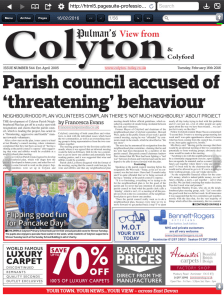
THE development of Colyton Parish Neighbourhood Plan has got off to a rocky start with resignations and claims that the parish council, which is leading the project, has acted in a “threatening, aggressive and hostile” manner towards volunteers.

After a slow start on the plan, issues came to a head at last Monday’s council meeting, where volunteers complained that they had been accused of “having a shindig at the parish council’s expense” after suggesting that wine and nibbles would be available at a neighbourhood plan meeting.

Last year, Colyton Parish Council agreed to develop a neighbourhood plan, which will shape how the parish is developed in future years, and asked for volunteers to come forward to work on the project. Separate committees were set up in Colyton and Colyford, consisting of both councillors and volunteers, to deal with the individual issues which faced the two communities, as well as an overarching steering group to bring representatives from the two committees together.

The steering group met for the first time earlier this month, where it was agreed that an informal meeting would be held on February 24th for the two committees to get to know one another and potentially form working parties, and it was suggested that wine and nibbles would be available.

Parish clerk Liz Berry disagreed with the format of the meeting, saying that the council could not pay for wine and nibbles and that any neighbourhood plan meeting should follow official guidelines, which resulted in a number of emails being circulated between the clerk and volunteers.

Former Mayor of Colyford and chairman of the neighbourhood plan’s Colyford committee, Howard West, spoke in the public forum of last week’s parish council meeting, saying he was “offended” by comments made in the emails, which he described as “the last straw”.

The next day he announced his resignation from the neighbourhood plan committee, claiming that he and his wife had been threatened by a member of the parish council. But parish council chairman Andrew Parr claimed that Mr West had been fighting a “turf war” between Colyton and Colyford and said he now hoped to be able to move forward with the plan.

Frustrating

Speaking at the parish council meeting before his resignation, Mr West said: “Today, as far as I’m concerned, was the last straw. I have had 13 emails today and I’m quite offended that we’re being accused of having a ‘shindig’ at the parish council’s expense.

“It is so frustrating; everything we’re trying to do for the neighbourhood plan is for the good of the parish and we never had any intention of asking the parish council to fund what the parish clerk calls a ‘shindig’, which is isn’t, it’s a meeting of all the people involved in the two committees of the neighbourhood plan to get to know one another.

“Does the parish council really want us to do a neighbourhood plan, because every time we try to move forward we get pushed back a step? I’ve spent nearly all day today trying to deal with this problem and it’s not just me, a lot of other people are quite upset about the way we have been treated… we can’t just let it carry on like this.”

Fellow Colyford resident Diane Nason commented: “I second that. I went to a steering group meeting last week and I was quite apprehensive about it because what has been coming from the council has, it seems to me, been quite aggressive, hostile.”

Mrs Berry said: “Having got the message that there would be an informal meeting of the two committees potentially to form working groups, obviously decisions would be made at the meeting.

“Anything to do with the neighbourhood plan has to be a community engagement exercise, open to public, have an agenda, be minuted, and as a council we can’t fund a get together where there’s wine and nibbles, and I’ve been told by the chairman that the public would not be allowed to go to it. It’s not a meeting to form working groups, you can’t make decisions.

“As the responsible financial officer for the council’s money, which is indeed public money, we can’t fund a shindig, a party, a get together – call it what you like. We can fund a meeting that makes decisions. You don’t need wine and peanuts.”

Councillor Huntley Evans, who sits on the neighbourhood plan steering group, said: “Let’s not undo the good work that we did last week. In all innocence it was suggested that the two committees get together, mostly with the idea that, for the vast majority of things which affect this community, the two committees would be able to work as one.

“I propose that we carry on with our meeting of the two committees; we don’t need wine or nibbles, perhaps we’ll have a cup of tea or cake, and we’ll carry on as planned.”

Mrs Berry asked if the meeting would be open to the public. Councillor Evans said it would be, and that an agenda could be published in advance.

“That’s the way I suggest we go forward and diffuse this rather unnecessary spat,” he added.

Mr West added: “That’s exactly what it was all about but all these emails that were flying around today were totally uncalled for.”

Mrs Nason commented: “It’s not just today, it’s been the same for some time. There are other people involved in neighbourhood plans in other areas and they’re very happy groups but I have to say, if this is a neighbourhood plan there’s not been very much neighbourly about it. I’m getting quite upset about it.”

Later in the meeting Councillor Evans gave a full report on the steering group meeting held earlier this month. Members made no further comments on the matter, prompting Councillor Paul Dean to ask if the council was going to address concerns raised during the public forum.

“What’s the council’s views on what has been said? People are upset and we either need to allay their fears or not. We can’t just say, ‘OK, they’ve said their piece and we’re not even going to listen, discuss it or anything’,” he said.

Mrs Berry then explained the situation again, adding that there was “no way” that public money could be spent on drinks and nibbles. She said that after questioning the meeting she received a “flurry of emails” saying it was just a “get to know you” event.

“Working in working groups you’ll get to know each other,” she continued.
“If you’re having a meeting it has to be properly advertised, it has to have an agenda and minutes. If you’re going to make decisions then it all has to be open and transparent, open to the public.”

Councillor Evans said he would ensure that the meeting on February 24th was publicised.

Speaking to Pulman’s View later that week, Mr West announced that he was resigning from the neighbourhood plan committee and standing down from “involvement in all Colyford village affairs”. He reported that he and his wife Anne had been “accused of splitting the village in two”, had received verbal threats from a parish councillor, and another member of the Colyford committee had received similar threats and had also since resigned.

In his letter of resignation, Mr West said: “After attending the Colyton Parish Council meeting last night, and making an impassioned plea in public question time for the parish council to let us all get on with the neighbourhood plan, I came away totally demoralised and feeling intimidated by the parish council once more.

Mr West went on to explain the situation regarding the planned “social get together” and expressed disappointment that Councillor Evans was “forced to concede that it would not be a social evening”.

He added: “Councillor Evans cannot and should not be allowed or encouraged to arbitrarily alter what was agreed at the steering group meeting. This can only be democratically done at the next steering group meeting. “I therefore feel that there is no further point in me continuing as your elected chairman, and I resign with immediate effect. The treatment yesterday was in addition to the verbal threats given to my wife Anne and I a few weeks ago by a councillor. This has been followed by a resignation of a member of our Colyford neighbourhood plan ommittee, who has received similar threats also from a councillor.

“The continuous intimation from the parish council, its parish clerk and some councillors is totally unnecessary and should stop immediately. I do feel that I have let you all down, but enough is enough, let someone else have a go.

“I will now stand down from involvement in all Colyford village affairs and leave it to others, especially as Anne and I are accused of splitting the village of Colyford in two! Those who are against what we are trying to achieve have won. Let them get on with it! We have worked hard over the last 10 years or so with the sole aim of improving things in Colyford and the surrounding area.”

SAVE CLYST ST MARY – FEBRUARY UPDATE

“Apologies for the length of this update. There have recently been a number of significant developments with regard to planning applications of which we feel you should be aware. You are therefore strongly urged to read the whole document.

As always, thank you for your continued support; we remain committed to protecting Clyst St Mary from inappropriate developments.

1. Local Plan

The most significant event since the last update has been the formal adoption of the Local Plan by EDDC. In theory this should protect the village from further large scale development other than the 150 houses on the brown field areas of the former Friends Provident site.

At the meeting of the Parish Council on 8th February, which was attended by members of our Campaign Group, Councillor Howe gave a very warm and upbeat welcome to the Plan and emphasised that it would give EDDC the clout it needed to prevent inappropriate development of green field sites. He also said that the Planning Committee had already refused several planning applications in East Devon on the basis they were not in accordance with the Plan.

We hope that this robust approach will be sustained when the planning applications for the Friends Provident site are eventually scrutinised by the Planning Committee. We are very fortunate that our District Councillor lives in the village and has been such a strong supporter of our Campaign against inappropriate development over the past 12 months. We are particularly grateful for his input to the draft of the Local Plan last March which resulted in the house numbers for the Friends Provident site being reduced from some around 300 to 150.

Within the Plan we have our own map! This clearly shows the playing fields of the Friends Provident site and the Plymouth Brethren field as remaining green and where building will not be permitted.

Interestingly it also shows the areas that become flooded when Grindle Brook bursts the banks, as it has several times this winter. You can view the map in the online version of this update on our website http://www.saveclyststmary.org.uk

2. Future of the Friends Provident Playing Fields

The Save Clyst St Mary Campaign Group has consistently taken a robust line that the green areas in and around Clyst House should remain green and, as already mentioned, we have been successful by having this included in the Local Plan.

We do not see it as being in our remit to get involved in deciding what these green spaces would be used for in future or how they should be administered. We feel this is a matter for the Parish Council. Our assumption and hope has always been that the existing sports pitches would remain and continue to be used by local sports teams to the benefit of the village and wider community.

At the Public Meeting held at the Village Hall on 16th November we listened with interest as Mr Peter Cain, who has a role in the administration of Clyst Valley Football Club, outlined his vision for the future of the sports fields. Our understanding that he has consulted with various sports related bodies and the agents for the Friends Provident Site.

We are also aware that the Parish Council has formed a Sport and Recreation Committee which will eventually be responsible for the administration of the sports fields and hold the land in some form of trusteeship.

Mr Cain also made some suggestions regards agreeing the release of some parts of the green field for house building in order to give something back to Friends Provident for allowing the sports pitches to remain as such. This is something we would strongly oppose because it would be against the Local Plan.

At the Parish Council Meeting on 8th February further details of these plans came to light and these are now causing us concern.

The Parish Council have been briefed by a representative of the agents, JLL, about a plan to build around 100-150 extra houses on the Plymouth Brethren field and in a line running from the Brethren field eastwards towards Clyst House.

The Parish Council has been sounded out by JLL about the possibility of a three way land swap. This would involve swapping the current Clyst Valley Football field for a new pitch on the Friends Site. The Plymouth Brethren land would swopped be for the Clyst Valley Football Pitch. An application would then be made to build a Plymouth Brethren meeting hall and large car park on the pitch.

These are proposals in principle and until a formal application is submitted the Parish Council cannot comment.

At this time we do not know the exact status of the football field land beyond that it is held in some sort of trust and from hearsay that it may have been given to the football club and/or village many years ago. If you can help us in any way with more information please get in touch.

It was confirmed at the Parish Council meeting by Councillor Howe that the trustees of the Football Club had agreed in principle with JLL to a land swap.

Obviously this is very disturbing news because it runs contrary to the aims of our Campaign Group, the Local Plan and the soon to adopted Neighbourhood Plan. We must now await the submission of fresh planning applications by JLL and the Plymouth Brethren. In the meantime we will keep you updated on further developments by email and on the website at http://www.saveclyststmary.org.uk.

When and if appropriate we will ask the Parish Council to call another Public Meeting in the Village Hall.

Over the past 12 months we have, with your invaluable support, achieved a great deal. Providing we stick together as residents and remain strong we will succeed in blocking further appropriate development from whatever quarter. As a village we are now in a far stronger position with the full backing of a Local Plan and very soon the Neighbourhood Plan.

3. Neighbourhood Plan

This is currently in the final consultation phase and is expected to be published in May. Once in place this will provide a further level of protection against the onslaught of the property developers. It can be seen at http://www.planning.bishopsclyst.co.uk/

For those that would prefer to look at a printed copy, it can be seen, until 1st March, at the following locations:

Cat & Fiddle Inn
Clyst St Mary Church
Clyst St Mary Post Office (Mills)
Clyst St Mary School
Clyst St Mary Village Hall
Half Moon Inn
Sowton Church
Sowton Village.

4. Foul smell coming from the Digester (pink ‘bubble’ situated in Oil Mill Lane)

Should you smell a strong odour which you believe is coming from the digester, remember that this needs to be reported to the Environmental Agency on an individual basis (they will not accept a group complaint). It is simple to do this: telephone (free) 0800 80 70 60.

5. Traffic Action Group
(distributed on behalf of the Parish Council)
As a member of our Parish Council, I am aware that there are any number of concerns relating to traffic, speeding, and general pedestrian and driver safety within the village and around the Parish.

One thing has become very apparent when pursuing any traffic related issue. Because Devon Highways are so cash strapped, and from experience difficult to communicate with, it has been suggested that a Traffic Action Group be formed.

If you have an issue you wish to raise, then so far as Devon Highways go, they require documented evidence of any problems. Therefore we are looking to local residents to write in to the Parish Council together with any photographic evidence highlighting their concerns.

It is no good grumbling to neighbours, or in the pub or shop, or even to your PC. Written documentation is what is needed, sent to your PC, so it can be collated and prioritised before approaching Devon Highways. As with so many local government departments, the more letters and pieces of evidence presented to them, the more likely they will take notice.
This is especially so if a safety issue plays an important role in any given concern. But it must be supported by as many individual missives as can be got together.

Therefore your Parish Council is encouraging you all to put pen to paper, or fingers to E-mail: bishopsclyst@gmail.com .If any of you wish to participate in helping to run an Action group you would be most welcome. You would not have to be a Parish Councillor as the group would gather information to present to the PC.

It seems that in the present climate of local and central government austerity, local lobbying as I have described is becoming an essential way of getting things done within a community like ours.

6. Flood insurance survey
(letter distributed on behalf of the Parish Council)
Dear Supporter

Please help Flood Re with research about the cost of flood insurance

The cost of flood insurance is high on the news agenda again following the flood damage caused by Storms Desmond, Eva and Frank. It is only two years since the previous significant flood event in the UK and experts predict that the risk of flooding is set to increase even further.

A new scheme called Flood Re has been set up by the insurance industry with the support of the Government to help those struggling to find affordable home insurance and will launch in April 2016.

In order to better understand what impact the new scheme will have, it is important for Flood Re to measure the availability and cost of home insurance now and then compare this with data collected after the launch in April.

National Flood Forum would like you to contribute to this research by taking part in an online survey. This study is being carried out by Consumer Intelligence http://www.consumerintelligence.com on behalf of Flood Re http://www.floodre.co.uk . It should take less than 10 minutes of your time to complete and as a thank you for helping Flood Re with this vital work, Consumer Intelligence will send you £5 via email to a registered PayPal account or if you prefer, they will donate £5 on your behalf to the National Flood Forum.

What do you need to do?

Simply complete the online response via the link below. Flood Re will use this information to obtain home insurance quotations at four points during 2016 and 2017. Your details will not be used for any other purpose without prior consent. https://consumerintelligence.fluidsurveys.com/s/flood_research/

National Flood Forum hopes that enough people will participate in the research to demonstrate how effective Flood Re is at making household insurance available to households in flood risk areas and that this can be used to shape and develop the scheme in the future.

N.B. There are still a few places left on the FloodRe roundtable discussions notably Reading (18th Feb), Wrexham (22nd Feb), York (25th Feb) and Gloucester (3rd March) for further details please contact Laura Furman on laura.furman@floodre.co.uk.

Neighbourhood Plan Roadshow

‘DEVON NEIGHBOURHOOD PLAN ROADSHOW’
On
Friday 18th March 2016, 10am-2pm
At
The Refectory Room, Hannahs (formerly Seale-Hayne Agricultural College), Howton lane, Newton Abbot, Devon TQ12 6NQ

‘The Government is absolutely clear, they want you to build more & develop more & they want it to be easier for you’.
Richard McCarthy, director general for neighbourhoods, DCLG June 2011

What are Neighbourhood Plans?
What impact do they have on you & your community?
How can you have your say?

Speakers & Agenda:
Penny Mills: CPRE Devon – Welcome & introduction
Jonathan Green: Dept of Communities & Local Government – ‘Neighbourhood Plans’
Planning officer: Teignbridge DC – ‘Neighbourhood Plans – What is the Local Authority
involvement?’
Q & A

Coffee Break

Carole Box: Chair, CPRE Torbay. ‘The Challenges’
David Watts: Chair of Paignton Neighbourhood Plan – ‘The experience so far of producing a
Neighbourhood Plan for an area of 43,000 people.’
Geoff Melbourne: ‘Strategic Environment Assessment and The Habitat Directive-The practical implications of compliance for community volunteers’
Q & A
Martin Parkes: Devon Communities Together
Conclusion

To reserve a place..

RSVP: Penny Mills, CPRE Devon. Tel: 01392 966737 email: secretary@cpredevon.org.uk
Free admission Refreshments available
http://www.cpredevon.org.uk
Registered Charity no: 245317

Thanks to South Devon Watch Facebook page for info

Clyst St Mary: Neighbourhood Plan meetings

Neighbourhood Plan
The Neighbour Plan which will protect the village itself is now in its final pre-submission Consultation phase (16 Jan – 1 March 2016). A copy of the draft Plan can be found on the Bishops Clyst Planning website at: http://www.planning.bishopsclyst.co.uk or you can go along to one of the open sessions as listed below:

– Clyst St Mary Village Hall Saturday 6th February 1pm-6pm
– Sowton Village Hall Saturday 13th February 1pm-6pm
– Cat and Fiddle Inn Wednesday 10th February 10am – 1pm

Important case law on relationship of developers, local plans and neighbourhood plans

Chichester District Council has successfully defended a judicial review challenge to a neighbourhood plan.

The claimant in Crownhall Estates Ltd, R (on the application of) v Chichester District Council & Ors [2016] EWHC 73 had been promoting the development of 25 dwellings on a site in Loxwood, West Sussex. However, its application for planning permission for the site had been refused.
A referendum on the Loxwood Neighbourhood Plan (LNP), which did not include Crownhall’s site for potential housing, was held on 24 July 2014 and 97.7% of those voting, voted in favour.

The district council (CDC) therefore became obliged under the Planning and Compulsory Purchase Act 2004 to make the LNP.

In July 2014 Crownhall brought its first claim for judicial review. The following October the High Court made a consent order quashing CDC’s decision to hold the referendum and also the subsequent referendum on the grounds that the Environmental Assessment of Plans and Programmes Regulations 2004 had not been complied with.

In particular the district council accepted that the process for making a screening decision that Strategic Environmental Assessment (“SEA”) was not required for the LNP had been unlawful.

Subsequently, a lawful screening process was carried out by CDC which determined that SEA was not required for the neighbourhood plan. Crownhall did not raise any legal challenge to that decision.

Between 23 October and 4 December 2014 a fresh round of public consultation took a place on a resubmitted draft of the neighbourhood plan. Twenty representations were made, some supporting the LNP in its entirety. Crownhall made representations objecting that the LNP had not identified its site for housing.

On 25 February 2015 an examiner sent her report on the examination of the re-submitted LNP to the district council. She recommended that, subject to modifications set out in the report, the LNP satisfied the “basic conditions” and should proceed to a referendum. CDC agreed and therefore came under a duty once again to hold a local referendum.

Crownhall issued a second application for judicial review on 20 April 2015. On 5 June 2015 Mr Justice Dove granted Crownhall permission to apply for judicial review on all grounds save for a challenge to the earlier reliance upon delegated authority.

On 25 June 2015 the local referendum on the re-submitted LNP was held. On this occasion 98.5% of those voting, voted in favour of the making of the neighbourhood plan.

In the meantime on 8 June 2015 Crownhall had issued its third proceedings for judicial review challenging the decision in April 2015 to hold the referendum and seeking an order to quash that decision.

On 14 July 2015, the same day as it adopted the local plan, CDC also made the Loxwood Neighbourhood Plan under section 38(4) of the PCPA 2004.
Crownhall sought to have the legal proceedings stayed until March 2016, by which time it was expected that the Communities Secretary’s decision on the developer’s appeal against refusal of planning permission would be known.
Both Chichester and Loxwood Parish Council objected to the company’s application. A deputy master refused the application and so Mr Justice Holgate heard the case over two days in November 2015.

Crownhall, which wanted its site to be allocated as an additional housing site in the neighbourhood plan, raised the following grounds of challenge:

The examiner and Chichester District Council failed to consider whether, in accordance with the basic condition in paragraph 8(2)(a) of schedule 4B to Town & Country Planning Act 1990, it was appropriate to make the LNP, having regard to national policies and advice contained in guidance issued by SSCLG. In particular the examiner and the CDC failed to consider whether it was appropriate for the LNP to allocate land for more than 60 new dwellings in Loxwood;

The examiner and CDC gave no adequate or intelligible reasons for concluding that the LNP should allocate land for only 60 new dwellings;

The examiner and CDC erred in law: (a) by considering that the local Plan treats small windfalls (i.e. non-allocated sites for less than 6 dwellings) as being included within the indicative figure of 60 dwellings for Loxwood; 
(b) by failing to deal with the claimant’s representation that the LNP fails to allow windfalls for 6 or more dwellings to be approved on non-allocated sites;


The scoring system used to select sites for allocation in the LNP was legally flawed, because (a) it had regard to an immaterial consideration, namely whether a site fell inside or outside the proposed revision of the settlement boundary for Loxwood, and (b) the treatment of the Nursery site as “previously developed land” involved a misreading of the definition of such land contained in the NPPF.

But Mr Justice Holgate concluded that all the grounds of challenge failed and that Crownhall’s applications for judicial review must be dismissed.
On grounds 1 and 2, the judge found that:

Reviewing the examiner’s reasoning fairly and as a whole it was self-evident why she considered it appropriate for the LNP to be made without increasing the plan’s allocation of housing beyond a minimum of 60 dwellings in aggregate at the Farm Place and Nursery sites under polices 4 and 5. She had accepted the district council’s case as to why there was no need for any additional allocation to be made in Loxwood at the time of considering the LNP.

There was nothing unlawful in the examiner or CDC proceeding on the basis that (i) the LNP allocated sufficient land to satisfy the draft local plan provision for Loxwood, (ii) criticisms of that provision were a matter for the local plan process, (iii) in any event the OAN (objectively assessed housing requirement) figures were not disaggregated to Loxwood Parish or to any other sub-area of the district and (iv) the claimant did not put forward any need figures for the parish in the examination.

The examiner (and hence CDC) discharged their respective obligations to give reasons.

Mr Justice Holgate rejected Crownhall’s third ground. “Even if there were to be a tension between the LNP and the local plan as regards larger windfall sites, contrary to the conclusion I have reached, that would not cause the LNP to fail to meet the requirement for general conformity with the strategic policies of the local plan,” he added.

On the fourth ground of challenge, in relation to the scoring system, Mr Justice Holgate said he saw “some force” in the criticisms made.
“For the purposes of this challenge I will assume that the corrections should have been made so as to result in the revised scores set out……,” he said.

“Nonetheless, the real question is whether this line of argument provides a basis for vitiating the conclusions drawn in the Examiner’s report and the decisions taken by CDC to put the LNP to a local referendum and to make the plan. I have reached the firm conclusion that it does not.”

The High Court judge added that ground 4 must fail, given that (a) the claimant’s sole objective had been to secure the modification of the LNP by adding the Crownhall site as a third housing allocation and (b) that case was rejected by the examiner and CDC for reasons which were freestanding and could not be impugned.

“The criticisms of the URS scoring exercise did not give rise to any material legal error in the process leading to the making of the LNP,” he said.

http://localgovernmentlawyer.co.uk/index.php?option=com_content&view=article&id=25766:district-council-defeats-judicial-review-challenge-over-neighbourhood-plan&catid=63&Itemid=31