“Tory MP bills taxpayer for megaphone he hired to blast cuts made by his OWN party”

“A wealthy Tory MP claimed £45 for a megaphone to lead a march protesting against NHS cuts.

The Sunday Mirror can reveal Conservative Jonathan Djanogly billed the taxpayer for the item which he rented ahead of a rally to save his local hospital.

Yesterday we sent a reporter to his constituency where locals branded him a hypocrite.

One said: “The hospital was under threat because his party is attacking the NHS. He’s been acting the hero, but this shows he’s just as bad as the rest of them.

“He probably could have borrowed one for free.”

Local Labour chairman Dr Nik Johnson said: “We’ve been wondering whether we are going to be asked to pay some money towards it too, as I was also asked to speak at the march.

“It was handed round various speakers, so we don’t know if we owe something for it or not.”

http://www.mirror.co.uk/news/uk-news/tory-mp-bills-taxpayer-megaphone-10185579

“NHS in ‘Mexican standoff’ with locums due to new tax rules”

The press release below is not well constructed. It gives the impression that self- employed people in the NHS are refusing to work because they are being forced to have tax deducted by the NHS.

It is rather more complex. Indeed, the NHS WILL deduct taxes BUT the contractors will NOT gain any benefits of being a direct employee – i.e. no sick pay, pension contributions or holiday entitlements.

They will be treated as employees for tax purposes but not as employees for any other purposes. They will have the obligations of employees, but not the rights.

-New tax regulations for off-payroll staff come into force on Thursday
-Some locums and temporary staff are refusing to work at NHS trusts

-Trusts face “Hobson’s choice” over locums’ pay demands, says finance director

-Medical director says NHS “must hold the line” on pay cap

The NHS is in a “Mexican standoff” with locum doctors, agency nurses and private contractors, with some threatening not to work when new tax rules come into force this week; some locum doctors are demanding uplifts of more than 50 per cent in their pay as NHS trusts take on responsibility for paying their tax and national insurance from Thursday, under new IR35 regulations from HM Revenue and Customs.

-In one example of the problems facing the NHS, IT contractors walked away from working on a multimillion pound project at Guy’s and St Thomas’ Foundation Trust rather than accept the new rules.

-At Blackpool Teaching Hospitals FT, 14 locums are refusing to show up for work on Thursday. This was revealed in an email to trust consultants, appealing for help to fill gaps. One consultant described the situation as a “disaster”. The trust had not responded.

-In other trusts, substantive staff are being asked to work extra shifts.

Trusts have cancelled non-mandatory training time, consultant supporting professional activities time and have suspended secondments so staff can work on wards.

Some trusts have prepared processes used during last year’s junior doctors’ strike to respond to any significant staffing shortfalls.

The IR35 regulations apply to any temporary staff being paid through a personal service company and could reduce income for temporary staff by more than 20 per cent.

One NHS finance director said: “It is akin to a Mexican standoff. Some locums have been asking for between 30 and 50 per cent price uplifts. More than likely we will have to pay this; it is a Hobson’s choice.”

NHS Improvement said it was working with trusts to resist any demand for higher pay because of the new rules and added it would work with NHS trusts to try and tackle the culture that led to locums charging high rates.
Some trusts have longstanding relationships with locum doctors and agency nurses to maintain staffing in key specialties such as emergency departments, intensive care and medicine.

An email to a trust director at a hospital in the South West, said three locums were putting pressure on the trust to increase pay by more than 56 per cent.

The email said: “All three have advised their agency that they will only be working with us if a pay rate of £95 is agreed, meaning the total charge would be £100 per hour. They were all previously on total charge rates between £64 and £69.”

An FT medical director at a different trust said: “We have had some locums who have joined our substantive staff, some have agreed the lower rates but some have said they are taking a two week holiday at the start of April and will see how it plays out before making a decision.”

They added: “Some individuals and agencies are playing games. Locums will play trusts off against each other and some of these people are quite prepared to travel long distances. The first two weeks in April will be crucial. If the NHS can hold the line, then we might see a change in the market.

“But if one trust breaks the cap for one doctor in one ward then it will fail. We need to all hold the line on this.”

At Guy’s and St Thomas’, 35 contractors working on a £16m IT project to update the trust’s Windows XP system left the project last month.

A trust spokesman said they left because of the IR35 regulations and efforts by the trust to replace their contracts with permanent staff. He said the trust was under a legal duty to comply with IR35 rules and provided the contractors with “clarity” about this. “It was then a matter of personal choice if contractors left the trust as a result of these changes,” he added.

Chris Hopson, chief executive of NHS Providers, said: “A number of our members have reported that some contractors are seeking to put pressure on them to pay more or interpret the rules more generously than they should be. This is a concern as every trust wants to guarantee safe care at a time of workforce shortages…

“The law is the law. As we have seen with issues such as agency rates that when the whole sector acts collectively it can be more effective. There could well be immediate impacts on rotas, which means that NHS Improvement needs to stand ready to support trusts to overcome these.”

An NHS Improvement spokeswoman said: “We’re absolutely clear that the NHS shouldn’t be picking up the tax liability or costs for individual agency staff – that’s not fair or right for patients and goes against the grain of what we know many nurses and doctors believe in. Any trusts that see locums increasing costs in this way should talk to us and we will support them to resist this.”

She said the regulator was offering trusts direct support including sourcing staff from other local providers to work shifts. She added: “We are working with medical directors and agencies to try and tackle the culture that’s behind locums charging high rates and bring about longer term improvement.”

Source:
http://www.hapia2013.org/

Midweek Herald front page – crack down on boy racers; page 16 NHS protests

Well, best be pleased the NHS protests get half a page on page 16 when the perennial problem of boy racers grabs the headlines:

and Otter Nurseries offering £10,000 to fight for a judicial review of bed closures only rates a third of a page on page 19!

Stop the Sustainability and Transformation Plans website

http://www.stopthestps.org.uk

In addition there is a parliamentary inquiry into STPs which is taking submissions NOW until Tuesday 9 May 2017- full details here:

http://www.parliament.uk/business/committees/committees-a-z/commons-select/health-committee/news-parliament-20151/sustainability-transformation-plans-launch-16-17/

NHS (Property Services) threatens GPs with closure

Coming soon to a GPs surgery near you. Not if it is coming but when it is coming. Well, all that “care at home money” has to come from somewhere so why not the GPs – who will be caring for you at home. Anyone see the flaw here? Owl wonders: will it be possible to get shares in NHS Property Services – it’s booming! It will obviously moving into housing development on those empty sites – can we taxpayers cash in? No? That’s not fair is it.

“Dozens of GP surgeries across the country are threatened with closure after the NHS increased its property service charges by up to 1,000%.

Hundreds of surgeries that rent premises from the NHS have been hit by the increased charges. Practices say they may have to close or else cut back on nurses and doctors. Some surgeries that have refused to pay the invoices have been sent letters threatening legal action and the use of debt collection agencies. The demands are being made by NHS Property Services (NHSPS).

NHSPS is a limited company owned by the Department of Health. It is headed by Elaine Hewitt, a former BT executive, who was paid more than £265,000 in 2015-16, including a bonus of more than £65,000. The organisation, which has a £3.5bn property portfolio and covers about 10% of the NHS estate in England, took over the property management of about 1,400 GP practices when primary care trusts were abolished in 2013.

Practices facing demands of up to £100,000 in extra maintenance costs complain that the charges are unfair and unjustified. They also say that some of the figures have been miscalculated.

“We can’t pass on these costs to the customer — the only way for us to sustain ourselves is to cut services,” said Gaurav Gupta, a GP who is part of a British Medical Association team disputing the charges, formed after doctors started disputing the increased fees; it is overseen by the British Medical Association (BMA), the doctors’ union.

“This is an NHS body trying to run NHS practices out of business. It’s complete madness — it should never have got to this stage.”

NHSPS says it has increased what were traditionally low service charges to reflect more accurately the maintenance costs at practices. GP practices have their rents reimbursed by the NHS, but pay service charges out of their own budgets.

GPs say the increases have been introduced too fast and many of the charges have been “plucked out of the air”.

Among the hardest hit is Shepperton Medical Practice in Surrey, which is facing about a 1,000% rise. It has been billed an extra £100,000 in backdated service charges, more than 11 times last year’s costs, with another £100,000 charge to follow next year.

The surgery said it might be forced to close if the bill was not reduced.
“They’ve increased the service charges out of all proportion to what they’re actually providing,” said Simon Bellamy, a GP at Shepperton. “They appear to have stuck a finger in the air and come up with a sum, basically. If we have to pay all of that money then the practice won’t be viable — we won’t be able to provide the service any longer.”

Bellamy added that 19 of the 48 practices in his area were facing similar charges from NHSPS. NHSPS said the bill sent to Shepperton was incorrect and it was meeting the GPs to discuss the fees.

Kent Mullis, 70, from Leigh-on-Sea in Essex, is a patient who has been campaigning against the charges. His local practice, Valkyrie Surgery, closed one of its premises in September, partly blaming the NHSPS which had increased its bill by thousands of pounds.

NHSPS now says the figures were incorrect, according to the practice.
Mullis said the charges were disgraceful. “I can’t understand why one part of the NHS is ripping off another part of the NHS,” he said.

Evergreen Practice in Bracknell, Berkshire, had service charges increased by 320% from £14,976 in 2015-16 to £62,916 this financial year. This included annual management fees which rose from £1,127 to £43,000.

Prash Nelli, a GP at Evergreen, said: “If this carries on we will have to shut down. And I don’t think other practices can survive either.”

Faversham Medical Practice in Kent says its service charge bill rose from £15,000 in 2014-15 to £60,000 in 2015-16 and then to £80,000 in 2016-17.
These included an increase in maintenance fees from £2,600 two years ago to £40,991 this year and an increase in electricity and gas charges from £5,000 to £12,000 over the same period.

Ian Hume, head of GP premises for the BMA, said: “NHSPS needs to reconsider urgently any charges it intends to levy if these are going to threaten the ability of that practice to deliver patient care.”

Surgeries standing up to their NHS landlord may face legal action. NHSPS threatened one GP surgery with “immediate referral to an external debt recovery agency” and “possible commencement of legal proceedings” if it did not pay up in seven days.

“This is a national issue affecting almost every GP practice which occupies NHSPS property,” said Victoria Armstrong, a partner at Sintons Law, a Newcastle-based firm helping practices to dispute the bills. “There is no real basis in most cases for the increased charges. Our advice is: don’t pay the increase. It would financially cripple practices.”

She said one practice with four partner GPs had received a backdated demand for £100,000. Some GPs had been sent the wrong invoices, while others had been charged extra for gardening and cleaning already covered by their rent.
NHSPS says it is increasing the service charges to reflect maintenance costs more accurately but is keen to address GPs’ concerns. It said: “We have been getting better information about the space our customers actually occupy and this is one reason why some are seeing costs increase and others reduce.

“We want to explain any increases fully and make our bills more understandable. We know we’ve got some way to go on this but we are making improvements. Every penny we generate is reinvested back into the NHS.”

Source: Sunday Times (paywall)

Ottery Hospital’s “red line” led by DCC Councillor Claire Wright

Holding the Red Line at Ottery Hospital

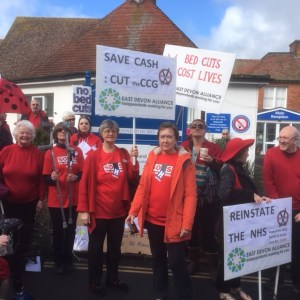
“Ottery St Mary people (and from wider afield turned out in force this afternoon to hold the Red Line against any further risk to our hospital and its very building.

We were one of 13 such events across Devon – all residents involved are fighting for their own local hospitals.

Thank you to around 150 determined people who turned up in the pouring rain.

Ottery Hospital lost its general medical beds in 2015 and the stroke unit will transfer to the RD&E imminently.

The message from the CCG was that it would become a health hub. Then it was it “could” become a health hub, nowadays there are little or no assurances from the CCG as to the hospital’s future.

And the wolf is peering in the window…. NHS Property Services has acquired the building for free (and 11 others across Eastern Devon) and is charging commercial rent to a cash-strapped local NHS, who previously owned it!

I am personally disappointed that we were asked to move twice by staff (presumably acting from orders on high) on the basis we were causing an obstruction. Yet I had already cleared our event with Ottery’s senior GP, Dr Simon Kerr who was quite happy about us being there.

Of course we would have moved if a car or ambulance had arrived. One vehicle did during the course of the 45 minutes or so we were present and people moved accordingly.

I felt sorry for police community support officer, Maria Clapp who was having to enforce us moving around as many people, understandably, were not happy about it!

Aside from these frustrating interruptions and my speech getting soggy in the rain and then getting stuck to my foot, it was a great event and thoroughly enjoyable.

I was using my brand new megaphone, which was great fun!

The thing that always happens at these sort of protest events is that a sense of solidarity, energy, shared purpose and iron is created. NO ONE will take any more services away from Ottery Hospital, NOR will it be sold off to the highest bidder by NHS Property Services.

I think we all went away feeling absolutely determined that we will do everything we can to prevent this from happening.

Thank you to EDDC Cllr Peter Faithfull for these excellent photos and thank you to retired Ottery GP, Dr Graham Ward, who urged people to come forward with ideas for the use of the building into the future.

Here’s the call to action at the end of my speech…

1. Write to Hugo Swire MP asking that he takes up Ottery’s case with the CCG and the govt

2. Write to local newspapers – letter for publication to Ottery Herald and Pulmans View From

3. Write to CCG – Chair is Tim Burke

4. Write to chair of DCC health and wellbeing scrutiny cttee after May elections

5. IMPORTANT POINT – Make all your letters public by sending to local press for publication!

Ottery Hospital is OURS. While the beds have gone for now. I live in hope that one day that common sense will prevail and they will be returned one day.”

Until that day we must fight to retain our hospital.”

http://www.claire-wright.org/index.php/post/holding_the_red_line_at_ottery_hospital

Sidmouth “red line” Save our Hospitals pics – Tory councillors conspicuous by their absence

Spot the Independent East Devon Alliance councillors: easy
Spot Tory councillors – impossible!

“Local authorities launch legal action over plans to downgrade hospital”

Owl says: could you EVER see EDDC doing this? NEVER – while Diviani is in charge.

“A group of local authorities have launched a judicial review challenge over what they described as a “confusing and flawed” consultation process on plans to downgrade services at a local hospital.

The challenge over Oxfordshire Clinical Commissioning Group’s plans for Banbury’s Horton General Hospital is being led by Cherwell District Council.
South Northamptonshire Council, Stratford-on-Avon District Council and Banbury Town Council are acting as co-claimants. The legal action is also being supported by the Keep the Horton General campaign group.

The OCCG’s proposed changes affect services including maternity, critical care and hospital bed use.

The consultation covers five key proposals which include taking all of the most serious critical care patients and all stroke cases directly to Oxford.
It also proposes changing the way hospital beds are used and permanently closing almost 200 beds between the Horton and Oxford hospitals.

Cherwell said that a key aspect of the changes would involve changes to the maternity unit and replacing a consultant-led service with only midwives. “This would mean there would be no doctors or opportunity for epidural relief which means 90% of mothers will have to travel to Oxford or other hospitals.”

The only proposal which would increase availability at the Horton would relate to planned care services, it argued. These would be welcomed with the right investment, the council said.

Ian Davies, interim joint chief executive of Cherwell and South Northamptonshire Councils, said: “Oxfordshire Clinical Commissioning Group has carried out a two-phase consultation into plans to downgrade key services at the Horton General Hospital. This approach has proved incredibly confusing and those who will be most affected by any changes – namely the residents of Banbury and surrounding areas – are still unsure as to exactly what is happening to their local hospital.

“For over two months we have struggled to help local people understand the implications of what is being consulted on and we have tried to answer the real concerns of real people. But there is still widespread confusion. We know the Horton General Hospital is a very valued and accessible hospital to people in north Oxfordshire, south Northamptonshire and parts of the Stratford district who regard it as their ‘local’ hospital of choice.
“These proposals have significant and permanent implications for future access to local services. Therefore we consider it entirely unacceptable that the OCCG is trying to move ahead with plans which have not been fully understood by those who will suffer the consequences.”

Cherwell said that a decision on whether it would receive permission to bring the judicial review challenge was expected next month.”

http://localgovernmentlawyer.co.uk/index.php?option=com_content&view=article&id=30617%3Alocal-authorities-launch-legal-action-over-plans-to-downgrade-hospital&catid=174&Itemid=99

This is what our NHS taxes pay for … and trying to bamboozle us with

“NHS managers diagnosed with a rampant case of jargon

The NHS is riddled with jargon and gobbledygook and may even be using impenetrable language on purpose to hide plans from the public, the Plain English Campaign has warned.

“Sustainability and transformation plans” (STPs) that divide England into 44 “footprints” and make promises such as “system-wide quality improvements” as a consequence of “shared understanding of all the interrelated issues” was one example highlighted by the campaign. Steve Jenner, its spokesman, said: “If you use impenetrable language it means the public has no clue what is going on. I can’t help thinking that suits the NHS sometimes.

“What this jargon is describing is very important. It should be articulated very clearly. We expect doctors to clearly explain themselves. It should be the same for the NHS management.”

Health service bosses have been told to draw up STPs for their areas to show how they can save money and improve services. Many of the plans involve hospital or service closures and have drawn widespread opposition. But despite the importance of STPs, some officials have started referring to them as “sticky toffee puddings”, the BBC reported.

The campaign said that jargon terms were “an inevitable sign of trouble” and that references to “reconfiguring” were “suitably vague enough to hide all manner of potential changes”.

It added: “We all know what it means when think tank representatives and planners talk above, over and behind the backs of those whose lives they are meddling with.

“Simply put, it’s to keep those that might have concerns and justifiable complaints out of a debate. In this case, that’s completely unacceptable.”
Last year, NHS England ordered hospitals to stop referring to being at “red alert” or “black alert” as a result of winter pressures.

Instead, hospitals that were so busy that they had to cancel non-emergency operations, call in extra staff and divert ambulances — previously a black alert — were at “operational pressures escalation level four”.

The level down — formerly a red alert — is now “operational pressures escalation level three”.

Source: Times (paywall)

“NHS bosses ‘spent half of extra Autumn Statement cash on outside services’ “

“About half of a £2bn cash boost from the 2014 Autumn Statement for frontline health services in England was spent outside the NHS, research has found.

The Health Foundation analysis for the Financial Times showed £901m was spent on buying services from private and non-NHS providers in 2015/16.
It said £800m was spent buying the same kind of care from NHS trusts.

The government said it showed the NHS was “making clinical judgments about delivering high-quality care.

Ex-chancellor George Osborne said in his final Autumn Statement before the 2015 general election that the money for NHS England was a “down payment” on a plan drawn up by NHS bosses, which called for an extra £8bn a year above inflation by 2020.

‘Diverted’ patients

The Health Foundation report also found that £1 in every £8 of local commissioner’s budgets in England is spent on care provided by non-NHS organisations.

Anita Charlesworth, director of research and economics at the Health Foundation, said: “Rising demand for emergency care meant that NHS providers haven’t had the capacity to deliver planned care and patients had to be diverted outside the NHS.

“NHS hospitals were left squeezed by sharply rising drug and staff costs with little additional funding.

“The result was big deficits that had to be covered by raids on investment budgets.”

She said the NHS had to “urgently” consider how to ensure additional funds reach NHS providers.

“The health service needs to plan better for emergency demand, fund emergency care fairly and make sure it gets the best possible price for care provided outside the NHS,” she said.

The Department of Health said it spends less than 10% of its budget on independent providers.

A spokesman said: “This report simply shows the NHS is making clinical judgments about delivering high-quality care for patients.

“The truth is that for many years the independent sector has made a contribution to helping the NHS meet demand, now amounting to less than eight pence in every pound the NHS spends.”

http://www.bbc.co.uk/news/health-39401540

Surprise! Government says one thing and does exactly the opposite – this time rural pharmacies

“Ministers are planning to allow hundreds of rural chemists to close across the country despite repeated assurances to MPs this would not happen, The Telegraph can disclose.

In private letters to Theresa May, last August Philip Hammond and Jeremy Hunt warned that pharmacies would have to close because of the cut in a subsidy worth hundreds of millions of pounds a year to the hard-pressed pharmacies.

The Cabinet ministers’ warnings appear to be at odds with ministers’ repeated public claims in Parliament and in official documents that no closures are likely.

They also appear to confirm that Mrs May is concerned about the plans and had to seek reassurances from Mr Hammond, the Chancellor, and Mr Hunt, the Health secretary.

Campaigners said the letters amounted to a “smoking gun” which laid bare the Government’s indifference to saving rural pharmacies. …

… According to letters disclosed in a High Court challenge to the plans, and seen by The Telegraph, Mr Hammond and Mr Hunt warned that the cut will result in the closure of pharmacies.

Mr Hunt told Mrs May on August 2 the cut would mean that “500-900 pharmacies will close”, in a letter that was copied to Mr Hammond.

Mr Hunt said: “We cannot know exactly how individual pharmacies will be affected by the funding reductions and there is a risk that some pharmacies may close as a result of these changes, although this has never been our objective.”

Mr Hammond went further in a second letter on August 11, telling Mrs May he supported the subsidy cut to what he described as an “inefficient and over-subsidised market” to move chemists “away away from the traditional bricks-and-mortar business model”.

He told the Prime Minister: “Longer-term I would like the community pharmacy market to follow trends we have witnessed in other retail markets.

“This might include a shift away from the traditional bricks-and-mortar business model towards scaled-up, innovative supply solutions employing digital technology, where Government expenditure is minimised.”

The Government announced revised plans in October that increased the number of chemists that can access a special fund from 900 to 1,300, only half as many as the up to 900 that Mr Hunt expected to close.

Weeks later Pharmacies minister David Mowat told MPs three times that no closures were likely. He told MPs on October 17: “We do not believe that community pharmacies will necessarily close as a result of these cuts.”

The department’s own impact assessment was based on a scenario “a scenario where no pharmacy closes” as a result of the cut.

Labour’s shadow health secretary Jonathan Ashworth said Mr Hunt should explain to MPs “why he was saying one thing to the Prime Minister while Mr Mowat was telling the House of Commons something different”.

He said: “Someone in Government needs to get a grip and clarify the future of these hundreds of community pharmacies, the staff who work in them, and the patients who depend upon their services.” …”

http://www.telegraph.co.uk/news/2017/03/26/exclusive-philip-hammond-jeremy-hunt-tell-theresa-may-secret/

More “Red Line” round our hospitals info – Saturday 1 April

http://www.devonlive.com/devon-hospital-closures-red-line-protest-planned-across-the-county/story-30227709-detail/story.html

“Looming countryside health crisis as stoic elderly ‘won’t make a fuss’ “

“A crisis in countryside health care could be looming because of the number of older patients who are reluctant to “make a fuss” and seek out help, a new report suggests.

The Public Health England study warns that one in six areas with the worst levels of health and deprivation are in rural areas, with “pockets of real hardship” in areas assumed to be idylls.

Almost half of rural households are at least five miles away from a hospital, when 97 per cent of those living in cities have one close at hand. And 20 per cent were more than 2.5 miles from a GP surgery, compared with 2 per cent of those in urban areas.

“Rural areas have worse access in terms of distance to health, public health and care services,” the report says. “Longer distances to GPs, dentists, hospitals and other health facilities mean that rural residents can experience ‘distance decay’ where service use decreases with increasing distance”.

The report, written jointly with the Local Government Association, says councils are under increasing pressure as they attempt to meet the needs of an ageing rural population.

On average those living in rural areas are five years older than those living in cities.

Councillor Izzi Seccombe, Chairman of the LGA’s Community Wellbeing Board, said:

“We often think of rural areas as picture-postcard scenes of rolling green fields and farming land, yet this idyllic image is masking pockets of deprivation and poor health.

The stoic nature of some countryside dwellers could fuel pressures on services, because some were prone to put up with health complaints until they became serious, she suggested.

“The make do attitude and reluctance to make a fuss of some older rural residents means they may not seek out health care or treatment when they need it. This stores up worse problems for later on where they require far more serious and emergency care.”

Duncan Selbie, chief executive of PHE said the report “busts the myth that poverty, deprivation and ill health are confined to urban, inner city areas.”

http://newscdn.newsrep.net/h5/nrshare.html

Honiton Hospital allegedly being measured up for closing off – nurses not informed

This report comes from Honiton and is on the “Save Our Hospital Services” Facebook page:

“Last night the steering group for Honiton met for our weekly catch up in the Star in Honiton and invited the nurses from the hospital to join us after for a drink and chat to find out how they were and what news that they had.

“After a few tears, they proceeded to tell us that last week, someone from the CCG along with other people turned up and started to measure the areas in the ward that they want to have boarded up when the ward closes. They did this in full view of the nurses and staff as well as the patients (the ward is full at present with mostly medical cases, not bed blockers).

“They also told us that so far not one nurse has been spoken to regarding retraining, change of job, what happens when they close the ward etc.

“There has been no mention of the maternity unit that depends on the ward nurses during the night.

“THIS IS DISGRACEFUL BEHAVIOUR.

“We feel that after 1st April it will do no good to have street parties, red lines or whatever. We have to continually and totally bombard our MP’s, Councillors (sorry for those already on this list) the well being and scrutiny committee and anyone else that will listen who might have some say.”

Honiton/Ottery/Seaton: Red Lines around community hospitals on 1 April

“HEALTH campaigners say “you can’t fool us” as they prepare for a dramatic Devon-wide demonstration on April 1 against plans to reorganise health services in Devon. Save Our Hospital Services activists plan to form a red line of people around hospitals in Ilfracombe, Bideford, South Molton, Barnstaple, Exeter Honiton, Ottery St Mary, Seaton and Torbay.

Demonstrators are opposing the Devon Sustainability and Transformation Plan (STP), a plan to reduce the area’s NHS deficit, which will be more than £550m by 2020/21. In North Devon for example the Northern Devon Healthcare Trust is using a consultation to decide on the future of acute health services at North Devon District Hospital. …”

Red Lines at hospitals across Devon on April 1:

Honiton – Activists will assemble at St Paul’s on the High Street before marching to the hospital, EX14 1EY, at 11am.

Ottery St Mary – Activists will gather outside the Ottery St Mary Hospital, EX11 8ER, at 2pm.

Seaton – Demonstrators will gather outside Seaton Hospital at 10am.

http://www.devonlive.com/protesters-to-put-red-lines-around-hospitals-across-devon/story-30217902-detail/story.html

Closing community hospitals – local GP speaks truth to power

“Dr Jon Orrell, A LOCAL GP has warned residents to not be “fooled by the warm words” in the Dorset Clinical Commissioning Group’s (CCG) current consultation.

Dr Jon Orrell attended a meeting in Bridport last week along with Wendy Savage – a gynaecologist and campaigner of women’s rights in childbirth and fertility – and Claudia Sorin of Save SCBU, Maternity and Kingfisher at Dorset County Hospital.

Dr Orrell discussed the CCG, of which he was previously a member, and said the group don’t take their views from the public.

He said: “The CCG is the local organisation which has been tasked in making all these cuts palatable and trying to sell them. You will be told it is clinically driven, you will be told that it is an improvement and there is no alternative.

“The CCG is headed by local doctors, however it is compulsory, I can’t carry on being a GP practising in Dorset unless I am a member of the CCG.

“It is very much hierarchical… we don’t take our views from the public, it is top down and a culture of agreement – I have experienced this first hand.”

He also warned residents to look deeper in the Clinical Services Review document and to be careful when filling it out.

He added: “Throughout the document you will see ‘care in the community’ popping up and ‘care closer to home’ as if that is necessarily a good thing. It is all playing with words in my opinion.

“If you rename ‘care in the community’ to ‘neglect and anonymity’ you have got it closer to the truth.

“Looking after people properly costs a lot of money and you need more doctors, nurses and healthcare assistants to do it.

“Care in the community would be great if you did it to the same high standards and done properly as in hospitals, but they don’t and it is just a couple of hours a day, half-an-hour, and is not necessarily a nurse, it could be a healthcare assistant who is not trained – it is not the same.

“If you look at the document it all looks very bright and smiley – everyone is happy by this change. However, you get down to the detail and small print and you find the truth emerging – this isn’t improvement, this isn’t making things better, this is Dorset’s share of £22billion worth of national savings.

“Be careful with the consultation, it looks like they are putting [forward] something good, if you tick ‘yes’ to any of the boxes you are voting to close local services without realising it, you will close community hospitals and GP surgeries.

“The final word of warning – don’t be fooled by the warm words, the motherhood and apple pie in the document; look a bit deeper.

“Absolutely fill it in and get your family and friends to fill it in as our NHS depends on this.”

Wendy Savage spoke to the audience about threats to the NHS nationally, including Sustainability and Transformation Plans (STPs) which outline how NHS trusts will make savings, and urged residents to talk to their local MPs and councillors about protecting the future of health care.

She said: “The latest threat are these STPs, or what we call slash, trash and privatise. Slash the funding, trash the local services and privatise.

“We have got to make sure parliamentary candidates as well as sitting MPs know that not supporting the NHS is the kiss of death.”

Claudia Sorin highlighted some of the concerns that members of the Save SCBU, Maternity and Kingfisher ward at Dorset County Hospital have and how safety could be compromised if services were moved to the east of the county.

She said: “Various families with seriously ill children or children with disabilities will have their provision at home in the community.

“When I spoke to one of the CCG members who is in charge of children services and maternity, she said ‘yes, that is the case’ – they will be given a package of money and they will be given that funding and they will organise it themselves in their own homes.

“That is the integrated community model; closing down beds in hospitals, closing down the children’s ward and maternity unit and that will be a midwife led unit only.

“Some of the mums on the campaign have open access to the children’s ward.

“That takes pressure off the emergency services, takes the pressure off the GPs because they can go straight to the Kingfisher Ward where the staff there know their child and can quickly give them the vital treatment that they need. This is something that is going to be lost if Kingfisher closes.

“The parents of these children have spoken to consultants there, the nursing staff, and all of them, on the whole, think that it would not be safe for a lot of the treatments that their children are coming in to the hospital for to have at home.

“The idea that maternity services and the children’s ward should be over in the east of the county, consultants at DCH are saying that would be complete madness.

“So this is the message we are getting from DCH – it would compromise safety to have those services over on the east of the county.”

A spokesperson for Dorset CCG said: “The proposals that have been developed by local clinicians and are subject to public consultation have been well documented over the last few months.

“We want to be absolutely clear that no decisions have been made, nor will they be until after the public consultation has ended and the feedback analysed.

“We invite anyone who attended either the drop-in event in January or the recent meeting in Bridport to get in touch if they would like more information or clarification before they complete their questionnaire.

“It is important that you don’t miss out on your opportunity to have a say and you complete the questionnaire by February 28th.

“Whether you agree with the proposals or not or you maybe have an idea of how things could be done differently – if you don’t tell us what you think, we won’t have heard your point of view.”

https://www.viewnews.co.uk/gp-warning-ccg-consultation/

Rural health concerns

“The government must improve the way it collates information on the health of people who live in rural areas, according to the Local Government Association and Public Health England.

One sixth of areas with the worst health and deprivation levels are located in the countryside, says the organisations said in a joint study released over the weekend.

Izzi Seccombe, chair of the LGA’s community wellbeing board, said: “We often think of rural areas as picture-postcard scenes of rolling green fields and farming land, yet this idyllic image is masking pockets of deprivation and poor health.

“Although many rural areas are affluent, this is not the case for everywhere.”

The report points out 55% of rural households compared to 97% of urban ones are within 8km of a hospital. Eighty per cent of rural residents live within 4km of a GP surgery compared to 98% of the urban population, Health in rural areas highlights.

Rural areas have on average 23.5% of their population over 65 compared with 16.3% of urban areas aged over 65.

“Rural communities are increasingly older, and older people often experience worse health and have greater need of health and care services,” said Seccombe.

“We are also concerned that the make do attitude and reluctance to make a fuss of some older rural residents means they may not seek out health care or treatment when they need it.”

This stores up worse problems later on, she explained, when they will need more serious and emergency care.

Councils could better plan how to provide services and meet the needs of people in rural areas if the government collated better information on health of people in these areas, the LGA and Public Health England believe.

Duncan Selbie, chief executive of Public Health England, said: “Local authorities are already finding new and imaginative ways of reaching out to people in remote communities who so often go unnoticed.

“This report offers a number of great examples that other areas can use to ensure they do not miss out on the opportunity for better health and wellbeing.”

http://www.publicfinance.co.uk/news/2017/03/lga-and-public-health-england-highlight-rural-health-concerns