GP slams secret health cuts

” … “The GP profession (alongside nurses, paramedics and so many others in the NHS) is struggling to recruit and retain its workforce – perhaps this has been the reason why we have not been asked to come to the table. We are imploding from workload and burnout. Shifting work into the community is already happening without an increased workforce and there’s no plan to increase dwindling GP numbers.

These plans are setting alarm bells ringing. Involving frontline staff or the public in any meaningful way is likely to pose delays for their implementation. And as NHS England states in its own guidance, due to financial challenges “we do not have the luxury of waiting until perfect plans are in place”. Certainly it could be argued that STP boards are trying to make the best out of the must-do mantras, rigid financial control and timescales stipulated by NHS England.

The greatest danger of STPs is that they become the focus not of improvement or innovation but of cost-cutting
Can there be any room for transformation at a time when many of the STP organisations are experiencing significant financial deficits? Can we moderate demand, promote self-care, roll out seven-day access, improve cancer and other health outcomes, reduce hospital and emergency nursing home occupancy and balance the books? The greatest danger of STPs is that they become the focus not of improvement or innovation but of cost-cutting: moving bottle-necks of demand from one setting to another and leading to poorer health.

Ultimately the level of NHS deficit will dictate how achievable these STPs become. In the end it seems that NHS England is asking local organisations to deliver a sugar-coated pill that may look ambitious and futuristic, but will nevertheless still be bitter to swallow.

https://www.theguardian.com/society/2016/dec/06/secret-plans-to-transform-nhs-zara-aziz

NHH hospital and bed cuts public meeting Sidmouth Parish Church Friday 7.30 pm

Chris East via 38 Degrees:

“I hope that some of you managed to get to the amazing “see red” rally in Exeter Princess Hay last Saturday.

This message gives notice of a public meeting this coming Friday in Sidmouth Parish church at 7.30 pm.

The “Your Future Care” consultation ends on 6 January. Please come to this local meeting and learn how it is not just a matter of proposed Sidmouth hospital bed cuts, or even just bed cuts, but cuts to many different NHS services in Devon wide, hidden under different project names, aimed at confusing us.

You can download a meeting leaflet from out East Devon campaign web site:

http://www.one-name.name/protect-east-devon-hospitals-campaign.html
Please spread notice of this meeting among your friends and neighbours.

Thanks

Chris East

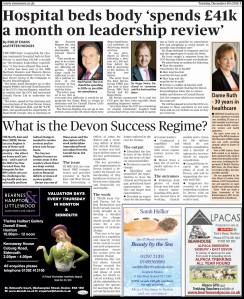
Local NHS – where our money goes – “leadership review” costs £41,000 per MONTH

80aa4a4d-c25c-4f2c-8fc5-7cb7f1be109b-2012-000001718f4e8194_tmp

THE NHS body responsible for closing community hospital beds in East Devon is spending £41,400 a month on “developing leadership capabilities,” it has been alleged this week.

A letter has been sent to the NHS Northern Eastern and Western Devon Clinical Commissioning Group by the East Devon Group of the Campaign to Protect Rural England.

The letter, dated December 1st, to Mrs Angela Pedder, the Lead Chief Executive of the CCG’s Success Regime, asked her to confirm that the CCG had instructed Carnall Farrar Ltd to undertake the work.

The letter, signed by the chairman and vice-chairman of the East Devon Group CPRE, Dr Margaret Hall, and Mr T.J.W. Hale, also questioned the impartiality of Dame Ruth Carnall, who is chairman of the Success Regime but also a director and shareholder of Carnall Farrar Ltd.

“This would appear to be a clear conflict of interest, affecting all parties, which alone could be sufficient to justify a judicial review of the outcome of this consultation,” said the letter.

The letter goes on to say that to overcome this difficulty it would be appropriate for Dame Ruth to resign as chairman and for Carnall Farrar Ltd’s contract to be terminated.

The Success Regime was set up as one of three areas in the UK where there were deep rooted financial problems in delivering health services.

It was introduced in Devon following a forecast of a £40 million deficit for 2014-15 increasing to £87 million in 2015-16 (see below).

The letter from the East Devon Group CPRE was also sent to East Devon MPs Neil Parish and Sir Hugo Swire.

Mr Parish commented: “It is vital the CCG gets the best value possible when spending taxpayers’ money.

“At a time when the CCG are consulting on closing community hospital beds across East Devon, they should be spending as little as possible on consultancy fees and ploughing as much money as possible into frontline care.”

Sir Hugo declined to comment until he had the opportunity to study the letter.

We have sought a response from the CCG but they failed to meet our deadline. We asked them to confirm the following:

  • That the monthly consultancy fee is £41,400?
  • How long has that monthly fee been paid?
  • How long will the monthly fee be paid?
  • Is there a conflict of interest with Dame Ruth Carnall chairing the Devon Success Regime when he is a shareholder and director of Carnall Farrar Ltd, the company which was awarded the contract?

We will be pleased to print the CCG’s responses to these questions in our next issue and on our website as soon as they are received.

Does anyone know what the CCG’s 30 questions are?

“…Speaking on behalf of the CCG, Budleigh Salterton-based GP Dr Rick Mejzner said: “Clinicians have developed a series of tests, building on a similar process used to support the implementation of changes in Northern Devon, which will underpin the introduction of the plan.

“This process comprises 30 key questions and scenarios which must be addressed, with supporting evidence, to measure the impact the new models of care will have across primary and secondary care settings.”

“Each of the 30 questions in this robust ‘gateway process’ must have a positive answer with evidence provided before any changes could happen. This will ensure that GPs and other clinicians have confidence in a safe implementation.”

http://www.midweekherald.co.uk/news/health_bosses_give_assurance_east_devon_hospital_beds_will_not_close_until_stringent_measures_in_place_1_4801160

Now Unison adds its voice on health care crisis

“Health reform plans being put together across England should be halted in order to allow for greater consultation on the planned changes, according to the trade union Unison.

Ahead of the publication of all 44 NHS sustainability and transformation plans, the union also called for greater staff involvement in the plans to help ensure they can be implemented and a government funding boost.

The STP areas bring together health and care leaders, organisations and communities to develop local blueprints for improved health, care and finances in regional areas known as footprints. It takes forward part of the NHS’ Five Year Forward View.

Concerns have already been raised that some plans are unrealistic and Unison said both the government and NHS England have failed to consult properly with the public and staff on these reforms, which are being pushed through too rapidly.

The union’s head of health Christina McAnea said health and social care had been ignored in the Autumn Statement at a time when both services desperately need more money.

“These new NHS plans will fail if the government doesn’t give the health service extra funds and staff are not on board,” she stated.

“Health and care organisations have had to show how they will make services less fragmented. But better integration is just wishful thinking without more funding.

“Unless more is done to reassure staff and the public the government will find it has little support for these plans.”

http://www.publicfinance.co.uk/news/2016/12/unison-calls-pause-stp-planning

DDC to debate health cuts on Thursday

Thursday 8th December 2016, 2.15 pm, County Hall

Discussion and vote on whether to halt the “Sustainability and Transformation ” process in order to investigate fair funding for the Devon rural area.

Email your DCC councillors with your views:

http://democracy.devon.gov.uk/mgMemberIndex.aspx?bcr=1

and remind them to attend and to vote in favour of motions to suspend the process.

Agenda here:
http://democracy.devon.gov.uk/ieListDocuments.aspx?CId=132&MId=195

The live webcast of the meeting will be here:
http://devoncc.public-i.tv/core/portal/webcast_interactive/244711

Recall that, when last discussed at the DCC Health Scrutiny Committee, a similar motion proposed by independent councillor Claire Wright was defeated with DCC Councillor and EDDC Leader Paul Diviani voting AGAINST her motion.

More “Future [lack of care] Care” roadshows – probably your last chance to give your views

Seaton
Friday 16 December 2016
Town Hall, 09.30 – 11.30

Sidmouth
Friday 16 December 2016
Kennaway House, 14.30 – 16.30

Exmouth
Monday 19 December 2016
All Saints Church Hall, 09.30 – 11.30

Woodbury
Wednesday 21 December 2016,
Village Hall, 09.30 – 11.30

Budleigh Salterton
Wednesday 21 December 2016
Public Hall, 13.30 – 15.30

Honiton
Thursday 22 December
The Beehive, 14.00 – 16.00

Axminster
Friday 23 December 2016
Guildhall, 13.30 – 15.30

Brexit money could go to landowners rather than NHS

Wonder why pro-Remain farmer Neil Parish supported Andrea Leadsom (pro- Brexit, now Minister of Agriculture) for PM?

“Prominent Brexit campaigners and big landowners could pocket millions in farm subsidies if Tory minister Andrea Leadsom gets her way, an investigation has found.

The Vote Leave campaign said the gross amount of money we sent to the EU, £350 million a week, could go to the NHS. But they also quietly made a series of other promises about spending that money, leaving far less for the NHS.

A Greenpeace investigation has found that prominent Brexiter said she would guaranteed the controversial single farm payment to continue at current levels, if she were elected leader. She clearly didn’t win, but she is now the new environment secretary, and in a position to guarantee millions of pounds in farm subsidies post-Brexit.

This means that supporters and donors of Vote Leave, including Lord Bamford and Sir James Dyson, could get large taxpayer-funded subsidies. Others currently benefitting from the scheme include farming minister George Eustice and vice-president of Conservatives for Britain, Viscount Ridley. Iain Duncan Smith does not benefit directly but resides on the grounds of Swanbourne Estate, owned by his parents-in-law, who received £134,309 in farm subsidies last year.

The subsidy, which forms part of the EU’s Common Agricultural Policy (CAP), has been heavily criticised in the past for transferring wealth from the general public to rich landowners, including the aristocracy and billionaires from Denmark and Dubai.

The EU subsidies were meant to support family farming across the UK, but the money largely goes to large landowners. Many of them are Tory donors. Last year £2.3 billion was doled out as part of these payments. Prominent Brexit campaigners received over £4 million in EU farm subsidies in 2015, Greenpeace found.

That would mean more broken promises on the NHS – what a surprise.”

https://politicalscrapbook.net/2016/08/leading-brexiteers-could-keep-millions-in-farm-subsidies-under-tory-pledge-instead-of-nhs/

Budleigh Salterton Health and Wellbeing Hub to Open in Spring 2017 – is this Hub the bright new future of the NHS or what is left when the wheels fall off?

A press release of 30 November press claims this regeneration of the old Cottage Hospital, and one time specialist stroke unit, is aimed at providing a population of 50,000 with:

Bringing health, social care and well-being services together, as they will be at the Budleigh Hub, is a vision of the future and what can be achieved through partnership and focusing on the needs of the local community.

It will be a centre for a wide range of services in one place and it will provide a range of social and clinical services with the focus on prevention, rehabilitation and wellbeing.

Services will include NHS outpatient clinics, day centre, gym, café alongside health and wellbeing services such as diabetes and weight management support, dementia support, exercise classes, carers support, family groups, arts and craft and music. …”

Owl thinks that how you view this might depend on whether you interpret the provision of “spinning and other classes” alongside “jigsaws, knitting and crafts” as meaning something to do with spinning yarn, spinning words or exercise bicycles.

Whichever is correct it doesn’t seem directed at relieving the acute problem of bed blocking.

EDA Councillor Cathy Gardner on BBC Spotlight talking about health crisis

Lead story:

http://www.bbc.co.uk/iplayer/episode/b083gk3j/spotlight-weekend-news-03122016

East Devon Alliance Councillor Cathy Gardner radio interview on health crisis

http://www.eastdevonalliance.org.uk/cathy-gardner/20161203/eda-councillor-continues-fight-for-local-hospital-beds-and-healthcare/

Exeter NHS Rally: East Devon Alliance well represented, no Tory councillors or MPs spotted!

East Devon Alliance:

img_1357

Spotted in the crowd (not an exhaustive list as crowd too large): East Devon Alliance councillors Marianne Rixon and Cathy Gardner (also on Spotlight and Radio Devon), Sidmouth campaigners Di Fuller and Robert Crick along with town councillor Martin Shaw of Seaton and Independent Councillor Roger Giles of Ottery St Mary.

Many people attended from Exeter, Okehampton and North Devon.

No East Devon Tory Councillors or MPs sighted at all. Nor Exeter MP Ben Bradshaw.

Hundreds protest over NHS cuts

“Protesters were seen marching in red lines from every direction along Sidwell Street, Fore Street, Queen Street, North Street, South Street, and Paris Street.

Protesters then gathered in Bedford Square where the speeches began.”

http://www.exeterexpressandecho.co.uk/hundreds-of-people-attend-protest-in-exeter-to-stop-nhs-cuts/story-29954867-detail/story.html

img_1358

It included a rousing speech by DCC councillor Claire Wright:

Health crisis: EDDC scrutiny committee grills NHS rep

01 December 2016
Scrutiny committee questions CCG representative
Councillors voice concerns over proposed East Devon in-patient bed provision within Your Future Care consultation

At a meeting on Thursday 24 November 2016, members of East Devon District Council’s Scrutiny committee listened to Rob Sainsbury, the Chief Operating Officer of the NHS North Eastern & Western Devon Clinical Commissioning Group (NHS NEW Devon CCG), give a talk about the NHS’s Your Future Care consultation.

Mr Sainsbury spoke about issues such as the financial pressure faced by the NHS, the changing way in which people are cared for, proposed models of care and the number of community inpatient beds in East Devon. He outlined the options set out in the consultation and reassured the committee that no changes to services would be made until tests created by local clinicians had been undertaken to ensure the changes are safe and reliable.

Consultation options
• Option A: Tiverton 32 beds, Seaton 24 beds, Exmouth 16 beds
• Option B: Tiverton 32 beds, Sidmouth 24 beds, Exmouth 16 beds
• Option C: Tiverton 32 beds, Seaton 24 beds, Exeter 16
• Option D: Tiverton 32 beds, Sidmouth 24 beds, Exeter 16 beds
The CCG’s preferred option is A, as this combination is considered by the CCG to result in the smallest changes in travel time and to have the greatest impact on the whole system.

Prior to councillors questioning Mr Sainsbury and debating a number of issues, the Scrutiny Chairman Councillor Roger Giles reminded the committee of recent comments made by Neil Parish MP who asked that action be taken to: “Fight all closures across East Devon.” Cllr Giles expressed a hope that the committee would adopt a unified front rather than focus on arguments between the towns where community hospitals are located.

Following a wide range of questions from councillors, which Mr Sainsbury answered, councillors voted in favour of the following comments being sent in a response from the Scrutiny committee to the NEW Devon CCG Your Future Care consultation:

1. Asks that the New Devon CCG presents an outline of how care delivery integrates health, social, and mental care, as well as physiotherapy, and how it is provided to patients

2. Consider that the comparison with Northern and Western Devon areas is unfair as the demographics were not the same as Eastern Devon

3. The committee considers that the models proposed in the consultation will not meet the needs of the District because of the local issues of social isolation, and the support that carers need

4. The NEW Devon CCG should review the expenditure on management and administration as a means to realise savings that could be used to provide care rather than divert funding from in-patient beds

5. The committee considers that the evidence presented to date by the NEW Devon CCG is not sufficient to convince them that the new model of care will be successful

6. The Committee does not accept Options A – D, but recommends that the NEW Devon CCG should retain the current level of in-patient beds in community hospitals in the Eastern Devon locality

7. Should a decision be made to close in-patients beds, the Committee insists that this is not undertaken until the replacement model of care is recognised as safe and in place; subject to the provision of evidence that the model of care has resulted in no bed blocking at acute hospitals, non occupancy of beds in community hospitals, and full care in the community

Commenting on the content and outcome of the meeting, Councillor Roger Giles said:

“The Scrutiny Committee were very far from convinced about the practicality of the CCG proposals to close beds in East Devon community hospitals and replace them with care in the community. There was also concern about the accuracy of the CCG costings used to justify closure of hospital beds. The committee felt strongly that East Devon hospitals provided an excellent and essential local service and that the existing hospital beds should be retained.”

ENDS

Devonwide NHS cuts rally Exeter 3 December midday – assembly arrangements

Dear Friends,

I wrote to you a few days ago giving you the suggested meeting places in Exeter on Saturday for those demonstrating who wished to march through the town to the area of our rally in Bedford Square, Princess Hays rather than going directly to the rally. The rally is from 12.00-14.00.

I have now been informed that at the final planning meeting it was considered that the suggested places were too many and too complicated.

So to Keep it Simple, individuals and any towns or communities that have not made their own arrangements to enter Exeter as a group could gather, at 11.30, at Bury Meadow at the Northern end of Queen Street (ten minutes walk up the hill from St Davids Station, near Exeter College) and walk south to High Street, and turn left to Bedford Square. If you do get lost, just join a group wearing red, particularly if they are waving placards!

Others may assemble as already planned, for instance, East Devon people will meet near the bus station by the civic centre on Paris Street, walk north to High Street and left to Bedford Square.

It looks as though we can expect a very active rally with some good speeches. This is not just about the hospital beds in East Devon. That is only the first of the NHS cuts planned here in Devon which are part of the NHS’s STP (Sustainable Transformation Plan). People throughout England are getting up to be counted, led and motivated to some extent by 38 Degrees who have revealed the secretive nature of this STP which will be applied in 44 areas, or footprints, in England. Cuts are also to be made in AE departments, major acute hospitals and GP surgeries.

See you on Saturday.

https://you.38degrees.org.uk/petitions/save-community-hospital-beds-in-east-devon

Thanks

Chris East

Chris East started this campaign on the 38 Degrees Campaigns by You website.

Most NHS Finance Managers don’t believe their own hype on Sustainability and Transformation plans

Finance chiefs in charge of implementing NHS sustainability and transformation plans are struggling with a “club versus country” dichotomy, according to the Healthcare Financial Management Association.

Meanwhile, 52% of trusts and 21% of clinical commissioning groups (CCGs) are forecasting a deficit in 2016/17.

These were the findings of the latest NHS Financial Temperature Check undertaken by the HFMA, which represents NHS finance directors and finance staff working in healthcare.

It draws on responses to a survey of over 200 finance directors and chief finance officers from 128 provider trusts (53%) and 72 (35%) clinical commissioning groups across England. The responses were received between 20 October to 3 November this year.

Feedback indicated that 22% of trusts and 35% of CCGs are forecasting a worse position than predicted in their financial plan for the year. The most common causes of deficits were under-achieving savings plans (61%), increased agency costs (34%) and an increase in non-pay costs (24%).

Most respondents do view the STPs as a cornerstone in plans to reduce deficits. However, an overwhelming majority also voiced concerns about the structure of the plans, with almost three-quarters (72%) concerned about their governance.

Respondents professed limited confidence in the simultaneous delivery of both STP and organisational financial objectives. Only 6% of trust finance directors and 17% of CCG finance chiefs believe they are both deliverable.

Of the finance directors that responded, 62% claimed they will prioritise organisational objectives rather than their STP objectives. On reflection, 82% believe the regulatory regime needs to change to support the delivery of the STPs, and 79% believe the financial regime needs to change too.

Moreover, only half (54%) of finance directors believe that risks associated with STPs have been recognised, and only 5% believe adequate risk management arrangements are currently in place. …

http://www.publicfinance.co.uk/news/2016/12/hfma-survey-reveals-divided-loyalties-nhs-finance-chiefs-implementing-stps

East Devon will be represented at NHS cuts rally in Exeter on Saturday 3 December

“Sidmouth campaigners will join with others across Devon to rally against hospital bed cuts in Exeter on Saturday, December 3.
Organisers are urging the public to join them in a united show of opposition to proposals under which the town could lose all of its inpatient beds.

People from East Devon will gather at 11.40am near the bus station, outside the Civic Centre in Paris Street, Exeter. The rally will take place from noon in Bedford Square, Princesshay.

Campaigner Robert Crick said Sidmouth can be proud of its leading role in the campaign.

Organisers coined the term ‘See Red Day’ to highlight the point lines should be drawn to stop essential services being cut.”

http://www.exmouthjournal.co.uk/news/sidmouth_campaigners_join_in_see_red_day_rally_against_hospital_bed_cuts_1_4791281

Sidmouth public meeting on health cuts 9 December – Swire invited

“Organisers of a public meeting to discuss proposed hospital bed cuts are calling on East Devon’s MP to join and help fight the cause.

Campaigners are inviting people from across the district to attend a gathering on Friday, December 9, from 7.30pm, in Sidmouth Parish Church, in response to plans that could see the town lose its 24-bed inpatient unit.

Several community hospital beds around the county are under threat as the Northern, Eastern and Western Devon Clinical Commissioning Group (CCG) seeks to change to a more ‘home-based model of care’ and plug a predicted £384million deficit by 2020/21.

One of the organisers, Robert Crick, has issued a call for the community to join ‘urgent talks’ and East Devon MP Sir Hugo Swire – who has raised concerns about the cuts in Parliament has been invited.

Mr Crick said the idea to mobilise individuals and groups in a public meeting was born out of dissatisfaction with the CCG’s ongoing consultation into the proposals and a feeling that asking the public to choose one of four set options does not offer people enough choice.

He is calling on residents and Sir Hugo Swire to resist the CCG’s proposals and demand the Government restores funding levels for NHS and social care.

There is also a county-wide rally planned in Exeter on Saturday, December 3. For more information, call Robert on 01395 519292.”

http://www.midweekherald.co.uk/news/urgent_public_talk_in_sidmouth_on_hospital_bed_cuts_1_4791334

New Devon CCG transformation: as transparent as a lead block

Owl recalls that claims were made that the “transformation” plans for the NHS were ordered by the government to be kept secret, and that attempts by mere mortals to get information about them through Freedom of Information requests should be actively resisted.

Well, here is proof.

A local elector made two requests for information (community hospital bed occupancy and objective evidence for the decisions made by New Devon CCG). Both of these requests have been ignored ( no reply within 20 working days) and the first noted is now 40 working days overdue – with a request for internal review of the decision also ignored. This is a necessary step that must be made before a formal complaint to the Information Commissioner.

Link to the request 20 working days overdue and not acknowledging the Internal Review request made 20 working days ago:
https://www.whatdotheyknow.com/request/community_hospital_bed_occupancy

Second needed to be answered yesterday to be in time.

This is the important one – it will be reasonable to assume that either they have no clinical evidence whatsoever, or that they are deliberately avoiding answering because the evidence they have is negative:
https://www.whatdotheyknow.com/request/objective_evidence_of_the_clinic

Owl notes that none of our MPs appear to be trying to get this information for us – it is being left to local people to try to find out for themselves.

Privatisation: some things to think about

1. Your services get worse

Private companies have a legal duty to reward their shareholders, so they have to prioritise making a profit. This means they may end up cutting corners, or underinvesting in your public services. Water companies ignore leaks instead of investing in infrastructure, while private company involvement in the NHS has been bad for patients. Private companies also have ‘commercially confidential’ contracts, so they don’t share information with others; this makes it harder for them to work in partnership to make services better.

2. Your costs go up

You pay more, both as a taxpayer and directly when you pay for public services. Value for money goes down because private companies must make a profit for their shareholders and they also pay their top executives more money. This means either we the people, or the government, or both, end up paying more. Fares on our privatised railways and buses are the most expensive in Europe, while people are also being hit with high energy bills. 57% of 140 local authorities surveyed in 2011 said they had brought outsourced public services back in-house or were considering it, with 60% saying that the main reason was the need to cut costs.

3. You can’t hold private companies accountable

If the local council runs a service, you know where to go to complain. But if a private company runs a service, they are not democratically accountable to you. That makes it harder for you to have a voice. Academy schools are less accountable to parents. Private company Atos tried to silence disability campaigners instead of responding to their concerns about work capability assessments. A report by the Institute of Government reveals problems in outsourcing public services, including a lack of transparency, manipulation of contracts by suppliers and a reluctance to sack underperforming providers.

4. Staff are undermined

If you work in public services, privatisation will make your life harder. A Europe-wide study found that privatisation has had ‘largely negative effects on employment and working conditions’. There are often job cuts and qualified staff are replaced with casual workers, who are paid less and have worse conditions. This has a knock-on effect on the service being provided – for example, in the cases of care workers or court interpreters.

5. It is risky and difficult to reverse

Once our public services are privatised, it’s often difficult for us to get them back. Not only that, we lose the pool of knowledge, skills and experience that public sector workers have acquired over many years. We also lose integration both within and across different public services. A Deloitte report finds that many large companies are bringing services in-house because of the costs, complexity and risks of outsourcing.

But wait!

Aren’t private companies supposed to be better than the public sector? Doesn’t competition reduce costs and improve quality and customer care? No, because there is often very little competition; public services tend to be natural monopolies so there isn’t much choice for consumers. Instead, government (local or national) asks private companies to bid for contracts running our services – but there’s no real opportunity for our voices to be heard.

https://weownit.org.uk/privatisation