
SEE INSIDE pages at http://www.mtapublications.co.uk/dev.html
The date for your diary is Friday 12th December: Details here: Lit and Land Sid event
Category Archives: NPPF
“Are we committing ourselves to the slums of the future?”
Those in charge of planning must be asking themselves the same question.
The Town and Country Planning Association’s annual conference raised some of the issues facing EDDC and their planning partners Exeter City and Teignbridge:
Extracted from Planning Resource:
New residential PD rights are ‘heart of darkness’ says TCPA planning chief
27 November 2014 by John Geoghegan , 1 comment
England’s planning system is in its ‘poorest state’ since it was created and needs ‘a fundamental reassessment’, the Town and Country Planning Association (TCPA)’s head of policy has said.
The TCPA’s Hugh Ellis, speaking at the association’s annual conference in London earlier this week, singled out controversial new permitted development (PD) rights easing the conversion of offices and shops into homes as the “heart of darkness”.
Talking about planning from 2015 onwards, he said: “We need to start again, because we don’t have a system that’s fit for purpose.
“We need a fundamental reassessment of planning in England.
“How can we cease to be an embarrassment in the context of Western Europe on urbanism, on sustainable transport, on design?
“The system is highly deregulated and it seems to be probably in the poorest state since 1947 when it came into being.
Ellis went on to say that “the heart of darkness is the permitted development regime”, which allows commercial premises to be converted into homes without needing planning permission.
The PD rights “unlock two fundamental tenets” of the 1947 Town and Country Planning Act, he said: the nationalisation of development rights and democratic comprehensive planning.
The development outcomes of the PD rights, he said, “are going to be very poor”, adding: “Are we committing ourselves to the slums of the future?
“Is this really what the fifth-richest country on earth wants to leave as a legacy?”
Speaking earlier, chief planner Steve Quartermain, reading a speech from planning minister Brandon Lewis, said the office-to-residential permitted development rights had “proved to be successful” and were helping to deliver new homes on brownfield land.
Calling for more ambition, Ellis said a new purpose for planning was needed so that it is “outcome-led” rather than “process-led”, with its social purpose restored.
His wishlist for the next government included a national plan and the reintroduction of the New Towns Act with 10 areas designated for new settlements. Ellis also called for and an update to the National Planning Policy Framework (NPPF) and better building standards.
Elsewhere, Chris Tinker, regeneration chairman of housebuilder Crest Nicolson, said developers faced problems dealing with neighbourhood planning and had little representation in the process.
“So you have a system of land allocation being done without the deliverer,” he said.
Tinker also said it was beyond the resources of housebuilders like Crest to deliver a garden city or large urban extension, something that would require the government to lead on.
Local and neighbourhood planning would never deliver the major housing sites of 10-15,000 homes, he added.
Other speakers, including Alice Lester, programme manager at the Planning Advisory Service (PAS), expressed support for a national spatial plan.
But shadow communities secretary Hillary Benn, speaking later, confirmed that the Labour Party had no plans to introduce such a plan if it came to power in next year’s general election.
Labour would “leave in place” the NPPF, said Benn, though it would strengthen its requirement to build homes on previously-used brownfield land.
Under a Labour government, “every community must take responsibility for meeting its own housing need”, said Benn, and would be given tools to make sure schemes granted planning condition are actually built out by developers.
“Build on those sites that have already felt the hand of man”
Martin Hesp, writing in the Western Morning News yesterday, gives a clear case for choosing brownfield sites. See http://www.facebook.com/eastdevonalliance
Leading academic says planning system letting the countryside down and may be being made ready for sell-off
” … Planning departments across the peninsula have been cut by up to half, and Prof Balch said the axe was likely to fall again. One planning officer told him she had a caseload of 91 applications, which had to be determined within eight weeks – more than two a day.
“How can you visit the site, prepare paperwork and do all the consultation?
“The changes may not be bad in principle, but you will see unintended consequences. You are probably going to see more legal challenges from a system which is running on three-quarters empty.”
Who are we doing planning for? Is it for the landowner and applicant, or is it for the community and society?”
Prof Balch said that there was some suspicion that the government was “teeing up” the planning system to be outsourced.
Prof Balch warned that decisions were likely to become more inconsistent because the government had introduced more ambiguity into the system.
“In Teignbridge virtually all the barn conversions go through on prior approval. In Wiltshire they have hardly approved any,” he said. …”
Read more: http://www.westernmorningnews.co.uk/Countryside-risk-planning-control-ditched-8216/story-24609710-detail/story.html#ixzz3JuPHdRgG
Follow us: @WMNNews on Twitter | westernmorningnews on Facebook
Teignbridge Council wants to compulsorily purchase farmer’s land to make up for development elsewhere
Teignbridge Council wants to compulsorily purchase a farmer’s land so a nearby developer can use it as “parkland” for their development which otherwise will not have the requisite green space.
The farmer does not want to sell the land to the council and, if it is compulsorily purchased, he will get only the low agricultural value and not much, much higher development land value.
http://www.torquayheraldexpress.co.uk/Campaign-save-farmer-s-land/story-24569287-detail/story.html
Another unsatisfactory ‘public consultation’ in Exmouth.
See recent entries and comments about the Marley Road planning application, on the EDA facebook page https://www.facebook.com/eastdevonalliance?hc_location=timeline
Dying supermarkets: a plague on the landscape
Big supermarkets may be dying but they leave a plague on the landscape.
Sir Simon Jenkins has written another interesting, though controversial, article in The Guardian on planning. This time on the death of the supermarket, how the High Street may evolve in the face of on-line shopping and what role the planners should play.
Here are the highlights:
“Big supermarkets are dying. ….. Some may become warehouses for online distribution centres. Most will languish as cheap stores and homelessness shelters, like the high streets they ruined. Some will be replaced by bleak, ill-sited housing estates, part of the scarred, blotched landscape that is the coalition’s most visible legacy to the British environment.”
“Planning was certainly too rigid, but non-planning is far worse. The leads and lags of a free market in land impose huge “external costs” on the community. It was clearly wrong to allow an oversupply of out-of-town sites for competitive retailing, with no thought given to the impact on city centres or on local communities in general. The anti-green waste of energy, building material and infrastructure was never considered. The gods of the market triumphed.”
“There is no mystery here. If you want to kill a town centre, offer out-of-town sites to Tesco and Sainsbury’s – and build roads to help them. Thatcher, Blair and Cameron did just this. Shoppers had “market choice” for a year or two, then saw their towns “hollow out” and collapse. ……..This is not a free market, it is a stupid market.”
“Land is Britain’s most precious resource. The point of planning is to economise its usefulness. At present, smart planning ought to be thinking ahead of the boom in online shopping. What mistakes might there be in pandering to its gargantuan appetites? What are the implications of every street jammed with home delivery lorries? What of every suburb blighted with distribution centres, supplied by giant hangars littering every motorway?”
“Markets go in cycles.
The job of planning is to even them out, not to exaggerate boom and bust. The out-of-town supermarket era has been brief, barely a quarter century old, but it has done as much damage to the countryside as it has to Britain’s urban cohesion. Its inflexible floor plates and characterless exteriors make even the ghosts of the industrial revolution look picturesque. They will blight the landscape for decades.”
“I am sure many big supermarkets will survive. The convenience ones in town are booming. The Institute of Grocery Distribution predicts they will grow by a third in the next five years. The law of futurology applies to them as to all once-doomed relics of the past, such as books, newspapers, the church, live theatre and jazz. Booms burn out, but every fashion finds its level and something of it survives.”
“I believe town and village centres will find a new role in the post-digital economy of “live experience”. Convenience itself has a value. High streets supply such personal services as coffee bars, beauty salons, tattoo parlours and gyms. After them will come market stalls, foodie counters, pop-up shops and junk vendors, the live activities of the new “smart city”.”
“The high street has no right to eternity but it can supply the framework in which a “small society” flourishes, far below the metropolitan scanner of the coalition’s big society. The high street should embody the ideal of a regulated free market. They tried to kill it, but what a mess we have made of bringing it back.”
Full article here:
http://www.theguardian.com/commentisfree/2014/nov/20/big-supermarkets-dying-plague-landscape-retail
‘Politicians are all the same, except on rural issues’…says today’s Western Morning News
WMN invites its readers to send in their comments to the newspaper, on today’s hot topic article. See 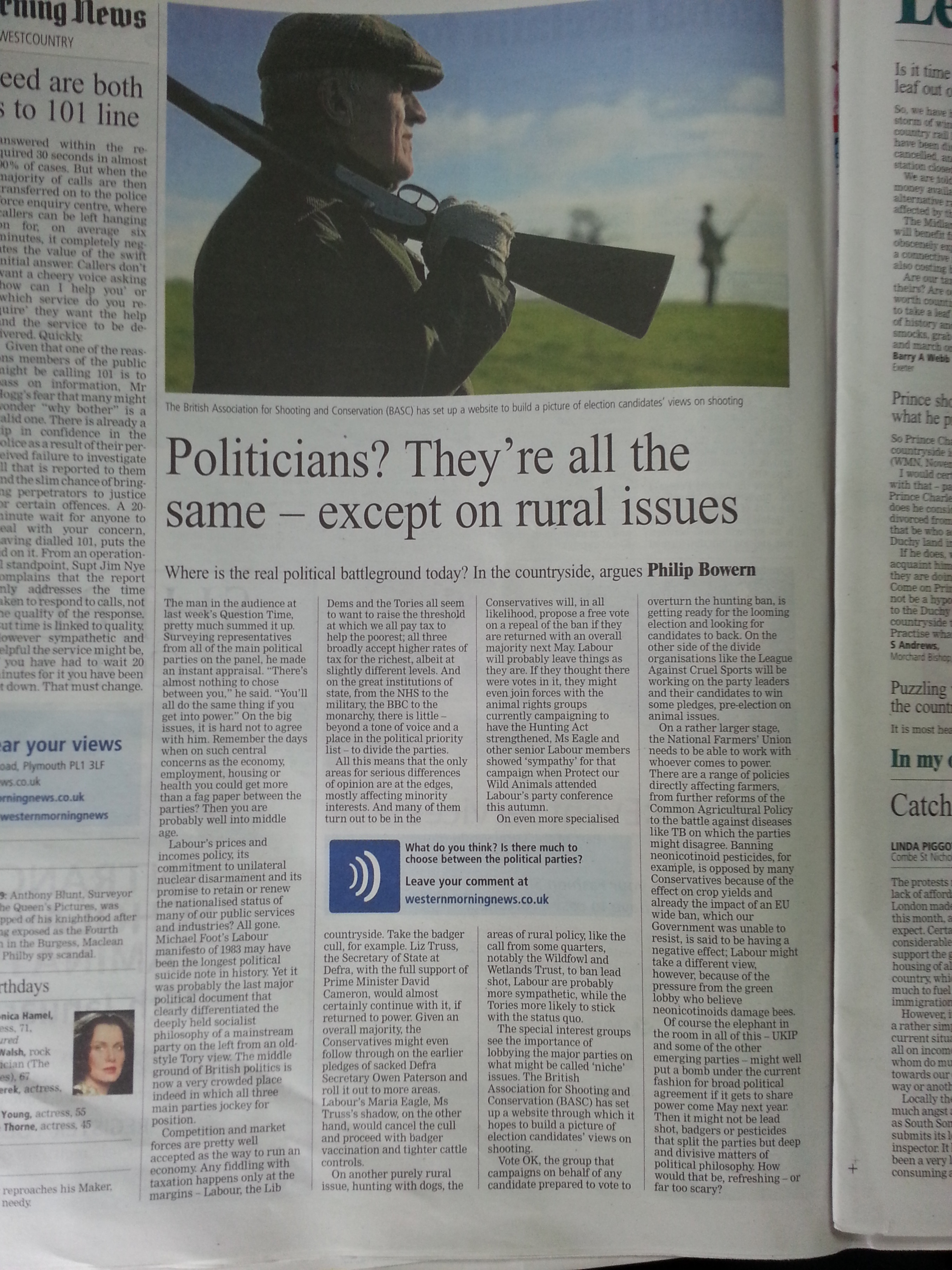
“Country Life” magazine wades into the “sustainable” development in the countryside argument
“Growth” in “non-metropolitan areas”
aka “Development in rural areas”
Needless to say, the Local Government Asdociation has its own view of localism and devolution:
http://www.local.gov.uk/documents/10180/6193395/How+the+Other+Half+Grows+(lo+res).pdf/b1556a61-b8c5-4676-8df7-e3ee3090eaef
“The arrogant and philistine are ruining our countryside”
Countryside under siege
Thought-provoking article on Western Morning News website:
“…If you love something and know it should be protected from harm, you will fight for it – preferably with others, but alone if needs be. But standing up for the countryside can be a lonely furrow to plough in a modern world where our leaders seem to have turned their backs on the nation’s once beloved green acres. …
..But if we have warned, cajoled and focused on the idea that the countryside is under attack from a government which puts short-term profit and gain above the concept of long-term sustainability, then what has puzzled me is why national newspapers and celebrity media commentators aren’t leaping on the same bandwagon. …
….Mr Jenkins [ outgoing Chairman if the National Trust] believes developers have been successful in their bid to build on the countryside, thanks to the fact that they have a “friend” in the Chancellor. If you think the former NT chairman might be deluded, then look at how many towns around the Westcountry are being encircled by new housing developments, despite the fact that communities are protesting they don’t have the infrastructure – or jobs – to support such large numbers of incomers. …
… The countryside isn’t just a pretty place – although there’s evidence to prove that being a pretty place has financial worth both in terms of tourism and wellbeing. It is a provider rather than a taker. It gives far more in the way of economic benefit than it costs. It grows the food we eat, provides the water we drink, helps clean the air we breathe and sequester the muck we shove into the atmosphere. Its worth is far more than anything politicians could hope to accrue by allowing get-rich -quick developers to convert green acres into temporary money spinning fields.”
Retiring director of National Trust slams Prime Minister
In an article in today’s Sunday Times, Sir Simon Jenkins says:
“PM ‘ has wrecked beautiful Britain’
Summary
He argues that Britain has a better record of protecting urban environments than rural ones;
“We have looked after our cities very well for decades”
“We are very good at preserving architecture. But we are now really bad at protecting the countryside and landscapes.”
Over the past year, the trust has received about 400 calls from people in towns and villages objecting to what they consider unsightly and unnecessary applications for developments on their outskirts, “Yet five years ago we used to get a handful annually,” said Jenkins.
He ends by saying: “This guerrilla warfare between developers and the countryside must be stopped.”
“Illiterate planning”
“The idea you can allow these volume estates – almost all identical – to go ahead as they wish on the grounds that they are pro-growth is illiterate planning.”
Sir Simon Jenkins, Outgoing Chair of The National Trust (quoted from his article in today’s Daily Telegraph, p.4)
Council, developers, secret meeting in the last month …..
Simply inputting into Google the search terms “council developer secret meetings uk” and reducing searches tonthe last month only brings up, amongst many other examples, these interesting results:
http://www.wigantoday.net/news/local/counciller-secretly-met-with-developers-1-6882202
http://www.westsussextoday.co.uk/news/letters/letter-secret-meetings-over-development-1-6376761
Celebrity stops development
What you can do when you are a celebrity:
or anyone else with more influence than the ordinary resident.
How many houses needed? …Feedback given to MPs
Is the present National Planning Policy Framework (NPPF) based on correct targets?
The latest comments on the Parliamentary Enquiry into the NPPF are now visible on the national Community Voice on Planning website, so please see the home page for a link. http://covop.org/ .
East Devon Alliance is of course an active participant in CoVoP.
The law of unintended consequences?
“In East Devon, the ratio of house prices to incomes is 11.2, with the average salary of £22,870 dwarfed by the average house price of £256,312. …
… In rural and coastal areas, the situation is even worse. With beauty spots commanding premium house prices and attracting wealthy second home owners, spiralling prices are forcing young people to move elsewhere.
… As more people in the region are priced out of buying a home, the number of private renters is increasing. As well as having short-term contracts that offer little stability, private renters in the South West are spending over a third (35 per cent) of their earnings on rent – the third highest rent-to-income ratio in the country.”
So, just remind us: who are we building these houses for: local people on low wages, people from outside the area with lots of money, or buy-to-let landlords cashing in?
More on “consultation” – this time in the extension to the extension of Cranbrook
The developer exhibition for the extension to the extension of Cranbrook took place at the Younghayes community centre in Cranbrook on Thursday 16 October from mid-day to 6 pm.
There was very little advance notice of the exhibition (most people heard about it only the day before on the local news) and those hours would have excluded many working people from seeing it and asking searching questions about the “suggestions” the developers have put forward about the infrastructure that MIGHT support the extra dwellings.
Surely this cannot be the only “public consultation” on these plans?
Oh, and do these new houses count towards the Local Plan unlike earlier ones? And what will be the difference between affordable housing promised and delivered?
Forget the seaside, it’s the rural vote that counts says New Statesman
Not sure our seaside towns would agree!
http://www.newstatesman.com/politics/2014/10/forget-seaside-its-rural-vote-stupid
 East Devon Watch