Rural broadband still a second-class service

Owl says: it will drag down the “doubling of growth” our LEP promised us. But perhaps they mean in urban areas only.

“There has been a marked improvement in home broadband, according to an annual survey by the UK’s communications watchdog Ofcom.

It said that average fixed-line download speeds rose by 28% over the year to 46.2 megabits per second, while uploads gained by 44% to 6.2 Mbps.

It added that the typical household now consumed 190 gigabytes of data a month, in large part due to the use of Netflix and other streamed TV services.

But rural consumers still lag behind.

Ofcom said:

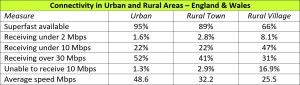
in urban areas, 59% of connections delivered average speeds topping 30 Mbps over the 20:00-22:00 peak-time period – meeting the watchdog’s definition of “superfast” – while 17% were under 10 Mbps.

but in rural areas, only 23% of connections surpassed 30 Mbps over the same hours, while 53% were under 10 Mbps.

The regulator said the primary reasons for the discrepancy were less availability and reduced take-up of cable and fibre services in the countryside.

Later this month, internet service providers will be obliged to quote average peak-time speeds in their adverts and other promotional materials, rather than the “up to” figures that have been more common.”

http://www.bbc.co.uk/news/technology-44056617

“Countryside dwellers ‘abandoned to poor coverage’ by big mobile phone companies”

“People living in the countryside have been abandoned and left in the “digital wildnerness” by big mobile phone operators, it is claimed, with the worst-hit areas getting no new masts.

A Freedom of Information request has found that in areas where signal is the poorest no new applications have been submitted for new mobile phone masts in the past three years. …”

https://www.telegraph.co.uk/politics/2018/04/07/countryside-dwellers-abandoned-poor-coverage-big-mobile-phone/

“Rural counties suffer broadband speeds three times slower than nearby cities”

“Broadband speeds in rural areas are up to three times slower than those in neighbouring cities, analysis has found.

Statistics published by the county councils network show that more than two-thirds of England’s counties are below the national average download speed of 45mbit/s.

In some places rural counties lag significantly behind neighbouring urban areas.

For example, in north Yorkshire residents have an average download speed of 30.2mbit/s, compared to York’s average speed of 102mbit/s.

The rural county of Ryedale, which includes part of the North York Moors, has average speeds of just 25.8mbit/s, less than a fifth of those experienced in the nearby city.

Rural Dorset has average speeds of 26.9mbit/s, less than half those enjoyed in neighbouring Bournemouth, of 61.2mbit/s.

The slowest broadband in Britain is in west Devon, the report adds, at just 21.8mbit/s.

Ofcom data shows that 91 per cent of homes and businesses in the UK now have access to superfast broadband, defined as 30mbits/s.

The network said that all but four of the 79 areas council areas which have speeds below this level are based in non-urban counties. …”

https://www.telegraph.co.uk/news/2018/04/06/rural-counties-suffer-broadband-speeds-three-times-slower-nearby/

£2 million unspent on broadband cannot be reallocated

“Councillors in Devon have been told that they cannot use £2m of unspent funds from a major broadband project.

External funding has been used to finish the first phase of the Connecting Devon and Somerset scheme, the largest government-funded superfast broadband programme in the UK.

However, councillors who wanted to use the extra £2m to accelerate the project have been told that it is not within the county council’s power to reallocate funds.

“Councillor Stuart Barker, Devon County Council cabinet member for economy and skills, said: “The money isn’t for us to redistribute.

“We are not the accountable authority or the contract holder, so it is not for us to redistribute that money.”

The first phase of the Connecting Devon and Somerset project has been used to install superfast broadband in homes on Exmoor and Dartmoor with other difficult areas due to be completed by next year.

http://www.bbc.co.uk/news/live/uk-england-devon-43377890

Rural extra-fast broadband grants exclude East Devon

“Thirteen areas win funding for broadband

Thirteen areas have been awarded a share of £95 million to help with the rollout of ultrafast broadband – which delivers internet speeds of up to 1GB per second – which is currently only available to three per cent of the population. The successful bidders include Manchester, London, Blackpool, Cambridgeshire, Coventry, Mid Sussex, North Yorkshire, Portsmouth and Wolverhampton.”
Source: i p10

and full list:
https://www.ispreview.co.uk/index.php/2018/03/brief-summary-13-new-uk-full-fibre-local-network-projects.html

Are EDDC Tory councillors having broadband problems?

Written Answers – Department for Digital, Culture, Media and Sport: Broadband: East Devon (26 Feb 2018)
https://www.theyworkforyou.com/wrans/?id=2018-02-07.127464.h&s=speaker%3A11265#g127464.q0

Hugo Swire: To ask the Secretary of State for Digital, Culture, Media and Sport, what estimate his Department has made of the number of homes that have access to superfast broadband in East Devon.

Written Answers – Department for Digital, Culture, Media and Sport: Broadband: East Devon (26 Feb 2018)
https://www.theyworkforyou.com/wrans/?id=2018-02-07.127464.h&s=speaker%3A11265#g127465.q1

Hugo Swire: To ask the Secretary of State for Digital, Culture, Media and Sport, what estimate his Department has made of the number of businesses that have access to superfast broadband in East Devon.

“east devon” : 1 Written Answer
===============================

Written Answers – Department for Digital, Culture, Media and Sport: Broadband: East Devon (26 Feb 2018)
https://www.theyworkforyou.com/wrans/?id=2018-02-07.127464.h&s=%22east+devon%22#g127464.r0

Margot James: According to Thinkbroadband, currently 90.02% of premises in *East Devon* can access superfast broadband. This is up from 9.4% in 2012. DCMS does not hold data on broadband coverage which distinguishes between homes and businesses.

Sunday Telegraph: “Tory manifesto pledge on broadband not-spots at risk”

“A broadband upgrade for 1.4 million rural homes is expected to be delayed by as much as three years with talks on a deal between the Government and BT’s network subsidiary Openreach close to collapse. …

… the Government will be forced to impose new regulations to give broadband customers a right to an upgrade. It means the work is likely to take much longer and that a Tory manifesto pledge to deliver the minimum standard to everyone by 2020 is under threat. …”

Source: Sunday Telegraph

Broadband outage and missed appointments compensation

Bet there will be a lot of claims from East Devon! Shame it starts only in 2019.

“Householders who receive poor service from their telecoms provider are to get automatic compensation, the regulator Ofcom has announced.
From 2019 they will get £8 a day if a fault is not fixed, paid as a refund through their bill.

This is less than the £10 that was proposed when Ofcom began its consultation earlier this year.

Providers will also have to pay £5 a day if their broadband or landline is not working on the day it was promised.

If an engineer misses an appointment, they will have to give £25 in compensation.

Ofcom has estimated as many as 2.6 million people could benefit from the new rules. …”

http://www.bbc.co.uk/news/business-41940505

BT (Won’t) Openreach

Templeton, a small village near Tiverton, showed exactly what it thinks of BTs heel-dragging on rural broadband with this effigy on its village bonfire:

BT rural broadband deal under threat

”A proposed £600m deal between the Government and BT’s network subsidiary Openreach to deliver superfast broadband to 1.4 million rural homes faces legal hurdles.

It is understood that legal advisers have raised concerns that a voluntary offer from Openreach could be challenged in the courts as unfair state support.

Talks between officials and the company are ongoing in the hope of finding a solution, but sources said discussions towards a voluntary investment by Openreach were proving “very challenging”. In some areas the upgrade would come on top of £1.2bn in subsidies that funded upgrades for easier-to-reach rural homes.

The Government has the option of imposing new regulations that would force Openreach to upgrade rural broadband lines when requested, but both sides would prefer a deal that they say would deliver quicker results. Ministers are keen for the final 5pc of homes that cannot receive a 10 megabits per second connection to be upgraded by 2022 at the latest.

New regulation would be welcomed by BT’s rivals, however, who fear that Openreach would be able to dictate the technological and financial terms of a negotiated deal. …”

https://www.theguardian.com/public-leaders-network/2017/oct/19/government-wastes-10bn-patching-up-public-services-prisons-nhs-schools

The free market – free to whom and for what? Not broadband!

“BT could face a legal challenge over proposals to spend up to £600 million connecting a million homes in rural areas with faster broadband, amid criticism that an offer it has made to government represents a “backroom deal” will tighten its monopoly grip on the sector.

Rivals including Talktalk, Sky, Hyperoptic and Gigaclear oppose BT’s proposal for a “voluntary” deal to connect every home in Britain with a minimum speed of ten megabits a second, fast enough to stream movies or browse the web.

While they support proposed upgrades to a minimum national standard, a so-called universal service obligation (USO), they support a different model to carry out and fund them.

An industry source said that several companies had taken legal advice about a potential legal challenge if the government accepted BT’s offer to make the improvements on its own and to pass on the costs to rivals.

The source said: “The law is very clear on how a USO should be delivered. BT and government can’t simply call the USO something else and hope the law doesn’t apply. If BT persuades the government to ignore the legal framework, they could face years in court. That would derail the process and leave customers waiting even longer for the fast broadband they deserve.”

Matthew Hare, chief executive of Gigaclear, a rural broadband specialist, said: “If the government were to go with BT’s voluntary deal, this would effectively stifle competition.”

He said that Gigaclear had not yet considered legal action, “but we strongly believe that a regulated universal service obligation is the only way to guarantee a competitive marketplace. Competition is vital, not only to give consumers choice and access to high-quality broadband, but also to secure the future of this country’s digital economy.”

A government consultation concluded this month, with a final decision on how to proceed likely to be made by Christmas.

Most of BT’s competitors favour a regulated model, in which all broadband operators would invest, with costs recovered from consumers via a levy on profits or another funding mechanism. BT is pressing for an alternative, under which it would make the improvements itself, with the costs of up to £600 million passed on to its wholesale customers, who protest that they would have no control over how the money was spent or the technology used.

Sharon White, chief executive of Ofcom, said that in the event of a voluntary deal, the regulator would apply a “very, very careful approach” to ensure BT would not pocket any difference.”

Source: Times (pay wall)

Rural broadband: a lesson from Canada

“Former Liberal Democrat leader Tim Farron has criticised the government for failing rural people on broadband.

Mr Farron, who is the MP for the South Lakes in Cumbria, said the average household speed in the area was just 10.9Mbps, compared to the national average of 17Mbps.

New figures from the consumer rights group Which? reveal that 1 in 4 people in Westmorland and Lonsdale have less than 4.0Mbps broadband connection.
Under the Government’s Universal Service Obligation, 10Mbps is the minimum speed that anyone in the UK would be entitled to request by 2020.

The Cumbrian MP has tabled two parliamentary questions to the government.
The questions seek to establish what progress is being made towards the Universal Service Obligation, and whether BT will face financial penalties if the targets are not met.

Mr Farron said: “The fact that one in four people in the South Lakes have a broadband connection of less than 4Mbps is frankly not good enough.
“Many small businesses in rural areas like ours are finding it impossible to function without adequate broadband. “The government’s Universal Service Obligation target of 10Mbps is nowhere near ambitious enough.”
Canada, which was a much larger and sparsely populated country than the UK, had a target of 50Mbps, said Mr Farron. “The government must put in place measures which penalise BT if they fail to meet the targets.”

A government representative is expected to respond to Mr Farron’s questions over the coming weeks.

Meanwhile, the National Infrastructure Commission has warned that urgent investment is needed in the UK’s broadband and mobile networks.
Increased broadband speeds could add £17bn to UK output by 2024, according to an NIC report.

The report says the UK’s digital economy is the largest of any G20 nation as a percentage of GDP.

But it warns that almost one in four rural premises lack a decent broadband service.

The UK lags behind other developed countries – such as the USA, Netherlands and Japan – for 4G and broadband speeds, it adds.”

http://www.rsnonline.org.uk/services/rural-mp-slams-government-on-broadband

Communications gaffe costs police equivalent of 7,800 jobs

“The £4 billion upgrade to emergency services communications is already years behind schedule, and there are growing concerns that critical elements of it cannot work.

Incredibly, the technology does not even exist to operate the new generation of radios in police helicopters, while hundreds of extra phone masts must be built before the network can be used in rural areas.

Police leaders fear these unresolved problems will push the start date for the Emergency Services Network (ESN) back again, leaving them with a huge bill for keeping the existing Airwave radio system switched on as they pay for the development of its replacement. …

… Earlier this year, the Home Office admitted the transition period would have to continue until September 2020, nine months after the expected ‘national shutdown date’ for Airwave.

But a key part of the Airwave infrastructure is due to stop working six months earlier in March 2020, in what MPs on the influential Public Accounts Committee described as a ‘potentially catastrophic blow to the ability of our emergency services to carry out their job and keep citizens safe’.

A restricted document written for the National Police Chiefs Council this summer claims it would cost ‘£403 million or 7,800 constables’ if forces had to pay for an extra year of running Airwave.

Last night, the national police lead for the project, Deputy Chief Constable Richard Morris, said: ‘The Government has a contingency plan in place and has extended all Airwave contracts to December 31, 2019.’

The Home Office said: ‘Emergency services will only transition when they are satisfied with the new network.’ “

http://www.dailymail.co.uk/news/article-4959474/Delays-police-radio-cost-salaries-8-000-PCs.html

Developers, magic money trees and (un)affordable housing

Government thinks 20% profit is acceptable for developers.

We all know that, as developers make their case to cut affordable homes on a development by development basis, and not on aggregate figures, they can make numbers tell any story.

Seems weird that, with this system, as so many developments don’t make enough money to fund affordable homes, their profits soar, their directors get bigger and bigger bonuses and their shareholders get higher and higher dividends.

It’s a magic money tree!

“The countryside is facing a shortfall of 33,000 affordable homes over the next five years despite builders making record profits at a time of rising rural homelessness.

Profits at Britain’s three biggest builders have quadrupled since 2012 to £2.2 billion, yet they regularly cite financial constraints when cutting affordable homes in developments. Builders miss targets for affordable homes in the countryside by 18 houses a day, research by the Campaign to Protect Rural England (CPRE) shows.

Profits at Barratt Developments, Britain’s biggest developer, increased almost sevenfold from £100 million in 2012 to £682 million last year. Meanwhile, the number of affordable homes fell from 23 per cent of the total built in 2012 to 17 per cent last year.

Developers use “viability studies” under planning laws to pressure local authorities into cutting the requirement for affordable homes. The reports are kept confidential, on commercial grounds, but documents seen by The Times show that officials from the Department for Communities and Local Government (DCLG) ruled that 20 per cent profit was a “reasonable” margin for a developer. They backed a builder’s attempt to cut the number of affordable homes at a development in Gloucestershire to safeguard that return.

Sajid Javid, the communities secretary, has said that failing to fix Britain’s “broken housing market . . . would be nothing less than an act of intergenerational betrayal”.

Research by the CPRE found that the government overruled councils fighting house builders in 17 out of 23 appeals since 2013. Matt Thomson, the CPRE’s head of planning, said developers had councils “over a barrel”. “The developers will say, ‘Either you give us the 20 per cent profit we need, otherwise we won’t build the houses’,” he said. “It’s just extortion at the end of the day.”

The charity analysed more than 60 local plans, which are council blueprints for new housing, and found that the average rural authority needed 68 per cent of new homes to be affordable. Affordable housing includes shared ownership schemes, council houses and properties owned by housing associations which are rented at no more than 80 per cent of the market rate.

In practice, the councils cut the official requirement to just 29 per cent affordable, on the ground that developers would never agree to 68 per cent. Even that has proven unachievable. Just 26 per cent of new homes in the countryside were classed as affordable over the past three years. The average rural authority is short of 46 affordable homes a year. Across 145 rural authorities in England that is a shortfall of 6,670 homes a year.

A separate report by the Institute for Public Policy Research found that 6,270 rural households became homeless in 2016, part of a 40 per cent rise in rough sleeping since 2010. The centre-left think thank partly blamed “shortages in affordable homes”.

Polly Neate, the head of Shelter, a charity for the homeless, said the crisis would only get worse “if we keep letting developers off the hook”.

The Home Builders Federation, which represents developers, said local authorities “should be realistic”. “Making projects unviable reduces overall housing supply, including the supply of more affordable housing,” Andrew Whitaker, its planning director, said.

Georgina Butler, head of affordable housing at Barratt, said the company was “absolutely committed to delivering the homes of all types that the country needs”.

A spokesman for the DCLG said almost 333,000 affordable homes had been built since 2010, more than 102,000 in rural local authorities.

A funding crisis in social housing will continue unless the government “breaks with the past” to provide financial backing for new affordable homes, the head of an influential housing sector body will say today.

Billions of pounds of taxpayers’ money could be saved by building social housing instead of channelling housing benefit to private landlords, David Orr, chief executive of the National Housing Federation, will tell the organisation’s annual conference.

The government decided in 2010 that no further public money would be made available to finance social housing, which provides accommodation at below-market rents to those on low incomes.

Britain needs to build about 250,000 new homes a year to cope with an existing shortage and a growing population, but only 141,000 homes were built last year.

About a million families are on the housing waiting list, said the NHF, which represents housing associations and social landlords.

In a report published today, the NHF says that the government is now spending “more than ever” on housing benefit to accommodate people in private rentals instead of cheaper social homes, which cost £21 a week less per person.

The amount of housing benefit channelled to private landlords almost doubled in the last decade to £9.1 billion.

“This is poor value for the taxpayer and has a knock-on effect on everyone struggling to rent or buy,” the NHF said.”

Source: Times (pay wall)

Transport charities may not be allowed to compete with non-existent bus routes!

The government is proposing that, if a charity such as TRIP, which provides has salaried employees or carries out services under contract it could be considered as a competitor to bus companies and might lose its licence – even if there is mo bus company doing the same thing.

Wonder which MPs have bus company shares!

“The manager of a Honiton community transport charity says a proposal to change how legislation is enforced could ‘stifle’ many of the services it offers.

Neil Hurlock, who oversees TRIP in New Street, has expressed his fears about the impact of proposed government changes detailed in a letter from the Department for Transport (DfT).

The letter revealed that the government is currently consulting on a raft of alterations to existing legislation for all groups using a Section 19 permit under the Transport Act 1985.

This permit, under which TRIP operates all of its vehicles, allows charitable and not-for-profit groups to provide transport services at a reduced cost.

But in its letter, the DfT warned that an operator whose activities mirror that of a bus company, in that it employs salaried drivers and carries out services under won contracts, cannot be regarded as carrying out its activities ‘exclusively for non-commercial purposes’.

As a result of this, the DfT added, operators can not operate any vehicles under a section 19 permit as it ‘falls outside the scope of the derogation’.

This means TRIP could be forced to consider the way it is run if it wants to carry on with any commercial work.

Mr Hurlock says if the proposed alterations are approved, the regulations could greatly increase the charity’s vehicle operating costs – potentially forcing its ‘essential’ rural transport services to be axed.

Mr Hurlock said: “This could be the kiss of death for older people who use our service.

“A lot of these people are only able to live in their homes because they can rely on us to help maintain their ability to stay there by taking them shopping and to other vital appointments.

“If our services were forced to be axed due to this legislation, it will massively impact on our users, who could be left high and dry.”

Mr Hurlock says the charity is unable to afford the extra expenditure that it would face if the legislation is passed.

He is urging the community to rally behind a national campaign to ensure that the services can continue without extra cost burdens being placed on them.

Mr Hurlock added: “Devon has already lost three important community transport providers. We want to make sure this does not happen to others.

“The DfT is holding a consultation on these proposals during the autumn and I strongly urge people who rely on our services to write to them and emphasise the importance of affordable community transport in their own words.”

A spokesman for the DfT said: “Community transport operators provide vital services that encourages growth and reduces isolation by linking people to existing transport networks, jobs, education, shops and services.

“We are committed to supporting community transport operators and have no intention to end the permits system.

“We will carry out a consultation later this year, which will set out the changes needed to the guidance on the issue and use of permits.”

http://www.midweekherald.co.uk/news/fears-that-legislation-changes-could-damage-honiton-transport-charity-1-5194867

“Health services top rural concern” but there are many other concerns too

“Rural residents are more concerned about declining healthcare services than any other issue, reveal the preliminary results of a wide-ranging survey.
Health topped the list of the topics of most concern to rural residents – ahead of public transport, rural housing and rural crime.

The survey of 1901 people was conducted on behalf of Rural England Community Interest Company by researchers from the Countryside and Community Research Institute, based at the University of Gloucestershire, and in partnership with the Rural Services Network.

The survey – believed to be the largest of its kind for many years – highlighted a range of issues with health services of most concern to respondents.

Full findings are due to be published later this autumn.

However, the preliminary ‘headline’ – summary results are being published at this year’s annual Rural Services Network Rural Conference – held at the University of Gloucestershire’s Cheltenham campus on Wednesday, 6 September.
RSN chair Cecilia Motley said: “The theme of this year’s conference is ‘The Infrastructure of Success – New Routes to Economic Growth’.

“What we mean by ‘Infrastructure’ is all those things essential to economic and community well-being.

“So we include health services and care, reliable, affordable fast speed broadband and mobile connectivity; affordable homes to meet the needs of local people; reasonable public transport; accessible training and development opportunities; good quality schools and the accessibility and affordability of all of the essential services provided by local government.
“These preliminary results are very timely to aid discussions at the conference.

“Confirmation that health – together I suspect with social care – is the main preoccupation for rural communities will surprise many people who might think other issues are more pressing, as past surveys (by others) have shown.”

“This early evidence of concern about healthcare provision comes at a time when many countryside communities face the withdrawal of vital GP services, NHS Service re-configurations and general recruitment difficulties. NHS providers are already expressing grave concerns about what they are describing as the worse winter in recent history.

“Although rural residents have other concerns – such as lack of affordable housing, poor public transport, often non-existent mobile and broadband connectivity and fears over the future of rural schools – health provision, social care and accessibility has risen sharply up the rural agenda.”

The aim of the survey was to canvass rural opinion with a view to creating, for the first time it is believed, a statistically valid representative panel of people to highlight the need for the adequate provision of rural public services and other policy issues affecting rural areas.

Largely rural shire areas score badly on some Public Health Outcomes Framework (PHOF) indicators, according to a recent report by the Rural England Community Interest Company.

This includes the provision of health checks, mental health services, access to health screening and late HIV diagnosis.

In terms of rural public transport, the survey findings come as little surprise with significant reductions in public transport services across rural areas as a result of government cuts in financial support for local government services.

And when it comes to rural housing, campaigners have long warned that high prices mean people are often unable to afford to buy their own home in the communities where they were born.

Meanwhile, a National Rural Crime Network report in 2015 warned that crime in the countryside was costing as much as £800m annually – putting further pressure on already stretched police forces.

Councillor Motley said: “There is a lot of concern among rural communities about the impact of public service cuts on services generally.

“Rural areas have always had thinner services than in other areas and funding cuts are hitting those services very hard – rural people, businesses and communities are still having a very difficult time.”

http://www.rsnonline.org.uk/services/health-services-are-top-concern-–-survey

East Devon community bed closures to be speeded up – Seaton to close next week, Honiton the week after

From the blog of Claire Wright – did Diviani and Randall-Johnson know this? Do they care?

“I have seen this SO many times.

A threat to hospital beds. Hospital beds close temporarily due to staffing shortages (because understandably staff leave) and then the permanent closures are brought forward.

What I am not reassured on here is how the loss of the existing beds will morph into the new care at home service and the message on staff redeployment is as vague as ever. Last autumn, I was told by the CCG chair, Tim Burke that around double the number of staff will be appointed… the CCG now talks in terms of ‘redeployment’ and ‘recruitment’ of 50 staff, which is difficult to get to the bottom of, given what we have already been told.

What we also still don’t know (because the CCG won’t tell us) is what happens to those hospitals that lose their beds…

Devon County Council’s health scrutiny committee needs to keep a very close eye indeed, on this issue.

The letter below has been sent to Health Scrutiny committee members:

Your Future Care

I am writing to let you know that we are ready to proceed with the changes to improve care for people across Eastern Devon as part ‘Your Future Care’.

These changes are intended to shift the focus of health and care services to keep more people well and independent at home. Part of this shift will be the redeployment and recruitment of over 50 nursing, therapy and support worker roles to enhance the existing community services in each local area. This will enable the reduction in the number of community inpatient beds across the Eastern locality of Devon.

In order to achieve this safely, we will take a phased approach – working closely with staff and partners – to implement the changes as per the following timetable:

• Seaton Community Hospital week commencing 21 August 2017
• Okehampton Community Hospital week commencing 21 August 2017
• Honiton Community Hospital week commencing 28 August 2017
• Exeter Community Hospital week commencing 4 September 2017 (this is the original closure timetable).

The provision of inpatient services at these locations will cease from these dates. All other services at these hospitals will continue as normal. Patients in these areas in medical need of a community inpatient bed will be accommodated at either Tiverton, Sidmouth or Exmouth hospitals, depending on where they live.

It has become apparent over the last couple of weeks that the schedule for the closure of the in-patient beds at Seaton, Okehampton and Honiton would need to be brought forward by a number of weeks due to the increasing pressures on safely staffing the current configuration of seven community inpatient units.

We have been preparing the comprehensive plans for each area since March 2017 and are confident that moving to the new model swiftly is in the best interests for our patients and our staff. For example, our new Community Connect out-of-hospital service, introduced this Spring, has already led to a reduction in demand for community inpatient beds.

Gateway Assurance Process

As you may be aware, part of the implementation process included a clinical assurance panel reviewing the implementation plans against a series of 30 gateway questions. These were developed to provide assurance of the RD&E’s and the wider system’s readiness to switch to the Your Future Care model.

The Gateway Assurance Panel has given its recommendation to proceed. The workforce HR consultation has been completed and staff have been informed of their new roles and working environments. We have also received the approval of the Equality and Quality Impact Assessments, which took place on the 4th August. We can now commence the redeployment of staff into our enhanced community teams and into the remaining community hospital sites. This change will provide extra capacity and resilience to meet the needs of our local population.

Your Future Care is just the beginning of the work needed to move fully to a model of care which proactively averts health crises and promotes independence and wellbeing for our population.

There is still much more to be done and we at the RD&E look forward to continuing this in partnership with you and our local communities.

Yours sincerely,

Adel Jones
Integration Director”

300,000 homes in South-West with no internet access

And EDDC plans to become an “internet based” council! Inequality? You bet.

“Almost 300,000 homes in the South West don’t have access to the Internet, it has been revealed.

Latest data from the ONS reveals the shocking numbers of offline households in the region.”

http://www.devonlive.com/this-is-how-many-south-west-homes-don-t-have-the-internet/story-30468378-detail/story.html

Mobile operator fines should be ringfenced to boost connectivity

“FINES paid by mobile operators for poor customer service or coverage should be handed over to councils to boost digital connectivity, leaders have said.

Currently, fines levied on mobile operators by regulator Ofcom for incorrectly billing customers and the poor handling of complaints go straight to the Treasury, with no guarantee it will be spent on improving the country’s digital connectivity, the Local Government Association (LGA) said.

The Government’s new Digital Economy Act, which is coming into force, will give Ofcom new powers to fine operators up to 10% of their gross revenue if they breach licensing obligations to improve mobile coverage.

The LGA is calling for the money to be handed over to local areas to support efforts to help residents and businesses access digital infrastructure. …”

http://www.express.co.uk/news/uk/825868/Mobile-phone-operators-fines-local-councils-internet-connectivity-coverage

“The state of rural services” report

Changes to rural transport provision affect access to a range of service facilities and outlets, where these are not available locally and where travel is necessary. Recent reductions to bus services are therefore of direct relevance to various topics covered by this report.

Similarly, rural access to a range of services is altering due to the provision of and take-up of online services. This has considerable scope to address long standing concerns about rural access to services, if geographic distance is no longer such a barrier. However, this is not straightforward. Not all groups are online, some rural areas await decent (broadband) connectivity and one consequence may be less used physical outlets e.g. bank branches.

The demography of rural areas and, in particular, the growing number of older people has implications for the future of services covered in this report. On the one hand it places considerable extra pressures on public services such as GP surgeries and adult social care, especially if funding for them is tight, as it has been for some years and seems likely to continue being. On the other hand older age groups are more likely to be users of locally based commercial services in rural areas, such as convenience stores, thus helping them to survive. Retired people who remain in good health are also likely to make up a good proportion of the volunteers engaged with providing community-run services. …”

https://ruralengland.org/the-state-of-rural-services-2016-report/