Exeter/Plymouth/Torbay super- mayor? Meeting in Cullompton today

“Council leaders from across south Devon are understood to be discussing plans for a “super-mayor” at a meeting today.

Leaders from Plymouth, Exeter and Torbay councils are meeting in Cullompton to discuss a bid for devolution.

It is thought that a central part of the proposal is to create a single authority stretching from Exeter to Plymouth, and including Torbay.

The authority would be run by an elected mayor.

At the South West Growth Summit in Exeter in October Sajid Javid, the Communities Secretary, told local politicians that they could forget any meaningful devolution unless they embraced the idea of an elected mayor for the whole region.

In private tweets yesterday Peter Doyle, head of external affairs for Devon County Council, wrote: “The very odd Southern Devon unitary plan will make tomorrow’s Heart of SW devolution meeting interesting to say the least.

“Hard to see any sense in breaking Devon into two unitary councils. Huge reorganisation costs, duplicates county council services, zero savings.”

http://www.plymouthherald.co.uk/plymouth-could-get-an-elected-super-mayor/story-29970966-detail/story.html#UJzDE8H1jAitmWS5.99

TWO unitary authorities? What’s left apart from North Devon? Does “Exeter” include East Devon or not? And where does the LEP fit in, if at all?

Of course, we, the council tax payers, will be the last to know!

And bet your bottom dollar the “same old” (vested interest) politicians and (vested interest) business people, same troughs, same snouts.

South devon wants breakaway mini-devolution – north Devon excluded

“Plans to unite south Devon under a single elected mayor follow a visit to the county by the Local Government Secretary Sajid Javid in October when he made it clear that only “ambitious” devolution bids including mayors would get new money and significant powers.

It cuts across an existing devolution bid covering the whole of Devon and Somerset which has already been submitted to the government.

All of the councils involved in the new proposals had signed up to the earlier bid – but there has been growing frustration at its slow progress and the refusal of the councillors leading it to accept a mayor.”

BBC Devon Live website

The item does not state which parts of South Devon this includes.

CORRECTION:

it does:

“Exeter City Council and the two unitary authorities in Plymouth and Torbay are leading the initiative which would see a new combined authority stretching from Exeter to Plymouth.”

It comes hot on the heels of a plan to create a much more official “Exeter Travel to Work Area” including Exeter, East Devon, Mid-Devon and Teignbridge. Including bringing on board unelected business people to make decisions for us, of course – none of that pesky democracy here, thank you!

Whither Devon and Somerset now? And whither North Devon and its hinterland?

Oh, oh, trouble: a mini Local Enterprise Partnership or a maxi East Devon Business Forum on its way?

Another unelected, unaccountable, non-transparent secret society on its way?

Another shady group of “private sector representatives and business community” Tories wetting their pants with the excitement of yet another trough for their snouts?

Cabinet Agenda for 14 December, 2015
Item 19
Page 147

The “Exeter Travel to Work Area (TTWA) area recommendations:

Click to access 141216combinedcabagendafinals.pdf

“It is presently proposed that the desired formal body for the Exeter TTWA will be a ‘Greater Exeter Growth and Development Board’ (GEGDB) including the local authorities covering the Greater Exeter functional economic area.

The Board would be a Joint Committee under s101 (5), 102 Local Government Act 1972 and s9EB Local Government Act 2000 and pursuant to the Local Authorities (Arrangement for the Discharge of Functions) (England) Regulations 2012.

It will comprise the 5 local authorities [Exeter, East Devon, Mid Devon, Teignbridge and DCC] as voting members

and a number of non-voting co-opted private sector /other representatives drawn from the wider business community.

This approach was agreed by Exeter City Council in principle on 8 November and is now being considered by the other potential partners.”

The great LEP scandal – part 3: Government says LEPs should investigate themselves!

“Officials should be banned from taking cash from any public bodies they run following a Daily Mail investigation, Dame Margaret Hodge declared last night.

The former chairman of the Public Accounts Committee said the law must be changed to stop board members benefiting from grants.

Her intervention came amid fury over the Daily Mail’s revelations that officials responsible for billions of pounds have been handing money to their colleagues’ firms.

The Commons Business Committee last night said it was investigating the ‘extremely serious issues’ – after the Public Accounts Committee also launched a major probe.

Officials oversaw the payments after getting places on boards called Local Enterprise Partnerships – or LEPs – which consist of business bosses and council chiefs and were put in charge of £7.3billion meant to kick-start economic growth.

Reporters found LEPs have made at least 276 payments to their own board members, their companies, or projects from which they stand to benefit. One received £1million for his call centre, while another got £13,000 of payments towards events at his family castle.

‘There is a quite clear and simple answer to all this – you outlaw it,’ Dame Margaret said last night. ‘Where you’ve got a conflict of interest, you have to choose – you either are a member of the board or you want to make money out of it.’

Last night the Government insisted LEPs should investigate any suspect payments themselves – and that this was not the Government’s job.

But MPs said this was ‘simply not good enough.’ Dame Margaret criticised the Government for failing to properly scrutinise LEP spending.

‘It is your money and my money that they are spending,’ she added.
‘When Government sets up these fragmented structures it always fails to put in place proper regulatory systems. It’s because the Government doesn’t care. What the Mail has uncovered doesn’t surprise me, what it does is depress me.’

Incredibly, there are currently no rules to prevent LEP officials from using the money they have received to award grants for their firms’ benefit, or to make decisions in secret.

LEPs have failed to account for at least £3.7billion of the cash they have been given by the Government, in their responses to Freedom of Information requests by the Mail.

The revelations are a major embarrassment for Chancellor Philip Hammond, who handed LEPs another £1.8billion in last month’s Autumn Statement. Meg Hillier, Public Accounts Committee chairman, has vowed a major probe into the payments and the ‘utterly unacceptable’ lack of transparency. She said the boards were acting like ‘a cosy little club’.

Iain Wright, chairman of the Business, Energy and Industrial Strategy committee, said last night: ‘These are extremely serious allegations. LEPs have been given stewardship of massive amounts of public money. There appears to have been some appalling failings in accountability at some LEPs. We will want to know how they are spending public money and who is checking that they are spending it responsibly.’

Tory MP Philip Hollobone represents Kettering in Northamptonshire, the county where a banker on the LEP board received nearly £13,000 for his family’s Norman castle. He added: ‘The Daily Mail has played a crucial role in bringing these issues to national attention and is providing much needed scrutiny about how this money is being spent.

‘But it shouldn’t have been up to the Daily Mail. It is clear when LEPs were set up proper systems for scrutiny were not established. I would welcome further investigations from organisations like the PAC.’

The TaxPayers’ Alliance accused Government of ‘frittering away taxpayers’ hard-earned money’. Chief executive John O’Connell added: ‘Many of these cases quite frankly do not pass the smell test.’

Downing Street insisted it was ‘for those councils and partnerships’ to investigate ‘individual allegations’. But every council contacted by the Mail over suspect LEP payments has refused to investigate them.

Many councils and LEPs share the same staff, and when contacted by the Mail many councils offered joint statements with the LEP – apparently failing to understand they were supposed to be carrying out independent scrutiny.
The Prime Minister’s official spokesman said: ‘We expect these partnerships to maintain the highest possible standards.’

She said that after the Mail contacted the Government with its concerns it had taken action.

‘We strengthened the rules to make sure there was greater transparency,’ she added. ‘We have been very clear that we won’t hesitate to act if any LEP fails to comply with the new tougher standards.’

MORE CASE STUDIES

BRISTOL

A former Mayor took £48,000 for his ‘beer factory’ – and another £14,000 for his brewing firm – from the LEP board he sat on.

The grants were handed to enterprises owned by George Ferguson while he sat on the board. He was Mayor of Bristol until earlier this year.
But no minutes exist on how the decisions were taken and no documents indicating his interest in the factory and brewing firm appear to have been published by the LEP.

The £48,000 grant for Mr Ferguson’s Bristol Beer Factory was supposed to be to support local jobs, but there is also no publicly available record of why his other beer firm – the Bristol Brewing Company – received two other payments totalling £14,499.

Neither the LEP nor Mr Ferguson would explain the payments.

While on the board, another company the Mayor was a director of – Destination Bristol – was also paid £10,000 in consultants’ fees by the West of England LEP.

Five other payments – worth just over £92,000 – were made to a company owned by one of Mr Ferguson’s political donors, Alasdair Sawday. The former Mayor said he had ‘properly declared all his known interests’ and ‘studiously avoided being involved in any decision relating to my own or family interests’.

West of England LEP said Mr Ferguson ‘played no part’ in the funding decisions but would not comment on why no registers of interest were available for former members or why minutes of key funding decisions before 2014 did not exist.

LEICESTERSHIRE
A zoo was given a £550,000 grant for ape enclosures after its chief executive joined the LEP board.

Sharon Redrobe said securing the funding had been her finest achievement. And after the grant was handed out, her pay went from £85,000 to £94,000, a rise linked to the zoo’s improved financial performance.

Dr Redrobe, 47, became CEO of Twycross Zoo in October 2013 and joined LEP board the following summer. Less than a year later, a panel on which two of her LEP colleagues sat approved a £558,000 grant to help the zoo refurbish animal enclosures.

Twycross Zoo denied Dr Redrobe’s pay rise was linked to the LEP grant. A spokesman said: ‘There is no conflict of interest. Dr Redrobe played no part in the grant decision.

Leicester and Leicestershire Enterprise Partnership also said Dr Redrobe had no role in the decision to grant the funds.

BRIGHTON
… fashion boss Susie Cave was handed a £53,000 taxpayer-funded grant from her Local Enterprise Partnership.

She was given the money after telling the LEP Coast to Capital she wanted to launch a designer collection but her business didn’t have enough cash.
By then, Mrs Cave’s designer clothes line – which she makes from the comfort of her home – had already been worn by celebrities such as Cate Blanchett and model Daisy Lowe.

But she told the board she needed more money to hire staff and launch a full collection for women ‘with money to spend on beautiful things’. It has now been launched, with dresses ranging from £575 to nearly £1,000.

Milliner to the stars Philip Treacy OBE and designer Bella Freud – Lucian Freud’s daughter – are among the company’s board members and advisers.
Mrs Cave, the business’s 50-year-old creative director, lives in a regency-era mansion worth around £3million with her husband Nick, the singer-songwriter, who is worth £4million.

Coast to Capital said: ‘This is a strong local business. It has already delivered the 5.5 jobs for local people it committed to at its premises on a Brighton Business Park. This grant, representing 25 per cent of the total investment, was awarded through a transparent process, with the proposal assessed against the published criteria by an independent panel.’ ”

http://www.dailymail.co.uk/news/article-4003918/Ban-fat-cats-secret-deals-says-MPs-demand-action-Mail-exposes-old-pals-club-doles-public-money.html

Daily Mail investigation into LEPs part 2 – prepare to be shocked to your core

“Officials in charge of billions of pounds of Whitehall business grants have overseen hundreds of payments to their colleagues’ firms, the Daily Mail reveals today.

They were put in charge of £7.3billion of taxpayers’ money to boost growth and help small businesses, under the Government’s flagship Growth Deal scheme.

But on at least 276 occasions, the cash has been used to make payments to the officials themselves, their own companies, or projects they stand to benefit from.

The officials sit on boards called Local Enterprise Partnerships or LEPs consisting of local business bosses and council chiefs. These bodies have not accounted for £3.7billion of the cash they have been given by the Government.

Astonishingly there are no rules to prevent the officials from using the cash to award grants to themselves, or from making their decisions in secret.

In the first comprehensive audit of the billions spent under the Growth Deal, the Mail’s investigation found conflicts of interest over hundreds of payments. In some of the most extraordinary cases:

■ A board boss saw his own call centre handed a £1million taxpayer-funded grant – a quarter of the funding available for his area;
■ A multi-millionaire banker oversaw payments of nearly £13,000 to his family’s Norman castle for board events;
■ A board member’s multi-millionaire business partner received a £40,000 payment – to renovate a luxury barn on his estate that they both used as their offices;
■ A £60,000 grant intended for local companies was given to a Saudi chemical giant after its UK boss joined an LEP board.

Last night a Government spokesman admitted the Mail’s findings were ‘extremely serious’. And the evidence was branded ‘completely unacceptable’ by the Commons public accounts committee chairman Meg Hillier, who accused the boards of acting like ‘a cosy little club of private businesses’.
She vowed that the committee would carry out a full investigation of the Mail’s evidence.

Under the Growth Deal, £7.3billion has been allocated to LEP boards to spend on projects that will supposedly boost growth all over England.

The revelations will embarrass Chancellor Philip Hammond, who just last week pledged to hand a further £1.8billion to LEPs in his Autumn Statement.
But no rules were ever laid down by the Government about whether the private sector bosses who sit on LEP boards and administer the funding can award the money to themselves.

Many of them seem unaware that taxpayers’ money must be accounted for.
In many cases, the bodies have simply refused to explain payments, or been unable to provide any records of how decisions involving tens of millions of pounds of public money were made.

Because most of the bodies do not publish accounts, it took months of Freedom of Information requests to establish where the £7.3billion had gone. And the Mail has found that barely half has been properly accounted for – with at least £3.7billion unaccounted for publicly. Hundreds of grants have also been handed out in secret – so it is impossible to tell whether officials have benefited financially. Nearly £500,000 worth of grants have been labelled ‘miscellaneous’ or ‘redacted’ in accounts provided to the Mail.

One LEP refused to provide an account of its spending, and told the Mail to look at board minutes online – where all details of all its funding decisions were redacted. Another said it had promised all the companies it gave money to that their names would be kept secret.

It was last night refusing to name the 182 businesses that had benefited – meaning it is impossible to know whether any of its board members were among them.

From the figures that have been provided nationally, the Mail found 276 payments – worth more than £100million – which involved obvious conflicts of interest.

In many cases there are no public records of how the decisions were made. Where they are available, we found some board members had declared their interests – but had been allowed to sit in and even vote on decisions anyway.

Others do not bother to declare their private interests in registers which are supposed to be published online.

Until our investigation, four in ten of the bodies failed to publish a register of interests – even when asked for one by the National Audit Office. In addition, some board members were found to have taken fees for ‘consultancy’ work or other services – while publicly claiming they were not remunerated. Some of the fees have been paid through private firms or personal service companies – a practice which allows the beneficiary to potentially avoid paying income tax.

The supposedly low-cost LEPs have also spent a fortune on their lavish expenses – for hotel stays, foreign jollies, chauffeured travel, meals out, curries and burgers.

Although they are supposed to spend only £500,000 a year on their running costs, one has spent £24million in just six years.

In a report published earlier this year, the National Audit Office raised serious concerns about the accountability of LEPs. It said it had been unable to find details of the remuneration of senior staff at 87 per cent of LEPs, and said registers of interest were missing at four in ten of the bodies. The report said the Government’s ‘light touch approach to assessing value for money’ was at risk of becoming ‘no touch’ and criticised it for having an incomplete picture of how the bodies were operating.

Last night MPs said the abuses were shocking – and accused the Government of allowing a ‘staggering’ lack of accountability over the billions of taxpayers’ money.

And they have demanded to know why billions were handed to boards chaired by representatives of private sector companies – without any safeguards to stop public funds being abused.

‘It’s not at all clear that the right safeguards have been put in place,’ Meg Hillier said. ‘To have more than £3.7billion that is not accounted for publicly is just completely unacceptable. These board members need to understand that if they go on an LEP board, it’s not just a cosy little club of private businesses. We have already raised concerns about the accountability of LEPs and the lack of basic systems in place to make sure interests are declared and where money is being spent. This whole issue is of deep concern to us.’

Charlotte Leslie, Tory MP for Bristol North West, said the Mail’s findings were ‘diabolical’ and suggested LEPs were at risk of becoming ‘cosy clubs for local vested interests.’ She added: ‘This must be investigated fully.’
A Government spokesman said: ‘We take the Daily Mail’s findings extremely seriously.’

Last week, after being contacted by the Mail about the story, the Government published new rules. The spokesman added: ‘We want to see greater transparency on how taxpayers’ money is spent. We won’t hesitate to act if any Local Enterprise Partnership fails to comply with these new tougher standards.

The Mail has found that more than £100million has been paid to LEP board members and officials’ own businesses or projects they have a stake in.

These are some of the most shocking examples…

1. ESTATE AGENT HAD OFFICES RENOVATED FOR £40K

A board member’s business partner was handed £40,000 to refurbish a luxury barn on his private family estate.

The barn belongs to Richard Burton, the business partner of LEP board member Bill Jackson. It also happens to be where Mr Burton and Mr Jackson run their estate agency – called Jackson Equestrian.

Mr Jackson’s girlfriend also runs an interior design business, Horton Interiors, from the building – and reports online suggest her firm may also have been a beneficiary of the grant because it was used to carry out some of the refurbishment work.

Her company boasts of having undertaken ‘all work in the planning and feasibility stages, as well as securing grant funding’.
A news release on her company’s website added that it had ‘created a fun yet practical scheme for the offices, including whimsical wallpaper in the communal kitchen’.

After being fitted out at taxpayers’ expense, the barn now appears to boast luxury interiors, a design studio and oak signs, while a sculpture of a rearing horse stands amid manicured gardens in its front drive. As well as being the multi-millionaire heir of the estate, Mr Burton has a share in Mr Jackson’s business.

Mr Jackson did not disclose the fact that Mr Burton is his business partner – and married to his girlfriend’s niece – in his register of interests. He only declared the fact that the grant was ‘on buildings used on offices for Jackson Equestrian and Horton Interiors’. He insisted he had no financial interest, because the firms only rented the building.

The LEP has refused to provide evidence of how the funding decisions were made but said Mr Jackson, 71, who is the current High Sheriff of Herefordshire, has no involvement in funding decisions related to the redundant buildings scheme, and that they were made by a steering group. A spokesman added: ‘Neither Mr Jackson, nor any of his companies, has applied for or been a recipient of funding. Mr Jackson has no involvement in the allocation of any funds.’

Mr Jackson, said: ‘The grant was made to Longner Farms to which I have no financial connection. Jackson Equestrian, a company I am director of, rents part of the converted barns at £10 per square foot, which is a commercial rent and there is a lease in place. At all times I have declared my interest to the board in writing and have made no financial gain.’ Neither Mr Burton or Horton Interiors responded to requests for comment.

2. BANKER’S OWN CASTLE GOT £13K

A multi-millionaire banker received nearly £13,000 for his family’s Norman castle from the LEP board of which he is a member.

Eton-educated James Saunders Watson runs his family’s 20-acre Rockingham Castle Estate, alongside a lucrative career at investment bank JP Morgan.
Before Mr Saunders Watson joined the Northamptonshire LEP board in 2011, it made no payments to the estate. But within months of him joining, the LEP started giving money to public events there. This included more than £12,000 to sponsor dressage, cross-country, and show jumping competitions.
More than £400 was also used to cover the cost of canapes, elderflower presse, orange juice, mulled wine and mince pies for an LEP event at the castle.

This event was to ‘promote Northamptonshire’ – although technically, the castle is in Leicestershire.

The payments for the events were made directly to Mr Saunders Watson, who operates as a sole trader rather than through an official company. Mr Saunders Watson, 55, lives in the castle with wife Elizabeth, 51, and their three children.

The castle, started in 1071 on the orders of William the Conqueror, has been the family seat of the Saunders Watson family for 450 years.
In an interview with the Financial Times in 2004, he said: ‘It’s wonderful to have so much space. The part we live in has 11 bedrooms, with a further five available if needed, and there are 20 acres of garden outside – the kids love it.

‘Of course there are drawbacks. It takes ages to unload the car after we’ve been to the supermarket because we have to walk through two courtyards carrying everything; and it’s also an awful long way to the loo.’
Mr Saunders Watson is estimated to be worth £22million. He is head of investment trust marketing at JP Morgan.

There are no public records showing how the decisions were made, but Northamptonshire Enterprise Partnership said Mr Saunders Watson had no role in the decision to pay money to his castle, which was made by officials and not at board level.

It said sponsoring the Rockingham International Horse Trials allowed it to promote Northamptonshire ‘as an investment and housing location to a national and international audience’.

A spokesman added: ‘The refreshments were best value as no charges were made for use of the venue. NEP has a key strategic objective to promote Northamptonshire as a great place to live, work and invest.’

Mr Saunders Watson said the horse trials sponsorship was ‘exceptionally good value’ and that refreshments ‘were charged at cost with the venue costs met by me, as part of my commitment to NEP and Northamptonshire’s economic growth’.

He said he had no role in choosing to pay the castle, adding: ‘Rockingham Castle is the oldest historic building and the only international equestrian event in the county so it is not surprising or inappropriate that an organisation responsible for promoting Northamptonshire would include Rockingham in its activities.’

3. SAUDI ROYALS’ FIRM GOT £60K

A £60,000 growth grant intended for ‘local companies’ wanting to ‘take on more business’ was given to a Saudi chemical giant represented on the board handing the cash out.

The multinational firm – which is one of the world’s largest makers of petrochemicals and makes profits of £5billion a year – was chosen for the growth grant after its UK director joined the LEP board handing out the money.LEP advertising stated that the grants would ‘support local companies looking to recruit more staff, enabling them to grow and take on new business.’

But astonishingly SABIC – which is based in Saudi Arabia and is 70 per cent owned by the Saudi royal family – was given £60,000 as a ‘wage subsidy’ for its British base in Teesside.

The global chairman of SABIC UK Petrochemicals Limited is Prince Saud bin Abdullah bin Thenayan Al Saud, a member of the Saudi royal family +7
The global chairman of SABIC UK Petrochemicals Limited is Prince Saud bin Abdullah bin Thenayan Al Saud, a member of the Saudi royal family
Paul Booth, chairman of SABIC UK Petrochemicals Limited, continued to sit on the Tees Valley LEP board when the payments were made. SABIC – which stands for Saudi Basic Industries Corporation – employs more than 40,000 people across more than 50 countries.

The global chairman is Prince Saud bin Abdullah bin Thenayan Al Saud, a member of the Saudi royal family. SABIC UK and Tees Valley LEP said Mr Booth had no involvement in the funding decisions, which were taken by an LEP panel he did not sit on. SABIC UK said the application was made without Mr Booth’s knowledge.

A spokesman added: ‘Mr Booth was not involved in the decision-making process for making these payments. He and SABIC UK Petrochemicals Limited did not operate under any conflict of interest or otherwise exert any inappropriate influence.’

The LEP said the grant had led to new jobs, adding: ‘There is no impropriety. Robust procedures are in place to ensure any potential conflicts of interest are identified and dealt with.’ ”

http://www.dailymail.co.uk/news/article-4000010/Exposed-Secretive-fat-cats-carving-7bn-cash-friends-family-including-40-000-renovate-barn-155-000-Jamie-Oliver-s-charity-restaurant.html

Daily Mail investigation into LEPs – part 1

LOCAL ENTERPRISE PARTNERSHIPS: QUESTIONS & ANSWERS

What are LEPs?

Local Enterprise Partnerships were set up by the coalition government in 2010. They control billions of pounds of public money, which they are supposed to use for investment that will help drive economic growth in their region. They replaced Regional Development Authorities. But unlike RDAs, LEPs were never set up in law and are ‘voluntary bodies’. This means that, despite making decisions over billions of pounds, many have no legal structure.

How many of them are there?
There are 39, one in every region in England.

Who sits on them?
LEPs are led by boards of local authority officials and private business bosses. According to the rules set out by the Government, the boards must be chaired by a businessperson and at least half the members must be from the private sector. But under the Government’s ‘light touch’ regulation of LEPs, the bodies are otherwise free to make their own decisions on how to appoint board members.

How powerful are they?
LEPs have been given £7.3billion of taxpayers’ money so far – and in last week’s Autumn Statement, Chancellor Philip Hammond promised them another £1.8billion. Although the money they control is kept in council accounts, LEP boards have free rein to decide where it goes.

Are they transparent about how they spend our money?
Despite being asked for details of all their expenditure via Freedom of Information requests, they were unable or unwilling to provide details of at least £3.7billion of the money they have been given.

Some LEPs refused to provide any information at all for more than five months – and many still refuse to answer key questions about payments they have made.

No firm rules were made about how transparent LEPs had to be about how they used public money, or how grants were made. And no rules were made which prevent the board members from benefiting from grants. In March, the National Audit Office found LEPs were ‘not as transparent to the public as we would expect’. It found no details of the pay and perks of senior staff available to the public at 87 per cent of LEPs. Four in ten did not publish a register of interests.

How are they scrutinised?

Incredibly no real scrutiny of LEPs appears to exist. The Government claims it is the job of councils to check on their decisions.

But no councils contacted by the Mail were willing to investigate the questionable payments we found. In fact, many did not appear to understand they were supposed to be carrying out independent scrutiny. The NAO said Ministers’ ‘light touch approach to assessing value for money’ was at risk of becoming ‘no touch’, relying on conversations with the LEP and ‘self-reporting’ to assess how well they are doing.

http://www.dailymail.co.uk/news/article-4000010/Exposed-Secretive-fat-cats-carving-7bn-cash-friends-family-including-40-000-renovate-barn-155-000-Jamie-Oliver-s-charity-restaurant.html

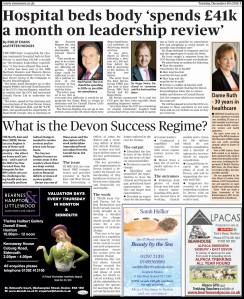
Local NHS – where our money goes – “leadership review” costs £41,000 per MONTH

80aa4a4d-c25c-4f2c-8fc5-7cb7f1be109b-2012-000001718f4e8194_tmp

THE NHS body responsible for closing community hospital beds in East Devon is spending £41,400 a month on “developing leadership capabilities,” it has been alleged this week.

A letter has been sent to the NHS Northern Eastern and Western Devon Clinical Commissioning Group by the East Devon Group of the Campaign to Protect Rural England.

The letter, dated December 1st, to Mrs Angela Pedder, the Lead Chief Executive of the CCG’s Success Regime, asked her to confirm that the CCG had instructed Carnall Farrar Ltd to undertake the work.

The letter, signed by the chairman and vice-chairman of the East Devon Group CPRE, Dr Margaret Hall, and Mr T.J.W. Hale, also questioned the impartiality of Dame Ruth Carnall, who is chairman of the Success Regime but also a director and shareholder of Carnall Farrar Ltd.

“This would appear to be a clear conflict of interest, affecting all parties, which alone could be sufficient to justify a judicial review of the outcome of this consultation,” said the letter.

The letter goes on to say that to overcome this difficulty it would be appropriate for Dame Ruth to resign as chairman and for Carnall Farrar Ltd’s contract to be terminated.

The Success Regime was set up as one of three areas in the UK where there were deep rooted financial problems in delivering health services.

It was introduced in Devon following a forecast of a £40 million deficit for 2014-15 increasing to £87 million in 2015-16 (see below).

The letter from the East Devon Group CPRE was also sent to East Devon MPs Neil Parish and Sir Hugo Swire.

Mr Parish commented: “It is vital the CCG gets the best value possible when spending taxpayers’ money.

“At a time when the CCG are consulting on closing community hospital beds across East Devon, they should be spending as little as possible on consultancy fees and ploughing as much money as possible into frontline care.”

Sir Hugo declined to comment until he had the opportunity to study the letter.

We have sought a response from the CCG but they failed to meet our deadline. We asked them to confirm the following:

  • That the monthly consultancy fee is £41,400?
  • How long has that monthly fee been paid?
  • How long will the monthly fee be paid?
  • Is there a conflict of interest with Dame Ruth Carnall chairing the Devon Success Regime when he is a shareholder and director of Carnall Farrar Ltd, the company which was awarded the contract?

We will be pleased to print the CCG’s responses to these questions in our next issue and on our website as soon as they are received.

How ruthless chief executives avoid the sack

“The NHS was accused of a whitewash this evening after a hospital boss who spent £10million suppressing whistleblowers was cleared by an official report.

David Loughton, who earned £260,000 last year, has been allowed to keep his job despite using taxpayers’ money to fight staff who raised serious concerns about patient safety.

The review into how Mr Loughton’s hospital trust is being run would only go as far as saying that he had ‘an impulsive and honest style’. It appears he will now face no disciplinary action and no sanctions will be taken against him.

Whistleblowers who were forced out of their jobs by Mr Loughton were not even interviewed for the report, and only found out the review had been published when contacted by the Mail.

In a further twist, it has emerged that the consultancy firm chosen by the NHS to do the review has been paid £78,837 by Mr Loughton’s trust for other jobs this year.

Deloitte was paid £45,444 for the review by watchdog NHS Improvement.
Mr Loughton, 62, chief executive at The Royal Wolverhampton NHS Trust, is renowned for fighting whistleblowers through the courts.

They include leading heart surgeon Dr Raj Mattu, who was vilified and sacked after he exposed that two patients had died in dangerously overcrowded bays in a hospital at another trust run by Mr Loughton.

Dr Mattu was cleared at a tribunal and in February was awarded £1.2million damages.

Manager Sandra Haynes Kirkbright was also suspended after raising concerns that Mr Loughton’s Woverhampton trust had mis-recorded deaths, making it look like fewer patients had died needlessly.

An investigation into her case condemned the trust for its ‘significantly flawed’ and ‘unfair’ treatment.

It described an account of how Mr Loughton made sure Mrs Haynes Kirkbright was ‘out of the way’ before a visit from hospital inspectors, telling staff to ‘kick this into the long grass’.

After the report into her case was published in May, NHS watchdogs ordered a review into the management of Mr Loughton’s hospital trust. But the results of that review were only quietly published on the trust’s website earlier this week. And it emerged that Deloitte was instructed to focus on the hospital as it is now, rather than considering previous whistleblowing cases.

As a result, the report’s authors did not contact Dr Mattu, Mrs Haynes Kirkbright or former board members who have criticised the management. They did not check what they were told by Mr Loughton and his employees, writing in the review: ‘We have assumed that the information provided to us and management’s representations are complete, accurate and reliable.’

Describing Mr Loughton, the report stated: ‘The chief executive is a strong character with an impulsive style and can attract controversy from time to time. However, he is strongly supported.’ It added: ‘Any past behavioural challenges have tempered in recent years.’

Today Dr Mattu said: ‘They have taken at face value everything management has said. I have great experience of Mr Loughton and he ruthlessly attacks anyone who dissents. He has persecuted whistleblowers. This has been a disgraceful waste of taxpayers’ money.’

Mrs Haynes Kirkbright said: ‘I was not consulted at all on this report. I didn’t know a thing about it until the Mail told me.’

Professor David Ferry was outed last year by Mr Loughton’s hospital after he anonymously revealed in the Mail that 55 cancer patients were needlessly put through the agony of chemotherapy.

This evening, he said: ‘They have whitewashed everything. I told them about Dr Mattu, about Sandra, about my case, but they said this is about the future, not the past. They have rewritten history their way, whatever the facts are.’

Mr Loughton, an NHS chief executive for 28 years, was awarded a pay rise of about £35,000 last year.

He joined Royal Wolverhampton in 2014 after 14 years at Coventry’s Walsgrave Hospital.

Mr Loughton said: ‘We are pleased with the review’s conclusions. Our number one priority is always patient care. Having an open and transparent culture is one of the ways in which we can ensure we remain committed to providing the best care we possibly can.

‘We are always seeking ways in which we can improve and we will take on board the recommendations the review makes.’

A trust spokesman said NHS Improvement commissioned Deloitte to do the review and ‘in line with many other organisations we have used the services of Deloitte’.

NHS Improvement said: ‘Deloitte were appointed following a formal and thorough tendering and evaluation process.’
Deloitte declined to comment.”

http://www.dailymail.co.uk/news/article-3995418/NHS-boss-Royal-Wolverhampton-NHS-Trust-faces-no-action-spending-10m-silence-whistleblowers.html

EDDC lack of transparency challenged – again

“EDDC’s transparency challenged over relocation from Sidmouth

06:30 05 December 2016 Stephen Sumner
Jeremy Woodward (front right) with campaigners from Save Our Sidmouth at Knowle in 2014
A transparency campaigner is questioning what district chiefs are ‘so desperate to hide’ after they refused to release correspondence on how a developer for Knowle was selected.

Jeremy Woodward’s Freedom of Information (FoI) requests to East Devon District Council (EDDC) about the decision to sell the site of its headquarters to PegasusLife, and the deal between them, were denied.

He appealed to the Information Commissioner to force the disclosure of two key documents – but the authority again refused as it argues the papers are commercially sensitive. The matter will now go to a tribunal.

Mr Woodward said: “What are they so desperate to hide? Why is the council so determined to avoid being held properly accountable, let alone transparent to its rate-paying electorate?”

The tribunal will not be resolved before PegasusLife’s planning application for a 113-apartment retirement community comes before EDDC’s development management committee (DMC) on Tuesday (December 6).

Mr Woodward added: “This timing seriously puts into question the extent to which the DMC’s decision-making is being compromised. Any information touching on the planning application should be made available to DMC members – and the developer’s contract clearly refers to the planning application.”

He said EDDC would rather incur ‘further embarrassment and potential damage’ to its reputation, as this is the second time it has appealed against a ruling from the Information Commissioner.

Last year, the authority refused to release progress reports Mr Woodward submitted FoI requests for on its relocation project. The eight-month legal battle saw EDDC blasted as ‘discourteous and unhelpful’ and cost taxpayers £11,000 in lawyers’ fees.

After Mr Woodward’s latest challenge, EDDC complied with one of three rulings from the Information Commissioner and revealed that PegasusLife will pay £7,505,000 for the site, subject to planning permission.

A spokesman said EDDC is challenging the ruling on the other two documents on legal and procedural grounds as it believes the Information Commissioner has not applied her own guidance consistently or correctly. It argues that the documents are commercially sensitive – but the spokesman said it has always promised to publish them when this is no longer the case.

The spokesman noted the concerns about the DMC meeting but said contractual terms agreed between two parties is ‘legally an immaterial consideration’ to any planning decision.”

http://www.sidmouthherald.co.uk/news/eddc_s_transparency_challenged_over_relocation_from_sidmouth_1_4801011

Exmouth: have councillors been misled – asks councillor

PRESS RELEASE
Have Councillors been misled?

East Devon District Council’s Cabinet “rubber stamped” the go ahead for a “full planning permission” on the redevelopment at Queen’s Drive, Exmouth which they were told needs to be submitted by the end of the year.

This is part of what the Cabinet recommended on the 9th November:
“To note that under delegated powers and an exemption to standing orders, officers have engaged planning and design services to take forward a reserved matters application for the continuance of the current planning approval of Queen’s Drive.”

This means that contrary to normal procedures officers engaged the planning and design services of a company to design and submit a full planning application proposal for the remainder of the Queen’s Drive Development.

Within the submitted papers presented to the Cabinet it explains officers drew up a proposal to hire consultants in September 2016 and gave details of the costs which are estimated at £65,000.

The document states it is “necessary to submit the application by the end of 2016.” It also claims to be a “technical exercise” simply to “sustain a planning application”.

Local Independent District Councillors believe that the advice given to the Cabinet members was misleading. Rather than a “technical exercise” the proposal to submit a “reserved matters application” would provide full planning permission which in theory would allow contractors to start development as soon as it is approved. The ‘reserved matters’ application does not need to be submitted until 24th January, when the current outline application expires.

Megan Armstrong, District Councillor for Exmouth said “Independent colleagues and I cannot understand why the Council has now decided to appoint a designer to submit a full planning application at vast expense when all that is required is to submit a further outline planning application to replace the present one.

The cost of a new outline application would be far less than the ‘reserved matters’ proposal.”

Councillor Armstrong added “If this goes ahead, it contradicts the recommendation that “the Council will give Exmouth people another opportunity to have their say on what happens on that site. The Council will bring in external expertise to carry out a review. This will involve full consultation that is neither developer nor Council led.”

“I believe the District Council should put in a fresh outline planning application for phases two & three, which could be done before the current one expires. Then we can have the full consultation, rather than setting out the ‘reserved matters’ details first, which seems to be putting the cart before the horse. We understand that these Cabinet decisions will be discussed further at the next Full Council meeting on 21st December.”

— ENDS —

MPs asked to curb second jobs

Operative word “asked” not “forced” …

MPs will be asked to restrict the hours they dedicate to lucrative second jobs and drop any work involving lobbying lawmakers or civil servants, according to a proposed new code of conduct.

Outside work will be scrutinised to ensure that MPs dedicate a majority of their working week to parliament in proposals which have been sent to the commissioner for standards and seen by the Guardian.

Those who are paid to lobby for outside interests – including those who work full-time for unions or charities – will be asked to drop their second jobs, according to the proposed code.

Twenty MPs declare more than £100,000 from second jobs
The change in the rules, which are still to be approved by MPs, could cut the amount of time MPs will be allowed to spend away from their constituents.

Until now, there have been no regulation of MPs doing other jobs apart from a general requirement to register income received from outside sources and to declare a conflict of interest.

Tommy Sheppard, the SNP member of the standards committee, has written to Kathryn Hudson, the parliamentary commissioner for standards, suggesting major changes.

He argued that there should be a ceiling on the amount of additional work an MP can take and this could be measured either by the year or by the week. …

… It comes after a study last year from Transparency International found that scores of MPs were being paid millions of pounds a year for outside jobs. The research found that 73 MPs, who are paid £74,962 per annum, also received £3.4m in the previous 12 months for “external advisory roles”, including in some cases board positions.

The biggest earner in that period was former prime minister Gordon Brown, who made almost £300,000 while still serving as the MP for Kirkcaldy and Cowdenbeath.

https://www.theguardian.com/politics/2016/dec/01/mps-may-be-told-to-curb-lucrative-second-jobs-in-new-code-of-conduct

Knowle relocation: EDDC defies Information Commissioner AGAIN and heads for court AGAIN

“EDDC TO DEFY INFORMATION COMMISSIONER – AND TO TAKE FREEDOM OF INFORMATION REQUESTS ON KNOWLE TO TRIBUNAL

East Devon District Council have formally announced that they will only be complying with one of three Decision Notices issued by the Information Commissioner’s Office on 25th October.

They have formally released the already widely-known information that the price for the Knowle site to developers PegasusLife is £7.5 million – on condition that they receive planning permission. (Decision Notice on Case: FER0608237).

However, the Council do not wish to divulge the “minutes of meetings and correspondence on the subject the decision to award the contract to PegasusLife” (Decision Notice on Case: FER0623403) or give “a copy of an agreement between East Devon District Council and a developer, Pegasus Life, in relation to a site at Knowle” (Decision Notice on Case: FER0626901)

http://futuresforumvgs.blogspot.co.uk/2016/10/knowle-relocation-project-breaking-news.html
http://futuresforumvgs.blogspot.co.uk/2016/11/knowle-relocation-project-information.html

It is clear that the Council do not want any information to be revealed about the contractual arrangements it has with the developer. And in particular, they do not want this to happen before a crucial vote by their planning committee on 6th December – when the Development Management Committee will consider the controversial planning application 16/0872/MFUL from PegasusLife.

http://futuresforumvgs.blogspot.co.uk/2016/11/knowle-relocation-project-planning_24.html

This timing seriously puts into question the extent to which the DMC’s decision-making is thereby being compromised, in that any information touching on the planning application should be made available to DMC Members – and the developer’s contract clearly refers to the planning application.

It is now obvious, therefore, that the Council would rather incur further embarrassment and potential damage to their reputation by appearing at the Information Tribunal – as this is the second time it will be appealing against the Information Commissioner.

http://futuresforumvgs.blogspot.co.uk/2014/08/knowle-relocation-project-foi-request_27.html

The obvious question which has to be asked is: What are they so desperate to hide?

Moreover, the Council is clearly prepared to spend yet further on defending itself, no doubt with the use of expensive legal representation – and yet it complains regularly about the expense of having to deal with FOI requests.
Why, then, is the Council so determined to avoid being held properly accountable, let alone transparent to its rate-paying electorate?

http://futuresforumvgs.blogspot.co.uk/2016/10/knowle-relocation-project-continuing.html

It will be interesting to see how the Council deals with the legal process which will now ensue. Will it drag matters out as it did two years ago, during the first time it appeared at the Tribunal?

http://futuresforumvgs.blogspot.co.uk/2015/07/knowle-relocation-project-we-believe.html

And how will the Council’s representatives conduct themselves on this occasion?

http://futuresforumvgs.blogspot.co.uk/2015/05/knowle-relocation-project-information.html

END

Privatisation: some things to think about

1. Your services get worse

Private companies have a legal duty to reward their shareholders, so they have to prioritise making a profit. This means they may end up cutting corners, or underinvesting in your public services. Water companies ignore leaks instead of investing in infrastructure, while private company involvement in the NHS has been bad for patients. Private companies also have ‘commercially confidential’ contracts, so they don’t share information with others; this makes it harder for them to work in partnership to make services better.

2. Your costs go up

You pay more, both as a taxpayer and directly when you pay for public services. Value for money goes down because private companies must make a profit for their shareholders and they also pay their top executives more money. This means either we the people, or the government, or both, end up paying more. Fares on our privatised railways and buses are the most expensive in Europe, while people are also being hit with high energy bills. 57% of 140 local authorities surveyed in 2011 said they had brought outsourced public services back in-house or were considering it, with 60% saying that the main reason was the need to cut costs.

3. You can’t hold private companies accountable

If the local council runs a service, you know where to go to complain. But if a private company runs a service, they are not democratically accountable to you. That makes it harder for you to have a voice. Academy schools are less accountable to parents. Private company Atos tried to silence disability campaigners instead of responding to their concerns about work capability assessments. A report by the Institute of Government reveals problems in outsourcing public services, including a lack of transparency, manipulation of contracts by suppliers and a reluctance to sack underperforming providers.

4. Staff are undermined

If you work in public services, privatisation will make your life harder. A Europe-wide study found that privatisation has had ‘largely negative effects on employment and working conditions’. There are often job cuts and qualified staff are replaced with casual workers, who are paid less and have worse conditions. This has a knock-on effect on the service being provided – for example, in the cases of care workers or court interpreters.

5. It is risky and difficult to reverse

Once our public services are privatised, it’s often difficult for us to get them back. Not only that, we lose the pool of knowledge, skills and experience that public sector workers have acquired over many years. We also lose integration both within and across different public services. A Deloitte report finds that many large companies are bringing services in-house because of the costs, complexity and risks of outsourcing.

But wait!

Aren’t private companies supposed to be better than the public sector? Doesn’t competition reduce costs and improve quality and customer care? No, because there is often very little competition; public services tend to be natural monopolies so there isn’t much choice for consumers. Instead, government (local or national) asks private companies to bid for contracts running our services – but there’s no real opportunity for our voices to be heard.

https://weownit.org.uk/privatisation

“False, flawed and fraudulent” says “Save Our Hospital Services” of NHS plans for Devon

SAVE OUR HOSPITAL SERVICES DEVON PRESS RELEASE
ON THE NATURE OF INDEPENDENCE AND IMPARTIALITY

The ‘Success Regime’/STP Team in Devon

“Save Our Hospital Services Devon (SOHS Devon) is today calling for the abolition of NHS England’s Sustainability and Transformation Plan (STP) for Wider Devon and the suspension of the so-called Success Regime for North, East and West Devon that is now an integral part.

“These two programmes are false, flawed and fraudulent,” says Dave Clinch, a spokesperson for SOHS in North Devon. “They are riddled with public-private, professional-personal conflicts of interest.”

SOHS Devon points out that the Case for Change document on which both the Success Regime and the STP are based was produced by a private-owned health service consultancy, Carnall Farrar. One of the consultancy’s founding partners, Dame Ruth Carnall, is now the ‘Independent’ Chair of the Success Regime pushing through the STP in Devon.

“SOHS Devon believes that there is a pre-determined agenda in Devon to cut services, limit access and reduce demand by redefining medical need to ensure that government cuts are carried out. How can Ms Carnall, who produced the blueprint for the STP, be considered remotely independent in assessing our needs or services to meet them?” asks Mr Clinch.

SOHS Devon points out that to push their agenda for cuts to NHS services and staff, the Success Regime/STP team will have been allocated £7.4 million between 2015 and 2017. Some of this funding has been used to recruit senior staff from those same services they plan to cut; for example, Andy Robinson, who left his role as Director of Finance at the Northern Devon Healthcare NHS Trust to join the Success Regime in Exeter. What is more, Mr Robinson happens to be the partner of the Chief Executive of the Trust, Alison Diamond.

“Professional or personal? How can this relationship avoid directly impacting on the life-and-death decisions now being made?” says Mr Clinch.

Meanwhile, the proposed relocation to Exeter of acute services based at North Devon District Hospital (NDDH) is being overseen by the Success Regime’s Lead Chief Executive Angela Pedder, the former CEO of the Royal Devon & Exeter Foundation Trust.

“How can she be considered unbiased given her former role?” says Mr Clinch. It’s no coincidence that RD&E needs to cover a much bigger deficit than NDDH in Barnstaple.”

On top of this, the two leads on the STP’s Acute Services Review programme are both from hospitals in South Devon, namely Derriford in Plymouth and Torbay in Torquay. SOHS Devon can find no evidence that they are talking to the clinicians working in acute services at NDDH. And the fact is, if the proposed acute services cuts go ahead, people here in North Devon will suffer and die”.

ENDS

“£7.4 million of NHS funds for ‘reorganisation’ in eastern Devon”

Does Project Omega (see post below) include profligate spending on NHS ‘reorganisation’ to bring it to its knees so it can be privatised?

Health bosses have come under fire for spending £7.4million of NHS funds on ‘reorganisation’ – that campaigners say could have gone towards frontline care.

The Northern, Eastern and Western Devon Clinical Commissioning Group (CCG) is identified as one of the most economically challenged in the country with a predicted £384million deficit by 2020/21.

In response to the crisis, the region was chosen to undergo a drastic ‘transformation’ led by the Success Regime, which is proposing to axe 71 community hospital beds as part of a series of cuts.

Campaigners have hit out at plans that would see Sidmouth lose its inpatient beds and said patients should not suffer as a result of badly-managed finances.

District councillor Cathy Gardner said: “I think it’s shocking that £7.4million can be found for reorganisation but not for frontline care. Many will question how wisely NHS funds are being spent when management consultants and internal managers are using up so much cash.

“Health and social care in Devon has suffered from chronic underfunding. The NHS does need serious reform but not of the kind being undertaken under the guise of improvements.”

The CCG confirmed that the Success Regime in Devon received £1.4million in 2015/16 and a further £6million in 2016/17 – but stated that the money was specifically set to implement changes and was not taken from the region’s £1.1billion budget for health services.

Campaigner and chairman of the Sid Valley patient participation group Di Fuller said: “The additional costs of managing the Success Regime, to try and put right what CCG management had failed to do, have diverted yet more funding from frontline services in the NHS.

“We must not endorse cuts to try and put this right until CCG can prove that alternative provision will be safe and meets quality standards.”

A CCG spokesman confirmed a total of £3.3million was spent on the Success Regime’s first phases of ‘transformation’ in Devon, Essex and Cumbria, with a further £17million budgeted for 2016/17. He added that the Success Regime’s programme aims to transform the way care is provided with a move towards a ‘home-based’ model of care.

This is expected to save between £4.7million and £7million a year after reinvestment into community services.

The CCG says it is continually looking at how to make the administration of care more efficient and streamlined.

http://www.sidmouthherald.co.uk/news/7_4_million_of_nhs_funds_for_reorganisation_in_eastern_devon_1_4791348

Destruction of the NHS planned in Thatcher era National Archive documents show -‘The Omega Project’

“… Another document in the National Archives outlines radical plans to end universal free healthcare.

The document stamped “secret” was called, in keeping with films and books of that era, “The Omega Project”.

Civil servants noted that “for the majority it would represent the abolition of the NHS”.

But in spite of what was described as the nearest thing to a Cabinet riot in the history of the Thatcher administration, the prime minister secretly pressed ahead with the plans – before later backing down”.

http://www.bbc.co.uk/news/uk-38101020

The choice of name is chilling – Omega being the last letter of the Greek alphabet, Alpha being the first. So the phrase ‘Alpha and Omega’ came to mean ‘the beginning and THE END’.

It appears that it has been resurrected.

Devolution: “flawed fiscal ‘power’, an unjust system, unfulfilled potential”

“… local authority funding (for services) will become far more volatile as year to year income will be intrinsically linked to those who pay rates locally and those who choose to appeal. So, in sum business rates devolution in its current guise is less about devolved power and more about the devolution of risk and the associated, potentially negative, effect on services. …

… In 2016, there is no such thing as the UK housing market, rather a polarised collection of divergent, individual markets (hyper-dynamic price inflation in London versus low demand and price stagnation in parts of Liverpool & East Lancashire, for example) bearing little or no resemblance to the situation at the time of the last revaluation some 25 years ago.
The effect of this is an increasingly unfair council tax banding where a resident in Blackpool in a Band A property currently pays 35% more in council tax than a resident in a Band A property in Kensington and Chelsea, where average gross earnings are more than double that of those living beside the Pleasure Beach. …

… So far, devolution has only served to deflect risk and responsibility for the local effect of national cuts and add a further layer of complexity to an already intractable local government governance system. The lack of real power in devolution deals to date does not fully equip places or the incoming City Mayors to effectively deal with the challenges of the modern economy whilst driving tax revenue.

Without true devolution of power, the potential contribution of local government towards a prosperous future for people and place is in danger of drowning in a mire of unnecessary fiscal constraints and excessive levels of localised risk.”

http://www.cles.org.uk/wp-content/uploads/2016/11/CLES-Think_Devolution-Beyond-the-rhetoric_Nov-2016.pdf

Save Exmouth Seafront meeting – 1 December 2016, 7.30 pm Harbour Cafe

see:

https://www.eastdevonalliance.org.uk/event/save-exmouth-seafront-ses-meeting/

and Exmouth Splash Facebook page

Daily Telegraph says street protests could reduce NHS bed losses

The Labour Party has a national day of action on Saturday 26 November 2016.
Devon has a county-wide non-political protest (“Draw a Red Line”) on Saturday 3 December midday Bedford Square, Exeter (see above for information)

Hospital closures planned to shore up NHS finances could be derailed if enough people take to the streets in protest, a health service chief has said.

Chris Hopson, leader of England’s hospitals sector, said public unrest and opposition by local MPs could scupper so-called Sustainability and Transformation Plans (STPs), which are billed as crucial to the long-term viability of the health service.

On Monday the respected think tank The King’s Fund heavily criticised health bosses for trying to organise the sweeping closure of hospitals and NHS units in secret, moves which it said could put lives at risk.

Yesterday Mr Hopson, Chief Executive of NHS Providers, said architects of the schemes were so far failing to engage local communities, which “have the ability to sink plans they don’t support”.

“It’s very difficult for the NHS to proceed with wholescale change if you’ve got people out on the streets marching with placards and banners and saying “don’t do this”,” he said.

“Fundamentally you can’t make big changes to service provision without taking local people with you.”

The plans follow an admission in May that the provider sector overspent by a historic £2.45 billion in the last financial year.

The country has been divided into 44 areas, with each ordered to come up with a proposal that both closes the gap and caters for booming patient demand.

So far the plans involve the closure of one of five major hospitals in South West London, an A&E unit in the North East of England, the loss of almost 600 beds in Devon and the possible closure of two A&E units in St Helens and West Lancashire.

Mr Hopson yesterday said unit closures were too widely being regarded as a “silver bullet” to make the “overambitious and undeliverable” plans conform to tight budgets.

“We have become obsessed by the money and not got the public engagement right,” he said.

“We are also trying to do it too quickly.”

But Sir Bruce Keogh, the NHS medical director, has this week there was “plenty of time” for the public to shape the changes.

NHS cuts on EDDC scrutiny agenda – 24 November 2016, 6 pm

The full consultation document begins on page 9:

Click to access 241116-scrutiny-agenda-combined.pdf