“THE COUNCILS SELLING LAND WORTH MILLIONS TO OFFSHORE COMPANIES”

“Councils are selling off land: vast swathes of it. It’s estimated that 10 million hectares of public land have been sold in the past four decades, and sales are accelerating. In Gloucestershire, where I live, the council has sold £100 million of land since April 2011 and recently announced plans to sell up to £53 million more.

Who’s buying it all? There has been little press coverage of this fire sale of land, and councils are cagey about reporting it. To find out more, I wrote code to compare a mid-2017 version of the Land Registry’s Corporate & Commercial Ownership data, which lists what UK corporate bodies own, with the latest Overseas Companies Ownership data, which lists what overseas companies own. If titles move from the first dataset to the second, that indicates they’ve been sold to an overseas company.

I found that since summer 2017, local authorities, government bodies and universities have sold public land worth more than £100 million to companies in Jersey, Guernsey, Isle of Man, British Virgin Islands, Malta and Cayman Islands. This is despite David Cameron promising to end property sales to “anonymous shell companies” in May 2016.

These countries are tax havens and secrecy jurisdictions. Private Eye, Global Witness and Transparency International have exposed for years how offshore companies hide the true identity of the buyers, allowing ‘dirty money’ to be laundered through the UK. Yet still the sales go on.

There’s no suggestion that the sales below are being used for money laundering, or even good old-fashioned corruption – the few I can identify look like UK development groups using offshore vehicles. But the problem is, we just don’t know who the buyers are – that’s the point of offshore. And most likely, nor do the public bodies doing the selling!

The government recently announced plans for a register of beneficial owners of offshore companies that own UK property. But campaigners say this is too little, too late: unless draft legislation goes to Parliament soon, the register won’t be in place till 2021.

In the meantime, and despite Theresa May also promising a ‘crackdown’ on companies’ use of offshore tax havens (£), public bodies are still merrily selling off public land – plenty of it to anonymous companies in these “sunny places for shady people”. …

The councils selling land worth millions to offshore companies

[For specific examples see the remainder of the article]
“The Greater Exeter plan has been delayed”

Owl is STILL having difficulty understanding how the Greater Exeter Strategic Plan (GESP) fits in with the Devon and Somerset Heart of the South West Strategic plan!!! So many strategies, so many plans, so many people being paid to work out how to invent what might, or more likely might not, turn out to be a wheel – though one of them MIGHT just manage to invent a square one!

“Mid Devon, East Devon, Teignbridge and Exeter City Council, in partnership with Devon County Council, are teaming up to create a Greater Exeter Strategic Plan (GESP) which focuses on the creation of jobs and housing until 2040.

… A consultation on the issues that the GESP should focus on took place 12 months ago and it was initially hoped that a consultation on a draft plan would begin in January of 2018.

But publication of the draft plan has been delayed and it is now likely that the draft GESP will be published in the summer of 2018.

Explaining the delay, a statement said: “In respect of the Greater Exeter Strategic Plan (GESP), and since our last Local Development Scheme was approved, there have been a number of factors which have delayed plan production.

“These include the fact that a great many sites were submitted through the Housing and Employment Land Availability Assessment ‘call for sites’ and these are being carefully assessed as well as further draft changes to national Government planning policy and a wish to investigate differing ways to ensure we can secure the best forms of development, including the highest quality new housing with supporting facilities, to meet our future needs.”

… The GESP will sit above District-level Local and community Neighbourhood Plans, taking a long-term strategic view to ensure important decisions about development and investment are coordinated. … “

https://www.devonlive.com/news/devon-news/greater-exeter-plan-been-delayed-1412993

Q: who audits the auditors? A: their pals

“The chief accountancy watchdog has hired lawyers to keep evidence confidential that might throw light on its contentious decision in 2013 not to investigate KPMG’s audit of HBOS.

Four of the auditor’s former partners were serving on the Financial Reporting Council’s conduct committee when it decided not to investigate their former firm’s role in the bank’s collapse. Another committee member had advised KPMG previously.

The FRC, which last week emphasised the importance of transparency in its workings, has appointed Fieldfisher, a law firm, to fight a tribunal appeal aimed at winning access to documents and emails under the Freedom of Information Act.

The regulator is under pressure to improve its investigatory processes after several corporate collapses where the auditors failed to spot problems. Last week Greg Clark, the business secretary, promised an independent investigation into the regulator.

Some concerned investors say that the FRC is soft on auditors because it has been “captured” by the accounting profession, with its board and decision-making committees liberally sprinkled with former Big Four accountants.

MPs described the regulator’s initial decision not to investigate KPMG as “a serious mistake”. Poor accounting and accounting rules have been cited as one reason why no one understood how bad the bank’s problems were until it was too late. The bank was rescued by Lloyds TSB with £20 billion of backing from taxpayers. Later £53 billion of its loans went sour as the extent of its reckless approach to creditors became clear.

The FRC belatedly investigated, only to find the auditor not guilty of any serious failings — triggering more astonishment from some MPs.

Margot Gibbs, a researcher originally backed by Greenpeace, is appealing against a decision by the Information Commissioner in November in order to establish how individual members of the conduct committee voted and whether there was any lobbying between KPMG partners and their former colleagues and advisers on the committee.

She also wants to challenge the FRC claim that, despite being a public body, it is largely exempt from the Freedom of Information Act. The watchdog and the business department, its sponsoring ministry, have been fighting the public sector classification for 14 years.

The former KPMG partners on the ten-member conduct committee were Paul George, a partner until 1999, Sean Collins, one until 2009, Joanna Osborne, a partner until 2011, and John Kellas, one until 2004. In addition, Richard Fleck, its chairman, is a consultant with Herbert Smith, which used to advise KPMG.

The minutes of the meeting show that Ms Osborne and Mr Collins left when KPMG was discussed, according to a report into the affair published by the FRC in November last year. Mr Kellas stayed but “did not participate”. The report did not say what Mr George and Mr Fleck did, nor how anyone voted.

The FRC confirmed that it had appointed lawyers. “We took this approach, ie explaining why the request was out of scope and referring Ms Gibbs instead to information we had published in connection with her request, for consistency of treatment and fairness with all other FOI requesters whose requests are out of scope.”

Fines by the FRC last year were their highest ever at almost £15 million.

KPMG has been auditor to several leading British companies that have failed or come to close to failing, including Co-operative Bank, Carillion and Conviviality, the group behind Wine Rack and Bargain Booze.

The tribunal is due to hear the case on April 27.”

Source: The Times, paywall

Don’t count your (productivity) Unicorns before they hatch!

From David Daniel:

“The “Joint Committee” (representatives from 23 organisations across Devon and Somerset – political balance rules do not apply) has just endorsed the final version of the HotSW Productivity Strategy.

But would you buy the proverbial second-hand car from an organisation that takes such a cavalier attitude to presenting facts and figures? Would you trust it to invest hundreds of millions of pounds of your taxes wisely? And, if you did, would you have any faith in its ability subsequently to deliver the goods?

Let’s start with the press release statement: “The Productivity Strategy aims to double productivity in the area over 20 years”. It does no such thing. The maximum claimed productivity gain in the strategy is to jump from a currently “assumed” 1.7% local annual productivity growth (probably nearer 1.5%) to 2.2%. No doubling here even if you accumulate the change over 20 years. For interest, historic average UK productivity growth rate is 2.0% and in the league table of LEPs, HotSW ranks 32nd out of 37 (London and South East dominate).

The 20 year timescale is a bit fuzzy as well. The introduction to the adopted strategy says: “Our ambition is simple – to double the size of the economy over 20 years.” In the consultation draft, however, it said: “Our ambition is simple – to double the economy in 18 years.” So which is it? On page 36 the Productivity Strategy is clearly marked (as it was in the consultation draft) 2018 to 2036, and none of the other numbers has changed. In my book that is 18 years, not 20!

Anyhow, what is being doubled is not productivity but the size of the economy (a combination of growth in both productivity and employment). Except the economy won’t be doubled using any of the combinations of growth in productivity and employment mentioned in the strategy, in either 18 or 20 years. The best on offer is a 3% compound growth. If that started instantaneously this year, and it obviously won’t, it would yield 70% growth in 18 years or 80% in 20 years. To double the economy, a compound growth rate of 3.94% (4%) would be required. Long term average UK growth rate is 2.6%.

It is proposed to achieve this 3% economic growth by “holding” employment growth to 0.8% per annum (add 2.2% productivity growth to 0.8% employment growth = 3%). We are effectively at full employment now. The Office for National Statistic population projections do show the South West population as a whole growing over this period at around 0.8% (0.76%) per annum. However, we have an ageing population and the annual increase of those classified as of working age is only 0.16% (16 to 64 for all genders). This will leave a shortfall of around 83,000 workers by the end of 18 years. Pension age is increasing to 66 by 2020 and to 67 between 2028 and 2028. Even if all 65 to 69 year olds are added to the work force they would not make up the shortfall. They would probably not be at the cutting edge of productivity either. So the plan can only work with major inward migration. This could be difficult in the post Brexit world.

Having ambition is one thing; plucking numbers out of the air and throwing them around without regard to the real world is quite another. There is no discussion of how long the transition from the slow to fast lane might take, delivery considerations come later. The hype assumes instantaneous change. How can anyone take this seriously?

Perhaps the members of HotSW and the Joint Committee believe they will all be long gone in 18 or 20 years and can’t be held to account. But what they have signed up to is so dramatic that failure will very soon become apparent. Brexit, surprisingly, might herald a refocussing of minds as suggested by Philip Aldrick, economics editor The Times, 20 March:
“….One theory doing the rounds is that the Treasury wants to know if its business support schemes are working. A crunch is coming. England’s 39 local enterprise partnerships, designed to boost growth, are funded largely with EU grants. For 2014 to 2020, they secured €6.51 billion of European Structural and Investment funds. Of that, €2.5 billion was allocated to “enhancing the competitiveness of small and medium enterprises”, about a tenth of which went to less developed regions.”

“After Brexit, now formally delayed until 2021 after yesterday’s transition deal, the money will no longer make the round trip via Brussels. It will come directly from Westminster, bringing with it more political accountability. If the money is not driving productivity, which it patently isn’t, the Treasury may decide the financial medicine could be administered more effectively.”

“I don’t believe it!” – NHS Providers say we are short of at least 10,000 hospital beds and are treating our elderly shamefully!

“The NHS is more than 10,000 beds short of what it needs to look after older people properly, hospital leaders have said.

NHS Providers, which represents hospitals, said that it was impossible for waiting time targets to be met this year and warned that the government’s pretence that they would be met created a “toxic culture” similar to that which led to the Mid Staffordshire scandal.

This week Theresa May promised that a long-term plan for NHS budget rises would be agreed within months, and will be under pressure to agree increases of up to £20 billion over five years.

However, Jonathan Ashworth, the shadow health secretary, said that “a nod and wink from the prime minister” was not enough for patients.

The NHS has not hit any of its main targets for more than two years. Chris Hopson, chief executive of NHS Providers, said: “The levels of performance expected and the savings demanded for next year are beyond reach. While we strongly welcome the prime minister’s commitment to increase long-term funding for the NHS, it makes no immediate difference to the tough task facing trusts for next year.”

Mr Hopson’s report estimates that 3.6 million patients will not be treated within four hours at A&E over the next year and 560,000 will be denied routine surgery within 18 weeks. He said that hospitals could make £3.3 billion in savings next year but that ministers had demanded 20 per cent more than this.

“This creates a toxic culture, based on pretence, where trusts are pressurised to sign up to targets they know they can’t deliver and then miss those targets as the year progresses,” his report said.

The NHS is probably somewhere between 10,000 to 15,000 beds short on a bed base of about 100,000.”

One hospital chief executive suggested that hospital overcrowding pointed to deep social problems. He said: “As a country we don’t look after old people well. We have too many people living by themselves in houses that are unsuitable . . . In the end they get really unwell and call 999.”

Source: The Times, pay wall

Our Local Enterprise Partnership’s favourite project ringing alarm bells

Not what our nuclear-linked LEP board members want to hear:

“The UK nuclear regulator has raised concerns with EDF Energy over management failings that it warns could affect safety at the Hinkley Point C power station if left unaddressed, official documents reveal.

Britain’s chief nuclear inspector identified several shortcomings in the way the French firm is managing the supply chain for the £20bn plant it is building in Somerset.

Though not serious enough alone to raise regulatory issues, together they “may indicate a broader deficiency” in the way the company is run, concluded Mark Foy, chief inspector at the Office for Nuclear Regulation (ONR).

In October and November 2017, a team of 11 inspectors led by Foy visited the Hinkley site, EDF facilities in Bristol and Paris, and a French factory making parts for the plant.

The visits were triggered by the regulator’s concerns that EDF did not have sufficient oversight of the Creusot nuclear forge in France, where records have been found to be falsified.

A summary of the inspections, published by the ONR earlier this month, judged EDF’s supply chain management to be improving but below standard in some areas.

The full reports, released to the Guardian under freedom of information rules, paint a critical picture. They show that:

The ONR was concerned that EDF’s internal oversight and governance had not identified the shortcomings at the forge

Stuart Crook, Hinkley Point C managing director, admitted that EDF, not the ONR, should have spotted those shortcomings first

a lack of resources meant EDF did not undertake an internal audit of its quality control processes during 2017. Foy said this was “disappointing” as it might have picked up problems

On safety, the report said that: “Throughout this … inspection, themes have emerged that relate to both improvements in NNB GenCo’s [the EDF subsidiary building Hinkley] processes and to shortfalls in management system arrangements that, if unresolved, have the potential to affect safety.”

EDF’s own assessment of how it managed Hinkley’s supply chain had discovered shortfalls that could affect safety, the regulator found. The ONR also felt that the company’s plan for improving its self-assessment process was inadequate.

Moreover, they said that it was not clear who at EDF was managing quality control on the supply chain.

Interviews with EDF’s contractors for the Hinkley project, which include civil engineering groups Kier BAM and Bylor, also found that EDF had not done enough to pass on information about the failings at the Creusot forge to its suppliers.

However, the regulator said it was confident the company could make improvements ahead of the next key regulatory milestone for the power station, in August 2018. Overall, EDF was found to be operating within the UK’s exacting nuclear regulations.

“Current arrangements for the control of quality are judged, through ONR’s wider regulatory activities, to be appropriate at present,” said Foy.

Experts said the inspection’s conclusions were significant, as nuclear regulation language is usually restrained.

Paul Dorfman, of the Energy Institute at University College London, said: “Looking at this report with a practiced eye, you can see that the UK regulators are worried, and things aren’t necessarily going to get any better.

“In all things nuclear, safety is absolutely paramount. The fact that the UK nuclear regulator says that these problems could affect safety is very significant.”

EDF said it was already implementing improvement measures where required ahead of an increase in construction activity at the site. The company was also completing the outstanding internal quality assurance programme.

A spokesperson said: “The chief nuclear inspector’s report recognises that the current quality control arrangements for Hinkley Point C are appropriate.”

There are about 3,500 people working on the site at the moment, a number that is expected to peak at around 6,000 in 18 months, when construction is due to be at full throttle.

The power station should provide around 7% of the UK’s electricity and is due to switch on in 2025, though EDF has warned the project may run 15 months over schedule.”

https://www.theguardian.com/uk-news/2018/mar/25/nuclear-watchdog-raises-hinkley-point-c-concerns

Should Randall-Johnson remain chair of the DCC Health and Social Care Scrutiny Committee (or even be a councillor at all?)

We all know our problems with Randall-Johnson as Chair of DCC’s Health and Social Care Scrutiny Committee (or, if not, we should). Here are just a few of many Owl posts on this councillor and her behaviour as its Chair:

https://eastdevonwatch.org/2017/08/12/conduct-of-health-committee-members-investigated-by-devon-council-diviani-and-randall-johnson-heavily-criticised-for-behaviour/

https://eastdevonwatch.org/2017/06/24/claire-wrights-report-on-the-disgraceful-dcc-nhs-meeting-and-its-disgraceful-chairing-by-sarah-randall-johnson/

https://eastdevonwatch.org/2017/08/31/councillor-calls-for-randall-johnson-resignation/

NOW, it seems, she was EXTREMELY reluctant to allow the CCG’s Sustainability and Transformation Plans to be a standing item on her committee’s agenda and inly the intervention of a “committee adviser” led to this being agreed. See Claire Wright’s blog for details:

http://www.claire-wright.org/index.php/post/sustainability_and_transformation_cuts_plan_agreed_to_be_an_item_on_every_h

“… Essentially, the NHS in Devon is looking at a £500m overspend by 2020 unless major cuts and centralisation of services take place.

It is absolutely vital that the committee keeps a very close eye on what cuts are to be made and how this is affecting patients. We are their only ears and eyes on this.

When I made this proposal yesterday – that we receive a detailed report at each committee meeting. Chair, Sara Randall Johnson appeared to be reluctant to introduce such a standing item, given all the other issues that needed to be examined.

I could not see her point of view at all. Surely, this is the most important issue facing Devon’s patients today?

Committee adviser, Anthony Farnsworth suggested that councillors have sight of the CCG’s own financial reports relating to the STP on a regular basis and this was a legitimate area of scrutiny. …

This was agreed.

Here’s the webcast – https://devoncc.public-i.tv/core/portal/webcast_interactive/318671

What is this woman’s problem? Is it simply that she knee-jerks a “no” on any and every proposal from Independent Claire Wright” – putting personalities before what is best for Devon, its healthcare and its scrutiny? We know she has problems with Ms Wright’s forthright defence of our NHS against cuts and privatisation (though the problem seems to stem from further back when the then Leader of East Devon District Council was ousted from her seat by the likeable, knowledgeable and planning policies aware winning candidate – Claire Wright).

Or is it even more dangerous than that? Putting HER personal political beliefs and ideology above those of others – including moderate DCC Tory councillors – and forcing them on others by whatever means she has at her disposal?

Questions, so many questions, and so few answers.

“The Case for Public Consultation Hearings”

In its latest Briefing Paper, the Institute argues the case for Public Consultation Hearings. In the recommended format, organisations undertaking a consultation will provide the opportunity for selected consultees to appear before decision-makers and give their evidence and their viewpoint – a little like Parliamentary Select Committees.

It is not a new idea, but there are important reasons why the time is right to consider these forms of dialogue:

People are heartily fed up with perfunctory, tick-in-the box forms of dialogue, especially simplistic online surveys with questions like ‘Do you agree with us that we should revise the regulations …. Blah blah.? ‘ Serious stakeholders want a better level of debate that considers issues properly. Public hearings can help.

We have to tackle what can be described on the week of Stephen Hawkins’ death) as the consultation ‘black hole’ It is where respondents make a submission or reply to a consultation but have no idea what happens to their views. Does anyone read them? Are they considered? If so, by whom. It is as if responses disappear down a black home never to reappear. Public hearings are one way to demonstrate that consultors listen!

All the emphasis is now on digital dialogues, and they have many fine features that encourage participation by large numbers who might not have responded using traditional methods. Public hearings can be a welcome antidote to the de-personalisation of electronic media – where real people can be seen to sit down and discuss evidence. Video-streaming can make this visible and transparent to far wider audiences, and be living proof that consultation is really taking place.

The Briefing Paper looks at the role of evidence in public debate, and the need for participants in consultations to evidence their claims and assertions. It then presents the arguments in favour of public hearings, and explores whether they might work in the context of public consultations. For existing public engagement practitioners, the most valuable section may well be on the practicalities of organising a programme of hearings and the challenges that might need to be overcome.

Our conclusion is that where there is a considerable amount of public interest, or where the subject-matter is deeply controversial, they will help convince sceptical communities that decision-makers care enough to explore the issues openly and in public. There is even a case for holding events like this well before a consultation is launched. A pre-consultation exploration of key issues and an opportunity for stakeholder to spell out what they would like to see considered might be a first-rate way of involving the public. Used in this way, hearings can even form part of a co-production approach.

Make your own mind up by reading the latest ‘Briefing Paper 35’ which you can view here if you are member. Alternatively contact Rebecca Wright to request a copy if you are not a member, or would like Institute Associates to help prepare a programme of Public Consultation Hearings for your own organisation.”

https://www.consultationinstitute.org/tackling-the-black-hole-of-consultation/

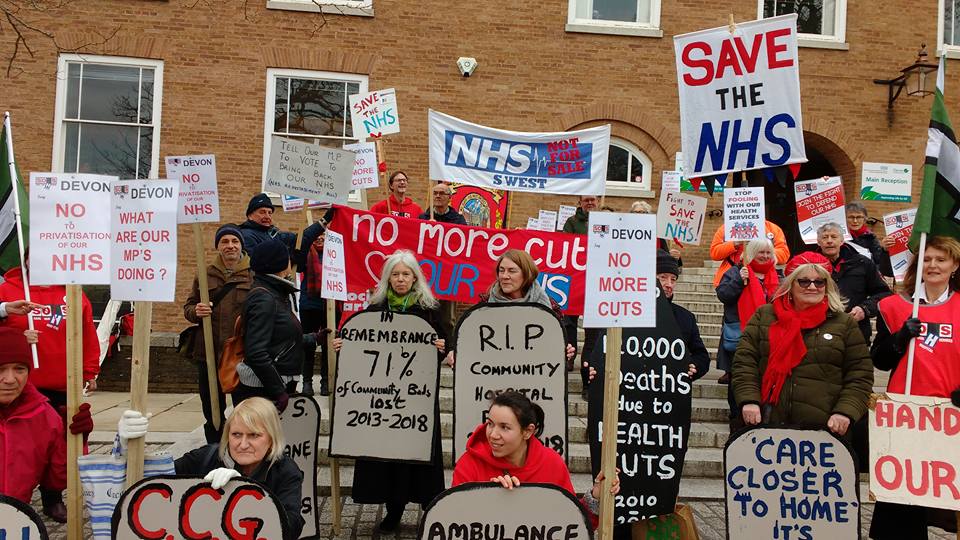
Campaign group forces further consideration of “integrated care” in Devon

Save Our Hospital Services scored a major victory today when after its demonstrations (including another one today):

Emails, public speaking and media onslaught led to the DCC Health Scrutiny Committee refusing to agree to the commencement of the secretive and undemocratic imposition of an “Integrated Care System” (accelerating privatisation of health and social care) being forced on the county from 1 April 2018 (probably not coincidentally April Fool’s Day).

Well done SOHS!

BUT remember we are in the national local government election period and it may well be that, once this has passed, the Tory enthusiasts for this privatisation by the back door may well rediscover their taste for it!

“Manchester council to publish files used to bypass affordable housing quotas”

“Manchester city council has voted to make public the secret documents used by developers to bypass affordable housing quotas.

Analysis by the Guardian earlier this month showed that developers behind almost 15,000 new homes given the green light by the council’s planning committee in the past two years all managed to avoid including any affordable housing in their developments.

In many cases, developers submitted confidential viability assessments to successfully argue that their projects would not go ahead if they were to offer even one flat for affordable rent or sale. Just 65 of the 14,667 units analysed by the Guardian made any concessions to affordability, being pitched as shared ownership properties.

Over the past year councillors on Manchester city council’s planning committee have become increasingly frustrated that they are being asked to approve huge new developments – some containing 1,500 market-rate, luxury apartments – without being able to scrutinise the viability assessments.

‘We said it wasn’t acceptable’: how Bristol is standing up to developers
On Wednesday councillors voted to require viability assessments for developments of more than 15 units where less than 20% of the development is affordable housing as part of the planning process and for these to be public.

After the unanimous vote, all information submitted for the documents (including commercially sensitive information) will also now be made available to members of the planning committee and other relevant members of the council in advance of determination of the planning decision.

The motion read: “This council notes that developers have often used viability assessments to avoid their obligations to provide affordable housing and where this happens, it can damage public confidence in the planning process. Labour councils in Greenwich, Bristol and Lambeth have improved transparency by making their viability assessments public. “This council believes that the developers who make money from building in our city have an obligation to make a fair contribution to providing affordable housing.”

Last November Bristol became the latest city to force developers to be transparent by publishing viability assessments. Bristol’s mayor, Marvin Rees, believes that it sends a signal to developers: “We’re a great city to do business in – but we want the right kind of money.”

https://www.theguardian.com/cities/2018/mar/21/manchester-council-to-publish-files-used-to-bypass-affordable-housing-quotas

“WHY WE CANNOT ACCEPT THE INTEGRATED CARE SYSTEM, by the Councillor who first exposed the CCGs’ plans”

PRESS RELEASE

“I am the County Councillor who first put the ICS (Integrated Care System) on the Council’s agenda, at the last Health Scrutiny in late January. This is what has led to the item at today’s meeting. Then, the CCGs and the Council’s leadership had failed to bring the proposals to Council ​- ​although they had been agreed since September. ​They did not want debate on the proposals in the Council – still less for the public to know what is planned.​

I shall be telling Health Scrutiny [Committee, meeting today] that even now, despite having 6 months to produce proper information, they still haven’t revealed some of the most ​worrying aspects of the ICS:

funding of services in the new system, how contracts will work, and whether these will lead to privatisation

details of the proposed Local Care Partnerships for N, S, E & W Devon and for Mental Health which are key to the system, and how they will be funded/contracted

the governance of the system – as things stand, Devon County Council could be handing over control of its social care services to unelected quangos (the CCGs)​​

plans for public engagement – the Cabinet paper says this is necessary but there are no proposals.

However, we do know there will be equalisation of funding between Eastern and Western Devon. Because the CCGs say Western Devon is relatively underfunded, this means deeper cuts in Eastern Devon – probably including closures of community hospitals. Scrutiny should reject this ‘equality of misery’.

On governance, I support the proposals of Cllr Hilary Ackland that if integrated commissioning in the ICS is to go ahead, a reformed Health and Wellbeing Board with proper all-party representation should become the integrated commissioning board. Democratic control is not an optional extra.

Devon County Council cannot support these proposals as they stand. Without full answers to our questions, Health Scrutiny should call in the plans.

I should be happy to talk to (journalists) today​. I shall be with the Save Our Hospital protestors ​outside County Hall ​between 12.30 and 1​ or you can phone me on ​07972 760254.

Martin Shaw
Independent East Devon Alliance County Councillor for Seaton & Colyton”

“Tory donors among investors in Cambridge Analytica parent firm”

“Conservative party donors are among the investors in the company that spawned the election consultancy at the centre of a storm about use of data from Facebook.

Filings for SCL Group, which is at the top of a web of companies linked to Cambridge Analytica, show that since its conception in 2005 its shareholders and officers have included a wine millionaire who has given more than £700,000 to the party, a former Conservative MP, and a peer who was a business minister under David Cameron. …

From its outset as a UK-registered company, SCL Group had investors from the upper echelons of British life. Lord Marland, a successful businessman who became a minister in 2010, held shares personally and through two related investment vehicles, Herriot Limited and a family trust. …

Sir Geoffrey Pattie, a former Conservative defence and industry minister, took a key role in the company for its first three years. In a Guardian article from 2005 he is described fronting the company’s stand – which is “more Orwell than 007” – at a defence show in London. Pattie is shown to have resigned as a director in 2008.

One of Marland’s fellow investors, and the person now registered as having “significant control” over SCL Group, is a Conservative party donor called Roger Gabb.

Gabb, who introduced the Volvic water brand to the UK then went on to make millions selling wines including the Kumala label, now owns more than 25% of the company. At its formation he was named as a shareholder, as was the Glendower Settlement Trust which is linked to him and his wife.

Gabb has given £707,000 to the Tories since 2004, making contributions to the main party and his local Ludlow branch. In 2006 he gave £500,000 to the party, making him one of its largest donors at the time.

He was also a campaigner for Brexit, signing letters on behalf of the campaign as a director of Bibendum Wine, and placing an advert in local newspapers. In October 2016 he was fined £1,000 by the Electoral Commission for failing to include his name and address in the advert.

The property tycoon Vincent Tchenguiz was also a shareholder via his company Consensus Business Group. Tchenguiz donated £21,500 to the Conservatives between 2009 and 2010.

For eight years from 2005 Consensus Business Group held just under a quarter of the shares in SCL, which was valued at around £4m at the time of the investment.

The firm said it had no role in the running of the company, and had sold off its stake in 2013. It appears that it received around £150,000 for the shares.

Julian Wheatland, a close associate of Tchenguiz, was involved with SCL Group from the beginning, and is still a director at the company.

The other main players at SCL Group are Nigel Oakes, an old Etonian from a military family – his father is Maj John Waddington Oakes – and a former boyfriend of Lady Helen Windsor. Oakes had previously set up a company called Behavioural Dynamics which made many similar claims to SCL about its ability to influence voters. In 2000, it worked for the Indonesian president, reportedly without great success.

Nix, a fellow old Etonian, is reported to have joined Oakes at an earlier incarnation of SCL in 2003. Companies House data shows he is linked to 10 firms, which all appear to be linked in some way.

On Wednesday, the Scottish National party’s leader in Westminster, Ian Blackford, asked May about her party’s links with SCL, which he said “go on and on”.

“Its founding chairman was a former Conservative MP. A director appears to have donated over £700,000 to the Tory party. A former Conservative party treasurer is a shareholder,” he said. …”

https://www.theguardian.com/politics/2018/mar/21/tory-donors-among-investors-in-cambridge-analytica-parent-firm-scl-group

How can you be trusted with the economy if you can’t get your election expenses right!

“Details of enforcement action relating to political parties

The Conservative Party, Green Party and the Labour Party are under investigation for submitting spending returns that were missing invoices and for submitting potentially inaccurate statements of payments made.

The Conservative Party and Liberal Democrats are under investigation for making multiple payments to suppliers where either the claim for payment was received past the 30 day deadline or it was paid after the 60 day deadline following the election. These deadlines are specified in law.

The Women’s Equality Party is under investigation for submitting a spending return that was inconsistent with its donation reports covering the same period.

Details of enforcement action relating to non-party campaigners:

Best for Britain is under investigation for submitting a spending return that was missing invoices. The campaigner is also under investigation for not returning a £25,000 donation from an impermissible donor within 30 days as required by PPERA.

The National Union for Teachers is under investigation for submitting a spending return that was missing an invoice.”

https://www.markpack.org.uk/154324/2017-general-election-expense-returns/

“Official figures mask A&E waiting times”

“Tens of thousands more patients spent more than 12 hours in A&E waiting for a bed last year than official figures suggest. Doctors and MPs called for a change to how “trolley waits” were reported in England after an investigation by The Times.

Official numbers show that 2,770 A&E patients had to wait more than 12 hours for a bed last year. These NHS statistics only capture the time between a doctor deciding a patient needs to be admitted and then being found a place on a ward. If the time is recorded between arriving at A&E and being found a bed, the number of patients who had to wait in emergency departments for more than 12 hours leaps to at least 67,406 patients, 24 times higher, according to data obtained under freedom of information laws.

The true figure is likely to be even higher, as only 73 hospitals out of 137 replied to the requests. The Times also asked hospitals for details of the longest wait they had recorded each week. Those revealed about 200 patients waiting more than a day for a bed last year. In December a 103-year-old woman spent 29 hours in A&E before she was admitted to the Great Western Hospital in Swindon, Wiltshire. The trust said that it had been one of the busiest months on record. The longest wait reported to The Times, of almost four days, was a 16-year-old boy at Barking Havering and Redbridge NHS Trust.

Sarah Wollaston, Conservative chairwoman of the health select committee, said that long waits in A&E raised patient safety concerns. “When departments are already at full stretch, having to care for individuals who may be very unwell and waiting for transfer to a more appropriate clinical setting reduces the time clinicians are free to assess and care for new arrivals and this can rapidly lead to spiralling delays,” Dr Wollaston said. “The total length of time that people are spending in emergency departments should be recorded alongside the current figures.”

Paul Williams, a Labour member of the committee, said: “If the clock doesn’t start ticking on ‘trolley waits’ until this decision has been made, then hospitals can legitimately have someone waiting for more than three hours to be seen and assessed, and then another 11 hours on a trolley without this leading to a breach of targets.” In Wales, Scotland and Northern Ireland, 12-hour waits are recorded from when a patient arrives in the department.

Rachel Power, chief executive of the Patients Association, said: “It’s clear from this data that many patients are enduring even longer waits with their safety, privacy and dignity compromised than the official statistics show.”

Taj Hassan, president of the Royal College of Emergency Medicine, said: “I think all independent observers would agree that, at the moment, the way we are describing our 12-hour trolley waits is not accurately describing the numbers.”

An NHS England spokesman said: “In the last 12 months to February 2018 the number of 12-hour trolley waits has dropped by more than 20 per cent on the previous year, and this has been achieved while hospitals also successfully looked after 160,000 more A&E patients within the four-hour target this winter compared to last winter.” NHS Digital is set to publish separate monthly statistics on the total number of patients spending more than 12 hours in A&E, whether or not they eventually needed admission. They said there were more than 260,000 during the financial year 2016-17.

Behind the story

Hospitals are expected to treat, admit or discharge 95 per cent of patients within four hours of their arrival at A&E (Kat Lay writes).

However, they have not met that target since July 2015. In January, only 77.1 per cent of people going to larger A&Es were dealt with within four hours.

For patients who require admission — “the sickest group” attending A&E, says the Royal College of Emergency Medicine — it appears to be worse.

At hospitals that provided figures to The Times, on average only 53 per cent of patients requiring admission were found a bed within four hours in January this year.

A lack of social care means that many of the beds that such patients need to be moved on to are taken up by people who do not need to be in hospital any longer, doctors complain.

Source: The Times (pay wall)

LEPs – not fit for purpose

Owl says: No accountability, no transparency and yet they are taking over more and more money that used to be supervised by district and county councils. Why and who benefits? Certainly not us.

A group of MPs has told the government to “get its act together” regarding the governance of public-private partnerships set up to boost local economies.

A Public Accounts Committee report on the Greater Cambridgeshire Greater Peterborough Local Enterprise Partnership, released on Friday, found that the LEP had failed to meet standards of accountability and transparency.

In particular, the report found that the GCGP LEP failed to publish board papers and reproduce minutes in a timely or accessible manner.

The PAC also found the former chair of the GCGP LEP- Mark Reeve- did not take responsibility for the LEPs failings and did not appreciate the importance of good governance of LEPs.

Consequently, the PAC suggested that the Ministry of Housing, Communities and Local Government, should implement the recommendations of the Mary Ney review, which sets out guidelines to improve governance and transparency of partnerships, for all LEPs.

It also called for all LEP board members to be familiar with the Nolan Principles, which were published by the government in 1995 and set out the basis of ethical standards expected of public office holders.

PAC chair, Meg Hillier said: “Local enterprise partnerships are not an abstract concept on a Whitehall flipchart.

“They are making real decisions about real money that affect real people.

“This troubling case only serves to underline our persistent concerns about the governance of LEPs, their transparency and their accountability to the taxpayer.”

The report also revealed that the MHCLG’s oversight system failed to indentify GCGP LEP as one which should have raised concerns, after Cambridgeshire County Council’s section 151 officer signed off on GCGP LEP’s assurance framework without checking all of its supporting documentation.

As such, the PAC has asked the MHCLG to write to them setting out the results of its compliance checks and annual conversations and for them to publish these results.

Hillier added: “Taxpayers need to be assured their money is being spent wisely and with adequate protections in place to prevent its misuse.

“Central government must move swiftly to ensure the recommendations of the Ney review are fully implemented and we expect to see evidence that this has happened.”

The MHCLG has been approached for comment.”

http://www.publicfinance.co.uk/news/2018/03/government-told-get-its-act-together-over-leps

Devon County Council: the place democracy goes to die

Facebook post by DCC Lib Dem Councillor Brian Greenslade

Late last year we started to learn about plans by the Health Secretary Jeremy Hunt and NHS England to introduce by the 1st April Accountable Care Organisations to replace CCG’s in the Health Service. These organisations would provide health and social care services. Bringing these services together makes sense but democratic oversight appeared to be an after thought. ACO’s seemed to be based on similar type Organisations in the US.

What was clear was that little or no public scrutiny of these proposals had happened. Congratulations to Sarah Wollaston MP Chairman of the Health Select Committee who then intervened to stall this initiative to allow the Parliamentary Health Select Committee chance to scrutinise the proposals. The same was true at Devon County Hall where nothing about this was brought to the attention of members of the Health Scrutiny Committee.

Opposition to ACO’s started to brew up so then suddenly the Government and NHS England started to talk about integrated care systems instead which apparently are different. How different is not clear and I am concerned that this could be a back door attempt to introduce ACO’s.

Yesterday at the DCC Cabinet a report by the Chief Executive about Integrated Care Systems was considered. It failed to answer key questions but it was clear that changes from April were on the way.

My Lib Dem colleagues and I hotly contested the recommendations and called for time to have this report sent to Scrutiny first. This was voted down by the Tory majority.

We reacted to this by calling in the Executive decision for scrutiny. This as the effect of delaying any decision on this being made until 11th April at the earliest to consider representations by Scrutiny.

Amazingly the Tories are rushing scrutiny through by making it an urgent item for the Health Scrutiny meeting on the 22nd of March giving little time for consideration of this critical issue for the health of the people of Devon.

Democratic standards that the Lib Dem’s stand for mean little to Devon’s ruling Tories!”

LEP governance … in the wrong hands?

The report below states that the lead council for a Local Enterprise Partnership should exercise firm control over all aspects of the LEP’s governance and claims.

In our area that would be Somerset County Council.

Aaahhh … Owl has already foreseen a problem here:

Warning light for our LEP council partner’s finances (Somerset)

Public Accounts Committee: “Government still failing to get a grip on oversight of LEPs”

Owl can see almost no difference between governance and conflict of interest issues between Peterborough LEP and the Heart of the South West LEP at which exactly the same criticism can be made. Another post to follow on this later today.

“The Public Accounts Committee report finds case of Greater Cambridge Greater Peterborough highlights persistent concerns about ‘complexity and confusion’ in devolution.

In 2016 the Committee of Public Accounts reported on the governance of Local Enterprise Partnerships (LEPs) and made clear recommendations for improvement which were accepted by the Ministry of Housing, Communities and Local Government (the Department).

Despite this, the Greater Cambridge Greater Peterborough Local Enterprise Partnership (GCGP LEP) provides the latest example of the Department devolving powers and funding to LEPs in a manner characterised by both complexity and confusion.

The Department needs to get its act together and assure taxpayers that it is monitoring how LEPs spend taxpayers’ money and how it evaluates results.

The Department assures us that there was no misuse of public funds in this instance; however, this is due more to luck than effective oversight given that there appear to have been no effective mechanisms in place for identifying conflicts of interest in GCGP LEP. We are not at all convinced that the issues uncovered in GCGP LEP might not be found elsewhere in other LEPs.

We also put on record our displeasure at the conduct of the former Chair of GCGP LEP when giving evidence. He failed to appreciate the importance of good governance, showed a lack of remorse about the outcome for GCGP LEP, and was evasive when questioned about his potential conflict of interest.

Such an attitude only serves to underline the need for the Department to get a grip of its oversight of LEPs. It needs to implement quickly the recommendations of Mary Ney’s review of Local Enterprise Partnership governance and transparency, ensure that all LEPs and their boards are aware of the Nolan Principles for the standards of conduct expected in public life and ensure that they live up to these principles in practice.

Chair’s comments
Comment from Committee Chair, Meg Hillier MP:

“Local Enterprise Partnerships are not an abstract concept on a Whitehall flipchart. They are making real decisions about real money that affect real people.

This troubling case only serves to underline our persistent concerns about the governance of LEPs, their transparency and their accountability to the taxpayer.

The Greater Cambridge Greater Peterborough Local Enterprise Partnership failed to comply with the standards expected in public life. Yet there are also clear failings in oversight by central government.

Taxpayers need to be assured their money is being spent wisely and with adequate protections in place to prevent its misuse.

Central government must move swiftly to ensure the recommendations of the Ney review are fully implemented and we expect to see evidence that this has happened.

But it must also do a far better job of explaining the objectives and anticipated benefits of these local partnerships to local people.

Taxpayers surveying the increasingly complex landscape of local government might reasonably ask what LEPs are for.

It is wholly unacceptable that central government does not have a clear, up-to-date answer to that question.”

http://www.parliament.uk/business/committees/committees-a-z/commons-select/public-accounts-committee/news-parliament-2017/cambridge-peterborough-lep-report-published-17-19/

Follow link for:

report summary
https://publications.parliament.uk/pa/cm201719/cmselect/cmpubacc/896/89605.htm
report conclusions and recommendations
https://publications.parliament.uk/pa/cm201719/cmselect/cmpubacc/896/89605.htm
full report: Governance and departmental oversight of the Greater Cambridge Greater Peterborough Local Enterprise Partnership
https://publications.parliament.uk/pa/cm201719/cmselect/cmpubacc/896/89602.htm

Bailing out Northamptonshire County Council would be “a reward for failure”

More on that scandal – so easily replicated when a few arrogant, ignorant officers and councillors, whose majority gives them the belief they cannot ever be challenged or scrutinised, think they can get away with anything …..

“Northamptonshire county council (NCC), which declared effective bankruptcy last month, should be scrapped, a devastating inspectors’ report into widespread financial and management failures at the authority has recommended.

A government-appointed investigator’s report said the problems at the council were so deep-rooted that it was impossible to rescue it in its current form, and to do so “would be a reward for failure”. It recommends that ministers send in a team of external commissioners to take over the day-to-day running of the council until it can be broken up and replaced with two new smaller authorities.

The lead inspector, Max Caller, said NCC had ignored a growing financial crisis at the authority, which he said had been beset by poor management, lack of scrutiny and unrealistic budget-setting.

Explaining why he advised breaking up the council, Caller’s report says: “The problems faced by NCC are now so deep and ingrained that it is not possible to promote a recovery plan that could bring the council back to stability and safety in a reasonable timescale.”

He added: “To change the culture and organisational ethos and to restore balance, would, in the judgment of the inspection team, take of the order of five years and require a substantial one-off cash injection. Effectively, it would be a reward for failure.”

It was unlikely councillors and the officers had the strength of purpose to bring the council back into line, he said. “A way forward with a clean sheet, leaving all the history behind, is required.”

The council’s leader, Heather Smith, resigned after the report’s publication, telling the BBC that she blamed “vicious attacks by four local MPs”, adding “you cannot win” if the “machinery of government turns against you”.

Responding to the report, Northampton North MP Michael Ellis called the management of the authority a national scandal. All seven local Tory MPs criticised the council last month saying they had no confidence in its leadership [too little too late!).

The report rejected the council leadership’s claim that it had been disadvantaged by government funding cuts and underfunded given the pressure of a growing and elderly population. Similar councils had coped with these pressures and Northamptonshire “was not the most disadvantaged shire council”, the report says.

It excoriates the council’s disastrous attempt to restructure services by outsourcing them to private companies and charities, the so-called Next Generation programme. Poor design, chaotic management, and a lack of controls and oversight meant that budgeting was “an exercise of hope rather than expectation”, it says.

It drily notes that it was not clear whether the programme was still in existence.“It would appear to have been abandoned but that is not clear,” the report says.

The council had lost control of its budgeting in 2013 after a critical Ofsted report into its children’s services forced an expensive overhaul of child protection services, and never recovered, the report says. It said the council’s approach to financial management came across as “sloppy, lacking in rigour and without challenge”.

There was a lack of realism in business plans, and savings targets were frequently not met. Senior councillors and officials ignored or evaded criticism and challenge, it says, and budgets were set by without regard to need, demand or deliverability. “Living within budget constraints is not a part of the culture at NCC,” the report concludes.

Although financial officials had raised the alarm about the extent of NCC’s growing finanical problems as far back as 2015, this had been ignored by senior management and councillors. There was a culture in NCC where “overspending is acceptable and there are no sanctions for failure”, the report says.

The council had continually patched up financial holes with one-off uses of reserves, or by selling off assets and using the proceeds. The report concludes: “This is not budget management.”

By the end relationships with public sector partners such as the NHS has deteriorated so much that there is a “significant level of distrust that NCC will ever be able to deliver against its promises and undertakiings”.

It noted that the councils’ staff were not to blame for the fiasco. “NCC employs many good, hardworking, dedicated staff who are trying to deliver essential services to residents who need and value what is offered and available. The problems the council faces are not their fault.”

Last month the council issued a section 114 note – the local government equivalent to bankruptcy – because it said it could not set a balanced budget for 2018-19.”

https://www.theguardian.com/society/2018/mar/15/scrap-northampton-county-council-inspectors-say

Damning report on culture at insolvent Tory council

Anyone interested in how a council can go bad should read this relatively brief and easy-to-read report on the shenanigans which went on at Northamptonshire County Council prior to its technical insolvency. It was SO bad the Inspector recommends doing away with it entirely and creating two separate unitary authorities for a fresh start.

Full report here:

Click to access Best_Value_Inspection_NCC.pdf

Owl particularly “enjoyed”:

Section 3.46 – 3.52 – the behaviour of the Chief Executive and senior officers)

Section 3.78 – 3.84 – scrutiny (lack of)

Section 3.90 – 3.100 (role and function of the Audit Committee)

and Section 4.5

“The council did not respond well, or in many cases even react, to external and internal criticism. Individual councillors appear to have been denied answers to questions that were entirely legitimate to ask and scrutiny arrangements were constrained by what was felt the executive would allow. When external agencies reported adverse findings these were not reported with an analysis of the issues and either a justification or an action led response to a relevant decision taking body. At its most extreme, the two KPMG ISA 260 reports, stating an adverse opinion on Value For Money matters were just reported to the Audit Committee without comment and the unprecedented KPMG Advisory Notice issued under the 2014 Act was reported to full council without any officer covering report giving advice on what the response was recommended to be.

and 4.11:

“It is not possible to establish what action the corporate management team took in the face of all these issues as those meetings that took place were not minuted.”

As reported in the area’s local paper:

“Max Caller, an independent inspector, was called in by local government secretary Sajid Javid after allegations of financial mismanagement. He was also tasked with seeing if the local authority was being run properly by bosses and the cabinet’s Conservative councillors. …

His report, published this morning, says the origins of the crisis was the Ofsted inspection into Children’s Services in 2013 that caused emergency money to be pumped in, which meant the local authority ‘lost tight budgetary control’.

What came next was a poor response to the financial pressures, Mr Caller says, in effect chasing a heavily flawed model championed by departed CEO Paul Blantern.

He said: “Instead of taking steps to regain control, the council was persuaded to adopt a ‘Next Generation’ model structure as the solution.

“There was not then, and has never been, any hard-edged business plan or justification to support these proposals. Yet councillors, who might well have dismissed these proposals for lack of content and justification in their professional lives, adopted them and authorised scarce resources in terms of people, time and money to develop them.

“This did not and could not address the regular budget overspends which were covered by one off non-recurring funding sources.”

When the use of capital receipts to fund transformation was introduced by central government, Mr Caller says this was seized on as a way of supporting revenue spend – by classing some expenditure as ‘transformative’.

However until this week, there had been no report to full council – or anywhere else – that set out the specific transformation that was to be achieved, on a project-by-project basis. This goes against the terms of use of the money.

Despite his criticism of bosses, Mr Caller makes a point of separating the acts of managers and leaders from frontline staff.

He says: “NCC employs many good, hardworking, dedicated staff who are trying to deliver essential services to residents who need and value what is offered and available. The problems the council faces are not their fault.”

https://www.northamptonchron.co.uk/news/inspector-s-verdict-two-new-councils-should-be-created-in-northamptonshire-by-2020-all-others-should-be-abolished-1-8416675