The BoJo diaries seem to have mysteriously gone missing, at the last moment!
“I think the prime minister looks really slippery today. He says he wants the government to co-operate with the inquiry but the government has been withholding information the inquiry has asked for.
“One minute the government says the messages they have are immaterial; the next minute they’re saying they don’t exist. Which is it?” Wes Streeting
Failure to hand over everything requested would “make a mockery of this whole process and would be yet another insult to the millions of bereaved still waiting for justice”. Lib Dem health spokesperson, Daisy Cooper.
“Some cover-up going on here to save embarrassment of ministers”, Bob Kerslake, a former head of the civil service.“This government will have integrity, professionalism and accountability at every level.” Rishi Sunak.
The Conservatives’ failure to win over young voters poses an “existential” challenge to the party, Rishi Sunak has been warned, as new polling found nearly two-thirds of millennials said it deserves to lose the next election.
Research from the centre-right thinktank Onward found that millennials – which it defined as those aged 25 to 40 – think the Tories are dishonest, incompetent and out of touch. Yet despite this, it said there was hope younger voters could be attracted back to the party.
Millennials are predominantly “shy capitalists” who support lower taxes over redistributing wealth, Onward’s report said.
The report has been endorsed by former Tory vice-chair Bim Afolami. “The millennial generation is not becoming more likely to vote Conservative as its members age, this situation is worsening, and we need to better understand it,” he said in his foreword.
“This issue is existential for the Conservative party, and not just for votes at the next or subsequent elections.”
In what will make sobering reading for party bosses before the expected general election next year, a survey commissioned by Onward of 8,000 millennials found only 21% would vote Conservative should polling day be held tomorrow.
Such is their antipathy that nearly two-thirds – 62% – said the Tories “deserve to lose the next election”, with 45% saying they planned to vote Labour.
While the Conservatives have historically been less popular with younger voters, the party’s problem is getting worse.
“Millennials are the first demographic cohort not to become more rightwing as they age,” said Afolami. “They are failing to acquire many of the attributes that have traditionally moved voters rightwards: home ownership, secure and stable employment, starting families.”
About 26% of the adult population are millennials, and they are said to be the largest cohort of any generation in about half – 324 – of Britain’s 650 constituencies. However, turnout at elections is often higher among older age groups.
Areas with high numbers of younger voters tend to be clustered in cities – but also stretch to the periphery of them, to places such as Thurrock and Slough.
Onward’s report warned that there is a danger the Tories “will eventually run out of road” and that if the party did not start to win over younger voters, “it risks an electoral timebomb”.
Home-owning millennials are more likely to cite a distrust of the Conservatives to manage the economy, Onward found. It said this “suggests that the market shock caused by the 2022 mini-budget has undermined one of the traditional strengths of the Conservative brand”.
A “silver lining” for the party is that Sunak himself is far less unpopular than his party among those born in the 1980s and 90s, the thinktank’s survey found. It said that his popularity was 20 percentage points higher than the party’s.
Those “pro-Sunak, not Tory” voters, as Onward described them, are less likely to be white, probably live in urban areas, have high-level jobs and own a home. The cost of living, the NHS and the environment are top issues they share with all voters. But uniquely, they place housing and taxation much higher up the list.
“Government has not delivered on millennials’ core priorities,” found the report, titled Missing Millennials. It cited issues with housing, and a lack of family-friendly policies and jobs, and said millennials had “no time for the culture war” which senior Tories are often accused of trying to wage.
“The Tories’ opportunity for improving their stand with millennials is clear. They will need to be bold to win younger generations back,” it concluded.
In early May every four years, East Devon electors choose 60 individuals to represent them, and after the deed is done these members spend the rest of the month organising themselves into the appropriate committees. Then, on the last Wednesday, in May we hold “Annual Council”.
This year’s happened at the Ocean in Exmouth, where I turned up with a kidney infection and a heavy cold and couldn’t wait for the evening to be over, to be frank. This saddened me because there was much to celebrate.
The first business transacted was to elect a Chair of Council. This is a critical non-partisan role, the conscience of the council, and members selected Eleanor Rylance from Broadclyst without opposition. I had then intended to say something substantial in support of proposing Sam Hawkins from Cranbrook as Eleanor’s vice chair, but felt so groggy I kept it pretty brief. Sorry Sam.
Eleanor is a Broadclyst working mother of four children from graduate to school age. She is a passionate local representative in a part of the district saturated with planning applications, often contentious. She has an Oxbridge law degree, is a bilingual translator, and is altogether a class act. And I have no doubt that if she finds me wanting as Leader I will be as remorselessly grilled as much as any backbencher!
Sam from Cranbrook is in his thirties, a qualified accountant and auditor by profession, and has had to deal with the many teething troubles of the new town. He has a forensic mind, is courteous at all times, and as his time chairing our Audit & Governance committee has shown will not hesitate from asking the most difficult of questions.
Forgive me for labouring this point but I’d emphasise again how important the appointment of a woman councillor with professional and family breadth, and a younger male councillor with auditing skills, is for East Devon. Vive la difference.
This week, then, it’s back to business full tilt. I was very grateful to be elected Leader for a fourth year, and feel confident that my Democratic Alliance group with nearly half of all members will work brilliantly with other groups for the public good.
In between coughs in my short acceptance speech at the Ocean, I simply stated where the emphasis will remain for the coming year. Homes. Environment. Economy.
These are the areas of public life we know a district council can influence (unlike pot-holes, education or adult social care which are county responsibilities). Two days after being made Leader again, I attended a meeting of the new Devon Housing Commission, where various local representatives could meet with members of the new board, chaired by excellent crossbench peer, Lord Richard Best.
Hosted brilliantly by the Cranbrook Education Centre, Lord Best was able to hear about the challenges, failures and successes of how the new town was conceived and developed. It was an excellent, non-political exchange of views.
At East Devon we are in no doubt that this must be an absolute priority. Local people of all ages are facing a crisis if trying to rent or purchase, and there is a lot of evidence of younger people moving back home.
The Kwarteng/Truss bombshell budget of last year and its immediate effect on spiking interest rates has not helped.
Our Strategic Planning Committee will push hard on all this, as will our excellent Homes and Communities Cabinet Member Dan Ledger, a genuine local in his early 30s working professionally in local government. We’ve got the A team in place – now let’s get some results.
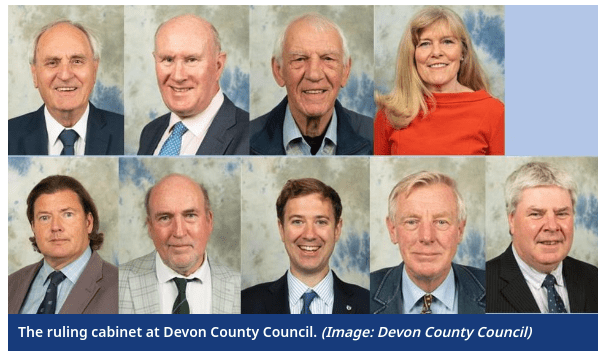
The lack of female Devon county councillors in senior roles is coming under fire.
Just one of the nine members of Devon’s ruling cabinet are women, while men also occupy most of the chair and vice chair positions on various committees.
The council says that despite trying to promote ‘greater diversity,’ around 70 per cent of councillors are men, and parties “put forward who they feel is most appropriate” to various roles.
The issue was raised by independent councillor Frank Biederman (Fremington Rural), who voted against the appointment of chairs and vice chairs at the authority’s annual meeting on Thursday, May 25.
“A great deal has been made of this county council’s move to more [inclusivity], equality and diversity,” Cllr Biederman said.
“And it’s also our mission statement on our website. We’re rightly very proud of our diverse workforce and we’re working to help them.”
The issue was raised by independent councillor Frank Biederman (Fremington Rural).
But he added: “I don’t believe that we do that in our election of chairs and vice chairs, and that’s why I’d like to be recorded as voting against it.
“And just to remind you, we’ve just appointed 25 male vice chairs, chairs and members of cabinet, and only six of those will be female. That’s why I can’t support this.”
In response, a council spokesperson said: “All political groups at the council are asked to put forward chairs and vice chairs for our committees, proportionally to the number of seats held by each group.
“Despite Devon County Council trying to promote greater diversity in all its forms, including the proportion of women to men, the split between male to female councillors is currently around 70 per cent male, to 30 per cent female.
“Ultimately, the political groups will put forward who they feel is most appropriate to the role.”
Meanwhile, Cllr Percy Prowse (Conservative, Duryard & Pennsylvania) has been elected as the new chair of the council.
He will perform the ceremonial role for the next 12 months, which involves hosting full council meetings and representing the authority at civic functions.
Cllr Colin Slade (Conservative, Tiverton East) is his deputy.
Below are the Chairs and Vice-Chairs of some of the important committees.
Remember that the committee members are chosen to achieve “political balance” amongst the political groupings, a complicated operation when it comes to rounding up or down.
The full list of Committees, Boards, Panels and Forums and links to lists of members can be found here.
Given the potential interest and impact of this committee on communities, Owl has included the full list of members, including which ward they represent.
Whilst political balance might be achieved, it is not obvious that geographic representation will be achieved. This has always been the case.
In this case it looks as if the communities in Honiton and Seaton will have to do with near neighbours.
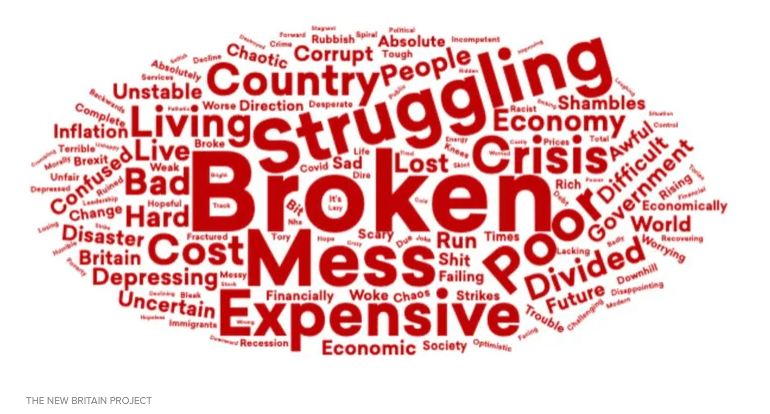
A survey conducted for the The New Britain Project think-tank by More in Common and shared with HuffPost UK has captured the mood of the nation.
The poll asked 2,017 adults between 12 and 15 May to describe Britain in their own words. And the results were not positive.
Of the words picked, “broken” was the top choice, used by 162 people. In second place was “mess” with 118.
The first term rated as positive rather than negative was “rich”, in 56th place with eleven people having chosen it.
Other popular choices included “divided”, “depressing”, “confused”, “bad” and “shit”.
The results prove uncomfortable reading for Rishi Sunak who has just over a year before he has to call a general election.
Sunak’s seven months in office have been against the backdrop of soaring inflation and rolling strike action.
Labour has held a consistent poll lead for months and the results of the local elections earlier in May suggest Keir Starmer is on course to become prime minister.
The most recent YouGov poll showed Labour on 43%, ahead of the Conservatives on 25% and the Lib Dems on 12%.
The mass exodus of Conservatives includes former deputy prime minister Dominic Raab, former culture secretary Nadine Dorries and former chancellor Sajid Javid.
Labour is planning to give local officials sweeping new powers to buy land cheaply and develop on it, as part of the party’s new “pro-building” agenda.
Might be prudent for EDDC to start identifying land on the back of its local plan review. “Doing today what is right for tomorrow” is the aspiration of Clinton Devon Estates’ long term strategy. – Owl
Party sources say that if elected next year, they will pass a law to allow local development authorities in England the power to buy up land at a fraction of its potential cost if they want to build on it.
The new law will allow officials to buy land under compulsory purchase orders without having to factor in the “hope value” – a massive price premium granted to any land on which developers hope to secure planning permission.
Keir Starmer, the Labour leader, is already under fire for his promise to make it easier to build on the green belt. But the details of the party’s latest pro-development policy show he is willing to risk the wrath of existing land and property owners in his attempt to jump-start new building across the country.
One party source said: “We want to rebalance the power between landowners and local communities. We want local areas to capture a lot more of the value that is created when you build on land nearby. The principal is to tilt the balance of power, which right now is tilted towards landowners and not communities.”
Homeownership in England has been falling for years, as prices have risen and banks have asked for increasingly large deposits. In 2003, 71% of all homes were owned by the people who live there, but by 2021-22, that had fallen to 64%.
The Conservatives have attempted to tackle this by offering financial help for new buyers, but the impact of those schemes have been limited by falling supply.
Michael Gove, the housing secretary, has promised a series of planning reforms, but has been hampered by a set of powerful Conservative backbenchers who believe their seats are under threat because of building schemes in their constituencies.
Last year Gove bowed to pressure from those Tory MPs to drop a mandatory target to build 300,000 new homes every year, making it voluntary instead.
Since then, several local authorities have delayed or scaled back their building plans, causing analysts to slash their projections of new housebuilding over the coming years. A study earlier this year by the Home Builders Federation suggested housebuilding in England was set to fall to 120,000 a year – the lowest level since the second world war.
Labour is promising to be “the builders, not the blockers”, launching a series of pro-building policies, including a return to the mandatory 300,000 target.
As part of that, sources say the party would pass a law soon after entering government to allow local development authorities to buy up land under compulsory purchase orders without factoring in the hope value.
Hope value is the price premium attached to land on which planning permission has either been granted or on which developers hope it will be granted. An analysis by the Centre for Progressive Policy in 2018 found that planning permission inflated the price of agricultural land by 275 times, pushing it up from £22,520 per hectare to £6.2m per hectare.
Politicians from the two main parties have argued for years that hope value should be stripped out of compulsory purchase valuations. In 2018 the Tory MP Neil O’Brien called the practice of paying it “highly questionable”, in a report for the centre-right think tank Onward.
O’Brien, who is now a health minister, said: “This has made it prohibitively expensive and complex for the old ‘new towns’ model to be viable. And even where government spends taxpayers’ money on major infrastructure projects, the value of this investment is often not discounted when government buys the land for the infrastructure. The system has become unbalanced.”
Gove has taken up a version of O’Brien’s reforms, but intends to leave it up to the housing secretary at the time to decide whether to eliminate hope value from CPOs on a case-by-case basis. The reforms are part of the levelling up and regeneration bill, currently passing through the House of Lords.
A spokesperson for Gove’s department said: “It will ultimately be for the secretary of state to decide whether a compulsory purchase order can be approved and if the removal of hope value is appropriate.”
Labour argues, however, that this would leave local planning officials relatively powerless to buy up the land they believe is needed for local development schemes, and would also leave the secretary of state vulnerable to sustained lobbying from landowners.
Labour officials are still deciding on the scope of the reforms, and whether they should be passed in the “take back control” bill, which Starmer has promised will be part of his first king’s speech, or whether they should be part of a separate planning bill. They are also deciding on how best the value added by planning permission should be dispersed to local communities themselves.
T1, birch – dismantle and fell. Broad Oak Lodge Ford Lane West Hill Devon EX11 1XERef. No: 23/1022/TRE | Validated: Mon 15 May 2023 | Status: Awaiting decision
Similar wealth taxes in Norway, Spain and Switzerland had helped to reduce inequality and eased the cost of living crisis for some of the poorest people in those countries.
Won’t happen because guess who is on the list? – Owl
A modest wealth tax on the richest 350 families in the UK could raise more than £20bn a year – enough to fund the construction of 145,000 new affordable homes a year – according to research by fairer taxation campaigners.
The campaigners said similar wealth taxes in Norway, Spain and Switzerland had helped to reduce inequality and eased the cost of living crisis for some of the poorest people in those countries. They called on the government to carry out urgent reform of the “fundamental unfairness in the tax system which means that income from work is taxed more than income from investments, rent and inheritances”.
Lukasz Krebel, economist at NEF thinktank, said: “This year’s rich list shows that at a time when so many of us are struggling with the cost of living, the very wealthiest in society continue to thrive.
“Yet this elite group aren’t taxed as much as those of us who earn our living, leaving us with less money to invest in hospitals, schools and parks. We can share the wealth that we all create by increasing taxes on the very rich. By doing this, we can repair our public services, power our future with locally made energy from the wind and sun, and create jobs and thriving neighbourhoods for all of our families.”
The richest 250 families in the UK are sitting on combined wealth of £748bn, according to the annual Sunday Times rich list published last week, an increase from £704bn the previous year.
Those on the rich list include the prime minister Rishi Sunak and wife Akshata Murty at number 275 out of 350, with £529m, and the 32-year-old Duke of Westminster, with £9.9bn, at number 11.
The campaigners pointed out that less than a quarter of the 100 wealthiest people on the Sunday Times rich list appear in the same publication’s annual tax list celebrating those who pay the most tax.
“Because assets are generally taxed at a lower rate than income, many of the wealthiest people in the UK are likely to be paying a relatively low tax rate,” the campaigners said. “However, it should be noted that some on the list with ‘non-domicile’ status or who are fully based offshore for tax purposes may not be paying UK tax on all earnings.”
Robert Palmer, executive director of Tax Justice UK, said: “The growing wealth of those on the rich list highlights the inequality in our tax system, where those who are already wealthy from investments, rent and inheritances are taxed relatively lightly compared to those who get their income from work. It can’t be right that many working people are paying a higher effective tax rate than some of the very wealthiest in our society, especially when we are seeing falling living standards and increasing bills for the majority.
“The government must urgently bring forward reforms to fix our broken tax system, bringing in higher taxes on wealth, so that those who earn the most, and own the most, pay their proper share.”
The number of UK billionaires has increased sharply since the pandemic, from 147 in 2020 to 171 this year, with billionaires now holding about £4bn on average each. There were 15 UK billionaires when the Sunday Times first published its rich list in 1990.
In 2021, the independent Wealth Tax Commission recommended that the government introduced a one-off 1% wealth tax on households with more than £1m, which they said would generate £260bn, more than enough to cover a year’s funding of the NHS and social care spending.
A Treasury spokesperson said: “The UK’s taxes on wealth are on par with other G7 countries and our progressive system means that the top 5% of income tax payers pay half of all income tax, with millions lifted out of paying it altogether.
“We have already built more than half a million affordable homes since 2010 and our £11.5bn affordable homes programme will deliver thousands more right across the country.”
Rishi Sunak has been warned the UK economy could be in recession next year as stubbornly high inflation pushes interest rates to more than 5% before the next general election.
This editorial spells out just how bad things are, (more detail here). – Owl
The Observer view on Britain’s economy: it is very sick, but there are remedies
It has been a week of bad economic news. The latest data from the Office for National Statistics confirmed that inflation has fallen in the UK, but to 8.7%, slightly higher than had been predicted. This triggered a strong reaction in the bond markets, pushing up the cost of government borrowing to almost the same as it was in the wake of Kwasi Kwarteng’s mini-budget that tanked the markets last September.
It is a sobering reminder of the lasting legacy of Liz Truss’s brief premiership. In just 49 days, she and her chancellor undermined long-term investor confidence to the extent that the UK government, once able to borrow at interest rates of almost zero, now faces some of the highest borrowing costs of developed nations, with these costs liable to rise even further as a result of only moderately bad economic news. It means that for the first time in decades, the UK is subject to the same sorts of external market pressures on its investment, tax and spending decisions as much less affluent economies.
The British economy has been subject to the same shocks as others around the world such as the pandemic and the impact of the Ukraine war on energy and food prices. But the UK has fared far worse than its competitors as a result of long-term structural weaknesses and terrible political choices.
The UK was too reliant on financial services to drive its buoyant growth in the 2000s, creating significant regional inequality between London and the south-east, and the rest of the country. This growth masked low productivity in other sectors and an economy too dependent on consumer spending, fuelled by personal debt secured against a housing price bubble, with not enough business investment and spending on skills. These weaknesses were exposed by the world financial crisis of 2008, but instead of trying to redress these imbalances the Conservatives have made the UK’s structural issues even worse.
This is the product of their austerity policies – deep cuts to the welfare safety net, public services and national infrastructure that have not only caused immense hardship in the here and now, but have damaged the long-term productive capacity of the economy. This is evident, for example, in the skills shortages, and in the fact that the pandemic appears to have had a much bigger impact on labour participation rates as a result of people leaving employment due to long-term sickness than in other countries. The UK’s participation rate in the workforce is below where it was before the pandemic, adding to inflationary pressures.
Austerity has been made worse by the hard Brexit pursued by Boris Johnson and other Tory Eurosceptics. By sharply increasing barriers to trade, Brexit has made it more difficult for British companies to grow through exporting and has had a significant depressive effect on growth. It, too, has added to inflation, one study by the London School of Economics suggests that as a direct result of Brexit, British households have collectively spent £7bn more on their food bills than they would have otherwise done since December 2019. All this means that Britain is suffering from the second worst productivity growth in the G7. The impact of these appalling economic decisions will not dissipate when the Conservatives leave office. They will continue to affect the British economy in the long term and will take a new government years to address.
Should Labour win the next election, its shadow chancellor Rachel Reeves will face an unenviable economic inheritance. Unlike in 1997, when the economy and tax receipts were booming, Labour’s overriding focus will have to be how to restore the economy to a healthier growth trajectory in order to fund the expansion of public services and the welfare state the country so desperately needs. That will be a huge task, requiring an ambitious industrial and skills policy. Reeves set out the emerging detail of her approach in a speech in Washington last week. She was reassuringly sober about the scale of the challenge. Labour would pursue an active industrial policy, centred on a £28bn-a-year capital investment programme in greening the economy, and expanding affordable childcare and skills provision to get more people into work.
Improving the productive capacity of the economy from the laggard starting point left by a combination of austerity, Brexit and Truss’s abandoned tax cuts will not be easy. Much will depend on the detail of policy: on exactly how capital investment and extra money for skills will be spent; it is easier to spend money badly than well, and its impact on growth will be a matter of robust policy design. But Reeves is showing how much more she has to offer than the slash-and-burn approach of Truss and Kwarteng, or the acceptance of painfully high interest rates in the absence of any other plan we have seen from Rishi Sunak and Jeremy Hunt.
Britain urgently needs a period of economic renewal, and only a Labour government can deliver that.
Torbay council “appear to want to mark their own homework’”
[Torbay council political composition: Conservatives 19, LibDemes 15, Independents 2.]
Torbay Council’s new Conservative administration has come under fire from its opponents for turning the council into a “one-party state” by appointing its own members to key positions.
But the Conservatives insist they are committed to engaging with the whole council and have chosen the right people for the job.
At an adjourned meeting of the full council on Friday the majority Tory party put forward its proposals for ‘scrutiny leads’ to oversee council policy in a number of key areas. Apart from one experienced Liberal Democrat councillor responsible for children’s services, the party chose four newly-elected Conservative councillors for the other key jobs.
Cllr Cordelia Law (Lib Dem, Tormohun) has the portfolio for children’s services. She said she was “extremely disappointed and saddened” at her colleague’s rejection, and said the appointments went against prime minister Rishi Sunak’s advice. She added: “They appear to want to mark their own homework using inexperienced teachers.
“This administration has not only chosen to put forward all new and inexperienced councillors, but also take the majority of lead positions on the council and give them to those new and inexperienced councillors.”
Cllr Swithin Long (Lib Dem, Barton with Watcombe) said it was traditional for the key roles to be shared more equally among parties and, he added: “Torbay Council is not a one-party state, and an impartial view would determine that these seats are shared out more equally.”
And former council leader Cllr Steve Darling (Lib Dem, Barton with Watcombe) went on: “Having the confidence that you can be held up to scrutiny results in better outcomes for your community. Choosing to exclude other members from that is not a good look.”
But council leader David Thomas (Con, Preston) insisted: “We are looking to work constructively and engaging across the whole council.”
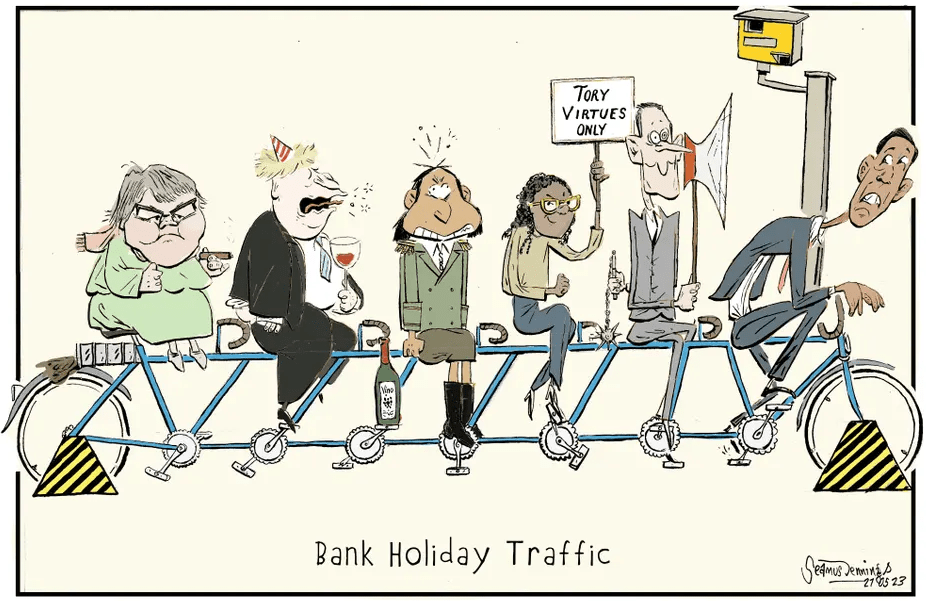
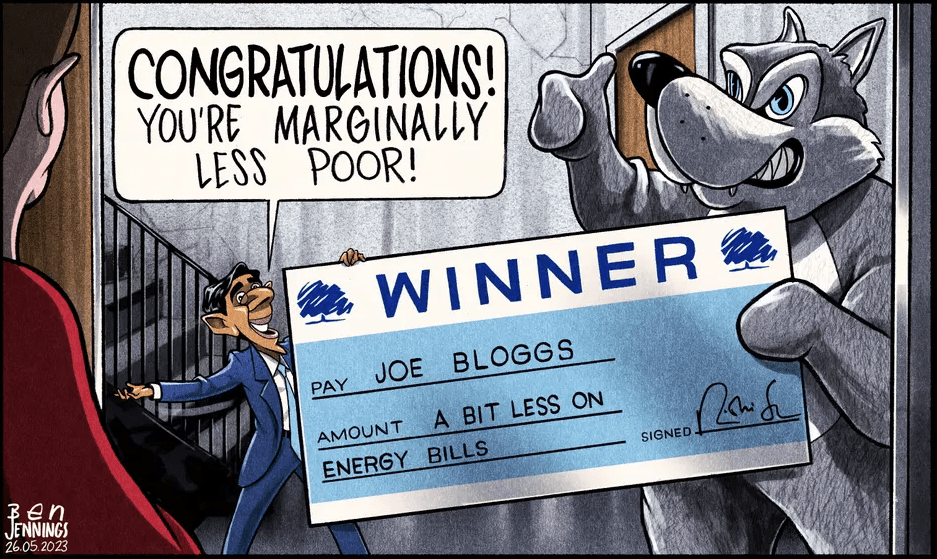
Your cartoons cleverly evoke the broken,stricken nation we’ve become, for all but the rich. www.theguardian.com
…. The tories have created a country where 4 people have the same wealth as 70% of the rest of us…
…where state education and the NHS, once exemplary and heralded as world-beating, have been starved to the point of destruction…
…where we can’t trade with the countries closest to us…
…where our rivers and beaches, which were becoming cleaner under EU regulations and which the leave campaign promised would become yet cleaner following Brexit, are now amongst the filthiest in Europe…
…where 5 million children live in poverty…
…where young people have done what we asked of them and earned top honours degrees only to find they are saddled with enormous debts and can’t afford a home…
…Where the Tories brown-tongued the Russian oligarchs enabling them to buy up extraordinary amounts of British property, launder their ill-gotten gains and accumulate yet more vast wealth which is still funding Putin’s evil war…
…where addictions are rife and where up to two suicides a day are caused by gambling…
…Where the person who threw £30 billion of the nation’s money down the drain is invited to the King’s coronation…
…where, since 2019, 8 Tory MPs have been found guilty of serious sexual misconduct and where many others have been accused or are facing investigation…
…where the most incompetent Home Secretary the country’s ever seen, previously sacked for breaking the Ministerial Code, but who is reappointed by a Prime Minister who then allows her to say asylum seekers are ‘invaders’. He then indulges her yet further to hold separatist meetings where it’s her criticising him, following which she appears to have broken the ministerial code again – but he lets her off Scot free, to inflict more pain, yet again.
We live, in short, in a country where the tories want us to believe that black is white and wrong is right.
We need to reverse it all and prevent them from coming anywhere near the corridors of power for decades, but Blairite devotees aren’t going to do that – not alone…
…With Caroline Lucas, Carla Denya, Adrian Ramsay, Humza Yousaf and Ed Davey keeping Keir focused, however, it’ll be the strongest coalition of the left this country has ever seen…
…And the Tories will be consigned to the sewer where they so belong to be.
Dorset ‘super reserve’ recreates ancient savannah habitat to boost biodiversity
It comes three years after the UK’s first “super national nature reserve” was created in Dorset, knitting together 3,400 hectares (8,400 acres) of priority habitat.
The mighty aurochs have gone, as have the tarpan horses and the wild boars, but modern-day substitutes have been drafted in to recreate a large open “savannah” on heathland in Dorset.
Instead of aurochs, considered the wild ancestor of domestic cattle, 200 red Devon cattle are to be found roaming the Purbeck Heaths, while Exmoor ponies are stand-ins for the tarpan horses and curly coated Mangalitsa pigs are doing the sort of rooting around that boars used to excel at here.
The idea of the project is to create more of the sort of habitat where precious species such as the sand lizard, southern damselfly and heath tiger beetle can thrive.
It comes three years after the UK’s first “super national nature reserve” was created in Dorset, knitting together 3,400 hectares (8,400 acres) of priority habitat. Within the super reserve, 1,370 hectares of open “savannah” for free-ranging, grazing animals as it would have been thousands of years ago is being developed with the cattle, ponies and pigs roaming freely to graze alongside deer to help shape a more diverse landscape with richer habitats.
David Brown, the National Trust’s lead ecologist for Purbeck, said: “Over large swathes of open grassland and heath, these domestic grazers are now mimicking their wild ancestors, who would have shaped habitats in the past.
“We can’t bring back aurochs but we can use our 200 red Devon cattle to graze and behave in equivalent ways. Similarly, Exmoor ponies mimic the actions of extinct tarpan horses, and the quirky, curly coated Mangalitsa pigs are rooting around like wild boars.
“We’re also discovering that by letting them get on with their own thing as much as possible, our grazing animals explore new habitats and discover different types of vegetation to eat – all of which help create a more dynamic and complex ecosystem.”
Large herbivores can play a crucial role in helping plants and less mobile insect species move around the landscape, carrying seeds and larvae on their fur and hooves, or in their dung.
By giving cattle, ponies and pigs this landscape to wander around, they are helping rare and threatened species such as Purbeck mason wasps, and heath bee-flies disperse and build stronger populations.
Brown said: “Grazing in their own individual ways, these animals are slowly forming diverse, wildlife friendly habitats. Cattle are untidy eaters, leaving messy tussocks perfect for insects; pigs turn over the soil and help sand lizards burrow; and ponies nibble tightly down to the ground creating grassland lawns full of specialist flowers such as stork’s-bill and waxcap fungi.
“These grasslands can be really important for pollinating insects, too, including rare mining bees. It’s the perfect mix of habitats in which biodiversity can thrive, and a great landscape for people to also roam freely.”
There have been some unexpected consequences. Peter Robertson, the RSPB senior site manager, said: “What has come as a surprise is how they have created new ponds by wallowing in water-logged areas and have opened up areas of salt marsh by foraging for shellfish.”
The Purbeck Heaths super reserve, which is to be the base for BBC Two’s Springwatch from Monday, is a mosaic of lowland wet and dry heath, valley mires, acid grassland and woodland, along with coastal sand dunes, lakes and salt marsh.
Already one of the most biodiverse places in the UK, it is home to thousands of species of wildlife, including all six native reptiles – the adder, grass snake, slow worm, sand lizard, smooth snake and viviparous lizard.
Liberal Democrat councillor Luke Taylor, who represents Bradninch, was elected at the authority’s annual meeting on Wednesday [24 May].
His party romped to victory at this month’s local elections to take control of Mid Devon, gaining 22 new seats to replace the Conservatives as the largest party.
Speaking after his election, Cllr Taylor said: “I promise the residents of Mid Devon that we will bring stability to [the] council. We will give the council a new start. We have an ambitious manifesto that we will now get on with delivering.
The new administration’s priorities include building more social housing, protecting leisure services, increasing recycling and meeting the council’s 2030 net zero target.
“We will also take steps to ensure the council is more open and transparent in its decision making,” Cllr Taylor said. “For too long discussions and decisions which could have taken place in public have taken place behind closed doors. We will look at ways of opening up the discussion at meetings to the public.”
He added: “As a working father of young children, I know how much time being a councillor takes, so we will be looking at how to involve a more diverse range of people.
“It is not acceptable that to participate in local democracy you need to be retired, wealthy or self-employed.”
Cllrs Simon Clist (Lib Dem, Upper Culm) and Jane Lock (Lib Dem, Canonsleigh) will serve as the new leader’s deputies.
Meanwhile, Lib Dem county and district councillor Frank Letch (Crediton Lawrence) was elected to be the council’s new chairman and promised to use his year in the role to encourage more people to vote.
“I found the turnout of voters at the recent council elections very disappointing,” he said. “This council is spending local people’s money and we have to convince them that participating in elections is in their interest.”
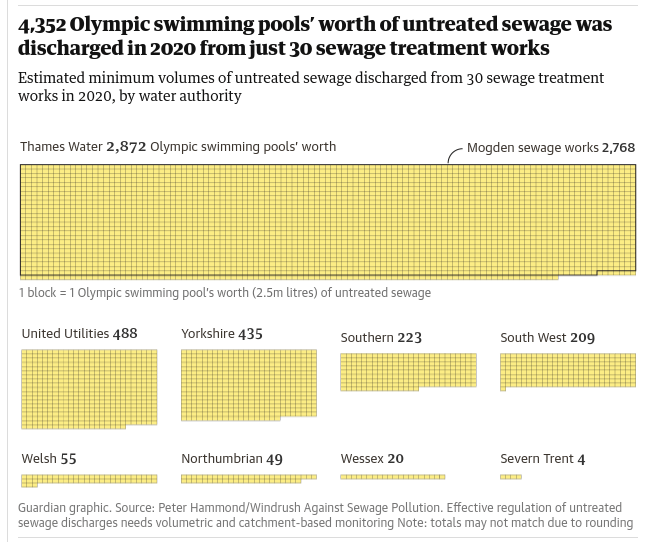
That’s 4,352 Olympic sized swimming pools of raw sewage from just 30 water treatment works out of a total of more than 7,000.
What a lot of whoopsies! – Owl
“It is extraordinary to see estimates of the volume being discharged. I am very disappointed that the government did not follow the recommendations of the environmental audit committee and make water companies fit volume monitors.” [David Clayden of the Harrogate Flyfishers’ Club and a member of the Nidd Action Group,
“I would never vote to pollute our water…….I voted for a crackdown on sewage spills.” [Simon Jupp MP]
Here are some more of Simon’s comforting words:
“….In recent years, a spotlight has been shone on storm overflows and CSOs. Water tourism is booming across our region, including windsurfing in places such as Exmouth and Sidmouth in my constituency. However, there is another reason why people have finally started talking about the issue: the Conservative Government have put in place a plan to improve our water, giving us all an opportunity to hold water companies to account.”
And:
“……Of course, in a perfect world, we would stop sewage spills completely and immediately. Sadly, that is virtually impossible in the short term; because of the pressure on our water infrastructure, we would risk the collapse of the entire water network, and the eye-watering costs involved mean we would need not just a magic money tree, but a whole forest.” [Simon Jupp MP leading his Westminster Hall debate on South West Water]
30 water treatment works released 11bn litres of raw sewage in a year, study suggests
Eleven billion litres of raw sewage were discharged from a sample of 30 water company treatment works in one year, new research suggests.
The study aimed to reveal the volume of discharged effluent released from storm overflows by water firms. Companies are not forced to reveal the volume of raw sewage released during discharges. They are only required by regulators to provide data on the number of discharges and the length of time they lasted.
Recommendations by MPs on the environmental audit committee that volume monitors be installed by water companies have so far been rejected by ministers.
In a study of 30 treatment works in 2020 run by nine of the 10 water and sewerage companies in England and Wales, the volume of raw sewage discharged was estimated at 11bn litres – or the equivalent volume to 4,352 Olympic pools.
Hammond said it was vital to establish the volume of sewage discharges by water companies. He said his research suggested the government’s target to reduce raw sewage releases to 20 per year by 2025 was not robust because there was no requirement to reveal the volume of raw sewage discharged for each release.
“There is still no data readily available showing the volume of untreated sewage discharges,” he said. “Water companies have some idea, but the regulators [Ofwat and the environment agencies in England and Wales] and the government [the Department for Environment, Food and Rural Affairs] probably have no idea. Sewage detritus in rivers, on beaches and in seas offers clues but may not reflect the volume of discharges.
“So what is the potential discharge volume for 20 spills per overflow per year?”
Of the 30 treatment works analysed, only one – Mogden sewage treatment works in west London – has volume monitors fitted. In 2020, Mogden, which serves more than 2 million people, released a volume of raw sewage equivalent to 2,768 Olympic pools.
The average volume of sewage discharged per spill from the other 29 treatment plants in 2020 was 1.3 Olympic pools. The government target of 20 spills per year by 2025 would therefore still involve huge volumes of untreated sewage, according to the analysis.
“Even if the government’s storm overflow discharges reduction plan target of 20 spills per overflow per year were to be achieved, some treatment works could still discharge a volume equivalent to 26 Olympic pools of untreated sewage annually,” Hammond said.
Measuring the volume of discharges was vital to establish the environmental impact of them upon rivers, he said. “Individual rivers receive direct, simultaneous discharges of untreated sewage from multiple storm overflows on their journey from source to sea,” Hammond said. “So, during longer spills, the lower reaches of a river may already be polluted from upstream discharges when yet more overflows downstream discharge untreated sewage.”
The River Nidd in North Yorkshire, one of the river catchments studied by Hammond, receives untreated sewage discharges from at least seven treatment works. Calculations were possible on estimated volumes for four treatment works: Pateley Bridge, Harrogate North, Darley and Kirk Hammerton. Hammond estimated the river received an equivalent of 317 Olympic pools of raw sewage from those works in 2020.
David Clayden of the Harrogate Flyfishers’ Club and a member of the Nidd Action Group, said he saw no reason water companies could not reveal the volume of raw sewage being discharged into rivers. The group is carrying out testing on the river helped by the University of Leeds. They are working on an application for bathing water status for a section of the Nidd known as the Knaresborough Lido, to drive a clean-up.
“There is a real buzz about this issue here as there is nationally,” he said. “It is extraordinary to see estimates of the volume being discharged. I am very disappointed that the government did not follow the recommendations of the environmental audit committee and make water companies fit volume monitors.”
Data from treatment works run by Welsh Water that feed into the Conwy, a sea trout river in north Wales, was also studied. Hammond estimated the volume of discharges from both inlets and storm tank overflows was an equivalent to 34 Olympic swimming pools.
Volumes at the 29 treatment works that did not have monitoring were estimated in one group by calculating the difference between flow meters at the inlet where raw sewage arrives and outlet where treated effluent is discharged. During spills of raw sewage, Hammond estimated the volume of raw sewage being released rather than treated, as the difference between the two meters.
At another group of treatment works Hammond had to estimate the volume by analysing data from overflow weirs, start and stop times on event duration monitors and flow to treatment meters – something he accepts was the least reliable approach.
A Yorkshire Water spokesperson said: “In the short time we’ve had to review this report we’ve identified several industry-wide claims we don’t recognise … The report focuses on potential impact of storm overflows at Pateley Bridge, Harrogate North, Darley and Kirk Hammerton. We are aware of an instrument issue that was identified in the 2020 Pateley Bridge return, which overinflated discharges from the 6x overflow and paints a false picture of the overflows.
“This monitoring is being replaced and was discounted in the 2021 and 2022 returns. Storm overflows are not identified by the Environment Agency as reasons for these sections of the Nidd not achieving good ecological status. The assessments suggests that where Yorkshire Water can make a difference is in reducing phosphorus from final effluent of wastewater. That is why we are investing £790m by 2025 in phosphorus removal.”
Royal Marines from the Commando Training Centre, in Lympstone, Devon, came to the aid of Ms Pinfold
Hilary Pinfold, from Newton Poppleford in Devon, said she contacted the local barracks and was “delighted” when more than 40 marines turned up to help.
Dane, one of the marines, said it “feels good” to be able to help the local community.
A 6ft (1.8m) wall in Ms Pinfold’s garden collapsed during the downpours, and the downstairs of her house was also flooded.
Ms Pinfold’s garden following the flood
“We were getting a bit downhearted at the weekend about the amount of work that we’ve got to do and didn’t see, even with volunteers, how we could get it done,” she said.
Ms Pinfold, a nurse, said she made a phone call to the local barracks, Commando Training Centre, Lympstone, after a friend suggested they might help.
Royal Marines helped to build a sandbag wall to offer some extra protection to the garden
“What they’ve done in just a few hours is amazing, it would’ve taken weeks.
“This is part of what King Charles III said in his Coronation mandate, that he wanted to see communities working together and I think that’s what you’re seeing here.”
Newton Poppleford was badly hit by the flash flooding
Matthew, one of the commandos, said: “She needed help digging up all the mud that came through from the farmer’s field.
“It [the garden] looks quite good now, but it was quite a mess when we first got here. It was under a lot of mud and we just had to shift it out the way.”
Ms Pinfold said builders were expected to start work on her house in late June.
Medical care and surgical services at the Royal Devon & Exeter Hospital (RD&E) and North Devon District Hospital (NDDH) have been rated as ‘requires improvement’ following an unannounced inspection instigated by 16 ‘never events’ being reported at the sites between March 2021 and November 2022.
Never events are serious, largely preventable patient safety incidents that should not occur if healthcare providers have implemented existing national guidance or safety recommendations. It promoted independent health and social care regulator Care Quality Commissions to inspect the hospitals at the end of 2022.
Areas of concern found included a ‘high number’ of staffing shortages, long increasing waiting lists, surgical outcomes not always meeting national standards, action not always being taken quick enough for patients at risk of deterioration and significant challenges with the new integrated electronic patient record system.
The results of the inspection of diagnostic services, published today, May 26, state the RD&E has declined from a rating of ‘good’ to ‘requires improvement’ overall for medical care. It was rated as requires improvement for being safe and well-led. Effective, caring and responsive categories were inspected but not rated.
Surgery at both locations, dropped from good to requires improvement overall as did the ratings for safe and well-led. How responsive, caring and effective the service is was inspected but not rated. Medical care at North Devon District Hospital remains requires improvement overall. It was rated as requires improvement in safe and well-led. Effective, caring and responsive were inspected but not rated.
Diagnostic imaging at both locations was rated as good overall. It was also rated as good for being caring, responsive and well led, and requires improvement for safe. As per all CQC inspections, diagnostic services were inspected but not given a rating for how effective they are as it is not usually used for treatment.
This is the first inspection of the trust since the Royal Devon and Exeter NHS Foundation Trust and Northern Devon Healthcare NHS Trust merged to form the Royal Devon University Healthcare NHS Foundation Trust in April 2022. The aim of the merger was to combine resources and expertise to provide acute, community and specialist services across North Devon, Mid Devon East Devon and Exeter.
Corporate and clinical services are in the process of being merged. The inspection was one of a number of CQC visits that will form the Royal Devon’s overall trust rating.
The trust had a separate well-led inspection earlier in May which looked at the leadership and governance of the organisation. A further report and an overall trust rating is expected in the coming weeks.
Cath Campbell, CQC deputy director of operations in the south, said: “Our inspection of Royal Devon University Healthcare NHS Foundation Trust was prompted by concerns about the number of never events that had taken place. Although we understand the pressures that healthcare providers have faced, and continue to face, never events are precisely that – they should never occur.
“If they do, it’s important they are thoroughly investigated to ensure they don’t happen again. Once an investigation has taken place learning should be shared with all staff and that wasn’t always happening.
“The trust had mitigated risks by putting in place a never event investigation report. While individual investigations into each never event had taken place, the trust also recognised the need to join up the learning and communicate this between all trust locations as it wasn’t currently happening.
“Inspectors found staff knew how to safeguard people. They also treated people with kindness and compassion, considering their individual needs and preferences.
“Following the inspections, we reported our findings to the trust. Its leaders know what they need to do to improve services, and where there’s good practice on which they can build on.”
The inspection report does not reveal details of the 16 never events that were reported by the trust. The concerns highlighted by inspectors include:
The service had a high number of vacancy rates at all levels. There was a high reliance on a locum workforce. Due to the shortages on most shifts, some people had to wait longer to receive help with food and personal care.
In medical care, people’s documentation and risk assessments were not always completed. This meant staff did not always identify or act quickly enough for patients at risk of deterioration.
In medical care staff did not always know if people had enough food and drink to meet their needs and improve their health as it was not recorded.
In surgery, outcomes for people did not always meet expectations based on national standards. The surgical division was under pressure with long waiting lists which were increasing.
In surgery and medical care, there were challenges with the new integrated electronic patient record system as a complete oversight of the service provided was difficult. Some audits that were required had been postponed during the pandemic and the results were currently unavailable due to the introduction of a new integrated electronic patient record system. This did not give sufficient oversight of performance and how to improve.
Staff were not always competent in using the new integrated electronic patient record system.
At the safety and risk meeting in October 2022, the trust acknowledged they were not completely assured that all the steps identified to minimise the amount of never events, were being taken. While individual investigations were completed, the trust did recognise the need to join up the learning and communicate this between all trust locations.
However, inspectors also praised the hospital in a number of areas. Inspectors note people didn’t stay in hospital longer than they needed to as managers and staff started planning each person’s discharge as early as possible.
Staff were said to be open and honest and understood the duty of candour. They gave patients and families a full explanation if and when things went wrong.
If staff were concerned about people’s mental health, it was noted the service had 24-hour access to mental health liaison and specialist mental health support provided onsite by the local mental health trust.
In diagnostic imaging services, inspectors found staff were discreet and responsive when caring for people. They took the time to interact with people and those close to them in a professional, respectful, and considerate way – to ensure people understood every issue.
Chris Tidman, the trust’s Deputy Chief Executive Officer, said: “We are pleased that our diagnostic imaging services have been rated good. We are of course disappointed by the results in our medical and surgical services, however, we feel it is a fair reflection of the challenges the trust and our teams were under at the time of the inspection.
“We are a learning organisation and we welcome feedback from the CQC and their response to our never events, which will help us to continuously improve our services for our patients and communities. We are reassured that the majority of the areas for improvement were already known to us, and work is underway to raise standards and performance.”
The report describes the challenges caused by the rollout of the trust’s electronic patient record.
Chris said: “Epic brings us huge opportunities to modernise the care we provide to our patients, but with a new system of this size we always expected it to take time to become embedded, so we were not surprised to see this reflected in the report.”
Inspectors also highlighted how patients were treated with compassion and kindness, and examples of positive-team working, staff feeling empowered to raise concerns and treating patients according to their individual needs.
Chris added: “As a leadership team, we are extremely proud of our staff and we encourage them to be proud too, of everything they do every day for our patients.”
Ministers have appointed external commissioners to in effect take control of a Surrey council with debts expected to reach £2.4bn – 100 times its annual net income – after spending heavily on commercial property.
The council, which was run by a Conservative administration when the investments were made but now has Liberal Democrat leadership, said it welcomed the move as the “challenges are so significant that the council and its officers cannot deal with these on its own”.
We will be living with Conservative legacy problems such as this for years to come. – Owl
Woking borough council, which spends £14m a year and has an annual net income of £24m, now has a total debt of £1.9bn. But it is forecast to hit nearly £2.4bn by 2024-25, a written statement from Lee Rowley, the junior levelling up minister, said.
The council, described by Rowley as the most indebted council in England compared with its financial resources, risks effective insolvency after a surge in debt interest costs on its investments including a shopping centre, residential tower blocks and a 23-storey Hilton hotel.
In February, Woking said it was at risk of issuing a section 114 notice, which signals insolvency. Councils cannot technically go bankrupt, but such a move obliges central government to intervene to ensure local services are sustainable.
Rowley’s statement said the council faced “the most challenging financial position of any local authority in England”, and that his department had increasing concerns about the size of the debt and how it was being managed.
In January, the levelling up department commissioned three experts on local government to carry out an external review. While this has not yet been published, and is likely to be redacted in part due to commercial sensitivities, Rowley quoted it as concluding that there “is no realistic route to the council returning to financial sustainability alone”.
He has thus appointed the same three experts to become commissioners with wide-ranging powers over the council, including financial and commercial decision-making, and restructuring the authority.
They are Jim Taylor, who was chief executive for three metropolitan councils; Carol Culley, the deputy chief executive of Manchester city council; and Mervyn Greer, a senior Cabinet Office official with responsibilities for local government.
The decision to appoint the three, taken by Michael Gove, the communities secretary, “reflects the acute situation in Woking and the urgent need for commissioners to begin work immediately to ensure that the council takes steps to secure compliance with their best value duty”, Rowley’s statement said.
The council, which was run by a Conservative administration when the investments were made but now has Liberal Democrat leadership, said it welcomed the move as the “challenges are so significant that the council and its officers cannot deal with these on its own”.
Ann-Marie Barker, its leader, said: “My administration is very clear about the huge challenges facing the council due to the legacy of both the extraordinarily high and disproportionate levels of debt that we have inherited from the previous administration. We are also very clear and focused on the significant risks that the council is now facing up to as a result of that debt.
“We also recognise that these challenges are so significant that the council and its officers cannot deal with these on its own. We therefore fully acknowledge and accept the findings of the report and welcome the support set out by the minister in his letter.”

 Lower Woodbeare Farm Kentisbeare Devon EX15 2DDRef. No: 23/1092/FUL | Validated: Fri 19 May 2023 | Status: Awaiting decision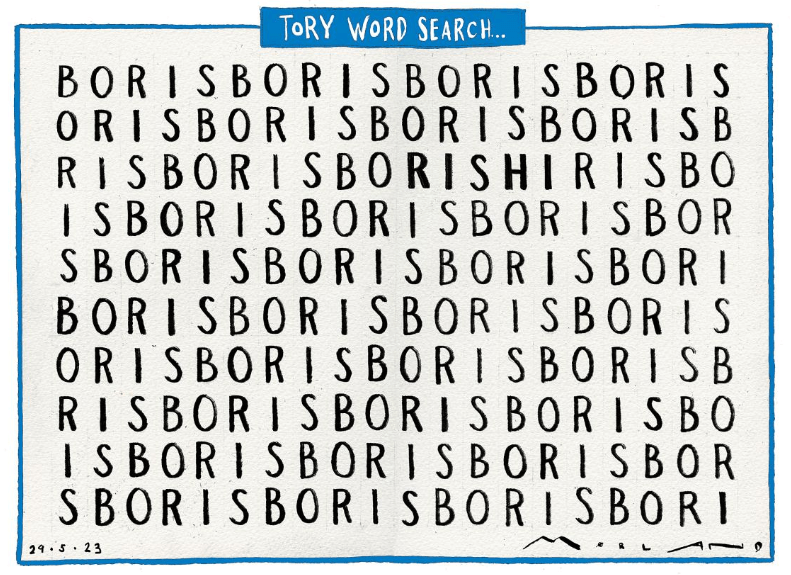



 East Devon Watch