Honiton mayor determined to keep his seat amid petition to disband town council

Emergency councillors could be drafted in to lead Honiton Town Council if a petition to dissolve the authority is successful, according to:

https://www.midweekherald.co.uk/news/honiton-mayor-reaction-to-council-petition-1-6522324

The petition was launched by a group calling itself ‘Honiton Residents’, and is demanding that all town councillors resign from the council to allow for a new election to take place.

However, the petition looks set to fail – as town mayor Councillor John Zarczynski has resolutely stated he will not relinquish his seat.

When asked by the Herald, Cllr Zarczynski said: “No, why should I?”

Cllr Zarczynski said a very small group of people in Honiton are spreading ‘misinformation’ around the town to discredit the council, and personal agendas are being publicised on social media platforms.

Accusation have been aired of infighting and bullying in the council, but Cllr Zarczynski said the only bullying taking place is by a handful of people on social media.

He said: “This petition has been inspired by people not knowing the true facts and stems from the misinformation they have been fed.”

A spokesman for East Devon District Council said: “If Honiton Town Council were to become inquorate then there is a procedure which would allow East Devon District Council to appoint temporary councillors who would be in office while a new set of elections were taking place.”

Owl: no doubt a procedure as opaque as a brick wall – step forward the “great and good” of Honiton!

More details can be found in a succession of three (maybe more by now) post here:

https://honiton.nub.news/n/petition-calling-for-honiton-town-council-to-resign-gathers-traction

Town shows ‘love for Shandford’ as Budleigh battles to save care home

Families of vulnerable pensioners being cared for at a soon-to-close care home in Budleigh Salterton came out in support for an SOS campaign to Save Our Shandford.

Owl comments at the end.

Becca Gliddon East Devon News:

/2020/02/18/town-shows-love-for-shandford-sos-meeting-uncovers-relatives-anger-as-budleigh-battles-to-save-care-home/

A drop-in public meeting held on Friday evening at Budleigh’s football club was to glean interest in forming a Friends of Shandford group with the aim of setting up a Community Interest Company, to allow the care home to continue, and its residents to remain.

The town has come out in support of Shandford since Abbeyfield, who took over the site in 2012, announced its decision to close the care home, saying it was no longer viable to run.

Friday’s meeting tested the waters for setting up a Community Interest Company for Budleigh to run Shandford as a not-for-profit community venture.

The public was invited to pledge their time volunteering, helping with Shandford’s day-to-day management and maintenance, or giving a small annual subscription.

Abbeyfield said its decision to close Shandford, moving residents out by the end of March, followed a ‘lengthy consultation’, which concluded it was ‘not a viable option’ to keep the home open.

Relatives of residents living at Shandford have hit out at Abbeyfield’s decision to close the home, showing support for the SOS campaign, attending Friday’s public meeting.

Shirley Ann Woodman’s mother-in-law Ivy Woodman, aged 91, who retired to Budleigh, suffers from dementia and must leave Shandford when it shuts.

“She’s devasted,” said Shirley Ann, of Isaac Close, Otterton, “I am absolutely dreading settling her in somewhere else. She took a little while to settle in there, but that’s normal. To have to do it all again, that’s criminal.

“She’s very distressed. She has dementia. She knows it’s closing, I had to tell her. It’s all she talks about now.”

Gerald Moyle, 89, who also has dementia, moved from East Budleigh to be cared for at Shandford, and is visited regularly by his wife, Kathy, aged 77

Kathy said: “It’s heartbreaking. They are forcing us to move them out so quickly. I have told Social Services my husband’s not going anywhere. They can’t force us out.

“It’s the underhandedness. It’s all about money and greed at the end of the day.

“Nobody knows what’s going on, it’s fishy, it’s so smelly. You can’t say something isn’t viable unless you provide evidence.”

A confidential transfer agreement means Abbeyfield must hand Shandford back to the town.

The hope is to protect the home from sale or development, and for it to be owned and managed by Budleigh’s community.

Setting up a steering group is the first step to forming a Community Interest Company, to safeguard Shadford’s future, SOS organisers said.

The public meeting was an opportunity for people to pledge time, money, or express and interest in helping.

Helen Tickle, a spokeswoman for Save Our Shandford said there would be other opportunities for people to pledge support.

She said: “I have been very encouraged by the amount of love there is for Shandford in the town.

“Almost everybody you meet, their lives have been touched by Shandford in some way.

“My feeling is there’s sufficient support, but there are other options on the table.”

The SOS campaign said it was ‘last chance saloon’ for the care home after Abbeyfield gave notice of its intention to close the home.

Without sufficient support, the closure of the ‘valued’ home will be ‘inevitable’, and its 25 residents forced to move out of the town – four who are more than 100 years old.

“It doesn’t matter where these people have come from, they are residents of Budleigh Salterton, said Helen. “I feel as neighbour I have to do what I can for them.”

Shandford was set up on 1958 for and was run by a management committee of trustees until 2012, when Abbeyfield took over.

Shandford’s most recent Care Quality Commission (CQC) inspection found the home to be Good.

Abbeyfield said it was ‘with great regret’ it had to close Shandford, saying the decision was taken after a lengthy review of the service.

A spokesman for Abbeyfield said: “ This decision follows a lengthy consultation period in which we carefully considered the future of the home.

“A group of local people, made up of former professionals in areas including care home management, finance, property and law, undertook a detailed review of the infrastructure, building condition and financial performance of the home.

“Unfortunately, they also concluded that keeping the care home open was not a viable option.”

The spokesman added: “We will now work with residents, their loved ones and all the relevant authorities to find residents a suitable new home that will meet their individual care needs.

“Our priority at all times remains the comfort and wellbeing of residents and we are committed to supporting them throughout the closure process. We hope to complete this process by 31st March 2020.”

Owl’s correspondents say that Simon Jupp MP promised that he would put the questions residents’ relatives and concerned local people made to him the previous Friday to Abbeyfield. They understand this meeting took place elsewhere, at the same time as the drop-in. As yet no information on the outcome has been released.

Owl thinks it is worth reiterating some of their main concerns. Lack of transparency over who authorised and conducted the “local review” which concluded that keeping Shandford open was not a viable option. Local opinion finds the conclusion on non-viability runs counter to perception. The building was bought by the local community in the fifties and is unencumbered by debt. It has been reasonably maintained and, although, some further, modest, improvements are needed there is no immediate pressure to undertake them. The CQC report is good, it is full of contented residents and their relatives say that the charges are modest compared to the competition (i.e there could be scope for modest increase in income if that is a problem). It has a low staff turnover and the current manager has increased staffing levels to reduce the need for  expensive agency staff. Shandford is also the beneficiary from a recent legacy. Lastly, locals don’t see anywhere else in Budleigh where the assets released by a sale could be employed to provide residential care for the local elderly.



Wages back above pre-economic crisis levels – peanuts!

Owl finds that the real increase in wages since the crash in 2008 isn’t peanuts. It’s far less than that. It will take an average wage earner three weeks to to buy a packet on the increase!

Andy Verity Economics Editor BBC

It’s always good to have some cheerful news to report, such as the news that wages, after stripping out the effect of inflation, have finally squeaked above their level in March 2008. In other words, your wage can finally buy a little bit more than it could before the banking crisis. So let’s celebrate. Hooray.

Now let’s home in on the amounts. The average wage excluding bonuses is now £511.61. In March 2008, the average wage would have bought you £510.96 (in 2019 prices). In other words you are 65p better off than you were – 12 years ago.

There’s always a half-full or a half-empty angle on wage increases. But to many workers, this minor economic landmark will serve less as a cause for celebration and more as a reminder that the past decade has been the worst for improvements in living standards in more than 200 years.

The 2008 crisis, caused in part by reckless mismanagement of the banks, is one reason (not the only one) that the average pay packet has failed to do what we used to take for granted – i.e. increase by more than inflation.

It used to happen every year. Low-pay think tank the Resolution Foundation points out that if pre-crisis trends for increases in pay in real terms had continued, the average wage would now be £141 a week higher.

Exeter set for 2,500 job-boost as developer buys historic park (in East Devon)

Yet another “job-boost” headline. Owl doesn’t think this is particularly good news except for developers.

As a region and a nation we have very high levels of employment, which is undoubtedly good news. In these circumstances it is not clear to Owl just what the benefits of pursuing relentless job creation actually are. This is the policy of the Greater Exeter Strategic Plan. EDDC’s Local Plan is also based on a jobs led scenario (which they don’t seem to be achieving).

In Owl’s view this is too simplistic, more jobs do not equate to more prosperity. But it’s an easy measure and, as in this case, a headline grabbing one.

Owl has been told that economic growth (if that is what is meant by increasing prosperity) is achieved by a combination of increases in the number of people in work, how many hours they work, and how productive they are. The first two are often rolled together so that, in simple terms, economic growth is driven by growth in working population and productivity.

The Heart of the South West (HotSW) is set on doubling our economy over the next 20 years. (Owl has reported many times on the lack of realism in this aim.) And HotSW acknowledges that most of this will have to come through growth in productivity, not in jobs. Demographic growth in the working age population, including inward migration, is projected to be really low. Are the Planners aiming at the wrong target?

Of course it is good news for developers, and where would we be without them?

Here is the story:

https://www.devonlive.com/news/devon-news/exeter-set-2500-job-boost-3860783

Burrington Estates revealed its £80m vision to re-invigorate the historic site in October.

A commercial regeneration specialist and luxury homebuilder has bought an historic estate in Devon to kick-start a major project and a huge 2,500 jobs-boost for the region.

Burrington Estates has recently the purchase of Winslade Park, in Clyst St Mary, which is set in 86 acres of parkland on the outskirts of Exeter.

The buy, which includes an 18th century Grade II-listed manor house, is the first step towards plans to provide 150 new homes and 125,000 ft of commercial office space at the heart of a new purpose-built community.

It will also be home to a £5m leisure complex with fitness studios, gym, spa facilities, beauty salons and a swimming pool.

Mark Edworthy, Group Managing Director at Burrington Estates, said: “Our Company’s vision is To Create beautiful living and working environments, build enduring communities and to improve quality of lives.

“Winslade Park provides the perfect platform for us to express our vision as it is a development that will genuinely create an enduring community and improve quality of life of all people living and working in this stunning parkland setting.”

Burrington Estates’ purchase of the site, which has been unoccupied since 2015 and was previously owned by insurance giants Aviva, comes as a result of a major collaboration between key partners.
Former Exeter Chiefs and England international rugby player, Tom Johnson, will run his new personal coaching gym ‘Number 6’ in the manor house under the Tom Johnson Leisure brand and will be consulting on the leisure complex.

Tom said: “We are delighted to be joining the Burrington Estates team to deliver a unique wellness and lifestyle offering at Winslade Park. Health and wellbeing has a hugely positive impact on all areas of life and our aim, together with Burrington Estates, is to ensure that it is as accessible and enjoyable for everyone to get the very best in health and fitness services.

“Be it fantastic personal coaching, a state of the art gym, a spin studio experience, fitness and holistic classes, superb family leisure, outdoor training facilities, health walks, team sports, lifestyle focussed food and drink offerings and many other ways to improve both your body and mind.”

Real estate consultants Lambert Smith Hampton and corporate advisers James Lang LaSalle (JLL) brokered the sale and East Devon District Council provided crucial support for the plans.

Tony Fisher, Head of Exeter Office at Lambert Smith Hampton said: “Winslade Park will be the only campus ‘business community’ throughout the South West, offering staff a truly unique environment in which to work. A country park setting offering 21st century facilities for businesses to attract and retain their employees within an environment which inspires creativity, increased productivity together with wellbeing and lifestyle. “

Council planners have already granted permission for much of the proposed development, with further applications due to be submitted early next month.

The public consultation is said to have completed with ‘immensely positive feedback’ from local residents and reparation and refurbishment work is set to start at the end of March.

Andrew Pearce, Director at JLL said: “Great to see this hidden jewel in Exeter’s and East Devon’s office stock brought back into use. Formerly a gated headquarters site it will be reopened as a placemaking smart office campus to cater for the unsatisfied demand for modern efficient workspace.

“Placemaking is the buzz word in the office sector, whether businesses are looking for WeWork space in London or Business Parks in the regions. Winslade Park ticks all the boxes. This former HQ campus is being restored and revamped and will provide full leisure and gym facilities spa and swimming pool, club restaurant and conferencing trim trails riverside walks and cricket ground and new pavilion for the local club. As well as the latest smart offices”.

Ritchie Watson, lending director at specialist financiers Together who have provided £7m to assist the purchase of the mixed-use site said: “When we first saw the ambitious plans for this mixed-use campus development at Winslade Park we were impressed.

“It will provide fantastic new, luxury homes on the same site as high-quality offices and leisure facilities. In addition, the major project will bring new 2,500 jobs, having a great impact on the wider city and region, and we were delighted to have been able to provide finance to support the impressive scheme.”

Devon County Council’s proposed new budget is not a good deal for residents

County Councillor Martin Shaw responds to John Hart’s “triumphalist” presentation of the DCC budget.

DCC’s leader John Hart and Chief Executive Phil Norrey are selling the budget which will be proposed on Thursday as a good deal, even the best in years. However essentially we have a standstill on services, more spending on administration and a big increase in council tax. What’s not to like?

https://seatonmatters.org/ posted on February 18, 2020

  • There will be more spending on adult social care and children’s services – but only to keep pace with demand, not to improve services.
  • 70 per cent of the Council’s spending will go on 3 per cent of the population – less than 10,000 vulnerable old people and 5,000 vulnerable children.
  • Council tax will rise by 3.99 per cent, well ahead of wage inflation at 2.9 per cent, another above-inflation increase after many years of them. The Government says it’s not increasing taxes – but by underfunding councils, it’s forcing us to increase council tax,
  • On top of this, because the Government has prioritised Brexit and hasn’t announced its medium-term spending plans, DCC is keeping more in reserves than it really needs, rather than spending on services or keeping council tax down, in case the Government lets us down.
  • And of course, we’re putting up council tax this year because next year it will be election year, and the Tories won’t want to go into the County elections with another big rise.
  • Obviously it’s right that the Council should ensure that those with the greatest needs are properly looked after. But it’s not right that most residents should pay more and more every year in return for fewer services. The Council’s own community survey shows many people complaining about this – and they are right.
  • There will be a small above-inflation rise in Highways spending – this is welcome. But other services will see no real increase, while the Council’s corporate services will get a big rise. That’s not right.
  • I’m specially concerned about libraries. The Council is rightly proud of keeping all 50 libraries open. But we are expecting a further drastic fall in book issues, from 2.4 to 2.2 million, over 8 per cent, after years of similar falls. The Council seems to think books don’t matter so much, but if we keep on like this, the core function of our libraries will be dead within a decade.
  • It’s time to put some money back into services that can benefit everyone. That’s what I shall be looking for on Thursday.

‘Best budget in a decade’ will see Devon council tax rise by 3.99 per cent

Following the previous post we now have the “you’ve never had it so good” news , well not since……… :

Council tax in Devon is set to rise by 3.99 per cent to help pay for what has been called ‘the best budget in a decade’.

Devon County Council’s cabinet on Friday morning (February 14) unanimously recommended to next Thursday’s full council meeting their budget plans, which will see the council’s spending will rise by £43.1 million from £498 million in 2019/20 to just over £541 million.

There will be an extra £23.7 million for adult care and health, £11.5 million more for children’s services and £2.7 million for highways including £1 million to help deal with drainage issues on the road network, with an increase of 8.7 per cent on spending year-on-year.

The spending rise will partly be funded by a £1.7million increase in the final Local Government financial settlement for 2020/21, but also by a proposed 3.99 per cent rise in council tax.

The proposed 2020/21 Band D Council Tax figure is £1,439.46, a rise of £55.17 from last year, or £1.06 a week. Of that 3.99 per cent rise, two per cent is ring fenced to help fund adult social care.

Councillor John Hart, leader of the council, said: “This is a good budget for Devon and better than we have had in a few years. There is extra money going in and we will never have enough to meet the rising demand.

“But we have more money going into adult and children’s services and some extra money for road drainage because, with climate change, the rain is coming down heavier than ever and we must ensure our roads can cope.”

He added: “There is an increase in expenditure, particularly in adult services and children’s services, with adult services increasing by 10 per cent and children’s by 8.5 per cent. But we are also looking to put extra money into highways as we know we have got a problem with the different type of rain today, with the more monsoon type rain we are getting. We are having a drainage problem and a breaking up of roads problem, so we have put an extra £2m into drainage.”

Explaining why council tax needs to rise, Cllr Hart added: “Council tax is going up as we don’t get enough from government in grants. Over the years we have lost something close to £300million but we have kept the services going and the show on the road by reorganising the county council.

“We are putting an £43million this year into services. It means the council tax will go up by £55 a year but it means we can maintain and somewhat improve the services we are offering.”

Chief Executive Phil Norrey added: “In cash increase terms, this is the best budget we have had for a decade. This is a pretty good budget for us due to prudent stewardship of our finances.”

Dr Norrey added that the independent Chartered Institute of Public Finance and Accountancy had judged the finances of top tier councils across the country against a number of measures of resilience. Devon’s finances had been judged to be good and robust.

www.exmouthjournal.co.uk /news/devon-council-tax-2020-21-rise-by-3-99-per-cent-1-6515475

The worst decade for growth in two centuries

Today’s [11 Feb] new GDP figures show growth at the end of 2019 grinding to a halt, bringing to an end to the worst decade of recovery in two centuries.

Owl has just found this analysis published by the TUC a week ago on 11 Feb.

Flat quarterly growth (i.e. 0.0 per cent) in 2019Q4 continues the volatile but overall weak figures throughout the year: Q1= 0.6%; Q2 =-0.1%; Q3=0.5%. Overall growth for the calendar year was 1.4 per cent, second weakest of the past decade. Within this, the manufacturing industry is in recession – a calendar year decline of 1.5% is the worst since the global recession.

This year’s growth was a dismal end to a dismal decade. Looking simply at calendar decades, over the 2010s growth averaged 1.9 per cent. This was just above the 2000s, and lower than each other decade since the war.

But decade statistics are to some extent arbitrary, depending on the timing of recessions. Performance is better judged over recovery cycles, measured from the low point of recessions.
So the present recovery begins at the trough of the ‘great recession’ in 2009 and extends a decade to the end of 2019.

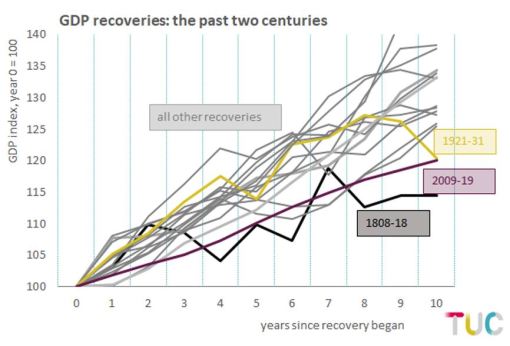
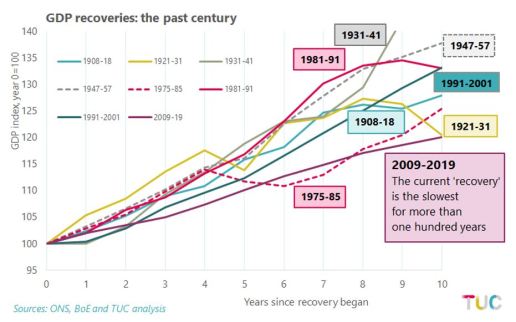
The chart below shows this episode worse than all other recoveries over the past century. The only comparable recovery was the 1920s.


Even over a decade some recovery episodes begin to overlap with others – so for example 1975 to 1985 overlaps with 1981 to 1991, depending on the frequency of recessions.

Looking at even older data the problems become more acute, with GDP data increasingly volatile. Nonetheless some judgment allows comparable figures to be devised.

On this basis the present recovery is the worst since an episode over 1808 – 1818 – which overlaps with the Napoleonic wars.

Leaving the latter figures aside, the only meaningful comparison is with the 1920s. Strikingly this is the decade that fostered modern macroeconomic thinking in the 1930s.

Over the 1920s wrongheaded monetary and fiscal policies operating in tandem meant great hardship, with the decade ending in the Great Depression – the most severe economic crisis of all time.

It is as if over the past decade ignorance has been re-invented. While renewed recession has at least been avoided for the moment, the economy has gone nowhere.

A cynic might find it unsurprising that the Prime Minister has chosen to confirm HS2 today [11 Feb].

Looking at the detail in the 2019 figures also shows that outcomes would be significantly worse if not for a recent uptick in government current and investment expenditure.

But a lot more needs to be done. Fundamentally, these figures demonstrate policy failures over the whole of the last decade.

Why has this has been allowed to happen?

Why indeed – Owl.

Is CHINO (Chancellor in name only) about to splash the cash on the orders of the weirdo-in-chief? Will the boom then be followed by bust?

There are more charts accompanying this article and Owl recommends a look:

https://www.tuc.org.uk/blogs/worst-decade-growth-two-centuries

Owl’s contact details have changed

To complete the transition between Owls Old and New, Owl’s contact e-mail has changed to eastdevon.owl@gmail.com

This change has already been made on the “contact us” page of the Watch website.

Owlets, Eager Beavers, Ferrets and Moles who have Owl on “speed dial” might like to note the change details in their contacts.

Please keep sending Owl alerts to anything of interest in East Devon.


Ministers could backtrack on crucial Flybe tax cut

As talks to secure a bridging loan continue, the change of Chancellor could hit the long-term viability of Flybe according to Oliver Gill 17 February 2020 The telegraph

New Chancellor Rishi Sunak could abandon a controversial overhaul of air passenger duty agreed as part of a rescue deal for Flybe – hurling the regional airline’s long-term future into jeopardy.

Mr Sunak is against a cut to the tax, industry sources said. His predecessor Sajid Javid had backed a reduction in a bid to keep Flybe afloat.

One source said: “The change of Chancellor will make it significantly less likely to happen.

“The message was: ‘Don’t bank on it happening.’”

Flybe has complained for years that air passenger duty (APD) of up to £26 per flight disproportionately affects its finances, making its low-cost, short trips between UK cities less attractive than alternatives such as taking the train.

Slashing the levy was a key part of a rescue deal agreed with ministers last month when the airline came close to appointing administrators after running low on cash.

The carrier’s backers – who include billionaire entrepreneur Sir Richard Branson – are thought to have warned that a tax cut is essential for its survival.

Talks are continuing over a taxpayer-funded £100m bridging loan to fix a hole in Flybe’s finances, which could go ahead even if APD is not reduced.

Ministers last month announced a review of the levy as applied to domestic flights as part of a package of short-term measures to boost “regional connectivity” and ensure Flybe’s services continued running. 

Mr Sunak is said to have opposed the reforms in his previous role as Chief Secretary to the Treasury.

Meanwhile, the Government is continuing to ramp up its contingency planning if a rescue deal cannot be struck.

The Telegraph understands Aim-quoted jet charter service Air Partner has been put on notice by the Government to fly home any passengers left stranded if Flybe collapses. Accountant EY has been lined up to handle a potential administration.

The prospect of Government intervention to save Europe’s biggest regional airline has enraged many of its rivals.

Ryanair Michael O’Leary has threatened legal action, while Willie Walsh, the boss of British Airways parent IAG blasted financial support as “a blatant misuse of public funds”.

Last week’s reshuffle has changed two of the three key decision-makers who previously suggested the Government would support Flybe.

Mr Javid was replaced along with Andrea Leadsom, the former Business Secretary. Transport Secretary Grant Shapps is the only consistent voice of support from the Cabinet outside of No 10.

Despite concerns about setting a dangerous precedent for other struggling airlines, it is understood that Mr Shapps is broadly in favour of supporting Flybe.

The airline has insisted that any taxpayer-funded support would be on commercial terms, but talks with the Government and its adviser Alvarez & Marsal have dragged on.

Agreeing a loan has been complicated by Flybe mortgaging off aircraft, engines and buildings, leaving the taxpayer little or no security as would be standard practice when agreeing loan.

The airline has asked suppliers for more time to pay its bills and insists that bookings are returning to normal levels.

But credit card firms are understood to be holding back customer payments while talks of its futures hang in the balance, because they would be on the hook for refunds under consumer protection rules if it were to go bust.

Earlier in February Flybe admitted that it only had enough cash to get through to the end of the month. Shareholders are understood to be prepared to inject more money into the business if they can secure a deal with ministers.

A spokesman for Flybe said: “Flybe and its shareholders continue to have productive and positive discussions with the Government regarding support to enable us to deliver our long-term strategic plan.”

Air Partner and the Treasury declined to comment.

SINO – Scrutiny in Name Only

Owl had a distinct feeling of deja vu on reading this. If it didn’t concern the disdain our councillors, once elected, feel they can treat their electors, it would be funny. It appears all the adults must have left the room. Not EDDC this time but Teighnbridge.

There were fun and games at the Teignbridge Overview and Scrutiny Committee on Friday, February 7. If by ‘fun and games’ you mean a spectacle of avoiding scrutiny while being on a committee. It all revolved around the contentious NA3 development that apparently nobody wants – apart from those who voted for it. And the whole council is powerless to stop, despite their green aspirations and the many other reasons to refuse it.

Use of “Procedures”

You’d think a ‘Scrutiny’ committee would want to scrutinise. But there are procedures and processes. And the point of these procedures and processes seems to be to ensure that scrutiny is kept out of the committee. Whereby it can be brushed under a carpet, the carpet burned and followed by a denial there was ever was a carpet. But with the dust of the issues still remaining. At which point you’d be accused of being vexatious if you continued to want an answer. [You’d be surprised how accurate this clumsy extended metaphor is, from what we’ve heard.]…………

Continue reading here:

https://www.theprsd.co.uk/2020/02/12/teignbridge-overview-and-scrutiny-committee-cant-scrutinise/


Flooding brings our Beavers back into National News again

Owl is delighted to see that East Devon’s wild beavers are back in the news so soon. Owl is pleased to have  now found the link to the study report, by a team of scientists overseen by Prof Richard Brazier of the University of Exeter, that concludes that beavers’ quantifiable benefits on the River Otter, including eco-tourism and “ecosystem services” such as flood alleviation, outweigh costs such as the minor flooding of some farmland.

https://www.exeter.ac.uk/creww/research/beavertrial/

Summary of report below comes from the Guardian.

https://www.theguardian.com/environment/2020/feb/17/beavers-cut-flooding-and-pollution-and-boost-wildlife-populations?CMP=Share_iOSApp_O

The beavers, which escaped from a captive population, were discovered in 2013 living wild on the river. When plans to exterminate the animals were greeted by a popular outcry, the government agreed to a scientific trial, with the funds entirely raised by Devon Wildlife Trust and its supporters.

The number of beavers on the Otter has risen from two breeding pairs in 2015 to at least eight pairs today as the herbivorous rodent has expanded along tributaries including the River Tale.

The beavers’ positive impact includes one family constructing six dams upstream of the flood-prone village of East Budleigh. The dams have slowed the flow of floodwater through the village, reducing “peak flows” during flood events.

The scientists also found that the beavers played a significant role in filtering pollutants including manure, slurry and fertilisers from the river, while new wetlands created by the beavers have benefited water voles, riverine birds such as dippers and wildfowl including teal. There were 37% more fish in pools created by beaver dams than in comparable stretches of river. Trout have been recorded leaping over beaver dams during high river flows.

While beavers prevent flooding by slowing floodwater flows, their dams can also flood valuable valley farmland. The study identified an “adverse impact” at just five sites in the 250km2 river catchment over five years.

In one case, a small organic potato field was flooded. Riverside orchards were also at risk from beavers gnawing the trees, but negative impacts were mostly solved with active management.

Wire guards were provided to protect trees while Devon Wildlife Trust and Clinton Devon Estates – a supportive local landowner – occasionally removed beaver dams or installed “beaver deceivers” to prevent flooding. Beaver deceivers are pipes that carry water through beaver dams without the beavers realising, to lower water levels and stop flooding.

“Following five years of detailed research work, the report concludes that the positive impacts of beavers outweighed the negatives,” said Brazier. “However, it also makes clear that those who benefit from beaver reintroduction may not always be the same people as those who bear the costs, highlighting that the reduction of flood risk in communities downstream may come at a cost of water being stored on farmland upstream.”

Mark Elliott, who led the River Otter beaver trial for Devon Wildlife Trust, said: “We’ve all been surprised by these amazing animals’ ability to thrive, once again, in our wetland ecosystems. It also shows their unrivalled capacity to breathe new life into our rivers and wetlands, very few of which are in good health.

“There are overwhelming reasons why beavers should be reintroduced back into the wider countryside.”

According to Elliott, the key to successfully returning the beaver across England will be to provide support for affected landowners, so that those who lose small areas of farmland to flooding will not incur financial losses.

In recent months the government has licensed dozens of schemes for wild beavers to be placed in large fenced areas in valleys to help with flood alleviation and restoring wildlife.

But Elliott said the next step would be for the government to approve wild releases into particular river catchments. “We’re not zookeepers, we’re conservationists and it’s a native species to Britain so we shouldn’t be having to keep them in with fences in the long-term,” he said.

Tony Juniper, chair of Natural England, said: “It is fantastic to see the successful reintroduction of these majestic creatures back into the English countryside, which Natural England has licensed. I commend the work of the Devon Wildlife Trust in helping to show how beavers can have such a transformative impact on the natural world.

“This is a massive step towards boosting the richness of wildlife around the River Otter, reducing pollution, mitigating flooding and making this landscape more resilient to climate change.”

The Department for Environment, Food and Rural Affairs has announced an extension of the Devon trial until September, when it will decide if the Devon beavers can remain.

If [Owl says there must be no ifs…] Defra backs the beavers, it is likely that a new licensing system will enable the release of free-living beavers in other river catchments – with the beaver officially recognised as a native species again.

Universal Basic Services – Vision Group for Sidmouth

Why should universal provision be limited to free healthcare and education?

Is Universal Basic Mobility the next step?

Both left and right are finding the idea of a Universal Basic Income very attractive.

There is now also growing interest in Universal Basic Services – especially following the election when all parties promised huge amounts of spending.

It’s just a question of how and where.

More detail and web links to reference papers can be found on the Vision for Sidmouth website:

https://visionforsidmouth.org/universal-basic-services/

Is EDDC development strategy losing high tech jobs to attractive Barnstable?

Owl spotted this article. It explains why the attractiveness of Barnstable has enabled it to encourage very high tech businesses. Do you remember years ago we were promised that if we concreted over Grade 1 agricultural land for Skypark and Cranbrook we would get this sort of employment here?  Also, Is it such a good idea for EDDC to turn its back on the joint National Park initiative with Dorset when lifestyle and proximity to a National Park feature so prominently in attracting high paid jobs? 

www.thetimes.co.uk /edition/business/levelling-up-is-not-just-about-the-north-fn65w0bmr

Peter Evans in the Sunday Times writes:

One of the apprentices at Applegate Marketplace takes a week off each spring to help with the lambing on her family’s farm. Such is life in a cutting-edge technology business if you are based in Barnstaple, north Devon, an hour’s drive from Exeter.

“It’s a real advantage not to spend your life in broken-down trains or traffic jams,” said chief executive Stuart Brocklehurst. He gave up a City career six years ago for a more bucolic life running Applegate, which uses artificial intelligence (AI) to match buyers with suppliers in the public and private sectors.

“I come to work with my dog; I go out walking on Dartmoor every weekend,” said Brocklehurst, 46.

While these lifestyle factors are undoubtedly alluring, building a business outside a recognised hub can be tough. Last week, The Sunday Times published the inaugural KPMG Best Places for Business supplement, listing the top 20 cities and towns in Britain for fast-growing companies. Among the locations were international powerhouses such as London and Edinburgh, along with rapidly evolving hotspots such as Leeds and Manchester.

But what of the places that did not make the list? Before his shock resignation as chancellor last week, Sajid Javid repeatedly promised to “level up” the economy by boosting the regions. If his successor, Rishi Sunak, is to pursue a similar agenda, the towns and cities that have been left behind will require the most attention. Places such as Barnstaple — not to mention Gloucester, Plymouth and Portsmouth — struggle with poor infrastructure, lack of investment in their centres and low retention of skilled workers to boost growing companies.

Bringing greater prosperity will require more than a glib political slogan.

A recent report by the CBI found more than half of Britain’s cities ranked among the 25% least productive in Europe. While projects such as the Northern Powerhouse have started to deliver results for the big conurbations in the north of England, there is a growing fear that a tier of towns in other parts of the country will be left behind as the Tories try to satisfy the voters who handed Boris Johnson victory in December’s general election.

“It poses a risk for places in the south that don’t do well,” said Paul Swinney, a director of the think tank Centre for Cities. “There is a question about whether they get overlooked.”

Focusing on certain parts of the country also risks undermining those places that have performed strongly, Swinney added, because cities require constant investment to keep functioning. “The challenge for their economies is not about getting growth going, it’s about dealing with the cost of success.”

One of the biggest challenges for the cities outside the top 20 is attracting workers — both graduates and experienced professionals — with the skills to take companies to the next stage of growth. London, Edinburgh and Manchester can be cripplingly expensive, but firms open offices in these places because they offer access to the best talent.

There are ways to buck the trend, though. Experts say a thriving city centre is a significant factor in attracting companies and workers. Councils play a big part: cities such as Sunderland and Coventry have moved much of their local government workforce into buildings in the centre, improving footfall for retailers and custom for pubs and restaurants.

Companies based outside the economic hubs are finding innovative ways to attract staff. Applegate employs 35 people, including nine apprentices, all of whom are working towards a degree-level qualification in management. The apprentices are offered up to £10,000 towards a house deposit if they can match the funding. This year there were 284 applicants for three places.

Such perks help persuade young workers to stay in the area and support those unable to afford university — and Barnstaple is not such an unlikely place for an AI business as it sounds. Exeter University’s Institute for Data Science and Artificial Intelligence provides access to the latest research and a stream of qualified staff.

“It’s a distributed hub,” Brocklehurst said. “We’re not on top of each other, stealing each other’s staff, having rent go through the roof. We’ve got space to breathe and build our own community.”

Another strategy is to generate large-scale investments without relying on central government. ..

…However, business owners in the south say they have suffered from being lumped in as part of a prosperous bloc dominated by London. In reality, the coastal towns of Devon and Dorset and the former mining communities of Cornwall are among the most deprived in Britain, yet many politicians still talk of a north-south divide as if there were a neat distinction between the two.

The Great South West is an attempt to build a southern answer to the Northern Powerhouse. The initiative claims £45bn of economic growth could be generated for Cornwall, Devon, Dorset and Somerset through a focus on sustainability and the “marine economy”. MPs have requested £2m in the budget to start the programme [£45M in total Owl] — and had been hopeful of receiving it before Javid’s resignation.

Whether the Great South West project and other areas absent from Best Places for Business receive funding will be a test of how serious the government is about “levelling up” the whole country.

Discounted housing scheme out of reach of most first-time buyers


Analysis suggests 96% of average earners in England would still not be able to afford a house under government’s new plan.

https://www.theguardian.com/society/2020/feb/16/first-homes-scheme-unaffordable-most-buyers?CMP=Share_iOSApp_Other

A high-profile housing scheme offering first-time buyers discounted homes will be unaffordable to the vast majority of workers on average or low incomes, it has emerged.

The First Homes scheme has been described by ministers as “genuinely life-changing for people all over the country”. However, new analysis suggests it will be out of the reach of average earners in 96% of England. The fresh concerns follow claims that the scheme will exacerbate the housing crisis by cutting the amount of scarce, more affordable social housing.

The scheme, which would see successful applicants given 30% off new-build homes, is aimed at military veterans and key workers such as nurses, police officers and firefighters, who will be given priority access to the properties.

But research by the charity Shelter found that, in almost all parts of England, someone on an average salary or lower could not afford to buy one of these new-build homes. It also shows that almost two-thirds (63%) of private renters in England have no savings at all for a deposit. New-build properties in England cost £314,000 on average. A 30% discount would offer a saving of £94,000, but would still require a significant deposit.

Writing for the Observer online, Polly Neate, chief executive of Shelter, warned the scheme was “a comfort blanket only, providing nothing for the people at the sharp end of the national emergency our housing crisis has become.

“At a time when we desperately need properly affordable housing, policymakers are looking to give a lucky few a 30% discount on what are still going to be incredibly expensive homes. And let’s be clear about who the lucky few are. Not those facing a monthly struggle to afford their rent.

She adds: “For those earning above the average, or with a helpful inheritance – people already on the cusp of home ownership in other words – this may get them over the line. There is nothing wrong with that, but it becomes a massive problem if it comes at the expense of social homes.”

The outline of the scheme was first announced during the election campaign. The Conservatives pledged that the discount would apply to about 19,000 homes by the mid-2020s. About 240,000 new homes are currently being built each year. However, a recent consultation on the programme did not contain any targets for the scheme.

Charities and unions have already raised concerns that it will end up reducing the amount of more affordable types of housing. The programme will be paid for through “Section 106” agreements, which require developers to build certain types of affordable housing as part of their building plans. Building more new-build homes for sale through this method could cut the amount of affordable homes for rent.

The supply of social housing, which is more secure than private rented accommodation and has rents on average 50% of the market rate linked to local wages, is already very low. Just 6,287 were delivered last year, with Section 106 agreements accounting for 57% of them. More than 1.15 million households are currently waiting for a social home in England.

A Ministry of Housing, Communities and Local Government spokesman said: “First Homes will give tens of thousands of people the opportunity to buy a home in their local area with a saving of up to £100,000, turning the dial on affordability. The government has invested £9bn in affordable housing through our Affordable Homes Programme, which we are committed to renewing, and since 2010 has delivered over 464,000 new affordable homes.”


Flood defences get 1% of infrastructure spending

Just over 1% of government infrastructure spending in England will go towards flood defences, analysis by BBC News has found.

www.bbc.co.uk /news/uk-england-51463267

Current figures show nearly £5bn is due to be spent on flood defences up until 2026, with a third of the money spent in London and the South East.

MPs in northern England said flood defence funding needed reallocating.

The government said it was investing “record” amounts in new flood defences that would protect 300,000 homes.

And it said in terms of money spent per home at risk of flooding, the North received more than the South……….

The latest infrastructure spending figures published by the Treasury showed nearly £5bn was earmarked to be spent on flood defences in England over the next six years.

The money was due to be spent on more than 1,300 projects.

But flood defence spending makes up just 1.5% of the total £317bn set to be spent on all infrastructure across England, which includes upgrading roads and railway lines……..


Ramblers says time is running out for lost paths

Ramblers wants Owl and Owl’s followers to take their phones for walks to make sure lost footpaths are added to the oficial register before it’s too late. 

An estimated 10,000 miles of historic footpaths are thought to be missing from the map in England and Wales.

People are being urged to pore over old maps to help identify thousands of miles of lost footpaths before time runs out to add them to the official register.

The Ramblers has launched a website with historic and modern maps of England and Wales. It wants thousands of “citizen geographers” to compare the maps to detect lost paths.

The walking charity believes there are 10,000 miles of paths missing from modern maps. If not claimed by the government cut-off of 2026 they can no longer be added to the official map after and the public’s right to access them could be permanently lost.

It can take years of research to prove the case for adding a path to the official map. The Ramblers wrote to the government last year asking for the deadline to be extended but has not received a reply.

The Ramblers believes that many of the lost paths were not included on modern versions which are based on maps councils were required to draw up in the 1950s.

https://dontloseyourway.ramblers.org.uk/

The Don’t Lose Your Way website divides England and Wales into 150,000 1km squares. The Ramblers said: “Users simply select a square, do a quick ‘spot the difference’, mark on any missing paths and click submit. It takes just a few minutes to check a square.”

Some of the lost paths are still in use, despite not showing up on modern maps, including a well-used track near Knightwick, Worcestershire, while others have become overgrown and unusable, such as a “missing mile” of the Markway in Hampshire, which vanished when a Hurricane fighter base was built in the Second World War.

Jack Cornish, manager of the Don’t Lose Your Way campaign, said: “Our paths are one of our most precious assets. They connect us to our landscapes — ensuring we can explore our towns and cities on foot and enjoy walking in the countryside — and to our history and the people who formed them over the centuries. If we lose our paths, a little bit of our past goes with them. This is our only opportunity to save thousands of miles of rights of way and time is running out.”

Stuart Maconie, the Ramblers’ president, said: “Public rights of way are our birthright and genuine national treasures. We must find and record and walk these sometimes ancient ways and preserve and protect them . . . for ourselves and generations of walkers to come.”

Now to the phones.

 The Pathwatch app

https://www.ramblers.org.uk/advice/pathwatch-report-path-features-and-problems.asp

“We’ve   built an entire app that allows you to report features on the go – straight from your pocket.

Using the app you can report positive and negative features, send us photos and even share your discoveries via social media. Using GPS and your phone signal, the app can locate you on OS maps and will allow you report what you’ve found with the press of a few buttons.

The app also works offline and allows you to download OS grid square maps for your walks in England and Wales.

Pathwatch online 

You can report features directly through the online version of the app.

It’s slightly different to the app but still gets us all the information we (and local authorities) need. It also syncs up with the features you record on the app, so you can view all your reported features. Online, you can also report features anonymously and won’t need to register or login.

Just like the app, you can scroll around Britain on OS Map data to find the location of the feature you’re reporting.”

Mel Stride MP has been elected Chair of the Treasury Committee


Why could this be important for Owl’s readership? Of all the parliamentary committees, the Treasury Committee (chaired by the majority party) and the Public Accounts Committee (chaired by the opposition) are arguably two of the most important, holding the government to account by inquiries and scrutiny. When an election is called all committee business ceases. The newly elected parliament and its committees may or may not continue with inquiries in progress. 

The previous treasury committee had just started taking oral evidence in an inquiry into regional imbalances in the UK economy. So it is to be hoped that the new committee will continue with this inquiry. Mel Stride is the MP for Central Devon and is, therefore, particularly well placed to make sure that Devon and the South West generally are not left behind in the race to re-balance the economy to the regions, primarily the “red wall” in the North.

Mel Stride MP will formally take up position as Chair of the Committee when the remaining members of the Committee have been named by the House. This is expected to be announced in February.

Owl has posted a number of links in the past couple of weeks to studies that highlight the deprivation and isolation found in rural areas, especially in Devon. 

Owl has also posted the Great South West’s latest attempt to make the case for more investment.

Last September the East Devon Alliance submitted evidence to this inquiry of the imbalance felt here in Devon.Theirs was the only evidence submitted by any solely Devon organisation among 76 submissions. The summary reproduced below seems to Owl to make a compelling case. 

https://www.parliament.uk/business/committees/committees-a-z/commons-select/treasury-committee/inquiries1/parliament-2017/inquiry7/publications/

Written evidence submitted by the East Devon Alliance (RDE0002)

Executive Summary

  • There is a widespread belief that the “far” South West has suffered long-term lack of strategic investment hampering economic growth, particularly in Devon and Cornwall.
  • We present evidence of poor economic growth, productivity and earnings in the sub-region.
  • East Devon has 30% of its population already aged 65+ with high social and health care needs. It has one of the highest internal immigration rates in a region which, overall, has the highest rate of this type of immigration in the country.
  • We present evidence of the unaffordability of housing and show that it is a matter of low earnings. The private sector has been unable to build the affordable houses needed.
  • We highlight poor access to public transport as one of the discriminants between metropolitan and rural life.
  • The creation of Local Enterprise partnerships (LEP) has added complexity to local government with little benefit. They are unrepresentative, unaccountable and have minimal public recognition. Our LEP growth deal was agreed with Government in 2014. Nothing was revealed to the public until 2015.
  • We explain why increased productivity in our economy will take a long time to achieve.
  • Our LEP’s strategy to double the economy in 20 years, 3.5% pa growth, lacks realism and is undeliverable. The latest LEP review shows our economy continuing to fall behind UK average; objectives already look “very aspirational”; only 23% of matched funding comes from private sector; there has been no significant influence on private investment plans.
  • Regional and sub-regional economic data is essential to good planning, feedback and scrutiny. Our LEP has no feed-back loop to understand what works well and what does not.
  • We give examples where our LEP and District Council have missed the opportunity to analyse readily available data. As a result they are continuing to follow growth strategies and plans demonstrably failing at an early stage.
  • Hinkley C is regarded by our LEP as a “Golden Opportunity”. However, construction of Hinkley A & B (57/65 & 67/76) means that we have already experienced two decades building similar magnitude nuclear projects. We ask whether any forensic historical analysis of the benefit from such major infrastructure projects to local economies has ever been conducted and suggest that Hinkley C is substituting for a genuine regional growth strategy.


Great South West pitches to yesterday’s man. A week is a long time in politics.

In a recent post Owl touched on the complexity surrounding the way that devolution is evolving and explained that the Great South West wasn’t another rail franchise but yet another added layer.

We have the formal devolution body, the Local Enterprise Partnership (LEP), Heart of the South West (HotSW). This has been pitching to government for funds since 2014. Then we have the Joint Committee with a single representative councillor from each of the 17 local authorities from Devon and Somerset. This started out in 2018 as a way for elected councillors to oversee and agree policy e.g. the HotSW Productivity Strategy, but has apparently rapidly evolved into developing relationships with key local partnerships and in overseeing delivery of the Strategy alongside the LEP. Owl is not sure how effective a large committee is at doing this.

The briefing papers for last week’s cabinet justified EDDC putting more resources into the Joint Committee suggested something quite different:

“Changes in Government policy away from large devolution ‘deals’ to a more targeted dialogue on key themes of relevance to the local authorities and partners, e.g housing. The Joint Committee’s influencing role has become increasingly important as recognised by Ministers, local MPs and Government officials. The ambition remains to draw down additional functions, powers and funding from Government.” I.e. EDDC anticipate that most funding will by-pass HotSW.

Obviously EDDC has an insight into the way the wind is blowing which has not yet dawned on the Great South West (GSW). The GSW website explains that on Wednesday, January 22, a delegation comprising business leaders, Local Enterprise Partnerships (LEPs), MPs and local authorities (Including DCC Leader John Hart) presented Minister for Local Growth, Rt Hon Jake Berry MP, with the GSW growth prospectus and briefed him on ambitions to deliver £45 billion of economic benefit and 190,000 new jobs over the next 15 years.

Last week devonlive reported that the Great South West had made a similar pitch to yesterday’s man Sajid Javid:

https://www.devonlive.com/news/devon-news/chancellor-urged-back-great-south-3820532

Owl wants to see increased investment and prosperity in the South West but these approaches look fragmented and muddled. Owl isn’t convinced that the best way to influence Ministers is by handing them glossy brochures and demanding £45M. (And £2M on account – see below).

Steve Hindley, Chairman of Midas Group, a construction company, stepped down as Chair of HotSW in 2019 and has now popped up as Chair of GSW.

GSW is the latest business led growth alliance proposed to rebalance the UK economy, alongside the Northern Powerhouse, the Midlands Engine and the Western Gateway. GSW covers Cornwall & Scilly Isles, Devon, Somerset and Dorset. The GSW prospectus seeks £2million over three years from government, and a dedicated liaison Minister, to move forward “at pace” and enable full business cases to be developed across a range of topics. [£2M and 3 years before anything really happens – is this “at pace” – Owl]

It seeks support for an enhanced export and investment hub; recognition of a Great South West Tourism Zone and an agreement to create a rural productivity deal.

At HotSW, Hindley oversaw an unrealistic and undeliverable strategy for regional growth aimed at doubling the local economy in 20 years, way ahead of any national performance forecasts, with no clear strategy or feedback mechanism to measure success. At GSW the proposal is more modest. If the Great South West economy reaches the UK average, it would be worth £84.1 billion today and would be worth £121.7 billion by 2035. Even just closing the gap to 90% of the UK average would see the local economy worth between £103 billion and £110 billion by 2035. Where does this leave the HotSW “ambition”?

Initial governance arrangements for GSW are, apparently, already in place with a business led Partnership Group representing the leading strategic public and private sector organisations from across the region (just look at the logos on the devonlive page). This is supported by a small Executive Board to ensure clear leadership and focused delivery. The work to date has been supported both financially and ‘in-kind’ by the three Local Enterprise Partnerships that form the backbone of the Great South West. The private sector provided the catalyst for this initiative, with the #backthesouthwest campaign and the public sector and academic institutions have made significant contributions to its progression.

Government support is now required to help realise these “shared” ambitions.

So, once again, we have an unelected, unaccountable, group putting forward a growth strategy on our behalves. Adding a further layer of overarching bureaucracy to the already complex hierarchical relationship explained above. Along the line it is worth recalling that in autumn 2015 another group, independent from our local LEP, was formed under the surprising leadership of the Pennon Group, owners of the utility company South West Water. This group drafted a “South West Group Charter” within in days, following an invitation from Sajid Javid when visiting Exeter as Secretary of State for Housing, Communities and Local Government (he is an alumnus of Exeter Uni). This was sent to the Government ahead of the Chancellor’s Autumn Statement. However, it sunk without trace. Pennon is now a backer of GSW.

Owl agrees that the current division of the sub-region into three LEPs is a hotchpot arrangement and something like the GSW would be more a more sensible geographic area on which to base a regional strategy. Owl also thinks that the prospectus, whilst lacking any depth (it’s just a glossy brochure), is more sensible than anything produced by HotSW. For example it recognises, as problems: poor wages; poor productivity; the above average age distribution and the need for major changes to agriculture post-Brexit. As mentioned above it also has a more realistic approach to growth. There remain some dubious ideas: eg that the ageing population presents an opportunity to trial new approaches to wellbeing, care and employment with older people which will offer learning for the rest of the UK (so oldies become a marketing opportunity). Also, examples of exploitable opportunities taken from each county seem to be of very questionable value: Hinkley Point in Somerset, Europe’s first horizontal launch spaceport in Cornwall; the largest naval base in Western Europe at Devonport; and Dorset is one the country’s leading centres for financial services (Owl didn’t know that Dorset was the place to leave your nest egg).

None of this seems to relate to solving the problems of rural isolation and deprivation featured in recent East Devon Watch posts. Nor does it address the need for something like a national regional investment bank to support firms such as Flybe or Axminster Carpets.

With Sajid Javid’s departure Steve Hindley and his marketing team will have now to swivel rapidly to make their pitch to Dominic Cummings. The people who seem to impress him are: super-talented weirdos with genuine cognitive diversity, true wild cards. So no problem then.

GSW Prospectus

Click to access GSW%20Prospectus%20published%20final%20version%20100120.pdf

Will Javid’s departure lead to boom or bust?

Owl recommends this analysis of what Sajid David’s resignation might mean for the economy – Larry Elliot, economic editor of the Guardian:

https://www.theguardian.com/politics/commentisfree/2020/feb/13/treasury-will-bide-its-time-over-johnsons-radical-changes

It was billed as just a limited shuffling of the pack, but Boris Johnson’s reshuffle proved to be the moment when the simmering conflict between 10 Downing Street and the Treasury burst out into the open.

The departure of Sajid Javid and his replacement as chancellor by the inexperienced Rishi Sunak means that first blood has gone to the prime minister or, more accurately, his chief adviser Dominic Cummings.

Javid is out and Sunak is in – but not because of a Whitehall disagreement over the activities of the former chancellor’s special advisers. Nor is it simply about the shape of next month’s budget, important though the disagreements were between a prime minister bent on an expansionary package and a distinctly more cautious Javid.

Ultimately, this is about power and whether the Treasury should continue to exert its stranglehold over the totality of economic policy – or be relegated to the role of a finance ministry, as it is in so many other countries.

Britain has been here before. Maynard Keynes argued in the 1920s and 1930s that the Treasury’s obsession with balancing the budget was the wrong response to a demand-deficient and high unemployment economy.

In the 1960s, Harold Wilson hived off a large chunk of the Treasury’s responsibilities to a new Department of Economic Affairs. John Major’s answer to the Treasury’s dominance was to beef up the industry department and put Michael Heseltine in charge. Tony Blair regularly chafed at being kept in the dark about key economic decisions when Gordon Brown was running the Treasury.

The power grab attempt by Johnson and Cummings is somewhat different. Instead of setting up a brand new ministry, they have decided to make 10 Downing Street the hub of economic policy.
This approach has both strengths and weaknesses. Its strength is that there are many economists who think that a successful industrial strategy for Britain has to involve limiting the power of the Treasury to keep vetoing things on budgetary grounds.

As an institution, the Treasury is hard-wired to be conservative and has often been wrong as a result. It was, for example, fully behind George Osborne’s austerity programme in 2010 on the grounds that running big budget deficits risked losing the confidence of the financial markets and would result in much higher interest rates.

A better solution – and the one Johnson and Cummings are trying after 10 years that have seen the weakest wage and productivity growth since the 19th century – would have been to take advantage of low interest rates to borrow for public infrastructure projects that would have produced faster growth, higher tax receipts and a lower deficit.

The weakness of the Johnson-Cummings approach is that Downing Street really doesn’t have the resources to run economic policy itself and will have to import resources from elsewhere.
Unless, of course, Cummings thinks he is so smart he can run the show on his own. Even Keynes, a man famed for his arrogance, did not think that.

History suggests that the Treasury will play a long game. It will sit tight for a while, and work on the more expansionary package that the new chancellor is having prepared for him in Downing Street.
It will assume that after a while Sunak will go native as most chancellors do eventually. And it will wait – as it did when Wilson tried to clip its wings – for something to go wrong, knowing that in a financial crisis it will be fully back in business.

The boost provided by the budget will mean stronger short-term growth, but this war is not over by a long chalk.

Sidmouth prepares residents for flash flooding as Storm Dennis moves in

Sidmouth Town Council said flood advice is to be prepared and not wait until it is too late.

The empty sandbags, for people to fill themselves, are available from the town council offices from 9am until 1pm Monday to Friday.

During the weekend they can be collected from the yard of the council building in Woolcombe Lane.

Weather information, weather warnings, river levels and flood warnings for the Sidmouth area can be viewed here.

http://visitsidmouth.co.uk/weather/index.htm

https://www.sidmouthherald.co.uk/news/town-council-advice-be-prepared-for-flooding-1-6513966