Swire: between a rock and a hard place this weekend

Junior ministerial appointments such as Swire’s will probably be sorted out next week.

What an awful long weekend it will be for him, worrying about whether he will be left to try to keep Boris under control or demoted to ordinary constituency MP.

Or perhaps Mrs May might have some other post in mind for him – back to Northern Ireland or Culture, Media and Sport – under some younger, grammar-school-educated boss.

It’s a hard life.

Something for Leadsom and Parish to chew on

“… In Defra’s case, the National Audit Office found that £65.8m of penalties were imposed by the European Commission over failure to properly administer Common Agricultural Policy payments. Of these penalties, most (£38.6m) related to the Single Payment Scheme, with £13.3m from Rural Development, £9.9m in cross compliance penalties and £4.0m from other schemes.

One particular problem the department has is ensuring the details submitted by farmers are kept up-to-date. Where there is a mismatch in information, Defra withholds a proportion of the payment. More than £25m in outstanding payments is estimated to be owing.

Auditor general Amyas Morse said: “The department continues to struggle with managing the complex CAP scheme in a way that ensures accurate, timely payments to farmers. As a result, it has incurred EU penalties of £65.8m related to the CAP scheme in 2015-16, and estimates that it owes 13,000 farmers a total of at least £25.3m.

“Exit from the European Union will not, in the short term, reduce these penalties. The department therefore needs to ensure its strategy for tackling these challenges is effective.”

A Defra spokeswoman said: “We are taking action to tackle the causes of disallowance and are making a significant investment in our mapping data. This will be used to better administer CAP payments.”

http://www.publicfinance.co.uk/news/2016/07/defra-and-mod-accounts-qualified

With new agriculture Minister Mrs Leadstrom on record as having said that UK farmers should not be relying on EU payments, Farmer Parish may be in for a bit of a tough time as piggy-in-the-middle.

Jo Cox, MP

Jo Cox’s funeral took place today.

Her husband’s message:

Jo would ask us not to fight hate with hate but draw together to drain the swamp that extremism breeds in. Thinking of all victims of hatred today”

Jo’s fund is just £15,000 short of its £1.5 milion target for three charities she supported: Royal Voluntary Service, Hope Not Hate and The White Helmets, each of which will get one-third of the funds raised.

It would be a fitting tribute to her to see that target achieved today.

https://www.gofundme.com/jocox

West Hill: new parish council boundary “compromise”

Independence day as West Hill splits

11:01 15 July 2016 Eleanor Pipe
Proposed new West Hill parish council boundary
Compromise reached over divisive boundary issue

“West Hill looks set to form its own parish council after a contentious bid to gain independence was given the green light.

A long and acrimonious battle came to an end on Wednesday (July 13) when members of East Devon District Council’s (EDDC) cabinet voted in favour of the village breaking away from the governance of Ottery.

The bid was launched by the West Hill Parish Campaign Group (WHPCG), which argued the community has its own identity.

During the consultation process, a bitter row broke out over the proposed boundary.

Speaking at Wednesday’s meeting, WHPCG chairman Margaret Hall said: “Our primary objective has always been to establish a parish council for West Hill. We know we have overwhelming support for this from residents of West Hill. We are disappointed by the boundary, however, we do recognise the need for compromise. We do look forward to working positively with all our neighbouring councils in the future.”

The compromised boundary option means the new parish will be far smaller than the current West Hill ward, but it does incorporate some households in Higher Metcombe, who strongly objected to being included in the Ottery ward.

Mayor Glyn Dobson – not speaking on behalf of the town council – said: “I will be sorry to see West Hill go, because the parish of Ottery will lose approximately 25 per cent of its precept. However, if it’s the will of the majority of West Hill residents, I respect that.”

District councillor Peter Faithfull said the issue should be postponed entirely – as the level of acrimony did not allow for constructive debate. However, Councillor Phil Twiss argued there is a clear case for West Hill forming its own parish council.

EDDC needs to issue a final go-ahead before the proposal will come into legal effect on April, 1, 2017. The first elections could be held in May 2017.”

http://www.sidmouthherald.co.uk/news/independence_day_as_west_hill_splits_1_4617573

Judge quashes out-of-town planning permission for discount store

Wonder how this applies to out-of-town industrial developments?

Mr Justice Ouseley has quashed planning permission for an Aldi store in Mansfield after finding a series of errors in the way in which the planning authority processed the application.

Mansfield District Council had given permission to developer Regal Sherwood Oaks for a food store of 1,925 square metres at Sherwood Oaks Business Park, for which the intended occupier was Aldi.

Developer Aldergate Properties challenged this citing an adverse impact on its development in the town centre contrary to the sequential test in planning policy designed to protect town centre retailing from out-of-town rivals.

Aldergate argued that the council erred in its approach to the sequential test, imposed a condition personal to Aldi without considering relevant planning policy objections to this and failed to consider whether the proposal accorded with the development plan.

In his judgment, Ouseley J said Mansfield had misinterpreted the National Planing Policy Framework as the necessary sequential test has not been carried out and a material factor has not been taken into account.

He also did not accept that the planning committee would have been aware of guidance on personal conditions “in the absence of specific evidence to that effect.

“This is not just because this is not a very common point, but also because the evidence produced by the district council did not show that their training had covered this particular aspect of conditions, and nothing more was forthcoming despite requests.”

He also found the council had misinterpreted its development plan.”

http://localgovernmentlawyer.co.uk/index.php?option=com_content&view=article&id=27743%3Ajudge-quashes-planning-permission-over-interpretation-errors-&catid=63&Itemid=31

Sharp fall in house building and maintenance

“A sharp fall in housebuilding ahead of the EU referendum dragged down the construction sector in May as firms mothballed projects and delayed new work. Housing construction tumbled 3.2% during the month after edging down 0.1% in April, the biggest drop since February 2014.

Earlier this week the UK’s biggest housebuilder, Barratt, said it could reduce the rate at which it builds new homes as the company prepares for a possible slowdown following Britain’s vote to leave the EU.

The impact of an underperforming housebuilding sector on the broader industry was to drag down output by 2.1% on the previous month and by almost 2% on the previous year. Housing output has now fallen in every month this year apart from February, and things could slow further after the 23 June Brexit vote.

The latest figures from the Royal Institution of Chartered Surveyors, published earlier this week, found that buyer interest and expectations of future sales withered in the post-referendum period. Government cuts to local authority spending were also to blame for a fall in repairs and maintenance activity, highlighting the need for Theresa May’s new infrastructure ministry to boost growth.

Local authority spending on repairs and maintenance has declined sharply in real terms since the middle of 2014, mainly in response to cuts to council budgets.

In May, construction firms reported a fall in new work and repairs and maintenance by 2.6% and 1.4%, respectively. “The fall in May 2016, taken together with the strength of April’s figures, continues a longer trend of broadly flat output growth since the start of 2015,” the ONS said. “Within all new work, there were decreases in all work types, except infrastructure. The main contribution to the decrease came from private new housing.”

Chris Williamson, chief economist at financial data provider Markit, said the drop in construction output adds to “what’s looking like an ugly run of data for the sector”. “It looks like there’s worse to come; possibly much worse. Markit/CIPS PMI survey data recorded the steepest contraction of construction activity for seven years in June as projects were put on hold in the lead up to the EU referendum. Housing and commercial construction were especially badly affected,” he said.

http://www.theguardian.com/business/2016/jul/15/sharp-fall-in-uk-housebuilding-drags-down-construction-sector?CMP=Share_iOSApp_Other

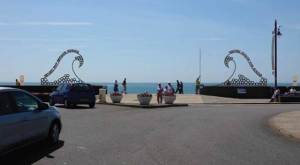
The Seaton Seaside “chickens”

image

Much furore about a new sculpture erected on Seaton seafront a few days ago as part of its Jurassic Coast arts interpretation. Many people have remarked that it looks like two chickens heads, with some even saying that the noise of the wind passing through the sculpture even sounds like chickens clucking!

The saga began long ago in 2014 when the controversial sculpture was first mooted, when, in September 2014, then Mayor, Tony Woodman and Councillor Val Christmas voted against the project, which was carried by a majority of Seaton Town Council:

http://www.viewfrompublishing.co.uk/news_view/33584/21/1/seaton-oppositiongrows-to-proposed-jurassic

A photograph of the sculpture was published in the Midweek Herald on 8 April 2015:

http://www.midweekherald.co.uk/news/controversial_waves_sculptures_get_the_go_ahead_1_4025621

where it was reported that a survey of 200 people asked if they liked the design overwhelmingly approved of it.

The two newspaper reports seem not to have been seen by many people in Seaton who have taken to social media to violently disagree about the merits of the artwork.

Lobbying

“An influential Conservative member of the House of Lords has been accused of lobbying the government for the benefit of the coal industry, despite previously saying he does not argue for the industry’s interests.

Viscount Matt Ridley, a journalist and businessman, benefits financially from coalmines on his estate and has used his column in the Times newspaper to downplay the seriousness of climate change.

The former chairman of Northern Rock wrote to energy minister Lord Bourne in April to tell him about a Texas-based company with “fascinating new technology, which may well interest the Department of Energy and Climate Change”.

http://www.theguardian.com/environment/2016/jul/15/matt-ridley-accused-of-lobbying-uk-government-on-behalf-of-coal-industry

Tipton school closes as 750,000 new places needed by 2025

What a masterstroke of bad planning and bad decisions. Instead of small, village schools we will probably end up with mega- primary schools where 4 and 5 year olds will be overwhelmed.

“An extra 750,000 school places will be needed in England by 2025 to keep up with a population bulge, says an official forecast from the Department for Education.

The pressure on creating new schools and extra classrooms will be one of the challenges for incoming Education Secretary Justine Greening.

Schools will have faced 16 consecutive years of rising pupil numbers.
The Department for Education says it has committed £7bn to extra places.
Between 2009 and 2016, the school system had already expanded to take in an extra 470,000 pupils.

From 2016 to 2025, the projection says there will be another 10% of pupils in the state school system, up from about 7.4 million to about 8.1 million.” …

http://www.bbc.co.uk/news/education-36796999

Communities and Local Government boss is now in “less prominent role”

“Conservative lawmaker Sajid Javid was removed from his position as business secretary by new Prime Minister Theresa May on Thursday, taking up a less prominent role leading the department responsible for local government.”

Source: Reuters

Well, that’s planning given its priority!

“Supreme Court to consider NPPF definitions for first time”

The Supreme Court has granted permission to Suffolk Coastal District Council and Cheshire East Council to appeal the landmark decision of the Court of Appeal in the case of Suffolk Coastal D.C. v Hopkins Homes and Richborough Estates Partnership LLP v Cheshire East Borough Council.

The decision re-opens the controversy over the meaning of “relevant policies for the supply of housing” in paragraph 49 of the NPPF. A clear definition of the term has eluded decision makers and several conflicting decisions were hoped to be resolved by the Court of Appeal’s decision in April 2016.

In his judgement in the Court of Appeal, Lord Justice Lindblom had come down on a “wide” definition, which had included policies for the protection of Green Belt and AONB as “policies for the supply of housing” to be treated as “out of date” where a Council could not demonstrate a 5 year housing land supply and triggering the presumption in favour of planning permission in paragraph 14 of the NPPF.

Suffolk Coastal D.C. had also sought permission to challenge a second ground in the judgment where the Court of Appeal had ruled on the approach to assessing the impact of development on the significance of heritage assets.
The grant of permission by the Supreme Court leaves the issues open to reconsideration in full.

This is the first time the Supreme Court has considered the NPPF. It also gives the Court the opportunity to reconsider the principle in Tesco v Dundee that holds that the meaning of planning policy is a matter of law.
Jonathan Clay and Ashley Bowes of Cornerstone Barristers instructed by Trevor Griffiths of Sharpe Pritchard solicitors appeared for Suffolk Coastal D.C in the Court of Appeal and prepared the grounds for the permission application for Suffolk Coastal in the Supreme Court.”

http://localgovernmentlawyer.co.uk/index.php?option=com_content&view=article&id=27719%3Asupreme-court-to-consider-nppf-definitions-for-first-time&catid=63&Itemi

Our new Communities Minister – Sajid David

“Javid was born in Rochdale, Lancashire, one of five sons of parents of Pakistani descent. His father was a bus driver. His family moved from Lancashire to Stapleton Road, Bristol.

Javid was educated from 1981 to 1986 at Downend School, a state comprehensive near Bristol, followed by Filton Technical College from 1986 to 1988, and finally the University of Exeter from 1988 to 1991. At Exeter he studied economics and politics and became a member of the Conservative Party.

When he was twenty, Javid attended his first Conservative Party Conference and campaigned against the Thatcher government’s decision in that year to join the European Exchange Rate Mechanism (ERM), calling it a “fatal mistake”.

Javid joined Chase Manhattan Bank in New York immediately after university, working mostly in South America. Aged 25, he became the youngest vice-president in the history of the bank. He returned to London in 1997, and later joined Deutsche Bank as a director in 2000. In 2004 he became a managing director at Deutsche Bank and, one year later, global head of Emerging Markets Structuring.

In 2007 he relocated to Singapore as head of Deutsche Bank’s credit trading, equity convertibles, commodities and private equity businesses in Asia, and was appointed a board member of Deutsche Bank International Limited. He left Deutsche Bank in 2009 to pursue a career in politics. His earnings at Deutsche Bank would have been roughly £3m a year at the time he left.

Javid is a trustee of the London Early Years Foundation, was a governor of Normand Croft Community School, and has led an expedition to the summit of Mount Kilimanjaro, the highest mountain in Africa, to show his support of Help The Aged.”

Source: Wikipedia

What is the best option for East Devon?

Swire:
A: Boris and Hugo swan around the world together with Hugo as Boris’s bagman
or
B: Becomes a backbench constituency MP and commutes to East Devon from Mid-Devon and desperately tries to persuade Theresa May’s colleagues to listen to him?

Parish:
A: Remains As Chairman of the Select Committee on Environment, Food and Rural Affairs and keeps on trying to dual the A303
or
B: Becomes a non-office- holding backbench constituency MP with no major role in government and finally has to decide whether he is a Remainer or Brexiter?

“Councils’ commercial ambitions outstrip expertise”

“Four in 10 council bosses want to increase commercial revenue but just 4% say they have significant commercial expertise, a poll by CIPFA and Civica has found.

The survey of 45 local authority chief executives and chief finance officers found authorities were developing commercial plans to raise revenue by, for example, developing trading arms for shared services and through more effective use of property.

However, concerns were also highlighted about a lack of understanding of what the market needs (36% of respondents said this was a factor) and concerns about the risks involved (56%). “…

http://www.publicfinance.co.uk/news/2016/07/councils-commercial-ambitions-outstrip-expertise

“Arms companies charged taxpayer for Xmas parties and charity donations, says defence spending watchdog “

Surely some contracts for Hinkley C will be susceptible to such things?

“Arms companies have padded defence contracts to the tune of £61m with costs including “charitable donations”, Christmas parties and commemorative mugs.

Spending watchdog the Single Source Regulations Office (SSRO) has revealed how defence deals where the contract was not put out to tender have been abused by suppliers, accusing them of failing to meet contract agreements.

The SSRO was set two years ago to crack down on abuse of the £8bn the UK military spends on “single source” deals annually. These are contracts where there is only a single buyer – the MoD – and single supplier because of national security or an urgent need for equipment on the frontline. Once the cost of the contract has been totted up, companies are allowed to make a set profit rate – currently 8.95pc.

The watchdog said it has found examples including suppliers charging £32,500 for a donation to charity, £34,000 for “staff welfare” which include the cost of a Christmas party and £10,000 for “entertaining costs”. Other costs the watchdog is cracking down on include companies charging the MoD to fix their own faulty workmanship and bidding for the deal – even though there was no competition.

Defence procurement minister Philip Dunne has previously cited companies charging £24,000 for ceremonial mugs and £2,000 for a children’s party as other inappropriate costs.

Announcing that its interim compliance report had rated defence contractors as “poor” at following the controls overseen by the SSRO, Clive Tucker, the watchdog’s chairman said: “For too long single-source defence procurement went without effective scrutiny and this is precisely the kind of inappropriate expenditure the Defence Reformed Act was meant to kill off.”

Paul Everitt, chief executive of aerospace and defence trade body ADS, said companies “recognise the SSRO’s role ensuring contracts deliver value for money for the taxpayer and a fair return for industry. Every effort is made to comply with guidance”.

He added: “All companies make every effort to comply with the SSRO’s statutory guidance. All parties are becoming more accustomed to the detailed and complex reporting requirements and each contract is agreed with the MoD following extensive and detailed negotiation.”

http://www.telegraph.co.uk/business/2016/07/13/arms-companies-charged-taxpayer-for-xmas-parties-and-charity-don/

Rural broadband guarantees: can EDDC deliver? If so, at what cost?

Dozens of broadband network providers are expected to bid for six contracts to improve broadband connections in Somerset and Devon.

The second phase of a superfast broadband scheme for Somerset has been launched this week by Connecting Devon and Somerset (CDS).”

http://www.somersetlive.co.uk/more-than-40m-to-be-invested-in-superfast-rural-broadband/story-29502729-detail/story.html

This does not include East Devon, which decided to “go it alone”, applied for grants and was turned down because too much of the project was like the one they left!

Recently, the government has said EVERYONE must get a decent broadband service and is bringing in legislation to this effect:

https://www.gov.uk/government/news/consumer-interests-at-heart-of-digital-economy-bill

and a Parliamentary Briefing paper just published states:

“Broadband Delivery UK (BDUK) part of the Department for Culture, Media and Sport (DCMS) is responsible for implementing the Government’s policy on superfast broadband roll-out which consists of three stages:
• provide superfast broadband coverage to 90% of UK premises by early 2016 and access to basic broadband (2Mbps) for all from December 2015 – “Phase 1”
• provide superfast broadband coverage to 95% of UK premises by the end of 2017 – “Phase 2”
• explore options to provide superfast coverage to the hardest to reach parts of the UK – “the final 5%”
The BDUK coverage targets include the commercial roll-out, however, the BDUK programme and funding is focussed on those areas that are not reached by the commercial roll-out.”

BRIEFING PAPER, Number CBP06643, 4 July 2016

So, where does this leave East Devon? Over to you, Councillor Twiss, Broadband Supremo ….

“Help support Love Parks Week in East Devon” (except the ones they want to build on!)

Love which parks? The elephant in the park – Knowle, of course! And no events at all in Honiton, Seaton, Ottery St Mary or Axminster – only Sidmouth (Connaught Gardens) and Exmouth (Phear Park and Manor Park)!


“Enjoy lots of fun activities in parks across East Devon from 15 to 24 July
As part of the nationwide Love Parks Week 2016 initiative, which is taking place from 15 July to 24 July, East Devon District Council is running a number of fun and exciting events at its parks across the district.

Activities for children and families, such as circus skills, arts and crafts and giant garden games will be taking place at Phear Park and Manor Gardens in Exmouth and in Connaught Gardens in Sidmouth.

Love Parks week 2016 is a nationwide initiative that aims to get everybody outdoors, enjoying the beautiful parks and green spaces in communities up and down the country. All East Devon’s events can be found on http://www.facebook.com/eastdevon and on Twitter – just search for @streetsceneops

Anyone requiring further information can contact StreetScene on 01626 226960 or email: streetsceneops@eastdevon.gov.uk”

Hinkley C: top-up payments could add £30 bn to the bill

“A government spending watchdog has launched a devastating critique of Hinkley Point C, warning the nuclear project could cost energy consumers £30bn in “top-up payments” due to falling wholesale power prices.

The National Audit Office (NAO) also expressed fears that taxpayers could end up with a range of other payments under debt guarantees agreed by the government with EDF, the French energy group wanting to develop Hinkley.

There could also be potential liabilities for disposing of spent fuel and meeting claims in the event of a nuclear accident, argues the NAO, which says renewables may be a cheaper option.

“Supporting early new nuclear projects could lead to higher costs in the short term than continuing to support wind and solar. The cost competitiveness of nuclear power is weakening as wind and solar become more established,” says the report, entitled Nuclear Power in the UK.” …

http://www.theguardian.com/uk-news/2016/jul/13/hinkley-point-c-cost-30bn-top-up-payments-nao-report

Buying votes by political donation

Published in full because Owl found it impossible to decide which paragraph to cut.

“We may be told donors do not influence policy, but anywhere else our setup would be seen as corruption
Is this a democracy or is it a plutocracy? Between people and power is a filter through which decisions are made, a filter made of money. In the European referendum, remain won 46% of the money given and lent to the two sides (£20.4m) and 48% of the vote; leave won 54% of the money and 52% of the vote. This fearful symmetry should worry anyone who values democracy. Did the vote follow the money? Had the spending been the other way round, would the result have reflected that? These should not be questions you need to ask in a democracy.

If spending has no impact, no one told the people running the campaigns: both sides worked furiously at raising funds, sometimes from gruesome people. The top donor was the stockbroker Peter Hargreaves, who gave £3.2m to Leave.eu. He explained his enthusiasm for leaving the EU thus: “It would be the biggest stimulus to get our butts in gear that we have ever had … We will get out there and we will be become incredibly successful because we will be insecure again. And insecurity is fantastic.”

No one voted for such people, yet they are granted power over our lives. It is partly because the political system is widely perceived to be on sale that people have become so alienated. Paradoxically, political alienation appears to have boosted the leave vote. The leave campaign thrived on the public disgust generated by the system that helped it to win.

If politics in Britain no longer serves the people, our funding system has a lot to do with it. While in most other European nations, political parties and campaigns are largely financed by the state, in Britain they are largely funded by millionaires, corporations and trade unions. Most people are not fools, and they rightly perceive that meaningful choices are being made in private, without democratic consent. Where there is meaning, there is no choice; where there is choice, there is no meaning.

Politicians insist that donors have no influence on policy, but you would have to be daft to believe it. The fear of losing money is a constant anxiety, and consciously or subconsciously people with an instinct for self-preservation will adapt their policies to suit those most likely to fund them. Nor does it matter whether policies follow the money or money follows the policies: those whose proposals appeal to the purse-holders will find it easier to raise funds.

Sometimes the relationship appears to be immediate. Before the last general election, 27 of the 59 richest hedge fund managers in Britain sponsored the Conservatives. Perhaps these donations had nothing to do with the special exemption from stamp duty on stock market transactions the chancellor granted to hedge funds, depriving the public sector of about £145m a year. But that doesn’t seem likely.

At the Conservatives’ annual Black and White Ball, you get the access you pay for: £5,000 buys you the company of a junior minister; £15,000, a cabinet minister. Politicians insist that there’s no relationship between donations and appointments to the House of Lords, but a study at Oxford University found that the probability of this being true is “approximately equivalent to entering the national lottery and winning the jackpot five times in a row”.

We might not have had a say in the choice of the new prime minister, but I bet there was a lively conversation between Conservative MPs and their major funders.

Among the many reasons for the crisis in the Labour party is the desertion of its large private donors. One of them, the corporate lawyer Ian Rosenblatt, complains: “I don’t think Jeremy Corbyn or anyone around him is remotely interested in whether people like me support the party or not.” Why should the leader of the Labour party have to worry about the support of one person ahead of the votes of millions?

The former Labour adviser Ayesha Hazarika urged Corbyn to overcome his scruples: “Meeting rich people and asking for money is not exactly part of the brand that has been so successful among his party faithful. But … sometimes you just have to suck it up and do things you don’t like.”

Under our current system she might be right, not least because the Conservatives have cut Labour’s other sources of funding: trade union fees and public money. But what an indictment of the system that is. During the five years before the last election, 41% of the private donations made to political parties came from just 76 people. This is what plutocracy looks like.

Stand back from this system and marvel at what we have come to accept. If we saw it anywhere else, we would immediately recognise it as corruption. Why should parties have to grovel to oligarchs to win elections? Or, for that matter, trade unions?

The political system should be owned by everyone, not by a subset. But the corruption at its heart has become so normalised that we can scarcely see it.

Two-fifths of British political donations made by just 76 people
Here is one way in which we could reform our politics. Each party would be allowed to charge the same fee for membership – a modest amount, perhaps £20. The state would then match this money, at a fixed ratio. And that would be it. There would be no other funding for political parties. The system would be simple, transparent and entirely dependent on the enthusiasm politicians could generate. They would have a powerful incentive to burst their bubbles and promote people’s re-engagement with politics. The funding of referendums would be even simpler: the state would provide an equal amount for each side.

The commonest argument against such arrangements is that we can’t afford them. Really? We can’t afford, say, £50m for a general election, but we can afford the crises caused by the corruption of politics? We could afford the financial crisis, which arose from politicians’ unwillingness to regulate their paymasters. We can afford the costs of Brexit, which might have been bought by a handful of millionaires.

Those who urged us to leave the EU promised that we would take back control. Well, this is where it should begin.”

A fully linked version of this article can be found at Monbiot.com

http://www.theguardian.com/commentisfree/2016/jul/13/billionaires-bought-brexit-controlling-britains-political-system?CMP=Share_iOSApp_Other

Nuclear south-west

… Referring to study commissioned by the Heart of the South West LEP, he added that the next 20 years is expected to see “up to £50 billion of nuclear-related opportunity” generated in the South West. …”

http://www.plymouthherald.co.uk/booming-nuclear-industry-creating-opportunities-from-plymouth-to-gloucester/story-29504664-detail/story.html

That would be the Heart of the South West LEP where a large number of its Board members – who make the decisions about how to spend millions of pounds in Devon and Cornwall – are in the nuclear industry … and which is in charge of our devolution bid.

Sweet!