Where are the main badger setts on Exmouth seafront?

Deputy CEO Cohen and Deputy …. whatever, something or other, waffle …. Councillor Moulding were both very, very vague about where the main badger setts (plural) are on Exmouth seafront.

Under the Premier Inn?
Under the Bowling Alley?
Under Exmouth Town Hall?

Owl thinks we should be told!

Brian May’s latest Save the Badger song:

img_1307

EDDC’s Cohen says they will “do the right thing by them” in Exmouth

Source: today’s BBC Spotlight Richard Cohen, Deputy CEO of EDDC and Regeneration supremo, interviewed on Exmouth seafront said that “EDDC will do right by them”.

Unfortunately for us (though fortunately for the badger set under the demolished Crazy Golf area) he meant only the badgers.

Badgers are a protected species whereas human beings are not. Though perhaps someone should check that they don’t come under the Devon gassing orders.

Looks like EDDC got him down there pretty fast after the Moulding omnishambles on Radio Devon earlier – see post below.

Exmouth regeneration: Councillor Andrew Moulding, comedian

img_1306


BBC iPlayer, Radio Devon this morning, Simon Bates

From 1:05:15

After a fair amount of discussion about the badger set found under the Crazy Golf and some local “vox pop’, Independent EDA Councillor Megan Armstrong can be heard at 1:09:53 followed by Tory Councillor Andrew Moulding at 1:10:28.

By 1:14:30, when Moulding has said nothing whatsoever of interest or use, simply regurgitating old, old, information, Simon Bates feels obliged to cut into Moulding’s waffle (and it IS ultra-top-grade waffle) Moulding says “the water sports park will have open spaces in it” (1:15:28). He doesn’t even understand why what he said was so silly!

When Moulding says they have a developer for the water sports development and also HAVE (not had) a preferred developer for the rest of the site, Moirai Capital Ltd, Bates breaks into laughter. He then says really ruefully: “Well, Adrian I think that’s all we are going to get, don’t you?” to which Adrian (the on-site reporter) says, just as ruefully and with a big sigh “”I know …” at which point they both break into peals of laughter!

http://www.bbc.co.uk/programmes/p046w538

Summary: 30 seconds of Independent EDA councillor being totally focused and on point, then roughly 5 minutes of Councillor Moulding saying nothing at all, waffling and being laughed at by two radio presenters!

By Owl’s reckoning that leaves BBC Radio Devon owing Councillor Megan Armstrong 4.5 minutes of air time for right of reply.

Though, to be fair, Moulding said nothing anyone COULD reply to!

EDDC hints at return of Sidford Business Park planning application in future

Owl NEVER knew that delegated decisions could be made this way! And so quickly!

The latest press release sounds like a hint that if the applicant can put in lots of trees to largely camouflage it, hide it and baffle some noise, dig into their pockets for a little bit of traffic management and change the use of some of the buildings to generate slightly less traffic, they will be able to push it through.

Bet their agent is finishing off plan B as Owl writes. Keep those barricades up, Sidford – you may need them sooner than you thought yesterday!

East Devon District Council (EDDC) has this morning shed light on why it refused an outline planning application for a 9.3-acre business park in Sidford.

The decision was made yesterday (Tuesday) at the authority’s weekly planning chairman’s meeting.

In accordance with EDDC’s constitution, as both Councillor David Barratt, the ward member for Sidmouth Rural, and Sidmouth Town Council were opposed to the proposal – and the officer recommendation was also for refusal – the application did not need to be determined by the development management committee (DMC).

“The application was therefore presented by officers at the DMC chairman’s delegation meeting, where the decision was made in consultation with the ward member and DMC vice-chairman Councillor Mike Howe (standing in for the Cllr David Key), an EDDC spokeswoman told the Herald.

“The reasons for the refusal were that the application failed to demonstrate how the developers would achieve the high standards of design and landscaping, which are a requirement for all developments taking place in an Area of Outstanding Natural Beauty. The proposal also did not sufficiently prove that traffic likely to be generated from the proposed mix of uses at the site would not be harmful to highway safety.

“Members attending the delegated session were also not satisfied that any noise impact would be acceptable and were concerned that the application did not show how a cycle route would be put in place. The proposal also failed to include possible junction improvements and did not show how the site would be landscaped to reduce its impact on the surrounding area.

“The applicant has a right to appeal the decision to the Planning Inspectorate within six months, or they may wish to attempt to address the reasons for refusal through the submission of a new planning application.

“It is important to note that the council remains committed to seeing the Sidford Two Bridges site developed for employment purposes – its allocation remains in place and is supported by the Local Plan. All future applications for the site’s development must fulfil the requirements of the Local Plan and should include specific details that justify the extent and mix of proposed employment uses.”

http://www.sidmouthherald.co.uk/news/eddc_sidford_business_park_plan_was_unacceptable_1_4714620

EDDC councillor laughed at on radio when talking about Exmouth and Moirai

Which EDDC councillor got laughed at on air by a BBC presenter this morning for a daft answer to a question about Exmouth seafront regeneration and EDDC’s links with Moirai Capital Investments?

Answer: Councillor Andrew Moulding!

From a correspondent:

Cllr Moulding seemed very flustered when questioned on radio Devon about the opinions of locals and EDDC financial support for the Ocean complex. Ignoring the question entirely, Cllr Moulding proceeded on his own agenda to talk about phase three of the development, leaving the presenters laughing incredulously.

Additionally, Cllr Moulding agreed that people love the openness of the space but that it is okay to develop on that because the watersports centre will include open space! I’m not entirely sure Cllr Moulding actually understands how people value open space?!”

Er, is it open space when you have to pay to use it Councillor Moulding? Owl guesses that, in EDDC la-la-land, where money rules, it probably is!

“Right to know Day”

International Right to Know Day is an annual occasion designed to promote freedom of information worldwide.

In 2016, 250 years since the launch of the world’s first Freedom of Information law in Sweden, the right to request information from public bodies is as important as ever to democracy.

The Information Commissioner:

Acts on Complaints
Works to improve transparency in public sector outsourcing
Provides guidance and helping raise awareness of information rights
Is independent

https://iconewsblog.wordpress.com/2016/09/28/international-right-to-know-day-2016/

and EDDC is one of a handful of councils that the ICO has taken to court (Knowle consultancy secrecy) where the ICO won its case and forced previously secret papers to be published.

The full refusal for Sidford Business Park

[Has Owl said Hip Hip Hurrah, Councillor Marianne Rixson? What the heck, here is another one for her!]

EAST DEVON DISTRICT COUNCIL
Council Offices, Knowle
Sidmouth, Devon EX10 8HL
TOWN AND COUNTRY PLANNING ACT 1990
REFUSAL OF PLANNING PERMISSION

Applicant: Fords And Sons Application No: 16/0669/MOUT
Address: (Mr T Ford)
Alexandria Industrial Estate
Sidmouth
EX10 9HA
Date of Registration:
22 March 2016

Agent: Context Logic Ltd Date of Decision: 27 September 2016
Address: (Mr J Marchant)
Threshers Stone
Church Road
Colaton Raleigh
Sidmouth
EX10 0LH

Proposal: Outline application accompanied by an Environmental Statement (with all matters reserved except access) for the development of up to 22,800sqm of floor space for use classes B1 (Office Light Industry), B2 (General Industry) and B8 (Storage and Distribution) with details of, and associated strategic landscaping for, the access, linking cycleway and footway, and flood improvements/attenuation.

Location: Land Adjacent To Two Bridges
Two Bridges Road
Sidford

The Council hereby refuses permission to carry out the development described in the application and the plans attached thereto for the following reasons:

1. The application has failed to demonstrate how the quantum and mix of development and the parameters for its scale and massing could be incorporated into this rural location whilst reflecting both the local vernacular styles and reinforcing the existing landscape.

Without robust landscape mitigation and an associated design code with adequate detail, the development would:
o result in harm to the landscape;
o make inadequate provision for green infrastructure; and
o fails to work sensitively with local habitats resulting in an over engineered appearance to the regraded stream and proposed flood attenuation ponds.

It is considered that the proposal therefore fails to meet the requirement for the highest design and landscaping standards set out within the policy which allocates the site for employment development and fails to adequately respect the landscape which is designated as an Area of Outstanding Natural Beauty and which should therefore be afforded the highest level of landscape protection. As such the proposal is considered contrary to national guidance and to Strategies 5 (Environment), 26 (Development at Sidmouth), 46 (Landscape Conservation), 48 (Local Distinctiveness in the Built Environment) and Policies D1 (Design and Local Distinctiveness) D2 (Landscape Requirements) EN5 (Wildlife Habitats and Natural features), of the adopted East Devon
Local Plan 2013-2031.

2. The proposed development would use access routes that by reason of their inadequate road width (with unsuitable footway provision) and a potentially unsatisfactory junction, are unsuitable to accommodate the increase in traffic likely to be generated by the currently proposed quantum and split of employment uses. In addition the directional split of traffic generation has also not been justified. As such the proposed development is therefore considered contrary to paragraph 32 of the National Planning
Policy Framework and Strategies 26 (Development at Sidmouth), and Policies TC7 (Adequacy of Road Network and Site Access) of the adopted East Devon Local Plan
2013 – 2031.

3. Insufficient information has been submitted to justify the noise assessment and its findings that are contained within the Environmental Statement. As such it is not
considered possible to accurately understand or assess the likely amenity impact that the development would have on near neighbours or secure appropriate mitigation. As
such the proposal is currently considered contrary to Policies D1 (Design and Local Distinctiveness) and EN14 (Control of Pollution) of the adopted East Devon Local Plan
2013 – 2031.

4. No mechanism has been submitted to secure necessary contributions towards or the management and maintenance of both the hedgerow bounding the proposed cycle route and the surface water attenuation and drainage scheme proposed. In addition there is no mechanism to secure the necessary junction assessment in respect of Sidford Cross which is likely to require an improved signal system and which falls
outside of the identified strategic infrastructure list associated with the adopted CIL charging scheme. As such the proposed development is therefore currently considered
contrary to Strategy 50 (Infrastructure Delivery) and Policies TC7 (Adequacy of Road network and site access), EN22 (Surface run off implications of new development) and
D2 (Landscape requirements) of the adopted East Devon Local Plan 2013 – 2031.

NOTE FOR APPLICANT
Informative:
In accordance with the requirements of Article 35 of the Town and Country Planning (Development Management Procedure) (England) Order 2015 in determining this application, East Devon District Council has worked proactively and positively with the applicant to attempt to resolve the planning concerns the Council has with the application.
However, the applicant was unable to satisfy the key policy tests in the submission and as such the application has been refused.

The plans relating to this application are listed below:
CONTEXT LOGIC General
Correspondence
11.08.16
PETER BRETT General Correspondence
11.08.16

LANDSCAPE/VISUAL IMPACT STMT
General Correspondence
11.08.16
G416B Proposed Combined Plans
11.08.16
G417C Landscaping 11.08.16
H100K Other Plans 11.08.16
G415D Sections 11.08.16
H102A Proposed Site Plan 11.08.16
H103 REV P1 Location Plan 11.08.16
Other Plans 12.08.16
058-001A Landscaping 11.08.16
CIL Form – Additional Information
19.08.16
H101B Other Plans 31.05.16
General Correspondence
31.05.16
Arboriculturist Report 05.05.16
Design and Access Statement
05.05.16
LIGHTING STRATEGY
Additional Information 06.05.16
ENVIRONMENT
AL STM
Additional Information 22.03.16
ENVIRONMENT
AL STM
Additional Information 22.03.16
ENVIRONMENT
AL STM
Additional Information 22.03.16
ENVIRONMENT
AL STM
Additional Information 22.03.16
ENVIRONMENT Additional Information 22.03.16

Who wants to go to the LEP annual conference – tickets here

DATE AND TIME
Mon 3 October 2016
13:30 – 18:00

LOCATION
Sandy Park
Sandy Park Way
Exeter

“Heart of the South West LEP’s Annual Conference”

We would like to invite you to register for the HotSW LEP’s Annual Conference, which this year will be held in the afternoon of Monday 3rd October at Sandy Park, near Exeter (EX2 7NN).

The Conference is an opportunity to meet with the wider LEP partnership and to network with other stakeholders. It is a free event that is aimed at the private, public and third sectors, and that will include an update on present economic issues for our area – including Brexit and Devolution – and a look at what is planned for the future. This year the focus will be around Productivity and particularly in relation to the ‘people’ and supply chain elements.

We are expecting that demand will be high and recommend that you reserve your place early. To this end the registration link above is to reserve your place at the Conference. Once registered and nearer the date, you will be sent a link to book your preferred seminar sessions and optional attendance at the AGM.

The following is a guide for the afternoon:

1.30pm to 1.45pm – Arrival at Sandy Park – Registration and refreshments

2pm – Conference starts, followed by seminar sessions

5.00pm – Conference closes

5.00pm – 5.15pm – Refreshment break, registration for those attending just for the AGM

5.15pm – 5.45pm – HotSW LEP’s AGM

5.45pm – Finish

Please note that the refreshments that will be provided will be tea / coffee with biscuits etc.”

https://www.eventbrite.co.uk/e/heart-of-the-south-west-leps-annual-conference-registration-26536396075?aff=eiosprexshrefabk&ref=eiosprexshrefabk

SIDFORD INDUSTRIAL SITE REFUSED PLANNING PERMISSION

Full report to follow.

But for now, thank Councillor Marianne Rixson for this.

Make no mistake this is NOT sensible or responsible Tories, or even sensible and responsible planning officers (though they HAVE done the right thing). Our Tory councillors should NEVER have been allowed to sneak in to the Local Plan through the back door.

It is definitely NOT thanks to Councillor Stuart Hughes, who watched it walk through that back door and did nothing.

It is totally NOT thanks to Hugo Swire who did – you guessed it – nothing.

The war is NOT won, this is just the first battle of almost certainly many more, with a powerful landowner. But no doubt Councillor Rixon will carry on her fight.

THANK YOU COUNCILLOR RIXSON, EAST DEVON ALLIANCE.

Tourism is expected to have a much higher growth rate than the national economy as a whole. Do our councils and Local Enterprise Partnership reflect this in their local plans or devolution plans? No. Why? You will need to ask them – provided you can drag them all away from their high-end housing development and nuclear industry interests first.

LGA press release 27 September 2016

“New research by the LGA has found that the tourist industry is set to grow by nearly 3% every year over the next decade.

The LGA is urging the Government to keep up the momentum on agreeing devolution proposals to further boost tourism-led growth.

English tourism can soar under devolution, say councils
LGA press release 27 September 2016

English tourism can soar under devolution deals with new figures revealing the tourist industry is set to grow by nearly three per cent every year over the next decade, research by the Local Government Association revealed today.

With tourism emerging as one of the fastest growing industries, the LGA said local areas can use the devolution agenda to turn their cities and counties into thriving tourist hotspots for the growing ‘staycation’ market and overseas visitors.

To mark World Tourism Day, new research commissioned by the LGA shows that domestic tourism is predicted to grow 2.9 per cent every year over the next decade, which is more than the overall economy (2.5 per cent).

It follows latest industry figures which reveal there were 103 million overnight trips in England in 2015, an 11 per cent increase compared to 2014, and an 8 per cent increase in expenditure compared to 2014, with a total spend of £19.6 billion.

Regions which saw the biggest increases in overnight trips include the West Midlands (+22 per cent), Yorkshire (+20 per cent), the South West (+14 per cent) and London (+14 per cent).

Councils are already enjoying huge economic returns on investment in tourism through ambitious projects. They include:

· Plymouth City Council – Plymouth has enjoyed visitor growth of over 28 per cent since 2008 and an increased spend of 23 per cent in turn has helped to increase overall jobs in the sector by 92 per cent to just over 8,000 – 7 per cent of the local economy. The strategy has included being re-branded as ‘Britain’s Ocean City’ in 2013 ahead of the 400th anniversary in 2020 of the Mayflower sailing which is to be celebrated on a globally significant scale

· Staffordshire County Council – adopting a new strategic approach to sport, “Sportshire”, is paying dividends for tourism. Hosting Ironman Staffordshire 70.3 and the UK Corporate Games, both in 2015, attracted 16,000 visitors into the area, creating an economic boost of £5.4 million. Staffordshire secured a three-year contract for the long-distance Ironman triathlon

· Liverpool City Council – to boost the city’s tourism industry, which is worth nearly £4 billion a year, the council is using its borrowing power to provide an upfront capital grant which is repaid by reduced revenue funding, or increased lease charges if it’s a council-owned building. The grant is used for venue refurbishments, resulting in a boost in revenue and visitors, making them more sustainable. To date, The Philharmonic Hall, Royal Court Theatre and Unity Theatre have all benefited.
The LGA is urging the Government to keep up the momentum on agreeing devolution proposals to further boost tourism-led growth. The recently announced Tourism Action Plan is a step in the right direction, but much more could be done to put the levers of growth in the hands of local leaders.

By focusing on improving transport, infrastructure, skills and business support – all central to devolution deals and key to boosting tourism – combined authorities and other similar arrangements can make better, more efficient decisions to maximise tourist revenue.

Crucially, councils and local partners can link these policy levers to enhance the distinctiveness of destinations, including high quality attractions and skilled labour to drive England’s tourist economy and unlock further growth.

With UK residents increasingly holidaying – and spending – at home rather than abroad, this is a trend that devolution deals can exploit. The UK’s tourism deficit – the difference between money spent by UK residents holidaying abroad and money spent in the UK by overseas visitors – has fallen from a peak of over £20 billion in 2008, to under £14 billion in 2014.

Even with this trend, less than 40 per cent of England’s total holiday spend goes on domestic tourism, which offers significant potential growth for devolved powers to target by offering high quality destination experiences that will keep people holidaying at home and persuade international visitors to London to extend their stay to the rest of the country.

Reports of a jump in tourist spending following a softening in the pound post-Brexit further underline the potential of tourism for local economies.

Councils will also be able to keep all locally raised business rates by 2020 which will further incentivise councils to attract and retain businesses in local growth sectors, including tourism.

Cllr Ian Stephens, Chair of the LGA’s Culture, Tourism and Sport Board, said:

“Councils have long recognised, and supported, the value of tourism to local growth, jobs and prosperity, which the devolution agenda should be primed to exploit.

“The tourist economy is one of the UK’s fastest growing economic sectors and councils have the opportunity to align their devolved responsibilities to improve their tourism offer to best showcase their unique identity and heritage, from food and drink and natural landscape to historic buildings and traditional festivals.

“Local areas have already capitalised on recent tourism opportunities and councils can use devolution deals to improve transport, infrastructure, skills and business support, which are crucial levers to maximise the tourist pound and economic growth.

“Decisions about these critical success factors for boosting tourism are best taken at the local level, which devolution deals stand to make possible through combined authorities and similar local governance arrangements.

“The move to full localisation of business rates in 2020 means that it will be even more important for councils to support and attract tourism-related businesses, where this is a local growth priority.

“There is significant growth potential from tourism and our analysis highlights an opportunity for increasing staycations in order to close the UK’s large tourism deficit.

“By creating the wider conditions for the visitor economy to thrive, local communities also benefit from a successful local visitor economy with an increased choice of facilities such as places to eat out, local shops, events and exhibitions, as well as conservation of local heritage and the natural landscape.

“The Government needs to keep up the momentum on agreeing devolution proposals to further boost tourism-led growth and transform local economies.”

Case studies

Plymouth City Council

Plymouth re-branded as ‘Britain’s Ocean City’ in 2013 as part of its first ever Visitor Strategy launched in 2010. With the 400th anniversary of the Mayflower sailing in 2020 the city aims to grow visitors to the city by 20 per cent and spend by 25 per cent up to 2020 in line with a huge ambition to commemorate the anniversary on a globally significant scale.

Since the baseline figures were established in 2008 visitor growth of over 28 per cent and increased spend of 23 per cent in turn has helped to increase overall jobs in the sector by 92 per cent to just over 8,000 – 7 per cent of the local economy. Looking forward to 2020, Plymouth has aligned itself behind the Mayflower plans and has in process unprecedented capital development of over £70 million as well as a major commitment of over £2.25 million revenue from the city council to supporting the project. Projects include a new hotel development, coach hub, re-designed railway station and cruise terminal as well as a £40 million extension by British Land to their Drake Circus development. It is estimated that more than 25 million Americans are descended from the Mayflower pilgrims and Plymouth is working closely with the national partnership to ensure that the UK benefits not just in 2020 but significantly beyond.

Staffordshire County Council

Developing from the City Deal process, Staffordshire County Council has adopted a new strategic approach to sport, “Sportshire”, which is attracting visitors and boosting the local economy through major events and sporting infrastructure.

The main aims were to increase the number of overnight stays and subsequent visitor spend, which are low in comparison to West Midlands counterparts, and attract more high spending visitors. In Year 1 (2015), this was achieved by hosting Ironman Staffordshire 70.3 and the UK Corporate Games. These events attracted 16,000 visitors into the area, creating an economic impact of £5.4 million. Staffordshire secured a three-year contract for the long-distance Ironman triathlon.

Liverpool City Council

Liverpool’s tourism industry is worth nearly £4 billion a year. One of its biggest challenges is funding cultural organisations which play a vital role in tourism landscape. Invest to Save is an initiative in which the council uses its borrowing power to provide an upfront capital grant which is repaid by reduced revenue funding, or increased lease charges if it’s a council-owned building. The grant is used for much-needed improvements to the physical condition of a venue, resulting in a financial and visitor number boost, making them more sustainable.

To date, The Philharmonic Hall, Royal Court Theatre and Unity Theatre have all benefited. This work directly supports the City Region’s plan to grow the visitor economy’s value by £200 million by 2020.


“Brilliant” delivery of housing in coastal communities and market towns

“… When it came to housing delivery, Elphicke said biggest was not always best. “Some of our coastal communities, country villages and market towns, post-industrial heartlands and historic cities and counties of England are absolutely brilliant at making housing delivery happen and are delivering the majority of our new homes.”

http://www.theguardian.com/business/2016/sep/27/refocus-housebuilding-towns-villages-housing-finance-institute

Who says? Natalie Elphicke, of the Housing and Finance think tank.

Yeah, brilliant … for you Natalie!

Farnham group challenges council regeneration scheme

Of interest for Exmouth … if it could get a £50,000 donation towards costs!

“A council in Surrey has vowed to defend “as strongly as rpossible” a High Court challenge to its decision to proceed with a much-delayed regeneration scheme.

A preliminary hearing to determine whether campaigners in Farnham have the right to challenge Waverley Borough Council’s decision on the Brightwells Farnham Regeneration Scheme is set to be heard in the High Court on 31 January 2017.

The Farnham Interest Group (FIG) – which represents the Farnham Society, the Farnham Building Preservation Trust and the East Street Action Group – argues that the “massive and unsustainable” scheme fails to provide what the council offered when it first set out its ideas for the development in 2003.

FIG is seeking to overturn a planning decision taken by the council on 24 May 2016 to proceed with the development, having made changes to the scheme. The claimant will argue that the changes were significant and the contract should have been retendered as developers who tendered for the original scheme were put at a disadvantage to the development partner, Crest Nicolson. FIG has already secured a £50,000 donation from an anonymous donor to help with the legal challenge.

Cllr Julia Potts, Leader of Waverley, said: “While it is good news that the court has agreed to allow a preliminary hearing, it is disappointing that council tax payers will have to pay for the council’s costs to defend the scheme which delivers jobs, homes and numerous community and financial benefits to Farnham and the borough as a whole.

“The construction phase was due to start in autumn 2016; this will now have to be delayed, impacting on the delivery timetable. It will be upsetting for the residents who were so keen to see this scheme go ahead as quickly as possible.
“Given the Brightwells Farnham Regeneration Scheme is a key corporate priority, the council will defend the judicial review challenge as strongly as possible and is proceeding with the Compulsory Purchase of the Marlborough Head pub to complete the site assembly.”

Cllr Potts said notices had been served to action the compulsory purchase with the council taking possession of the Marlborough Head site on 2 December 2016. Possession of the pub site would create the main pedestrian access to the new development from East Street in Farnham. The CPO was approved by the Secretary of State for Communities and Local Government in 2013.”

http://localgovernmentlawyer.co.uk/index.php?option=com_content&view=article&id=28456%3Acouncil-vows-to-defend-high-court-challenge-to-regeneration-scheme&catid=62&Itemid=30

“‘Secrecy’ over public spending exposed by Transparency International report”

“Secrecy and lack of information about UK public spending is so great that in more than a third of cases, the ordinary taxpayer can’t even know who has been awarded a Government or local authority contract, a new report has found.

Spending data was so heavily redacted, the campaign group Transparency International claimed, that in just one month a single London borough – Hackney – recorded £14 million of payments without revealing to the public who got the money.

Nationally, the Counting the Pennies report said that at least 35 per cent – more than a third – of published local and central government tender data did not even show who was awarded the contract.

Descriptions of what public authorities had purchased were, the report said, often so vague as to be “almost meaningless.”

And, it was reported, spending data was displayed in such a bewildering variety of different ways – “with 81,057 different column names used by public authorities to describe the money they have spent” – that the ordinary taxpayer trying to trace how their money was spent would be left baffled.

The result, said Duncan Hames, the director of Transparency International UK, was that people may be getting away with corruption in public office.

He said: “Open data is an essential tool in the fight against corruption. Real transparency significantly reduces hiding places for corrupt individuals and allows the public to hold the Government to account.

“There is a danger that although the Government are ticking the right boxes, the true spirit of transparency is being lost. The result is a missed opportunity to flush out questionable contacts and root out waste.”

The report analysed a total of £2.3 trillion of published transactions made by local and central government between 2011 and 2015. It concluded: “The UK has, in theory, one of the most open governments in the world, [but] the system is not working properly in practice.”

Despite Government guidelines calling for as much transparency as possible over public spending, the researchers found: “A significant amount of the transaction data that is being published appears to be redacted unnecessarily, in effect hiding the details of potentially substantial payments.”

In one London borough, which was unnamed in the report, £512 million of transactions – equivalent to 52 per cent of all transactions the council published – “were redacted so there was little information about the nature of these payments.”

The researchers put another London borough, Hackney, at the top of a ‘league table’ of public bodies ranked in terms of the highest value of transactions that were redacted in a single month.

In May 2015, the researchers claimed, Hackney recorded £14,050,025.66 spent in direct debits where the names of the suppliers paid by the council were redacted – leaving council tax payers unable to tell who had received £14 million of their money.

Difficulties in tracking how taxpayers’ money was spent, the report added, were compounded by the fact that in only 0.75 per cent of cases nationwide, (1 recorded transaction in 133), did the public body provide the unique Companies House identification number of the firm receiving its money.

Comments from Sussex University students asked to find out how councils and central government were spending taxpayers’ money by using the data they had published included: “If you’re a citizen you would simply give up.”

This was despite measures such as the UK Open Government National Action Plan, launched at the international Anti-Corruption Summit overseen by then Prime Minister David Cameron (at a time when he was under fire over his own family’s finances because of the Panama Papers leak.)

“These commitments are welcome,” the report concluded, “However it is now imperative that government works closely with civil society to make sure they are implemented in practice.”

Commenting on the £14 million spend where recipients of public money weren’t identified, a spokeswoman for Hackney Council said: “A large proportion of the figures listed were direct debit payments. We weren’t able to include the details of these payments in data collection at that time, but the value of the payments were included so that we could offer as much information as possible.

“Since April 2016, following improvements to our banking system, we have been able to provide the full details.”

A Cabinet Office spokesman said: “”This Government is determined to deliver on its commitment to continue to be the most transparent government in the world and we continue to build on this.

“We are the first G7 country to have committed to the Open Contracting Data Standard on our central purchasing authority and we are now improving the quality and transparency of government grants.

“We are also improving the Freedom of Information Act, making more data available across the public sector, and will continue to make government more open.”

http://www.independent.co.uk/news/uk/politics/secrecy-over-public-spending-exposed-taxpayers-money-government-corruption-where-is-taxpayers-money-a7327186.html

Conservative whip chooses councillors for Port Royal project

“During Wednesday’s meeting the cabinet agreed two Sidmouth councillors – Cllr John Dyson and
Cllr David Barratt – would represent EDDC on the group.

Councillor Phil Twiss said: “We must not forget Sidmouth is more than just a town, we have Sidford, Sidbury and Sidford rural – they will be excluded if it is just seen as an EDDC town ward councilproject.

“We want to include as many people as we can, in every way we can – we weren’t perfect in Exmouth and we have all learnt lessons from that – we have to be more open and inclusive.

“This has gone on for far too long, it seems like it has been 40 or 50 years … It is a part of the
town that is let down badly. We need to help Sidmouth Town Council go ahead with this.”

Cllr Twiss proposed they had one town council ward member on the group – Cllr John Dyson along with Cllr David Barratt, so they could have a more wider and open representation.

Cllr Dawn Manley said: “I have every faith in Cllr Barratt and Cllr Dyson but I find it extraordinary [that] the Conservative whip has chosen who they want to go forward. It makes no sense to me that the town councillors, who were voted for because of these specific issues are being
sidelined.”

http://www.eastdevonalliance.org.uk/cathy-gardner/20160925/cabinet-stitch-up-port-royal-representation/

Owl says: Councillor Twiss ALWAYS says he does not whip despite holding the post which would be redundant if he did not!

Now he can prove it by allowing Sidmouth councillors to choose their reps!

Swire accuses “some local politicians” of misleading the community on NHS and should apologise

From Swire’s Twitter account 22 September 2016

5.13 am

1/2 Pleased to attend Exmouth Town Council on Monday. Good discussion with Devon Doctors on proposed changes to out-of-hours GP services.

5.18 am

2/2 Fully agree with them that some local politicians have been misleading the local community and should apologise.

Anyone have any idea what he means – he sounds very unpleasant – or perhaps on the back foot?

Any “local politician” heard from Swire with a demand to apologise?

And what’s he up to at 5 am – on his way to Saudi, perhaps!

Cranbrook: vandals cause at lease £4,000 damage which all home occupiers will have to pay

From the Cranbrook Herald e-edition:

Vandalism and graffiti  damage has taken place in the play park, fencing and to town signage as well as fly-tipping.  EDDC says that the cost of putting in right will fall on all householders and the money will be clawed back from the “Estate Rent Charge” (whatever that is) which each and every dwelling has to pay and for which there are no discounts for single parents or those on benefits or low incomes.

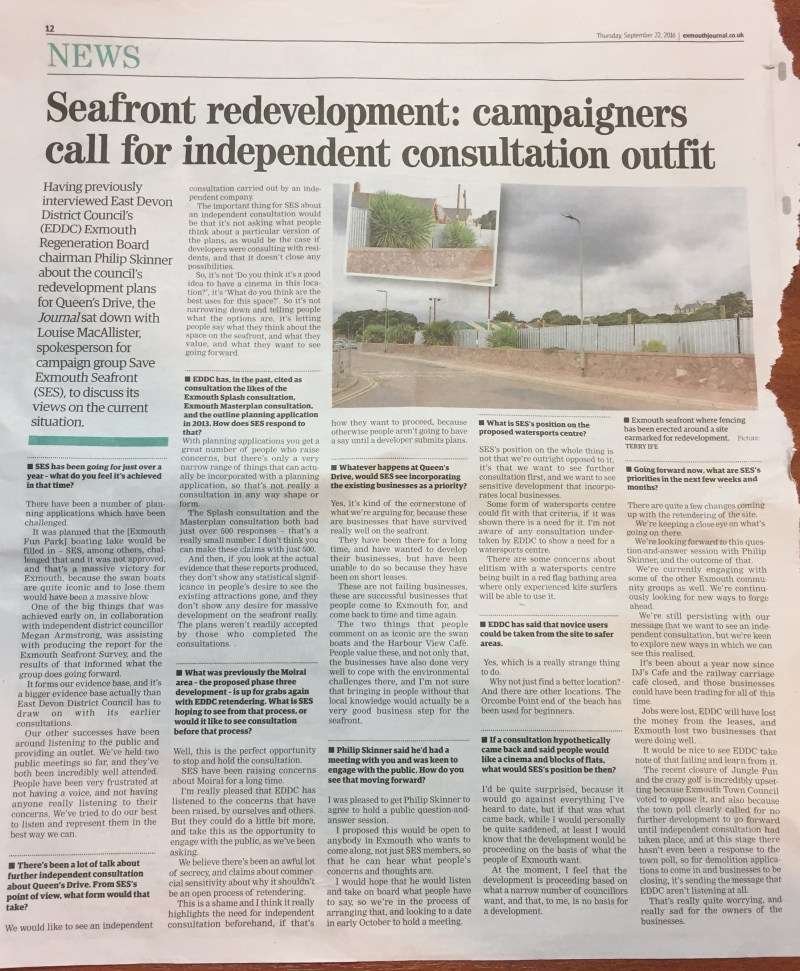
Exmouth seafront regeneration: an alternative view

In this week’s Exmouth Journal an interview with Dr Louise McAllister, spokesperson for Save our Seafront:

img_1304

“Footballers’ £400m social housing dream unveiled”

“… A year ago, former England captain Rio Ferdinand, West Ham United skipper Mark Noble and ex-Brighton striker Bobby Zamora turned up at the conference to unveil their Legacy Foundation – a regeneration charity with a plan to build a series of social and privately rentable housing schemes, backed by private investors.

The stars (all three of whom have played for West Ham) are coming back to present their first project, worth £400m, to build 1,300 homes on a 22-hectare site in a run-down area in Houghton Regis near Luton. The scheme is a partnership with Central Bedfordshire council, which they met at the conference last year, and is being funded by Aviva Investors. …”

http://www.theguardian.com/society/2016/sep/24/footballers-400m-social-housing-dream-unveiled?CMP=Share_iOSApp_Other

EDDC parking meter overpayments

According to the response below “What is this excess revenue spent on? – This income is not separated from the total income received from car parking, which is used to fund the service itself and helps to fund a range of services provided by the Council.”

Er, what range of services? Income from parking is meant to be spent only on parking related projects and creaming-off the overpayments for “other services provided by the council” is very questionable to say the least and possibly illegal, though Owl will bow to the expertise of EDDC’s legal eagles on that point – and fortunately we do gave an expert councillor too – Chairman Hughes.

Let’s hope they follow correct procedure for using surplus funds, which is:

Safer Parking:
In deciding how to spend their parking surplus, local authorities should have regard for the advice given in the Local Government Association’s Circular 535/00. This circular urges authorities to work towards Safer Parking Accreditation (Park Mark®), and to consider using parking surpluses to fund the necessary measures.

The circular refers to section 17 of the Crime and Disorder Act 1998 and argues that this Act together with the provisions of section 55 of the 1984 Act makes it both necessary and desirable for authorities to prioritise spending on crime prevention measures in car parks before consideration is given to spending parking surpluses in other areas.”

Click to access PPN1%20-%20Charging%20for%20Parking%20-%20Aug%202011.pdf

Here is the Freedom of Information request:

“Date submitted: 15 September 2016

Summary of request

• Over the past five financial years how much money has the council made through parking-overpayments from its meters i.e. “over-vend” in parking meters that do not give out change?
• What is this excess revenue spent on?
• How many of these parking meters do the council manage?
• Over the past five financial years how much money has the council made in total through car parking meters?
Summary of response

• Over the past five financial years how much money has the council made through parking-overpayments from its meters i.e. “over-vend” in parking meters that do not give out change? – There were no overpayments in the financial years up to and including 2013/14 as our machines were programmed then to give the appropriate time for the money inserted into ticket machines. Because we wanted to add more choice to the customer, from the 1st April 2014 we introduced 2, 3 and 4 day permits. This meant that the memory available in the current ticket machines did not allow for the previous increments and so we introduced 50p increments without the option to give change.

2014/15 – £16,946 Gross inc VAT ( NET £14,122); 2015/16 – £15,066 Gross inc VAT (NET £12,555)

• What is this excess revenue spent on? – This income is not separated from the total income received from car parking, which is used to fund the service itself and helps to fund a range of services provided by the Council.

• How many of these parking meters do the council manage? – Currently we have 61 ticket machines.

• Over the past five financial years how much money has the council made in total through car parking meters? – The figures below are the NET income (which is how we report in the accounts/budgets etc) for the respective years just for the ticket machine income and Parkmobile charges.

2011/12 – £2,401,376
2012/13 – £2,244,874
2013/14 – £2,346,703
2014/15 – £2,477,864
2015/16 – £2,554,583

Date responded: 23 September 2016

show details
http://eastdevon.gov.uk/access-to-information/freedom-of-information/freedom-of-information-published-requests/