Just because YOU can’t see OWL doesn’t mean OWL can’t see YOU


Just because YOU can’t see OWL doesn’t mean OWL can’t see YOU
“Councils have been accused of deliberately hiding the scale of the rough sleeping crisis in England by changing the way they compiled figures for the 2018 official count, the Guardian can reveal.
Official government statistics reported a 2% fall in rough sleeping in England in 2018 after seven consecutive years of rises when the figures were released last month. But critics have suggested the percentage decreased after several councils changed their counting method and does not reflect the reality on the streets.
The government has described the claims as “an insult” to the volunteers and charities who help compile the official figures. But back in 2015 the figures were also criticised as low-quality, untrustworthy and vulnerable to political manipulation by the UK Statistics Authority who threatened to remove their official status.
The rough sleeping statistics for England, based on a combination of estimates and spot counts on a single night in autumn, are intended to include everyone about to bed down or already bedded down on the street, in doorways, parks, tents and sheds but not hostels or shelters. …”
“Bosses at Britain’s largest private construction business enjoyed a sharp rise in payouts last year despite ongoing losses and a bumpy refinancing that forced it to file its accounts months after the legal deadline.
Five directors at Laing O’Rourke, which has worked on major projects such as Crossrail and Heathrow Terminal 5, were paid £3.4m in salaries and short-term incentives in the year to March 2018, compared with just £1.6m in the previous 12 months.
The accounts were due to be filed in September but auditors refused to sign off on the company as a going concern until it refinanced £177m of debt in its UK business. …”
https://www.telegraph.co.uk/business/2019/02/24/bumper-pay-day-bosses-loss-making-laing-orourke/
Bumped from comments below:
Thanks again for keeping an eye on this, Owl.
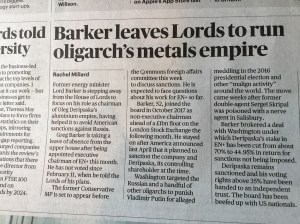
Your scanned piece from the Sunday Times can be picked up on-line – where the bit we can read tells us that Barker “is set to appear before the Commons foreign affairs committee this week to discuss sanctions. He is expected to face questions about his work for EN+ so far.”
The same article refers to Barker’s lack of interest in the second chamber:
“Former energy minister Lord Barker is stepping away from the House of Lords to focus on his role as chairman of Oleg Deripaska’s aluminium empire, having helped it to avoid American sanctions against Russia. Greg Barker is taking a leave of absence from the upper house after being appointed executive chairman of EN+ this month. He has not voted since February 11, when he told the Lords of his plans.”
Back in August 2016, the Sun considered two of the resigning PM’s choices for gongs:
“TWO of David Cameron’s cronies have attacked criticism of his decision to shower aides and allies with honours. Hugo Swire, who was given a knighthood on Thursday, and Greg Barker who was made a Lord last year hit back at Mr Cameron’s ex-guru Steve Hilton who branded the resignation list “corruption” for including Tory donors.”
The Daily Mail ran a piece back in July 2014 lambasting the Tories for cosying up to Russian money – and it began with an auction:
“As bidding passed the £100,000 mark, guests at this year’s Conservative Summer Party broke into spontaneous applause. For sale was what auctioneer Hugo Swire, a Foreign Office minister and former director of Sotheby’s, billed as a ‘once-in-a-lifetime’ experience: the chance to play a tennis match with both David Cameron and Boris Johnson.”
The £160,000 prize was famously won by a Russian oligarch’s wife:
https://www.mirror.co.uk/news/politics/boris-johnson-defends-playing-tennis-12209056
What is clear, though, is not only that the Conservative Party has seriously compromised itself in taking Russian money (it was the Labour Party which was lambasted for doing so from the 1920s…) – but the extent to which lobbying on behalf of Russian business (aka political) interests is happening at the heart of Westminster – as reported last year by intelligenceonline.com:
It will be interesting, then, when Barker gives oral evidence on “Global Britain: the future of UK sanctions policy” to the Commons foreign affairs committee this Wednesday:
https://www.parliament.uk/business/committees/committees-a-z/commons-select/foreign-affairs-committee/#
.
Keep at it, Owl!
David Smith, economics editor The Sunday Times:
“… There are two other elephants in the room.
The first is affordability. Official figures show that the average house price in England and Wales is 7.8 times annual full-time average earnings. The ratio has continued to climb in recent years, even since the crisis.
Over the past 20 years, it has more than doubled in England — up 123% — and nearly done so in Wales — up 92%. Viewers in Scotland have their own figures, but it has also gone up substantially.
It is true, of course, that ultra-low interest rates affect the affordability calculation when it comes to monthly mortgage payments, making bigger mortgages more affordable, but high prices are still a mountain to climb when it comes to deposits.
Also, even though wage growth has picked up, at a little over 3%, it is not making much of a dent in the high house price/earnings ratio. Older readers will remember a time when you took out a mortgage you could barely afford, confident in the knowledge that salary rises would come to the rescue. Things are different now.
The other elephant is the Help to Buy scheme, beloved of my friends in the housebuilding industry, where it has been like manna from heaven. First-time buyers have been steered towards new housing by Help to Buy equity loans on up to 20% of a property’s value in most of the country and a hefty 40% in London.
This has had two effects. By tilting first-time buyers towards new-build homes, it has distorted patterns in the market for existing homes. Young people who used to buy older homes, including “doer-uppers”, now have a powerful incentive to buy new. Normal housing market chains are not having a chance to form.
The second effect has been to push up prices for new properties relative to existing homes. Again, this comes out clearly from the affordability data.
In the early 2010s, the house price/earnings ratios for new and existing homes were similar. Since then they have diverged significantly. The latest figures are that the ratio for new homes is 9.7 — the average new home costs nearly 10 times average earnings — compared with 7.6 for existing homes. First-time buyers are being pulled into higher-priced homes and, ultimately, more debt. …”
Source: Sunday Times (pay wall)
“East Devon District Council (EDDC) and Grenadier Estates agreed a development deal in August 2017 and planning permission for the facility was granted in June last year, but the supplementary agreement relating to beach access has yet to be signed.
Peter Quincey, director of Grenadier, has said the company is excited to commence with this project and is keen to get on site as soon as possible, but the details of a supplementary agreement is still to be finalised.
The council’s deputy chief executive told councillors at a cabinet meeting that Grenadier is still being chased.
At the meeting on Tuesday, February 12, Exmouth councillor Steve Gazzard asked for answers on the Queen’s Drive project.
He said: “I am trying to be helpful, but I want some answers.
“Can we have an update on whether Grenadier signed finally signed the contract, whether Michael Caines is definitely opening a restaurant or is just interested in opening a restaurant, and whether, subject to planning permission being granted, there is money allocated in a budget for repairs to the play park on the seafront?”
Richard Cohen said: “I cannot say specifically what the details between Grenadier and Michael Caines are, but the fact they have announced he will be opening a restaurant suggests they have a high degree of confidence in it.
“We will have to budget for any maintenance at the play park that needs to be carried out and we have already done some work on wear and tear repairs.”
After the meeting, Mr Quincey said: “We are delighted to have Edge Watersports and Michael Caines supporting the new watersports centre on Exmouth seafront. Work is expected to begin on site in Summer 2019 and conclude Summer 2020.”
In November, the cabinet approved the £1.2m work on realigning the road and the car park as part of ‘phase one’ of the Exmouth seafront regeneration scheme, The second phase will be the development of the watersports centre and ‘phase three’ is a mix of leisure facilities on the former Exmouth Fun Park site and the current Harbour View plot.”
https://www.exmouthjournal.co.uk/news/watersports-centre-contract-not-signed-1-5896955
So, just what is the (currently dormant) 50/50 business Eaglesham Investments Ltd Which he runs with Swire FOR:
https://eastdevonwatch.org/2019/01/28/swire-eagle-and-sham-an-unfortunate-choice-of-company-name/
Originally it was described as investing in “emerging markets” and later as being for “renewable energy” investments.
Shouldn’t our MP tell us?
Owl says: they don’t mention the district heating system – which keeps residents tied to one supplier – E.on – for 80 (yes EIGHTY years)!
“Local authorities and developers are charging for supplying services in new towns that are free to other homeowners.
Residents of a new town in Devon are being charged an extra £370 a year in council tax in a practice — already being called “the new town tax” — that could spread across the country.
Cranbrook, a new town to the east of Exeter, is charging band F properties a £370 surcharge, rising to £512 for band H properties. Residents receive no more services than people elsewhere in Devon.
Mark Williams, chief executive of East Devon district council, said: “It is very likely that other towns not just in East Devon but elsewhere will have to adopt a similar approach if they wish to maintain their local assets or facilities.
“We believe that the approach adopted by Cranbrook town council is likely to be replicated across the country, especially in areas where there are areas of significant new housing.”
Cranbrook, whose population will eventually exceed 25,000 people, was managed by developers who levied an “estate rent charge” on residents.
The charge was a contribution for the upkeep of facilities such as landscaped gardens and bin collections. When the town council took over responsibility for the services, it kept most of the charge as an addition to the council tax.
Activist groups have sprung up to help residents nationally who have moved into new homes only to discover they are at the mercy of developers on service costs for green spaces or parking. Developers can levy fees because local authorities are not obliged to “adopt” new housing and provide the services.
Cathy Priestley of Homeowners Rights Network, a pressure group, has been contacted by people from 457 new estates housing 86,000 residents with fees ranging from £100 to more than £700 a year. The developers include Bovis, Linden, Persimmon, Redrow and Taylor Wimpey.
She said: “Buyers are lumbered with hidden estate taxes no matter who collects them or who is to blame for this set-up. Stop the rot! Adopt the lot!”
The prospect of permanent higher council taxes for buyers of homes on greenfield sites will be controversial. The government is supporting a housebuilding drive intended to benefit younger people and the “squeezed middle”.
Kevin Blakey, chairman of Cranbrook council, justified the council tax surcharge by saying a lot of people “simply couldn’t afford” to pay the developer’s flat-rate service charge “and the collection rates were going to be pretty awful”.
He added: “There are no council houses but 40% of the first phase of development was given over to social housing managed by housing associations. These charges [were] being applied to people in East Devon who are probably least able to afford it.”
Blakey said that even though the town council would provide services more efficiently than the developers, the charges reflected the cost of maintaining trees and green spaces, including a country park, insisted on by the district council. The residents have to meet the costs even though it is open to everyone. “Our arguments have fallen on deaf ears,” he said.
Williams said: “There are no rules. The government has allowed developers to pass their obligations directly onto new home owners and the ability to remedy the situation lies with the government. This is a national issue.”
Source: Sunday Times (paywall)
and
EU offers lucrative tax breaks to firm of billionaire Brexiter
https://www.theguardian.com/business/2019/feb/23/eu-offers-lucrative-tax-breaks-to-firm-of-billionaire-brexiter
“Britain’s most profitable housebuilder faces being stripped of its right to sell Help to Buy homes after allegations of poor standards and punitive hidden charges.
James Brokenshire, the housing secretary, is reviewing Persimmon’s participation in the government scheme, which accounted for half of the homes it built last year, The Times has learnt.
Since Help to Buy was introduced, Persimmon’s profit per house has almost tripled, rising from £22,114 in 2012 to £60,219 in 2018. Half of the 16,000 homes the company built last year were sold under the scheme, which is designed to boost home ownership.
Persimmon is now set to become the first housebuilder in the country to report profits of more than £1 billion.
Introduced in 2013, Help to Buy offers buyers with a deposit of only 5 per cent an interest-free loan of up to 40 per cent of the purchase price in London, or 20 per cent outside the capital.
Critics say the scheme has subsidised huge profits and multimillion-pound bonuses across the housebuilding industry while inflating property prices.
An investigation by The Times last year found that homes available under Help to Buy cost an average of almost 15 per cent more per square metre than comparable properties that were not eligible.
At the end of 2017 Jeff Fairburn, then Persimmon’s chief executive, was in line for a bonus of £110 million despite the company being embroiled in a scandal over unfair leases and criticised for the quality of some of its homes.
The company has been accused of selling houses on leasehold terms, under which buyers are forced to pay ground rent charges that provide an extra source of income. There have also been complaints about the quality of some of the new homes.
Mr Brokenshire is understood to be worried about the company’s behaviour after a string of complaints. A source close to the housing secretary said that Persimmon’s “approach” would be “a point of discussion” when the government decided which house builders would be allowed to offer Help to Buy homes from 2021.
“James has become increasingly concerned by the behaviour of Persimmon in the last 12 months,” the source said. “Leasehold, build quality, their leadership seemingly not getting [that] they’re accountable to their customers are all points that have been raised by the secretary of state privately.
“Given that contracts for the 2021 extension to Help to Buy are being reviewed shortly it would be surprising if Persimmon’s approach wasn’t a point of discussion.”
They added: “James is clear any new government funding scheme will not support the unjustified use of leasehold for new homes, including Help to Buy.”
Yesterday critics demanded a complete overhaul of the scheme.
Clive Betts, the Labour MP and chairman of the housing, communities and local government select committee, said: “Help to Buy has clearly been the prime driver of Persimmon’s profits. Companies are there to make money but they should behave responsibly as well. Some of Persimmon’s practices have been questionable to say the least.
“I think most ordinary people will be outraged by this.”
Nationwide Building Society says that house prices for new-build properties have grown 15 per cent faster than for older properties since Help to Buy was introduced.
An official report published last year found that almost two thirds of people using Help to Buy did not need it to get on the property ladder and that the average income of applicants was £53,000.
Mr Betts added: “My personal view would be that if government wants to help solve the housing crisis, it will have to put more money into helping build homes that people can afford to rent.”
Henry Pryor, a buying agent, said that the increasing number of homes being built across the country had led to a decline in quality. “If you aspire to build 300,000 homes a year there will be people taking short cuts, it is human nature, and we don’t have a sufficiently robust system in place to ensure the properties are fit for purpose,” he said.
“I don’t think there is a conspiracy to knock out shoddy homes but we are seeing what I call Friday afternoon houses. Homes that seem like they have been built by someone who’s had a good lunch on a Friday or is rushing off for the weekend.”
The government confirmed last year that Help to Buy would be extended by a further two years from 2021, although from this date there will be a cap on the value of eligible homes to within 20 per cent of average prices in each region.
The Home Builders Federation argues that the scheme has been a huge success because it has helped to boost the supply of new homes.
A spokesman for Persimmon said: “Our performance over recent years reflects the group’s success in growing its construction volumes to meet UK housing need, particularly by offering attractively priced new homes to first- time buyers. Since 2012 we have increased our output by 75 per cent and invested £3.8 billion in new land. In late 2018 we announced a range of new customer service initiatives and we are confident that these will improve our performance once they have had time to take effect. We are also making a significant investment in training to address the shortage of skills in the industry.”
Analysis
Help to Buy has some heartfelt enthusiasts (Anne Ashworth writes). These are the millennials who cannot rely on a payout from the Bank of Mum and Dad but still want a place of their own. If they have a deposit of 5 per cent they can use Help to Buy to climb on to the ladder. Without it some would be forced to remain in rental accommodation for decades, excluded from home ownership.
However, even supporters of Help to Buy will share the widespread dismay about the way in which housebuilders have exploited the policy. Some bosses have enriched themselves at the taxpayers’ expense, apparently with the co-operation of the Treasury, which did not impose rules to ensure that the policy did not become a bounty for the boardroom. The most notorious example is Jeff Fairburn, former chief executive of Persimmon, who pocketed £75 million, but others have also prospered.
One of the original aims of Help to Buy was to ensure that builders “got shovels into the ground”. Little thought seems to have been given to ensuring that these homes would be solidly constructed. Many are shoddy, unlovely and not energy-efficient.
Thanks, in part, to Help to Buy, mortgage lending to first-time buyers is at its highest since 2006. The chancellor is likely to hail this as a success story in his spring statement next month. He should instead order that Help to Buy, which runs until 2023, provide quality housing for first-time buyers, rather than financing yet more mansions for housebuilder directors.
Anne Ashworth is property editor of The Times
Case study
Nicola Bentley thought she was buying a “dream home” for her family last May when she exchanged contracts on a £280,000 house from Persimmon in Kippax, Leeds (Louisa Clarence-Smith writes). However, when the finance director, 46, moved in she said she found 700 snags, ranging from a damaged cooker to leaking pipes and shoddy plasterboard on internal walls.
Ms Bentley, a mother of two, said she is still waiting for issues to be resolved. “We have been living in hell for the last nine months,” she said. “Persimmon told us it would take three to four weeks to rectify all our snags. We are now into week 26 and living in a building site.”
A spokesman for Persimmon said: “We recognise that Ms Bentley has experienced an unacceptable level of issues and have been working hard to address these. The majority have been dealt with and we are working with Ms Bentley to resolve the remaining matters.”
Source: The Times (pay wall)
“A plan for where the next 4,170 homes in Cranbrook will be built has been backed – and it will see homes built south of the old A30.
Planners have already given the go-ahead for a total of 3,580 new homes to be built in the new town of Cranbrook, with a total of 7,850 eventually set to be built.
East Devon District Council’s Strategic Planning Committee on Wednesday morning backed the Cranbrook Plan Development Plan Document (DPD) which outlines the land where a further 4,170 new homes will be built, and that it is expected that at least 100 new homes will be built in the town centre.
Four expansion areas, two of which are south of the A30, are allocated for development of the 4,170 new homes, as well as a neighbourhood centres, community buildings, open space, allotments, two primary schools, sports pitches, and land suitable for a place of worship and a cemetary. …
… Development would take place at Bluehayes, to the west of the existing development, and include 960, Treasbeare, south of the existing development and south of the old A30, and include 915 new homes, Cobdens, to the east of the existing development, and include 1,495 new homes, and Grange, to the south of Cobden and south of the old A30, and include 800 new homes …
… The plan also safeguards land for a second railway station in Cranbrook, but only 15 per cent of the residential developments within the built-up area boundary of Cranbrook will be affordable houses, compared to the 30 per cent for the first phase of development, in order to make the plan viable to developers.
A policy to ensure delivery of the town centre, which includes a new town square, a health and wellbeing hub, a leisure centre, a civic centre, a library, a children’s centre, a youth centre, plus retail uses, is included in the DPD.
A town centre is considered a priority as since the original outline planning permission for the first 2,900 homes back in October 2010 was granted, only The Cranberry Farm pub has been constructed on the land and residential development of the town has now taken place both east and west of the Town Centre, leaving it as a void.
Councillors did raise about the green wedge and that only 15 per cent of the houses would be affordable, but Mark Williams, the council’s chief executive said that it was due to the massive infrastructure build required to provide all that the Local Plan and this plan wants to see at Cranbrook.
He said: “The work that we have had commissioned looks at whether this is actually affordable and whether what we think is necessary is affordable. The only way if it is affordable is to reduce the percentage of affordable housing and to reduce the developers profit from 20 per cent to 17.5 per cent.” …
… The committee revised the recommendation to approve the Cranbrook Plan Development Plan Document for consultation and to recommend the Cranbrook Plan Development Plan Document to Full Council for submission to the Planning Inspectorate for Examination in public, subject to any necessary changes from the consultation being approved by the strategic planning committee first.”
https://www.devonlive.com/news/devon-news/major-plans-change-cranbrook-forever-2572325
“Construction work has been halted in one area of a new homes development site after foundation issues were discovered.
Work began on the Clinton Devon Estates and Taylor Wimpey’s Plumb Park development in Exmouth back in November 2017 with planning permission granted for 264 new homes. Work is expected to finish by the end of 2022.
However, it has emerged one plot – which is currently unoccupied – has foundation issues, but it has not been confirmed what they are.
Taylor Wimpey have stated the plot will not be sold until investigations are complete, or until any subsequent remedial work is carried out to the foundation.
The developer is currently is working closely with consultant engineers to carry out ongoing ground investigation works in the vicinity of affected plot.
It means construction work has been postponed in the area while those investigations take place.
Taylor Wimpey confirmed there are no issues in any occupied homes.
A Taylor Wimpey spokesperson said: “We are investigating a foundation issue that relates to one unoccupied plot at our Plumb Park development.
“This issue was identified as part of our ‘pre-construction testing of ground conditions’ on subsequent plots, and as part of our stringent quality checks. We can confirm that no occupied houses nor any public areas are affected.”
https://www.devonlive.com/news/devon-news/work-stopped-taylor-wimpey-homes-2573195
“Exeter-based regional airline Flybe has been bought by a consortium led by Virgin Atlantic.
Connect Airways, which consists of Virgin, Stobart Air and Cyrus Capital, paid £2.8m for the airline on Friday.
It now means that flights currently operated by Flybe will soon be taking off under the Virgin brand.
Cyrus Capital now own 40 per cent of the Exeter-based airline, with Virgin and Stobart acquiring a 30 per cent stake each.
Flybe tweeted about the takeover on Friday night: “Today’s confirmation of the sale of Flybe to Connect Airways secures an exciting future for our customers & employees as we continue to provide vital regional connectivity in the UK & beyond. …”
https://www.devonlive.com/news/devon-news/flybe-completes-sale-virgin-led-2571675
Members of the House of Lords who are not paid a salary may claim a flat rate attendance allowance of £150 or £300 for each sitting day they attend the House. All they have to do is sign in and 5 minutes later they can leave and collect the money. Or, they could dine in their highly-subsidised restaurants first, of course.
“Older people should lose their pensions if they refuse to do community work to stop them being a “negative burden on society”, a former senior Whitehall official has suggested.
Lord Bichard, an ex-chief of the Benefits Agency, said the elderly should get rewards and fines to make sure they are taking a more active part in the world.
The crossbench peer, who also chaired an inquiry into the murder of two Soham school girls, suggested the same tough attitude towards benefit scroungers should be taken with older people.
“Older people who are not very old could be making a very useful contribution to civil society if they were given some incentive or recognition for doing so,” he told a committee of MPs.
“We’re prepared to say to people if you’re not looking for work, you don’t get a benefit. If you’re old and you’re not contributing in some way, maybe there should be some penalty attached to that. These debates never seem to take place.
“Are we using all the incentives at our disposal to encourage older people not just to be a negative burden on the state but actually be a positive part of society?”
His remarks were condemned by pensioner groups as “little more than National Service for the over-60s”.
Dot Gibson, general secretary of the National Pensioners Convention, said: “This is absolutely outrageous. Those who have paid their national insurance contributions for 30 or more years are entitled to receive their state pension and there should be no attempt to put further barriers in their way.
“We already have one of the lowest state pensions in Europe and one in five older people in Britain live below the poverty line.”
Dr Ros Altmann, director-general of Saga, said the idea was “very strange indeed”.
“Those who have retired have already made huge contributions to our society and are already the largest group of charity and community volunteers,” she said. “The Saga website has been buzzing all day with angry messages of incredulity.”
Owl begs to differ – but the Sidmouth Herald (headline to article: ‘Expert to offer advice to potential election candidates’ seems not to know about his election officer past where he “lost” 6000 voters and had to explain himself (not too well) to a parliamentary committee!
Hopefully, this “expert” will also visit other towns!
“Residents wishing to stand as a candidate for Ottery Town Council, but are unsure about the process and role can speak to an expert tomorrow (Saturday) at the community market.
Ottery Town Council has 11 seats to be contested during the election on May 2.
Mark William’s EDDC’s returning officer will be available to speak to between 9.30am and 12.30pm at The Institute to offer advice and assistance about the role.
An Ottery Town Council spokesman said: “As a local councillor you can become a voice for your community and make a real change. Councillors are community leaders and represent the interests of the communities they serve. If you’re still undecided and feel you require more information before making a final decision, then there is an expert available who should be able to provide you all the answers.”
Meet your current EDA independent councillors and maybe think about becoming one yourself!
East Devon Alliance Annual General Meeting
Saturday 23 February 2019 11.00 am – 12.30 pm
Dissenters Hall, The Old Meeting Unitarian Chapel, All Saints Rd, Sidmouth EX10 8ER
All East Devon Alliance Members & Supporters are cordially invited to attend the Annual General Meeting
Further information available from the EDA Secretary: secretaryeastdevonalliance@gmail.com
Well, he would, wouldn’t he …
But a bit odd that the picture with the article on the newspaper page shows snow on one of the warmest February days ever …

https://www.theexeterdaily.co.uk/news/local-news/east-devon-mp-visits-donkey-sanctuary
If industrial estates are essential sites and supposedly we don’t have enough of them, why is Taylor Wimpey being allowed to build more than 200 houses on the former Parkhurst Close Industrial Estate in Exmouth – the largest town in East Devon?
“The government should consider taxing online sales, deliveries or packaging and cutting property taxes for retailers as part of a package to help revive the UK’s ailing high streets, according to an influential group of MPs.
In a report published on Thursday, the housing communities and local government committee says local authorities need more help, including extra cash, to redevelop town centres. It also suggests an overhaul of planning regulations, including scrapping rules that allow developers to turn offices into flats without special permission.
Clive Betts MP, the chair of the committee, said it was likely that “the heyday of the high street primarily as a retail hub is at an end”. However, he added: “This need not be its death knell. Local authorities must get to grips with the fact that their town centres need to change; they need to innovate, setting out a long-term strategy for renewal, reconfiguring the town centre and finding new ways of using buildings and encouraging new independent retailers.”
Betts said dated planning policies and unfair business rates, which are a tax based on the value of property occupied by a business, were “stacking the odds against businesses with a high street presence and this must end”. …”
 East Devon Watch