
Monthly Archives: November 2019
50,000 more nurses? Of course not!
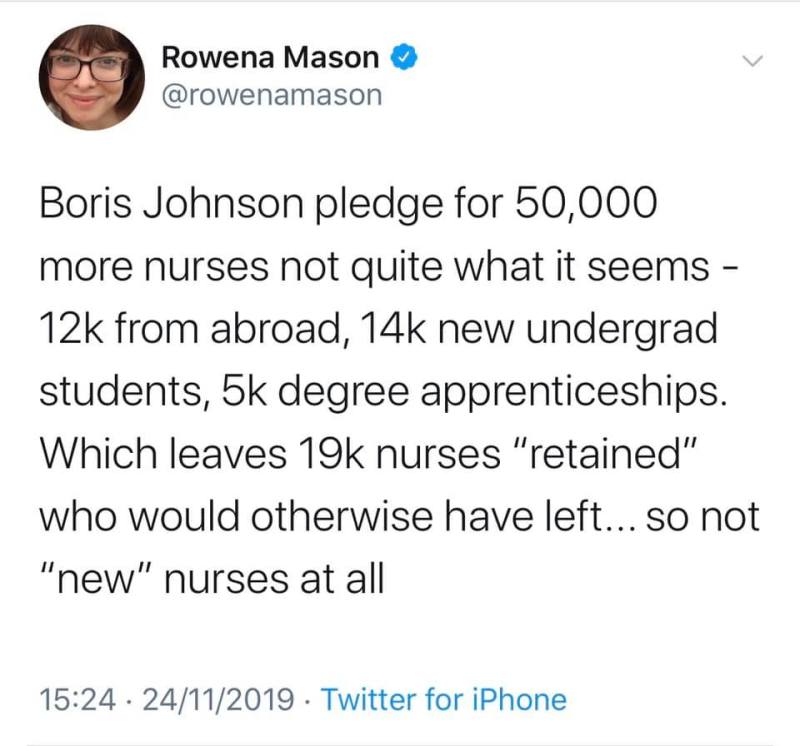
“Breakdown of that Tory 50k new nurses pledge. Party sources say 14k from students, 12.5k from overseas 5k from new nurse apprenticeships. But bulk of increase will come from better ‘retention’ of existing staff (better childcare/management support)…..So 31,500 “new” nurses then and a pipe-dream about retaining staff who are growing more unhappy in their roles each day due to the 40,000 nurse vacancies that can’t currently be filled. This man really has a problem with the truth…….”
“Poor urban councils bear majority of Tory funding cuts, study shows”
“Drastic cuts to local government funding have seen the UK’s most deprived metropolitan areas “shoulder the burden of austerity” while some more prosperous counties have flourished, according to new research.
Analysis by the TUC and public service union Unison of central government funding for local councils in England since 2010 highlights a yawning chasm between urban and rural areas. It shows that , overall, councils in England are spending £7.8bn a year less on key services than they did in 2010, which equates to a cut of £150m a week.
The analysis reveals that the 20 councils with the biggest funding gaps are overwhelmingly metropolitan boroughs in London and the north of England. Of these 18 are controlled by Labour; only one is Conservative-run.
In contrast, the 20 councils with the smallest funding cuts are overwhelmingly all Conservative-controlled county councils. Of these, 16 are controlled by the Conservatives and just two are Labour-run.
The analysis – using methodology employed by both the Institute for Fiscal Studies and the Centre for Cities – found that Labour-run Salford Council is spending 38% – or £99m a year – less on key local services than a decade ago. That works out to £479 a year less per resident. …”
The Local Government Association estimates that in the past eight years, councils in general have lost 60p out of every £1 the government used to provide prior to the funding cuts. This has left councils increasingly reliant on raising income through council tax, business rates and other charges and fees. Urban councils in more deprived areas have found this task more difficult than their rural counterparts.
“Poorer parts of England have suffered most from the Conservatives’ local government cuts,” said TUC general secretary Frances O’Grady. “By slashing central government funding, they have made deprived areas shoulder the burden of austerity. We need fair and sustainable funding for all of our communities. Key services have been cut to the bone.”
Unison general secretary Dave Prentis agreed: “Local services hold communities together, but nine years of austerity has put paid to that. We’ve seen libraries shut, care visits reduced, allotments and parks sold off, youth centres closed, subsidised bus services scrapped and public conveniences axed. The government’s funding squeeze has forced councils to charge residents more, reduce key services or cut them altogether. Now the cupboard is virtually bare and some local authorities can no longer provide the legal minimum.”
A spokesman for the Ministry of Housing, Communities & Local Government said it could not comment as it is currently in election purdah.”
How to submit a question to Sidmouth hustings
From Vision Group for Sidmouth:
This is your ‘red button’ to leave a question:
https://visionforsidmouth.org/contact/
Otherwise questions can be submitted on the night at the door by 7.30pm.
Note: At the last general election hustings held by the Vision Group in Sidmouth, quite a few people turned up late to attend because there had been an important council meeting that same evening. In other words, it’ll be no problem to arrive after 7.30pm and after the Late Night Shopping, as candidates will be giving short presentations in the first half and taking questions in the second.
A seat cannot be guaranteed though!
Tory Telegraph rattled by Claire Wright

Sidmouth hustings 6 December slight delay to start time (now 7.30 pm)
“The General Election Hustings planned for Sidmouth on December 6 has been put back half an hour due to the town’s Late Night Shopping event.
The event will now run from 7.30pm to 9pm.
Peter Murphy, chair of the event, said, “We wanted to complement the shopping event in Sidmouth and not compete with it. And so we decided to move the start time from 7pm to 7.30pm, to allow people to take part in both events.”
The Vision Group for Sidmouth, which is hosting the hustings, says that the calling of the snap general election left little time for organization and there were limited dates for the use of halls to hold the event.
Friday, December 6, had already been chosen by the Chamber of Commerce for its annual Late Night Shopping – so in order to avoid a clash, the Vision Group has pushed its own event to start a little later.
As Peter commented: “This way, we hope that people will be attracted to the centre of town with a double bill that evening!”
The hustings will be attended by all six parliamentary candidates and will be held at All Saints’ Hall, All Saints’ Road, near the hospital in Sidmouth.
All are welcome to come along.
To put a question to the candidates, click the red button below and write to the group’s secretary.
Daily Telegraph sees Claire Wright as potential winner in East Devon
“East Devon doesn’t seem like a natural place for a revolution. Its gentle landscape, retirement communities and well-kept seaside towns don’t suggest a predilection for insurrection.
Indeed, in its various guises, the seat has been represented by a Conservative MP for 150 years. Yet next month, voters across Exmouth and its surroundings could be the first to elect an independent first-time MP in England for nearly two decades.
Claire Wright is standing in the seat for the third time, having come second at both previous attempts. Her share of the vote surged in 2017, leaving her with 21,000 votes to Sir Hugo Swire’s 29,000. …”
(Remainder of article behind paywall)
An American talks about the NHS
Retirement flats – the big con
“Tens of thousands of families have seen their inheritances decimated after elderly relatives paid inflated prices for new retirement homes that have collapsed in value, an investigation by The Times has found. Prices of retirement flats in developments built by some of Britain’s biggest housebuilders have plummeted by up to 90 per cent in the face of costly annual management charges and ground rents.
Analysis of Land Registry data suggests that £3 billion could have been wiped from the value of retirement homes built between 2001 and 2015. In one case, a flat bought for £197,000 in 2009 from builder McCarthy & Stone, a FTSE 250 company, was sold for only £26,000six years later. The owner, Miriam Savage, was paying £8,200 a year in service charges and ground rent to the managing agent.
The losses often become apparent to families only when their loved ones die and they try to sell their home. There are 150,000 retirement flats in the UK. They don’t have full-time nurses but most have communal areas and features to help residents live independently. There is often 24-hour telephone support or wardens on site.
The properties are sold as leaseholds with the freeholds bought by the highest bidder. The freeholder collects an annual ground rent and appoints an agent to run the development. These companies have been accused of levying excessive fees and charges and leaving facilities to fall into disrepair.
Sebastian O’Kelly, of betterretirementhousing.com, said: “These flats routinely plummet in value and the reason is the leasehold system. The freeholder and property manager still get their ground rent and service fees irrespective of price. It’s deplorable that families are pouring money into these purchases, often in desperation, only to see their value evaporate.”
Retirement home builders say the value of the properties is not just financial. They say they reduce loneliness and the burden of maintenance and increase safety and security. McCarthy & Stone points out that since 2010 it has not allowed outside companies to manage its sites and this is protecting values.
Some families have concerns about how properties are sold. One complained that a 88-year-old relative was sold a flat while her daughter was on holiday. When the woman died, the flat wouldn’t sell. Land Registry data shows the average loss of value for flats in the block is £74,000.
The Times looked at nearly 500 retirement flats in 15 developments built between 2001 and 2015. Almost 80 per cent of the homes sold since their first purchase had fallen in value with an average loss of £38,846. The analysis suggests that flats built since 2010 have fared better with only 37 per cent experiencing losses. But one McCarthy & Stone flat built in 2015 lost £45,000 in value when it was sold this year. In the past four years McCarthy & Stone has made profits of £383 million.
Mr O’Kelly said: “The situation may be improving as builders move to being service providers but these companies successfully lobbied government to retain ground rents on retirement sites, which doesn’t encourage the belief they have a long-term interest.”
This week Churchill Retirement Homes donated £150,000 to the Tories. The company is run by Spencer and Clinton McCarthy, the sons of John McCarthy, the co-founder of McCarthy & Stone. There is no suggestion that the donation was linked to the decision to exempt retirement home providers from a ban on ground rents. Spencer and Clinton McCarthy have been Tory supporters for ten years.
The industry says the sale of freeholds funds communal areas and without this system flats would cost more.
Sources at McCarthy & Stone insist it is a different company to the one that developed homes pre-2010. FirstPort is responsible for maintaining the developments built before 2010. It said that nine out of 10 customers say its properties improve their quality of life. It added: “Independent research by the Elderly Accommodation Counsel in 2019 found that new retirement properties typically increase in value. The vast majority of our managed properties increase in price on resale and they are more than just places to live.”
“The billionaire and the 219 tiny flats: a new low for rabbit-hutch Britain?”
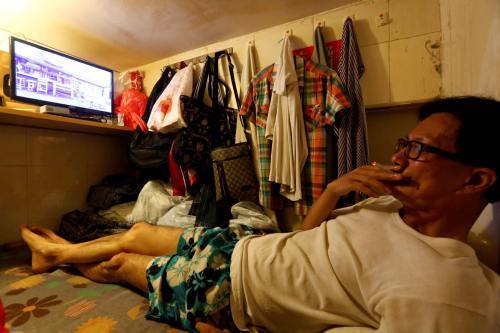
“Campaigners have piled in to criticise plans drawn up by a billionaire property tycoon to cram more than 200 tiny flats into an office building in north London. They describe it as a “human warehouse” that would be filled with people living in “cramped single-occupancy shoeboxes” like “rabbits in hutches”.
Amid claims that some of the planned flats would be as small as 15 sq metres – that’s less than 13ft by 13ft for residents’ entire living space – some locals say the proposal is one of the most shocking examples yet of the phenomenon known as office-to-residential conversion. A typical Premier Inn hotel room is 21 sq metres, while national space standards state that the minimum floor area for a new one-bedroom one-person home is 37 sq metres.
It was 10 years ago that, while London mayor, Boris Johnson pledged an end to “hobbit” homes in the capital, but examples of rabbit-hutch developments keep coming, and one leading architect told Guardian Money: “We’re heading towards the so-called ‘coffin homes’ in Hong Kong.” …”
The plight of small rural primary schools
“Leaders of small, rural primary schools fear that funding constraints could see their school closed, a poll has revealed.
Primary schools in England with less than 150 pupils are being forced to cut back spending on things like equipment, teaching assistant hours and building maintenance, according to a survey by the National Association of Headteachers union.
The survey, which heard from 10% of 3,614 small schools, found that 42% of leaders were concerned about the possible closure of their school with a lack of funding given as the primary cause (84%).
Low or fluctuating pupil numbers was another key reason given for potential closures, with 73% citing this as the most likely cause.
The NAHT found that 70% had reduced investment in equipment, 67% have cut hours for teaching assistants and 60% have spent less on their building maintenance “in recent years”.
Speaking at the NAHT’s primary schools conference in London today, Paul Whiteman, general secretary of NAHT, said: “Small schools are at the heart of our local and rural communities. But as one of the groups hit hardest by budget cuts, for thousands of small schools the future remains uncertain.
“This is a terrible state of affairs when you think about how about vital these schools are. In many places, the school is the last public service left standing in their community. The post office, the police station, the library, the community centre have all gone.
“We cannot allow the school to be next. These schools may be small, but their loss would be incalculable.”
The poll found 41% of school leaders surveyed said they received additional funding through the National Funding Formula for being a small school, such as ‘sparsity funding’ – brought in to protect small schools.
But even those that did, 84% said it was not enough to provide “reasonable budget stability”.
James Bowen, NAHT director of policy, said: “All schools have suffered as a result of budget cuts, but small schools have been hit particularly hard. These schools play a vital role in their communities and they must be protected.”
Bowen added that current funding arrangements are “clearly” not working for small primary schools. …”
https://www.publicfinance.co.uk/news/2019/11/union-reveals-plight-rural-primary-schools
The reality of estate rentcharges – inability to sell a home
As in Cranbrook, and possibly other areas of East Devon. In Cranbrook, the town council is taking on these charges and includes it with the precept, so everyone in the town pays for them whether they are part of thse developer’s estates or not.
“‘Freehold charges cost us our dream home’
Peter Kirby and Jen Tweedle, with children Amelia and Zac, say they’ve been told their house could be unsellable
“To be honest we were absolutely devastated by it. You would never buy a house without being able to sell it again”.
Jen Tweedle is talking about the moment she and her fiancé Peter realised why their house sale fell through over the summer.
Their buyers couldn’t get a mortgage after discovering Jen and Peter’s new-build, freehold property was subject to an estate rentcharge.
Peter said: “We lost the sale and our dream house… and that was very disappointing.”
What is an estate rentcharge?
An estate rentcharge is imposed when private developers build housing estates that the local authority won’t “adopt”, meaning councils won’t pay for the upkeep of public spaces or roads on that estate, or pay for things such as street lighting.
When that’s the case developers – or once any building works are finished, residential management companies – establish the charge to pay those bills.
But some residents have criticised this process, saying they have very little control over the charges and that there’s not enough transparency about exactly what they’re paying for.
In addition to this, crucially, if homeowners fall 40 days behind on their payments, the law on estate rentcharges allows developers, or management companies, to take possession of a property to ensure they get the money they’re owed.
Although this is extremely rare, the fact that the legal right exists can put potential buyers off and leave mortgage providers unwilling to lend on properties subject to rentcharges.
However, the Home Builders Federation says rentcharges are the fairest way to make sure communal areas are paid for and maintained.
‘Unsellable’
In Peter and Jen’s case, their potential buyers couldn’t get a mortgage agreed because the home was subject to an estate rentcharge.
“We bought our house [in Oxfordshire] back in July 2016 and we were informed by the estate agent there’d be a service charge which, coming from London, we weren’t worried about,” Peter says.
“Basically we weren’t told by our solicitor or by our estate agents what an estate rentcharge actually meant in terms of the law”, Jen adds.
She’s also unhappy at how they were treated by the developers, their solicitors and estate agent, and how they didn’t even find out their rentcharge might be a problem until they tried to sell.
“The sudden surprise of it all, the fact that the term ‘your house is unsellable’ was thrown at us… you would never buy a house to not be able to sell it again.”
For now, Peter and Jen have taken their home off the market and will look again in the new year.
“We have to be resigned to the fact that this problem may reappear.
“Probably about £2,500 has already been paid out and we still need to pay solicitors another £1,500 hoping they will be able to sell our house, we don’t know.
“Maybe our house is unsellable.”
Beth Rudolph, a director of the Conveyancing Association, says the failure of house sales due to estate rentcharges is becoming more common.
“Just yesterday a developer refused to vary the terms of a rentcharge that the lender had confirmed was not acceptable to them because of the risks to themselves and the borrower,” she says.
“We need the government to intervene to change the law so that someone cannot effectively lose thousands of pounds because they forgot to pay a £6 rentcharge.
“We would absolutely expect that any rentcharge owner should be able to recover arrears of payments in the normal debt collection way, but not to be able to grant a long lease or possess the property.”
‘Fairest way’
Andrew Whitaker from the Home Builders Federation says because of cuts to local authority budgets many local councils just don’t have the money to adopt estates like they would have in the past.
“As part of a development we [developers] build places – not just homes. So things like parks, shared spaces, roads,” he says.
“In the past we used to hand all of this to the local authority and they’d maintain it in the future. Because of cuts and local authority budgets being strained they are less keen to do this.
“They still need maintaining and the fairest way to do this is to establish an estate rentcharge.”
Tories retain candidate who took £54,000 in illegal dividends and repaid £2,000
“A Conservative parliamentary candidate who has been praised by Boris Johnson is facing questions over why he received an illegal dividend from a security firm that went into administration owing £271,000 in tax.
Stuart Anderson, who is trying to overturn a Labour majority of 2,185 in Wolverhampton South West, was a director and major shareholder of Anubis Associates for eight years until 2013 when the firm collapsed.
The firm, which trained security guards, was wound up by administrators who noted that Anderson had received more than £54,000 in unlawful dividends. He later repaid £2,000.
It comes amid criticism from unions that the Conservatives have failed to rein in malpractice in business.
When Anubis went under it owed £271,738 to HM Revenue and Customs in VAT, PAYE, national insurance and deferred taxation, documents show. Another 59 unsecured creditors were owed £179,330. Secured creditors received a portion of what they were owed.
Anderson, a former soldier and a Brexit supporter, had not mentioned his involvement with the firm in his online biography or during interviews. When approached by the Guardian, he said he complied with all his legal obligations. …”
Ladbroke’s gives Indie Claire Wright best of all odds for capturing seat
A vote for any other candidate will be a vote for the Tory parachuted candidate.
“Bookies at Ladbrokes have put Claire Wright at 7/4 for the East Devon seat on December 12.
At the time of writing, Conservative candidate Simon Jupp was the favourite at 2/5.
The company tweeted odds for selected Independent candidates nationally, and put Cllr Wright ahead of Dominic Grieve (Beaconsfield, 2/1), David Gauke (NE Herts, 4/1), George Galloway (West Bromwich E, 8/1) and Chris Williamson (Derby North, 20/1).
On December 12, Cllr Wright is contesting the seat vacated by Conservative Sir Hugo Swire.”
Why are only half of Cranbrook residents using the soon-to-close doctors surgery?
Could it be the transient nature of renters in the town? Or no effort to sign people up? Or its poor location?
Whoever heard these days of doctors complaining they don’t have enough patients!
“Cranbrook residents are hoping to find out more about the future of its GP surgery which is at threat of closure due to low patient numbers, staffing problems and financial problems.
Access Health Care (AHC), which runs Cranbrook Medical Centre in Younghayes Road, has revealed it will not be extending its contract which is due to expire on March 31, 2020.
It is not known what will happen to the centre after that time, but Devon’s Clinical Commissioning Group has assured it is working on potential solutions.
AHC, which operates five Plymouth GP surgeries, as well as Cranbrook Medical Centre and Exeter’s Clock Tower Surgery for the homeless and vulnerably housed, has stated the following reasons for not renewing the contract.
Currently only around 3,500 of the 6,500 residents at Cranbrook are registered
AHC cannot recruit the necessary GPs and nurses to provide the service required
The location of the surgery
A lack of government funding per patient to run an effective GP service” …
https://www.devonlive.com/news/devon-news/residents-await-outcome-cranbrook-gp-3563934
Donors to parties …

Buck stops at councils for poor rural broadband
“A council-run broadband group has been branded “incompetent” for repeatedly terminating contracts and failing to deliver broadband after a decade.
Last month, Connecting Devon and Somerset (CDS) began its fourth procurement for a new supplier.
Graham Long, chairman of campaign group Fast Broadband for Rural Devon & Somerset, said the problems needed to be “lanced” and suggested bringing in new operators.
Council-run CDS declined to comment.
Campaigners have highlighted the lack of certainty around the roll-out due to funding arrangements with central government.
About £20m is needed to complete the work but this money was not set out in September’s Spending Review.
The review normally covers three years but this year only covered one.
‘Track record’
Farmer, Steve Horner, from Yarcombe, struggles with a slow internet connection.
“The only way they can recover is by replacing the current team in Exeter… they have to be replaced with competent people who have a track record.”
Mr Long said: “This is a boil that needs to be lanced and my suggestion of bringing in other operators is a way to lance it.
“My conclusion is CDS is currently gambling on that problem being solved by November next year when they expect to sign contracts, and whatever government we have at that time guaranteeing that money would be provided.”
The project is also subject to EU state aid rules and under the terms of approval the work needs to be completed by 2020.
CDS, which is run by Somerset and Devon county councils, has terminated three large contracts so far, twice with BT, and last year with Gigaclear.
People in affected areas believe any supplier would face the same problems as Gigaclear of laying cables underground.
“Some of the roads didn’t have proper foundations so they couldn’t use narrow trenches so had to do a lot more work,” Mr Long said.
Gigaclear connected about 3,000 properties before its contract was terminated.”
Meet Claire Wright in Exeter – 26 November 7.30 pm
Why Exeter?
Because part of the “East Devon” constituencty is in Exeter. Boundary changes gave East Devon the part of Exeter just south of Heavitree, and Topsham – even though for district purposes they come under Exeter City Council
You are invited to meet her for a Q&A session in Exeter, on
Tuesday 26 November,
19:30 – 21:00, at
St Peter’s Church of England High School.
Coincidentally the last day to register to vote:
https://www.gov.uk/register-to-vote
This Q&A is open to all, including those who live elsewhere in the constituency. This is a fantastic opportunity to come ask your questions about the election and talk to Claire in a more informal setting.
Outbreak of manifestisis
“The prime minister is either an idiot or a liar. It is a difficult call for a spin doctor to make. So they went for idiot. It seemed safer.
Boris Johnson was only supposed to be churning out the “Get Brexit Done” spiel for workers at a fabrication firm (stop it) in Teesside. Instead he managed to blurt out a flagship manifesto pledge, which could cost as much as £10 billion.
He had been asked by Claire Cartlidge, a chemist: “You said low tax, do you mean low tax for people like you or low tax for people like us?”
Nice and easy one to bat away with talk of all being in it together, perhaps even a chance to tease the manifesto. Instead Johnson replied: “I mean low tax for working people. If you look at what we are doing and what I said in the last few days, we are going to be cutting national insurance up to £12,000.”
Klaxons. Sirens. Heads in hands. Glass smashed in emergency. Spin doctors, fresh from an earlier visit to a washing machine factory, were in a spin.
Had the prime minister accidentally scooped himself by leaking his own manifesto? Was it not true and he had got it wrong? Perhaps he was a big wally who couldn’t keep his mouth zipped.
Decisions, decisions. It was definitely not deliberate, the spinning spinners spun. But the policy was true. Sort of.
A briefing note was rushed out. In fact the policy was that the threshold to start paying national insurance contributions (NICs) would rise from £8,628 a year to £9,500, with an “ambition” for it to eventually rise to £12,500. He was, it turned out, tantalisingly close to being right.
To be fair this is a hell of a policy. It means taking NICs in line with when you start paying income tax (which was raised by the coalition, a Lib Dem policy which the Tories had dismissed as unaffordable in 2010, but let’s not dwell on that).
It would mean more than two million low-paid workers being lifted out of paying NICs altogether, eventually saving people £450 a year.
Johnson was putting a brave face on it. In an interview with The Times soon after, the PM insisted that he had not blundered. “No, no, no,” he starts. “I’ve been campaigning on this for months. If you’d been paying attention during the Conservative Party leadership election it will not have been news to you.”
As Francis Elliott writes: “The drawn faces of his aides tell a different story.”
This bit of clumsiness has also had the effect of overshadowing the Labour manifesto launch today, which Tory HQ will no doubt be furious about. If they keep drip-dripping policies out ahead of Sunday’s big launch, they could dominate the news cycle for six days.
For Labour, a harder task. Everything from 2017 has to stay, pretty much. They have not had the luxury of a change of leader to ditch the duff ideas or trim the expensive ones.
Instead Jeremy Corbyn’s focus is on the messaging. He hates billionaires. Billionaires are bad. And he is good. “I accept the implacable opposition and hostility of the rich and powerful is inevitable.”
A party conference policy to make the UK carbon neutral by 2030 will be watered down, but the BBC is reporting there will be a windfall tax on oil companies.
Corbyn will vow to press ahead with increasing the tax on the richest, raising the minimum wage to £10 an hour, building millions of homes, tackling climate change and nationalising the rail, mail, water and energy firms.
“And here’s a brand new one: I accept the implacable opposition of the private internet providers because we’re going to give you the very fastest full fibre broadband for free. That’s real change.”
The problem is that voters don’t think he will. New polling by James Johnson, the Downing Street pollster 2017-19, shows that voters don’t believe Corbyn will actually deliver on his flagship promises if he becomes PM.
It showed that only 13 per cent of people think that the promise of a four-day working will ever happen, and only 15 per cent think that the UK could have net zero carbon emissions by 2020, a policy that has been hotly debated in the party.
Just a quarter think that the free broadband policy will be delivered or that a scheme to give 10 per cent of the shares in every company to their workers will happen.
Meanwhile, over in Libdemland Jo Swinson is promising to legalise cannabis when she becomes prime minister. (It is not clear if the two claims are connected.) She unveiled the Lib Dem manifesto yesterday with pledges to stop Brexit, tax frequent flyers and launch a £130 billion capital investment programme. (The Times’s Oliver Wright unpacks the policies, and how they compared to previous manifestos, here:
So we have a prime minister making promises when he isn’t supposed to, a wannabe prime minister making promises that voters don’t think he can keep and a never-gonna-be prime minister making promises nobody expects her to have to honour.
Manifestitis comes in many forms. Symptoms include a rash of promises, verbal diarrhoea and delusion. A cure is not expected for another three weeks.”
Source: Red Box (Times)
“Leaders’ election TV debate cancelled after Boris Johnson refuses to take part”
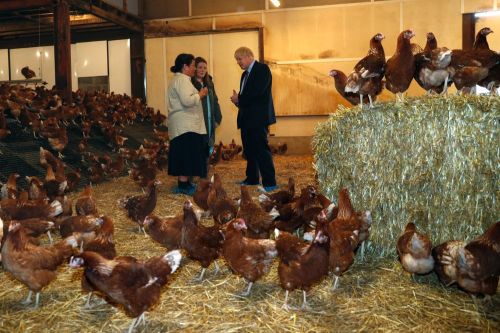
Chicken – AND he’s refused to appear at the husting in his constituency!
Frit!
“A planned leaders’ debate between Boris Johnson and Jeremy Corbyn has been cancelled after the prime minister refused to take part.
The Channel 4 debate, which was scheduled for Sunday, would have been the second direct clash between Mr Johnson and the Labour leader after a contest on ITV this week.
But despite agreement from Labour, a producer announced on Thursday evening that the programme had been cancelled just days before it was supposed to air.
“Gutted we’ve had to cancel a planned Leaders debate on Channel 4 for this Sunday. Jeremy Corbyn had agreed to take part but, after many weeks of intense discussion, we were unable to secure agreement from Boris Johnson team,” said Channel 4 producer Louisa Compton.
Channel 4 News anchor Krishnan Guru-Murthy, who would have presented the debate, added: “Boris Johnson said he was in favour of debates and his team have been in detailed talks with us for weeks about format and rules right up until yesterday.
“They insisted they were engaged and wanted to take on Jeremy Corbyn on our channel. Corbyn said yes. Offer still stands.”
It comes as the Labour candidate in Mr Johnsons’s seat said the prime minister was ducking out of a local hustings event there, leading it to be cancelled as well.
Ali Milani tweeted: “Name any time that works for you. My team will organise the venue, details and all logistics. All you have to do is show up. Show an ounce of integrity. Come debate me. What do you have to worry about?”
Channel 4 says it will still hold a live debate on 8 December featuring “representatives” of seven major parties taking questions from an audience of undecided voters. The politicians would be questions about everything except Brexit.
Another head-to-head clash is expected to take place on the BBC on Friday 6 of December, with Question Time specials planned for this Friday and further events potentially in the pipeline.”
 East Devon Watch