Rishi Sunak admits taking money from deprived areas

Is this why Exmouth and Axminster keep losing out? – Owl

Rishi Sunak has admitted taking money from deprived urban areas in order to give it to other parts of the country.

Rajeev Syal www.theguardian.com 

The former chancellor, who is standing to be prime minister, made the claim last month while speaking to Conservative party members in Tunbridge Wells, Kent.

In footage obtained by the New Statesman, Sunak said: “I managed to start changing the funding formulas to make sure areas like this are getting the funding they deserved.

Link to Twitter here 

“We inherited a bunch of formulas from Labour that shoved all the funding into deprived urban areas and that needed to be undone. I started the work of undoing that.”

Tunbridge Wells has a Tory majority of 14,645 and has been held by the party since the constituency was created in 1974.

An analysis by the Guardian in February found that, under Boris Johnson’s “levelling up” agenda, some of the wealthiest parts of England, including areas represented by government ministers, were allocated 10 times more money per capita than the poorest.

The analysis brought together the four main levelling up funds for the first time. The future high streets fund, the community renewal fund and the towns fund have been fully allocated, while the levelling up fund has allocated £1.4bn, with a further £1.8bn still to be announced. A total of £4.7bn has been allocated in England across the four schemes so far.

It is not clear from the video to which funding formula or levelling up fund Sunak is referring.

Labour’s Lisa Nandy, the shadow levelling up secretary, said: “This is scandalous. Rishi Sunak is openly boasting that he fixed the rules to funnel taxpayers’ money to rich Tory shires.

“This is our money. It should be spent fairly and where it’s most needed – not used as a bribe to Tory members. Talk about showing your true colours.”

Sunak’s Conservative colleagues were divided over the footage. The Foreign Office minister Zac Goldsmith said: “This is one of the weirdest – and dumbest – things I’ve ever heard from a politician.”

Jake Berry, the chair of the Northern Research Group of Tory MPs, said that in public Sunak “claims he wants to level up the north, but here, he boasts about trying to funnel vital investment away from deprived areas”.

“He says one thing and does another – from putting up taxes to trying to block funding for our armed forces and now levelling up,” Berry, a Liz Truss supporter, said.

But Sunak’s supporters rallied around him, with the Conservative Tees Valley mayor, Ben Houchen, arguing that Johnson led the party to electoral victory on a pledge to invest in areas “that have been ignored at the expense of urban cities”.

The public accounts committee, parliament’s spending watchdog, has been critical of the lack of rules over the towns fund. The levelling up fund is supposed to create economic growth but with no clarity of what that means and no measurements of success.

Responding to Sunak’s words, Meg Hillier, the chair of the cross-party PAC, told the Guardian: “This is evidence of a deliberate decision to change public spending priorities based on who you know.

“Pork barrel politics is unfair on taxpayers, and the areas that don’t get the funding cannot even begin to qualify for the cash in a game with no rules.”

Sunak is reported to be trailing Truss in the race to succeed Johnson as prime minister, as party members begin voting. But there is still a month of the campaign to go, with the result to be announced on 5 September.

Both candidates will appear at another hustings event on Friday evening, this time in Eastbourne, where they will take questions from Tory members.

Sunak’s campaign did not dispute the video, but argued that he had moved the cash from inner city areas to towns and poorer rural areas.

A source said: “Levelling up isn’t just about city centres, it’s also about towns and rural areas all over the country that need help too. That’s what he changed in the green book and he will follow though as prime minister.”

They added: “Travelling around the country, he’s seen non-metropolitan areas that need better bus services, faster broadband or high-quality schools. That’s what he’ll deliver as prime minister.”

The government was criticised last year for the terms of the £4.8bn levelling up fund, after it emerged that dozens of Conservative regions were placed in the top tier for assistance, despite their relative affluence.

Ministers responded to the backlash by saying they “did not have any of the political influence” suggested and had left the scheme in the hands of civil servants.

In 2020, Robert Jenrick, the then communities secretary, admitted that he and a junior minister approved payments to towns in each other’s constituencies from another government fund earmarked for deprived areas.
Sewage sleuths: the men who revealed the slow, dirty death of Welsh and English rivers – The Axe

The Long Read in yesterday’s Guardian concerned an investigation by amateur sleuths: retired professor Peter Hammond and retired detective superintendent Ashley Smith. Between them they have uncovered how the clean-up of our rivers has stalled in the past couple of decades, and the reasons why.

This extract describes the situation on the Axe.

Oliver Bullough www.theguardian.com (Extract)

…When EA inspectors checked farms along the River Axe in south-west England between 2016 and 2019, they found that almost every farm was non-compliant with the rules for storing slurry, silage or fuel oil, all of which are harmful if they leach into rivers. On almost half of the farms, the inspectors saw pollutants entering the waterway. Farmers told the inspectors they had been flouting the rules because they saw the risk of enforcement as being so low – a problem the regulators know all too well. “Last year, we had sufficient resources that would allow us, in theory, to visit every farm … less than once every 200 years,” Bevan, the EA chief executive, told a parliamentary committee last year. “That is not a great disincentive to a farmer to stay on the right side of the line.”

“I get bloody irritated, and so do most people in the EA,” one veteran EA inspector told me. “The problem is that we don’t have the resources or the legislative muscle to do what everyone knows we need to do. But you only have to look at some of the farms in Herefordshire – they are big businesses, they are not scared of loose legislation or penalty notices. They can ignore all that.”

A year ago, the government provided funding for 50 additional inspectors to check farms in England, which will increase the headcount to 80, but that will only repair some of the damage caused by a decade of underfunding. “Given the length of the river system in this country, having only a few hundred people to oversee them is a pretty tall ask,” said Bevan, in evidence to parliament.

Such interventions from Bevan are noteworthy for their laconic understatement, but the ex-inspectors and current insiders who were prepared to talk to me spoke more in the language of crisis. Although little is being done to prevent sewage and manure from poisoning our rivers, at least we recognise the problem and are seeking to understand it. With regard to other threats, such as those from antibiotic-resistant micro-organisms, microplastics or “forever chemicals” such as polyfluoroalkyl substances – which are used in dozens of consumer products and have been linked to multiple serious diseases – the collapse in funding has reduced research, meaning we are always looking at pollution in the rear view mirror. “We don’t know what’s getting into the rivers. Nobody’s looking,” said another former EA inspector who took early retirement thanks to the funding cuts. “That’s a complete failure.”

So, what’s the answer? Some local groups – such as the Friends of the Upper Wye and the Wye Salmon Association, near where I live – have started testing the rivers for themselves, trying to discover the extent and the origin of the pollution. But gathering the volume of data that Hammond had access to requires resources far beyond even the largest NGOs. Truly understanding what is happening to our waterways could only come from the regulators doing the kind of monitoring and analysis they used to do before their budgets were gutted….

Who paid for “Fizz with Liz”?

Liz Truss is embroiled in fresh controversy after a leaked email left her facing questions over why she did not declare thousands of pounds spent on schmoozing Tory MPs in the run up to her bid to succeed Boris Johnson.

Simon Walters www.independent.co.uk

Around a dozen Conservative MPs attended a so-called “Fizz with Liz” champagne dinner hosted by the foreign secretary at Mayfair members club 5 Hertford St last year.

The event was paid for by club owner, multimillionaire aristocrat Robin Birley.

When The Independent asked why Ms Truss has not declared the function – worth an estimated £3,000 – in the Commons register, where MPs are obliged to disclose hospitality worth more than £300, her spokesperson denied she had organised it.

It had “nothing to do with her,” they said. Ms Truss was merely one of a number of Conservative MP guests invited by “organiser and host” Mr Birley, the spokesperson said.

However, this account is disputed by other MPs present who told The Independent that she was the host and not Mr Birley, who “turned up briefly to say hello”.

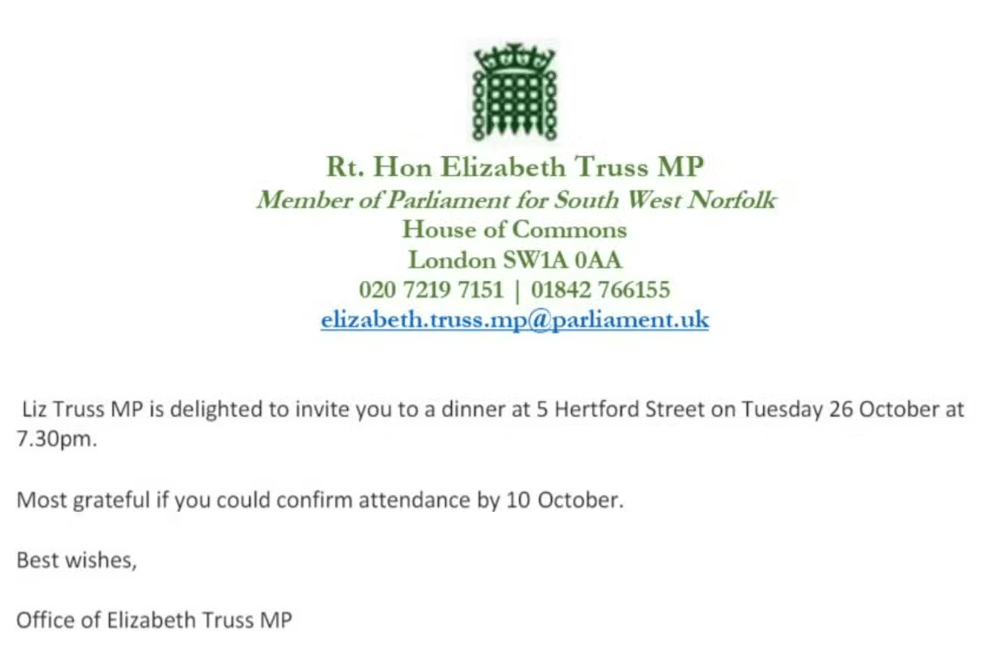
The invitation sent to MPs suggests the event was organised by Truss’s office

( Supplied)

Moreover, they said they were invited by Ms Truss. Their version of events appears to be borne out by a copy of the invitation obtained by this newspaper.

Sent from her Commons email address, it said: “Liz Truss MP is delighted to invite you to attend a dinner at 5 Hertford Street on 26 October at 7.30pm. Most grateful if you could confirm attendance by 10 October. Best wishes, Office of Liz Truss.”

A source close to Boris Johnson told The Independent that he was informed that at the time that Ms Truss had met a group of Tory MPs at 5 Hertford St in October last year and that she appeared to be “on manoeuvres”.

Former cabinet minister David Davis, who is supporting Mr Sunak, said: “We have just lost one prime minister after he broke the rules and couldn’t bring himself to tell the whole truth to the House of Commons. It would be a tragedy if a would-be prime minister did the same before they even got into Downing Street.”

Parliament’s code of conduct says MPs must declare in the Commons register of financial interests any gifts, benefits or hospitality with a value over £300.

This includes “‘any benefits which relate in any way to their membership of the House or political activities… hospitality, including receptions and meals”.

In addition, donations worth more than £1,500 must be declared to the Electoral Commission watchdog.

Declarations to the Commons register and the Electoral Commission must be made within a month.

The “Fizz With Liz” row comes hours after Ms Truss was forced to scrap plans to save up to £11bn per year from civil service pay reforms after claims that it would mean cutting the wages of nurses and teachers.

She said there had been “wilful misrepresentation” of her initiative but critics said she should “stop blaming others” for the muddle.

The 5 Hertford St club is popular with wealthy Tory donors and Brexit backers, showbusiness celebrities and royals.

It is not the first time Ms Truss’s links to the club, where membership costs £2,850 a year, have attracted attention.

She clashed with Foreign Office after insisting on hosting an official £3,000 lunch there last year for a US trade envoy. She spent hundreds of pounds on wine and gin alone, according to a Sunday Times report in January.

She reportedly described suggestions of a cheaper and less party political option as “inappropriate”, said the newspaper. The £1,400 bill was picked up by taxpayers after the Foreign Office negotiated a price cut.

This followed reports in December that 5 Hertford St had become “ground zero for anti-Boris plotters”.

The club was reportedly being used by Ms Truss for “Fizz With Liz” functions to “schmooze MPs and potential financial backers for a leadership bid”.

The Independent has spoken to a number of MPs who attended a dinner they say was hosted by Ms Truss at the club on 26 October.

“Liz was centre of attention, in great form and we discussed all sorts of things,” said one. “We had champagne, cocktails, wine and a lovely three-course meal. Mr Birley turned up briefly to say hello.”

Another MP said: “Liz said it was time to stand up for Conservative values. She didn’t talk about the leadership but we all knew why we were there. She wanted our support.”

Approached by The Independent about the event, Ms Truss’s team changed their account several times.

Initially, her spokesperson said Ms Truss paid for the event personally, which would mean there was nothing to declare.

They later said it was paid for by Mr Birley but said there was no need to declare it.

Ms Truss was merely “an attendee,” a guest of Mr Birley, said her spokesperson, and the value of her dinner was “below the £300 threshold for Commons declarations”.

The spokesperson was adamant that the event had “nothing to do with her”. “It was not organised for her, on her behalf or by her. She was invited by Robin Birley with loads of MPs. It was put on by Mr Birley to discuss low tax and deregulation.”

Asked to explain the email from her Commons office inviting MPs to the event the spokesperson said later: “I am aware of the email but it was not her event. We are sticking with the line. We have had very clear advice

“A declaration would only need to be made if there was a benefit to Liz, or it was above the threshold for individual declarations for MPs’ register of interests. Liz was one of a number of MPs in attendance.”

Mr Birley, who donated £20,000 to Boris Johnson in 2019, and who is a half brother of environment minister Zac Goldsmith, said last September that he had lost faith in the government. Mr Birley told The Times: “I do not see this government as particularly pro business. I am terribly depressed about the situation.”

Despite recent gaffes, Ms Truss remains the strong favourite to defeat Mr Sunak in the Tory leadership contest. The latest YouGov poll put her 34 points ahead among Conservative members.

Most local MP’s not on the same hymn sheet as their members

But whatever song they are singing, Tories are consumed with their own in-fighting and not concentrating on the real issues facing the country. – Owl

From today’s Western Morning News:

Rishi Sunak has won the backing of the majority of Westcountry Tory MPs.

Ed Oldfield reports

A majority of MPs in Devon and Cornwall are backing Rishi Sunak as the next Prime Minister – against the polling of party members, which puts Liz Truss way out in front.

Six of the eight Tory MPs in Devon are backing the former Chancellor to be Conservative Party leader and succeed Boris Johnson. They include Central Devon MP Mel Stride, who is running the campaign for the former chancellor.

In Cornwall, George Eustice, the Environment Secretary and MP for Camborne and Redruth, and Steve Double, the St Austell and Newquay MP, have also thrown their weight behind Mr Sunak, who was accompanied by North Cornwall MP Scott Mann – also a supporter – on a visit to Launceston this week.

Mr Sunak made a bid for the rural vote when he spoke at the Westcountry hustings event at the Great Hall at University of Exeter on Monday. He said he would make sure post-Brexit international trade deals do not penalise farmers, and said fields should be used for food production not solar panels.

Mr Stride, speaking after the meeting, said suggestions that Ms Truss was in the lead with party members was not proving to be the case, and said Mr Sunak had “everything to fight for” because there were a large number of undecided voters. He added: “He is the best person to beat Labour – the central thing is, he can beat Keir Starmer.”

The other declared supporters for Mr Sunak in Devon so far are Torridge and West Devon MP Sir Geoffrey Cox, Selaine Saxby in North Devon, Simon Jupp in East Devon, South West Devon MP Sir Gary Streeter, and Anthony Mangnall in Totnes. Torbay MP Kevin Foster outlined his support for Liz Truss in the initial stages of the contest, while Newton Abbot MP Anne Marie Morris backed Tom Tugendhat, who has since backed Ms Truss.

Mr Foster and Ms Morris attended a meeting on Monday in South Devon with Ms Truss, and the Torbay MP tweeted afterwards: “She will deliver on her pledges and unite the party behind her to do so”. Both Mr Sunak and Ms Truss pledged to win back the Tiverton and Honiton parliamentary seat, which was lost to the Liberal Democrats in a by-election in June after the resignation of Neil Parish for watching pornography on his mobile phone in the House of Commons chamber.

After Monday’s meeting, Devon County Council leader John Hart said he had come to listen and was still undecided, but added: “I was very impressed with Rishi.” How he dealt with a question about loyalty following his resignation from the Cabinet, which was one of the triggers for the departure of Boris Johnson, impressed Mr Hart.

Mr Sunak told the audience: “The Government found itself on the wrong side of yet another ethical debate that I found it hard to defend.” That related to what Mr Johnson knew about misconduct allegations against deputy chief whip Chris Pincher. Mr Hart said the response from Mr Sunak had “cleared the air”. Such opinions will be seen as an important factor as Conservative Party members make their decision about who to support in the postal ballot during August.

Who MPs support will affect their promotion prospects, when the winn­er is announced on September 5 and appoints a team of ministers.

It emerged on Tuesday that the Conservative Party has delayed sending out ballot papers for the leadership election over security concerns. The party has made changes to its process on the advice of the National Cyber Security Centre (NCSC), part of GCHQ, following warnings that hackers could change members’ votes.

Devon’s leader warns local authorities could go bust

Chickens coming home to roost for low tax, small state, austerity Conservatives – Owl

Some local authorities could go bust as income fails to keep up with cost pressures and inflation, the leader of Devon County Council has warned.

Ollie Heptinstall, local democracy reporter www.radioexe.co.uk 

Devon recently predicted a potential overspend in this financial year of up to £40 million, with its finance chief saying the council has “never before faced a combination of demand growth and price shock pressures of this scale.”

Conservative councillor John Hart, leader since 2009, says demand has gone up “far higher than we really anticipated” in children’s and adult services, while soaring inflation is “something we didn’t budget for” at the start of 2022.

It means some of the council’s bills, particularly for highways projects, are now around 20 per cent higher than it expected last year.

“We have a choice,” Cllr Hart said. “We live within in our means or we go bust.

“The more local authorities that go bust, the biggest problem the government’s got. And it’s got quite a lot of local authorities that are warning at the present moment that they have financial troubles.”

While Devon is not one of them at the moment, Cllr Hart admitted the council does have financial troubles – due to a separate overspend on caring for children with special educational needs and disabilities (SEND).

The government has told councils to put SEND overspends into separate ring-fenced accounts for three years, which ends next April, while it develops a new funding plan.

Devon’s share – effectively debt – is projected to rise to £119 million by the end of the arrangement, roughly the same amount it will have set aside in reserves based on current estimates.

But the council, along with a number of others, are still waiting to hear from the government about what will happen with the overspends.

Unlike the government, local councils have to balance their budgets by law every year and Cllr Hart predicts that a number of authorities “will go bust”

He adds: “There are a number that are getting very serious warnings at the present moment from their auditors.”

In 2018, Northamptonshire County Council effectively went bankrupt twice, leading to it and seven district councils being merged by the government into two unitary authorities.

“I think we have a problem with local government funding,” Cllr Hart said, “in as much [as] government has reduced its grant aid to local government and we have had to become much more reliant on council tax and business rates.

“Over the last few years, we’ve been responsible for the business rates and the council tax. We have been controlled, though, by government as to how much we could raise.

“So, that in itself means you aren’t giving us the money in cash. You’re not giving us the money we possibly would want in council tax because you’re telling us we have to restrict it to one-to-two per cent.

“We were able to take some extra money for social care [one per cent], and this council has always taken it because we do have an elderly population and we do have a very large social care bill, but that doesn’t actually help the general run of everything.

“75 to 77 per cent of what we spend now is on care of some sort – looking after a very small proportion of the people of Devon ….that doesn’t give you much flexibility, then, to actually help the general public.”

Last month’s financial report to Devon’s ruling cabinet said: “Immediate action [is] being taken to safeguard the financial sustainability of the authority.”

A panel of senior officers is looking at options – work labelled as top priority. It could mean services are remodelled to save money and major building projects are delayed or cancelled.

Cllr Hart added: “I would like to think that we will be in a position by Christmas [or] early new year to have reduced our pressures for this year, which makes next year’s budget a lot more saleable.”

“Oxfordshire 2050” goes the same way as GESP

Councils ditch £2.5m Oxfordshire 2050 housing plan

A £2.5m plan that Oxfordshire councils had hoped would shape how much new housing would be built for decades has been abandoned.

www.bbc.co.uk

Oxford City Council and four district councils signed up in 2018 to work together on Oxfordshire 2050.

But there is disagreement amongst them as some, including the city council, want more homes to accommodate growth and others want fewer.

The councils will now use their own plans to decide their housing numbers.

Only Labour-led Oxford City Council and Conservative-led Cherwell District Council, which are in favour of accommodating more homes, are controlled by the same political parties which led them in 2018.

Vale of White Horse and South Oxfordshire District Councils, which are led by the Liberal Democrats and a Lib Dem-Green coalition respectively, have opposed housing targets. Both were previously led by the Conservatives.

West Oxfordshire District Council was also led by the Conservatives in 2018 but are now led by a Lib Dem-Labour-Green coalition.

In a statement, the authorities said it was “with regret” they were “unable to reach agreement on the approach to planning for future housing needs”.

“The Oxfordshire Plan 2050 work programme will end and we will now transition to a process focused on Local Plans. The issues of housing needs will now be addressed through individual Local Plans for each of the city and districts,” they said.

“The councils will cooperate with each other and with other key bodies as they prepare their Local Plans.”

Planning applications validated by EDDC for week beginning 18 July

Cash-strapped council shelled out £160,000 to keep chief executive who broke Covid laws

A cash-strapped council forked out more than £160,000 to keep hold of its chief executive after she broke coronavirus laws by throwing a party, it has emerged.

Colin Drury www.independent.co.uk

Sheffield City Council is currently facing the financial abyss after its £25m emergency reserves for the year ran out last month – meaning services will now be slashed.

But the precarious financial position did not stop the authority from coughing up huge amounts of cash on a process that effectively granted disgraced chief executive Kate Josephs six months off work fully paid before welcoming her back into her role in June.

The council spent £21,682 on legal advice, £16,136 on an investigation into Ms Josephs’ behaviour – which is still being kept secret – and £31,551 on staff payments for those who had to take upgraded rolls. Ms Josephs continued to be paid her full salary during her time off – estimated to have come to around £95,000.

It all came after the 44-year-old hosted leaving drinks for more than 20 people to toast the end of her previous job leading the government’s Covid taskforce. At the time – December 2020 – people across England were barred from socialising and there were limits on numbers attending funerals.

When asked if she had attended a No 10 party, she repeatedly said she had not. She did not mention her own boozy bash, which took place in the building next door. She was fined by police for the event, and granted discretionary, full paid leave from her job running the council while her position was considered.

Now, the revelation that so much has been spent by Sheffield City Council on a process that remains shrouded in mystery – the Labour-run authority has refused to publish its internal report into the matter – has sparked further ire in the city.

Lord Paul Scriven, a Lib Dem peer who led the council between 2008 and 2011, said: “Here we have a council now sticking its fingers up twice to its taxpayers. The first time by allowing this chief executive to break the law and the return to her role without any consequences. The second time by the revelation that they have spent huge amounts of money on saving her at a time when services are having to be cut.

“It also raises another question. If this chief executive is so good at her job that senior councillors were desperate to save her, why is the council in such financial dire straits? Why has she not got a grip on this?”

The fallout of the scandal may continue for some time yet.

Sheffield City Council is so far refusing to publish the report into the matter even when requested under the Freedom of Information Act, a position that experts suggest may be untenable if challenged.

The authority has been approached for comment.

Government steps in to stop council sale of Bournemouth beach huts after 1,000 strong petition

The controversial sale of beach huts in Bournemouth, Christchurch and Poole has been stopped by central government.

The Levelling Up Secretary, Greg Clarke, has now written to all local authorities telling them not to use “loopholes to do dodgy deals”.

Sir Christopher Chope MP, Christchurch, Con.“They [Conservative Council] were warned and persisted and that’s why there is quite a lot of egg on the face over this weekend.”

www.itv.com 

BCP Council had hoped to raise more than £50 million from the move to help fund the amalgamation of the three former local authorities.

However the plan sparked huge opposition from beach hut owners who signed a petition reaching more than 1,000 signatures.

Daniel Parkin, Save Our Beach Huts Campaign, said: “I just feel that selling or transferring these assets to a separate company, you might lose the protection that the council currently provides for the owners and visitors to the beach huts.”

The Levelling Up Secretary, Greg Clarke, has now written to all local authorities telling them not to use “loopholes to do dodgy deals”.

The beach huts generate around £5 million every year. 

Councillor Vikki Slade, BCP Council Opposition Leader, Lib Dem, said: “Being honest about having spent the money and now needing to do transformation differently, this is about allowing all councillors to get involved with this and letting the residents know that this is the state the council is in.

“We need to get to basics, we need to run a council for local people for future generations.”

The conduct of the conservative-led council has also been criticised by one local Conservative MP.

Sir Christopher Chope MP, Christchurch, Con, said: “The council was using a special purpose vehicle to try and sort out its budget problems instead of reducing its expenditure, living within its means and behaving like a proper Conservative council should.

“They were warned and persisted and that’s why there is quite a lot of egg on the face over this weekend.”

Cllr Drew Mellor, Leader, BCP Council, Con, said: “We are absolutely committed to providing low council tax and keeping our assets for future generations.

“We made a point to government at the time that we should not have to go through complicated means to get there, the government should allow more flexibility.

“I had a conversation with Greg Clarke over the weekend and he says he’s looking forward to working with us to deliver some of that flexibility so we don’t need to use complicated measures such as our beach huts.”

BCP Council has applied for a loan from the government to cover the shortfall in its budget that was to be plugged by the sale of the beach huts.

The 3,600 beach huts in the area generate £5 million of income every year.

UK government to only publish seven of the 24 environmental indicators for England this year

Environmental campaigners have accused the UK government of ‘cowardice’, over its decision to publish less than a third of the metrics it uses to track the health of nature in England this year.

Fiona Jackson www.dailymail.co.uk 

Keeping a close eye on indicators of biodiversity is an essential part of monitoring and managing threats, like climate change.

The Department for Environment, Food and Rural Affairs (Defra) had previously said it would pause reporting on all biodiversity indicators in 2022, so that it could bring them in line with the UN’s targets.

However, following pressure from environmentalists, it has now announced it will publish seven of the 24 indicators for England for 2022 – excluding those on water quality, habitats and bird populations.

Defra added that this year’s full assessment will be published in 2023, and it does not anticipate that the delay will result in any loss of data. 

However, campaigners claim that the announcement, ahead of the UN Biodiversity Summit in December, is a shameless attempt to ‘bury the evidence’ that it is failing to tackle wildlife loss.

‘It is inappropriate and irresponsible to try and cover up the scale of the challenge we face,’ Elliot Chapman Jones, head of public affairs for The Wildlife Trusts, told MailOnline.

Only seven of the 24 indicators for England will be published for 2022, excluding those on water quality, habitats and bird populations. Pictured, a redshank — one of the United Kingdom’s threatened bird species

The quiet announcement of the reduced list of biodiversity data comes after the government said it would temporarily pause publishing any of the 2022 metrics. 

The Department for Environment, Food and Rural Affairs (Defra) announced decision to publish the data in a footnote on last year’s biodiversity strategy and indicators assessment.

Last year, New Scientist revealed that the government would temporarily stop publishing any of its biodiversity data for 2022.

Defra now appears to have backtracked, and decided to instead publish a reduced set of indicators this year.

These include Global biodiversity impacts, Air pollution, Protected areas, Status of priority species (relative abundance), Butterflies, Pollinating insects and Biodiversity Expenditure.

These ‘have been chosen based on data availability, user needs and timeliness’, according to Defra.

However they exclude Status of threatened habitats of European importance, Woodland species, Pollution (air and marine) and greenhouse gas removal by forests, along with 13 others.

Richard Benwell at the Wildlife and Countryside Link coalition told the ENDS Report: ‘This year’s limited set of indicators can’t cover up the story behind the numbers.

‘Instead of rapid progress toward the recovery of species and habitats, we find that sites and species continue to decline.’

The Wildlife Trust’s Mr Chapman Jones added: ‘Our natural world is in dire straits with 15 per cent of species at risk of disappearing forever. 

‘The UK Government must present the full picture about how species are faring, rather than choosing numbers that help to tell the best PR story. 

‘Our future on earth depends on the health of our natural world.’

Beccy Speight, chief executive of the RSPB told MailOnline: ‘It is an odd and deeply concerning decision, in the midst of a climate and nature emergency, not to publish progress on the majority of the nature indicator targets this year for England. 

‘These targets really matter because they show how the Government is actually doing on the ground in making progress towards the welcome ambitions it has set for restoring our natural world within a generation. 

‘In just a few months, the UK is looking to play a leading role in the global COP 15 on nature. 

‘How can we lead others to action if we are not being transparent and measuring our own progress on the wildlife and wild spaces people love so much at home?’ 

Naturalist and broadcaster Chris Packham told New Scientist:  ‘Cherry-picking which ones is just cowardice. 

‘Claiming that they need a pause at a time of absolute crisis, that’s like saying we’ll stand down the fire brigade in the middle of the Blitz so we can pull ourselves together and think about what we’re doing. 

‘It’s ludicrous. I think principally it’s because the news that will emerge is bad news.’

Conservationist Mark Avery, co-founder of campaigning non-profit Wild Justice, told New Scientist: ‘Defra is failing to tackle wildlife loss and so it has decided to bury the evidence. 

‘This is a department with no shame.’

In a statement, Defra said that the decision to delay the publication of its biodiversity indicators will not lead to any missing data.

‘Data which would have been published this year will be available in 2023,’ it said.

The Joint Nature Conservation Committee (JNCC) state that the review of the indicators is ‘to take account of the new global biodiversity framework to 2030 being negotiated under the Convention on Biological Diversity’ 

The next UN Biodiversity Summit – where the Parties of the Convention meet to – will be held in Montreal, Canada in December.

This is to discuss the Global Biodiversity Framework and set out a series of targets for halting the reduction in biodiversity worldwide by 2030. 

The first part of the landmark meetings occurred virtually from Kunming, China last October and has been delayed due to the pandemic.

It is intended to be a successor to the strategic plan for biodiversity from 2011 to 2020, which set out the 20 Aichi Biodiversity Targets.

The UN Global Biodiversity Outlook 5 report, published in 2020, revealed the world has failed to fully meet any of the conservation targets.

Tory leadership ballot papers delayed due to security fears

Haven’t received your ballot paper yet?

Tory members can no longer “vote early, vote often” and Simon Jupp has a few extra days to shore up support for Sunak – Owl

Sophie Morris news.sky.com (Extract)

Conservative members are facing delays in receiving their postal ballots to vote for who they want to be the party’s next leader due to security fears.

In a letter sent to Tory members seen by Sky News, the Conservative Party’s head of membership confirmed postal ballots will arrive “a little later than we originally said” as “we have taken some time to add some additional security” to the process.

Members were previously due to receive their postal votes this week.

However, the email sent to members says they should receive their ballot by Thursday 11 August.

The correspondence adds that voting more than once in the ongoing leadership contest will be treated as “an offence” and warns that any member who is found to have voted multiple times will “have their party membership withdrawn”.

It adds that Tory members can either vote by post or online.

But the Conservative Party has confirmed that the security fears have forced it to abandon plans to allow members to change their vote for the next leader later in the contest.

Allies of leadership hopeful Liz Truss were believed to have been concerned the original rule allowing Tory members to change their vote in the contest would work to her rival Rishi Sunak’s advantage.

The rules of the leadership contest, set by the 1922 Committee of backbench MPs and the Conservative Party board, state members should only vote once but if a “duplicate” vote is recorded, the second one will be counted.

CCHQ described it as a slight delay and were unable to give any further guidance.

A Tory Party spokesperson said: “We have consulted with the NCSC throughout this process and have decided to enhance security around the ballot process. Eligible members will start receiving ballot packs this week.”

This Lady is for turning. “Level Down Lizzie’s” Exeter policy launch to “save” £11bn handbagged in 12 hours.

So much for all the “pussy bow” posturing. Truss is no Thatcher. The housekeeping never added up in this policy.

The U-turn leaves a £11bn hole in Liz Truss’s tax give away promises.

Where are she and her crackpot advisers coming from? – Owl

Conservative leadership contender Liz Truss has dumped plans to cut the pay of public sector workers outside London and the south east after a massive backlash against the policy from Tory MPs.

Kate Devlin www.independent.co.uk

Critics within her own party accused the foreign secretary of planning to make millions of nurses, police officers and teachers poorer.

Conservative Tees Valley mayor Ben Houchen, who is backing Ms Truss’s opponent Rishi Sunak, said he was “actually speechless” at her pitch to party members choosing the next prime minister.

The proposal was a “ticking time bomb” that risked costing the party the next general election, he said.

Matt Hancock, the former health secretary, also referred to Theresa May’s general election campaign when the former prime minister infamously u-turned on her proposals for social care – dubbed the “dementia tax”.

“What if this sort of basic error was made during an election campaign? 2017 all over again,” he said. “Poor judgement, lack of detail & a gift to Labour. I hope we see a full u-tun and this policy abandoned”.

The U-turn, barely 12 hours after she announced the plans, is a blow to Ms Truss, widely seen as the frontrunner to replace Boris Johnson.

The policy, for regional pay boards to set wages in line with the local cost of living, had been announced as part of plans for a “war on Whitehall waste” that would save the exchequer billions of pounds.

But within hours Ms Truss was facing a furious reaction from Tory MPs from across different parts of England.

Richard Holden, a member of the 2019 intake of Tory MPs and another Sunak backer, said Ms Truss must immediately scrap the plans that he claimed would “kill” the government’s levelling up agenda.

Steve Double – a Tory MP and Sunak supporter – added: “This is a terrible idea and would be hugely damaging to public services in Cornwall. This is levelling down not up.”

As they announced the U-turn, Ms Truss’s campaign claimed there had been “a wilful misrepresentation” of the proposals.

A spokeswoman said. “Current levels of public sector pay will absolutely be maintained. Anything to suggest otherwise is simply wrong. Our hard-working frontline staff are the bedrock of society.”

But they added: “There will be no proposal taken forward on regional pay boards for civil servants or public sector workers.”

The move has also provoked an angry reaction from unions. The general secretary of Prospect, Mike Clancy, accused Ms Truss of planning “more of the same economically illiterate and insulting ideological nonsense this government has been churning out in recent years”.

Dave Penman, the general secretary of the FDA union, which represents senior civil servants, said: “As the government faces the huge challenges posed by a new war on mainland Europe and recovering from Covid backlogs, what we need from a prime minister is solutions for the 21st century, not recycled failed policies and tired rhetoric from the 1980s.”

Labour also said the idea would sound the death-knell for the government’s ‘levelling up’ agenda, instead widening the regional income gap and creating a race to the bottom on public sector pay.

Andy Burnham, the Labour mayor of Greater Manchester, also warned: “If this is a serious policy, we will fight it tooth and nail”.

Jacob Rees-Mogg, a Truss supporter, told on Sky News the discussion around the policy was centred on civil servants and it was “not the plan at the moment” to cut pay for the rest of the public sector.

However, the announcement sent out by Ms Truss’s campaign made clear that the proposed savings would be achieved if the policy was applied to all public sector pay.

Plans for new community on edge of Cranbrook could see more than 1,000 new homes built

More than 1,000 new homes could be built on the edge of Cranbrook, if plans for a new mixed-use community are given the go ahead. 

Dan Wilkins www.midweekherald.co.uk

Proposals have been submitted to East Devon District Council, on behalf of Redrow Homes and Carden Group, for up to 1,035 homes, a neighbourhood centre, a primary school, public open space, a sports hub and employment land at Treasbeare Farm, Cranbrook. 

The site would also include 15 per cent affordable homes, which works out at up to 156 dwellings, with 39 allocated as ‘first homes’ and 52 for affordable rent. 

The 91.28ha site is just south of the existing Cranbrook expansion zone and is arable land with hedgerows, trees and field drainage ditches. 

It sites within the Cranbrook Plan area, as defined by the existing East Devon Local Plan. 

The applicant is seeking outline permission for the principle of development and access only at this stage, with a reserved matters planning application to iron out the finer details in the future. 

In the planning support statement, the applicants said there is scope for the development within the number of homes which East Devon needs to build in the Cranbrook Plan area. 

The statement said: “(It’s) identified in the adopted East Devon Local Plan as being within the Cranbrook Plan area but was not allocated to meet the initial requirements of Cranbrook. 

“However, the Local Plan requires the provision of an additional 1,550 dwellings, associated jobs, social, community and education facilities and infrastructure, which is to be provided within the Cranbrook Plan Area, but outside the allocations made within the Plan and the designated Neighbourhood Plan Areas of Rockbeare, Broadclyst and Clyst Honiton.” 

Plans for the site at this early stage include: 

  • A variety of housing types; 
  • A mixed-use neighbourhood centre 
  • Employment opportunities 
  • A landscape structure building on and enhancing existing assets
  • Allowance for pedestrian, cycle and public transport networks to be fully integrated 

The application also proposes several access changes including a new signal-controlled junction to the proposed employment area on the site, a mini-roundabout replacing the existing Younghayes Road roundabout and a ‘notional’ improvement to the Parsons Lane roundabout. There would also be a new priority T-junction onto the B3174. 

The deadline for comments is Tuesday, August 30. East Devon Disrict Council will make the final decision on the application. 

The proposal is available to view by going to https://planning.eastdevon.gov.uk/online-applications/applicationDetails.do?activeTab=documents&keyVal=REUO6NGH09100  

None of the above!

Promises, promises.

Liz Truss says she will make £11bn savings from cuts in Whitehall staff in sums that don’t add up (the total bill is only £9bn); and Rishi Sunak promises to cut income tax from 20% to 16% on the back of rapid economic growth (remember the promise of our Local Enterprise Partnership, HotSW, to double economic growth in 20 years which hasn’t gone anywhere?) 

But it seems the electorate isn’t that impressed:

Exeter voters unimpressed with Rishi Sunak and Liz Truss

Olivier Vergnault www.devonlive.com

Voters in Devon have been left less than impressed with the choice of candidates battling it out to replace ousted Boris Johnson in 10 Downing Street. Residents in Exeter made no secret of how little respect Rishi Sunak and Liz Truss inspire in them as the two candidates prepared to have it out at a husting in the city.

As reported by The Mirror, punters in the city didn’t hold back when describing the two candidates, with many saying both of them represent a ‘poor choice for Britain’. Rachel Hartland, 72, was scathing when she said: “It’s an absolute bottom-of-the-barrel choice of people. I really feel that both of them have already served in the Cabinet and they have been found wanting. They shouldn’t be there, we should have more options.”

The art gallery owner added: “Rishi Sunak is insubstantial in his entire presence, he’s too flimsy. Liz Truss is trying to be like Margaret Thatcher but if she comes into power we will go to war with Russia.”

Terry Hibberd, 56, who works in John Lewis, said he was not keen on either of them as he didn’t feel they have the interests of the peoeple at heart. He added: “They are careerists – all politicians are careerists. Out of the two of them, it’s a really hard choice. I would probably go for the lady but only because I don’t know so much about her. I wasn’t a Boris fan but he was good for entertainment value, but it’s a serious position to be in so you can’t have a joker.”

Rebecca Nisbet, 19, a gap year student due to study biology at Newcastle University, said the whole saga with Boris Johnson and the leadershhip race had been a shambles. She added: “Rishi Sunak’s out of touch with real people because he’s so wealthy and he has seemed really quite arrogant. I don’t like Liz Truss because she’s very ‘quick fix’ – say this, say that because that will get her where she wants to be.

“People say she’s experienced but when I think of statesmen-like people in the past, there were so many good people – Tories, Labour, the Lib Dems – and now we’ve got this lot.”

Ben Laes, 40, a teacher, said he would like Rishi Sunak to win because he feels his policies make a bit more sense than Liz Truss’s, who he thinks has ‘gone for the populist approach, not necessarily backed up with the evidence’. He added: “I still think they [the Conservatives] will win the next election though, whoever wins. I don’t think Keir Starmer has got enough to sway enough voters.”

Rishi Sunak and Liz Truss are the ‘two worst’ candidates for leader, Young Tories say

Chloe Chaplain inews.co.uk (Extract)

Tory MPs are “out of touch” with party membership and voter base and choosing Rishi Sunak and Liz Truss as finalists will damage the party’s chances in next election, young Conservatives have said.

A group of young activists discussed their views on the Conservative party leadership race and credentials of the candidates on offer so far and told i they feared losing the next election was inevitable.

Some said they were disappointed with final two in the leadership race because – having served in senior Cabinet positions – they are both too close to Boris Johnson, whom they warned is killing the traditional Tory vote.

And they condemned “embarrassing” public swipes Tory MPs in rival camps have been having with each other…….

South West Water fails to meet leakage reduction target. How bad is it?

South West Water wasn’t singled out in the recent press reports on the shortcomings of the water companies. The reason seems to be that, in absolute terms, its leakage rate of around 127 million litres a day is not as large as say Severn Trent or United Utilities (both more than 400 million litres a day), but its performance is bad.

Owl thinks a more useful measure for comparative purposes would be percentage loss through leakage of water supplied. Unfortunately this is not a metric easily discoverable. The latest South West Water Summary Performance Report 2021 only records losses but nothing about how much water was supplied in total.

To get an estimate of water supply Owl has had to turn to South West Water’s Fact Sheet.

This states:

“We deliver over 340 million litres of water each day through some 15,000km of water mains to 800,000 homes and 70,000 businesses in the South West. About 95% of the water we supply is returned to us for treatment and disposal. We do this through some 14,995km of sewers, around 800 sewage pumping stations and over 600 treatment works, many of which serve a population of less than 1,000 people.”

How should we interpret this delivery figure?

Is this the volume of water that leaves the treatment plants and enters the delivery system?

Or is it the water estimated to have been delivered to customers’ taps after leakage? 

I.e. Is it the measure of input or output?

The Performance Report records that for 2020/21 leakage average was 126.8 million litres a day against a target of 120.5 for which South West Water received a penalty of £3.875m.

The 127 million litres per day leakage represents 37% of the total under the first interpretation and 27% of the (340+127=467) million litres a day under the second. 

Either way the leakage is colossal. Who is to blame?

What they say is:

“The network was challenged throughout the year with increased demand due to changes in customer behaviour during the multiple lockdown periods and a higher than normal regional population given the significant proportion of second home ownership in our region.

As a result, increased pumping has been required to more rural areas. There was a record number of bursts in early 2021 and our teams responded well to this increase, however as a consequence of these factors, leakage rose resulting in our three year average leakage target not being met.”

“Unfortunately, we are below the industry average for our leakage performance this year.“

Hose ban looms as water continues to leak. Bill to keep water flowing in coming decades could reach £40bn.

Underperforming water utilities have been in the news in the past week.

Owl reviews a number of news articles, and in a separate post, looks at South West Water’s performance.

Up to £40bn to plug leaks in coming decades

From www.theguardian.com

A national hosepipe ban should be implemented as a national priority along with compulsory water metering across the UK by the end of the decade.

That is the key message that infrastructure advisers have given the government as the nation braces itself for a drought that is threatening major disruption to the nation. Failure to act now would leave Britain facing a future of queueing for emergency bottled water “from the back of lorries”.

The government was warned four years ago by the National Infrastructure Committee (NIC) that considerable new investment would have to be made in the nation’s water supply equipment by the 2030s. Although some improvements have been made by water firms, nearly 3billion litres of water is still lost every day.

Plugging these leaks will require an investment of around £20bn, Sir John Armitt, chair of the committee, told the Observer this weekend. Failure to invest now will mean, he added, that more than twice as much will have to be spent on distributing bottled water to UK residents by lorry as increasingly frequent droughts grip the nation.

“You have to pay for it, one way or another,” he said. “That could be investing in new reservoirs or moving water around the country, as well as stopping leaks.” Water metering is considered by the industry as the best tool for cutting water use – the UK has the highest usage in Europe. It is estimated that water meters have been installed in only about half of households in England and Wales, but these customers use 33 litres a day less than the national average, of 141 litres a day.

Who are the big leakers?

 From: www.thetimes.co.uk

The country’s nine water companies are leaking almost 2.4 billion litres of water every day while paying their chief executives large bonuses…

In the past two years the chief executives of England’s water companies were paid a total of £24.3 million.

Dame Meg Hillier, the Labour MP who chairs the public accounts committee (PAC), said: “It sticks in the craw that the chief executives are earning telephone-number salaries while their businesses are leaking billions of litres of water.”

Thames Water, England’s largest water company, was the biggest culprit, leaking 605 million litres of water a day, based on a three-year average. The company, which serves areas including Greater London, the Thames Valley, Surrey and Gloucestershire, said it was leaking 24 per cent of its supply. Sarah Bentley, its chief executive, received £3.2 million in the past two years.

Severn Trent Water, which serves the Midlands, leaked the second most, with a three-year average of 446 million litres a day. Liv Garfield, its chief executive, has earned almost £7 million since 2020, making her the highest-paid executive in England’s water industry.

United Utilities, which serves northwest England, leaked the third highest amount, with 413 million litres of water a day. Steve Mogford, its chief executive, earned almost £3.2 million in the past year, including almost £2.2 million in bonuses and incentives.

In 2020 the PAC published a report that warned Britain could run out of drinking water by 2040 if more were not done to protect resources. Hillier told The Times: “This amount of leakage is unacceptable. We know it does not happen overnight but these companies should be doing more.”

According to the PAC report, the industry regulator Ofwat, the Environment Agency and the Department for Environment, Food and Rural Affairs have “taken their eye off the ball” on reducing water loss and repairing leaks, with “two decades of inaction” responsible for the impending crisis.

The committee said it remained unconvinced that enough would be done to address the problem. Ofwat said: “We have really pushed companies to cut leakage and set a target of 16 per cent reduction for all companies. While progress is being made, companies have to go further.”

Water UK, which represents the industry, said reducing leakage was a huge challenge: “Water companies are committed to doing everything they can to radically reduce leakage over the coming years and decades with plans in place to halve leakage by 2050.”

Thames Water declined to comment. Severn Trent said: “We’re committed to reducing leakage by 15 per cent by 2025 — the biggest reduction ever in a five-year period — and we’re making good progress.”

United Utilities said: “We have the lowest ever levels of leakage in the northwest and have met our target for the 16th year running. Between 2020 and 2025 we are reducing leakage by a further 15 per cent.”

Failing to meet targets, including South West Water

From: www.thetimes.co.uk

A quarter of water companies in England and Wales have failed to meet targets for reducing wasteful mains leakage as millions of Britons face a hosepipe ban amid the driest conditions for decades.

The latest findings by Ofwat, the regulator, show that, while leakage has come down by 11 per cent in five years, only three quarters of water companies are meeting their individual leakage targets, which were brought in because a fifth of mains water was being lost daily.

[Including South West Water which admits “we are below the industry average for our leakage performance this year” – see separate post on how bad it is – Owl]

The watchdog insisted that “progress has been made” on leaks but admitted “there is more that can be done”.

The underperforming utilities companies will be named later in the year and could be penalised financially. David Black, Ofwat’s chief executive, said: “We welcome the improvements companies have made in reducing leakage and it’s encouraging to see things heading in the right direction…

Debt-ridden water giants at risk from rate rises

www.thetimes.co.uk

Heavily indebted water utilities are at greater risk of collapse as interest rates rise, the industry regulator has warned….

“As interest rates rise … we tend to see the cost of poor investment grade debt, or poor-quality debt, go up faster than the cost of higher-rated debt,” Black said. “So water companies that are in a poor financial position will experience escalating costs of debt faster than better-financed companies.”

Water companies have attracted widespread criticism for loading up on debt while paying large dividends to their shareholders — many of them based overseas — but failing to get on top of leaks or sewage spills. Last week, Ofwat revealed plans to limit dividend payouts for companies with the lowest credit ratings.

Black said concern over the burden of higher rates was one factor in introducing the tighter controls: “We’re always concerned about the risk of a company failing and costs coming back onto customers.

“We want to make sure that the focus of company boards is on running these businesses well, and not on clever financing structures.”

His warnings raise the prospect of a similar failure in the water industry to that of Bulb Energy, the supplier that collapsed last November. Bulb went through a “special administration”, where the taxpayer provides funding to keep it going before a buyer is found. If a water company failed, it would also go through a similar process. Bulb’s collapse is expected to cost the taxpayer as much as £3 billion.

Net debt in the water sector topped £56 billion last year, according to Ofwat. One of the most indebted firms, Thames Water, took steps to shore up its finances last month with the injection of £1.5 billion of fresh equity from shareholders…

Debt written off in 1989

[When Margaret Thatcher sold off the water industry in 1989, the government wrote off all its debts. Since then, the nine privatised companies in England have run up debts of nearly £52 billion. Meanwhile, they have paid shareholders a total of £61.8 billion in dividends, an average of £2 billion a year.]

Tory dogma “working for us” – Owl

‘Sunak and Truss have learned nothing from Tiverton and Honiton’

Responding to the Conservative party leadership debate held in Exeter tonight, Liberal Democrat MP Richard Foord, winner of the Tiverton and Honiton by-election, said:

“Tonight’s debate showed that Sunak and Truss have learned absolutely nothing from their Tiverton and Honiton by-election defeat.

“This is a dismal contest between the former Chancellor who repeatedly hiked taxes and a Foreign Secretary who sold out West Country farmers with botched trade deals.

“Rural communities across Devon spoke with one voice in the by-election – they demanded change.

“People told me they wanted a fair deal for local farmers, a plan to solve the NHS backlog, and targeted support for rural communities, who suffer higher energy bills and pay more for petrol.

“We saw no sign of such support tonight.”

Promises and Damascene Conversions ahead of the “Secret Hustings” somewhere in Exeter tonight.

As our economy faces serious crises, there seems to be no end to the fantasy promises being made by the two candidates. 

Anyone discussing Standards in Public Life? – Owl

From today’s Western Morning News:

Housing pressures in the South West and support for farmers have been highlighted as key issues by Rishi Sunak and Liz Truss as their campaign to lead the Conservative Party and the country brings them to the Westcountry.

Mr Sunak and Ms Truss will appear at a hustings event for Conservative Party members in Exeter today ahead of a national membership ballot which will determine who wins the keys to Number 10 Downing Street.

Former Chancellor Rishi Sunak said ahead of this evening’s hustings that as part of his plan for the South West he will announce measures to tackle the issue of housing and holiday homes – a concern he said had been raised by communities across the region.

In a campaign statement he said he would give local councils a greater say over holiday homes and tourist rental properties; ensure that rural areas have sufficient affordable housing; review short-term tourist accommodation and give local authorities the power to introduce a register of holiday lets.

Mr Sunak said he had been touring the Westcountry, meeting local Conservative associations. “I am getting my message out to Conservative members in Devon, Cornwall, Somerset and Dorset because this region will have a critical say in who our next Prime Minister should be,” he said.

“A critical part of that plan is tackling the issue of uncontrolled property lets which prevent local people from getting onto the housing ladder. So I will amend planning policy to give local councils a greater say over proposals to convert primary homes into tourist rental properties, and I will press on with reviewing the effect of short-term lets on local residents – providing further powers to local authorities where these are needed. You will not be priced out of your home towns and villages on my watch.”

On Friday, in an interview with the party blog ConservativeHome, Foreign Secretary Liz Truss also talked about housing and stressed the importance of creating “low-tax investment zones which will also have a simpler planning system attached to them” and “more incentives at a local level to build houses”.

She said: “We need to think differently, and we also need different approaches in different parts of the country. What’s good in Cornwall is not necessarily good in London. In London, I support more building up of houses, allowing people to extend their houses upwards, using brownfield sites. In places like Cornwall, having more homes where people working in local industry can live and they’re attached to each other, like Bournville.”

Both leadership candidates have also outlined their positions on farming and food production.

South West Norfolk MP, Ms Truss has pledged to “unleash British food and farming” in order to improve the nation’s food security. The Tory leadership hopeful said she would “remove onerous EU regulations and red tape” if she becomes Prime Minister and promised to tackle labour shortages in farming, partly caused by post-Brexit freedom of movement restrictions, with a short-term expansion to the seasonal workers scheme.

Ms Truss, who is due to meet farmers on a campaign stop in the South West, said: “The pandemic and cost-of-living crisis have shown it is more vital than ever for us to ensure we have a high-quality and affordable supply of British food.”

Setting out his plans for farming, Richmond (Yorks) MP, Mr Sunak said that as Prime Minister he would maintain and boost domestic food production through a new UK food security target and also introduce a new ‘Buy Local’ target for the public sector.

“As an MP for a rural constituency, I understand how important it is to take care of our natural environment and those it supports. I will always back our farmers,” he said.

“The Common Agricultural Policy did nothing to deliver for farmers, farming and the environment. It was indefensible that 50% of the budget went to just 10% of the largest landowners. That is why I will drive forward the most significant reforms to farming in half a century. Not only that, recent events have demonstrated the importance of domestic food production and the national resilience that it gives us. I will put a renewed focus on it – and ensure that we are supporting our farmers to boost production.

“Whilst the opportunities are endless for UK agriculture, I know that farmers are concerned by some of the trade deals we have struck – including with Australia. I want to say to farmers that my Government will make you a priority in all future trade deals.”

Both have also outlined their vision for rural Britain in the Countryside Alliance’s membership magazine, My Countryside. Ms Truss told the rural campaign organisation’s members she wanted to “unleash the potential of our rural communities”, and “place planning powers in the hands of local people”, while Mr Sunak said that his “mission has always been to do things ‘for’ rural communities, not ‘to’ them.”