General election purdah begins today

The Local Government Association (LGA) has clarified its position on the commencement of Purdah ahead of the general election in June, following the publication of its guidance

http://www.local.gov.uk/purdah-short-guide-publicity-during-pre-election-period

The LGA has confirmed that Purdah begins tomorrow for the civil service, but does not come into effect for all of local government. Instead, it said, that those authorities that do not have local elections this year (mostly councils in London) should commence a period of “heightened sensitivity” as set out in the local government code governing publicity.

The LGA advised that extra care should be taken when undertaking anything which could directly, or be perceived to, affect support for a party or candidate and urge officers to seek advice from their MO at all times. The LGA also stressed that pre-election activity can also include such things as use of council facilities, resources, codes of conduct, developing new or controversial policies and holding events (including some meetings) featuring candidates.

The full recommended code of practice can be downloaded at the following link:

https://www.gov.uk/government/publications/recommended-code-of-practice-for-local-authority-publicity

“Exclusive: £8,000 for a blind, £2,000 for a tap; the true cost of PFI”

Owl says: although this is about schools, it applies to the NHS too. Why is Tiverton hospital staying open when others are closing – it is a PFI- funded hospital and closing it or even reducing beds, even if that is a right decision, is not an option.

“Schools are paying thousands of pounds more than they should for everyday items because they are locked into PFI contracts they have no control over, a Tes investigation has revealed.

In what are dubbed “life-cycle costs”, schools are charged over the duration of PFI contracts, which results in even modest monthly payments mounting up over the years.

One teacher, who asks not to be named, cites an example: “We are a PFI school with an annual PFI bill of £132,478. We have been paying £88 [a year] for the installation of a new sink for 14 years now. With nine years left on the PFI contact, that sink will cost £2,024.”

At Bristol Metropolitan Academy, a single blind for a room will end up costing £8,154 under PFI. Oasis Academy Brislington, also in the Bristol area, will pay £2,211 for an external water tap over the course of a contract.

Stella Creasy, Labour MP for Walthamstow, in north-east London, told Tes that the companies that profit from financing PFI deals were the “legal loan sharks of the public sector”. She wants an inquiry into PFI “before even more schools and hospitals are saddled with debts they can’t pay”.

For some schools, even getting the gates open to allow children to use the toilet before a school trip is a costly exercise.

One secondary in Oldham – Newman RC College – was charged £48 after security opened the school to allow pupils to visit the lavatory. The same school had to pay more than £400 for caretakers to fit some notice boards.

Such charges are not unusual. Tim Gilson, the head at Malmesbury School, in Wiltshire, said: “We had some benching put in the canteen, just along one wall, about 20 yards. We have to pay about £40 a month for the facilities management cost of that bench, on top of the cost of putting that bench in and all the materials. It’s a monthly charge that continues for the length of the contract.”

With 13 years left on his school’s PFI contract, the secondary will be charged £6,240 just for the management of the bench.” …

https://www.tes.com/news/school-news/breaking-news/exclusive-ps8k-a-blind-ps2k-a-tap-true-cost-pfi

“Public services pressures the next government can’t ignore”

Emily Andrews, Institute of Government writes:

“As the general election campaign gets going, politicians must not duck the issue of serious pressures in the public sector

It is no secret that the Conservative government has struggled to implement the promises of their last manifesto, particularly those around spending controls. As our Performance Tracker report shows, the short-term belt-tightening measures which produced efficiencies in the early part of the last Parliament – staff cuts and wage control – are no longer working.

In the last six months, the government has twice been forced into emergency action to stabilise services at or on the brink of failure: with emergency cash injections announced for 2,500 new prison officers at the end of 2016, and £2bn for social care at the March Budget.

The biggest pressures

The data makes it clear where the biggest pressures facing the incoming government lie.

The last time the UK went to the polls (in a general election at least) 91% of people were seen at A&E within four hours. This is shy of the government’s 95% target, which had not been hit since the end of 2012. Since then, despite record overspends and a cash injection at the last spending review, the number of people being seen within this targeted time has continued to fall, down to 81% at the end of last year.

Despite growing numbers of older people, and working-age adults with long-term conditions, adult social care received a 6% spending cut between 2009/10 and 2015/16. This includes a funding boost from the Better Care Fund last year.

Yet delayed transfers of care – where people who are deemed medically fit for discharge remain in a hospital bed – have continued to rise. The number of days delayed due to issues in social care has risen 51% since August 2015.

The extra £2bn provided to the adult social care in the March budget may help tackle this immediate problem, but the prime minister herself has admitted that the government does not currently have a long-term solution to put the struggling sector on a sustainable footing.

Schools have continued to be comparatively well-funded but deeper problems are starting to appear. Last year, the government’s target for teachers entering training was missed by 15%. Meanwhile the number of teachers leaving state secondary schools has outstripped the number entering them, at a time when the number of secondary school pupils is set to rise. Schools will have to tackle these problems at the same time as a 6.5% reduction in per pupil funding (up to 2019/20).

It is no secret that the Conservative government has struggled to implement the promises of their last manifesto, particularly those around spending controls. As our Performance Tracker report shows, the short-term belt-tightening measures which produced efficiencies in the early part of the last Parliament – staff cuts and wage control – are no longer working.

In the last six months, the government has twice been forced into emergency action to stabilise services at or on the brink of failure: with emergency cash injections announced for 2,500 new prison officers at the end of 2016, and £2bn for social care at the March Budget.

Waiting times IfG

Despite growing numbers of older people, and working-age adults with long-term conditions, adult social care received a 6% spending cut between 2009/10 and 2015/16. This includes a funding boost from the Better Care Fund last year.

Yet delayed transfers of care – where people who are deemed medically fit for discharge remain in a hospital bed – have continued to rise. The number of days delayed due to issues in social care has risen 51% since August 2015.

The extra £2bn provided to the adult social care in the March budget may help tackle this immediate problem, but the prime minister herself has admitted that the government does not currently have a long-term solution to put the struggling sector on a sustainable footing.

Facing up to the issues

So what are the options facing the current crop of ministers and aspiring ministers, as their election campaigns kick into gear?

Vague promises of efficiency and reform will not cut it this time round after another two years of intensifying pressures in public services.

Vote-winning cash injection promises – softening the blow of the new schools’ funding formula perhaps – may look appealing. But failure to match the cash to genuine solutions could end up wasting money which the next government, whatever their colour, will not be able to spare. And we know the ‘crisis, cash, repeat’ pattern of the last two years is unsustainable – financially and politically.

To square these circles – of demographic ageing, issues with the schools workforce, and a hefty Brexit implementation bill – the next government will have to make difficult decisions.

All politicians owe it to the electorate to make it clear what those are. It will be pretty obvious whether this is happening. It will mean, for example, putting some specifics behind promises of ‘long-term strategy’ for social care – for example, do the parties intend to implement the recommendations of the Dilnot Commission, and if so how do they intend to pay for it?

Even better, parties should commit to submitting their spending plans to independent scrutiny through an ‘OBR for public spending’, to assess their realism. In a ‘post-truth’ age, it is vital that the public can trust that politicians’ claims about what they can achieve are reliable.

Politicians should use this election to gain a political mandate for specific, challenging reforms to tackle these pressures – or risk failing services and intensifying public mistrust.

http://www.publicfinance.co.uk/opinion/2017/04/public-services-pressures-next-government-cant-ignore

Twiss and shout in Feniton

Phil Twiss is hoping to follow in the footsteps of disgraced fellow Tory Graham Brown, and latterly independent councillor Claire Wright to represent the ward of Feniton and Honiton in the forthcoming County Council elections.

Leaflets currently adding to EDDC’s recycling efforts include a testimonial from MP Neil Parish that “Phil will be an asset in a number of matters, such as helping positively to continue with the work put together, to make Feniton more secure from flooding”.

Strangely there seems to be no room to acknowledge Graham Brown’s inability to get a flood scheme going for Feniton, Claire Wright’s dogged success in ensuring that the scheme was not forgotten, and independent District Councillor Susie Bond’s determination and success in getting the £1.6m programme implemented. Not to mention Susie Bond’s tireless work as a flood warden and information broadcaster each time danger has struck the village.

Any “continuation” is totally down to the efforts of these two ladies.

Whether Mr Twiss is willing to acknowledge their contribution on the stump remains to be seen.

Readers will recall it was Mr Twiss who, in 2014, took offence at a metaphor on Ms Wright’s blog about the need to “cull” Conservatives in East Devon.

Police subsequently declined to investigate. Hardly surprising since Conservative Leader David Cameron used the word in exactly the same sense in 2012:

https://www.theguardian.com/politics/2012/sep/04/david-cameron-cabinet-reshuffle-deliver

Truth or post-truth in Feniton’s election?

Pigs … troughs … snouts … what happens in a cosy council

“Tory councillors on Swale Borough Council have awarded themselves an inflation busting bumper pay deal whilst council employees pay remains capped at 1%.

On average a Tory councillor is now a staggering 15.59% better off than last year whilst the average pay of a UKIP councillor has seen a pay cut of 4.70%. …

We asked the leader of the Council Andrew Bowles whether he cared to offer any justification for the increase to which he said, “Come on, I know it’s election time but 39K divided between 47 councillors is hardly large”. …

You may well ask how this was allowed to happen, surely there are restrictions in place to prevent such an outcome. Well that’s true, but you can always play the promotion game to circumvent the rules and that is exactly what has occurred in this case.

The remuneration of councillors is based on the recommendations of an independent panel, but their recommendations are not mandatory and have been overruled on previous occasions. …

This year in an apparent bid to share the workload, although not the pay, Tory members approved the creation of 7 brand new positions, all of which are for destined for Tory councillors and all of which attract additional pay. …

Out of the current crop of 32 Tory councillors, over half, 18 in fact will now hold special positions attracting additional pay. …

That’s nearly half the Council who need to keep the leader happy for fear losing a paid roll. This destroys independence of thought amongst Councillors, and ensures that residents’ interests will always come second to those of the Conservative Party. This is not democratic, it is not open and transparent governance, and is quite frankly a betrayal of the people who put their faith in this system.”

And if you think this year’s pay awards are just a one-off, I’m sorry to disappoint because over the last five years the basic allowances have risen by 50% and the Special Responsibility Allowances by an eye-watering 66%. ”

http://www.sittingbourne.me/sittingbourne-blog/council-leader-says-pay-rise-is-not-large

Sidford hustings: strong performance from Councillor Rixson (Independent EDA)

Best candidate for County Council? It’s your choice. Voting’s on 4th May!

The Devon County Council hustings at Sidford on Wednesday evening (19 April),brought together five of the six candidates vying for the Sidmouth division, which now covers the whole of the Sid Valley.

They are Jeannie Alderdice (Green), Ray Davison (Labour), Stuart Hughes (Conservative), Marianne Rixson (Independent East Devon Alliance) and Richard Wright (UKIP). Only Lewis Ragbourn (Lib Dem) was unable to attend the event, which was Chaired by Cathy Debenham of the Sidford-Sidbury Residents’ Group.

A common thread for most candidates was “transparency, accountability and listening to residents”; concerns about cuts to NHS, social care, and education; and inappropriate development. Despite passionate speeches from Jeannie Allerdice (“EU environmental rules should apply post-Brexit”); Ray Davison (“Conservative austerity policy is past its sell-by date”);and Richard Wright (“countryside not concrete”), just two serious candidates emerged based on their respective records as serving councillors: Marianne Rixson, and Stuart Hughes.

Cllr Rixson has a solid reputation for thoroughness and efficiency, much appreciated by local people in the successful fight against the planned Sidford business park. Long-serving Cllr Hughes offered promises such as “the long-awaited Sidmouth traffic management plan”, and “funding for Alma Bridge” this year.

On the basis of this hustings, Caroline Lucas’ suggestion this week of an informal coalition of e.g. Greens, Labour and Lib Dems, against the Conservative Party machine, sounds a sensible idea.

A second hustings, arranged by the Vision Group for Sidmouth, is scheduled for 28th April , 7pm, in the cellar bar at Kennaway House. For details, see futuresforumvgs.blogspot.com Voting for this DCC election is 4th May, 7am-10pm.

Persimmon non-payment for 3 years may lead to loss of bus service

Owl says: if a developer has not kept its side of a bargain and ows money or in-kind payments, with a planning application, surely it should not be allowed to submit further planning applications till the debt has been fully discharged (with appropriate interest).

“The future of a vital bus route could be placed in jeopardy. Persimmon Homes South West has built 334 new homes at Mile End on the Ashburton Road on the A383 at the edge of Newton Abbot, and as part of the planning agreement for the scheme, they would help to fund the number 88 bus service that runs between Newton Abbot and Totnes, via Buckfastleigh, and travels on the A383 Ashburton Road,

But, the developers have been accused of not paying those contribution for 2015, 2016 and 2017 – a total of £225,000.

Teignbridge Council have commenced legal proceedings against the developer to ensure all the signed contributions are met.

But there are fears that unless the developers pay up, the bus route could be placed in jeopardy as there could be no funds for it.”

http://www.devonlive.com/south-devon-bus-service-under-threat-as-developers-have-not-paid-contributions-for-it/story-30282913-detail/story.html

Claire Wright asks for “army of helpers” for bid to challenge sitting MP

An army of helpers are required if I am to run as a parliamentary candidate again!

I am seriously considering putting my hat in the ring as an Independent candidate in the 8 June General Election.

I have been for many years, deeply concerned at this government’s attitude towards public services, especially the NHS, social care and education, all of which are underfunded and hugely struggling, especially in Devon.

Devon County Council has seen over half its budgets disappear due to austerity measures. Many services have been cut back, or lost as a result.

I am also concerned about the effect of Brexit on the vast amount of land and species currently highly protected under EU legislation. This is at risk of not being properly protected as we leave the EU.

In Devon alone, there are 122 sites across 115,000 hectares, including at Woodbury and Aylesbeare Commons.

The transfer of this EU legislation to UK law needs carefully monitoring.

Since Tuesday morning I have received hundreds of messages of support and offers of help if I decide to run again, which has been touching and inspiring. This has forced me to consider my options carefully.

To run a successful campaign at such short notice, however, I need an army of leafleters and helpers.

If enough people come forward to offer practical help, I will be able to run.

If you are able to help, please contact me at

claire@claire-wright.org

stating relevant skills you have and how you can help.

Thank you.

Useful case law on sustainability

“A judge has dismissed all seven grounds on which a developer sought to challenge the Community Secretary’s decision to reject a planning inspector’s recommendation.

The case concerned Arun District Council’s refusal to grant permission to developer Keith Langmead to build 100 homes at Yapton, West Sussex.
An inspector recommended that Langmead’s appeal be allowed, but this was overturned by the Secretary of State.

Giving judgment in Keith Langmead Ltd v Secretary of State for Communities and Local Government & Anor [2017] EWHC 788, Mrs Justice Lang noted the Secretary of State had concluded the appeal did not accord with either the overall local plan or Yapton’s neighbourhood plan.

Arun lacked the five-year supply of housing sites required by the National Planing Policy Framework (NPPF) and so could be liable to the presumption in favour of sustainable development.

But the Secretary of State concluded that the proposed development did not comply with the social element of sustainability, and the “adverse impacts of this proposal would significantly and demonstrably outweigh the identified benefits”.

Langmead appealed on the grounds that the Secretary of State misunderstood and misinterpreted the NPPF, failed to apply it correctly, failed to take into account the independent examiner’s reservations about the Neighbourhood Plan and made a decision internally inconsistent with regard to the weight given to the local plan.

The company also argued that the decision was irrational and failed to give adequate reasons.

Lang J said the Secretary of State’s decision “did not disclose any misinterpretation or misapplication of the NPPF”, while it was unlikely that any material change came to his notice at the right time.

The inspector’s view had been incorporated and the Secretary of State “disagreed with the inspector’s conclusions, as he was entitled to do”.
Langmead had obtained by disclosure a copy of the internal planning casework division (PCD)’s submission to the Secretary of State to allow the appeal and while the decision letter did not mention this “it seems very unlikely that the Secretary of State failed to consider it, since an internal submission of this kind would usually be a helpful starting point for the minister”, the judge noted.

She said: “Although this appeal was controversial, it was not especially complex, in fact or law. The reasons in the [decision letter] were adequate and intelligible.

“In my view, the claimant knew full well the Secretary of State’s conclusions on the principal important controversial issues. Its real complaint was that the conclusions reached were unreasonable and misguided.”
The judge added: “The Secretary of State was entitled to make up his own mind, and reach a different conclusion to that of the PCD and the inspector.”

http://localgovernmentlawyer.co.uk/index.php?option=com_content&view=article&id=30835%3Ajudge-dismisses-challenge-after-minister-rejects-recommendation-of-inspector&catid=63&Itemid=31

NHS a major concern for voters

“Health is always discussed on the doorsteps in general election campaigns.
Labour has long seen the NHS as its defining electoral issue.

The Conservatives have tried hard to demonstrate their commitment with pledges in recent years of above-inflation investment.

But how much difference will it make this time in a campaign that is sure to be dominated by Brexit?

Polling suggests the state of the NHS is high on people’s list of concerns.
An Ipsos/Mori survey in January in association with the Economist showed that 49% of respondents considered it to be one of the biggest issues facing Britain, up nine percentage points since December and the highest level recorded since April 2003.

This was slightly ahead of the proportion (41%) seeing the EU and Brexit as a major issue. Immigration was next on the list, though lower than in December.

The same survey just before the general election in May 2015 had the economy, the NHS and immigration bunched quite closely together as issues of the highest public concern.

The latest snapshot has the NHS pulling ahead of both. But the key question is whether what people tell the pollsters are key issues translates into voting intentions.

The King’s Fund think tank recently analysed the British Social Attitudes survey taken across England, Scotland and Wales and found that public satisfaction with the NHS was high at 63%, little changed from 2015.
It is worth pointing out, though, that this polling was carried out in the summer and early autumn of 2016 before the latest bout of winter pressures.
The general election health debate will be about England as governments in Scotland, Wales and Northern Ireland run their health services and they have no elections this time.

Labour made health a central plank of its 2015 election campaign. Andy Burnham, then the party’s health spokesman, spoke out forcefully about the pressures on hospitals over the preceding winter. He also accused the Conservatives of encouraging privatisation of the NHS, which they in turn denied.

But this failed to cut through, as the Tories achieved a majority.
This time Labour is stressing that health will again be central to its campaigning effort.”

http://www.bbc.co.uk/news/health-39640624

A tactical voting guide

https://docs.google.com/spreadsheets/d/19_yf4RL133fBKscvSbID4eRKwztzY9KSI_2BMaI1bU8/htmlview?sle=true#

Council development gain mechanism flawed says RTPI

“The methods used to capture development gain for local communities are inadequate, the Royal Town Planning Institute (RTPI) has said.
It has commissioned research to see how the section106 and community infrastructure levy (CIL) regimes compare to alternatives used abroad to capture the uplift in land value resulting from planning permission or public investment on or near a piece of land.

CIL was found ineffective by a working group that reported to ministers in February.

The RTPI’s project will compare the current mechanisms with a simple tariff mechanism and two variants of the impact fee approach used in North America.
Each approach’s ability to raise money, and its attractiveness and ease of implementation will be tested via interviews with planners, planning consultants, lawyers, valuers and developers.

RTPI president Stephen Wilkinson said: “Infrastructure is critical to housing delivery and economic growth. At a time when public finance is squeezed we have to look at new funding models to ensure infrastructure can be built at the speed and scale we need.

“We are missing a trick by not accessing the vast potential of rising land values which currently go directly to landowners. Rising land values are a reasonable place to look for infrastructure funding and international evidence suggests there are fairer, more effective ways of sharing this gain.”

He said the present methods successfully clawed back some uplift but did not allow “local authorities to be proactive by using rising land values to fund land assembly and deliver housing”.

http://localgovernmentlawyer.co.uk/index.php?option=com_content&view=article&id=30817%3Amethods-for-capturing-development-gain-qinadequateq-says-rtpi&catid=63&Itemid=31

Can we afford to starve education of funding?

“BRITAIN is facing a chronic skills shortage as the country’s teens languish among the worst in the western World at reading and maths.

A devastating new report last night claimed England and Northern Ireland together are rated in the bottom four “of the international class” for literacy and numeracy.

And they’re the UK’s 16 to 24 year-olds are dead last in an OECD classification of 19 countries for computer problem-solving skills.

The Chartered Institute of Personnel and Development (CIPD) slammed ministers past and present for “two decades” of failing the nation’s youth.

And it urged the Government to use a further £2 billion from the Apprenticeship Levy to pay for more skills training.

Lizzie Crowley, CIPD skills adviser, said the country was “sleepwalking into a low-value, low-skills economy”.

She said: “Our report should serve as a real wake-up call for the Government to break with the past past two decades of failed skills policy and set the UK on a new course that delivers the right results for individuals, organisations and the economy as a whole.”

She added: “We can either take the high road as a nation or we can keep doing what we’ve always done and get the same mediocre results.”

The CIPD said it was the first time the OECD had arranged the statistics in this way.”

https://www.thesun.co.uk/news/3359236/britains-teens-among-the-worst-in-the-world-at-reading-maths-and-even-computer-skills/

Young people: time to have your voting voice heard

Too late to register to vote in county elections on 4 May but NOT too late to vote in the general election on 8 June:

A full FAQ guide:

http://www.independent.co.uk/news/uk/politics/general-election-2017-uk-how-do-i-register-when-is-it-am-i-registered-renting-address-constituency-a7688851.html

Many young people claimed they did not vote for or against Brexit because “it would make no difference”. Well, it would have done, so don’t make that mistake this time. Your votes could be decisive.

Swire ( slightly) earns his £2,000/month extra for a 57 second You Tube video on his views on Palestine

You would be correct in thinking Palestine is not a Sidmouth suburb nor is it an East Devon village.

And do remember he accompanies British arms manufacturers in their visits around the Middle East.

That’s when he’s not asking questions in Parliament on resuming flights to Egypt’s Sharm el Sheikh diving resort, democracy in balmy Mauritius and far away Venezuela and – just as important – motor cycle noise.

Swire: selling the world to East Devon!

DCC Hustings: Sidford tonight 7 pm

From Save our Sidmouth website:

Who do you want to represent us? Quiz Devon County Council candidates at hustings TONIGHT, 7pm, Sidford Social Hall

All six candidates have been invited to answer the public’s questions at tonight’s hustings, organised by the Sidford-Sidbury Residents’ Group. Don’t miss this chance to assess who will be your best choice.

Jeannie Alderdice (Green)
Ray Davison (Labour)
Stuart Hughes (Conservative)
Lewis Ragbourn (Liberal Democrats)
Marianne Rixson (Independent East Devon Alliance)
Richard Wright (UKIP)

Whatever happens at national level, your vote at the local Devon County (DCC) elections on 4th May will affect your daily life. Sid Valley has experience of this, having being let down by a flawed County Highways report, which initially supported a proposed Business Park site at Sidford. The report was only re-assessed, and the proposal rejected, after massive public pressure inspired by meticulous research from our newly elected District Councillors and the Sid Vale Association (a founder-member of the Save Our Sidmouth, SOS, campaign).

As reported in the Sidmouth Herald (14 April 2017), the date limit for an appeal on the Business Park refusal expired on 27th March 2017. Richard Thurlow, Chair of the Sid Vale Association (SVA) Conservation and Planning Committee , is quoted as saying, “We were all delighted when the application was refused in September last year, but there was always the chance that the decision might be appealed. We can now feel relieved that this ‘Sword of Damocles’ has been lifted. However, the site still exists in the Local Plan as an ’employment site’ and we must still be aware that other proposals might come forward–and we must be prepared to fight them if they do.”
Meanwhile, South West Water began drilling boreholes on the ’employment site’ in January this year. Results of their testing for water quality, apparently relating to a possible new supply for a rapidly expanding Sidmouth, are awaited.

Who do you want to represent us? Quiz Devon County Council candidates at hustings TONIGHT, 7pm, Sidford Social Hall

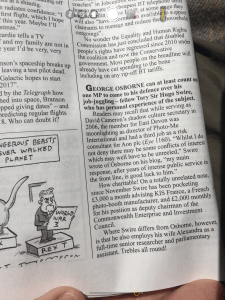
“3 jobs Swire” makes Private Eye

Not quite in his mate George Osborne’s league but getting there …

see:
https://www.hugoswire.org.uk/news/blog-greed-george-osborne

for the more gory details of this story.

Tory expenses scandal MPs in precarious position

“Conservative MPs accused of breaking election spending rules at the last election face the possibility of being prosecuted by the Crown while they are in the middle of fighting their re-election campaigns at this year’s general election.

14 police forces have sent files to the Crown Prosecution Service relating to the Tory 2015 ‘battle bus’ scheme, which it has been alleged led to Tory candidates breaking strict spending limits on elections.

The CPS is currently reviewing the evidence and considering whether to charge the MPs with breaking the election spending limits, which are put in place to prevent those with wealthy backers from gaining an unfair advantage during general elections.

A spokesperson for the CPS confirmed to The Independent on Tuesday evening that any charges would have to be made before the date of the general election, which Theresa May wants to hold on 8 June subject to a vote in Parliament tomorrow.

This means the CPS’s announcement must by law fall while the MPs are campaigning for re-election, before 8 June.

No charges have yet been made against any MP. All 14 police forces who sent files to the CPS last year applied for a 12 month extension to the prosecution deadline, which would have otherwise elapsed last summer.

Channel 4 News reported on Tuesday evening that the CPS is considering prosecution against over 30 individuals with regards to 2015 election expenses.

As a result, a decision has to be made by the CPS by late May or early June, meaning that any charges will land during at least the long election campaign period, and possibly even the short campaign.

Police forces who have sent files to the CPS relating to the spending allegations include Avon & Somerset, Cumbria, Derbyshire, Devon & Cornwall, Gloucestershire, Greater Manchester, Lincolnshire, the Metropolitan, Northamptonshire, Nottinghamshire and West Yorkshire.

Two dozen Conservatives are understood to be under investigation over claims that they did not include battle bus spending in their local campaign returns. The Electoral Commission is also investigating the allegations in parallel to the police.

The allegations centre on whether spending on hotels for visiting activists and certain campaign material was incorrectly registered as national spending rather than locally – potentially illegitimately taking advantage of a higher spending ceiling.

A Conservative spokesman said: “We are cooperating with the ongoing investigations.”

There have been suggestions that other parties may have failed to register similar spending in their local areas too.

In theory election results in individual seats could be declared invalid if laws are found to have been broken, though this is not an automatic process.

In recent weeks some Conservative MPs have hit out at party officials who they say have dodged blame for the fiasco at the expense of MPs’ reputation.

http://www.independent.co.uk/news/uk/politics/tory-election-fraud-prosecutions-cps-election-campaign-result-overturn-battle-bus-a7689801.html

“There’s going to be a general election, so let’s talk about the Tory MPs still under investigation for election fraud”

“Theresa May has announced a snap election on 8 June 2017. But as the country prepares for another election campaign, it’s important to remember that MPs in her party are being investigated for election fraud for the 2015 general election. And given the mainstream media’s reluctance to report the issue, we need to ensure it is kept firmly on the agenda.

Allegations of fraud

12 police forces have submitted files to the Crown Prosecution Service (CPS) over allegations that up to 20 MPs and/or their agents broke election spending limits in the 2015 election. The CPS is deciding whether charges should be brought. And a decision is expected soon – and is likely to come during the election campaign.

The allegations centre around the ‘battle bus’ campaign, and associated expenses such as hotel rooms. Many argue that the campaign promoted prospective local MPs in key seats. Under election law, any expenditure which promotes a local candidate should be covered locally. But the ‘battle bus’ and associated costs were declared nationally. Each constituency has a fixed amount of money it can spend locally. And including the ‘battle bus’ expenditure would have meant many candidates overspent.

Additionally, the Election Commission fined the Conservatives £70,000 for multiple breaches in connection to election spending during the 2015 campaign.

And there’s more

But it isn’t just the “battle bus” campaigns where the Conservatives have been accused of fraud. As The Canary previously reported, there are questions over how the party used social media and, particularly, Facebook, to target voters.

And a report by the London School of Economics has also warned [pdf] that Facebook targeting opens the door to electoral fraud:

The ability to target specific people within a particular geographic area gives parties the opportunity to focus their attention on marginal voters within marginal constituencies. This means, in practice, that parties can direct significant effort – and therefore spending – at a small number of crucial seats. Yet, though the social media spending may be targeted directly at those constituencies, and at particular voters within those constituencies, the spending can currently be defined as national, for which limits are set far higher than for constituency spending.
Implications

Theresa May might think she is avoiding difficult byelections if charges are brought in any of the constituencies. But she is equally taking a huge risk. There is a possibility that she will be running an election campaign while MPs are facing fraud charges. And then there’s the question of whether those MPs and their agents will run in this election.

Either way, the British public get to choose whether they want to vote for a party being investigated for fraud; and a party that’s already been fined £70,000 for election expenses breaches. But in order to do so, it is essential we do not allow the issue to be swept under the table.”

Source: https://www.thecanary.co/2017/04/18/theres-going-general-election-lets-talk-20-tory-mps-still-investigation-election-fraud/