Vultures swoop on foster care system

“Private equity firms buying up small agencies have “set off alarm bells” within England’s foster care system, the Local Government Association says.
Three groups account for 45% of funds spent on independent fostering by English councils, according to new analysis.

The LGA said councils worry about what could happen if one group failed.

The Nationwide Association of Fostering Providers said its members provided a vital and high quality service.

More than 75,000 children are in care in England, compared with about 60,000 a decade ago. Most of these children are in foster care.

Councils manage foster placements themselves as well as commissioning care from independent fostering agencies.

Many of these providers started as local, small-scale operations but private equity firms – essentially, investment companies – have moved into the sector in recent years.

The National Fostering Agency, Compass Fostering and Foster Care Associates are now the dominant independent groups in the industry.

All three run for profit and are backed by private equity. …”

https://www.bbc.co.uk/news/uk-england-49450405

“Governing as a permanent form of campaigning: why the civil service is in mortal danger”

” … This new permanent campaign style, encouraged by the crisis over Brexit and the ensuing clash between representative and direct democracy, means the structure of the civil service in Britain is being recast by three major shifts. The first is the growth of politically appointed advisers. All governments since the 1990s have sought to pack Whitehall with loyal apparatchiks. Their numbers have now reached over 90. Special advisers adept at handling an often hostile media are a particularly valuable commodity, but government has been contaminated by the rise of the spin machine and permanent campaign. Political aides help to enforce the political will of ministers, overcoming the bureaucratic inertia allegedly imposed by the Whitehall machine. Advisers are free to attack the monopoly over policy-making once coveted by the civil service, to the detriment of due process.

The second shift is the personalisation of civil service appointments with ministers increasingly hand-picking their favourite officials for the top jobs. Secretaries of state use back-channels to veto the appointment of civil servants to key posts who they believe are not ‘one of us’. Mandarins who seek promotion are encouraged to fulfil the immediate wishes of their political masters. The higher turnover of permanent secretaries leads to instability in Whitehall departments. The independence of the civil service has been repeatedly undermined.

The third shift is the emergence of a bureaucracy that is becoming ‘promiscuously partisan’, unwilling to speak truth to power. Civil servants are more likely than ever to be dragged into defending government policy. For an official to dissent from the expressed views of their minister is to commit career suicide. Yet the ability of officials to say no is a vital ingredient in the ‘governing marriage’ between ministers and civil servants. …”

Governing as a permanent form of campaigning: why the civil service is in mortal danger

Blackout (whoops, sorry, Blackdown) House – is the EDDC HQ best value?

Owl sees that relocating is expected to save £1.4 million over 20 years, according to a recent DevonLive article, mentioned earlier by EDW:

https://www.devonlive.com/news/devon-news/questions-hang-air-over-council-3148843

Owl wonders whether they are comparing Honiton to Knowle, or whether they are comparing the running costs of Honiton and Exmouth to Knowle. Is it apples with apples or apples with pears or apples with pears and jackfruit?

At a very minimum, the total cost of relocation was £10 million, but nearer £15 million is more likely, since all costs have yet to be fully accounted for.

So the putative savings per annum of £70,000 will not even cover the interest payments on the relocation debt and, if so, East Devon’s residents will be saddled with an increasing debt burden as the years go by. The relocation debt will almost certainly never be repaid – certainly not by the trivial cost savings achieved by the new building.

As most East Devon residents live on the coast, particularly of course Exmouth, and most of their councillors do likewise, Honiton is quite a remote location, certainly much less accessible than Sidmouth, particularly by public transport at appropriate times. So getting to the new HQ is more difficult and costly. It will be interesting to see how the travel expenses of staff and members compare to the Knowle years. Will the increased travel costs wipe out some or all of the £70,000 ‘savings’?

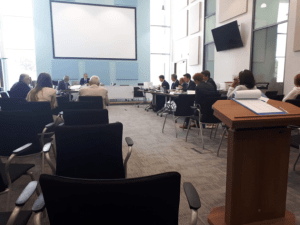
How long before Blackball (whoops, sorry Blackdown) House is deemed ‘not fit for purpose’? Judging by the inadequacy of the main chamber:

and the seemingly insurmountable parking and access issues, not to mention unpopular open-plan hot-desking and general inaccessibility, it would seem that day has already arrived.

Where shall we go next? Skypark? Cranbrook Town Centre? Exmouth seafront?

Perhaps PegasusLife could be prevailed upon to sell Knowle back to EDDC? With a refurbishment of the newer section of the Knowle and an extended “green” parkland to offset the global heating crisis, EDDC would probably be quids in.

AND, of course, with a ground source heat pump, up-to-date insulation, proper maintenance and warmer global temperatures, there would be none of those pesky utility bills EDDC were so secretive about when they were previously there!

“You don’t get to choose whether Brexit happens, Johnson tells MPs”

So, what are MPs FOR?

This chap was selected by around 90,000 people out of a population of 66 million – whyy does HE get to decide?

https://www.theguardian.com/politics/2019/aug/26/boris-johnson-warning-mps-block-no-deal-brexit?CMP=Share_iOSApp_Other

“England school places shortage ‘made worse by academies’ “

“Councils are warning that a looming shortage in the number of school places across England is being made worse by academies, as last decade’s baby boom enters secondary schools over the next five years.

The Local Government Association (LGA) is calling for the government to restore powers to councils enabling them to open new maintained schools if residents support them, and for new powers for councils to require academies to expand to meet local demand.

Anntoinette Bramble, the chair of the LGA’s children and young people board, said that without such changes children were at risk of not having a secondary school place.

“Our secondary school places crisis is now just one year away and this will be the reality for thousands of families without action,” Bramble said.

Last year, about 20% of families in England failed to gain a place at their first preference school, with the rate rising above 40% in several London boroughs including Lambeth and Lewisham. One in eight families in London failed to gain a place at any of their choices.

Councils say their position is made impossible by conflicting rules, which place a legal duty on them to ensure adequate school places for local children but allow only autonomous academies and free schools to be opened to provide more places, other than in rare circumstances.

With most state secondary schools in England now academies, the problem is made worse because local authorities cannot direct them to expand their intake or offer more places to meet forecast high demand, as they can with maintained schools.

“Councils need to be allowed to open new maintained schools and direct academies to expand. It makes no sense for councils to be given the responsibility to plan for school places but then not be allowed to open schools themselves,” Bramble said.

“The government needs to work closely with councils to meet the challenges currently facing the education system.” …”

https://www.theguardian.com/education/2019/aug/26/england-school-places-shortage-made-worse-by-academies?CMP=Share_iOSApp_Other

What can we believe about Clinton Devon Estates and bats?

The blog of August 24th – THE FIGHT TO PROTECT EAST BUDLEIGH BATS explains the determination of CDE to develop a barn in East Budleigh, home to 14 species of bats, some very rare including the Greater Horseshoe Bat.

On the other hand we see an employee of CDE receiving the Beer Bat Friendly Community Award in the Midweek Herald:

Why? Easy!

Beer Quarry Caves: no hope of using for housing development.
East Budleigh: every hope of using for housing development.

Polling station review

Is your polling station too far away (eg some Seaton people who now have to travel to Beer to vote)?

Is it inaccessible or has other disadvantages that make it difficult to cast your vote?

Have your say now:

https://eastdevon.gov.uk/elections-and-registering-to-vote/polling-place-review-2019/?fbclid=IwAR2rS9h_FF_oAV9481zBG2J0sX36d5iBNHZGh2VP0hLK_M11-u1In2f-YfA

and, if you haven’t registered to vote, you can do it here in less than 5 minutes:

https://www.gov.uk/register-to-vote

The “new” EDDC “independent” vision

From a disillusioned correspondent:

“The “new” East Devon District Council has submitted their plan covering the next four years. Like the previous tory council it is interesting what has been left out. We are left reading between the lines.

EDDC is to “immediately start preparatory work on the next East Devon Local Plan” but no mention of the Greater Exeter Strategic Plan and of course the former will have to conform to the latter. We must also remember EDDC will be represented by Philip Skinner (conservative) and Susie Bond (independent). Councillor Skinner represented the council when EDDC was prepared to take the lion’s share of the housing for the GESP growth area. I hope that he may have changed his mind but I very much doubt it. This new council must come clean on its strategy. It is of the greatest importance and influence on all our lives.

I applaud the aspiration to provide “300 new affordable homes per annum including an increase of Council housing stock” but once again there is no clue how this is to be achieved. To put these 300 affordables into perspective. The average annual dwelling completions in East Devon between 2007 and 2017 were 469 of which 108 (23%) were delivered by Housing Associations and the Council. (Some of the residual 360 may have been bought through the “Help to Buy” scheme but the majority would have been “market housing”). The annual average housing target in the local plan is 950. To get 300 affordables the Council will have to up its game with developers and increase its affordable delivery achievement to 32% of target or increase its annual housing delivery to a whopping 1,304 a year. However you look at it, 300 affordables a year is nearly three times the historic delivery rate.

At the election I voted Independent in the expectation that we would have transparent, evidence based policy making and not one which plucks numbers out of the air.”

PM keeps Devon visit secret

Announcements are happening only AFTER visits – so far Torbay Hospital and Brixham Harbour.

Extraordinary! Well, maybe not – after all, he was “elected” by 0.18% of the population!

And we all know Devon’s proud history of dissent!

EDDC Tory councillor has plan to take people out of poverty

Overview will discuss Councillor Mike Allen’s report:

” … The report proposes that the East Devon District Council should have two basic aims – no one in East Devon is destitute without immediate help, and nobody is in poverty for more than two years duration.

To achieve this, the council should try and boost incomes and reduce relative housing costs, work with partners to deliver an effective benefit system, deliver actions with Business and Public Sector to improve education standards, raise skills and improve work placements, strengthen families and communities to help those at risk of poverty and promote long-term economic growth to reduce dependency on agriculture, tourism and catering industries, the report says. …”

https://www.devonlive.com/news/devon-news/action-plan-proposed-help-tackle-3237472

Owl just more than a bit annoyed that his party’s austerity cuts caused most of these problems in the first place! And that now, pre-general election, there seems to be a magic money tree after all … maybe.

Thought for the day

“… In twenty years’ time, I dream all East Devon’s towns will be sustainable in their own right, offering jobs and careers across the district that, as schoolchildren, we did not dare to imagine possible.

I firmly believe we can do 
this.

If we talk, listen and think together, we can start a very exciting journey, creating a better life for future generations. …”

https://www.exmouthjournal.co.uk/news/east-devon-district-council-leader-column-1-6230688

Hhhmmmmm ……

“TiggerTories” outline their plans for the next 4 years (not unlike the plans for the last 40 years!)

Owl says: virtually identical to Tory “aspirations” for the last 4 years – or even the last 40 years!

And no mention of an overhaul of governance or a change to the committee system.

https://www.devonlive.com/news/devon-news/what-east-devons-independent-administration-3239119

Note the “independent leadership” includes the Independent Group and selected Tories, but only one East Devon Alliance member in a minor role – as Leader Ingham prefers to work with Tories rather than other independents.

May 2019 local elections: “Democracy Denied”

Electoral Reform Society:

“May’s local elections in England showed just how unfit-for-purpose the voting system is, as voters were left with restricted choices and random results.

For voters of all parties, the local elections saw democracy denied: the First Past the Post voting system meant that millions of voters were unrepresented.

In our latest report, Democracy Denied: The 2019 Elections Audit, we present new analysis of local, regional and national results. Councils across England saw the wrong party winning, hugely disproportionate results, and voters left voiceless as many seats were completely uncontested. …”

The report is here:

‘Democracy denied’ as report reveals how voters are left voiceless across England

EDDC Tory councillor apears to have removed debate about DBS checks from his Facebook page

Owl can no longer access the debate shown below on EDDC Tory Councillor Ian Hall’s Facebook page. Has it been removed or has Owl been blocked? What could be the reason for either action? Or is there another reason? Owl isn’t Facebook savvy enough to know. Curious!

Councillor Tom Wright said councillors who would not take the bait on checks (which are not required) were being non-transparent. If it has been removed is it an issue of non-transparency? Hhhmmmm …

“Fat-cat bosses still rake in 117 TIMES more than an average worker despite a pay fall – and former Persimmon chief earned more in a minute than most made in nearly three days”

“Bosses at Britain’s FTSE 100-listed companies are raking in 117 times more a year than a worker on the average salary of just under £30,000.

Chief executives at the UK’s top 100 companies were paid £3.46million on average last year, down 13 per cent from £3.97million the year before.

Former Persimmon boss Jeff Fairburn was the biggest FTSE 100 earner last year, trousering £38.97million.

Five biggest FTSE earners: Chief executives at the UK’s top 100 companies were paid £3.46million on average last year

Fairburn’s salary for 2018 was 1,318 times more than the median salary of a full-time worker in the UK.

It would take an average worker nearly three days to earn what Fairburn raked in during a single minute, according to Chartered Institute of Personnel and Development and High Pay Centre analysis. …”

https://www.thisismoney.co.uk/money/markets/article-7378481/Persimmon-boss-earned-single-minute-nearly-three-days.html?ito=rss-flipboard

Bodies left to rot for months at sheltered housing after warden cuts

“The bodies of two dead people were allegedly left to rot for months at a retirement home because of ‘callous’ care cuts, residents have claimed.

The latest corpse was found on August 8 at Mussidan Place in Woodbridge, Suffolk, after a neighbour noticed the man’s kitchen was infested with flies.

Residents at the home, which previously used to be sheltered housing before it turned into retirement accommodation, believe the body had been there since June, when they first complained about a bad smell. They said they were shocked by the death but it was not the first.

Another body was found in February and neighbours claim the dead man’s relative told them it had been there since November last year. They said the bodies would have been found sooner if budget cuts hadn’t stripped away wardens who used to check up on residents.

Valerie Kersey, 74, who has lived at Mussidan Place, owned by Flagship Housing, for four years, said: “There’s been a lot of reaction since the latest death.

“You feel guilty, thinking you should have noticed, and you feel angry. It shouldn’t happen. We’ve been through it twice now.”

Residents are urging Suffolk County Council to bring back funding for wardens. The cuts to sheltered housing support sparked complaints from tenants across the region when they came into force in 2018.

Flagship said there is a pull-alarm system in all communal areas connected to a call centre and people could buy individual alarms, but residents say these are unreliable.

Clive Field, 78, said it could take 20 minutes to get through to one the call centres, as there’s “never anyone on the phone.” Trevor Rose, 70, said Flagship failed to respond to complaints about the buildings and had not reassured people after the deaths.

Woodbridge mayor Eamonn O’Nolan, who attended as a first responder when the latest body was discovered, has since held a meeting with residents. He said: “I’m quite frankly horrified that their essential support services have been reduced to zero, in a cold and callous way”. “Two elderly residents have died and their bodies lay undiscovered for weeks and months while their neighbours and the authorities were in complete ignorance of their deaths.

“There is no doubt that had Mussidan Place still had a warden, then at least the bodies would have been discovered immediately.” He said the deaths were tragic and ‘should come as a serious wake-up call for us all’. He added: “It is clear to me that the county council’s social services department is not doing its job.”

Sylvia Keeble, who was a warden for 35 years, said there were 17 sheltered schemes locally when she started, all with live-in staff and then gradually over the years, they got ‘rid’ of them. “We had cutback after cutback until there were just four staff managing 15 shelter schemes”, she said.

Flagship, which made record profits of £33.1m last year, stopped providing sheltered support in 2016. Orwell Housing stepped in with a reduced service, which saw wardens phone round residents each morning and visit if needed. The services stopped completely in April 2018.

Coun Helen Armitage, Labour’s adult care spokesman at the county council, was ‘saddened and appalled by the failings in social care’. She said: “Residents move into sheltered accommodation because they need additional support and security – support and security that regular warden visits used to provide. “Since the Conservatives at SCC have cut their funding, housing associations been unable to plug the gap and have been forced to reduce their services.”

The council said sheltered housing providers had been informed of the proposals to remove funding two years before they came into force.

A spokesman said Flagship and Orwell Housing were both told about the budget changes in 2016.

“This was to provide an opportunity for the providers to develop options on how they may choose to provide support when the grant expired at the end of the 2017/18 financial year.

“Suffolk County Council publishes its proposed budget and any changes to funding are in the public domain. The council is committed to working alongside providers of care and support to deliver quality services to residents across Suffolk.”

The council allocated £234m for adult and community services in 2019/20,
almost half its total £500m budget for the year. It has cut £260m from its overall budget since 2011.

https://www.mirror.co.uk/news/uk-news/bodies-two-people-left-rot-18977024

“Building more new homes WON’T solve Britain’s housing crisis”

“Britain’s soaring house prices and ‘broken housing market’ have long been put down to a chronic shortage of homes, but new evidence has emerged that building more homes is unlikely to bring prices down.

A paper written by Tony Blair Institute chief economist Ian Mulheirn argues that building 300,000 homes a year wouldn’t make homes in the UK more affordable. Nor, he says, would more homes mean that more people manage to get onto the housing ladder.

The paper, published today by the UK Collaborative Centre for Housing Evidence, suggests that 160 per cent of the growth in house prices since the late 1990s has had nothing to do with a shortage in housing supply. Instead, Mulheirn claims that rock bottom interest rates for more than a decade have made borrowing so cheap that those able to buy have ratcheted up their borrowing, causing prices to soar.

‘Building 300,000 houses per year will do very little to bring down house prices in Britain, and next to nothing to raise home ownership,’ he wrote.
‘The real culprit for sky-high house prices is low global interest rates that have made it easy for homeowners and investors to take on large amounts of mortgage debt and pay ever more for houses.’

The figure of 300,000 new homes needed a year has been largely undisputed for the past decade.

In 2004, Kate Barker wrote a landmark review on housing supply for the then Labour government, concluding that 245,000 new private-sector homes a year were needed, plus another 17,000 social housing units, to keep house price inflation down to 1.1 per cent annually. She later revised that number up to 300,000 homes a year.

But Mulheirn disagrees. He points to official data showing that since the 1996 nadir of house prices, the English housing stock has grown by 168,000 units per year on average, while growth in the number of households has averaged 147,000 per year. Even in London and the South East, the number of houses has grown faster than the household count.

As a result, while there were 660,000 more dwellings than households in England in 1996, this ‘surplus’ has since grown to over 1.1 million by 2018. Similar trends are also apparent in Scotland and Wales, suggested Mulheirn.
Nevertheless, UK house prices have spiralled from around 4.5 times median household income in 1996 to a multiple of around 8 today.

The most recent figures from the Office for National Statistics showed across Britain, prices rose 0.7 per cent in June to an average of £230,292 – up 0.9 per cent compared to June 2018.

Mulheirn argued cheap mortgage finance is to blame.

‘Since the late 1990s, mortgage rates have tumbled, with inflation-adjusted interest rates on five-year fixed-rate mortgages, for example, falling from 8 per cent to around 2 per cent today,’ he said. ‘Since mortgage interest rates tend to be the dominant element of the cost of capital for home owners, this change can be expected to precipitate a substantial increase in house prices of a similar magnitude to the 160 per cent increase seen since 1996.’

Meanwhile, he said, a shrinking social rented sector, cuts to housing benefit and slow wage growth among young people are making rented housing less affordable for many even as though private sector rents are stable.
He added: ‘Neither our ownership or rental affordability problems will be solved by hitting the 300,000 target.’

According to the paper a 1 per cent increase in the stock of houses tends to lead to a decline in rents and prices of between 1.5 per cent and 2 per cent, all else equal. This implies that even building 300,000 houses per year in England would only cut house prices by something in the order of 10 per cent over the course of 20 years. ‘This is an order of magnitude smaller than the price rises of recent decades,’ said Mulheirn.

‘If we are to create more affordable houses to buy and rent, the solutions lie elsewhere.’ …”

https://www.thisismoney.co.uk/money/mortgageshome/article-7378649/Building-new-homes-WONT-solve-Britains-housing-crisis.html?ito=rss-flipboard

EDDC Tory councillors get called out on pointless (and possibly illegal) criminal checks

Tory councillors Ian Hall and Tom Wright get their knickers in a real twist about Hall’s call for councillors to submit to Disclosure and Barring checks.

Swiftly demolished by Tim Todd in this exchange on Hall’s Facebook page!