The 22 ft £50 table:

and another one (wonder who this one is going to?)
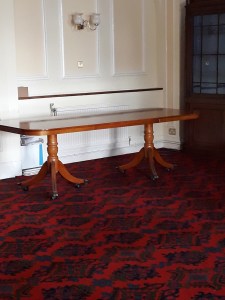

The 22 ft £50 table:
and another one (wonder who this one is going to?)
As published in Express and Echo today) (rejected by Midweek Herald)
“Former Conservative District Councillor, Mrs Liverton has recently (in the local press) accused East Devon Alliance (EDA) Independent Councillors of “constant negativity” and lack of positive action.
• Was it (and is it) “negative” to campaign for greater transparency, democracy and accountability in local government as members of EDA and other Independents are constantly doing? This is clearly necessary and was done by other local groups supported by EDA during the EDDC office re-location affair when the District Council repeatedly withheld information from the public and was twice castigated by the Information Commissioner.
• Was it (and is it) “negative” to campaign against the closure of hospital beds (and local hospitals) across the district? Again, this was done and is being done by EDA councillors and other Independents at both district and county level and has been supported by many concerned members of the public.
• And is it now “negative” to campaign for more action against the huge rise in poverty and homelessness in this country as recently revealed by the United Nations Observer and as EDA Councillors Cathy Gardner and Marianne Rixson did at Full Council recently*?
• And is it “negative” to campaign, (as members and councillors of EDA are doing), for a National Park for “Wessex” to include the AONB (Area of Outstanding Natural Beauty) of East Devon which currently lacks proper protection against inappropriate development?
Thanks to you, the voters, EDA is a positive new force at EDDC. Meetings are open to the public. Come and see for yourself in 2019, at the new Honiton offices you are paying for (with a long-term loan).
* The attached photo shows how the EDA motion brought complete cross-party unity, unheard of in Mrs Liverton’s time, to the Full Council recently.

Mike Temple, Sidmouth”
Story moving to regional media – watch this space.
If any town or parish council or local charity WAS or WAS NOT contacted about this or any other item for sale, Owl would be VERY interested to hear details!
Allegedly sold to Councillor Philip Skinner when officers and councillors given first dibs at Knowle furniture surplus to requirements – 22 ft extending mahogany board room table (only bid):
£50
Meanwhile on E-bay bay today:
Buy it now price
£12,000 mahogany board room table
https://www.ebay.co.uk/itm/Very-Large-Antique-Library-Table-Mahogany-Victorian-Boardroom-c-1870/323604161547
Buy it now price
Modern plain wooden board room table, well-used 7 m
£600
https://www.ebay.co.uk/itm/Boardroom-table-meeting-table-wood-1-5m-7m/401613530214?hash=item5d82082466:g:DzYAAOSwPR9bu0La
“ne of the country’s top-performing chains of academy schools has been accused of “systemic cheating” during Ofsted inspections at a number of its primaries, a HuffPost UK investigation can reveal.
Concerned teachers and a governor have made serious allegations that the renowned Harris Federation, which runs 47 schools in and around London, is “gaming the system” during Ofsted inspections at more than one of its schools.
The academy trust, one of the largest in England, was set up by Conservative peer and ex-Carpetright mogul Lord Philip Harris, and has often been praised by government ministers as a shining example of the academy schools model.
But insiders at some Harris primary schools have told HuffPost UK the unrelenting drive for success from the academy trust has led to an endemic culture of “cheating and rule bending” during Ofsted.
Those concerned say the Harris Federation needs good or outstanding Ofsted ratings at all its schools in order to justify the bumper salaries of top staff. Its CEO Dan Moynihan was paid at least £420,000 in 2015-16.
One former Harris teacher, speaking on the condition of anonymity, told HuffPost UK: “Staff are parachuted in to protect the Ofsted grade.
“This is all about the veneer of excellence without substance to hold up the PR about all Harris schools being good or outstanding at Ofsted.”
A number of sources close to Harris schools have made specific allegations about highly experienced executive teachers from a central team being brought into schools on the eve of Ofsted inspections, allegedly in order to boost performance.
Critics say this type of support is not available to local authority schools and the issue is a critical one, as a good or outstanding Ofsted rating is a key factor when parents select schools for their children. …”
“Here is my letter, about Ottery Hospital, which was published in the Sidmouth Herald about ten days ago [from Ottery Hospital campaigner Philip Algar]:
Last August, I asked the Ottery Town Council to request the East Devon District Council to declare the Ottery Hospital to be an asset of community value. Such a designation would have delayed any decision by NHS Properties to sell the hospital.
The request was rejected by EDDC because the hospital was not a community asset.
Unlike swimming pools and pubs, it did not contribute to “social wellbeing”! This is manifest nonsense but there is a more disturbing aspect to this EDDC decision which challenges common sense and justice.
Apparently, there is no precise definition of social wellbeing so any determination must be subjective. This is demonstrated by the fact that three district councils in Devon have granted the status to hospitals in their areas.
This raises some serious questions.
What was different about the request to give the Ottery hospital this designation? EDDC admit that they gave more weight to an NHS objection than they did to the wishes of the people of Ottery and district whom they are supposed to represent.
Why did NHS Properties oppose this proposal whilst other councils granted the desired status to hospitals serving their electors? Who should we blame for having our hospital treated in this way? Is it EDDC for cravenly giving in to the NHS or should it be the NHS itself which may plan to close the hospital entirely and sell the site and so opposes any action that could delay implementing such a decision?”
“The number of homeless families forced to move away from their communities is at its highest for 20 years, as councils struggle to find accommodation for the growing numbers of people in need.
According to official government figures, there were 23,640 families in temporary accommodation outside their local area in the second quarter of this year, the highest level in 20 years and more than double that recorded over the same period just five years ago.
The new data has emerged amid rising anger over homelessness, with recent research showing that deaths among homeless people in England and Wales have increased by 24% in five years. Deaths have risen every year since 2013, from 475 in 2014 to 597 last year, according to the Office for National Statistics.
Several factors are being blamed for the rise in homeless families being relocated. A freeze on benefits and a cap on payments have led to a rise in demand for temporary accommodation. Meanwhile, the stock of council-owned housing has been run down and rents are rising, making affordable private rented accommodation harder to find.
Melanie Onn, the shadow housing minister who uncovered the figures, said they revealed the “human cost of the housing crisis”.
“Eight years of Tory failure on housing means that more and more families are being forced to move away from their communities, schools and jobs,” she said. Labour blamed cuts to housing benefit and an 80% fall in the number of homes for social rent being built.
Greg Beales, director of campaigns at Shelter, said his charity had witnessed the damage caused “when homeless families are forced to uproot their lives and move miles away to temporary accommodation in another area, abandoning jobs, schools and support networks. To put an end to the devastating cycle of homelessness, the government needs to commit to a bold new vision for social housing.
“Only then will families have a fighting chance of a safe and secure home in their local area.”
Jon Sparkes, chief executive of Crisis, said the number of families being asked to relocate had become unacceptable: “As local councils struggle to find housing for people, the only option for many is to rent privately, but with renting costs now sky high and housing benefit falling short of rents, this is not a viable option for most,” he said.
“As a result many have no option but to leave any semblance of community and support behind, often moving to areas where they have no connections, leaving them trapped in a cycle of desperation.
“The government’s decision to start reinvesting in social housing is welcome, but it doesn’t go far enough. ” …
https://www.theguardian.com/society/2018/dec/23/24000-homeless-families-sent-miles-from-local-area
“The lessons of the Grenfell Tower fire risk being ignored because developers can convert office blocks into homes without full local authority checks, a former housing minister has warned.
Nick Raynsford said that “a new generation of slums” was being created in Britain because developers did not have to submit a planning application when converting old commercial properties into flats. The policy leaves councils with limited power to ensure that the buildings adhere to national standards.
Mr Raynsford said that “permitted development” rules were designed to minimise bureaucracy when making “modest adaptations” to existing properties, but developers were using them to create thousands of new homes in old commercial buildings.
“The council doesn’t have the power [to force developers] to comply with minimum standards on space, lighting, children’s play facilities, or fire safety,” said Mr Raynsford, who was a housing minister under Tony Blair.
A studio in Newbury House, a former office block in Ilford, east London, was planned with 13 sq m of space. The minimum standard is 37 sq m. Windowless flats have been marketed in a former office block in Brixton, south London, illuminated only by light wells that channel light from flats above.
More than 100,000 homes have been built under permitted development since 2013, accounting for up to 40 per cent of new homes in some areas. The Local Government Association found that 92 per cent of councils were “moderately or very concerned” about the quality of these homes, with 59 per cent worried about safety.
Many standards, including on space, are not compulsory and only apply to plans that go via the planning system.
Julia Park, of Levitt Bernstein architects, said such developments “tend to be occupied by vulnerable people” and were often used as temporary housing.
Mr Raynsford said: “There should be early engagement by planning authorities with the fire and rescue authority when an application for a high-rise residential development is submitted. That runs counter to the whole ‘permitted development’ approach, where obligations on developers are minimal and the council does not have the resources to explore the implications, to ensure fire engines can access the site, for example.”
The government is consulting on whether to extend the rules.
Mr Raynsford referred to evidence emerging from the Grenfell inquiry, after the fire in June last year in which 72 people died. “It seems to be extraordinary that one arm of government is pushing in a direction that’s very different to the conclusions emerging from the public inquiry in which failings, in terms of preparations for coping with serious problems, have been highlighted,” he said.
Hugh Ellis of the Town and Country Planning Association said the conditions in some developments were “Dickensian”, and added: “It is some of the most appalling slum housing this country has seen in the post-war era.”
Kit Malthouse, the housing minister, said: “All developments, including offices converted into homes, remain subject to strict fire safety rules.”
It is understood the government will look at permitted development when considering recommendations made by Dame Judith Hackitt’s Grenfell report. …”
Source: Times, pay wall
Oh, er – been kicking off on Facebook page!
22 foot mahogany table with 8 foot extension (not sure if included in 22 foot or makes it 30 foot, but probably the latter). Rumour is it was “valued” and was sold for a winning bid of £50 (fifty pounds).
Most councils have a policy on this. Anyone seen East Devon”s?
A couple of the rooms at the current EDDC HQ.
Wonder how many things have already been auctioned off to councillors and staff?


It appears that councillors and officers have been given first dibs of Knowle assets, in advance of the move to Honiton and one of them has rather jumped the gun on claiming his prize.
Is this best value or equitable, Owl ponders? As does at least one independent councillor.
Note: Neither of these emails were marked private and/or confidential when acquired by Owl.
From a well-known Conservative councillor:
Subject: Re; Large Table In Members Area
“Dear Members and SMT,
Subject: Re; Large Table In Members Area
You will all be aware there has been an auction of council furniture, chattels etc of which I bid for a few bits and pieces.
I bid on behalf of my partner for the very large table in the members area along with the 20 green chairs that we all sit around.
I have been told that I have been successful in my bid so the table along with the 8’ extension is heading back to Exmouth to sit in (address of councillor), Exmouth in its rightful Town (some may say).
The relevance of my informing yourselves is that the rightful date of removal is end of January/ beginning of February when we finally ‘pull out of the Knowle.
I would apologise for the short notice but we have 22 family members to Christmas dinner and would like to pick the table up tomorrow as it appears it is the last day of our offices being open, which of course would mean I couldn’t collect it on Monday, 24th, as we will be closed.
We do have one or two meetings between the New Year and our final pull out but I feel it only right to ask members if indeed anybody felt offended if it was collected tomorrow on our last day.
I will fully respect any position any member may feel regarding it being removed earlier and would kindly request your thoughts.
If indeed it were removed earlier I have spoken to Simon Allchurch who feels we could put a few of the red tables on wheels in the place of the table and there is an array of chairs to use for members in the interim so it doesn’t look bare.
I must again apologise for the short notice but with the closing date being the 19th and all that goes with it at this time of year I would like to think you may grant me a little latitude (or not).
Best wishes and a Happy Xmas to one and all.”
And here is the response from an Independent councillor
“I feel I must reiterate my comment from when this started. Who authorised the ‘private sale’ of Council property to staff and members? Why are we not duty-bound to seek the best price at public auction? No-one answered my questions.
Will we ever know the proceeds of this internal sale for the public record?”
I strongly suspect that members of the public would be shocked to know that councillors have been able to buy items in this way. It is somehow appropriate that 22 family members will sit down to feast at this table, assuming the removal goes ahead.”
“Two-thirds of academy school groups performed below the national average for disadvantaged pupils, according to research released today.
A five-year study by the Sutton Trust educational charity analysed 58 ‘academy chains’ – partnerships between a group of academies – and found in 38 of these disadvantaged pupils performed below the national average for all state schools.
In 12 of the 58 chains analysed, poorer pupils performed above the national average but this good practice had not been shared with other academy chains, the report found. It defined disadvantaged pupils as those entitled to the ‘pupil premium’ – a funding package from central government.
Becky Francis, director of the UCL-Institute of Education and co-author of the report, said it was “perplexing that the government has done so little to explore the methods of these successful chains and to distil learning to support others”.
“Our five year analysis of sponsor academies’ provision for disadvantaged pupils shows that while a few chains are demonstrating transformational results for these pupils, more are struggling,” she said.
Francis said that the government should capitalise on the successes of various schooling organisations including local authorities and multi-academy trusts.
The report found that long-standing academy chains achieve better exam results, with newer chains frequently performing poorly.
Peter Lampl, founder of the Sutton Trust, said: “Two-thirds of academy chains perform below the national average for all state schools on key measures of attainment for disadvantaged young people. Improving their educational achievement was the original reason why academies were set up. In this regard they have not succeeded.
“We at the Sutton Trust are recommending the sharing of good practice of the best academy chains with the rest. More generally schools should make increased use of the body of what works evidence.”
Lampl noted struggling schools are having difficulty attracting and retaining good teachers.
The charity’s report said there is “little to suggest” that regional schools commissioners – who are responsible for approving new academies and intervening in underperforming ones – are bringing about improvements.
RSCs must act “more decisively” with chains that do not deliver improvement on time, the trust said.
Anntoinette Bramble, chair of the Local Government Association’s children and young people board, said: “This research reinforces the compelling need for the government to give councils the powers to improve struggling schools.
“Councils have a strong track record in school improvement, with 91% of council-maintained schools now good or outstanding while evidence shows councils are better at turning around failing schools than those converted to a sponsor-led academy.”
The Department for Education has been approached for comment.
An annual report released last month showed that academies in England recorded a £6.1bn deficit in August 2017.
Previously the National Audit Office called on the government to ensure that academies could be trusted to manage large amounts of public money.”
https://www.publicfinance.co.uk/news/2018/12/academies-failing-poorer-students-research-shows
“The government must show more urgency in addressing regional health funding imbalances, MPs have warned.
The Public Accounts Committee has also expressed concern about the Department of Health and Social Care’s lack of planning for staffing and medical equipment after Brexit, in a report out today.
The MPs noted there was “significant regional variation” in funding of NHS providers and clinical commissioning groups. DHSC’s 2017-18 annual report and accounts suggest an improvement in finances when taken as a whole but this “masks the underlying deficits at local level”, the PAC report said.
MPs said the department was performing a “balancing act” by offsetting NHS providers’ deficits with a surplus from NHS England’s finances. In 2017-18, 101 of 234 NHS providers were in deficit, although this was mitigated by NHS England’s surplus, the report said. Although, 75 of the 207 CCGs reporting an overspend in the same year.
PAC chair, Meg Hillier, said the number of CCGs overspending was “concerning”.
She added: “The Department of Health and Social Care must show far more urgency in getting to grips with regional funding imbalances and demonstrate it understand the effects these have at the frontline.”
The report was also critical of DHSC’s planning for Brexit, especially around staffing and medical equipment.
It said there is a “lack of a clear plan” for recruiting staff post-Brexit and added: “We are not reassured by the department’s assertion that it has not seen a large exodus of staff since the referendum and that the number of people from the EU working in the NHS has increased.”
Health bodies recently warned that the NHS workforce shortfall could jump from 100,000 at present to almost 250,000 by 2030 without effective planning.
Despite the NHS procuring 56% of medical consumables (gloves, dressings, syringes) from, or via, the EU, DHSC is not putting specific contingency measures in place to stockpile this type of equipment, the PAC revealed.
Hillier said: “The department’s lack of clear Brexit planning could threaten the supply of medical equipment. Staff shortages could deepen. The potential consequences for patients are serious.
“These and other uncertainties are amplified by the continued absence of the government’s promised 10-year plan for the NHS, its promised plans for social care, and its promised plans for immigration.” A DHSC source has confirmed to PF the social care green paper and NHS 10-year plan are now likely to be published in the new year, rather than by the end of this year, as originally intended.
Regional variances in staff vacancies could also be overlooked, the PAC noted. The NHS examines vacancy rates at a national level – rather than a local level – which “hides underlying disparities in specific specialisms and local areas and does not allow them to fully understand the impact of staff shortages,” the report said.
The report also expressed concern that the NHS staff pay rise announced earlier this year would not be distributed fairly. By funding pay awards through the National Tariff the PAC is concerned that NHS Providers in more affluent areas will receive “disproportionately higher share of funding” because the tariff accounts for the cost of operating in different geographical locations.
DHSC has been contacted for comment.”
“The watchdog which oversees Britain’s tainted auditors will be scrapped after it was branded a ‘ramshackle house’ in a report.
The Financial Reporting Council will be shut down and replaced with a new organisation under different leadership, after former civil servant Sir John Kingman uncovered a litany of problems.
Kingman’s findings – in a study commissioned by the Business Secretary Greg Clark – are a vindication for campaigners who have spent years warning the FRC is not up to the job.
Kingman, an ex-Treasury mandarin who is chairman of Legal & General, said the FRC lacks transparency, is too dependent on the goodwill of big auditors for funding and has been damaged by constant leaks of information.
In his report he calls for:
■ A new regulator with a beefed-up regime to take action against failing bean counters and much shorter investigations to minimise delay;
■ Blanket bans on accountants who join the watchdog from overseeing their former employers;
■ A requirement for auditors to report any serious financial problems at companies they oversee;
■ Powers for the regulator to boot out a firm’s auditor if they have concerns it is not doing a proper job.
The FRC has been slammed for repeatedly letting auditors off the hook over accounting scandals, from Tesco to failed bank HBOS.
It came in for criticism earlier this year after the collapse of outsourcer Carillion was missed by accountants.
Kingman said: ‘What this spotlight has revealed is an institution constructed in a different era – a rather ramshackle house, cobbled together with all sorts of extensions over time. The house is – just – serviceable, up to a point, but it leaks and creaks, sometimes badly.
‘The inhabitants of the house have sought to patch and mend. But in the end, the house is built on weak foundations. It is time to build a new house.’ “
“The origins of the shake-up now facing the accountancy industry can be traced back to the collapse of Carillion at the start of this year.
Concerns about auditing in Britain had been quietly growing among politicians for some time, but they came to the fore after the demise of the government contractor.
An inquiry by MPs called the audit market a “cosy club” and criticised the Financial Reporting Council as “feeble and timid”. Nearly 12 months later, two inquiries have concluded that regulation of the sector and competition between firms must be improved.
Competition and Markets Authority study
The competition regulator announced in October that it would investigate the audit sector to examine concerns that it was “not working well for the economy or investors”. It said that this would include looking at whether the sector was competitive and resilient enough to maintain high standards.
Since then the Big Four have lobbied hard against a wholesale break-up of their firms. They were supported by their smaller rivals Grant Thornton and BDO, despite the fact that the measure would not belimposed on them.
The CMA has stopped short of recommending a break-up of the firms, proposing a ringfencing of audit activities instead, but it has not dropped the threat entirely. Will Hayter, the CMA director responsible for the audit market study, said: “The possibility of a full split of the Big Four should not be underplayed.” The CMA said that it would be “protracted and complex” and that an effective ringfence of audit was a more practical and quicker solution, but it has not ruled it out. …”
Source: Times, pay wall
Owl says: You cannot make it up – body set up to transform the NHS needs time to transform itself before issuing its transformation policies to transform anything else!
“NHS commissioning needs a prolonged period of organisational stability after almost three decades of change, according to the UK’s spending watchdog.
Continued organisational restructuring causes major upheaval and commissioning in the health services needs stability to transform, the National Audit Office urged in a report released today.
Amyas Morse, head of the NAO, said: “We have seen almost three decades of change to NHS commissioning.
“It would be a huge waste if in five years’ time NHS commissioning is undergoing yet another cycle of reorganisation resulting in significant upheaval.”
He added: “The current restructuring of Clinical Commissioning Groups must deliver balanced and effective organisations that can support the long-term aims of the NHS and deliver a much-needed prolonged period of stability.”
A period of stability would allow commissioning groups to focus on transforming and integrating health and care services rather than on reorganising themselves, the report said.
Since CCGs replaced primary care trusts in April 2013, there have been eight formal mergers, reducing their numbers from 211 to 195 in April this year. Further mergers are expected.
The report also highlighted an increasing number of NHS commissioning bodies in England were exceeding their planned expenditure.
A total of 75 of 207 (36%) CCGs went over their budgets in 2017-18, the NAO noted. The total overspend across the groups was £213m.
This compared to 57 CCGs over spending on their budgets in 2016-2017 and 56 in 2015-2016.
“Many CCGs are struggling to operate within their planned expenditure limits despite remaining within their separate running cost allowance,” the report warned.
Increased pressures, the uncertain futures of CCGs and a lack of access to training and development were cited as reasons for the continuing issue of commissioning bodies being unable to attract and retain high-quality leaders.
Even though “both NHS England and the CCGs stressed [to the NAO] the importance of high-quality leadership”.
The watchdog also warned with further mergers there was “a risk that working across greater areas will make it more difficult for CCGs to design local health services that are responsive to patients’ needs”.
The total net expenditure of CCGs in England in 2017-18 was £81.2bn with net running costs at £1.1bn. Staff costs made up 57% (£693 million) of CCGs’ running costs, the NAO noted.
A 10-year long-term plan for the NHS and how it will spend an extra £20.5m a year was expected to be released by the end of this year.
A source from the Department of Health and Social Care has confirmed to PF it is now “likely” this plan will be release next year.
Responding to the report, chair of the Public Accounts Committee Meg Hillier said: “We should be concerned that increasing numbers [of CCGs] are overspending against their budgets.
“Like previous changes to NHS commissioning, CCGs are going through more change and the NHS is crying out for stability.”
She added: “It is vital that further restructuring supports the 10-year plan and isn’t an unnecessary distraction to addressing the real challenges in the health service.”
https://www.publicfinance.co.uk/news/2018/12/nhs-commissioning-needs-period-stability-transform
Message from an Exmouth campaigner. If you agree, councillors (town, district, county) will need to be contacted.
“I am trying to encourage local community organisations to campaign against the proposed franchising of the Post Office in Exmouth which currently is based in the WH Smith Store to be run from February 2019 by WH Smith. I think this could be very bad for the community and the future of the Post Office as a government organisation for a number of reasons.
1. WH Smith is not a public organisation with a remit to provide a public service. The legal duty of its directors is to maximise shareholder value. Therefore the cost of running a well resourced post office could be in direct opposition to the aims of WH Smith which is to maximise its profits and maintain a viable commercial enterprise.
2. The value added service which the current Post Office staff provide is not directly quantifiable in monetary terms. The Exmouth Post Office provides an invaluable resource to elderly and vulnerable people. It is a safe place for people with dementia; the staff know their customers, many of whom have been using the Post Office for many years so the staff can look after their customers in a range of ways, from safeguarding their financial arrangements to alerting other services if they have concerns over the health and/or welfare of their customers. Recently a customer on a motability scooter was persuaded to wait in the store until the ambulance service was able to help him as staff were rightly concerned that he was on the verge of a heart attack.
3. The current staffing levels will not be guaranteed once WH Smith takes over the running of the Post Office; indeed it has been suggested that there could be as few as two members of staff on duty at any time running the Post Office. This will lead to longer queues which is a real trial for elderly or disabled people.
4. Existing staff have received several months of training to do their job. The CWU contrasts this with the poor training of a few days provided for staff where post offices have been franchised so that mistakes are far more likely to occur. Furthermore with limited staff, the level of personal customer service which is so key to community wellbeing will be lost.
5. Post Office staff who decide to stay may be TUPED over to WH Smith, but a few months down the line, if WH Smith puts forward a business case for reducing pension benefits or other work benefits which are not offered to its other staff, then the TUPED staff will lose those benefits. New staff will not enjoy the same level of benefits as staff formerly in the employ of the Post Office.
6. The Post Office is making a healthy profit up from £13 million to £35 million in 2017/18. It also received £370m in network subsidy from the government. Furthermore, customer numbers have increased at the Post Office with the number of bank branch closures. The continued uncertainty over the stability of the banking sector has made the Post Office an attractive savings option, so it is well placed to continue as a thriving public institution serving communities where private organisations have abandoned their customers.
7. This is not a private commercial organisation which needs to focus primarily on profitability and it should be true to its public service remit. Franchising reduces costs but it is also privatisation by the back door; vital public services suffered a damaging effect when they have had privatised services forced on them. The schools are a prime example of what can happen to public services when the private sector takes them over. Schools have been closed after gaining academy status and being transferred to private hands. This publicly funded asset is lost to the public sector and children lose their school when the academy trust runs into financial difficulties. The Post Office once franchised to WH Smith will be at the mercy of the market place not protected by public funding.
8. WH Smith has had mixed trading fortunes in recent years. It is currently increasing sales but not profits. It has closed 30 stores in the last year and opened 24 new ones but these have been based in travel hubs – bus and rail stations and airports – and hospitals. WH Smith is under no legal obligation to keep stores which it considers insufficiently profitable. The post office services could be lost if this happens in Exmouth.
I think the Post Office has been economical with the truth in its ‘information leaflet’ about the transfer of business to WH Smith. It has not provided the opportunity for the public to comment on whether they want this change or not, just feedback on accessibility issues. This is in no way a consultation; it is a purely commercial decision made by an organisation which should focus on communities not profits.
I hope you will be able to raise these issues on your website.”
“… In today’s report, the programme director for the council Keith Cheesman revealed that, whilst most of the transitional costs have been around what was expected, the cost of taking on interim staff to carry out projects related to changing to the new council have been far higher than anticipated and need extra funding.
Cheesman’s report said that the ongoing dispute between the shadow Dorset Council and Bournemouth Christchurch and Poole Council over the transfer of debts and reserves is yet to be resolved, and also warned that years of reducing employee numbers has left internal employee resources “very limited.”
The merger between Dorset County, East Dorset, North Dorset, Purbeck, Weymouth & Portland, and West Dorset councils was given the green light back in May, followed by a lengthy legal battle with Christchurch Borough Council.
Last week, Christchurch BC, which will be part of the second new council, said it was still split over the need to contribute £420,000 towards merger costs.”
AND government has said if councils need more money they should hold referendums which might, or might not, agree to further council tax rises to make up for the shortfall.
“Last week’s provisional settlement for local government was predictably disappointing, says Richard Harbord, while the big issues of funding social care and council tax reform wait unaddressed in the political long grass.
The delayed settlement was eventually published last week, leaving local authorities little time to do any detailed work on it before Christmas.
It has to be said it was never going to be earth-shattering, being the last year of an agreed multi-year settlement negotiated four years ago.
The actual settlement says that the government are planning to increase resources by £1.3bn next year, but this seems to include a number of separate issues such as Winter Pressures Funding for social care, the bulk of which comes with conditions, and the removal of the threat of negative grant.
The Local Government Association in a somewhat low-key response says that this settlement will still leave local authorities some £3.2bn short of the resources they require to maintain a reasonable standard of service.
Other announcements were expected at the same time but a number of these did not appear. The amount of time and energy spent on leaving the European Community has left a large void in moving forward to resolve the many problems local government faces.
There was a consultation paper on business rate retention, but this has been so long discussed in the joint working parties between central government and the LGA that it is hardly new. It is now set at 75%, this is somewhat less than Eric Pickles’ 100% and the various other figures talked about over the last few years, and is perhaps a disappointing increase on the 50% which has been the scheme for the last few years.
The announcement says that the government continues to work on the Fair Funding Formula which was also expected to go out to consultation. This was never intended to take effect next year, but local authorities need to know if there are to be major changes to distribution and to account and allow for them in their medium-term financial plans.
We had already been warned that perhaps the most important of all – the options for dealing with the increasing expenditure on social care – had been put back until next Summer. This was, it will be remembered the subject of a bungled announcement during the last general election campaign which had to be withdrawn with a Green Paper promised for immediately after the vote.
This has been delayed several times. It is just too difficult to find options that are acceptable to the majority. If there is to be a central funding solution rather than an insurance solution, it will have to come from additional taxation. Politicians continue to believe that increases in taxation are to be avoided at all costs but a relatively small increase in taxation could produce workable options.
The LGA urges the government to reconsider and to improve the offer by the time of the final settlement early next year. This is extremely unlikely to happen.
The fact is that this settlement does nothing to help local authorities become sustainable and to save them from having to make even more serious cuts in services going forward.
Business rates retention may have been sorted, but the government really needs to address the issue of council tax. Hopelessly outdated and not understandable to owners of properties, it is in desperate need of reform.
The government argue that it is open to local authorities to run referendums to increase council tax by over 3 % , indeed they have encouraged local authorities to do so but the limited gains and negative publicity have put authorities off.
At the very least the values used need to be current values and the banding system needs drastic revision to reflect the fact that so many properties are valued at over £1m and should be contributing more to local services.
We do now look forward to the spending review, but there cannot be widespread optimism that all will be well.”
http://www.room151.co.uk/blogs/provisional-settlement-does-nothing-to-help-local-authorities/
“Increasing levels of child poverty are affecting children and young people’s education, with schools dealing with ‘Dickensian’ levels of squalor, a major teaching union has warned.
A survey of members by the National Education Union found more than half (53%) believe children in their school will go hungry over Christmas, putting the blame on welfare cuts as well as those to schools and children’s services.
The poll of 1,026 NEU teachers in England revealed that 46% believe holiday hunger – a lack of access to food in the absence of free school meals – has got worse in the last three years.
The NEU’s report, published today, highlighted the “stark” impact of poverty on children’s education. Poverty-related problems include: absence from school (83%); behavioural issues (85%); concentration (81%); health (59%); and lateness (79%).
The survey heard from teachers who were buying or washing clothes for students who could not afford them. Some teachers said their students had been sleeping in their school uniforms because they don’t have pyjamas, and other children had food delivered to their home by the school.
Mary Bousted, joint general secretary of the NEU, said: “This is a Dickensian picture of the poverty that far too many children and their families are having to endure.
“The government has failed to recognise the human cost of its cuts to schools and other children’s services and to the social security system, and its failure to address the in-work poverty faced by one in five workers.
“The government must stop hiding from the facts. Children can’t escape the poverty trap without an urgent change to national policies.”
The poll also found 46% of teachers believe that poor quality and overcrowded housing conditions are affecting the education of children and young people more than they were.
Many schools are now offering free breakfast clubs for children and also running foodbanks, giving hampers to families and providing meals during the holidays, the survey found.
But union members said that school funding cuts were restricting the help that can be given.
A government spokesperson said: “Teachers shouldn’t have to step in to tackle the issues highlighted by this survey, and we’re already taking action to make sure that they don’t have to.”
https://www.publicfinance.co.uk/news/2018/12/dickensian-poverty-increasingly-prevalent-schools
“A primary school has set up a food bank for hungry kids whose parents are struggling under austerity.
Head Debbie Whiting launched it after seeing pupils so famished they were stealing from other children’s packed lunches.
“You can’t learn if you’re hungry,” she said. “Children need to be fed, clothed and warm.”
The food bank at North Denes juniors in Great Yarmouth, Norfolk, is thought to be the first at a British school.
Staff and some parents donate extra items from their shopping and a charity has given £1,500.
Mum Sadie Carter, who has two children at the school, said she fell to “rock bottom” after running out of money and was “crying for days”.
She said: “I didn’t know what to do. Then the school came to help.” ….
https://www.mirror.co.uk/news/uk-news/food-bank-primary-school-hungry-13741828
 East Devon Watch