Devon and Cornwall police force “on cliff edge”

“The Devon and Cornwall Police Federation has written to all MPs in the two counties saying the force is on “a cliff edge”.

Chair Andrew Berry said the problem was twofold.

He said: “The policing budget for our force has reduced by £15m in cash terms since 2010/11 and, during that time, we have lost 975 personnel, including 510 police officers – that is 15% less police officers.” ..”

https://www.bbc.co.uk/news/live/uk-england-devon-45972471

Those “little extras” in the education budget …

“Parents Are Contributing Money, Pens, Even Loo Roll To Their Kids’ Hard Up Schools:

Parents are coughing up an average of £11 a month to their children’s schools to help meet education funding shortfalls, a survey has shown, and many are being asked to provide items as basic as stationery and loo roll.

The parents and education charity Parentkind commissioned a survey of 1,500 parents and found that two in five are asked to contribute to a general school fund, to be used in whatever way the school needs.

The average monthly voluntary donation by parents has increased by more than a quarter in a year, rising from a reported £8.90 in 2017 to £11.35 in 2018.

Jo Murricane, 39, from Leeds, who has a four and seven-year-old, told HuffPost UK that her child’s school often asks parents to make monetary contributions. “Basically, the contributions cover all the things the school can’t afford, but that will really benefit the pupils and their learning,” she says, citing bakes sales and school trips. “I don’t really mind, but it’s hard to see the school struggle to make ends meet in this way, due to underfunding.”

https://www.huffingtonpost.co.uk/entry/parents-contributing-money-pens-loo-roll-to-schools_uk_5bd9c890e4b0da7bfc160c02

“How the actual magic money tree works”

“Shock data shows that most MPs do not know how money is created. Responding to a survey commissioned by Positive Money just before the June election, 85% were unaware that new money was created every time a commercial bank extended a loan, while 70% thought that only the government had the power to create new money.

The results are only a shock if you didn’t see the last poll of MPs on exactly this topic, in 2014, revealing broadly the same level of ignorance. Indeed, the real shock is that MPs still, without embarrassment, answer surveys.

Yet almost all our hot-button political issues, from social security to housing, relate back to the meaning and creation of money; so if the people making those choices don’t have a clue, that isn’t without consequence.

How is money created?

Some is created by the state, but usually in a financial emergency. For instance, the crash gave rise to quantitative easing – money pumped directly into the economy by the government. The vast majority of money (97%) comes into being when a commercial bank extends a loan. Meanwhile, 27% of bank lending goes to other financial corporations; 50% to mortgages (mainly on existing residential property); 8% to high-cost credit (including overdrafts and credit cards); and just 15% to non-financial corporates, that is, the productive economy.

What’s wrong with that?

On the corporate financial side, bank-lending inflates asset prices, which concentrates wealth in the hands of the wealthy. On the mortgage side, house prices rise to meet the amount the lender is prepared to lend, rather than being moored to wages. The lender benefits enormously from larger mortgages and longer periods of indebtedness; the homeowner benefits slightly from a bigger asset, but obviously spends longer in debt servitude; the renter loses out completely.

Is there a magic money tree?

All money comes from a magic tree, in the sense that money is spirited from thin air. There is no gold standard. Banks do not work to a money-multiplier model, where they extend loans as a multiple of the deposits they already hold. Money is created on faith alone, whether that is faith in ever-increasing housing prices or any other given investment. This does not mean that creation is risk-free: any government could create too much and spawn hyper-inflation.

Any commercial bank could create too much and generate over-indebtedness in the private economy, which is what has happened. But it does mean that money has no innate value, it is simply a marker of trust between a lender and a borrower. So it is the ultimate democratic resource. The argument marshalled against social investment such as education, welfare and public services, that it is unaffordable because there is no magic money tree, is nonsensical. It all comes from the tree; the real question is, who is in charge of the tree?

What could we do instead?

We could do QE for the people, overt monetary financing in which a government creates money for social benefit, such as green infrastructure or education. Or helicopter money, a central bank distributing it to everyone, either in a one-off citizen’s dividend or a regular citizen’s basic income. The nature of centrally created money should itself be opened up for debate, whose starting point is: if we agree that commercially created money is skewing the economy, can we then agree that it should be created by a public authority, even if we don’t yet know what that authority would look like.”

https://www.theguardian.com/global/shortcuts/2017/oct/29/how-the-actual-magic-money-tree-works

Will hospitals be sold off to US interests after Brexit?

One pundit thinks so:

“Leading Brexiter Tories have revealed their plans to allow private US firms to take over NHS hospitals. They are also planning for the UK to adopt lower US environmental and food safety regulations and allow imports of things that are presently banned for health reasons such as chlorinated chicken into the country.

The radical plans were revealed in recommendations by a think tank called ‘The Initiative for Free Trade’.

The IFT was launched in September 2017 by a small but influential group of right-wing Conservative figures.

Who might those figures be?

None other than Tory party leadership contender Boris Johnson, Tory International Trade Secretary Liam Fox who both launched the think tank along with IFT president, Tory MEP Daniel Hannan.

https://tompride.wordpress.com/2018/10/31/tories-reveal-plans-to-sell-off-nhs-hospitals-to-us-firms-after-brexit/

with back information here from 2017:
https://tompride.wordpress.com/2017/04/23/theresa-mays-secret-plans-to-replace-nhs-england-with-private-us-healthcare-system-kaiser-permanente/

Twiss gets his words into a twist – ANOTHER reason we need independent councillors!

This time from the blog of DCC EDA councillor Martin Shaw.

“Conservative County Councillor for Honiton, Phil Twiss told Devon County Council on 4th October that ‘Sonja Manton [Director of Strategy for the Devon Clinical Commissioning Groups] said at the Health and Adult Care Scrutiny Committee the other week that there no plans to close any community hospitals in our area. We were talking about Seaton, Honiton and Axminster at the time.’

I was surprised that he should give us this good news in passing, and that the CCG had made no announcement of something so obviously important. So eventually I watched the webcast of the Health Scrutiny meeting on September 20th. Although Sonja Manton spoke several times, I couldn’t find her saying anything like what Phil said – indeed anything about community hospitals at all.

So I emailed Sonja and she confirms she didn’t speak about the hospitals. As for the issue, all she would say was, ‘I can assure you that our continued focus remains on planning and commissioning services and support to meet the needs of the Devon population in the best possible way. We recognise how strongly communities feel about community hospital buildings and will continue to work with communities and stakeholders to modernise and evolve the way our services are delivered and where they are based to make sure we make best use of all our resources and public estate.‘

So was Sonja more forthcoming at another, presumably private, meeting, Phil? Or was what you said wishful thinking?”

@philtwiss’claim that @SonjaManton said ‘there are no plans to close any community hospitals in our area’, not backed up by @NEWDevonCCG. What’s the explanation, Phil?

Why we need independent councillors

From the blog of Claire Wright. The review would NOT be happening without Claire’s dogged persistence (and similar action by EDA Independent Councillor Martin Shaw. Without them these issues would be kicked into the very, very long grass!

“A Devon wide review of how carers are coping will take place, following my successful proposal at last month’s Devon County Council Health and Adult Care Scrutiny Committee meeting.

I had been carrying out research into this area since January, when I asked for more information on a scrutiny report, which suggested that carers may be struggling.

I had a meeting with officers and asked for a report of a focus group that was carried out last autumn (2017). …

The results (which I was asked not to publish) were worrying. In almost all areas carers who took part indicated that they were worse off, or saw services being poorer.

What came out strongly to me that the three key areas of health, financial support and respite care, were all deemed as being poorer, according to the carers who took part.

I proposed a review at the June scrutiny committee meeting but chair, Sara Randall Johnson suggested a meeting with Devon Carers staff first, at the Westbank League of Friends. Devon Carers is commissioned to provide support for carers in the Devon County Council area.

This was a useful meeting. What emerged for me, among other issues, was that under the Care Act 2014, the bar has been raised by the government for both financial support and for respite care so it is now harder to access. I am quite certain that this is partly the reason that carers are finding things tougher.

I asked for a further agenda item for the September Health and Adult Care Scrutiny Committee meeting. I invited two carers who had asked for my help – Maureen Phillips and Mary Hyland, who gave powerful and moving presentations of their experiences of caring. Maureen, for her father and Mary for her partner.

Mary said there is no respite care available. And that overnight she became a carer, she was thrown into it, she knew nothing about it and had to give up her job. She has no support and finds it hard to even leave the house. Previously, she was a very outgoing person, even having her own programme on BBC Radio Devon. She said she was there on behalf of all local carers. Everyone is finding things hard.

The committee was silent.

Maureen said she had been the carer to her father for eight years. Life is exhausting, demanding, frustrating and isolating, she said. Maureen said specialist support workers are required. She said both she and her father need emotional support. She asked who she should turn to when things get tough. There is a shortage of care workers. In the last eight years she had one holiday. She had to take her father with her. Maureen said she had to fight for every bit of support. She has turned to the services of a solicitor in desperation.

When I made the proposal for a spotlight review at the September meeting, it was seconded by the chair and agreed by the committee. I hope to have a date for the first meeting soon.

We need your help! If you would like to take part by giving your story to the spotlight review, please get in touch at claire@claire-wright.org – many thanks

Here’s the webcast: You can see Mary’s and Maureen’s presentation under public participation – https://devoncc.public-i.tv/core/portal/webcast_interactive/359701

The agenda item itself is under number 12..”

http://www.claire-wright.org/index.php/post/scrutiny_review_to_take_place_into_how_devon_carers_are_coping

Developers get another easy ride budget

“In a boost for U.K. homebuilders, Chancellor of the Exchequer Philip Hammond will introduce a new Help to Buy program that will run from 2021 until 2023.

The scheme extends the original program, which has drawn criticism for boosting prices. It will be limited to first-time buyers and regional price caps will be introduced, limiting the value of the home to 1.5 times the price for an average debut home purchaser.

The government gives home buyers an interest-free loan of 20 percent to 40 percent of the purchase price under the program. The announcement was made alongside the publication of an independent, government-commissioned review of the original program. Some had feared the review might result in the policy being scrapped, but it confirmed the policy has boosted house building.

Persimmon plc, the U.K.’s largest home builder, has gained about 107 percent since the introduction of Help to Buy in April 2013. About 60 percent of the company’s home sales are through the Help to Buy program, according to research by analysts at Liberum. The policy, which has already been extended once, was due to expire in 2021.”

https://www.bloomberg.com/news/articles/2018-10-29/u-k-to-start-new-help-to-buy-program-for-first-time-buyers

Homeless sent from London to cheaper far away areas

“The number of households being moved out of London by councils has increased dramatically, rising by almost 50% in the first half of this year as town hall leaders blame rising homelessness, tightening public finances and a chronic lack of new cheap homes in the capital.

Councils have sent homeless households as far away as Glasgow, Newcastle and Cardiff in the last year, according to figures collected by local authorities and seen by the Guardian. Seven hundred and 40 households have been relocated to Kent, 574 to Essex, 30 to the West Midlands and 69 to Surrey.

More than 1,200 households were sent out of the capital in the first six months of this year – a 46% rise in the number of out-of-London placements. Six hundred and eighty-eight households were sent away between April and June alone, the highest rate in at least six years, up from 113 households in the first quarter of 2012-13. …”

https://www.theguardian.com/society/2018/oct/29/number-of-homeless-households-moved-out-of-london-soars

Hospitals should not be used as “weapons”

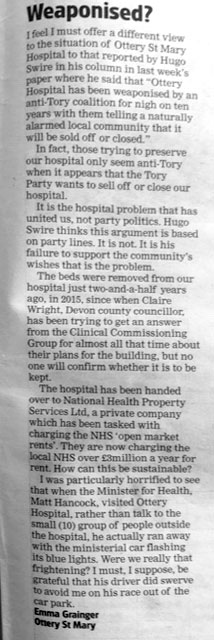
Here are some images of a few of the responses in the Sidmouth Herald to Hugo Swire after his claims that campaigners for Ottery St Mary Hospital are “anti-Tory” and have “weaponised” their campaign (click on images for better view):


The secret life of an MPs assistant [including those like Swire and Parish who employ their wives]

“Former parliamentary assistant Margot was thrilled to get a job in politics a few years ago, when she was in her mid-20s, but soon found herself a personal lackey, often doing private work instead of the constituency casework she was hired for – something that is against parliamentary rules. She spent three days designing a website for her MP’s wife’s company, and was then sent to the couple’s home to show his wife how to use it. At other times, she was told to run an online auction to sell her MP’s livestock collection and find people to write references so he could apply to a private members’ club. “It would have been so hard to say no to whatever I was asked to do,” she tells me. “I assumed it was par for the course, although I recognised it was outside of my duties. Had I wanted to complain, I would have had no idea how.”

Her boss, who is still an MP, shouted and swore at staff and told racist and sexist jokes, she and other members of his team tell me. With four full-time assistants paid from his parliamentary staffing allowance (this is £153,620, or £164,460 for London MPs), who helped with his personal life and political work, the MP spent significant time consulting for private businesses and attending board meetings. More than once, staff opened his office door and found him playing computer games in the middle of the day. “All I could really do was roll my eyes,” Margot says. “Because these people are more powerful, you just have to put up with it.” …”

… It also helps to be related or married to your boss [as Hugo Swire an Neil Parish do]: more than 100 MPs currently employ their relatives with public money, according to parliament’s register of members’ financial interests. Among them is Labour’s Margaret Beckett, whose husband Leo, in his 90s, has worked for her for decades. In a rare instance of intrusion into staffing, last March parliament’s standards authority banned MPs from hiring family members, saying it hindered diversity and transparency, although relatives who were already employed can remain. Archy Kirkwood tells me he “made no secret” of employing his wife, that she worked hard and “would never let me down”, but acknowledges some MPs have been less conscientious. “The only person in the world I would trust to handle constituency business in London in my absence would be my wife,” he says. “But [the system] was abused. It was.” Emma, another former researcher for an MP, says her boss employed his wife on the highest pay band (currently almost £50,000 a year), but it was unclear how much work she did.

https://www.theguardian.com/politics/2018/oct/27/sworn-at-belittled-fired-at-will-the-truth-about-working-for-an-mp

(Another) self-serving own goal for our Local Enterprise Partnership?

Our LEP is padded with business people who have heavy direst, indirect and subtle links to the nuclear industries and housing development around Hinkley C, so the longer they can keep this white elephant limping along the better. Eggs … basket …. though if the eggs fall out of the basket WE will be clearing up the financial mess, of course.

“France has postponed a decision on whether to order more nuclear reactors in an indication that it may be losing faith in the technology it has sold to Britain.

François de Rugy, the ecology minister, rejected calls for the swift launch of the construction of new French-designed European pressurised reactors (EPRs).

He said no decision would be taken before 2021 and hinted that the authorities might rule out more EPRs altogether. “That is a question which remains open,” he said.

His comments were a blow for EDF, the mostly state-owned French electric group that is building two EPRs at Hinkley Point in Somerset at a cost of £19.5 billion.

Hinkley has faced continued criticism and calls have been made for the project to be halted because of its spiralling costs as well as fears over the technology.

EDF, which is struggling to build France’s first EPR at Flamanville, Normandy, hoped to have a second one up and running by 2030. That is now highly unlikely, given the reluctance of President Macron’s government to place an order. An internal French government document leaked to Agence France-Presse said ministers had told EDF to show that it could limit construction costs before a new order would be considered.

Doubts about the EPR programme have grown amid a series of setbacks at the five sites where they are under construction.

EDF says the one at Flamanville will not be operational before the end of next year.”

Source: The Times

Clinical Commissioning Group merger for Devon – good or bad?

Owl says: a bigger group fo DCC NOT to scrutinise – right….

“There are claims a planned merger between two NHS bodies in Devon will result in a less accountable system with no guarantee of improved healthcare for patients.

At present, there are two clinical commissioning groups – or CCGs – which plan and buy healthcare for local people. There’s one covering the North, West and the East of the county – NHS NEW Devon CCG – and the other covering Torbay and the South – NHS South Devon & Torbay CCG. Health bosses want them to merge into one big organisation, claiming this will save money and result in a stronger service. They say there’s already been benefits from the two organisations working more closely together.

But GPs in Torbay have voted against the move and local councillor in the Bay, Swithin Long, is also worried…”

https://www.bbc.co.uk/news/live/uk-england-devon-45865015

Newham latest wobbly council

“Newham financial health check identifies control weaknesses

A financial health check carried out by the Chartered Institute of Public Finance and Accountancy (CIPFA) has recommended that London Borough of Newham addresses weaknesses in its financial control.

CIPFA was appointed by the borough’s mayor Rokhsana Fiaz to examine the council’s finances after she was elected earlier this year.

According to a council report this week, the initial findings of the review recommend that the council carries out a fundamental budget review with external challenge and new corporate standards.

It also says the council needs, as a matter of urgency, to assess the extent to which reserves might be needed to support this year’s revenue budget.

In addition, it recommends the adoption of outcomes-based budgeting, the consideration of council tax increases, and that the council “review the use of its assets, dispose of assets no longer required and how it finances investment in those assets”.

The final report is set to be presented to the council in the next three months.”

http://www.room151.co.uk/brief/#newham-financial-healthcheck-identifies-control-weaknesses

“New houses must be more than Noddy dwellings in the middle of nowhere”

“….. A report by the campaign group Transport for New Homes reveals a landscape pockmarked with new developments cut off from public transport, forcing people on low and middle incomes into car ownership – often two per household – for the sake of a cheaper house. Researchers visited 20 new housing developments around the country, many of which, in the report’s words, didn’t “connect to anything other than the road network”.

Central government assigns housebuilding targets to councils, which they must deliver purely on the basis of numbers. Local planners ask meekly for funding to integrate new developments into public transport networks and are told to get lost, because properly planned and integrated transport takes time, money and, above all, political will.

Planning incentives ‘lead to housing estates centred on car use’

The net result is that “we are building car parks as much as new homes”, according to the report. Compare this with the Netherlands, where any new development has to have integration into walking, cycling and public transport as a primary priority, and where a nationwide smartcard can be used anywhere in the country on any mode of public transport. (This fact alone makes me want to move there.)

Britain right after the war was better served by public transport than it is now. Until the late 1950s most towns and cities had extensive and cheap tram and trolleybus networks to complement buses. Rural and semi-rural areas were served by an extensive branch railway network until the 1963 Beeching report cut thousands of miles from the national network and closed more than 2,000 stations.

Only in the late 1970s did some councils, facing increasing congestion and pollution, try to redress the imbalance by offering super-cheap bus fares on their municipal services.

While car ownership appears to have peaked, the number of car journeys has risen since the 2008 crash, suggesting more pressured lives, longer and more frequent commutes, and the legacy of public transport cuts. Younger people are increasingly drawn to cities, where public transport tends to be better, and are less likely than ever to own cars. Yet those who live outside cities are increasingly forced towards car use, purely because planners can’t force developers to do anything other than build houses. …”

https://www.theguardian.com/commentisfree/2018/oct/25/new-houses-housing-targets-residents-car

Government not sure PFI/privatisation was such a good thing ….duh!

The article blames Labour but it was Sir John Major who introduced it in 1992 and later Labour, Coalition and Tory governments continued with them. Many dirty hands made nowt work!

“Sources claim that in the wake of the collapse of outsourcing giant Carillion earlier this year, the Treasury wants to see whether PFI schemes represent “real value for money”.

Under PFI, the state hires contractors such as Carillion to build and deliver projects – then lease it back for a set annual fee.

But under Labour [and later Coalition and Tory governments], more than 500 schemes ended up costing taxpayers five times the original building cost. In 2011 one hospital was being charged £333 by the PFI provider to change a lightbulb.

Industry insiders claim that while the Chancellor’s review won’t “re-write” previous PFI deals, it could kill off PFI “for good”. …”

Take a deep breath … on second thoughts – don’t

“UK ‘won fight to weaken rules on waste emissions’

The Government has successfully lobbied to water down new EU rules on waste incinerators’ emissions, according to Greenpeace. The decision comes amid concern that the UK already has levels of air pollution above legal EU limits in many cities, leading to the early death of 40,000 a year, according to the Royal College of Physicians.
i p8

Toxic air health threat at 2,000 GP surgeries
A new report by Cambridge Environmental Research Consultants, commissioned by the British Lung Foundation, has found that more than 2,000 GP surgeries and 200 hospitals are in areas with toxic air. This means people with heart and lung conditions could be putting themselves at risk by visiting these GP surgeries and hospitals. Air pollution has been linked to diseases ranging from Alzheimer’s to type 2 diabetes.
Guardian Online, Mail p21”

EDDC cannot protect heritage assets due to its “limited resources” leaving them at the mercy of developers

Owl says: no surprises there …..

“Hundreds of hours have been ‘wasted’ trying to protect important historical buildings after a council delayed a formal review for the third time, say a campaign group

The criticism was levelled at East Devon District Council (EDDC) by the Otter Valley Association (OVA) after a formal review into heritage assets in the area was postponed for a third time.

OVA campaigners are worried without a review planning decisions may be made which compromise important historical buildings and structures.

An OVA spokesman said: “For the third time since 2016, EDDC has postponed the long promised formal review of the local heritage assets list by the strategic planning committee.

“So, 100 hours of work wasted as the list is not legally accepted for planning purposes, as demonstrated by an inspector’s decision on a recent planning application which dismissed any idea of the ‘specialness’ to the community of a beautiful Hatchard Smith house in Budleigh Salterton.”

A spokeswoman for EDDC responded to the association’s criticisms, she said: “We very much value the hard work that the OVA has put into their list of nominations for the local list of heritage assets and are sorry that we have not been able to progress this work more quickly.

“Unfortunately, we have limited resources and, first and foremost, we have to prioritise undertaking our statutory duties in relation to listed buildings, conservation areas and other heritage assets to ensure that the nationally important heritage assets in the district are conserved.”

According to EDDC there are more than 3,000 entries on the national list in East Devon and the work involved in conserving the structures ‘leaves little time to commit to compiling a list of locally important heritage assets’.

However, work is being done on the council’s heritage strategy which will clarify the council’s position on the local list as well as provide a timeline for production of the list.

The spokeswoman added: “The heritage strategy has been delayed to enable wider engagement with the membership of the council, however this additional work will lead to a better strategy and a wider understanding of the issues among council members before it is presented to the Council’s strategic planning committee on November 27.”

http://www.exmouthjournal.co.uk/news/heritage-asset-review-east-devon-1-5751668

E.on temporary energy centre for Cranbrook’s phase 4 runs into problems

Cranbrook Town Council notes:

MESSAGE & APOLOGY FROM E.ON FOR PHASE 4 RESIDENTS – OVERRUN
E.on is sorry that the works to the temporary energy centre on Phase 4 have overrun but assures residents they should be completed by 5pm.

That’s the problem when you have district heating and no control over who provides your energy supply – or the price they charge.

Cranbrook: no road markings causing serious problems with anti-social parking

Cranbrook Town Council Facebook page draws attention to a serious traffic problem:

“APPEAL FOR CONSIDERATE PARKING ON CRANBROOK’S ROADS:

There was another near miss earlier today when a resident pulling carefully out of their road was unable, due to cars parked at the junction, to see a group of approaching cyclists. Although nobody was hurt on this occasion, the cyclists had to swerve and could have been forced into the path of oncoming traffic. Although Cranbrook has no road lining may we remind residents that the principles of the Highway Code still apply.”

6 mins ·
MESSAGE & APOLOGY FROM E.ON FOR PHASE 4 RESIDENTS – OVERRUN
E.on is sorry that the works to the temporary energy centre on Phase 4 have overrun but assures residents they should be completed by 5pm.

“Fresh cuts will leave largest forces in England and Wales with [police] officer numbers last seen in the 1970s

“Three of Britain’s most senior chief constables have warned of a fresh crisis in policing after the government squeezed budgets even further, which they say will leave no alternative but to cut the number of officers.

In an unprecedented public warning, the chief constables of the West Midlands, Greater Manchester and Merseyside forces told the Guardian the fresh cuts would leave them with officer numbers last seen in the 1970s.

Since 2010 the government has cut police funding by 19%. Police in England and Wales have now been told that a £420m pensions shortfall must be met from their already reduced budgets.

After recalculating officers’ pension liabilities, the Treasury decided forces needed to contribute more. Forces are now coming to terms with the impact of the further budget squeeze and anger is mounting.

Ian Hopkins, the chief constable of Greater Manchester, the third biggest force, said he had hoped to have 6,300 officers by the end of March 2021; instead he is likely to have 5,709 – fewer than the force’s 1975 total.

Hopkins told the Guardian: “Clearly we would always look to save money without job cuts, but the reality is 83% of our budget is people and after eight years of efficiencies across all parts of the organisation – which has seen us make reductions of £183m – there would be little alternative but to cut posts, both officers and staff.”

He said he feared the new funding squeeze would reduce his force. “This would just get worse as we would have to further prioritise against threat, harm and risk, screen out more and more crime. Essentially we would just have to focus on providing a response function, a serious and organised crime capability and a custody function as the core capabilities of policing.”…

https://www.theguardian.com/uk-news/2018/oct/23/police-chiefs-fewer-officers-treasury-shrinks-budgets-pensions?CMP=Share_iOSApp_Other