Say No to Sidford Business Park meeting

Owl says: notable by his absence was District Councillor and DCC Transport supremo Stuart Hughes, who, it seems, may have preferred going to his gym than attending the meeting:

https://eastdevonwatch.org/2018/10/10/where-was-eddc-and-dcc-transport-councillor-during-the-say-no-to-sidford-business-park-meeting/

“The only way to ensure proposals like the Sidford Business Park and others like it stay in the dustbin of history is for the community to buy it themselves.

Those are the words of campaigners who would like to see the Two Bridges site, where the multi-million pound scheme is proposed, turned into an area for the good of the community – but it would only work if the plans were rejected and the landowners agreed to sell.

More than 100 people attended the latest No Sidford Business Park meeting on Wednesday at St Peter’s Church Hall, Sidford.

Permission is being sought to build 8,445sqm of employment floor space but among the concerns raised are flooding risks and the extra traffic, especially lorries, it could bring to the area’s ‘inadequate’ roads.

During the meeting, John Loudoun from the group, revealed they now had 1,379 signatures on their petition, which opposed the plans and was only carried out in Sidford and Sidbury. And by the time they present the petition to East Devon District Council’s (EDDC) Development and Management Committee, campaigners say it will have more than 1,400 names on it.

John said: “The call to you and everybody out there – and your friends, your family, your neighbours – is please come along on Tuesday, October 30, at 9.15am at The Knowle and be with us when we present the 1,400 signatures to the committee.

“Let’s try now and make sure that this is the second time that we actually kick this planning application and any others like it into the dustbin of history.”

Councillor Marianne Rixson said: “I really can’t see what has changed since last time.

“If we are lucky, it could be refused again, which would leave us potentially facing yet another revised application at some date in the future. But personally, I don’t relish the prospect of wading through another 500-plus pages of documents so I have a radical suggestion. How would you feel about trying to raise the money to buy this land. I can’t promise they would agree to sell but this is the only way we can guarantee that this development or something similar couldn’t happen. Once the Japanese knotweed on the site has been eradicated it could then be a community asset and used for the public good.”

Cllr Rixson said she believed the landowner, Tim Ford, paid around £402,000 for the site.”

http://www.sidmouthherald.co.uk/news/nearly-1-400-residents-say-no-to-sidford-business-park-1-5733085

Yet another “free school” scandal

“University technical colleges – part of the free schools changes pushed through by Michael Gove – have been described as ineffective and unpopular by a report that found more than half their students dropped out.

Of those who remained at UTCs, many made poor progress, with even previously high-achieving students performing less well in their exams, according to the Education Policy Institute.

About 60 UTCs have opened since 2011, after being championed by the Conservative Lord Baker and the then prime minister, David Cameron, enrolling students aged 14 to 18 and designed to encourage the study of science, technology and engineering.

But despite official encouragement and lavish funding, they have failed to generate enthusiasm among parents, and 10 have subsequently closed or converted into conventional schools.

David Laws, the EPI’s executive chairman, said after spending “hundreds of millions of pounds” on UTCs, the Department for Education (DfE) should halt any further expansion until their effectiveness has been reviewed.

Baker, a former education secretary who chairs the Baker Dearing Trust, which promotes UTCs, accused EPI researchers of ignoring evidence.

“EPI start with their conclusion that a 14-18 institution cannot fit into an 11-18 system and then use statistics to support that,” he said.

“It is a pity that they did not take up Baker Dearing’s offer to visit several of our 50 UTCs and speak to teachers, students and parents.”

The EPI found many UTCs struggled to recruit students, and failed to retain the majority of those who did enrol. More than half of all UTC students left between the ages of 16 and 17 after taking GCSEs, while more continued to quit before finishing key stage five at the age of 18.

One in five UTCs were rated as inadequate by Ofsted inspectors, the EPI found, while a further 40% were rated as requiring improvement – well above the national average for mainstream schools in England.

Julian Gravatt, the deputy chief executive of the Association of Colleges, said the report showed UTCs “are an experiment that hasn’t worked”.

“Given the high level of support given to them by the DfE and the capital funding allocated by the Treasury, this is obviously depressing,” he said.

The analysis also found UTC students’ GCSE results were almost a grade lower than their peers at secondary schools. “Significantly, this poor progress is particularly acute for high attainers, who make over a grade’s less progress than high attainers in all state-funded schools,” the EPI noted.

The National Education Union said the report backed up its research, which found Black Country university technical college in Walsall cost more than £11m between its opening in 2011 and closure in 2015, with 158 students enrolled out of a planned 480.

Another UTC in Burnley cost £10m but closed three years after opening in 2013, with 113 students enrolled despite plans for 800.

The EPI did note several benefits from UTCs, including that they offer a wider range of technical subjects such as computer science than other schools.

The report concluded that existing UTCs should be repurposed as 16-18 colleges offering post-GCSE technical qualifications, such as the government’s promised T-levels.

But Gravatt said such a change needed careful consideration. “The 16-to-18 sector of education is already a chaotic and underfunded market,” he said.

A DfE spokesperson said UTCs were an important part of England’s diverse education system.

“Our most recent data shows that when young people leave a UTC, they are headed in the right direction – with twice as many key stage four students beginning an apprenticeship compared to the national average,” they said.”

https://www.theguardian.com/education/2018/oct/11/university-technical-colleges-schools-report-education-policy-institute

“Judge who jailed fracking protesters with ‘excessive’ sentence has family links to oil and gas firm”

“A judge criticised for handing prison sentences to three fracking protesters has family links to the oil and gas industry.

Judge Robert Altham jailed Simon Blevins, 26, Richard Roberts, 36, and Richard Loizou, 31, over their demonstration at a Cuadrilla site.

The trio, known as the “Fracking Three”, are believed to be the first environmental activists to be imprisoned for public nuisance since 1932.

Critics have claimed the punishment was “manifestly excessive”. Now the Daily Mirror can reveal the Altham family business supplies the Irish Sea oil and gas industry.

J.C. Altham and Sons is believed to be part of the supply chain for energy giant Centrica, which has invested tens of millions of pounds in fracking.

Judge Altham’s sister, Jane Watson, put her name to an open letter in favour of fracking, which said, “It’s time to give shale a chance” and claimed it would create jobs.

The judicial code of conduct states a judge’s impartiality may be questioned if family members are “politically active” or have “financial interest” in the outcome of a case.

Lawyers for the protesters are trying to overturn their sentences. Loizou’s mum Sharron, 62, told the Mirror: “I was completely shocked when he was jailed, the sentence is incredibly harsh. We were expecting community service or a suspended sentence.

“It’s quite scary that in this country you can be jailed for a peaceful protest.” …

Soil scientist Blevins and piano restorer Roberts were given 16-month jail terms while teacher Loizou got 15 months last month.

Sentencing at Preston crown court, Judge Altham said: “Only immediate custody can achieve sufficient punishment.”

The judge’s parents John and Linda, 86 and 84, are ­directors of J.C. Altham & Sons.

His sister Jane, 54, is managing director of the firm, which supplies ships’ stores, including food, tools, rigging equipment and clothes. The firm’s website says it is a “specialist supplier to offshore gas and oil platforms”.

Three oil rigs in the East Irish Sea – near Altham’s base at Heysham, Lancs – belong to British Gas owner Centrica, which has ploughed tens of millions of pounds into fracking firm Cuadrilla.

In 2015 Jane’s name and that of her firm appeared on an open letter backed by 119 businesses.

It urged Lancashire County Council to permit fracking and create a “£33billion supply chain”.

The campaign was led by North West Energy Task Force, which allegedly received financial support from Cuadrilla and Centrica. The NWETF was later rebranded as lobbying group ­Lancashire For Shale.

LFS has praised Judge Altham’s decision saying: “Justice was served effectively.”

But more than 200 academics signed an open letter calling for a judicial review of the “absurdly harsh” sentence. About 200 supporters of the trio marched outside HMP Preston, where they are being held, at the weekend. The trio’s lawyers have approached the Court of Appeal and asked for an expedited hearing.

It means they could be freed within weeks if Judge Altham’s sentencing decision is ruled unsafe. Kirsty Brimelow QC, of Doughty Street Chambers, has taken their cases pro-bono. She said: “These men should not be in prison at all, the sentence is manifestly excessive.”

Judges are expected to tell defence and ­prosecution lawyers if they feel their impartiality in a case may be called into question.

A spokesman for the Judges’ Council said: “There are longstanding principles, set out in case law, which guide how judges approach possible conflicts of interest. They ensure that when hearing a case, a judge will be mindful of possible conflicts of interest and can draw relevant matters to the attention of parties in the case.”

Judge Altham did not wish to add anything to the Judges’ Council’s statement.

Sister Jane, a former police officer whose husband Stephen is the Chief Constable of South ­Yorkshire Police, declined to comment today. …”

https://www.mirror.co.uk/news/politics/judge-criticised-jailing-fracking-protesters-13396324

“Universal Credit: 580,000 People Risk Losing Benefit Payments In Next Roll Out Of Reforms”

Many of these people are working and it includes children. At its current pace, around 1% of the population will be classed as destitute.

And we are told austerity is over. For whom?

“As many as 580,000 people could lose out on benefits payments in the changeover to Universal Credit, leaving vulnerable and hard-up families in crisis.

The Department for Work and Pensions (DWP) is currently rolling out the government’s flagship benefits reform programme and is due to move 2 million more claimants onto Universal Credit next year.

But the latest data shows that a “worryingly high” rate of claims are not being successfully processed onto the new system, HuffPost UK can reveal, with 29% closed or not paid.

If the current claim failure rates were replicated in the next stage of Universal Credit roll-out then 580,000 people who are currently receiving benefits, including many low income families who are in work and receiving income support, would lose out on payments.

The figures have led to urgent demands for the government to halt Universal Credit, which has been besieged by criticism from both the Labour Party and disability and welfare charities. …”

https://www.huffingtonpost.co.uk/entry/universal-credit-process-rate_uk_5bbe232ee4b01470d057ffcc

893 gifts or hospitality from developers in 6 years did not influence councillor’s decisions says Monitoring Officer [insert hollow laugh here]

On average accepted gifts or hospitality 3 times a week, every week for 6 years! But he resigned anyway ….. deja vu, deja vu says Owl!

“The Deputy Leader of Westminster Council has resigned following an internal investigation into his conduct.

Deputy Leader Robert Davis announced today he is to resign “with immediate effect” after 36 years of service.

Mr Davis’s resignation comes after he reportedly accepted hospitality or gifts 893 times over six years. These gifts frequently came from property developers who were seeking planning permission, according to the Guardian.

In a statement, Mr Davis said: “I am very proud of my 36 years’ service in local government during which I made a major contribution to the wellbeing of the City and its people.

“Earlier this year there was some press coverage concerning the hospitality I received during the course of my duties. To avoid this becoming an issue in this year’s elections, I agreed to refer myself to the Monitoring Officer, and stand aside as Deputy Leader while an investigation was carried out.”

Mr Davis, who chaired the Conservative borough’s planning committee for 17 years, continued: “My approach to declarations has always been to be honest, open and transparent. I have nothing to hide.

“I registered all my hospitality and it was posted by officers on the Council’s website. I have been making such declarations since 2007 when the requirement was first introduced.

“I also declared any relevant interests at the beginning of every planning committee I chaired during this time. I have acted with the utmost transparency and probity at all times and have only ever taken decisions on the basis of what I thought was best for Westminster.

“An inquiry has been completed by the Council. They have confirmed that none of the declarations I made or hospitality I received influenced decisions I took as a councillor and that nothing I did was unlawful.”

He said his actions “created a perception that was negative to the Council.

“While I dispute this, I wish to draw a line under the matter. It is now time for me to move on to the next stage in my life, and for the next generation of councillors to lead Westminster.”

https://www.standard.co.uk/news/politics/westminster-council-deputy-leader-resigns-after-hospitality-inquiry-a3958681.html

Is this why we now have a Minister for Suicide Prevention?

“Theresa May told to scrap fit-to-work assessments after nearly 50% of women attempted suicide during process:

Theresa May has been told to scrap “appalling” fit-to-work assessments after The Independent revealed nearly one in two women trying to claim benefits had attempted suicide.

SNP’s Ian Blackford grilled the prime minister on “the impact of her government’s own social security policies” on people’s mental health after she made a public commitment to reduce the number of self-inflicted deaths.

He pointed to an exclusive report by The Independent, which revealed that attempted suicides among out-of-work disability benefit claimants have more than doubled since the introduction of fit-to-work assessments in 2008.

Mr Blackford used the weekly prime minister’s questions clash to challenge Ms May to agree to “eradicate policies and circumstances that lead to people to believe that suicide is their only option”.

He told MPs: “I’m glad the prime minister agrees with me because, as reported by The Independent, nearly one in every two women taking part in the UK government’s work capability assessment say they have attempted suicide after or during the process.

“A series of secret internal enquiries into these reveal that Conservative ministers were repeatedly warned of the policies shortcomings.

“Will the prime minister commit today to ensuring that her new minister of suicide looks at the impact of her government’s own social security policies and at long last scrap the appalling work capability assessment?”

Ms May defended the assessments, which she said were regularly reviewed by the Department for Work and Pensions.

She said: “These were assessments that were introduced by a previous government [Labour in 2008].

“It is important that we get these assessments right. I think it is right that we are encouraging people into the workplace and wanting to ensure that those people are in the workplace – who are able to be in the workplace – are given the support to enable them to do that.

“That is what we want to do, I think it is right that we maintain assessments.”

The row came after Ms May appointed Jackie Doyle-Price as the first ever minister for suicide prevention as part of a £1.8 million push to reduce the number of people taking their own lives.”

https://www.independent.co.uk/news/uk/politics/theresa-may-fit-to-work-assessment-women-suicide-benefits-disability-a8577306.html

“Policing at ‘tipping point’ over budget cuts, warns police chief”

“Policing has been left at a “tipping point” by government cuts, and on the verge of failing the public and struggling to detect crime, a senior police chief has warned.

Dave Thompson, the chief constable of the West Midlands force, said agreement was needed on what the police should stop doing. It is an idea discussed privately by police chiefs and done by stealth by some forces.

Thompson leads for the National Police Chiefs’ council on finance and resources and his comments accept standards of service have fallen so badly the police risk becoming ineffective. He said: “The public’s experience is policing that is less visible, less responsive and less proactive.

“Core aspects of policing – such as answering calls, attending emergencies, investigating crime, bringing offenders to justice and neighbourhood policing – are being pushed beyond sustainability, and are in danger of becoming ineffective to the detriment of confidence in the police.”

Thompson took aim at the Conservative government’s approach to policing since they came to power in 2010 to explain the crisis.

He said “the government has had a partial view of policing in the last few years” – very interested in terrorism and high-end threats, but less focused on local crimes.

Those have been left for forces and police and crime commissioners to manage locally amid steep budget cuts, as demands on the police rise. The chief constable said: “This more local agenda has many positives in setting priorities but it has come with steep budget reductions and a widening mission. There has been a real-term reduction of police budgets of 19% since 2010, but ranging between 11- 25% across forces.”

Thompson said the fight against terrorism and serious and organised crime had improved, but added: “The gains we’ve made have come at a cost to perhaps the most important parts of policing for the public.

“Crime is rising and so is the demand on our service. The calls do not get answered as quickly as they did. Officers are not as fast at responding to emergencies and more crimes are dealt with on the phone. Fewer high-volume crimes like thefts are investigated and as a result fewer offenders brought to justice. The visibility and proactivity of neighbourhood policing is much reduced.

“Bluntly our ability to manage the big threats and protect the vulnerable, yet still be the traditional police the public want and need, is becoming ever harder. We are in danger of pursuing efficiency to the point of ineffectiveness – where we can process the work but we’re not detecting crime as we should be and not meeting public expectations. …”

https://www.theguardian.com/uk-news/2018/oct/10/policing-at-tipping-point-over-budget-cuts-warns-police-chief

Ministers must give reasons for calling-in and also for NOT calling-in planning applications

Big change from recent practice and a victory for SAVE.

“Ministers must follow published government policy and give reasons for call-in decisions on planning applications – including in those cases where the decision is not to call in, the Court of Appeal has ruled.

The case of Save Britain’s Heritage, R (on the application of) v Secretary of State for Communities and Local Government & Ors [2018] EWCA Civ 2137 concerned the Secretary of State’s decision, dated 15 March 2017, not to “call in” certain planning applications dealing with the controversial ‘Paddington Cube’ development.

SAVE argued that the Secretary of State was required in law to give reasons for that decision, and failed to do so. It put the case in two ways:

There was a legitimate expectation that reasons would be provided, based on a promise made in 2001 by the then Attorney General Lord Falconer. Although the Secretary of State accepted that it was the practice for many years to give reasons for not calling in an application (pursuant to s.77 of the Town and Country Planning Act 1990), the Secretary of State argued that this practice came to an end in 2014 and that SAVE knew or ought to have known about that change. SAVE maintained that, as a matter of principle, a published policy cannot be withdrawn or overturned by an unpublished practice.

The Secretary of State had a general duty at common law to give reasons for any decision under s.77 and/or that there was such a duty on the particular facts of this case. This argument was contrary to a number of first instance decisions and was advanced principally by reference to the decision of the Supreme Court in Dover District Council v CPRE Kent [2017] UKSC 79.

When granting SAVE permission to appeal, Lord Justice Lewison limited that appeal to SAVE’s claim for a declaration “that the SoS was required to give reasons for any decision whether or not to call in applications for planning permission and/or listed building consent for his own determination under s.77”. The planning permission granted by Westminster City Council on 14 August 2017 still stands.

The Court of Appeal ruled in SAVE’s favour. Lord Justice Coulson considered that the particular facts of this case did not require the common law to impose a duty to give reasons when none would otherwise exist.

In relation to the legitimate expectation issue, Mrs Justice Lang had concluded in the High Court that by 2016/2017, there was no longer an established practice that reasons would be given for a decision not to call-in an application. “On the contrary, the established practice was that reasons would not be given.”

Lord Justice Coulson decided that this conclusion was erroneous for three reasons:

The judge’s may appeared to confuse the promise cases with the practice cases. “I accept that, if a legitimate expectation was created as a result of a particular practice then, if that practice was changed, the legitimate expectation might well disappear with it. But that is not this case. This case is based on the unequivocal promise made by the relevant Minister in Parliament which has never been publicly changed.”

It was “a recipe for administrative chaos if a legitimate expectation can be generated by an unequivocal ministerial promise, only for it then to be lost as a result of an unadvertised change of practice.” Even at its highest, the Secretary of State’s case stopped short of the suggestion that the alleged change of practice was advertised as such when it occurred in 2014. Ms Lieven QC [counsel for the minister] properly accepted that it was not a change that could be said to have been ‘published’ at all.”

It was “worth noting how and why the SoS says that this change of practice occurred. It appears that, in the Westminster case, the Minister had given reasons for not calling in the decision which were plainly wrong on their face. As a result of this error, somebody (and it is quite unclear who) within the Department for Communities and Local Government decided that it would be more prudent for reasons not to be given under s.77. In consequence, changes were made to the template letter sent out (to the relevant LPAs, or to the objectors who had requested call in) when a decision was made not to call in an application under s.77. Mr Harwood QC [counsel for SAVE] was therefore right to say that this was not an open or transparent way to withdraw a public ministerial promise made in Parliament.”

The Court of Appeal judge said he was unpersuaded that the alleged change to the template letter was of any real significance.

Lord Justice Coulson continued: “Since a promise had been made to operate a particular procedure then, as a matter of good administration and transparent governance, any change to that policy also had to be announced publicly.

“It is a not a question of fettering the future exercise of discretion, but simply making public the decision that something which had been promised and provided in the past would not be provided in the future. In my view, good administration and transparent government required nothing less. Of course, this did not happen here because no-one in the Department knew that they were changing a promised policy (because they had forgotten about it).”
Lord Justice Coulson added: “I do not accept the proposition that a policy which has been promised can then be withdrawn simply by a change in the template of letters sent privately to individual LPAs and objectors, particularly where, as here, the alleged change is itself very difficult to discern.”

He said: “An unequivocal promise was made, and that unequivocal promise should have been publicly withdrawn when (or if) a conscious decision was taken no longer to give reasons for not calling in applications …. For these reasons, I consider that SAVE’s legitimate expectation case has been made out.”

SAVE said the ruling meant that the Secretary of State for Housing, Communities and Local Government must now follow his own published advice and give reasons for his decisions.

Henrietta Billings, director of SAVE Britain’s Heritage, said: “This is a fantastic result that opens up the decision making process for highly contested major schemes across the country. It literally changes the landscape of decision making – and is a major victory for openness and transparency.”

Source: Local Government Lawyer

Statistics, damned statistics and Department of Education statistics …

“The education department’s three latest cases of statistics misuse

In his letter to Damian Hinds, the education secretary, Sir David Norgrove, the UK Statistics Authority chairman, cites three recent examples of the education department putting out false or misleading figures.

Here is the first.

Last week, the minister of state for school standards [Nick Gibb] wrote that, in an international survey of reading abilities of nine-year-olds, England “leapfrogged up the rankings last year, after decades of falling standards, going from 19th out of 50 countries to 8th.”This is not correct. Figures published last year show the increase was from 10th place in 2011 to 8th place in 2016.

Here is the second.

My attention has also been drawn to a recent tweet and blog issued by the department regarding education funding. As the authority’s director general for regulation has noted in a letter to the department today, figures were presented in such a way as to misrepresent changes in school funding. In the tweet, school spending figures were exaggerated by using a truncated axis, and by not adjusting for per pupil spend. In the blog about government funding of schools (which I note your department has now updated), an international comparison of spend which included a wide range of education expenditure unrelated to publicly funded schools was used, rather than a comparison of school spending alone. The result was to give a more favourable picture. Yet the context would clearly lead readers to expect that the figures referred to spending on schools.

And here is the third.

The shadow secretary of state for education [Angela Rayner] has written to express concerns about your use of a figure that appears to show a substantial increase in the number of children in high performing schools, as judged by OFSTED. While accurate as far as it goes, this figure does not give a full picture. It should be set in the context of increasing pupil numbers, changes to the inspection framework and some inspections that are now long in the past, as an earlier letter to the department from the Office of Statistics Regulation pointed out.

In his letter Norgrove says these cases follow four other instances in the last year when the authority wrote to the department with concerns about its presentation of data. “I regret that the department does not yet appear to have resolved issues with its use of statistics,” Norgrove says.”

https://www.theguardian.com/politics/blog/live/2018/oct/08/labour-and-tory-mayors-unite-to-demand-they-take-back-control-of-regional-spending-after-brexit-politics-live

“Audit watchdog vows to restore public trust in sector”

Owl says: too late for us. EDDC’s then (and now) external auditor was given a consultancy contract to investigate the ramifications of the Graham Brown scandal:

https://eastdevonwatch.org/2016/03/06/external-auditors-watchdogs-or-bloodhounds/

https://eastdevonwatch.org/2017/11/08/so-guess-who-eddcs-new-external-auditors-will-be/

Maybe the Financial Reporting Council would be interested in this seeming conflict of interest?

“The UK’s audit watchdog has announced a reform programme to restore the public’s “falling trust in business and the effectiveness of audit” after its work showed that high-quality auditing was not being “delivered consistently”.

The Financial Reporting Council will implement a series of measures including increased monitoring and assessment of risks, and scrutiny of the future needs of investors and audit quality.

It will also address auditor independence, including banning accounting firms from providing consultancy work to companies they already audit.

The watchdog plans to work closely with the Competition and Markets Authority (CMA) on this issue.”

https://www.telegraph.co.uk/business/2018/10/08/audit-watchdog-vows-restore-public-trust-sector/

Failing our vulnerable children – we sink even lower

“The NHS and councils need to collaborate to develop a system to support children with mental health problems, the Local Government Association has said.

Its call came in the wake of a Education Policy Institute report, published yesterday, which revealed a 26% increase in the number of children referred to mental health services.

At the same time, a quarter of councils have phased out support they offer to children including schools-based services, family counselling and support for those exposed to domestic abuse.

One in four children referred for mental health support were rejected, the report said.

David Laws, chair of the EPI, said it was “very worrying” that services and support were being cut back just as demand was rising.

“A large number of children referred to mental health services are already rejected for treatment, and the follow up for these children looks unsatisfactory,” he said.

“It is also disturbing that many mental health providers seem unwilling or unable to provide even basic data on their services – the government should take steps to compel all providers to report regularly on their standards and performance, and this data should be collected and reported nationally.”

Responding to the findings, the LGA highlighted the £3bn funding gap that will face children’s services by 2025.

“As a result, many councils are being forced to cut early intervention work, including youth services, which helps children avoid reaching crisis point, perform better at school and avoid mental health issues in later life,” said Anntoinette Bramble, chair of the LGA’s children and young people board.

“This has been compounded by government cuts to councils’ public health funding, which also helps young people to get the best start in life.”

She said there was a need for an “urgent root and branch review” of children’s mental health services and local government and the health should together develop a system that “says yes” to children, rather than rejecting them.”

https://www.publicfinance.co.uk/news/2018/10/children-mental-health-problems-need-public-service-collaboration

“Say No to Sidmouth Business Park” public meeting: 10 October, 7.30 pm, St Peter’s Church Hall

“The Say No to Sidford Business Park group is inviting residents to hear about the campaigns activities in recent months and its newest proposals.

The group is keeping tight-lipped until the meeting next Wednesday (October 10), but says the announcements will demonstrate the depth of local opposition.

John Loudoun from the group said: “I think it’s important to get a sense of what we have been doing over the past few months, in order to try and put it before councillors so they understand the depth of opposition there is to the planning application.

“This has now been going on for a number of months and it is not going anywhere particularly fast. We are going to be making an announcement as we have a proposal to put to the people.”

The meeting will start at 7pm, in St Peter’s Church Hall, Sidford, on Wednesday.”

http://www.sidmouthherald.co.uk/news/say-no-to-sidford-business-park-campaigners-to-hold-another-public-meeting-1-5726601

“Secretive councils shut out reporters with ‘elaborate ruse’ ” [one our council is fond of]

And EDDC with its “working groups” (eg Knowle sale and relocation, regeneration groups, the notorious East Devon Business forum, etc). Here is a list of its “other panels and forums” most of which meet behind closed doors with no public minutes:

http://eastdevon.gov.uk/council-and-democracy/committees-and-meetings/other-panels-and-forums/

“Councils across the country are trying to evade scrutiny by restricting media access to meetings.

One authority has ordered that sensitive information be shared only on an overhead screen to prevent leaks, while Nottinghamshire county council used an “elaborate” ruse to bar journalists from a crucial meeting to discuss plans to dissolve district and borough councils and create a new super-council.

Rather than debate the proposals in public, the council established a “working group” to discuss the plans behind closed doors. The council’s constitution requires committee meetings to be accessible to the press, but working groups operate outside the transparency rules.

“It’s a political sleight of hand,” Mike Sassi, editor of the Nottingham Post, said. “They are behaving in a high-handed fashion, which just reinforces every reservation people have about modern-day politicians. It was an elaborate, detailed and thought-out attempt to circumvent transparency.”

The council’s secrecy drive failed after the working group’s discussion documents and minutes were leaked to Kit Sandeman, a reporter for the Post and the BBC. The Post has complained to the local government ombudsman.

Lucy Ashton, a reporter for the BBC, The Star and Sheffield Telegraph, was challenged at a consultation at a pub to canvass residents’ views on a redevelopment. Two city council officers were “very unhappy”, she said.

“The director said, ‘We weren’t aware you were coming. Have you informed the press office?’ I said ‘No, I don’t need to, it’s a public meeting.’ ” Ms Ashton said that it was the first time in 25 years of reporting that she had faced such hostility at a council meeting. She said: “Nowadays everything needs to go through the press office. A few years ago I would have rung a planning officer directly. All that’s gone now.” The council press office apologised to Ms Ashton and pledged to ensure that reporters felt welcome at future events.

Nottinghamshire council said that the reorganisation had already been debated three times at public meetings and that the working group had no decision-making powers. Kay Cutts, council leader, said: “There was no requirement on the council to set up a working group — it was set up solely in the interests of transparency. The working group is intended as a way of engaging members from all political groups on progress of the work.”

South Ayrshire council in Scotland has sent members on mandatory confidentiality training and restricted sending out written reports to prevent leaks.

Instead, documents containing confidential information will only be displayed on an overhead screen during council meetings. The measures were required to protect commercially sensitive and personal information, the council said.

Rules for open government:

• Journalists are allowed to report from all council meetings and given “reasonable facilities”. Guidelines state: “Councils should support freedom of the press within the law and not seek to restrict those who may write critical comments.”

• Councils must give at least five days’ notice of their meetings and publish an agenda in advance.

• Press and public can be excluded if the council decides that confidential or “exempt” information is likely to be disclosed. Members of the public can be expelled to maintain orderly conduct.

• Councils can get round the transparency rules by classifying specific meetings as “working groups”, rather than committees.

Source:The Times (pay wall)

Community hospitals in Devon lost to nursing homes in privatisation move

“There was a staggering revelation yesterday at Health Scrutiny from Liz Davenport, Chief Executive of South Devon and Torbay NHS Foundation Trust, that they had made ‘block bookings of intermediate care beds in nursing homes’ when they introduced the ‘new model of care’. South Devon has closed community hospitals in Ashburton, Bovey Tracey, Paignton and Dartmouth and is currently consulting on the closure of Teignmouth – where I spoke at a rally last Saturday.

The ‘new model of care’ is supposed to mean more patients treated in their own homes, and there does seem to have been an increase in the numbers of patients sent straight home from the main hospitals.

But the idea that all patients can be transferred directly from acute hospitals to home is untrue. There is still a need for the stepping-down ‘intermediate care’ traditionally provided by community hospitals – the only difference is that now it’s being provided in private nursing homes instead.

It’s likely to be cheaper to use private homes, because staff don’t get NHS conditions, and crucially it frees up space in the hospitals so that the CCGs can declare buildings ‘surplus to requirements’ and claim the Government’s ‘double your money’ bonus for asset sales. It seems NEW Devon CCG has also made extensive use of nursing home beds, but we don’t yet know if there were ‘block bookings’.

However the private nursing home solution may not last – DCC’s chief social care officer, Tim Golby, reported that nursing homes are finding it difficult to keep the registered nurses they need to operate, and some are considering reversion to residential care homes.

This may be where the South Devon trust’s long term solution comes in – it had already been reported that it is looking to partner with a private company in a potential £100m deal which will include creating community hubs that contain inpatient beds.

The new model of care is also about privatisation.”

Shock revelation at Health Scrutiny suggests the ‘new model of care’ is more about switching intermediate care from community hospitals to ‘block bookings’ in private nursing homes – saving costs and freeing up assets. How long will it last?

“Town council requests neighbourhood beat manager to bring an end to anti social behaviour in Cranbrook”

“The authority has been dealing with several issues in Cranbrook, including anti-social driving in the town’s railway station car park and unruly behaviour at night from youths.

Cranbrook is currently under the responsibility of Ottery’s rural policing team.

A spokeswoman for Cranbrook Town Council said: “The existing local policing team do a great job and we work very well together with them. Our request is to enhance that team as Cranbrook grows. This is because, firstly, our current policing team covers a very wide area and, secondly, during the last six years Cranbrook has grown from green fields to a town with a population of over 4,000 residents.

“Like most towns of a similar size a police presence is required to ensure the safety of the residents and to deal with any misbehaviour which occurs.”

The council said a neighbourhood beat manager would ‘quickly understand’ the day-to-day issues facing residents, and have a deterrent effect on those thinking of taking part in anti-social or criminal activities.

They would also reassure the majority of our residents that help is close at hand if and when required. The spokeswoman added: “Although we experience a low level of antisocial behaviour as evidenced in our crime statistics, it is important to remember that victims are at the heart of the response to antisocial behaviour. If left unchecked, antisocial behaviour can have an overwhelming impact on its victims and sometimes the wider community.

“Our main concern is that, as the town continues to grow, the number of incidents of anti-social behaviour is likely to increase too.

“We think that now is the right time to establish measures in order to respond to any undesirable activities in an appropriate and timely manner.”

Council chairman Councillor Kevin Blakey and his deputy, Cllr Bloxham, recently met with Alison Hernandez, Devon and Cornwall Police’s Crime Commissioner.

The council has now written to the chief constable with a request for a permanent neighbourhood beat manager.”

http://www.midweekherald.co.uk/news/town-council-requests-neighbourhood-beat-manager-to-bring-an-end-to-anti-social-behaviour-in-cranbrook-1-5723741

Independents knock some sense into DCC Tories about health and NHS

Thank the Lord for independent Councillor Claire Wright and East Devon Alliance Independent Councillor Martin Shaw

Press Release:

“In a hour-long debate in yesterday’s meeting, the Council adopted proposals which Cllr Claire Wright and I, the two Independent members from East Devon, put forward, in place of the original recommendation by the Cabinet. The ruling Conservative group adopted (with a small addition) the wording of my amendment, which Claire seconded, which proposed to work with to influence NHS decisions ‘in the direction of retaining all community hospitals to be used as health and wellbeing centres for their areas’, in place of the original Cabinet recommendation to merely seek ‘decision making appropriate to individual circumstances, including population need and the quality of building.’

This is an important change in direction by the Council, which is now committed for the first time to work to retain ALL hospitals, as Claire (who proposed the original motion) had requested. The Conservative leader, Cllr John Hart, insisted on adding the words ‘where appropriate’ to my proposal, which we opposed because it provides the NHS with additional leeway to close hospitals. Cllr Hart’s addendum was too much for one Conservative Councillor, Jonathan Hawkins (Dartmouth), who voted with the opposition for my amendment without this addition, in the light of his community’s experience of the closure of Dartmouth Hospital.

The Devon Clinical Commissioning Groups could end this controversy with a clear policy statement that all remaining hospitals will stay open and will be supported as health and wellbeing centres for our communities. Until this happens, Claire and I, with the support of tens of thousands of people around Devon who are fighting for their local hospitals, will continue our campaign. On yesterday’s evidence, we are winning.”

Martin Shaw
Independent East Devon Alliance County Councillor for Seaton & Colyton”

Swire currently in Lebanon talking up our military involvement in the country

“The press office of Prime Minister-deisgnate, Saad Hariri, on Thursday indicated that the PM received today at the Center House a British delegation from the Conservative Middle East Council CMEC, in the presence of the British Ambassador to Lebanon Chris Rampling.

The Chairman of CMEC Sir Hugo Swire said after the meeting:

“This is the second day of our trip to Lebanon. We had a series of interesting meetings. We started today by meeting with the head of the army general Aoun and we were able to talk about the assistance that the United Kingdom is bringing to the Lebanese military. We had an extremely good meeting with the president as well this morning, and then with Speaker Berri, to learn more about the political situation. We just met with Prime Minister Hariri, who was able to talk not only about domestic matters but also about the wider regional challenges for the country and how the United kingdom can do more, particularly in fulfilling some of his ambitions in terms of revitalizing the economy and the infrastructure.

We believe the United Kingdom can do a lot more in that prospect. We are already helping hugely on training the military, on an education program which is coming under a lot of challenge because of the Syrian refugees issue, but we want to do more now on the commercial side as well to make sure that all the people of this country prosper and play a part in the future.”

http://nna-leb.gov.lb/en/show-news/95850/Hariri-receives-British-delegation

Report that Randall-Johnson was with Swire and Minister of Health at Ottery St Mary

“If you thought Health Secretary Matt Hancock was a safe pair of hands for the NHS after Jeremy Hunt think again. Comedy antics ensued when the Hancock turned up at Ottery hospital. First he hid, then he hurried.

Matt may well have been doing a favour for a rich mate, East Devon money-bags MP Hugo Swire, but at what price, making him appear a hapless lacky to East Devon’s Tory elite.

Hugo by-passed the Department of Health to take Matt hospital surfing. They went to Budleigh Salterton Hospital, before popping into in Ottery.

East Devon Councillor and Devon County Council Health and Adult Care Scrutiny Committee Councillor Claire Wright was on hand, along with some residents, to ask the Health Secretary some questions.

Unfortunately, he was holed up solely with a number of East Devon Tories, including Sara Randall Johnson, chair of the Health and Adult Care Scrutiny Committee. East Devon MP, Mr Swire and his aides were also present.

Have a read of Claire’s account. It certainly seems weird, so does the behaviour of the communication people of the NEW Devon Clinical Commissioning Group.

‘Why was he so frightened about talking to a dozen residents, and the local county councillor?’ asks Claire.

‘I had been quite encouraged that he was visiting the hospital and wanted to hear from him that he will protect Ottery’s and other hospitals. After all, Mr Hancock commands the NHS and also NHS Property Services, which now owns many hospital buildings in the area.

‘They are all at risk of possible closure and sell-off due to the lack of funding available to pay the enormous rents NHS Property Services demands.

‘But his cowardly escape bid simply gave the impression of a man who does not wish to be even remotely accountable.’

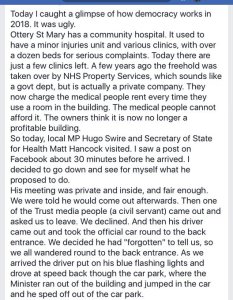
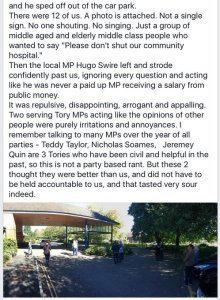
But that’s not all. Here’s the response of an East Devon constituent, as posted by Channel 5 News Health Correspondent Catherine Jones (check out the picture).

[There follow many hilarious comments on Swire’s justification for his actions and a You Tube video of Hancock doing a karaoke version of “Can’t Stop Me Now]

http://www.theprsd.co.uk/2018/09/27/first-he-hides-then-he-hurries-health-secretary-hancock-hot-foots-it-on-east-devon-hospital-visit/