Taylor Wimpey making nearly as much profit as Persimmon (£811 m)

“… The strong results came a day after rival Persimmon reported a £1.09bn profit for last year, the biggest ever made by a UK housebuilder. For every home sold, Persimmon made a profit of £66,265, compared with £53,073 at Taylor Wimpey.

Housebuilders have profited hugely over the past five years from the taxpayer funded help-to buy-scheme, which allows buyers to put down a deposit of as little as 5% on a new build home, while the government lends the buyer up to 20% of the value of the property (40% in London), interest free for the first five years.

More than a third of the homes sold by Taylor Wimpey last year were through the scheme, at 36%, although this was less than the 43% in 2017. The average price of a private home sold by the company was £302,000 – up 2% – while the overall average selling price, including social housing, was flat at £264,000.

Taylor Wimpey’s profits have trebled since the beginning of help-to-buy in 2013. It defended use of the scheme, noting that 77% of sales made through it were to first-time-buyers.

Greg Beales, campaign director at Shelter, said: “Taylor Wimpey joins Persimmon as the next developer making massive profits funded by taxpayer cash whilst doing very little to address the housing crisis in this country….”

https://www.theguardian.com/business/2019/feb/27/taylor-wimpey-reports-811m-in-profits-boosted-by-help-to-buy

“English councils accused of hiding scale of homelessness crisis”

“Councils have been accused of deliberately hiding the scale of the rough sleeping crisis in England by changing the way they compiled figures for the 2018 official count, the Guardian can reveal.

Official government statistics reported a 2% fall in rough sleeping in England in 2018 after seven consecutive years of rises when the figures were released last month. But critics have suggested the percentage decreased after several councils changed their counting method and does not reflect the reality on the streets.

The government has described the claims as “an insult” to the volunteers and charities who help compile the official figures. But back in 2015 the figures were also criticised as low-quality, untrustworthy and vulnerable to political manipulation by the UK Statistics Authority who threatened to remove their official status.

The rough sleeping statistics for England, based on a combination of estimates and spot counts on a single night in autumn, are intended to include everyone about to bed down or already bedded down on the street, in doorways, parks, tents and sheds but not hostels or shelters. …”

https://www.theguardian.com/society/2019/feb/25/english-councils-accused-of-hiding-scale-of-homelessness-crisis

“Housing is creaking — and not just because of Brexit”

David Smith, economics editor The Sunday Times:

“… There are two other elephants in the room.

The first is affordability. Official figures show that the average house price in England and Wales is 7.8 times annual full-time average earnings. The ratio has continued to climb in recent years, even since the crisis.

Over the past 20 years, it has more than doubled in England — up 123% — and nearly done so in Wales — up 92%. Viewers in Scotland have their own figures, but it has also gone up substantially.

It is true, of course, that ultra-low interest rates affect the affordability calculation when it comes to monthly mortgage payments, making bigger mortgages more affordable, but high prices are still a mountain to climb when it comes to deposits.

Also, even though wage growth has picked up, at a little over 3%, it is not making much of a dent in the high house price/earnings ratio. Older readers will remember a time when you took out a mortgage you could barely afford, confident in the knowledge that salary rises would come to the rescue. Things are different now.

The other elephant is the Help to Buy scheme, beloved of my friends in the housebuilding industry, where it has been like manna from heaven. First-time buyers have been steered towards new housing by Help to Buy equity loans on up to 20% of a property’s value in most of the country and a hefty 40% in London.

This has had two effects. By tilting first-time buyers towards new-build homes, it has distorted patterns in the market for existing homes. Young people who used to buy older homes, including “doer-uppers”, now have a powerful incentive to buy new. Normal housing market chains are not having a chance to form.

The second effect has been to push up prices for new properties relative to existing homes. Again, this comes out clearly from the affordability data.

In the early 2010s, the house price/earnings ratios for new and existing homes were similar. Since then they have diverged significantly. The latest figures are that the ratio for new homes is 9.7 — the average new home costs nearly 10 times average earnings — compared with 7.6 for existing homes. First-time buyers are being pulled into higher-priced homes and, ultimately, more debt. …”

Source: Sunday Times (pay wall)

Another developer pleads poverty – can’t afford to build affordable housing (lol)!

Councillors said they were horrified they were being asked to ‘give away poor people’s right to a house’.

Last month, Teignbridge District Council’s planning committee approved a scheme that will see 10 new two and three-bed apartments built on the site of the Neilston Retirement Hotel in Woodway Road, but only if an affordable housing contribution of £86,431 was provided.

But an independent viability appraisal confirmed that a contribution that large would mean that the development would not be viable and that they would not be able to proceed.

The application went back before planners on Tuesday morning and they voted to accept the recommendation of the planning officer that an affordable housing contribution of £37,500 was requested.

Had the application been totally policy compliant in terms of a 25 per cent affordable homes or off-site contributions for Teignmouth, then developers would have been asked for a total liability of £172,863.

Cllr Alistair Dewhirst said: “I am horrified that we could just give away poor people’s right to a house and I couldn’t possibly support it. I don’t think what is there now is special but what they are proposing looks like Colditz to me.”

Cllr Jackie Hook added: “Last time we were content with the application and were happy to see these new apartments built and we compromised in favour of a contribution of one affordable unit.

“The applicant’s appraisal identifies a developer’s profit of £228,280, so we should ask for £50,000, not the £37,500, and they will hardly notice the difference.”

Cllr Dave Rollason added: “A £228,000 profit is a lot of money. The need for affordable housing is massive and it is unfair that we are taking money from the pockets who need it most and giving it to developers.”

She added: “You either have to accept the independent advice over viability, or refuse the application.”

Cllr Phil Bullivant said it would be very difficult to go against the professional advice given and he could not see the evidence to go against it.

Cllr Dennis Smith, chairman of the committee, added: “We asked for this report and now seem to want to just be ignoring what it says. The viability statement says that £37,500 is fair, so I don’t see how we can argue about it.”

The proposal of Cllr Hook to increase the contribution required to £50,000 was lost, and then councillors voted by 14 votes to three to approve the application with an affordable housing contribution of £37,500.

The scheme would see the demolition of the existing building and the construction of a three storey apartment building containing 10 new two and three-bed apartments, plus 18 car parking spaces and two double garages.

Councillors had previously been on a site visit and raised no objections to the principle of the application, with Cllr Charlie Dennis said that the building has deteriorated, is past its best and at present it is a ‘sad thing to see’.

https://www.devonlive.com/news/devon-news/theres-busy-homeless-camp-exeter-2565711

“Housing developer forced to scrap ‘misleading’ ads targeting first-time buyers”

“One of Britain’s largest housing associations has been forced to scrap an advertising campaign that implied its shared ownership scheme was equivalent to home ownership.

The Advertising Standards Authority (ASA) ruled Notting Hill Genesis – which owns 55,000 properties in London and the south-east – misled consumers by comparing its scheme in contrast with renting.

A slogan on its ad said: “I own a two-bedroom apartment and pay less per month than my friends pay to rent a room in a flatshare.”

But the ads were promoting the group’s shared ownership scheme, where homeowners only technically own a slice of the property and pay rent to Notting Hill in respect of the rest. …”

https://www.telegraph.co.uk/money/consumer-affairs/housing-developer-forced-scrap-misleading-ads-targeting-first/

EDDC: “Relocation cost, No Deal Brexit, electric charging points and climate change motions rejected from being discussed”

Owl says: remember, the Chief executive, Mark Williams, is supposed to be a NEUTRAL civil servant and yet ALL of the refused motions are from ALL the minority groups ONLY……!

“Motions to support recycling, to call for a new property ombudsman to streamline complaints against shoddy builders, and for East Devon to get its fair share of the police precept rise will be discussed at next Wednesday’s full council meeting.

But motions over the full relocation costs of the move from Sidmouth to Honiton, to put electric charging points in all car parks, what to prioritise in a ‘No Deal’ Brexit and on climate change will not be discussed.

Various motions that councillors had put forward for debate at East Devon District Council’s full council meeting on Wednesday, February, were rejected by the council’s chief executive, as either the agenda already provides the opportunity for debate or the wording of the motions were inaccurate.

RELOCATION

Cllr Cathy Gardner had proposed a motion calling for the council to commit to publish an annual ‘summary of accounts’ for the relocation project until break-even is reached as relocation from Sidmouth to Honiton was proposed and predicated on the basis that the project would breakeven within 20 years and deliver cost-savings to the council tax payers of East Devon.

Cllr Gardner said: “Whilst some of this information is already available we feel it is vital for the ongoing costs to be published to show confidence that this project will breakeven. A majority of Councillors voted for relocation on the basis that money would be saved on energy bills. We are left unsure of whether breakeven will ever be proven.”

But an EDDC spokesman said: “The rejected motion contained inaccuracies and omissions that had the potential to mislead councillors and it was also premature. It is however proposed to bring a report to the next meeting of the Cabinet that will summarise the position reached with regard to the sale of the Knowle and the relocation. Cllr Gardner can raise the matters she is concerned about as part of the debate into that report.”

The motion would have called for the accounts to include

energy costs for the Knowle for the past 20 years (for comparison);

energy costs for both Blackdown House and Exmouth Town Hall per year;
the capital receipt for the sale of the Knowle;

a Red Book valuation of Blackdown House as of 1 March 2019;

the full costs for the relocation project since its inception, including: project management; removal, furnishing and equipment;

staff retraining and travel expenses;

new-build costs for Blackdown House; refurbishment costs for Exmouth Town Hall; and any other associated costs.”

CLIMATE CHANGE

Cllr Matthew Booth’s motion had called for the council to recognise that Climate Change and Global Warming are the key issues of our time, to acknowledge the strong concerns of young people in particular the recent walk out of school children and for the council to commit to introducing a policy of carbon measurement and reduction within all aspects of its own activity.

He said: “I personally do not care how we begin to do this, or who does it, but that we act now not wait for some planned strategy in the future.”

An EDDC spokesman said that the issue of climate change emergency is acknowledged to be of critical importance but that it would be appropriate to wait to see what Devon County Council decides. They added: “Currently, however, the County Council is considering its position and will shortly debate the matter. As we are in a two tier area it is appropriate for the District Council to assess the position taken by the upper tier authority and then respond accordingly. The public would expect us to work in partnership with the County Council rather than unilaterally.”

ELECTRIC VEHICLE CHARGING

Cllr Eleanor Rylance had submitted a motion calling for the council to plan for and implement over the next five years a full rolling renovation programme of its car parks estates to fit and bring into operation electrical charging points at every space for domestic cars, and cycle parks with charging points for all types of cycle and that there should be mandatory EV charging points for the parking spaces of every new-built house in East Devon.

She added: “This council should approach the future of electrically-powered domestic vehicles with enthusiasm and proactivity, play a positive role in helping develop the use of electrical and should make this infrastructure, that will be a necessity within the next ten years, available in advance of full electrification of domestic vehicles in 2042.

But an EDDC spokesman said: ““The agenda already provides an opportunity for this issue to be raised so this motion was inappropriate.”

BREXIT

Cllr Rylance had also submitted a motion that said in the event of a No Deal Brexit or a version of Brexit that causes significant disruption, the council should approach this event as a situation of emergency in respect of its most vulnerable residents, dedicating any available human, material and financial resources required to palliate any negative outcomes for these groups, but the motion was rejected.

Talking about all the motions, a council spokesman said: “The council agenda for February contains the most important annual decision, namely the setting of the budget and the approval of the Council Tax for the forthcoming year. The process leading to this meeting has included several meetings where members were encouraged to raise all items of future relevance so these could be assessed as part of our service planning process and for assessment as part of the budget.

“It is unfortunate that some members did not take these opportunities and have chosen instead to submit their proposed motions.

“It is also noted that the wording of the motions was not checked in advance with relevant officers who would have been able to give timely advice as to their wording.”

But motions on the police precept, protection for new home owners and supporting recycling will be discussed.

POLICING

Cllr Tom Wright’s motion says: “In view of the £24 per band D property increase in policing precept, this council urges the Chief Constable to recognise the needs of East Devon when deciding how to allocate extra resources. East Devon residents are the biggest contributors to the police budget in Devon, other than Plymouth. It is only fair that we should get a fair share of the larger cake.”

NEW HOMES

Cllr Douglas Hull’s motion says: “The Government has stated that it would therefore be introducing as a priority a new property ombudsman to streamline complaints against shoddy builders. As a council that not only provides an excellent and highly regarded building control service but also has seen significant levels of new building in its district, we call on the government to fulfil its pledge to provide this much needed remedy for homeowners as a matter of the highest priority.”

RECYCLING

Cllr Peter Burrows’ motion says: “This Council continues to support the fine work done by the EDDC Recycling team in achieving the best results in Devon and to support and encourage local Organisations and voluntary groups who are involved in trying to reduce the amount of single use plastics used in their communities & beaches by making resources and expertise available, where appropriate. The order of priority should be – Reduce, Reuse, Recycle. To actively help promote such activities through the Councils social media platforms.”

The full council meeting will be held at East Devon District Council’s new Honiton Heathpark HQ on February 27 at 6pm.”

https://www.devonlive.com/news/devon-news/relocation-cost-no-deal-brexit-2557565

“New “affordable” housing in Devon is anything but, investigation reveals”

“Most new “affordable” housing in Devon is anything but, a major new DevonLive investigation has revealed.

Affordable housing is an umbrella term used by the government to describe lower-rent properties that are available to eligible households unable to afford the full market rate.

This includes both traditional social rent housing – which is similar to what most people know of as council housing – and “affordable rent” housing, which was first introduced in 2011/12.

Social rent is based on a formula that combines local wages and local property values, and typically sees rents set at around 50 per cent of private rents in the same area.

“Affordable rent”, however, is capped at 80 per cent of the full market rate – meaning that in many areas it will still be out of the reach of people on low incomes. …

… Some local areas see “affordable rent” housing dominate more than others. In Mid Devon, South Hams, Teignbridge and West Devon, 100 per cent of new affordable housing was “affordable rent” rather than social rent last year.

Meanwhile, in East Devon the figure stood at 97 per cent, in Torridge at 67 per cent, and in both North Devon and Exeter at just 13 per cent.
In Plymouth the figure also stood at 100 per cent, while in Torbay they made up 58 per cent of the total.

In comparison, the national average saw 81 per cent of new affordable housing built or acquired across England in 2017/18 classed as “affordable rent” rather than social rent.

The most common type of affordable housing found in Devon is general needs properties managed by private registered providers, such as housing associations.

These cost an estimated £86 a week on average for a social rent property, compared to £121 a week for an “affordable rent” property – meaning “affordable rent” in Devon is typically 42 per cent higher, or £1,854 more a year. Private renters in Devon pay an estimated £150 a week, on average.

Kate Henderson chief executive of the National Housing Federation said: “In 2010, the government stopped funding social housing altogether, and announced it would only fund homes for “affordable rent” instead.

“This left housing associations in a really difficult position where they had to choose between building homes for “affordable rent” or building nothing.

“In the face of a dire housing shortage, many housing associations chose to build affordable rented homes, but continued to argue that social housing shouldn’t be neglected.

“While affordable rents do work for some people, there are many more who desperately need social housing.

“In 2017, the government announced some new money for social housing for the first time in seven years, but this is nowhere near enough.”

https://www.devonlive.com/news/property/new-affordable-housing-devon-anything-2543061

More spending on social housing could have saved governments £7 bn over 20 years

“A more consistent approach to social housebuilding over the past 20 years could have saved the government £7bn in housing benefit payments, research has found.

If the government had built 100,000 social rent homes each year over the past two decades, renters could also have benefited from an extra £1.8bn in disposable income, analysis from the Local Government Association has concluded.

The government currently has a commitment to build 300,000 new homes each year by the mid-2020s, but spreading this target out over the past 20 years could have saved both the government and renters significant sums, according to the analysis done in partnership with Capital Economics.

Overall, government would have had to borrow an additional £152bn (in 2017 prices) to build 100,000 social rent homes each year between 1997-2017, the LGA said.

But the report out today said building 100,000 annually would have meant all housing benefit claimants living in the private rented sector could have moved to cheaper social rent homes by 2016.

Every pound spent on construction output stimulates an increase of £2.84 in GDP, according to research referenced in the report. …”

https://www.publicfinance.co.uk/news/2019/02/social-housing-cutbacks-added-ps7bn-benefits-bill-reveals-lga

Daily Telegraph touts ’empty homes tax’

“Housing worth £123 billion is barely used in Britain, researchers have calculated, and have called for a one per cent tax on second homes to dissuade people from keeping hold of mothballed property.

A new study by University College London (UCL) concluded that building new homes is not the answer to Britain’s housing crisis as they are likely to be bought up as second homes or investments in the most popular areas.

Researchers collected information from around one third of local authorities in Britain covering 40 per cent of the population and found nearly 340,000 homes that were rarely used.

The majority were in London and the South West and Kensington was found to be the worst, with £21 billion of underused property in the borough.

Around four in 10 people currently live in an area where the average value of barely-used homes is higher than those that are permanently occupied, suggesting that the most desirable properties are being bought for purposes other than use as a home, for example as investment opportunities or holiday homes.

Researcher Jonathan Bourne at University College London, said: “Some of the most surprising findings were the sheer value and quantity of low-use properties in some areas.

“The data shows that low-use properties are very concentrated in small numbers of desirable areas. In such cases simply building more homes is not going to solve the problem, as the issue is intense competition for property, not a lack of places to live.

“An empty homes tax may be more effective, with the potential to generate a not inconsiderable income for local authorities, whilst taxing people who are typically not eligible to vote in local elections, or encouraging them to rent out their properties.” …”

https://www.telegraph.co.uk/science/2019/02/13/123-billion-property-barely-used-britain-experts-call-empty/

“Government housing delivery plan ‘flawed’ “

Well, cover me in tar and call me the M5! Owl has been saying this for YEARS. The only question that needs to be asked is: Is this deliberate or unintentional? Either way, it’s a damning indictment of its mendacity and incestuous relationship with developers or a damning indictment of its totally inept ability to govern. Or, of course (and more likely) BOTH!

“The government’s housing planning system is unable to demonstrate it is meeting housing demand effectively, public spending watchdog the National Audit Office (NAO) has said.
The government wants 300,000 new homes a year from the mid-2020s onwards.

The Ministry of Housing, Communities and Local Government has a standard method, developed in 2017, for local authorities to assess the number of new homes needed.
The NAO says this has weaknesses.

It says these weaknesses will result in a cut in the number of planned new homes in five of nine regions, while in London, the method will mean that new builds need to double in order to meet what the department thinks is needed.
The Local Government Association (LGA) said the current formula did not take into account the needs of local communities.

‘Free-for-all’

Local authorities – by law – need to have an up-to-date plan for building new homes.

If they are unable to prove that they have a five-year supply of land for housing, developers have greater freedoms to build where they want.

The NAO points out that this risks ill-suited developments, while the LGA says it risks a “free-for-all”.

The NAO says that between 2005-06 and 2017-18, 177,000 new homes per year were built on average, with the number never rising above 224,000.

To meet its ambition for 300,000 homes a year, the department will need to oversee a 69% increase in the average number of new homes built.

The NAO recommends the housing department should regularly monitor the gap between its ambition for 300,000 new homes and what is being planned.

It also says it needs to work with local authorities and other government departments to ensure that infrastructure is delivered more effectively.

Amyas Morse, the head of the NAO, said: “For many years, the supply of new homes has failed to meet demand.

“From the flawed method for assessing the number of homes required, to the failure to ensure developers contribute fairly for infrastructure, it is clear the planning system is not working well.

“The government needs to take this much more seriously and ensure its new planning policies bring about the change that is needed.”

Councillor Martin Tett, the Local Government Association’s Housing spokesman, said: “We remain clear that the government’s housing needs formula does not take into account the complexity and unique needs of local housing markets, which vary significantly from place to place.”

https://www.bbc.co.uk/news/business-47157413

“More than 165k social homes lost in six years, says CIH”

“The number of social rent homes in England has plummeted by 165,697 in just six years, analysis by a trade body has found.

As many as 199,000 of social rent homes will have been lost between 2012 and 2020, according to analysis of government data by the Chartered Institute of Housing released yesterday.

The housing trade body estimated 140,828 council homes and 57,869 housing association properties will be lost by 2020.

Terrie Alafat, chief executive of CIH, said: “For many people on lower incomes, the only truly affordable option is social rent.

“It is simply unacceptable that we are losing so many of our most affordable homes at a time when more and more people are in need.”

The loss was mainly due to homes sold through right to buy but also demolitions and properties being converted to ‘affordable rent’, the CIH said.

Alafat added: “Government investment is still heavily skewed towards the private market.”

The CIH analysis found 79% of the central housing budget up to 2020-21 is directed towards private housing, with just 21% going to affordable housing.

“Rebalancing this budget could make a big difference – it is vital that the government supports councils and housing associations to build more homes for social rent,” Alafat said.

She added that CIH supports the principle of helping tenants move into home ownership but said “it cannot be at the expense of other people in need”.

Since 2010 funding for social rent, which tends to be around 30-40% cheaper than market rent, has been cut and funding has instead gone towards homes for ‘affordable rent’, which can be up to 80% of market rents.

CIH said the projection of 199,000 homes is lower than previous estimates because the government has made several “positive announcements” including funding for housing associations, lifting the HRA borrowing cap and abandoning plans to force councils to sell their most valuable empty homes to pay for an extension of right to buy.

Minister for housing Kit Malthouse said: “Providing quality and fair social housing is a priority for this government – evidenced by the fact we have delivered over 400,000 affordable homes since 2010.

“And by abolishing the borrowing cap, we’re also giving councils extra freedom to build the social homes their communities need and expect.”

https://www.publicfinance.co.uk/news/2019/02/more-165k-social-homes-lost-six-years-says-cih

Will Exeter take the pressure off East Devon with 12,000 new homes?

Owl says: unlikely!

“Plans for 12,000 new houses in Exeter will be unveiled today as the city expands over the next two decades.

The biggest house-building project will be in Marsh Barton, where more than 5,000 new homes are planned.

Thousands of others will be built in Sandy Gate, East Gate and Red Cow village.

Other schemes are also in the pipeline, including a new bridge over the Exe, cultural spaces and new schools.”

https://www.bbc.co.uk/news/live/uk-england-devon-47030319

Exeter and Truro in top 20 least affordable cities

Truro at number 4, where you need 11.1 times the average salary to buy a home.

Exeter at number 12, where you need 9.1 times the average salary to buy a home.

Source: Lloyds Bank

Are the wheels falling off the East Devon growth wagon?

This is necessarily a somewhat technical summary of why Owl thinks EDDC has got its recent past and future jobs and housing numbers terribly wrong, and attempts to pinpoint why this is. If the assumptions below are correct East Devon cannot hope to match new jobs to housing number increases and hence to aspirational growth figures.

It has huge implications for the district – not least Cranbrook and Axminster, where huge housing growth does not appear to correlate with very modest job growth.

CURRENT STATISTICAL TREND 258 JOBS/YEAR
EDDC’s 2015 aspiration 950 jobs/year
EDDC’s “Jobs-led policy on scenario” 549 jobs/year
Ash Futures (Experian) “Upper end” 309 jobs/year
Ash Futures “more likely” scenario 200-234 jobs/year

Evidence from the first set of job growth statistics published by EDDC since the adoption of the local Plan are running at less than half the number used to justify the housing development target. This is only one quarter of EDDC’s aspiration to create one job per new household or 950/year.

A “Jobs-led Policy On” aggressive growth strategy lies at the heart of EDDC’s Local Plan for 2013 to 2031.

Consultants were employed to create a number of scenarios forecasting growth in jobs. They ranged from 162-191 jobs/year for forecasts based on past trends to a top estimate for above average “jobs led” growth of 309 jobs/year. This top estimate would justify a housing target of 13,050 for the period.

One of these consultants, Ash Futures, gave cogent arguments as to why this figure, in their opinion, lay at the upper end of likely growth and proposed a more modest, more realistic, set of growth assumptions generating 200-234 jobs/year. This more likely scenario was never converted from a jobs forecast to a housing assessment but it would have been just a bit higher than the 10,512 figure based on past trends. All these forecasts took account of demographic changes, migration into the region and economic growth.

Ignoring this, EDDC decided to add a further 240 jobs/year to the upper end 309 figure in a new “policy on” scenario to provide a total forecast of 549 jobs/year. (Something to do with Cranbrook but the details of this and whether there is any double counting remains a mystery). This 549 job/year figure was ultimately used to justify the final 17,100 minimum housing target for the 18 year period of the Plan adopted in 2016.

The plan requires a minimum average build of 950 houses/year. EDDC’s aspiration is to combine this with the creation of one job for every house built. But this demonstrates a complete failure to understand demographics and household formation. The need for houses and the need for jobs is not a simple equation of one with the other.

Papers attached to EDDC’s Strategic Planning Committee for 29 January 2019 (see footnote) contain data for East Devon employment covering 2009 to 2016. The explanatory text says: “It is recognised that it is an aspiration of Members [surely not every Councillor?] to deliver one job for each new home across the district but since the adopted Local Plan does not set out to deliver this it is not considered appropriate to formally monitor the relationship between the delivery of homes and the delivery of jobs.”

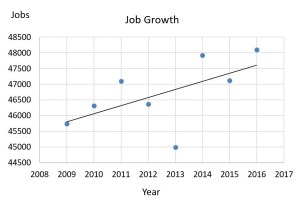
Here’s why – the real evidence, from the data, is of jobs growing at an annual rate of only 258 jobs/year.

This figure confirms the more modest forecasts presented by Ash Futures and, inconveniently for EDDC, is less than half of that used to justify the “Jobs-led Policy On” housing targets. It is only a quarter of the one job per house aspiration of “Members”.

Where does the 258 job/year trend come from? It is the gradient of the best fit linear regression trend line to the data given the Strategic Planning Committee and shown in the graph below. The full data source is referenced in the footnote.

This is a relatively small sample; and the extent of the fluctuations in the recorded number of jobs from year to year can be seen in the graph. For the technically minded the correlation coefficient of the trend line is 0.6, which is quite a strong one.

All the job number quoted above are for “full time equivalent” jobs (FTE).

Owl has been fortunate to find from the same official source as used by EDDC a set of estimates of the total number of jobs in East Devon which extends the time series to 2017. The significance of this is that the total number of jobs in East Devon fell between 2016 and 2017 and so we can expect the same to happen with FTEs. As a result Owl feels even more confident that the trend line shown above, despite the sample size, reflects what is actually happening.

The Local Plan has been in preparation since 2002 and EDDC has been following a growth policy for many years. So, although 2013 marks the formal start of the Local Plan, there is no statistical evidence to consider 2013 a “turning point” for job growth, though it does look to be an outlier.

With EDDC’s plan to build houses running ahead of creating the jobs needed for a sustainable community, just who are we building all these houses for?

Isn’t it time to cool the building programme, not ramp it up as Owl fears is being planned in the Greater Exeter Strategic Plan?

One of the key architects to all this is Councillor Paul Diviani. When asked at a recent council meeting why East Devon is taking all this development replied: “Because we have got the land, and we are good at it”.

Footnote: The combined minutes, agenda and reports of the Strategic Planning Committee with the job data for 2009 to 2016 on page 116 can be found here:

Click to access 290119strategicplanningcombinedagenda_opt.pdf

“An open letter on Permitted Development Rights”

This open letter on permitted development rights was sent to the Secretary of State for the Ministry of Housing, Communities and Local Government on 21 January 2019 and published on 28 January 2019.

“Dear Secretary of State,

Re: An open letter on Permitted Development Rights

Latest Shelter research shows that in England today, there are more than 270,000 people without a home. At the heart of the reasons for this is the simple fact that for a generation we have failed to build the homes the country needs.

In addressing this, however, it is important to think not only about the number but also the type of homes we build and where they need to be built. In particular, there is a pressing need to ensure that the homes we build are genuinely affordable. Last year we delivered just 6,463 social rent homes despite having more than 1.2 million households on council house waiting lists. These statistics begin to underline the scale of the crisis we face and the level of ambition we need to resolve it.

As well as increasing the focus on affordability, new housing development should also provide homes that are high quality, well designed, and served by the necessary community infrastructure.

These ambitions are currently in jeopardy, because of national policies that enable developers to avoid making such vital contributions. One of the most significant of these is permitted development rights allowing offices to convert to residential homes without the need for planning permission.

Since 2013, developers have had a national right to convert office space into residential homes, a right they have wholly embraced with nearly seven per cent of new homes provided in this way in the last three years. Unfortunately, because they are exempt from the full local planning process, they come forward with minimal scrutiny and outside of local authority control.

These homes are also delivered without making any contribution towards affordable housing, which other forms of developments are required to do. This means that we are losing out on thousands of affordable homes which would be delivered if these homes went through the planning system.

Separate research by both the LGA and Shelter has shown the scale of this loss. Both organisations have calculated that more than 10,000 affordable homes have potentially been lost in the last three years.

The result of this is that thousands of families remain in temporary accommodation and on council house waiting lists for years, despite levels of housebuilding rising – underlining that we need to think more about what we build as well as how many homes we build.

Permitted development rights have caused extensive problems. Therefore, we consider that the current proposals to allow for demolition of existing buildings and replacement with new residential ones, and for upwards extensions to existing buildings for new homes through a permitted development right, should not be pursued.

We call on the government to instead focus on delivering the affordable, high quality homes that people want and need through the local planning process. This would support the government’s own ambitions to improve the quality of homes and places, as outlined in the terms of reference of the ‘Building Better, Building Beautiful’ commission launched in November.

We also consider that there should be an independent review of the wide-ranging impacts of permitted development rights allowing change of use into residential homes.”

Yours sincerely
18 individuals or organisations – see below for link:

https://www.local.gov.uk/open-letter-permitted-development-rights

“California sues wealthy coastal city over low-income housing”

“Gov. Gavin Newsom used a new law for the first time Friday to try to force a wealthy Southern California coastal city to end its years of opposition to meeting low-income housing goals.

Newsom’s administration sued the Orange County city of Huntington Beach under the law that took effect Jan. 1 after passing in a 2017 package of measures intended to alleviate the state’s severe housing shortage and homelessness problem.

California has more homeless people than any other state and the nation’s highest poverty rate when soaring housing and rental costs are taken into account. Newsom, who took office this month, has proposed building 3.5 million housing units in the state with nearly 40 million residents.

The lawsuit says leaders in Huntington Beach, home to about 200,000 people, have repeatedly refused to amend the city’s housing plan to add state-required low-income housing and are fighting a separate lawsuit by housing advocates. The city says it’s complying with state housing and zoning laws. …

Newsom said high housing costs and rents “are eroding quality of life for families across this state.” He said the problem is “an existential threat to our state’s future and demands an urgent and comprehensive response.”

He has promised several moves to increase affordable housing, including giving cities more money for housing shelters but taking away transportation money if they fail to meet their goals. The Democratic governor’s budget proposal seeks $1.75 billion to combat homelessness by encouraging new affordable housing.”

https://www.seattletimes.com/business/california-sues-wealthy-coastal-city-over-low-income-housing/

How to regulate the home rental markets? An idea from (wait for it) Brussels!

“Types of properties and contracts in Brussels

Belgian rental contracts have some quirks, particularly the standard of a nine-year contract (often known as a 3-6-9 contract as the landlord can only increase the base rent every three years). Read more about regulation and contacts in our guide to renting in Belgium.

Short or long term?

In Belgium, a short-term contract is three years or less, however, the standard contract of nine years can actually be more flexible. Short-term contracts impose a penalty for giving notice before the end of the contract; in many cases, you will be charged for the full duration of the contract if you leave early.

Longer contracts – from nine years to the long-term contract of up to 25 years or ‘for life’ – impose penalties (up to three months’ rent) for giving notice in the first three years; after four years, no penalty applies for breaking a contract. Even where penalties apply, the tenant can give three months’ notice at any time.

On the other side, landlords will also have to pay a penalty of several months’ rent to the tenant if they give the tenant notice to leave.”

https://www.expatica.com/be/housing/renting/renting-in-brussels-445862/

“Asthma rising among ‘generation rent’ as damp and mould boost emergency hospital visits, experts say”

Eat or heat …

Generation rent” is suffering worsening levels of asthma because of the deteriorating quality of housing, a new report suggests.

A survey of 10,000 sufferers found that “millennials” – those aged between 18 and 29 – are now twice as likely to be hospitalised as a result of the respiratory condition than those in their 60s.

Experts at Asthma UK, who compiled the report, said younger people with asthma are now at greater risk because of increased difficulties finding good-quality housing without mould and damp problems.

Figures from the charity indicate a deteriorating picture for millennial asthma sufferers, of whom only 25 per cent where receiving basic care in 2016 …”

https://www.telegraph.co.uk/news/2019/01/23/asthma-rising-among-generation-rent-damp-mould-boost-emergency/
(pay wall)

40% of London’s right-to-buy council houses now privately rented

“Ministers are facing calls to shelve Margaret Thatcher’s totemic right-to-buy scheme after a devastating analysis revealed that more than 40% of council houses sold under its terms in London are now privately rented.

The damning findings of an analysis of Freedom of Information data also show that:

• Tens of millions of pounds are being paid by local authorities to rent former council homes in order to house growing numbers of homeless families;

• Some councils have bought back their former homes at more than six times the amount they sold them for;

• Hundreds of private landlords now own five or more right-to-buy properties. There are several London boroughs where more than half the houses sold through the policy are now in the hands of private landlords. Private renters have to pay more than people living in council-owned properties.

Labour London assembly member Tom Copley, who released the report containing the new data, said the findings provided fresh evidence for why right-to-buy should be scrapped in the capital.

“Something has gone very wrong when tens of thousands of homes built to be let at social rents for the public good are now being rented out at market rates for private profit, sometimes back to the very councils that were forced to sell them,” he said.

Right-to-buy, which offers discounts to council tenants who buy their home, has been in place since 1980 and was boosted in 2012 under the Tory-Lib Dem coalition government. The latest analysis found that 42% of homes sold under the scheme in London are now rented out by private landlords, up from 36% in 2014.

Around 466 individuals or companies have the leasehold for at least five former council homes each, while there are 2,333 right-to-buy properties where the local authority pays private landlords to house homeless families across London. Councils have spent £22m a year on renting back properties they once owned to use as temporary accommodation. …”

https://www.theguardian.com/society/2019/jan/19/ministers-urged-halt-right-buy-council-homes-rented

Deposit-free renting – another government scam to benefit its donors!

The government is touting the information that it is going to make it easier for renters to begin a tenancy without a big deposit.

What the small print does NOT tell people is that they will need to pay the equivalent if (at least) a week’s rent for a NON-REFUNDABLE insurance policy to cover potential damage!

“… Groups representing tenants say they cannot see the benefits for most of their members.

Dan Wilson Craw from Generation Rent says zero-deposit schemes are an unnecessary expense for tenants.

“This is money that you will never see again, whereas with a standard deposit if you take care of the property you should get all that money back,” he says. “People need to realise that it’s not taking away their responsibility for keeping the home in good condition and paying the rent. If there are problems you will have to pay what they ask for.”

Even landlord groups are concerned. John Stewart, policy manager at the Residential Landlords Association, says he can see the potential for a loss-loss situation with this type of scheme.

For tenants, he says “it might cut the upfront fees but it is an absolute cost at the end of the day”, while for landlords it was unclear how long claims would take to be paid and what would happen if a scheme went bust.”

https://www.theguardian.com/money/2019/jan/19/could-renting-without-huge-deposits-become-the-norm