“DEPRIVED TOWNS FUND IS INSIGNIFICANT COMPARED WITH STAGGERING CUTS”

You read here that EDDC Conservatives have decided that the only town they will put forward for this (meagre)fund is Axminster. Well, good luck, Axminster!

But when voting day comes remember your councillors have alteady overspent around £3 million on their new HQ and are funding a new road at the airport for another £3 million AND setting up a £20 million property company to invest OUTSIDE East Devon.

“The Stronger Towns Fund, announced by the government yesterday, is a £1.6 billion fund to be spent between now and 2025 on places that are often referred to as ​‘left behind’.

£1.6 billion as a lump sum is not to be sniffed at, even though in government spending terms it’s relatively small beer. Share small beer out over seven years and it’s reduced to a thimble full; around £267 million total per year if spending starts in the financial year 2019/​20 and is distributed evenly until 2025/​26. Share it out further to all the places in the UK that most need government investment, training and jobs and it’s a droplet in the ocean.

If that were the beginning and end of it, then fine. ​‘Government announces small bit of funding for something that needs a bigger bit of funding’ is not much of a story. However, the government is giving with one hand, and taking much more away with the other.

The Revenue Support Grant is given to local authorities by central government and makes up around a third of councils’ budgets. Between 2018/​19 and 2019/​20, the grant is due to be cut by 37% — that’s £1.3 billion in a single year — on top of savage cuts to it that have already taken place.

From 2013/​14 to 2019/​20, even with locally retained business rates and the main government unrestricted grant, local authorities have seen their net incomes decrease by 48%. The year of Stronger Towns Funding that will presumably occur in 2019/​20 (if allocated equally over six years) compensates this loss by less than 1%. Council incomes will still have been cut by 47%. The whole Stronger Towns pot of money would reduce this loss by no more than 5% if provided in one year — which will not be the case. Of course, some regions will receive more than this and others less, but compared to the staggering cuts to local authorities, the new fund pales in comparison.

Aside from this loss of government money, post-Brexit the UK will be losing money provided by the European Union via its structural funds. Between 2014 and 2020, the UK will have received €17.2 billion for regional and social development, which has flowed significantly to many of the same areas that the Stronger Towns Fund will prioritise.

If the UK were to remain in the EU, between 2021 and 2027, €13 billion of EU structural funds would flow to poorer regions; significantly more than the Stronger Towns Fund. Some further settlement is expected from central government to compensate areas for this loss, but the amount is still unclear.

The Stronger Towns Fund has not gone down well in many of the regions, smaller cities and towns at which it will be targeted. And why should it? One cause of the economic malaise many of these places face is austerity. Reversing its effect will take more than this paltry offer. It will take a transformational approach to government investment, focused both on rebalancing the economy and restoring basic public services that are often the lifeblood of communities.

Many, including opposition politicians, have suggested that the Stronger Towns Fund looks like a bribe to persuade Labour MPs in leave-voting constituencies in particular to support the government’s Withdrawal Agreement. If so, the chances are it will have the opposite effect. …”

https://neweconomics.org/2019/03/deprived-towns-fund-is-insignificant-compared-with-staggering-cuts

Only Axminster chosen for cash for ailing High Streets

Bet it won’t only be Cranbrook with its non-High Street (currently only 5 shops for the growing town) that will be miffed but also Seaton, where the Tesco superstore has sucked the life out of its High Street!

“Axminster will be put forward as the East Devon town to try and grab a share of a £675m fund to ‘help failing High Streets’ – ahead of Cranbrook.

East Devon District Council’s cabinet on Wednesday night agreed to submit a bid for Axminster to the Government’s Future High Streets Fund.

The Future High Street Fund has been set up to help address the significant structural changes that are currently having an impact on towns and high streets throughout the UK. …”

https://www.devonlive.com/news/devon-news/councillors-choose-axminster-over-cranbrook-2619176

Largest store in Axminster town centre to close

“Axminster’s biggest town centre shop is to close – with the loss of 19 jobs.

Trinity House department store is expected to cease trading towards the end of the year – probably in September.

Its owners – Goulds of Dorchester – say it is the victim of the nation’s changing shopping habits which have seen many people switch to on-line buying.

In statement they told The Herald: “As a result of an ongoing review the directors of Goulds (Dorchester) Ltd have announced their decision to cease trading at Trinity House.

“It is expected that the store will close at the end of September 2019, but the actual closing date is yet to be confirmed.

“The store was acquired on leasehold terms in November 2015 along with the premises known as TH2, which housed linens and housewares, until its replacement in 2017 by Costa Coffee.

“Despite having made a considerable investment in the business in an effort to make the Axminster store viable, current trading conditions, coupled with the continuing economic pressures on the department store sector, dictate that the business can no longer sustain an unprofitable branch store in Axminster.

“The company realise that this closure will be a major blow to the town. But even with sympathetic support from the local landlords it has been impossible to stem losses. In common with so many other retailers we are suffering the effects of on-line competition and a change in shopping habits.

“We are deeply sorry at having to take this action not least because our colleagues have done their utmost to help make the store successful and our regular customers will feel the disappointment of losing the only department store in town.”

Axminster county and district councillor Ian Hall said the closure would be a blow to the local economy.”

https://www.midweekherald.co.uk/news/trinity-house-is-a-victim-of-changing-shopping-habits-say-its-owners-1-5916167

Want to object (or support) plans for Axminster? Tough luck!

“I have now heard from 3 separate people that the EDDC Planning Website is not functioning properly and that submissions in objection to the planning applications can not be processed. I have asked EDDC Planning / IT to investigate immediately.

In the meantime, you can however submit by email to

planningeast@eastdevon.gov.uk or to

planningmajorprojects@eastdevon.gov.uk

And they will be treated as legitimate comments and uploaded to the website and considered by the planning department accordingly.

Best wishes.
Cllr. Paul Hayward.

Persimmon faces loss of Help to Buy homes contract over shoddy work : Anger as Persimmon set to post £1bn profit”

Britain’s most profitable housebuilder faces being stripped of its right to sell Help to Buy homes after allegations of poor standards and punitive hidden charges.

James Brokenshire, the housing secretary, is reviewing Persimmon’s participation in the government scheme, which accounted for half of the homes it built last year, The Times has learnt.

Since Help to Buy was introduced, Persimmon’s profit per house has almost tripled, rising from £22,114 in 2012 to £60,219 in 2018. Half of the 16,000 homes the company built last year were sold under the scheme, which is designed to boost home ownership.

Persimmon is now set to become the first housebuilder in the country to report profits of more than £1 billion.

Introduced in 2013, Help to Buy offers buyers with a deposit of only 5 per cent an interest-free loan of up to 40 per cent of the purchase price in London, or 20 per cent outside the capital.

Critics say the scheme has subsidised huge profits and multimillion-pound bonuses across the housebuilding industry while inflating property prices.

An investigation by The Times last year found that homes available under Help to Buy cost an average of almost 15 per cent more per square metre than comparable properties that were not eligible.

At the end of 2017 Jeff Fairburn, then Persimmon’s chief executive, was in line for a bonus of £110 million despite the company being embroiled in a scandal over unfair leases and criticised for the quality of some of its homes.

The company has been accused of selling houses on leasehold terms, under which buyers are forced to pay ground rent charges that provide an extra source of income. There have also been complaints about the quality of some of the new homes.

Mr Brokenshire is understood to be worried about the company’s behaviour after a string of complaints. A source close to the housing secretary said that Persimmon’s “approach” would be “a point of discussion” when the government decided which house builders would be allowed to offer Help to Buy homes from 2021.

“James has become increasingly concerned by the behaviour of Persimmon in the last 12 months,” the source said. “Leasehold, build quality, their leadership seemingly not getting [that] they’re accountable to their customers are all points that have been raised by the secretary of state privately.

“Given that contracts for the 2021 extension to Help to Buy are being reviewed shortly it would be surprising if Persimmon’s approach wasn’t a point of discussion.”

They added: “James is clear any new government funding scheme will not support the unjustified use of leasehold for new homes, including Help to Buy.”

Yesterday critics demanded a complete overhaul of the scheme.

Clive Betts, the Labour MP and chairman of the housing, communities and local government select committee, said: “Help to Buy has clearly been the prime driver of Persimmon’s profits. Companies are there to make money but they should behave responsibly as well. Some of Persimmon’s practices have been questionable to say the least.

“I think most ordinary people will be outraged by this.”

Nationwide Building Society says that house prices for new-build properties have grown 15 per cent faster than for older properties since Help to Buy was introduced.

An official report published last year found that almost two thirds of people using Help to Buy did not need it to get on the property ladder and that the average income of applicants was £53,000.

Mr Betts added: “My personal view would be that if government wants to help solve the housing crisis, it will have to put more money into helping build homes that people can afford to rent.”

Henry Pryor, a buying agent, said that the increasing number of homes being built across the country had led to a decline in quality. “If you aspire to build 300,000 homes a year there will be people taking short cuts, it is human nature, and we don’t have a sufficiently robust system in place to ensure the properties are fit for purpose,” he said.

“I don’t think there is a conspiracy to knock out shoddy homes but we are seeing what I call Friday afternoon houses. Homes that seem like they have been built by someone who’s had a good lunch on a Friday or is rushing off for the weekend.”

The government confirmed last year that Help to Buy would be extended by a further two years from 2021, although from this date there will be a cap on the value of eligible homes to within 20 per cent of average prices in each region.

The Home Builders Federation argues that the scheme has been a huge success because it has helped to boost the supply of new homes.

A spokesman for Persimmon said: “Our performance over recent years reflects the group’s success in growing its construction volumes to meet UK housing need, particularly by offering attractively priced new homes to first- time buyers. Since 2012 we have increased our output by 75 per cent and invested £3.8 billion in new land. In late 2018 we announced a range of new customer service initiatives and we are confident that these will improve our performance once they have had time to take effect. We are also making a significant investment in training to address the shortage of skills in the industry.”

Analysis
Help to Buy has some heartfelt enthusiasts (Anne Ashworth writes). These are the millennials who cannot rely on a payout from the Bank of Mum and Dad but still want a place of their own. If they have a deposit of 5 per cent they can use Help to Buy to climb on to the ladder. Without it some would be forced to remain in rental accommodation for decades, excluded from home ownership.

However, even supporters of Help to Buy will share the widespread dismay about the way in which housebuilders have exploited the policy. Some bosses have enriched themselves at the taxpayers’ expense, apparently with the co-operation of the Treasury, which did not impose rules to ensure that the policy did not become a bounty for the boardroom. The most notorious example is Jeff Fairburn, former chief executive of Persimmon, who pocketed £75 million, but others have also prospered.

One of the original aims of Help to Buy was to ensure that builders “got shovels into the ground”. Little thought seems to have been given to ensuring that these homes would be solidly constructed. Many are shoddy, unlovely and not energy-efficient.

Thanks, in part, to Help to Buy, mortgage lending to first-time buyers is at its highest since 2006. The chancellor is likely to hail this as a success story in his spring statement next month. He should instead order that Help to Buy, which runs until 2023, provide quality housing for first-time buyers, rather than financing yet more mansions for housebuilder directors.
Anne Ashworth is property editor of The Times

Case study
Nicola Bentley thought she was buying a “dream home” for her family last May when she exchanged contracts on a £280,000 house from Persimmon in Kippax, Leeds (Louisa Clarence-Smith writes). However, when the finance director, 46, moved in she said she found 700 snags, ranging from a damaged cooker to leaking pipes and shoddy plasterboard on internal walls.

Ms Bentley, a mother of two, said she is still waiting for issues to be resolved. “We have been living in hell for the last nine months,” she said. “Persimmon told us it would take three to four weeks to rectify all our snags. We are now into week 26 and living in a building site.”

A spokesman for Persimmon said: “We recognise that Ms Bentley has experienced an unacceptable level of issues and have been working hard to address these. The majority have been dealt with and we are working with Ms Bentley to resolve the remaining matters.”

Source: The Times (pay wall)

Axminster Masterplan “consultation ” this Friday 8 February

The Crown Estate is holding a public consultation event from

2pm to 8pm

on

Friday (February 8)

at Millwey Community Centre,

to seek residents’ input on its proposals for land east of Axminster.

The Crown Estate’s site forms part of East Devon District Council’s (EDDC) Masterplan for the area, approved last week by councillors, for up to 850 homes, employment space and community uses as well as green space and a relief road.

The Crown Estate’s application would look to provide 441 homes – 25 per cent of which would be affordable – the central section of the proposed relief road, as well as space for new offices, shops and community facilities.

The event is an opportunity for local people to hear more about the plans and share their thoughts, ahead of a planning application being submitted to EDDC later this year.

Steve Melligan, strategic land portfolio manager for The Crown Estate, said: “Our proposals will help deliver a significant part of the new relief road for Axminster, as well as new homes and employment space for the area. We’re excited to present our plans to the community and look forward to hearing their views.”

https://www.midweekherald.co.uk/news/plans-unveiled-at-millwey-community-centre-1-5879374

Strategic Planning pitfalls? Certainly for Axminster

A reporter … reports:

“At Tuesday’s Strategic Planning Meeting at Knowle (29 /01/2019), chaired by Paul Diviani, the masterplan for increasing Housing in Axminster by a whopping 30% , was voted through almost unanimously (there was one abstention), despite serious cross-Party criticism of the plan.

As the debate ended, the considerable number of Axminster residents in the public gallery were astonished to hear the Chair’s quip, to Cllr Jill Elson, “ I felt confident that you would come out with something that would stir things up”.

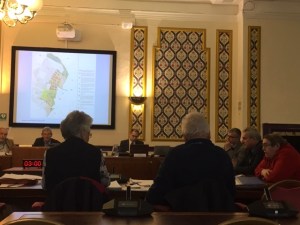
Cllr Elson (shown on right of the photo, beside Cllr Philip Skinner), had argued firmly that “the problem with plans is that they change” , citing her Ward as an example.

“Exmouth ended up with two huge estates with no play space or amenities whatsoever”, she said. Cllr Mike Howe (Con) shared her concerns, saying, (the masterplan) “doesn’t give us much credence or security that we will get the right houses”. But the Deputy Leader of the Council, Philip Skinner (Con ), expressed his view that “Give and take is needed in negotiations with a developer”.

Shortly afterwards, when Cllr Geoff Jung (East Devon Alliance, EDA) observed that the plan might not suit young families, it became apparent that Cllr Skinner was not aware that the proposal to include a primary school had been dropped.

Cllr Eleanor Rylance (Lib Dem) had noticed significant typing and other errors in the masterplan document. Cllr Rob Longhurst (Independent) observed there was no mention of the words ‘Neighbourhood Plan’ in the document.. although Cllr Moulding had told the meeting that he had designed one for Axminster… and suggested this Strategic Plan Committee would like to see “if the community wants and needs” the masterplan.

Cllr Susie Bond (Independent) asked for clarity about the legal implications for the Council if the costs for the relief road “went through the roof” (So far, EDDC has agreed to borrow £7m to ensure the road, estimated cost £16.7m, can be delivered.)

Ian Hall (Con) admitted “this masterplan doesn’t sit easily with the residents of Axminster”, which Alistair Ferguson’s speech in Public Question Time, confirms. The text is reproduced below, with Mr Ferguson’s permission):

In support of the objections, other District Councillors, Cathy Gardner and Marianne Rixson (both EDA), also attended the meeting, though not on the Strategic Planning Committee themselves.

Cllr Gardner pointed out that agreeing to a massive increase in the town’s housing numbers “would not be for the right reasons”, if it was done primarily to fund a relief road. The masterplan “was being done to the people of Axminster, not for them”, she said.

And Cllr Marianne Rixson added that “delivery of affordables does not have a good record” in East Devon.

Having listened to the comments aired, Cllr Geoff Pook (Ind) cautioned the committee not to be “persuaded by the opposition”. “There are just as many people in favour”, he opined.

Finally, the fear that the time-limited government funding for the relief road would be missed, therefore putting in jeopardy the 650 homes allocated in the Local Plan, swayed the committee members to approve the masterplan, albeit with caveats based on their misgivings.

Is this how the wrong sort of housing so often gets built in the wrong place?

In Axminster’s case, how much will the masterplan impact on the historic former deer park? As Cllr Mike Howe, Chair of the Development Management Committee (DMC) told yesterday’s meeting, there’s an urgent need to know….’

Are the wheels falling off the East Devon growth wagon?

This is necessarily a somewhat technical summary of why Owl thinks EDDC has got its recent past and future jobs and housing numbers terribly wrong, and attempts to pinpoint why this is. If the assumptions below are correct East Devon cannot hope to match new jobs to housing number increases and hence to aspirational growth figures.

It has huge implications for the district – not least Cranbrook and Axminster, where huge housing growth does not appear to correlate with very modest job growth.

CURRENT STATISTICAL TREND 258 JOBS/YEAR
EDDC’s 2015 aspiration 950 jobs/year
EDDC’s “Jobs-led policy on scenario” 549 jobs/year
Ash Futures (Experian) “Upper end” 309 jobs/year
Ash Futures “more likely” scenario 200-234 jobs/year

Evidence from the first set of job growth statistics published by EDDC since the adoption of the local Plan are running at less than half the number used to justify the housing development target. This is only one quarter of EDDC’s aspiration to create one job per new household or 950/year.

A “Jobs-led Policy On” aggressive growth strategy lies at the heart of EDDC’s Local Plan for 2013 to 2031.

Consultants were employed to create a number of scenarios forecasting growth in jobs. They ranged from 162-191 jobs/year for forecasts based on past trends to a top estimate for above average “jobs led” growth of 309 jobs/year. This top estimate would justify a housing target of 13,050 for the period.

One of these consultants, Ash Futures, gave cogent arguments as to why this figure, in their opinion, lay at the upper end of likely growth and proposed a more modest, more realistic, set of growth assumptions generating 200-234 jobs/year. This more likely scenario was never converted from a jobs forecast to a housing assessment but it would have been just a bit higher than the 10,512 figure based on past trends. All these forecasts took account of demographic changes, migration into the region and economic growth.

Ignoring this, EDDC decided to add a further 240 jobs/year to the upper end 309 figure in a new “policy on” scenario to provide a total forecast of 549 jobs/year. (Something to do with Cranbrook but the details of this and whether there is any double counting remains a mystery). This 549 job/year figure was ultimately used to justify the final 17,100 minimum housing target for the 18 year period of the Plan adopted in 2016.

The plan requires a minimum average build of 950 houses/year. EDDC’s aspiration is to combine this with the creation of one job for every house built. But this demonstrates a complete failure to understand demographics and household formation. The need for houses and the need for jobs is not a simple equation of one with the other.

Papers attached to EDDC’s Strategic Planning Committee for 29 January 2019 (see footnote) contain data for East Devon employment covering 2009 to 2016. The explanatory text says: “It is recognised that it is an aspiration of Members [surely not every Councillor?] to deliver one job for each new home across the district but since the adopted Local Plan does not set out to deliver this it is not considered appropriate to formally monitor the relationship between the delivery of homes and the delivery of jobs.”

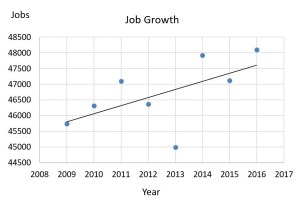
Here’s why – the real evidence, from the data, is of jobs growing at an annual rate of only 258 jobs/year.

This figure confirms the more modest forecasts presented by Ash Futures and, inconveniently for EDDC, is less than half of that used to justify the “Jobs-led Policy On” housing targets. It is only a quarter of the one job per house aspiration of “Members”.

Where does the 258 job/year trend come from? It is the gradient of the best fit linear regression trend line to the data given the Strategic Planning Committee and shown in the graph below. The full data source is referenced in the footnote.

This is a relatively small sample; and the extent of the fluctuations in the recorded number of jobs from year to year can be seen in the graph. For the technically minded the correlation coefficient of the trend line is 0.6, which is quite a strong one.

All the job number quoted above are for “full time equivalent” jobs (FTE).

Owl has been fortunate to find from the same official source as used by EDDC a set of estimates of the total number of jobs in East Devon which extends the time series to 2017. The significance of this is that the total number of jobs in East Devon fell between 2016 and 2017 and so we can expect the same to happen with FTEs. As a result Owl feels even more confident that the trend line shown above, despite the sample size, reflects what is actually happening.

The Local Plan has been in preparation since 2002 and EDDC has been following a growth policy for many years. So, although 2013 marks the formal start of the Local Plan, there is no statistical evidence to consider 2013 a “turning point” for job growth, though it does look to be an outlier.

With EDDC’s plan to build houses running ahead of creating the jobs needed for a sustainable community, just who are we building all these houses for?

Isn’t it time to cool the building programme, not ramp it up as Owl fears is being planned in the Greater Exeter Strategic Plan?

One of the key architects to all this is Councillor Paul Diviani. When asked at a recent council meeting why East Devon is taking all this development replied: “Because we have got the land, and we are good at it”.

Footnote: The combined minutes, agenda and reports of the Strategic Planning Committee with the job data for 2009 to 2016 on page 116 can be found here:

Click to access 290119strategicplanningcombinedagenda_opt.pdf

EDDC agrees Axminster masterplan with 200 extra houses (now 850)

Persimmon and Crown Estates say they won’t be able to afford to build a relief road unless they build 850 houses rather than the original 650.

So EDDC majority rolled over to have their tummies tickled … and agreed.

Do try to remember this if the developers say they got their sums wrong and will need to build hundreds more …. or no road at all.

https://www.bbc.co.uk/news/live/uk-england-devon-46947635

Axminster masterplan – still searching for a useable website !

THIS time managed to track down at EDDC a Powerpoint presentation of a public information session – to add to the hazy schematic and cartoons in local media! Though note it takes a LONG time to load! Getting there slowly.

Click to access 181206-december-public-exhibition-1_revised.pdf

Axminster: “Millbrook Park – includes a “publicly accessible” green space

Note the words. Not a publicly OWNED green space – a publicly ACCESSIBLE green space. Big difference!

Sorry there is no link to the masterplan. The three EDDC-dictated press releases Owl has seen on various sites include no link, just rather hazy schematics or cartoons, so far.

Axminster “master plan” – in cartoons!

Owl is having the greatest difficulty in understanding the true significance of the master plan in this article as all illustrations (presumably as supplied by EDDC – are cartoons!

https://www.devonlive.com/news/devon-news/new-details-axminster-masterplan-revealed-2318180

“Funding [loan] agreed for Axminster relief road that will end gridlock in the town centre

This loan of £7 million is being taken out based on an expectation that developers will pay it back … good luck there councillors, especially as developers are Crown Estates and … drum roll or scary music … PERSIMMON!

https://www.devonlive.com/news/devon-news/funding-agreed-axminster-relief-road-2211212

EDDC hopes Persimmon and Crown Estates will pay them back for Axminster Relief Road!

Owl says: good luck with that!

“Councillors are being asked to borrow nearly £7m to ensure the long-awaiting Axminster relief road can be delivered.

The £16.7m road, which hopes to finally end the bottleneck of traffic travelling through the town centre, would be built to the east of the town near land allocated in the Local Plan for 650 homes, eight hectares of employment land, and a primary school.

£10m from the government’s Housing Infrastructure Fund will help deliver the road, with the remainder of the cost covered by developers.

But East Devon District Council’s Cabinet is being recommended to borrow and forward fund the remaining £6.7m, and claw the funds back from developers at a later date, to ensure the road can be built in one swoop and not in stages, as Persimmon Homes control the northern and southern parts of the site and would provide the two ends of the relief road, while the Crown Estate control land in the middle.

A draft masterplan which will provide a template for the development of the site is expected to come before the Strategic Planning Committee by the end of 2018.

The report of Ed Freeman, Service Lead for Planning Strategy and Development Management, to next Wednesday’s cabinet meeting says: “The relief road is vital to the future growth of the town given the impact that HGV’s and other traffic passing through the town has on congestion, air quality, the attractiveness of the town centre and the damage that has been caused to historic buildings as large vehicles try and navigate its narrow streets. The relief road has the potential to divert 30 per cent of all traffic which travels east after passing through the town centre.”

Mr Freeman is recommending that the Council deliver the road in its entirety from the start of this project using the £10m HIF funding they have successfully bid for and borrowing the shortfall.

He added: “It is considered that the only realistic and viable means of delivering the relief road and doing it in good time to deliver the benefits for the community of Axminster is to procure and deliver the entire relief road borrowing the additional funds from the public loans and works board with repayment secured from the developers.

…. Questions though have been raised about whether the proposed north/south bypass that runs to the east of the town is the best option for Axminster.

At a recent town forum event concerning the relief road, residents said that a western route would be preferable as it would eliminate the bottleneck at the Weycroft Bridge, which the current proposed eastern route did not.

However, reporting back at a town council meeting, Cllr Ian Hall, East Devon District Council’s ward member for Axminster Rural and County Councillor for Axminster, said that the £10 million Housing Infrastructure Funding was not transferable to another route in Axminster.”

https://www.devonlive.com/news/devon-news/7m-borrowed-council-ensure-axminster-2147861

Wainhomes in the (bad) spotlight again

Many will recall Feniton’s problems with Wainhomes, for example:
https://eastdevonwatch.org/2016/05/31/wainhomes-feniton-another-second-chance-and-another-and-another/

and those in Axminster:
https://eastdevonwatch.org/2016/07/26/wainhomes-axminster-eddc-considers-legal-action-to-recover/

You might also have seen the feature on regional BBC Breakfast this morning where residents at the Wainhomes estate in Tawton having to move out because floors not finished, outside rendering falling off walls. They interviewed one unhappy house owner who’d been complaining for two-and-a-half years.

Interestingly enough there’s a website devoted to complaints about this company: https://www.thewainhomesnightmare.co.uk/?page_id=121

It seems to highlight a flaw whereby developers can build defective houses, but policing by NHBC not up to scratch.

Buyer beware, as they say!

Axminster by-pass – east or west?

East: developers of eastern extension to the town have to chip in = cheaper solution

West: no developer funding but solves the problem of Weycroft Mill bottleneck = more expensive solution.

Owl’s guess: no common sense or forward planning = cheapest wins

“Axminster Town Council has called a special meeting to discuss plans for the town’s long awaited north-south relief road.

It follows growing concerns about the current ‘preferred’ route and will take place on Thursday, September 27, at 7.30pm in The Guildhall. It will be open to the public.

Under present proposals the £20million scheme takes the road to the East of the town, emerging on the Lyme Road.

But campaigners are becoming increasingly worried that this will not solve the major problem of the Weycroft Bridge bottleneck.

And there are calls that the alternative route – to the west of the town – should be looked at again, despite its much higher cost.

* East Devon District Council has appointed consultants to produce a masterplan for the bypass and the associated housing development which will help to fund it, following its successful bid for £10 million government money towards the project.”

http://www.midweekherald.co.uk/news/campaigners-want-route-to-go-west-of-the-town-1-5695852

Western East Devon profits from extra buses; eastern east devon gets nothing. Time to join West Dorset?

Yet again, the eastern side of our district loses out to the richer, Exeter commuter belt which now gets more buses to serve the “growth point” Exeter suburbs. We’ve lost our community hospitals to the west, now we’ve lost out on bus routes:

https://www.devonlive.com/news/devon-news/exeter-devon-stagecoach-bus-times-1846544

It seems we have no growth strategy for the towns and villages on the Dorset border. Is it time for the eastern side of the district perhaps to join West Dorset?

What does it have to lose?

River Cottage HQ: controversial extension to be decided tomorrow

Daily Mail says yes:
http://www.dailymail.co.uk/news/article-5655473/Hugh-Fearnley-Whittingstalls-River-Cottage-HQ-set-expanded.html

Natural England seems not so sure and there seem to be unresolved drainage issues:

Click to access 010518combineddmcagenda.pdf

(page 107 onwards)

But all should be well as Oliver Letwin MP has written in support.

To be decided tomorrow