Only Axminster chosen for cash for ailing High Streets

Bet it won’t only be Cranbrook with its non-High Street (currently only 5 shops for the growing town) that will be miffed but also Seaton, where the Tesco superstore has sucked the life out of its High Street!

“Axminster will be put forward as the East Devon town to try and grab a share of a £675m fund to ‘help failing High Streets’ – ahead of Cranbrook.

East Devon District Council’s cabinet on Wednesday night agreed to submit a bid for Axminster to the Government’s Future High Streets Fund.

The Future High Street Fund has been set up to help address the significant structural changes that are currently having an impact on towns and high streets throughout the UK. …”

https://www.devonlive.com/news/devon-news/councillors-choose-axminster-over-cranbrook-2619176

“New homes in Devon are built so badly ‘children can remove cement with their fingernails’ “

Owl is confused. Isn’t EDDC’s Building Control department supposed to be passing or failing these new properties?

“The East Devon District Council meeting heard from Cllr Douglas Hull, who proposed the motion and said: “There are so many badly new built houses in East Devon and it is getting even worse”

The Government has been urged to prioritise a new property ombudsman to streamline complaints against shoddy builders as there are ‘so many badly new built houses in East Devon’.

Councillors on Wednesday unanimously voted to call on the government to fulfil its February 2018 pledge to provide the much needed remedy for homeowners as a matter of the highest priority.

The East Devon District Council meeting heard from Cllr Douglas Hull, who proposed the motion and said: “There are so many badly new built houses in East Devon and it is getting even worse.”

Cllr Hull added: “We have to have houses we can be proud of the region, and we have to say that enough is enough. We need to think about the people who end up buying second rate houses.”

He added that in some of the new houses, they are built so badly that small children with can rip out the cement with their fingernails, adding: “If you don’t believe me, try it yourself.”

Cllr Eleanor Rylance added: “We have a quality control issue with a lot of the houses, and then we have a problem with people are renting from a housing association who don’t feel that they can be complain as they will lose their house.

“Cranbrook is developer led but some developers are prone to get people to buy the property before everything is done.”

No developers were named during the meeting, but it has recently been confirmed that Persimmon Homes are carrying out fire safety barrier inspections in Cranbrook after it was found that some new build homes were missing them.

Cllr Ian Hall added: “Some of the building companies in this area just don’t care, and they have no shame.”

Cllr Geoff Pook, who has been involved in the building trade in East Devon, pledged his support for the motion.

The council unanimously agreed to urge the government to fulfil its pledge to introduce a new property ombudsman to streamline complaints against shoddy builders as soon as possible.”

https://www.devonlive.com/news/new-homes-devon-built-badly-2605646

Persimmon: Cranbrook is confirmed among developments being inspected for missing fire safety barrier inspections

“Persimmon Homes is continuing to carry out fire safety barrier inspections not just in Devon but across the South West and nationally after it was found homes were missing them, it has been confirmed.

The developer has not disclosed which housing developments it is inspecting, but it is now known Cranbrook, the new town in East Devon will have 6,551 homes by 2027, as well as Hill Barton Vale in Exeter, Coverdale in Paignton and even developments in Cornwall, are among them.

The issue was exposed following a ‘ferocious’ blaze which broke out in in one of its developments, Greenacres, and the Newcourt area near Topsham. Last April a fire in Trafalgar Road off Admiral Way and Topsham Road, last April, spread into the roof spaces of two of the adjoining properties. Both homes failed subsequent fire safety barrier inspections.

In an email shared with Devon Live by a Newcourt resident, Persimmon Homes stated last month it is continuing to inspect homes. Persimmon Homes South West suggested the pass rate in Newcourt is 59 per cent, and the majority of other sites are achieving a pass rate of over 90 per cent of plots inspected. …

…However, the developer has been criticised for taking too long to carry out inspections after being made aware of the issue, as well as for sending out inspection request letters to residents in Cranbrook on unheaded paper, and confusing residents by sending out duplicated inspection letters when their homes have already been investigated.

In the email, Richard Oldroyd, regional chairman of Persimmon Homes, said: “You have asked what we are doing nationally and I can confirm that further inspections are being completed, but I am unable to provide details at this stage.

“I can confirm that as we previously advised when we met we have increased the resource on this project to ensure we are able to complete the inspections in shorter timescales.

“As you are aware we had relied upon the National House Building Council (NHBC) as part of their building control service to ensure that the cavity barriers were correctly installed. As a result of this failure in process we have instigated our own additional checking regime to provide an additional compliance inspection.”

https://www.devonlive.com/news/devon-news/cranbrook-confirmed-among-developments-being-2582214

Sunday Times: “Council stings residents of Cranbrook for ‘new town tax’ of £370 a year”

Owl says: they don’t mention the district heating system – which keeps residents tied to one supplier – E.on – for 80 (yes EIGHTY years)!

“Local authorities and developers are charging for supplying services in new towns that are free to other homeowners.

Residents of a new town in Devon are being charged an extra £370 a year in council tax in a practice — already being called “the new town tax” — that could spread across the country.

Cranbrook, a new town to the east of Exeter, is charging band F properties a £370 surcharge, rising to £512 for band H properties. Residents receive no more services than people elsewhere in Devon.

Mark Williams, chief executive of East Devon district council, said: “It is very likely that other towns not just in East Devon but elsewhere will have to adopt a similar approach if they wish to maintain their local assets or facilities.

“We believe that the approach adopted by Cranbrook town council is likely to be replicated across the country, especially in areas where there are areas of significant new housing.”

Cranbrook, whose population will eventually exceed 25,000 people, was managed by developers who levied an “estate rent charge” on residents.

The charge was a contribution for the upkeep of facilities such as landscaped gardens and bin collections. When the town council took over responsibility for the services, it kept most of the charge as an addition to the council tax.

Activist groups have sprung up to help residents nationally who have moved into new homes only to discover they are at the mercy of developers on service costs for green spaces or parking. Developers can levy fees because local authorities are not obliged to “adopt” new housing and provide the services.

Cathy Priestley of Homeowners Rights Network, a pressure group, has been contacted by people from 457 new estates housing 86,000 residents with fees ranging from £100 to more than £700 a year. The developers include Bovis, Linden, Persimmon, Redrow and Taylor Wimpey.

She said: “Buyers are lumbered with hidden estate taxes no matter who collects them or who is to blame for this set-up. Stop the rot! Adopt the lot!”

The prospect of permanent higher council taxes for buyers of homes on greenfield sites will be controversial. The government is supporting a housebuilding drive intended to benefit younger people and the “squeezed middle”.

Kevin Blakey, chairman of Cranbrook council, justified the council tax surcharge by saying a lot of people “simply couldn’t afford” to pay the developer’s flat-rate service charge “and the collection rates were going to be pretty awful”.

He added: “There are no council houses but 40% of the first phase of development was given over to social housing managed by housing associations. These charges [were] being applied to people in East Devon who are probably least able to afford it.”

Blakey said that even though the town council would provide services more efficiently than the developers, the charges reflected the cost of maintaining trees and green spaces, including a country park, insisted on by the district council. The residents have to meet the costs even though it is open to everyone. “Our arguments have fallen on deaf ears,” he said.

Williams said: “There are no rules. The government has allowed developers to pass their obligations directly onto new home owners and the ability to remedy the situation lies with the government. This is a national issue.”

Source: Sunday Times (paywall)

Persimmon faces loss of Help to Buy homes contract over shoddy work : Anger as Persimmon set to post £1bn profit”

Britain’s most profitable housebuilder faces being stripped of its right to sell Help to Buy homes after allegations of poor standards and punitive hidden charges.

James Brokenshire, the housing secretary, is reviewing Persimmon’s participation in the government scheme, which accounted for half of the homes it built last year, The Times has learnt.

Since Help to Buy was introduced, Persimmon’s profit per house has almost tripled, rising from £22,114 in 2012 to £60,219 in 2018. Half of the 16,000 homes the company built last year were sold under the scheme, which is designed to boost home ownership.

Persimmon is now set to become the first housebuilder in the country to report profits of more than £1 billion.

Introduced in 2013, Help to Buy offers buyers with a deposit of only 5 per cent an interest-free loan of up to 40 per cent of the purchase price in London, or 20 per cent outside the capital.

Critics say the scheme has subsidised huge profits and multimillion-pound bonuses across the housebuilding industry while inflating property prices.

An investigation by The Times last year found that homes available under Help to Buy cost an average of almost 15 per cent more per square metre than comparable properties that were not eligible.

At the end of 2017 Jeff Fairburn, then Persimmon’s chief executive, was in line for a bonus of £110 million despite the company being embroiled in a scandal over unfair leases and criticised for the quality of some of its homes.

The company has been accused of selling houses on leasehold terms, under which buyers are forced to pay ground rent charges that provide an extra source of income. There have also been complaints about the quality of some of the new homes.

Mr Brokenshire is understood to be worried about the company’s behaviour after a string of complaints. A source close to the housing secretary said that Persimmon’s “approach” would be “a point of discussion” when the government decided which house builders would be allowed to offer Help to Buy homes from 2021.

“James has become increasingly concerned by the behaviour of Persimmon in the last 12 months,” the source said. “Leasehold, build quality, their leadership seemingly not getting [that] they’re accountable to their customers are all points that have been raised by the secretary of state privately.

“Given that contracts for the 2021 extension to Help to Buy are being reviewed shortly it would be surprising if Persimmon’s approach wasn’t a point of discussion.”

They added: “James is clear any new government funding scheme will not support the unjustified use of leasehold for new homes, including Help to Buy.”

Yesterday critics demanded a complete overhaul of the scheme.

Clive Betts, the Labour MP and chairman of the housing, communities and local government select committee, said: “Help to Buy has clearly been the prime driver of Persimmon’s profits. Companies are there to make money but they should behave responsibly as well. Some of Persimmon’s practices have been questionable to say the least.

“I think most ordinary people will be outraged by this.”

Nationwide Building Society says that house prices for new-build properties have grown 15 per cent faster than for older properties since Help to Buy was introduced.

An official report published last year found that almost two thirds of people using Help to Buy did not need it to get on the property ladder and that the average income of applicants was £53,000.

Mr Betts added: “My personal view would be that if government wants to help solve the housing crisis, it will have to put more money into helping build homes that people can afford to rent.”

Henry Pryor, a buying agent, said that the increasing number of homes being built across the country had led to a decline in quality. “If you aspire to build 300,000 homes a year there will be people taking short cuts, it is human nature, and we don’t have a sufficiently robust system in place to ensure the properties are fit for purpose,” he said.

“I don’t think there is a conspiracy to knock out shoddy homes but we are seeing what I call Friday afternoon houses. Homes that seem like they have been built by someone who’s had a good lunch on a Friday or is rushing off for the weekend.”

The government confirmed last year that Help to Buy would be extended by a further two years from 2021, although from this date there will be a cap on the value of eligible homes to within 20 per cent of average prices in each region.

The Home Builders Federation argues that the scheme has been a huge success because it has helped to boost the supply of new homes.

A spokesman for Persimmon said: “Our performance over recent years reflects the group’s success in growing its construction volumes to meet UK housing need, particularly by offering attractively priced new homes to first- time buyers. Since 2012 we have increased our output by 75 per cent and invested £3.8 billion in new land. In late 2018 we announced a range of new customer service initiatives and we are confident that these will improve our performance once they have had time to take effect. We are also making a significant investment in training to address the shortage of skills in the industry.”

Analysis
Help to Buy has some heartfelt enthusiasts (Anne Ashworth writes). These are the millennials who cannot rely on a payout from the Bank of Mum and Dad but still want a place of their own. If they have a deposit of 5 per cent they can use Help to Buy to climb on to the ladder. Without it some would be forced to remain in rental accommodation for decades, excluded from home ownership.

However, even supporters of Help to Buy will share the widespread dismay about the way in which housebuilders have exploited the policy. Some bosses have enriched themselves at the taxpayers’ expense, apparently with the co-operation of the Treasury, which did not impose rules to ensure that the policy did not become a bounty for the boardroom. The most notorious example is Jeff Fairburn, former chief executive of Persimmon, who pocketed £75 million, but others have also prospered.

One of the original aims of Help to Buy was to ensure that builders “got shovels into the ground”. Little thought seems to have been given to ensuring that these homes would be solidly constructed. Many are shoddy, unlovely and not energy-efficient.

Thanks, in part, to Help to Buy, mortgage lending to first-time buyers is at its highest since 2006. The chancellor is likely to hail this as a success story in his spring statement next month. He should instead order that Help to Buy, which runs until 2023, provide quality housing for first-time buyers, rather than financing yet more mansions for housebuilder directors.
Anne Ashworth is property editor of The Times

Case study
Nicola Bentley thought she was buying a “dream home” for her family last May when she exchanged contracts on a £280,000 house from Persimmon in Kippax, Leeds (Louisa Clarence-Smith writes). However, when the finance director, 46, moved in she said she found 700 snags, ranging from a damaged cooker to leaking pipes and shoddy plasterboard on internal walls.

Ms Bentley, a mother of two, said she is still waiting for issues to be resolved. “We have been living in hell for the last nine months,” she said. “Persimmon told us it would take three to four weeks to rectify all our snags. We are now into week 26 and living in a building site.”

A spokesman for Persimmon said: “We recognise that Ms Bentley has experienced an unacceptable level of issues and have been working hard to address these. The majority have been dealt with and we are working with Ms Bentley to resolve the remaining matters.”

Source: The Times (pay wall)

Cranbrook grows and grows and grows … with less affordable housing

“A plan for where the next 4,170 homes in Cranbrook will be built has been backed – and it will see homes built south of the old A30.

Planners have already given the go-ahead for a total of 3,580 new homes to be built in the new town of Cranbrook, with a total of 7,850 eventually set to be built.

East Devon District Council’s Strategic Planning Committee on Wednesday morning backed the Cranbrook Plan Development Plan Document (DPD) which outlines the land where a further 4,170 new homes will be built, and that it is expected that at least 100 new homes will be built in the town centre.

Four expansion areas, two of which are south of the A30, are allocated for development of the 4,170 new homes, as well as a neighbourhood centres, community buildings, open space, allotments, two primary schools, sports pitches, and land suitable for a place of worship and a cemetary. …

… Development would take place at Bluehayes, to the west of the existing development, and include 960, Treasbeare, south of the existing development and south of the old A30, and include 915 new homes, Cobdens, to the east of the existing development, and include 1,495 new homes, and Grange, to the south of Cobden and south of the old A30, and include 800 new homes …

… The plan also safeguards land for a second railway station in Cranbrook, but only 15 per cent of the residential developments within the built-up area boundary of Cranbrook will be affordable houses, compared to the 30 per cent for the first phase of development, in order to make the plan viable to developers.

A policy to ensure delivery of the town centre, which includes a new town square, a health and wellbeing hub, a leisure centre, a civic centre, a library, a children’s centre, a youth centre, plus retail uses, is included in the DPD.

A town centre is considered a priority as since the original outline planning permission for the first 2,900 homes back in October 2010 was granted, only The Cranberry Farm pub has been constructed on the land and residential development of the town has now taken place both east and west of the Town Centre, leaving it as a void.

Councillors did raise about the green wedge and that only 15 per cent of the houses would be affordable, but Mark Williams, the council’s chief executive said that it was due to the massive infrastructure build required to provide all that the Local Plan and this plan wants to see at Cranbrook.

He said: “The work that we have had commissioned looks at whether this is actually affordable and whether what we think is necessary is affordable. The only way if it is affordable is to reduce the percentage of affordable housing and to reduce the developers profit from 20 per cent to 17.5 per cent.” …

… The committee revised the recommendation to approve the Cranbrook Plan Development Plan Document for consultation and to recommend the Cranbrook Plan Development Plan Document to Full Council for submission to the Planning Inspectorate for Examination in public, subject to any necessary changes from the consultation being approved by the strategic planning committee first.”

https://www.devonlive.com/news/devon-news/major-plans-change-cranbrook-forever-2572325

Are the wheels falling off the East Devon growth wagon?

This is necessarily a somewhat technical summary of why Owl thinks EDDC has got its recent past and future jobs and housing numbers terribly wrong, and attempts to pinpoint why this is. If the assumptions below are correct East Devon cannot hope to match new jobs to housing number increases and hence to aspirational growth figures.

It has huge implications for the district – not least Cranbrook and Axminster, where huge housing growth does not appear to correlate with very modest job growth.

CURRENT STATISTICAL TREND 258 JOBS/YEAR
EDDC’s 2015 aspiration 950 jobs/year
EDDC’s “Jobs-led policy on scenario” 549 jobs/year
Ash Futures (Experian) “Upper end” 309 jobs/year
Ash Futures “more likely” scenario 200-234 jobs/year

Evidence from the first set of job growth statistics published by EDDC since the adoption of the local Plan are running at less than half the number used to justify the housing development target. This is only one quarter of EDDC’s aspiration to create one job per new household or 950/year.

A “Jobs-led Policy On” aggressive growth strategy lies at the heart of EDDC’s Local Plan for 2013 to 2031.

Consultants were employed to create a number of scenarios forecasting growth in jobs. They ranged from 162-191 jobs/year for forecasts based on past trends to a top estimate for above average “jobs led” growth of 309 jobs/year. This top estimate would justify a housing target of 13,050 for the period.

One of these consultants, Ash Futures, gave cogent arguments as to why this figure, in their opinion, lay at the upper end of likely growth and proposed a more modest, more realistic, set of growth assumptions generating 200-234 jobs/year. This more likely scenario was never converted from a jobs forecast to a housing assessment but it would have been just a bit higher than the 10,512 figure based on past trends. All these forecasts took account of demographic changes, migration into the region and economic growth.

Ignoring this, EDDC decided to add a further 240 jobs/year to the upper end 309 figure in a new “policy on” scenario to provide a total forecast of 549 jobs/year. (Something to do with Cranbrook but the details of this and whether there is any double counting remains a mystery). This 549 job/year figure was ultimately used to justify the final 17,100 minimum housing target for the 18 year period of the Plan adopted in 2016.

The plan requires a minimum average build of 950 houses/year. EDDC’s aspiration is to combine this with the creation of one job for every house built. But this demonstrates a complete failure to understand demographics and household formation. The need for houses and the need for jobs is not a simple equation of one with the other.

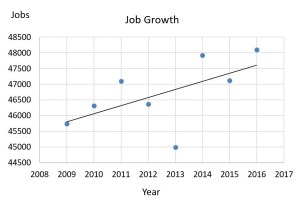
Papers attached to EDDC’s Strategic Planning Committee for 29 January 2019 (see footnote) contain data for East Devon employment covering 2009 to 2016. The explanatory text says: “It is recognised that it is an aspiration of Members [surely not every Councillor?] to deliver one job for each new home across the district but since the adopted Local Plan does not set out to deliver this it is not considered appropriate to formally monitor the relationship between the delivery of homes and the delivery of jobs.”

Here’s why – the real evidence, from the data, is of jobs growing at an annual rate of only 258 jobs/year.

This figure confirms the more modest forecasts presented by Ash Futures and, inconveniently for EDDC, is less than half of that used to justify the “Jobs-led Policy On” housing targets. It is only a quarter of the one job per house aspiration of “Members”.

Where does the 258 job/year trend come from? It is the gradient of the best fit linear regression trend line to the data given the Strategic Planning Committee and shown in the graph below. The full data source is referenced in the footnote.

This is a relatively small sample; and the extent of the fluctuations in the recorded number of jobs from year to year can be seen in the graph. For the technically minded the correlation coefficient of the trend line is 0.6, which is quite a strong one.

All the job number quoted above are for “full time equivalent” jobs (FTE).

Owl has been fortunate to find from the same official source as used by EDDC a set of estimates of the total number of jobs in East Devon which extends the time series to 2017. The significance of this is that the total number of jobs in East Devon fell between 2016 and 2017 and so we can expect the same to happen with FTEs. As a result Owl feels even more confident that the trend line shown above, despite the sample size, reflects what is actually happening.

The Local Plan has been in preparation since 2002 and EDDC has been following a growth policy for many years. So, although 2013 marks the formal start of the Local Plan, there is no statistical evidence to consider 2013 a “turning point” for job growth, though it does look to be an outlier.

With EDDC’s plan to build houses running ahead of creating the jobs needed for a sustainable community, just who are we building all these houses for?

Isn’t it time to cool the building programme, not ramp it up as Owl fears is being planned in the Greater Exeter Strategic Plan?

One of the key architects to all this is Councillor Paul Diviani. When asked at a recent council meeting why East Devon is taking all this development replied: “Because we have got the land, and we are good at it”.

Footnote: The combined minutes, agenda and reports of the Strategic Planning Committee with the job data for 2009 to 2016 on page 116 can be found here:

Click to access 290119strategicplanningcombinedagenda_opt.pdf

Claim mortgages being refused in developments with gypsy and traveller sites

Will this affect Cranbrook?

“The Council of Mortgage Lenders are REFUSING to grant mortgages to prospective house buyers if a new housing development includes gypsy and traveller pitches, it has been claimed.

The shock allegation was made at Tuesday’s Teignbridge District Council planning meeting when councillors were discussing creating additional pitches at a site in Teigngrace.

The pitches were due to be delivered as part of the strategic allocations at South West Exeter where nearly 2,000 new homes are to be built.

But Rosalyn Eastman, Business Manager for Strategic Place, said that gypsy and traveller pitches were required to be delivered off-site as the Council of Mortgage Lenders had told them they won’t provide mortgages to homes which have gypsy and travellers pitches within their allocation boundary. …”

https://www.devonlive.com/news/devon-news/claims-lenders-refusing-offer-buyers-2349956

“The fight against fast food continues …” but … but …

Cranbrook Town Council wants to block a kebab van from selling food in The town:
https://www.midweekherald.co.uk/news/the-fight-against-fast-food-continues-cranbrook-councillors-object-to-kebab-van-s-seven-days-a-week-trading-bid-1-5807445

Cranbrook has only a pub for eating out, which sells a mix of what is crudely called “healthy food” and junk food:
https://www.cranberry-farm.co.uk/our-food/?menu=513118

Cranbrook is installing outdoor barbecues at its “country park” where no doubt junk food will be cooked:
https://www.midweekherald.co.uk/news/plans-for-outdoor-barbecues-to-be-installed-in-cranbrook-before-easter-2019-but-council-is-looking-to-share-the-cost-1-5810127

Is it fair to try to stop the van? A poll says 58% want it.

EDDC liberalised street trading rules to encourage more street trading.

Confusing!

“Laybys in Cranbrook are being used by lorry drivers to ‘entertain’ women”

Owl LOVES the comment from the DCC officer: ““I know this is not a popular thing to suggest, but the people who bought the houses bought them in full knowledge of the layby” but Owl thinks they expected the LORRIES to be laid by, not ladies being laid by lorry drivers!

“Two laybys that lorry drivers are using to ‘entertain’ female companions will be closed.

The laybys, right in the middle of Cranbrook, are also being used a public toilet, for boy racers to congregate and play loud music and swear, and the proximity to houses mean that lorry drivers can see into homes from their cabs.

Unanimous agreement was given by councillors to close the laybys and for Devon County Council’s Highways officers to come up with a solution.

Cllr Ray Bloxham, who brought the proposal to Friday’s East Devon Highways and Traffic Orders Committee, said that the laybys used to be in a rural location but now are right in the middle of Cranbrook, and homes are now located immediately adjacent to the laybys.

He said: “The two laybys in question are now principally used by HGVs for overnight parking as a free car park. This results in considerable disturbance to adjacent households and there have been a series of complaints about noise disturbance especially overnight from refrigerated units and from engines being started and left running during the early hours. There have been ancillary complaints about anti-social behaviour by drivers using the hedgerow as a toilet and other unpleasant behaviours.

“The complaints by local residents have been referred to both Environmental Health at East Devon District Council and to Highways, and the only solution that was put forward and supported by highways department was to close the laybys.”

He added that there was organised lorry parking less than a mile away in Clyst Honiton, but there is a fee for it, so they prefer to park for free.

A resident of Roman Way, which is just 15m away over a hedge from the layby, said that they are facing anti-social behaviour ‘night and day’.

She said: “There are privacy issues as from their cabs, they can see into our residences, while the anti-social behaviour is disturbing out sleep. One lorry driver ‘entertained’ a female companion in his cab overnight and she left at 5.30am in the morning – this is the kind of behaviour we want to end.

“Some of the drivers urinate and use the hedge as a toilet, and they leave litter there which attracts vermin, and at night you get boy racers there and they play music and swear loudly.

“It is a real nuisance and causes health risks to us and our children. It doesn’t support the healthy town concept and for us as residents, the issues are very real. If you lived in our home and had this every day and night, you would realise the issues that we are facing at the moment.”

Mike Jones, Senior Devon County Council Traffic Officer, said that the laybys were on the road so lorry drivers do have a place to stop. He added that the road is a diversion route for the A30 and the road does need marshalling facilities and laybys are a useful thing to have, before saying: “I know this is not a popular thing to suggest, but the people who bought the houses bought them in full knowledge of the layby.”

But Cllr Richard Scott said that was an inappropriate argument to make, as it would be the same as saying if you bought a house next to a field, then it could never be built on. He said that if that argument was used, then Cranbrook itself would never have been built.

Cllr Phil Twiss said that he fully supported the laybys being closed to vehicles, but said that as a cyclist who used the road, those laybys are a handy little refuge to stop and have a drink or check tyres. He said: “I agree that we should close them, but officers need to go away and come up with a practical solution.”

The East Devon HATOC unanimously agreed that the two laybys, located on opposite sides of the highway alongside the B3174 at Cranbrook, approximately 100m west of Parsons Lane, be closed to vehicular use, either by the introduction of a Traffic Regulation Order, or a different solution that the highways department could identify which meant moving the kerb line.”

https://www.devonlive.com/news/devon-news/laybys-cranbrook-being-used-lorry-2303961

“More visible police resources for Cranbrook”… but … not yet!

“Cranbrook has been promised a police office in its future town hall development, and ‘more visible resources’ to tackle speeding and anti-social behaviour.

No decision has been made yet on a neighbourhood beat manager, but residents are being urged to report all incidents to help make the case for a stronger police presence.

Devon and Cornwall’s Police and Crime Commissioner, Alison Hernandez, attended Cranbrook Town Council’s meeting on Monday, November 19, with two senior police officers and two from the local area policing team, to hear residents’ concerns.

During the meeting, Ms Hernandez said she was ‘committed’ to having a police office in The Tillhouse when it is built – a statement that was welcomed by the town council.

She said the employment of a neighbourhood beat manager would not be achieved in the short term, but Cranbrook needs to keep providing evidence of the need for one.

“Encourage your community to report everything – if you don’t, it will be harder to fight for that resource,” she said.

“Reporting is really important. It is logged and it has a resourcing implication.”

The police officers present said even if they cannot attend a reported incident immediately, they need information about offenders from the local community so that they can take action at a later stage. …”

Cranbrook – no more unaffordable affordable homes or even affordable affordable homes?

“To date 10% of all homes at Cranbrook have been ‘affordable by design’ properties, whose maximum floor spaces have been limited by the terms of the existing S106 agreement. These are properties whose floor spaces have been below that which would normally be seen for two or three bedroom properties and which therefore have a lower open market value; they do not fall under the definition of affordable housing.

With a drive to improve people’s health and wellbeing at the town and lenders being increasingly reluctant to lend on the current terms of the S106 agreement, Officers consider it appropriate to cease the requirement for these houses to be delivered. A deed of variation to the S106 agreement is being progressed to deal with this matter.”

Click to access 271118strategicplanningcombinedagenda.pdf

Cranbrook district heating in hot (cold?) water

Residents in Cranbrook are tied to the E.on district heating plant for 80 (EIGHTY) years.

From Cranbrook Town Council website:

“In September, the Town Council complained to E.on on behalf of the residents about the continuing service disruptions which continue to be suffered by a significant proportion of residents.

The Town Council feels that six years into the project residents should not find themselves without a service other than in extreme circumstances. We also raised concerns in relation to the apparent lack of global resilience within the Energy Centre and the district heating scheme, asking for steps being taken to ensure that the residents of Cranbrook will not experience a loss of service again in the future.

As a result of our correspondence, E.on have been reviewing their network and have exchanged their temporary energy centre in phase 4. The other temporary energy centres are also being monitored for performance and resilience. Communication has also improved, as residents will note that recently they have been informed by text or email when planned maintenance was taking place. We could urge residents to ensure that E.on have their contact details e.g. mobile phone no. and email.

E.on will be holding customer open evenings again in the New Year at the Younghayes Centre to make it easier for residents to attend. We will publish the dates once they are confirmed. We cannot urge residents enough to take those opportunities to raise problems with E.on – as otherwise they won’t know.”

“Flybe ‘up for sale’ weeks after profit warning”

“Flybe is reported to have put itself up for sale less than a month after issuing a dramatic profit warning.

The regional airline is expected to say on Wednesday that its board is exploring a sale or a merger with a rival, according to Sky News.
Last month, the airline warned full-year losses would reach £22m due to a combination of falling consumer demand, a weaker pound and higher fuel costs.

The airline’s shares have fallen by almost 75% since September.

The Exeter-based airline is now valued at around £25m, far below the £215m it was valued at when it floated on the stock exchange in 2010.

Stobart Group – which pulled out of a bid to buy Flybe earlier this year after the airline rejected its offer – could be a possible purchaser, according to Sky.

Flybe, whose roots date back to 1979, has 78 planes operating from smaller airports such as London City, Southampton and Norwich to destinations in the UK and Europe.

It serves around eight million passengers a year, but has been struggling to recover from a costly IT overhaul and has been trying to reduce costs.
Last month, Flybe’s chief executive Christine Ourmieres-Widener said it was reviewing “further capacity and cost-saving measures”.

“Stronger cost discipline is starting to have a positive impact across the business, but we aim to do more in the coming months, particularly against the headwinds of currency and fuel costs,” she said at the time.

The airline is due to issue its interim results on Wednesday. The company declined to comment on the sale reports.”

https://www.bbc.co.uk/news/business-46203183

Cranbrook town councillors attempt to block mobile catering vans is defeated

Owl says: This is what happens when you fail to build a proper centre in a new town.

“Members differed in their opinions when deciding whether to support a request for annual street trading consent from Richard Filby, who runs popular chip van Flippy Chippy.

Councillor Ray Bloxham said granting consent would go against Cranbrook’s ‘healthy’ image, as it is just one of ten sites selected to join NHS England’s national Healthy New Towns programme. He said: “We are trying to do something about the health of our town.

“We need to, at some stage, make a stand against this type of thing because it is not good.”

Cllr Bloxham said there is a ‘proliferation’ of mobile businesses coming into Cranbrook, which do not pay business rates and sell ‘unhealthy food’ to the community.

Cllr Sarah Gunn said a fish and chip shop is set to open in Cranbrook soon and the council needed to support it. She added: “It is not cheap rent or business rates – there are no concessions.

“A chip van up the road is going to make that very hard.”

Cllr Matt Osborne said Flippy Chippy is ‘well known and liked’ in Cranbrook, and had been involved with a lot of community events held in the town.

He said: “If we take that away when there is a chip shop opening, the backlash will be quite severe – because we are the reason people can not have fish and chips in town anymore.

“I think we will get some kind of movement against that.”

Cllr Bloxham proposed the council objects on the grounds that Cranbrook is a Healthy New Town and the council is ‘trying to promote healthy living’.

He added: “It is unfair competition for businesses trying to set up shop in the town. [Flippy Chippy] has no overheads apart from a bit of petrol.”

Cllr Bloxham’s proposal was defeated by four votes to three.

Cllr Les Bayliss said two other mobile companies sell food in Cranbrook and it would be unfair to object to Mr Filby’s request.

He proposed the council supports the trading consent request, but his motion was also defeated by three votes to two.”

Councillors finally agreed they would send their comments to East Devon District Council, which will decide whether to grant consent at a future date.

Mr Filby’s application is to trade from a catering van every Monday, from 4.30pm to 7.30pm, on Younghayes Road (by the country park).

http://www.midweekherald.co.uk/news/council-split-in-deciding-whether-to-support-street-trading-request-from-popular-flippy-chippy-food-van-1-5749353

EDDC says it can’t afford to part-fund a community worker for Cranbrook

Yet it can spend £10 million-plus on a new HQ and says section 106 funding is running out despite continued building-out of the town. Developers seem to be getting a really easy ride in Cranbrook.

http://www.midweekherald.co.uk/news/fundraising-bid-to-employ-community-development-worker-for-cranbrook-dashed-1-5751029

E.on temporary energy centre for Cranbrook’s phase 4 runs into problems

Cranbrook Town Council notes:

MESSAGE & APOLOGY FROM E.ON FOR PHASE 4 RESIDENTS – OVERRUN
E.on is sorry that the works to the temporary energy centre on Phase 4 have overrun but assures residents they should be completed by 5pm.

That’s the problem when you have district heating and no control over who provides your energy supply – or the price they charge.

Cranbrook: no road markings causing serious problems with anti-social parking

Cranbrook Town Council Facebook page draws attention to a serious traffic problem:

“APPEAL FOR CONSIDERATE PARKING ON CRANBROOK’S ROADS:

There was another near miss earlier today when a resident pulling carefully out of their road was unable, due to cars parked at the junction, to see a group of approaching cyclists. Although nobody was hurt on this occasion, the cyclists had to swerve and could have been forced into the path of oncoming traffic. Although Cranbrook has no road lining may we remind residents that the principles of the Highway Code still apply.”

6 mins ·
MESSAGE & APOLOGY FROM E.ON FOR PHASE 4 RESIDENTS – OVERRUN
E.on is sorry that the works to the temporary energy centre on Phase 4 have overrun but assures residents they should be completed by 5pm.

“Fire stations may need to be moved due to new housing developments” [including Cranbrook]

Owl says: does this mean ambulance stations, schools and doctors’ surgeries may now be in the wrong places?

“New housing developments across Devon and Somerset may mean a rethink of where fire stations are needed.

There are currently 85 fire stations across the two counties, but the stations are aligned to standards of fire cover from the late 1940s and are not reflective of the current and future demographics of the two counties.

Assistant chief fire officer Peter Bond, director of service improvement, told fire authority members on Monday morning that its risk mapping graphs showed that in the great majority of cases, the authority has a lot of good cover and high risk areas are within the targeted 10 minute response time.

But he added: “It is pleasing to see and that we have our resources in the right place. But there will be some developments in Devon and Somerset, such as Cranbrook, Sherford, Taunton Garden Town, and other towns that as they expand, will sit outside the existing 10 minute response zone.”

https://www.devonlive.com/news/devon-news/fire-stations-need-moved-due-2135030

Cranbrook gets police drop-in surgery – but only for a couple of hours a month

“A member of Cranbrook’s policing team will be available to meet in the foyer of the Younghayes Centre across the next two months, subject to availability.

Next month, an officer should be at the Younghayes Centre on Saturday, November 3, from 1pm to 2pm. They are planned to return on December 1 at the same place and time.

A spokeswoman for Cranbrook Town Council said: “Please do come and make use of these sessions, which will be a great opportunity to raise any concerns you might have and to meet local officers.”

Cranbrook Town Council has approached the chief constable to request a permanent neighbourhood beat manager. The authority has been dealing with several issues including anti-social driving and unruly behaviour at night.

http://www.midweekherald.co.uk/news/police-drop-in-surgeries-planned-in-cranbrook-1-5738506