An owlet reports …

“Owl may like to hear from other indigenous flocks of birds that have, over decades, chosen to settle in small, rural nesting places, free from predatory, vulture-like species, whose aim appears to have been the destruction of the East Devon natural environment, primarily to further their own self-sustenance.

Without suitable culling, these raptorial groups with such voracious, insatiable appetites would have caused the ruination of many distinct, valued habitats throughout East Devon. This species is commonly known as “The Feather Their Own Nests Birds” (Latin name – ‘torymemberus senioradmindominari’)!

However, it appears that when birds of a feather flock together, their collective birdsong is so momentous that it can effect change. Most can hear the birdsong but few actually pay attention, fully understand and LISTEN. The East Devon resident bird population remains territorial, watchful and perched in anticipation.

Data supplied by a Local Ornithologist who wishes to remain anonymous for fear of targeted, defensive bird attacks!

Bats in East Budleigh: “licence to kill” say ecological campaigners

“A “licence to kill” has been granted, it was claimed, after plans to knock down a barn known to be home to rare and protected bats were approved.

Councillors voted by eight votes to five on Tuesday morning to give the go-ahead to demolish a barn in East Budleigh, known as The Pound, and for it to be replaced with a house.

A new bat barn will be built in the garden as mitigation and Clinton Devon Estates have said the new building will provide conditions “more suitable” for bats, including a dedicated loft area and ground floor with free flight access for the animals.

But concerns have been raised by ecological campaigners about the risk it would pose to the rare bats, saying the demolition of the barn could see them lose their homes and die.”

https://www.bbc.co.uk/news/live/uk-england-devon-48036376

Persimmon and Bellway – many homes not fire safe

https://www.bbc.co.uk/news/business-48113301

https://www.devonlive.com/news/devon-news/persimmon-homes-admits-dangerous-missing-2816833

A correspondent explains why he won’t be voting Conservative on Thursday

Unless your readers live in a new house on an estate they will have little understanding of what happens today.

I moved onto a new estate which had a grassed open area. I was aware that there was some infrastructure to prevent flooding beneath it and knew that I would have to pay a share of the upkeep. I did not fully understand was that it was a public open space which was available for anyone’s use, not just the residents on the estate.

Maintenance charges have rocketed whilst quality of service has been poor. Any talk of with holding service charge payments is referred promptly to debt recovery. The whole system is unregulated and frankly, stinks.

I have dug deep to try to understand how a simple purchase of a freehold house is suddenly caught up in a land charge where I am compelled to pay for maintenance of land owned by someone else.

The root cause of the problem seems to have started with the council. In this case EDDC. As part of the planning condition for the estate the developer had to provide a public open space and a SUDS system to prevent flooding. In all probability it was an attempt by the council to stick their fingers up at the developers and force them to provide facilities for public benefit at no cost to the local authority.

The next stage was to make the developers responsible for the maintenance of the new open spaces. They could either do that themselves or pay a lump sum to the council to maintain it for the next 25years. Clearly the developers were unable to afford that so they passed the maintenance charges on to the residents within the title deeds for each house.

That was very unpopular and most developers, wanting to distance themselves from the problem, gave the piece of public land to a land management company. It seems that none of those companies are regulated and can charge what they like. If you don’t pay their bill they could apparently seize your house. All quite outrageous.

There has been lots of bad press about these land management companies and the matter discussed in Whitehall although the housing minister has taken little interest.

In East Devon our Conservative council has decided to stick their nose in the trough and has decided to offer to take over the public open spaces at Cranbrook and offer to carry out the maintenance of the public open spaces and charge F band houses £370 per annum and H band houses £512 per annum. Both of those figures are in addition to the normal council tax which is supposed to cover supply and maintenance of public open spaces !!

So lets look at this…. EDDC created the problem by insisting that the developer provide the public open spaces which the council had no intention of maintaining. When it all starts to go wrong EDDC offer to take the responsibility over but only by penalising the residents who live on those estates.

To make it clear those public open spaces are available for use by anyone. So maintenance of those public open spaces should be maintained at public expense. The costs must be paid out of council tax revenue.

This mess has been created by EDDC who enjoy a massive Conservative majority. Any proposals are just nodded through without opposition.

I have always voted Conservative in the past but things have got out of hand. Things must change. The public has a chance to voice their opinion in the local elections on 2nd May.

I know I won’t be for any Conservative Councillor and no, it’s got nothing to to with Brexit….”

Wondering why new houses are so badly built? Here’s a clue

“Cornwall councillors are set to be asked to support a call on the government to give back responsibility for building control to local councils in a bid to improve the quality of homes being built by developers.

Under the current system, developers can choose their own approved regulator to undertake building control and checks.

But Threemilestone Liberal Democrat councillor Dulcie Tudor said she was leading a bid to have this returned to local councils amid fears the current system was open to abuse because “any company or person… can choose who regulates them”.

https://www.bbc.co.uk/news/live/uk-england-devon-48036375

“Auditors find ‘significant weaknesses’ in record-breaking investment deal and slam Surrey council’s £1bn ‘property roulette’ “

“Auditors have slammed a district council in Surrey which undertook the most expensive property investment ever made by a local authority after it found “significant weaknesses” in its financial processes.

KPMG delivered a damning assessment of Spelthorne Borough Council’s purchase of a BP research centre in Sunbury for £385m in September 2016, one of a number of costly property investments in the authority’s £1bn portfolio.

The auditors found that the acquisition of the site was decided by council officers without any public scrutiny, and the decision-making process was conducted via email and was “generally poor and difficult to follow.”
This meant it was “difficult to identify whether all the risks associated with such a large and significant transaction had been fully considered and mitigated,” the auditor said.

KPMG said it found little evidence the council had properly considered legal advice which said the purchase, the largest of its kind by a local authority in England, may be “disproportionate” to the rest of its spending.
Most worryingly, the auditor failed to determine whether the council had considered the financial impact if BP had decided not to renew or change the terms of its 20-year lease of the site.

The council then took four months to publish its decision, leading the auditor to conclude that “we are not satisfied that, in all respects, Spelthorne Borough Council put in place proper arrangements.”

Spelthorne has been the biggest investor in property in local government and since 2016 has borrowed £1bn from the Public Works Loan for the takeover of BP’s business park – as well as the purchases of offices in Reading, Slough and Uxbridge for £285m and a number of other investments.

The authority told the Bureau of Investigative Journalism that the “adverse value for money conclusion does not mean that the auditors are saying the actual transaction does not represent value for money but that in their opinion some aspects of decision-making processes were not conducive to maximising value for money.”

Surrey County Council’s Robert Evans said he was surprised Spelthorne had not done due diligence around the deal, and said the authority seemed to be “playing property roulette with council taxpayer’s money.”

“If the climate is good that might be okay but with Brexit around the corner everything is uncertain and this is foolhardy at best and downright dangerous at worst.”

http://www.publicsectorexecutive.com/Public-Sector-News/auditors-find-significant-weaknesses-in-record-breaking-investment-deal-and-slam-surrey-councils-1bn-property-roulette

3 days to local elections – today’s pictures

Today our theme is developers, affordable housing and housing in general.

Did you know that EDDC has overperformed on the housing delivery test set by the government by 50%?

The government set East Devon a target of 1,762 homes to be built in 2018 whereas the number actually built was 2,632 – more than 900 extra, very, very few of which were “affordable” (see pictures below about that!).

Source: https://assets.publishing.service.gov.uk/government/uploads/system/uploads/attachment_data/file/779711/HDT_2018_measurement.xlsx

Persimmon is making £73,000 per HOUSE profit, Taylor Woodrow £68,000 per HOUSE. Help to Buy is adding £33,000 to the price of new houses for first time buyers.

EDDC has been developer-led for YEARS because Conservative housing policies were designed by them and most major housebuilders are donors to the Conservative Party.

How to stop this? Vote Independent. Break the chain.

all this talk of a lack of affordable housing is exaggerated, i know, i’ve got six!

Affordable Housing Estate Agents – ‘It’s affordable if you’re rich…’

Designated area of outstanding natural profitability.

“Well one step down from our ‘Luxury Executive Mansion’ is our ‘crap terrace with outside loo’.”

New Planning Body in beauty spot – ‘Nice spot for our HQ…’

“Land Registry statistics say house prices in East Devon increased by 18.4 per cent in the two-and-a-half-years since the Brexit referendum”

EAST DEVON’S DEVELOPERS REAP THEIR STRATOSPHERIC REWARDS – DOUBLE REGIONAL AND NATIONAL FIGURES

“The growth of house prices since the Brexit referendum has bucked the national and regional trend, statistics show.

In the two-and-a-half years before the UK voted to leave the EU, the average house price went up by 9.1 per cent from £251,778 to £303,162, Land Registry figures show.

In the same time period after the vote, prices went up by 18.4 per cent.

This is in contrast the regional and national picture.

House prices in the South West increased by 17.7 per cent in the two-and-a-half years before the referendum but only grew by 7.7 per cent in the same period after the vote.

This downward trend is matched nationally, where property prices prior to the referendum grew by 19.6 per cent and in the 30 months after, growth fell to 6.1 per cent. …”

https://www.sidmouthherald.co.uk/news/post-brexit-house-price-growth-1-6004876

“Housebuilder Persimmon faces new investor revolt over ‘highly excessive’ pay”

“Housebuilder Persimmon is braced for a fresh revolt over its controversial bonuses after shareholder advisers urged investors to vote against the company’s ‘highly excessive’ pay.

Advisory group PIRC has instructed investors to oppose the pay report for a second year running at the annual meeting early next month.

Last year, the FTSE 100 company narrowly escaped defeat over its bonus scheme for top bosses, but still suffered a major rebellion.

The scheme included a bonus worth more than £100million for former boss Jeff Fairburn that was trimmed to around £75million after a public backlash. The bonus pot was boosted by the taxpayer-funded Help to Buy scheme.

Persimmon, led by new chairman Roger Devlin, has attempted to draw a line under the scandal by trimming the overall payouts, ousting Fairburn, ensuring that all staff are paid more than the living wage, and making steps towards improving the quality of its homes.

Two other advisory firms Glass Lewis and ISS have both backed changes made by Devlin.

A Persimmon spokesman said the company understood ‘the need for pay restraint and spent 2018 working to ensure Persimmon’s future remuneration is clearly aligned with best practice’.”

https://www.thisismoney.co.uk/money/markets/article-6943125/Housebuilder-Persimmon-faces-new-investor-revolt-controversial-bonuses.html

“End of Right to Buy set to increase demand for affordable housing”

Affordable housing output needs to be increased as the Help to Buy scheme is wound down, according to property consultancy Savills. The Help to Buy scheme has been a major factor in helping young people to afford their own home in recent years. However, its eligibility criteria are set to be tightened in 2021 with the future of the scheme up in the air.

[Take this with a pinch of salt – those “affordable” homes are, on average £33,000 more expensive than they ought to be]:

‘Help to Buy’ costs first-time buyers an average £33,000 extra

A report by Savills said that housebuilding in England may need to increase by up to a third between 2021 and 2025 to make up for the end of the current Help to Buy scheme. Emily Williams, associate director for residential research at Savills, said: “Private sector housebuilding for market sale has underpinned the rapid expansion in housing supply since 2013, including affordable housing delivery through Section 106. But that growth is slowing against market headwinds.”

http://www.room151.co.uk/brief/#end-of-right-to-buy-set-to-increase-demand-for-affordable-housing

“Half of England is owned by less than 1% of the population”

“Half of England is owned by less than 1% of its population, according to new data shared with the Guardian which seeks to penetrate the secrecy that has traditionally surrounded land ownership.

The findings, described as “astonishingly unequal”, suggest that about 25,000 landowners – typically members of the aristocracy and corporations – have control of half of the country.

The figures show that if the land were distributed evenly across the entire population, each person would have almost an acre – an area roughly the size of Parliament Square in central London.

Major owners include the Duke of Buccleuch, the Queen, several large grouse moor estates, and the entrepreneur James Dyson.

While land has long been concentrated in the hands of a small number of owners, precise information about property ownership has been notoriously hard to access. But a combination of the development of digital maps and data as well as pressure from campaigners has made it possible to assemble the shocking statistics.

Jon Trickett, Labour MP and shadow minister for the Cabinet Office, hailed the significance of the findings and called for a full debate on the issue, adding: “The dramatic concentration of land ownership is an inescapable reminder that ours is a country for the few and not the many.”

“It’s simply not right that aristocrats, whose families have owned the same areas of land for centuries, and large corporations exercise more influence over local neighbourhoods – in both urban and rural areas – than the people who live there.”

“Land is a source of wealth, it impacts on house prices, it is a source of food and it can provide enjoyment for millions of people.”

Guy Shrubsole, author of the book in which the figures are revealed, Who Owns England?, argues that the findings show a picture that has not changed for centuries.

“Most people remain unaware of quite how much land is owned by so few,” he writes, adding: “A few thousand dukes, baronets and country squires own far more land than all of middle England put together.”

“Land ownership in England is astonishingly unequal, heavily concentrated in the hands of a tiny elite.” …”

https://www.theguardian.com/money/2019/apr/17/who-owns-england-thousand-secret-landowners-author

VERY IMPORTANT update on Sidmouth Business Park appeal

NOTE: a planning inquiry is much more formal than a hearing and usually involves lawywers, examination of evidence and cross-examination:

Public Inquiries & Hearings

We have now been advised by the District Council that the Planning Inspector has determined that instead of holding a Hearing into the planning appeal as we previously had been told, the Inspector has now decided to hold an Inquiry which could last up to three days. The first of these days is due to start on 16 July. We are assuming that the Inspector will therefore have penciled in the Inquiry to be held on

16, 17 and 18 July

The Inquiry will be held in public and will be held locally. If you have any interest in attending then put these dates in your diary now!

In our last Update we asked you to consider submitting additional evidence to the Planning Inspector and we know that a number have done so, and thank you to those who have.

The District Council’s latest communication advises that the Inspector has put back the date by which additional submissions can be made. The new deadline by which any additional comments have to be received by the Inspector is now

17 May 2019

We again would encourage as many of you as possible who wish to, to submit comments even at this late stage. As the District Council refused planning permission solely on grounds related to highways matters you should only submit highways related comments. In doing so you might want to address matters that include –

Evidence or statements regarding the effect of noise, vibration, damage and pollution on your properties (and vehicles) due to HGV or other traffic

Effect on the health of residents attributable to air quality

Effect of pollution on children walking to school and in the playground of the primary school

Road safety issues – lack of pavements or narrow pavements, plus no lollipop lady, crossing nor traffic lights to help you cross safely with your children

Traffic delays due to congestion at the various pinch points on the A375 in both Sidford and Sidbury

Evidence of vehicles mounting and/or diving on pavements

Where possible your comments should be supported by photographic evidence.

We believe that it is important for as many photographs and/or videos are submitted to the Planning Inspector showing images of traffic congestion/difficulties along the A375 at any point between Sidford and Cotford in Sidbury.

Attached, once again, is a brief guide as to how to present any submission that you make.

Best wishes

Campaign Team

GUIDE TO PRESENTATION OF SUBMISSIONS:

Guidance on submitting additional evidence to the Planning Inspector

All comments and evidence must –

• be received by the Planning Inspector by no later than 22 April 2019. Anything received after this date will not be considered by the Inspector.

• quote the planning appeal reference for in order for it to be considered by the Inspector. The reference is – APP/U1105/W/19/3221978.

• quote the address of the appeal site i.e. the Business Park. The address to be quoted is – Land East of Two Bridges, Two Bridges Road, Sidford.

• your name and address

• state “I am against the appeal proposals” and explain whether it is for the same reasons as given by the District Council or, if not, explain your own reasons

The reasons given by the District Council in refusing the planning application were –

“1. The proposed development, by virtue of the proposed B8 uses, would result in an increase of HGV traffic on the surrounding road network, both in the vicinity of the site and through Sidbury which both suffer from inadequate road widths and a lack of footways. As such increased HGV movements within this area will result in conflicts between vehicles, and between vehicles, cyclists and pedestrians, to the detriment of highway safety. The proposed development is therefore considered contrary to paragraph 32 of the National Planning Policy Framework and Strategies 26 (Development at Sidmouth), and Policies TC7 (Adequacy of Road Network and Site Access) of the adopted East Devon Local Plan 2013 – 2031.”

The Planning Inspector asks that any additional submissions are –

• in a font such as Arial or Verdana in a size of 11 point or larger

• use A4 paper wherever possible

• number the pages of the documents

• make sure photocopied and scanned documents are clear and legible

• use black and white for documents unless colour is essential

• put any photographs (both originals and photocopies should be in colour),
maps, plans, etc, in a separate appendix and cross reference them within the main body of the document

• print documents on both sides of a page. You should use paper of good enough quality that something printed on one side of the page does not show through to the other side

• do not send original documents

• if possible, send 3 copies

You should send your written submission and/or photographs/videos –
By post to:

The Planning Inspectorate, Room 3/C Eagle Wing, Temple Quay House, 2 The Square, Bristol BS1 6PN

By email to: west2@pins.gsi.gov.uk
Planning Portal: https://acp.planninginspectorate.gov.uk

Remember all evidence must be received by the Planning Inspector by no later than

17 May 2019

PegasusLife ‘to build in phases’ at Knowle

Owl says: Won’t be much fun for those in Phase 1 (or their neighbours) to live on or near a building site until other phases (how many?) are completed.

“… Sidmouth Town Council revealed on Monday night 3.5hectres of land at Knowle could be transferred sooner than expected after members were told the land and car park would not be available until the completion of PegasusLife’s 113-home retirement community.

Town clerk Christopher Holland told the meeting the developer has decided to build its 113-home retirement community in phases, rather than one go, meaning it will be able to contain its construction materials without using the public car park.

In November, the Herald revealed the developer had been allowed the use of the lower car park and meadow as storage space for the duration of the works. …”

https://www.sidmouthherald.co.uk/news/transfer-of-knowle-parkland-to-sidmouth-town-council-moved-up-1-5992919

Linden homes: catalogue of serious problems in new Exeter home

“A new build owner has shared shocking pictures of her mouldy bathroom which came to light months after moving into what she thought would be a hassle free home.

Linda Hamlet claims the first problems began from the day she moved into the Linden Homes development Tithe Barn in Pinhoe, Exeter, when ‘snagging’ issues included being unable to lock her front door because it was misaligned.

Since then the main problem in three-bed semi-detached home has been four leaks, including from a u-bend which was not connected properly in the kitchen, and a rotten wall and mouldy floors in the ensuite and bathroom.

Linda said: “I went two months without being able to use the shower in our ensuite as they used mastic instead of grout after the first leak. At same time there was two botch jobs made with our leaking bathroom sink.

“I could smell a horrible smell in the bathrooms and it turns out it was because the floors were mouldy underneath. They were just going to regroup the tiles until I insisted there must be underlying damage. Then they only removed tiles and saw the stinking rotten wall.

“I have spent nearly £300,000 on a new house as I thought it would give me peace of mind because I could close the door and enjoy my life, but I haven’t been able to and now have a problem with missing pointing in the brickwork. I haven’t been given an apology and I haven’t been offered compensation.”

A Linden Homes spokesperson said: “We pride ourselves on the quality of our homes and our customer care. Our dedicated customer care team have been in regular contact with Ms Hamlet to rectify the minor faults in her property that have appeared during the snagging and defects period.

“We have worked to complete these items as quickly as possible, and with minimum disruption for the customer. We will continue to work with Ms Hamlet to ensure that any identified defects are resolved and any repairs are carried out, under the conditions of her warranty.”

https://www.devonlive.com/news/devon-news/horrible-smell-led-new-home-2754859

‘Help to Buy’ costs first-time buyers an average £33,000 extra

“First-time buyers who use Help to Buy to get on to the property ladder face paying a premium of more than £30,000.

That’s according to new research by the price comparison website Reallymoving, which claims first-time buyers using Help to Buy paid an average £303,000 in February, significantly more than the average of £270,000 spent by those who bought a home on the open market. …”

First-time buyers face a £33,000 premium when using Help to Buy

20 days to local elections: today’s picture

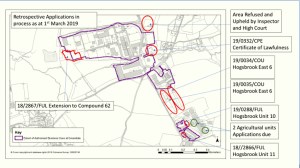
This image below shows current planning issues at Greendale Business Park – many of which have been allowed, or allowed to drag on, by EDDC Tory councillors who form the majority decision-makers in “planning” and planning “enforcement” (those inverted commas are there deliberately!). Many of Greendale’s planning applications have been approved retrospectively.

Independent Councillor Geoff Jung works tirelessly (in the face of great difficulty) to try to ensure that Greendale stays within its proper boundaries – but it is a never-ending task:

McCarthy and Stone poor results: closing operations in south-west – whither PegasusLife now?

“A slowdown in secondary housing transaction volumes eroded operating margins for McCarthy & Stone (MCS) during the first-half, as the retirement home providers used discounts and incentives – including part-exchange – to boost sales.

Management hopes to make more than £90m in cash savings between 2019 and 2021 by scaling back sales and marketing teams, standardising build designs and closing operations in the south-west of England.”

https://www.investorschronicle.co.uk/shares/2019/04/10/mccarthy-stone-hindered-by-property-slowdown/

AND

“Half-year profits at McCarthy & Stone tumbled by two-thirds as it ploughed more cash into a turnaround to cope with a slowdown in the housing market.

The retirement housebuilder handed consultants £4.5m for advice relating to its strategy shake-up, which included closing offices in Scotland and the south-west of England and making almost 200 of its 2,500 staff redundant at a cost of £3.5m.

Those and other one-off costs left McCarthy & Stone with pre-tax profits of £3.6m for the six months to February, down from £10.5m the previous year.”

https://www.telegraph.co.uk/business/2019/04/10/redundancies-restructuring-hit-mccarthy-stone-profits/

Read this before buying a new home (particularly from Taylor Wimpey )

Owl says: surely developers building shoddy or dangerously constructed new homes should be banned from tendering for new schemes and banned from using government subsidies from Help to Buy schemes to sell homes already constructed forever?

“It took seven families two years, but a group of homeowners in Scotland has taken on a housing giant in order to have their “crumbling” new-build homes repaired. It’s part of a broader, UK-wide issue – this is their story.

Sheila Chalmers moved to Peebles with her husband 10 years ago. Her three-bed home was one of 250 built by developer Taylor Wimpey on a new site in the Scottish borders.

For eight years, life went on as normal. Then something strange started to happen. Overnight, families at the top end of the estate started to vanish. But there were no for sale signs and no-one new was moving in. “It became almost a ghost street,” she says. “Houses were empty. People were disappearing.”

Sheila later heard that the properties had been bought back by Taylor Wimpey after problems were discovered. The owners had signed non-disclosure agreements so they could not speak out.

Taylor Wimpey confirmed it did buy back a “small number of homes” to start with. It later sent a letter to all the remaining residents, saying that some houses did have a problem with the mortar holding together their bricks.

Sheila thought she did not have anything to worry about, but she went outside and checked anyway. Patches of mortar were clearly eroding, she says, and in other places it could be scraped out with a fingernail.
She paid for assessments by two different structural engineers, who both said the house needed extensive repair work, though Taylor Wimpey said its own inspections found that was not the case.

Mortar is made up of two key materials: cement and sand. The more cement in the mix, the stronger the mortar, though the more brittle it can be.
The family paid to have their laboratory tests on the mortar carried out by a specialist firm.

The results suggested that there was far more sand in the mix than you would expect for a home in that area, although Taylor Wimpey says the type of chemical test used was “not appropriate” and the results could not be relied upon.

Our investigation in 2018 found similar complaints about weak mortar across at least 13 estates in the UK all built by different companies.

Three doors down from Sheila, live Pete and Jill Hall with their 13-year-old son. Like Sheila, they first learned about the problem two years ago when Taylor Wimpey were buying back the individual houses. They paid for their own tests, which showed only one in eight samples taken from their home met industry guidelines, although again Taylor Wimpey says the test used was “not appropriate”.

“On the garage the tests came back showing it was just sand,” said Pete.
A video filmed by the family after a rainstorm clearly shows the mortar on the back wall falling out when a screwdriver was run gently along it.

Handmade signs

In the end, seven core households became involved – passing on details to a wider community group on the estate. The families worked together to build their case, paying for their own structural surveys and using Freedom of Information laws to demand internal documents from the local council.
They made handmade signs and protested outside the showroom of another Taylor Wimpey estate in the area.

In 2017, they presented their findings to Taylor Wimpey’s lawyers, saying that they would go public if their properties were not fixed, demolished or bought back. They were surprised at the response.

The families’ solicitors received a letter back saying they had decided not to report the group to the authorities under the Proceeds of Crime legislation. “It was accusing us of bribery, effectively,” said Pete. “It took me about 10 minutes to stop laughing. But it was intimidation, a threat.”

By then, Pete and Jill had hired their own engineers to examine the house. They recommended that the couple should stop using the garage because it was at risk of collapse, although Taylor Wimpey denies that there was a structural problem.

The couple bought a giant shipping container, covered it with warning stickers and left it on their front lawn.

That, they say, got Taylor Wimpey’s attention and – two years down the line – an agreement has now been reached for their home to be fixed. “It falls short of where we think a full repair should be, but they have said it’s that or nothing – so we have accepted it,” Jill says.

‘Someone has to stand up’

In December 2018, Taylor Wimpey sent out letters saying all 130 houses in the estate built with the weaker mortar would now be offered “remediation” work.

Properties are being dealt with one at a time. Construction crews are scraping out the old mortar and replacing it with a stronger material.

Taylor Wimpey said it “sincerely apologises” to the all the homeowners affected, is “fully committed to resolving matters” and has “a clear plan in place to remediate affected homes”. “This is a localised issue and falls short of the high-quality standards we uphold,” it said.

The firm has now apologised to Sheila and, even though its own inspections found a full repair is not needed, said work to replace the mortar in her home will start this summer. It will refund the £16,000 she has spent on legal costs and technical reports, most of which she had to borrow.
Repair work on Pete and Jill’s property, which may involve the demolition of the garage, is due to start in mid-July.

Both families say the fight has been time-consuming, stressful and put them off ever buying a new-build home again. “These developers, these companies, cannot be allowed to continue the destruction of people’s lives with building shoddy homes,” said Sheila. “Somebody has to stand up and show them that they cannot get away with it.”

What went wrong?

Maps drawn up by Taylor Wimpey show about half of the 250 homes were built with far weaker mortar than recommended under industry standards

A memo sent to all developers in the UK by the National House Building Council (NHBC) in 2013 warned about this problem

The local council in Peebles says the mortar used was not the type in the original building warrant and was changed later without its knowledge

Taylor Wimpey says the material was “of sufficient strength to meet structural requirements” as “supported by an independent review” by the local council, but accepts it may be “less durable under prevailing exposure conditions”

It says it has now offered to repoint “any home which was constructed with the same mortar, regardless of whether our inspection found this was necessary or not”

https://www.bbc.co.uk/news/business-47816530