“Social care could drain local services cash dry, warns LGA”

For every £1 of council tax, almost 60p could be spent on social care by 2020, taking away from “vital day-to-day services”, the Local Government Association has warned ahead of the Budget later this month.

The umbrella-group has called on the government to ensure councils could keep raising the local tax to keep providing services as the money is “running out fast”.

Clair Kober, chair of LGA’s resources board, said: “With the right funding and powers, local government can play a vital role in supporting central government to deliver its ambitions for everyone in our country.”

She added: “Demand for services caring for adults and children continues to rise but core funding from central government to councils continues to go down.

“This means councils have no choice but to squeeze budgets from other services – such as roads, street lighting and bus services – to cope.”

The association projected 56p could be spent on caring for the elderly, vulnerable adults and children, up from 41p in 2010-11, and that this would take away funds that could be spent on services such as waste collection, road repairs and bus services.

Almost half of all local authorities (168 councils) will no longer receive any revenue support grant funding from central government by 2019-20, the LGA point out in a new analysis.

Uncertainty was growing over how local services would be funded after 2020, as the Local Government Finance Bill, which was passing through parliament before the election, was not reintroduced in the Queen’s Speech, the association said.

This has made it uncertain whether councils would be able to keep all their income from business rates by the end of the decade.”

http://www.publicfinance.co.uk/news/2017/11/social-care-could-drain-local-services-cash-dry-warns-lga

“Private equity firm made struggling care home operator take costly loan”

“Britain’s second biggest care home operator was made to borrow money through a very expensive loan from its private equity owner in a deal designed to extract £890m in cash from the struggling business.

The disclosures are likely to raise fresh concerns over the future of Four Seasons Health Care, which operates more than 300 care homes across the UK, and has been drowning in debt.

Described in reports as teetering on the brink of ruin, Four Seasons has been hammered by cuts to council care budgets brought on by years of austerity. This month, its private equity owner, Terra Firma, will plead with lenders to approve a financial rescue package.

However, filings in the tax haven of Luxembourg and data from the Paradise Papers reveal how Terra Firma hoped to make a vast profit from the business after acquiring it in 2012.

Four Seasons was made to borrow £220m from Terra Firma subsidiaries. The repayment terms were huge – 15% interest a year, on a compound basis, over 10 years. By 2022, when it was due to be repaid, Four Seasons would have owed its controlling shareholder four times the original sum.

The debt was later written off because of the financial struggles at Four Seasons. However, the bond stated a nominal repayment value of £890m. The intention seems to have been to extract profits from any future sale of the business largely tax-free – a manoeuvre that will raise concerns about whether buyout groups are suitable owners for businesses that form a key part of Britain’s care infrastructure. …”

https://www.theguardian.com/news/2017/nov/08/private-equity-terra-firma-care-home-four-seasons-loan

“We want our Brexit cash boost – NHS boss”

“The health service should get the cash boost it was promised during the EU referendum, the head of the NHS in England is expected to say later.
Simon Stevens will use controversial claims used by Vote Leave to put the case for more money in a speech later.

With waiting times worsening, he will say trust in politics will be damaged if the NHS does not get more.

During the referendum it was claimed £350m a week was sent to the EU and that would be better spent on the NHS.

The claim was widely contested at the time and ever since – it did not take into account the rebate the UK had nor the fact the UK benefited from investment from the EU. Some argued it proved highly influential in the referendum result.

‘Honour the promises’

The speech by Mr Stevens at the NHS Providers’ annual conference of health managers is highly political, coming just a fortnight before the Budget.
And it is being made as three highly-influential health think-tanks – the King’s Fund, the Nuffield Trust and the Health Foundation – publish a joint report calling for an extra £4bn to be given to health next year. That amounts to eight times more than health spending is due to rise by.

Mr Stevens is not expected to say exactly how much he wants, but instead will argue the health service needs a significant boost in funding beyond what has already been promised by ministers.

He will tell delegates gathered in Birmingham: “The NHS wasn’t on the ballot paper, but it was on the Battle Bus. Vote Leave for a better funded health service – £350m a week.

“Rather than our criticising these clear Brexit funding commitments to NHS patients – promises entered into by cabinet ministers and by MPs – the public want to see them honoured.

“Trust in democratic politics will not be strengthened if anyone now tries to argue: ‘You voted Brexit, partly for a better funded health service. But precisely because of Brexit, you now can’t have one.’

“A modern NHS is itself part of the practical answer to the deep social concerns that gave rise to Brexit.

“At a time of national division, an NHS that brings us together. An institution that tops the list of what people say makes them proudest to be British. Ahead of the Army, the monarchy or the BBC. Unifying young and old, town and country, the struggling and the better off.”

Targets ‘being missed’

NHS Providers chief executive Chris Hopson has also given his backing to extra money. He pointed out key targets for A&E, routine operations and cancer care were now being widely missed.

“The Budget is an important opportunity, at the beginning of this Parliament, to protect care quality for patients and service users and help the NHS break out of the downward spiral in which it is currently trapped.
“There isn’t enough funding to cope.”

The government has promised the NHS frontline budget will be £8bn a year higher by 2022 – once inflation is taken into account – than it is now.
But that does not take into account the whole health budget – which also includes spending on things such as training and healthy lifestyle services, like stop smoking services.

Once that is factored in, the current average annual increase are running at less than 1%.

Historically, the service has enjoyed rises of around 4% to cover the cost of the ageing population and new drugs.

A Department of Health spokesman said: “Research shows spending on the NHS is in line with most other European countries, and the public can be reassured that the government is committed to continued investment in the health service.”

http://www.bbc.co.uk/news/health-41908302

Another CCG judicial review request – but not in Devon

Campaigners have applied to the High Court for judicial review over Calderdale and Huddersfield NHS Foundation Trust plans to shake up services.
The Hands Off HRI campaign, advised by law firm Irwin Mitchell, is seeking to challenge the NHS Trust’s plans to axe the A&E department at Huddersfield Royal Infirmary (HRI) and replacing the 400-bed hospital with a 64-bed “planned care” facility.

It said the plans would also see a transfer of capacity to Calderdale Royal Hospital (CRH) in Halifax, which would be expanded to have 674 beds.
The group claimed that the costs of the plans were estimated at being more than £300m, proposed to be funded by a Private Finance Initiative.

Yogi Amin, a partner at Irwin Mitchell and the lawyer representing the Hands Off HRI campaign, said: “We believe that the Calderdale and Huddersfield NHS Foundation Trust has produced a flawed business case, which does not present all the necessary evidence or follow the government guidelines.

“The effect of seeing through these plans could not only be millions of pounds of taxpayers’ money being used, but also the closure of much needed acute local NHS services. Local campaigners and professionals have argued that alternative local options based on the use of existing resources should have been considered as opposed to the current proposed plan which would see hundreds of patients every month transported from the Huddersfield facility to CRH in Halifax.”

A spokesman from Hands Off HRI campaign group said: “This is a long and complicated road that we are taking to challenge the proposed changes to take away our much needed local hospital services in Huddersfield.

“We support the judicial review and we believe that the Court will consider the case fairly. In the meantime we hope that no steps are taken to make any changes to the hospital services.

“The NHS Trust plans are opposed by local people and have yet to receive any funding or full backing from the government, so we do not think that it would be fair to go ahead and move hospital services from Huddersfield to the CRH in Halifax.”

The NHS trust has been approached for comment.

http://localgovernmentlawyer.co.uk/index.php

Do tors question privatisation – no confidence in contractor Capita

Oh Lord, government says it is “holding Capita’s feet to the fire”. Would that be the same fire that MP Neil Parish said he was holding the CCG’s feet to, just before Honiton and Seaton hospitals closed?

Not much of a fire, feet rather a long way from it.

“Doctors raise alarm about controversial private company’s plans to overhaul cancer screening

GP representatives have raised concerns about the potential risk of delayed or missed cancer diagnosis from a new IT service being developed to administer smear testing for cervical cancer.

The British Medical Association’s GP Committee (GPC) has written to NHS England chief executive Simon Stevens to highlight the continued failures in key back-office functions from paying doctors to registering patients.

The problems all relate to a major contract for primary care “support services” that are essential to the day-to-day running of GP practices, dentists, opticians and pharmacists.

NHS England decided to contract for a single national supplier and awarded a contract to outsourcing giant Capita, starting in September 2015.

The BMA letter says major problems have persisted since NHS England commissioned the service two years ago, changes the letter says are “putting patients at risk”.

But it warns there are more changes planned for next year.

GPC chair Dr Richard Vautrey writes: “We understand that new systems for both cervical screening and GP payments and pensions are due to go live in July of next year.

“We are very concerned that preparations are not sufficiently advanced at this stage of the projects to guarantee a seamless transfer to the new service.”

“We have no confidence in Capita’s ability to deliver this service,” the letter adds.

A spokesperson for Capita told The Independent that a final date had not been set, but did confirm that a July deadline has been discussed.

They added that the new service was being developed alongside NHS England, NHS Digital and Public Health England.

Capita’s support services website shows it is responsible for updating and operating key elements of the National Cervical Screening Programme.

The programme invites women aged 25 and 64 years for a routine smear test every three years, and health chiefs warned earlier this year that screening uptake had hit a 19-year low. …

… A Capita spokesperson said: “This is a major transformation project to modernise a localised and unstandardised service, which inevitably has meant some challenges.

“This letter does not accurately reflect our involvement and responsibilities in PCSE, nor does it reflect our recent correspondence from NHS England who have recognised the improvements and significant progress being made across services in 2017, which has been demonstrated through improved and increasing customer satisfaction.

NHS England said: “We are holding Capita’s ‘feet to the fire’ on needed improvements”.

http://www.independent.co.uk/news/health/nhs-cancer-screenings-changes-capita-overhaul-doctors-raise-alarm-a8036381.html

“Jeremy Hunt faces legal action over attempts to ‘Americanise’ the NHS”

Exclusive: Senior health professionals and campaigners have now come together to take legal action and demand a judicial review

Legal action is being taken against Jeremy Hunt and the Department of Health over their proposals to restructure the NHS, The Independent can reveal.

Plans have been tabled to convert the NHS into a public/private enterprise, which critics say is based upon the US private health insurance-based system.

Senior health professionals and campaigners have now come together to take legal action and demand a judicial review, to ensure full parliamentary scrutiny of the proposals.

Under NHS England’s new plans, the boundary between health and social care would be dissolved and new systems and structures would allow alternative funding sources, ultimately leading to the creation of new healthcare overseers called Accountable Care Organisations (ACOs).

ACOs would permit commercial, non-NHS bodies to run health and social services. They could be awarded huge contracts to manage and provide whole packages of care, allowing the ACOs to either provide the NHS service themselves or sub-contract it.

Solicitors representing prominent NHS campaigners have now contacted Mr Hunt to inform him that they are seeking a judicial review in an attempt to ensure parliament can fully scrutinise the proposals.

They claim the Department of Health’s consultation process was limited, inadequate and unlawful due to the lack of national consultation or parliamentary approval.

Dr Colin Hutchinson, Professor Allyson Pollock, Professor Sue Richards and Dr Graham Winyard are all working together to put the case to the Department of Health.

Prof Pollock, a BMA council member and co-author of the NHS reinstatement bill, said the proposals were an attempt to Americanise health care in England and that the NHS was progressively being dismantled.

“Our NHS has been an international model for countries around the world for a health system that represents fairness, efficiency and freedom from the fear of illness. It has provided health care for all free at the point of delivery through public funding, public ownership and public accountability,” Prof Pollock told The Independent.

“Its popularity has endured since 1948 and is a symbol of all that is decent about Britain. However it is being starved of funds and progressively dismantled and replaced with corporate structures known as Accountable Care Organisations which will facilitate the introduction of American-style healthcare systems.

“These latest proposals are the tipping point in steps towards the Americanisation of England’s health care.

“We call on everyone to support this legal action against the Secretary of State for health to ensure proper national public consultation and full parliamentary oversight and scrutiny,” she added.

A Department of Health spokesperson said: “It is completely inaccurate to suggest ACOs are a step towards an insurance based system. They have absolutely nothing to do with the funding model of the NHS, which will remain a taxpayer-funded system free at the point of use, and are simply about making care more joined-up between different health and care organisations.

“It is irresponsible to scare vulnerable patients with these type of misleading allegations.”

The news comes as NHS bosses reportedly issued a “cry for help” after years of funding cuts.

NHS and social care leaders have written to Chancellor Philip Hammond to demand an increase in the pace of investment and an end to public sector pay restraint.

The heads of groups representing the entire NHS, medical royal colleges and a host of UK charities have co-signed a letter to the Treasury in advance of the upcoming budget.

It follows assessment from regulator the Care Quality Commission (CQC), which said that front-line services are now in a “precarious condition”.

The letter says: “Even if the Government were only to stick to its current commitment, we believe the remaining £5.2bn should not be reserved for the last two years of the Parliament. It should instead be brought forward now to address significant current challenges.”

Clive Lewis MP has endorsed calls for a judicial review and said the plans were an attempt to “erode and meddle” until a US healthcare style system was in place.

“I, like many, feel increasingly alarmed by what is happening to the NHS. It’s perilously threatened. Jeremy Hunt’s reply to me in health questions indicates that he feels he has the right to change fundamental structures without reference to those who work in, use and care about the NHS, without an Act of Parliament and without explaining properly why these commercial organisations are needed and how they will improve care,” Mr Lewis told The Independent.

“He’s wrong. If we don’t stay vigilant the Tories will erode and meddle until they get the US healthcare system they appear to have planned.

“The Labour party conference voted unanimously to oppose ACOs and we must fight Hunt and Simon Stevens [CEO of NHS England] every step of the way until a Labour government can reinstate the NHS as a publicly provided and funded service,” Mr Lewis added.”

http://www.independent.co.uk/news/uk/politics/jeremy-hunt-health-department-nhs-legal-action-americanise-privatisation-customers-id-pay-a8033986.html

Palliative care at home unavailable in more than two-thirds of health districts

“NHS palliative care delays mean thousands of terminally ill patients risk dying in hospital rather than at home.

Less than a third of NHS areas providing timely funding so terminally ill patients can be cared for at home.

… The report by end-of-life nursing charity Marie Curie estimates 57,000 patients who are terminally ill, or progressing to a terminal stage of their illness, are not receiving timely home terminal-care support.

The charity found fewer than a third (28 per cent) of NHS clinical commissioning groups (CCGs) hit national targets on providing fast-track Continuing Healthcare (CHC) support within 48 hours.

Of the two thirds missing the target, a third (32 per cent) of CCGs reported patients waited more than a week, with some areas even reporting two week waits for this support. …”

http://www.independent.co.uk/news/health/nhs-palliative-care-packages-terminally-ill-patients-dying-hospitals-home-a8029901.html

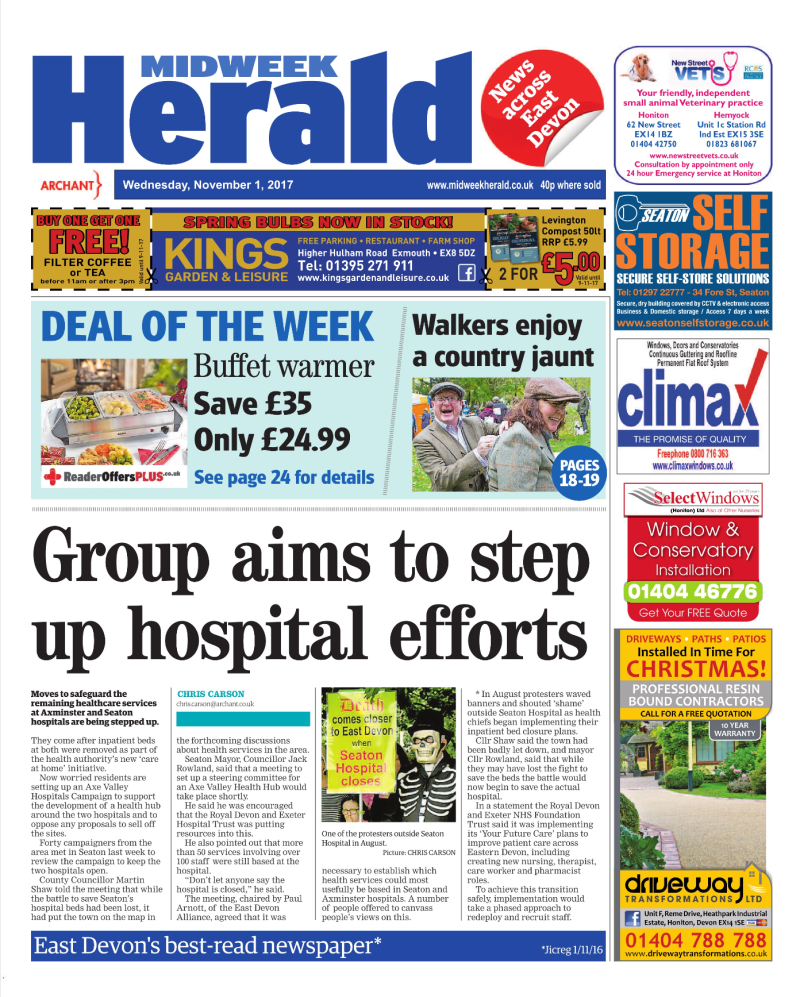
Save (what’s left of) Axe Valley hospitals hits the headlines

Things MUST be bad in the local NHS if they hit the front page of the Midweek Herald!

“Care Closer to Home”: the Torquay experience (not good)

Concerns that care in the community is failing some Torbay and South Devon residents have been raised by a health campaign body.

Gordon Jennings, chairman of the Community Health and Welfare Alliance, set up at the time of the consultation on the closures of community hospitals in Torbay and South Devon, said they feared the consequences of the closure of at least 74 beds across Torbay alone. One of the main providers of care in the area Mears Care was recently taken out of special measures by Government inspectors but they still rated it as ‘requiring improvement.’

It comes after Torbay and South Devon NHS Foundation Trust marked the second anniversary of the launch of the pioneering integrated care organisation in the area.

Mr Jennings said: “We are concerned as we have a high proportion of over 80s in the population, we should be making sure there are suitable arrangements for those people. The integrated care organisation’s argument is that the alternative to community hospitals is care at home. But they haven’t got the staff for home care. How are you going to get quality of care? Changes usually mean improvement, but it’s arguable that under the Devon NHS Sustainability and Transformation Plan (STP) this is not always the case and is a series of cuts – including the loss of 100 hospital beds.

“Evidence is being gathered on experiences under ‘Care in the Home’, but we would implore Torbay communities to become involved and share your experiences with Healthwatch Torbay, Paignton Library, who are conducting ‘have your voice heard today’ consultation on this and other health subjects.

“We need to remind ourselves that South Devon and Torbay Clinical Commissioning Group admitted at the consultation meetings in regards the lack of staff in this area. With your help it is our intention, not only to seek a meeting with the CCG, with these findings, but also Torbay Council Health and Well Being Board, who have a responsibility in this area.

“We have been seeking evidence that it isn’t working and we have had some cases come forward but we are looking for more. If people can write to us with their concerns we can take it up with the right people.”

Dr Kevin Dixon, chairman of Torbay’s independent consumer champion for health and social care, Healthwatch Torbay, said: “Healthwatch Torbay regularly shares an extensive variety of local feedback from Torbay residents on hospital discharge and community care with both Torbay and South Devon NHS Foundation Trust and the Care Quality Commission, along with relevant providers and health commissioners, in order to contribute to their intelligence reports and prompt them into any relevant action.

“Although we have heard public concerns with both discharge and community care, we have also received praise for both.

“The findings of the CQC report into Mears Care Ltd. were reflected in the feedback we have gathered from those people who shared their experiences with us, which indicated that although there was some improvement in the quality of care Mears have provided since the original CQC report in 2016, a number of issues still exist.

“We remain committed to escalating any public complaints and concerns directly with Mears Care Ltd. and continue to monitor the quality of care they provide. Healthwatch Torbay will carry on gathering local public feedback and sharing it with key decision-makers to ensure the public voice is listened to at a commissioning level.”

Michael Rennolds of Coombe Road, Preston, has muscular dystrophy and Muscular Dystrophy UK say the condition is a progressive and life limiting muscular wasting condition for which there is no cure and no effective treatment. That means he has high needs.

Joel Rackham, care and information advocacy officer has written to Torbay and South Devon Healthcare Trust saying Michael required constant individualised care and intervention over each 24- hour period including regular physiotherapy, support with food and drink, toileting and bathing needs.

They say it is critical an up-to-date care plan is in place. But they say he has lost out on several respite days as well as his care hours were reduced from 84 hours a week to 41 which the charity say is ‘insufficient to meet his care needs’ .

At the same time £16,200 was taken out of his bank account which would have been used to pay for care. The charity has asked for the money to be reinstated and say it is ‘not fair’ to expect his mother, who works part time to be expected to care for him as her health is being affected and she cannot be expected to handle Mr Rennolds on her own.

The charity has asked for a minimum of 98 hours of care per week, more than double the amount budgeted for.

Nic Bungay, director of Campaigns, Care and Information at Muscular Dystrophy UK told Devon Live: “Without the right support in place, the difficult job of helping Michael to get out of bed, get dressed, eat his meals and live his life will fall on his mother Susan. The severe and progressive nature of Duchenne muscular dystrophy means that any reduction in care is wrong, but cutting the hours in half and leaving an entire day without any provision is unthinkable. His hours need to rise to the recommended 98 hours a week immediately.”

Mrs Rennolds said the money has still not been reinstated and she had been told the consideration of her complaint had again been adjourned.

“The NHS have taken the £16,200 out of Michael’s bank account, because he wouldn’t sign some papers that were in dispute. Only an idiot would sign some papers they disputed. The charity has written stating that money has to be put back. Michael is really down about this.”

A Torbay and South Devon NHS Foundation Trust spokesman, said: “We are currently in the process of responding directly to Mr Rennolds’ complaint. “We are fully committed to providing our clients with the best possible care. We work hard to ensure that people stay as healthy and independent as possible and that those who would be at risk of injury, illness or isolation are cared for as a priority. Each client will have their individual needs professionally assessed on a regular basis and our health and care professionals will work with them to identify the best way for their needs to be met. This means we can be sure we continue to meet individual’s changing needs.

“Whilst we cannot discuss individual client cases, when clients have their needs and care plans reassessed, we always do this working in partnership with the person and jointly agree the outcome.

Direct payments are made to meet an individual’s specific care needs. In addition, as part of the national guidelines, all recipients of Direct Payments sign an agreement that states that we reserve the right to reclaim money that is not being used. If people in receipt of direct payments accumulate a significant amount of money saved from their direct payments, in line with these national guidelines, we will recover a proportion of this money which will then go towards providing care for other vulnerable people. When monies are recovered, we will always ensure a significant proportion still remains in their Direct Payment account to cover their own care costs as well as a contingency for any unexpected expenditure.”

Marilyn and Ivor Martin, of Salisbury Avenue, Torquay say they are struggling with the level of care offered at home after Ivor, 68, had a serious stroke.

Marilyn said he had a stroke out of the blue one lunchtime which has left him affected all down the left side and incontinent. She said: “I cannot fault the hospital staff at all, the ambulance staff they were incredible. He was moved to Newton Abbot and his care there was wonderful, impeccable. Then I had a visit from occupational therapy from Newton Abbot who said he was coming home. I said my house isn’t suitable.

“I have steps in my garden, I was told there was no money to do that. I have a corner bath and they said there were no aids to get him in and out of the bath so he would have to strip wash and he would need to for the rest of his life if needs be. If I wanted adaptations I would have to pay for it myself. I was offered handrails which would take six to eight weeks to install after he got home. He couldn’t get upstairs and I said I was not having him home if it was not safe. They said I would have to put a bed in the dining room. I don’t have a single bed but was told I would have to buy or borrow one. They put a rail on my bed upstairs, a commode, a rail around the toilet so he could get himself up.

“I was told if I don’t have him home he would have to go in a care home. That would cost hundreds of pounds, money which should be put into caring for people in the community. We had him home and within three days he had a hospital appointment at 12noon. I was told there would be transport but it would come at anytime between 9.30am and 11.30am, and they would pick him up any time between 1pm and 4pm. He’s incontinent, he would be sat at the hospital all that time without food. I was told ‘that’s the way it is’. We had three appointments in one week for the heart and lung department, but they said they couldn’t arrange for them all on one day so we had to get him up there three times. I took him up with my son’s girlfriend who helped, but I am lifting him in and out the car and I had open heart surgery last year. There is no thought about the carers.

“They said that while I was at work, there could be someone coming in the morning to dress him and someone to give him a sandwich at lunchtime. They said they could come any time between 7.30pm to 10.30am. He wouldn’t stay in bed that late, he’d be getting himself up and falling. I can’t have that. Then they could be back at 11am and 2pm getting him lunch. It’s ludicrous.

“I had help filling out the forms for attendance allowance but you can’t have that until they have been ill for six months. I have spent nearly £4,000 on having a ramp put in the garden and shower unit changed and putting in a second hand stairlift. The physios have been fantastic but suddenly they were told they weren’t coming again until October. His arm isn’t working at all and his hand is swollen. It’s not right. Having the physio in really boosts his morale as well. If you are going to have care in the community you have to the people to do it. Ivor could go swimming at Plainmoor Pool but there’s no way to get help taking him there, I have got to do it. If someone doesn’t have someone at home to help how do they get there?

“There needs to be an organisation that sets up a package and says you will need this, this and this and get it organised for you. In hospital they were fantastic every single nurse and doctor, but if you are going to do care in the community you need to set up what people need before you throw them out there. Nobody is helping us. “

Torbay and South Devon NHS Foundation Trust, the integrated care organisation responsible for social care in Torbay, said they could not comment as they had not had a direct complaint from the Martins. On the question of a shortage of carers a trust spokesman said: “We recognise that, like other places in the country, having enough people with the right skills and training to provide domiciliary care for people to be able to continue to be supported at home is a challenge. And there are a number of things we are doing to ensure the right level of care can be provided including supporting the campaign ‘Loving to Care’ to encourage more people to enter this very rewarding career.

A key part of how we are addressing the challenge is our partnership with a national provider of domiciliary care, Mears, This partnership helps to ensure enough carers are recruited, trained and supported to develop their skills. We extend our training and support so that carers working for all care providers are able to benefit from our training provision. This is an incredibly worthwhile profession and by supporting providers to be able to offer increased opportunities for development of their staff they are not only gaining important skills they also benefit from greater job satisfaction and are more likely to want stay in the caring profession.

“In addition to this support we also offer alternatives for people , such as direct payments which enables people to employ their own support assistant directly.”

Torbay residents can share their experiences by calling Healthwatch free on 08000 520 029, visiting upstairs at Paignton library, or even by rating and reviewing a local health and social care service online via http://www.healthwatchtorbay.org.uk. If you have a case write to Mr G Jennings, c/o Acorn Centre, Lummaton Cross, Torquay, TQ2 8ET.”

http://www.devonlive.com/news/devon-news/south-devons-pioneering-care-community-708511

“Axe Valley health hub plan launched as campaigners fight hospital sell off”

“Campaigners will continue to fight plans to sell off Seaton Hospital and to support plans for a new health hub for the Axe Valley. …

[Independent East Devon Alliance] County councillor Martin Shaw [Seaton and Colyton] said: “Forty campaigners from the Axe Valley area met in Seaton this week to review the state of the campaign for the local hospitals.

“I told the meeting that while the battle to save Seaton’s hospital beds had been lost, it had put Seaton on the map in the forthcoming discussions about health services in the area.”

Mayor of Seaton, Cllr Jack Rowland, said that a meeting to set up a steering committee for an Axe Valley Health Hub would take place shortly.

He was encouraged that the Royal Devon and Exeter Hospital Trust was putting resources into this and he also pointed out that more than fifty services involving over a hundred staff were still based at the hospital.

Campaigners will continue to fight plans to sell off Seaton Hospital and to support plans for a new health hub for the Axe Valley.

In August, a vigil was held outside Seaton Hospital as the beds inside the hospital were closed, as protesters waved banners, shouted “shame”, and expressed their anger and sadness outside Seaton Hospital as the controversial closures of community hospitals began.

Plans to remove the beds from Exeter, Seaton, Honiton and Okehampton community hospitals have been met with strong opposition since they were confirmed in March.

The North, East and West (NEW) Devon Clinical Commissioning Group (CCG) said the move will see more people being given care at home and save £2.6million.

Although the battle to save the hospital beds has been lost, a new campaign though has been set up in the Axe Valley area to support the development of a health hub in the region.

County councillor Martin Shaw said: “Forty campaigners from the Axe Valley area met in Seaton this week to review the state of the campaign for the local hospitals.

“I told the meeting that while the battle to save Seaton’s hospital beds had been lost, it had put Seaton on the map in the forthcoming discussions about health services in the area.”

He was encouraged that the Royal Devon and Exeter Hospital Trust was putting resources into this and he also pointed out that more than fifty services involving over a hundred staff were still based at the hospital. ‘Don’t let anyone say the hospital is closed’, he said.

The meeting, chaired by Paul Arnott of the East Devon Alliance, agreed that it was necessary to establish which health services could most usefully be based in Seaton and Axminster hospitals, and this might involve canvassing the views of local residents and a number of people present offered to help with this.

The meeting decided to set up a new Axe Valley Hospitals Campaign to support the development of a health hub around the two hospitals and to oppose any proposals to sell off hospital sites.”

http://www.devonlive.com/news/health/axe-valley-health-hub-plan-699423

Is a new, powerful supra-regional authority being created without public consultation?

Owl says: yes!

On 1 January 2018, a new “Joint Committee” will come into being.

It is charged with delivery of a “productivity strategy” for the whole Devon and Somerset area.

For its (sinister?) aims and objectives, see section 1.3 here:

Click to access 011117bpcabinethotsw%20jcarrangementsappendixc.pdf

Truly, we live in disturbing times as NONE of this has had ANY public consultation, yet, at EDDC, it will be decided on the nod at its Cabinet meeting on 1 November 2017:

Click to access 011117combinedcabinetagenda.pdf

Some really worrying points:

In Section 2.2 it says that the joint committee can at any time extend its powers as it sees fit.

Section 9.2 says a simple majority of votes will decide actions [the membership will be overwhelmingly Tory]

Section 12.0 Chief Executives and Monitoring Officers will be able to add items to the agenda.

NO DOCUMENT PUT FORWARD HAS ANY MENTION OF SCRUTINY OR TRANSPARENCY

The new “joint authority” authority consists of:

[MEMBERS]

Dartmoor National Park Authority
Devon County Council
East Devon District Council
Exeter City Council
Exmoor National Park Authority
Mendip District Council
Mid Devon District Council
North Devon Council
Plymouth City Council
Sedgemoor District Council
Somerset County Council
South Hams District Council
South Somerset Council
Torbay Council
Taunton Deane Borough Council
Teignbridge District Council
Torridge District Council
West Devon Borough Council
West Somerset Council

PLUS CO-OPTED NON-VOTING MEMBERS:

Heart of the South West Local Enterprise Partnership
NHS Northern, Eastern and Western Devon Clinical Commissioning Group
NHS South Devon and Torbay Clinical Commissioning Group
NHS Somerset Clinical Commissioning Group

AND ANY OTHER CO-OPTED MEMBERS THAT THE JOINT COMMISSIONING GROUP DECIDES TO INVITE

Another council refers its hospital closure to Secretary of State

“The future of the inpatient ward at Rothbury Community Hospital is going to the top, after councillors voted to refer the matter to the Health Secretary.

After the joint executive board of the Northumberland Clinical Commissioning Group (CCG) last month voted unanimously in favour of permanently closing the inpatient ward and shaping the existing services around a Health and Wellbeing Centre at the hospital, the proposed closure of the 12 beds was discussed by Northumberland County Council’s health and wellbeing overview and scrutiny committee this morning.

And now that closure is on hold and the final decision rests with the Health Secretary Jeremy Hunt. The aim of today’s meeting was to decide if the consultation with the committee had been adequate; if the committee felt the proposal would not be in the best interests of the health service in Northumberland; and therefore it it had sufficient evidence of these concerns to make a referral to the Secretary of State for Health. And as part of her statement to members, Katie Scott, from the Save Rothbury Community Hospital campaign group, reflected on this first issue.

“Surely at all stages the scrutiny committee should have been consulted? It seems to us that you have been ignored,” she said. “I believe today is the first opportunity in over 14 months for the committee to fully examine the proposal to take away our beds.”

She also questioned the reasons put forward by the CCG for the proposed closure – the alleged savings, bed underuse and the drive to treat people in their own homes – claiming all are flawed, as well as saying the consultation has been ‘defective’.

However, Stephen Young, Northumberland CCG’s strategic head of corporate affairs, outlined the lengthy process of consultation, including with the committee, and explained that it was made clear to councillors that there was no local support for the proposed closure. He added: “We believe there’s alternative, suitable provision in the area.” His colleague, Dr Alistair Blair, the clinical chairman, set out the clinical reasons behind the proposed closure, which included the fall in bed occupancy and the wider national context around more care being provided at home and why this was beneficial.

He added that they had been monitoring the impact on healthcare services elsewhere in Northumberland for 12 months while the ward has been shut and there have been no adverse consequences. “We understand that this does not have local support but we have to look at the evidence base,” Dr Blair said. “We hope the Health and Wellbeing Centre will benefit more local people.”

One local who benefitted from the ward prior to its closure was Coun Steven Bridgett’s grandmother – the care she received at the hospital prior to her death in 2012 was the focus of an emotional address by the local ward member: “Gran was so well looked after and cared for that you would forget that she was 91 and had most of her body failing her.”

It was his statement which probably resonated most with the Rothbury residents who had filled the council chamber at County Hall in Morpeth. “We are no more than numbers on paper to the CCG,” he said. Turning their attention to the three questions mentioned above, a majority of the committee members considered that the consultation with the committee had not been adequate as the preferred option for consultation, ie, the closure of the ward and the creation of a Health and Wellbeing Centre, was decided and the consultation started before being brought to the scrutiny committee, albeit the CCG brought the matter to the first available meeting once that decision was taken.

A majority of the councillors also felt that whether the proposal was in the best interests of the health service in Northumberland could not be fully assessed as it had not been made clear exactly what the Health and Wellbeing Centre will be and there were also questions over the robustness of the data in relation to future-proofing and knock-on impacts in the rest of the county.

Therefore, following around half-an-hour spent thrashing out their reasons amid advice from the council’s senior legal officer, members voted to refer the matter to the Secretary of State. In each case, members voted by five votes to two with one abstention.”

http://www.northumberlandgazette.co.uk/news/future-of-rothbury-hospital-ward-goes-to-secretary-of-state-1-8808912

Referrals by councils to Secretary of State increase – but not in Devon where local Tories said it wasn’t worth doing

“2017 is shaping up to be a bumper year for NHS service change proposals in England being referred to the Secretary of State for Health by local politicians. And that means a bumper year for initial assessments by IRP, the independent body that advises the Secretary of State. [This is what would have happened – mandatory independent scrutiny – if the DCC adult care scrutiny committee had not had a block Tory vote to refuse it – spurred on by Diviani ignoring the wishes of his own council and some very dubious chairing by Sarah Randall-Johnson. What were DCC Tories afraid of, Owl wonders?

We saw just two initial assessment letters in 2016. The assessment letter IRP published on 18 October responding to concerns raised by Thurrock Council about the location for a specialist scanner, is the fifth IRP has published this year and we’re waiting for more to progress through the system.

Local councillors are uniquely placed to understand public sensitivities around changes to local health services, so it’s no surprise that NHS legislation gives them a crucial role in overseeing health service change programmes. The role is important and the legislation sets out responsibilities for NHS and council leaders to make sure the process is effective.

The IRP’s assessment of the Thurrock referral is a timely reminder of the requirement for councils to formally join together to scrutinise proposals that affect more than one local authority area. In this case it seems Thurrock councillors declined to take part in a joint scrutiny committee and instead dealt with the matter on its own. The process is there for good reason and not following it risks weakening whatever good case a council has for making the referral.

The regulations allow councils to come together to form joint scrutiny committees whenever they see fit. The same regulations require councils to form a joint committee when “a relevant NHS body or health service provider consults more than one local authority’s health scrutiny function about substantial reconfiguration proposals”. The rules mean where a section 30 ‘mandatory joint health scrutiny committee’ is in place, only the mandatory committee is allowed to respond to the consultation; exercise the power to require information about the proposals to be provided to it; and require people from the relevant body to appear before it to answer questions relevant to the proposals.

The power to make referrals to the Secretary of State for Health is different. Councils can choose to delegate that to a mandatory joint scrutiny committee, or retain it. So the rules would have allowed Thurrock to participate in the mandatory committee and still consider the matter of referral alone. Would it have strengthened their case to have done that? It’s hard to envisage that following the required process would have weakened it.”

https://www.consultationinstitute.org/focus-health-scrutiny-irp-essex-cancer-scanner-review/

Tory DCC Councillor and Cabinet member for adult social care and health services) attends commercial enterprise event

A company looking for new home care assistants (which Owl will not name) is pulling a publicity stunt to attract both new carers and new clients. DCC and other councils (and Archant Newspapers) are said to be giving their support to such initiatives, saying that:

“The vacancy rate is estimated at 6.9 per cent with some 9,000 adult social care vacancies across the region at any one time.

And across the South West an estimated 30,000 new care jobs will be needed by 2025. …”.

The care company has arranged a Q and A meeting with local health care big wigs – including an influential Tory DCC councillor – and is publicising it via a press release (no doubt related word for word by Archant) in local Archant newspapers (coincidentally Archant being a large provider of advertisements for such jobs).

What puzzles Owl is why the DCC Tory councillor is enthusiastic to be associated with such a commercial publicity stunt when local people find it almost impossible to get him and other Tory councillors to speak about social care anywhere else? Even in DCC meetings!

You know who we mean – Councillor Andrew Leadbetter (DCC), Cabinet member for adult social care and health services.

“[A local home care company] is asking people for their views on ageing, their perception of what care means and the questions that ‘up until now they’ve been reluctant to ask’.

The home care provider has launched its (details) campaign, with pop-up events around Exeter this month, as well as on Facebook and Twitter.

On Wednesday, November 8, the top 10 questions will be put to an expert care panel, including:

Martyn Rogers (Age UK, Exeter),
Cllr Andrew Leadbetter (Devon County Council Cabinet member for adult social care and health services),
Dr Michael Dixon (GP, mid-Devon) and
William Flint [the care provider] …

… Devon County Council (DCC) and 15 other councils from across the region are also hoping to boost recruitment in the care sector with its Proud to Care campaign.”

http://www.exmouthjournal.co.uk/news/trio-of-campaigns-in-east-devon-will-kick-start-vital-conversations-about-care-1-5251282

The event is said to be on 8 November, but no venue is specified – you have to contact the home care company for more details.

“Lack of choice means families have to settle for poor care homes”

“Families are being forced to leave their loved ones in inadequate care homes, a consumer group has warned.

‘Systemic failures’ mean half of those needing care have to wait for a bed while choice is limited for many, the Which? survey found.

Some 48 per cent of those who arranged care for themselves or a loved one said there had been no places in one or more of the local homes they considered.

The lack of places meant many families – 17 per cent – were forced to move loved ones into care homes they had reservations about. And 16 per cent had to opt for a home away from friends and family. When they did find a bed, as many as 25 per cent said they were left feeling guilty or annoyed that they could not find a more suitable place.

The survey again highlights the extent of the crisis facing the broken care system. Those who go into a care home have to use their assets to pay the full costs of care until they are reduced to their last £23,250. …”

http://www.dailymail.co.uk/health/article-5022515/Lack-choice-means-families-settle-poor-care-homes.html

The scale of the social care crisis

NHS Digital figures reveal councils spent £17.5 billion on social care last year but the LGA warns services face a £2.3 billion funding gap by 2020.

The Adult Social Care Activity and Finance Report showed councils received 1.8 million requests for support last year.

Cllr Linda Thomas, Vice Chair of the LGA’s Community Wellbeing Board, said:

“These figures show councils are doing all they can to protect adult social care services. But the increase in demand and cost of services is adding to the huge pressure they are already under to support older and disabled people – keeping them at home living independently in the community.”

Source: Daily Express p9

“Get paid £1,000 a month to care for NHS patients in your spare room in drastic bid to tackle bed-blocking crisis”

No, it isn’t a sick joke – it’s in all mainstream newspapers:

Guardian:

“…The financial model is still to be finalised. Thirkettle said rooms would be rented out to funders at about £100 a night, with half going to the host. The rest would be used to pay for the care services required and a margin kept by the company as profit. He said the assumption was that it would be jointly funded by the NHS and councils. “We may also look to take self-funding patients who pay us directly.” For patients who are prepared to pay the option would be presented by a hospital’s discharge team alongside existing options such as nursing homes, he said.

https://www.theguardian.com/society/2017/oct/25/nhs-to-pilot-airbnb-type-scheme-for-patients-recovering-from-surgery

Daily Mirror:

“… Campaigners and clinicians argue that lodging frail and vulnerable patients with members of the public in return for cash is ripe for abuse. …”

http://www.mirror.co.uk/news/uk-news/paid-1000-month-care-nhs-11409267

Telegraph:

“… In return for fees of up to £1,000 a month, hosts are asked to ‘welcome the patient, cook three microwave meals a day, and offer conversation,’ the Health Service Journal (HSJ) has discovered. …”

http://www.telegraph.co.uk/news/2017/10/25/homeowners-offered-1000-host-nhs-patients-spare-rooms-airbnb/

“People want higher taxes for increased public spending, says poll”

“Nearly two-thirds of the public say government spending should increase even if that means higher taxes as support for austerity fades, according to research.

These are among the findings of a survey in Deloitte’s annual The State of the State report, which looked at changing attitudes to public spending.

The study, compiled by Ipsos Mori, found 63% of those surveyed were in favour of increasing government spending on public services, even if that means increases to some taxes.

This has risen from 59% in the same survey last year.

Rebecca George, lead public sector partner at Deloitte, said: “The chancellor was right to warn that people are growing weary of the long slog of austerity.

“This data shows people less convinced of the need to bring down public spending and increasingly seeing the effects of cuts in their everyday lives.” …”

http://www.publicfinance.co.uk/news/2017/10/people-want-higher-taxes-increased-government-spending-says-poll

Child mental health services “downgraded”

Guardian letters:

“Yet another report pleading the case for better child mental health services. The experts of the Care Quality Commission expressed “surprise to find that accessing care took so long”. I was a co-founder of YoungMinds, the national children’s mental health charity, in the early 1990s. Since then, I have taken part in or witnessed numerous reports and reviews published by all manner of concerned organisations. Their findings have consistently been the same: high prevalence of child mental disorders (approximately 10% of the child population under 15 in UK) set alongside grossly underfunded specialist services. In my experience, the situation has got worse in the last 10 years.

The problem is not only long waiting lists. Much more serious is the lack of qualified professionals to provide the necessary treatment following assessment. Commissioners of services, driven by government demands to cut costs, have gone about their business blindly and without any understanding of what it takes to provide a good service.

Previously well-functioning services have been dismantled or deformed under what is deceptively called the “transformation” of service delivery. Highly trained senior child and adolescent mental health professionals have been downgraded and submerged beneath a growth of needless bureaucracy. CBT has been the favoured treatment because it is supposed to be cheap, despite inconclusive evidence for its effectiveness, most particularly for the more disturbed children and their families.

Recent increased government funding for child mental health services has not been ringfenced; adult services have benefited more. The destruction of specialist child and adolescent services is a national scandal and no responsible person should be surprised to hear about it any more.
Peter Wilson
Co-founder and former director of Young Minds, London”

https://www.theguardian.com/society/2017/oct/24/crisis-in-mental-health-care-for-young-people