A glimpse into the size of land banking

“Kier Group will sell its housebuilding and property businesses, cut about 1,200 jobs and suspend its dividend for at least two years in a radical overhaul designed to lower debt and stabilise the business. …

[CEO] Davies said Kier had already received expressions of interest in its housebuilding business, which built 842 units in the six months to end-December, at which time it had a landbank of 4,739 plots. …”

https://uk.reuters.com/article/uk-kier-group-restructuring/kier-to-sell-housing-businesses-cut-1200-jobs-and-suspend-dividend-idUKKCN1TI0IN?

“Five million Britons – one in ten of the country – now own second homes worth a total of £1trillion”

The number of Britons with second homes has soared to 5.5million – with their extra properties worth £1trillion.

One in ten own holiday houses, buy-to-lets and overseas properties, according to the Resolution Foundation think-tank.

But the boom comes at the expense of young people, who struggle to get on the property ladder because of rising prices.

Just one in three own a home by the age of 29 – far fewer than the half of baby boomers who had one at the same age.

The Resolution Foundation said property wealth was becoming concentrated among older, richer Britons, with those born in the Fifties more likely to own a second home than any other age group.

It added that younger adults are left boosting the wealth of their parents’ generation by paying significant rental costs.

Spokesman George Bangham said: ‘The rise of additional property wealth is the flipside of falling home ownership. The scale of additional property wealth is an important driver of rising wealth gaps.

‘And as the huge stock of second homes, buy-to-let and overseas properties starts to be passed on to younger generations, Britain risks becoming a country where getting ahead in life depends as much on what you inherit as what you earn.’

The Resolution Foundation’s Game Of Homes report showed that the 5.5million people with additional property wealth had gone up by 53 per cent since 2001, and the value of their second homes increased from £610billion in 2001 to £941billion.

There are 1.9million owners of buy-to-let properties, 700,000 more than a decade ago, making it the most common form of second property. However, the number of people who own overseas property did not change at 970,000.

Since 2002, average house prices have soared from five times income to eight times income, but many believe this is the result of housing supply, not demand from those seeking a second home. …”

https://www.dailymail.co.uk/news/article-7143775/Five-million-Britons-second-homes-worth-total-1trillion-50-two-decades.html?ito=1490

Is our Local Enterprise Partnership attempting to hi-jack housing and infrastructure funding and control?

Yet another attempt by this unelected bunch of conflicted business people to suck up funding meant for local councils:

“…
Recommendations
2.1. 1.
That the Joint Committee pursue an area-based package to accelerate housing delivery which, at headline level, should include:

a. Resourcing of a strategic delivery team (capacity funding)
b. A major infrastructure delivery fund to unlock growth
c. A small schemes liquidity fund to bring forward stalled sites

2. That the proposed package as set out in appendix 1 is agreed as an
appropriate package to accelerate housing delivery across the HotSW
geography.

3. That the proposed package as set out in appendix 1 is used by officers as
the basis for future engagement with central government and its agencies in seeking to secure a bespoke deal for the HotSW area to structurally embed collaboration with central government on housing delivery.

4. That the Task Force seeks to now engage with senior figures within both Homes England and the MHCLG Growth and Delivery Unit to understand their appetite for driving growth and willingness to work with the Joint Committee on some kind of housing deal.

5. That the Task Force brings back any updates or progress to the Joint Committee to consider in due course.”

Click to access HotSW%20JC%20-%20Housing%20Task%20Force%20report.pdf

The appendix on pages 5 and 6 is particularly worrying.

And where does this leave the (stalled due to political changes) Greater Exeter Strategic Plan?

“Help to Buy: ‘Most users did not need help report finds’ “

“Almost two-thirds of homebuyers who used the government’s Help to Buy scheme could have bought a home without it, an official report has said.
However, they may not have been able to buy the house they wanted without the help, the report from the National Audit Office (NAO) found.

It also found that one in 25 of participants had household incomes of over £100,000.

The scheme did help boost the profits of building firms, the NAO said.

It was too early to determine if the scheme had delivered value for money for the taxpayer, the report said.

“Help To Buy has increased home ownership and housing supply, particularly for first-time buyers,” Gareth Davies, head of the NAO, said.
“However, a proportion of participants could have afforded to buy a home without the government’s help.

“The scheme has also exposed the government to significant market risk if property values fall, as well as tying up a significant public financial capacity.

“The government’s greatest challenge now is to wean the property market off the scheme with as little impact as possible on its ambition of creating 300,000 homes a year by 2021,” he said.

By 2023, the government will have invested up to £29bn in the scheme, tying up cash which cannot be used elsewhere,” the NAO said.

Bigger firms made the most of the scheme.

Between 2013 and 2018 more than half the sales in England made by Redrow, Bellway, Taylor Wimpey, Barratt and Persimmon involved Help to Buy.

‘Housing bubble’

Persimmon is the biggest beneficiary, with almost 15% of the sales made under the Help to Buy Scheme.

Persimmon saw its annual profits top £1bn last year.

Mike Amey, managing director of global investment management firm Pimco, has told the BBC that profit on a house sold by Persimmon had trebled since Help to Buy was introduced, “roughly from £20,000 to £60,000”.

Fran Boait, executive director of campaigning body Positive Money, said: “It’s now beyond clear that rather than helping those who can’t afford to buy a home, Help To Buy has mainly been a subsidy for a housing bubble, benefiting property developers and existing home owners.”

The government’s investment is expected to be returned from the scheme by 2032 after it closes in 2023. However, the size of the loans mean it is very much exposed to the performance of the housing market.

From April 2021, the scheme will be restricted just to first-time buyers.”

https://www.bbc.co.uk/news/business-48610977

Land: the new rhodium (the most expensive metal in the world)

“What is the most neglected issue in British politics? I would say land. Literally and metaphorically, land underlies our lives, but its ownership and control have been captured by a tiny number of people. The results include soaring inequality and exclusion; the massive cost of renting or buying a decent home; the collapse of wildlife and ecosystems; repeated financial crises; and the loss of public space. Yet for 70 years this crucial issue has scarcely featured in political discussions.

Today, I hope, this changes, with the publication of the report to the Labour party – Land for the Many – that I’ve written with six experts in the field. Our aim is to put this neglected issue where it belongs: at the heart of political debate and discussion.

Since 1995, land values in this country have risen by 412%. Land now accounts for an astonishing 51% of the UK’s net worth. Why? In large part because successive governments have used tax exemptions and other advantages to turn the ground beneath our feet into a speculative money machine. A report published this week by Tax Justice UK reveals that, through owning agricultural land, 261 rich families escaped £208m in inheritance tax in 2015-16. Because farmland is used as a tax shelter, farmers are being priced out. In 2011, farmers bought 60% of the land that was on the market; within six years this had fallen to 40%.

Homes are so expensive not because of the price of bricks and mortar, but because land now accounts for 70% of the price

Worse still, when planning permission is granted on agricultural land, its value can rise 250-fold. Though this jackpot was created by society, the owner gets to keep most of it. We pay for this vast inflation in land values through outrageous rents and mortgages. Capital gains tax is lower than income tax, and council tax is proportionately more expensive for the poor than for the rich. As a result of such giveaways, and the amazing opacity of the system, land in the UK has become a magnet for international criminals seeking to launder their money.

We pay for these distortions every day. Homes have become so expensive not because the price of bricks and mortar has risen, but because the land that underlies them now accounts for 70% of their price. Twenty years ago, the average working family needed to save for three years to afford a deposit. Today, it must save for 19 years. Life is even worse for renters. While housing costs swallow 12% of average household incomes for those with mortgages, renters pay 36%.

Because we hear so little about the underlying issues, we blame the wrong causes for the cost and scarcity of housing: immigration, population growth, the green belt, red tape. In reality, the power of landowners and building companies, their tax and financial advantages and the vast shift in bank lending towards the housing sector have inflated prices so much that even a massive housebuilding programme could not counteract them.

The same forces are responsible for the loss of public space in cities, a right to roam that covers only 10% of the land, the lack of provision for allotments and of opportunities for new farmers, and the wholesale destruction of the living world. Our report aims to confront these structural forces and take back control of the fabric of the nation. …”

https://www.theguardian.com/commentisfree/2019/jun/04/tackle-inequality-land-ownership-laws?

Government to allow Community Infrastructure Levy to fund big projects

Oooh … just in time for Cranbrook’s latest expansion plans! AND when councils all over the country are declaring a climate emergency and trying to avoid unsustainable projects. Catch 22 there for TiggerTories!

Or perhaps it will go to a new National Park – lol.

“Councils will be required to report on the agreements reached with housing developers to pay for infrastructure, under new rules laid in Parliament this week.

Housing Minister Kit Malthouse claimed that “confusing and unnecessarily over-complicated” rules were being simplified, so that communities would know exactly how much developers were paying for infrastructure in their area.

Councils will have to set out how the money will be spent “enabling residents to see every step taken to secure their area is ready for new housing”.

The Government also claimed that the changes would make it faster for councils to introduce the Community Infrastructure Levy in the first place.

Restrictions are to be eased to allow councils to fund single, larger infrastructure projects from the cash received from multiple developments, “giving greater freedom to deliver complex projects at pace”, it added.

The Minister of State said: “Communities deserve to know whether their council is fighting their corner with developers – getting more cash to local services so they can cope with the new homes built.

“The reforms not only ensure developers and councils don’t shirk their responsibilities, allowing residents to hold them to account – but also free up councillors to fund bigger and more complicated projects over the line.

“The certainty and less needless complexity will lead to quicker decisions.”

The regulations will be debated once parliamentary time allows.

The Government has also published its response to the views received in its technical consultation on developer contributions reform.”

https://www.localgovernmentlawyer.co.uk/planning/401-planning-news/40736-councils-to-be-required-to-report-on-deals-with-housing-developers

Glorious Devon?

“… The Devon Branch of the Campaign to Protect Rural England says it has been overwhelmed by the response from the public to its Greetings from Glorious Devon postcard campaign.

The group has printed thousands of cards highlighting development on green fields and is asking people to send them to Kit Malthouse, the Minister of State for Housing and Planning.

In May, Mr Malthouse announced a major new scheme to build “20,000 much-needed properties” across Exeter, East Devon and Teignbridge.

“Holiday makers come to Devon because they love the countryside, the peace and quiet, the fresh air, the seaside. Are they honestly coming to look at sprawling housing estates and traffic jams? I don’t think they are, so we’re hoping this will attract a lot of attention.” [says] Penny Mills Director, CPRE Devon

Mr Malthouse says only one per cent of England is developed with homes and the government has “failed to build enough homes over the last few decades”.”

https://www.bbc.co.uk/news/live/uk-england-devon-48431440

Cities (with highest wages) too expensive for young people to buy homes in

So, what happens when the towns and villages you do come from are just as expensive as Bristol (with wages in Exeter lower than those in Exeter)?

Well, in East Devon, you are mostly funnelled into Cranbrook – as that is where most so-called “Help to Buy” new homes are being built.

The national article uses an example of someone moving from East Devon to Bristol.

“More young people are getting stuck where they grew up or went to university because they cannot afford rents in places where they can earn more money, according to the Resolution Foundation thinktank. It found the number of people aged 25 to 34 starting a new job and moving home in the last year had fallen 40% over the last two decades. …

In 1997, moving from east Devon to Bristol increased median incomes by 19%, but rising rents cut that increase to 1% in 2018. …

Landlords blamed the government for failing to sufficiently increase the supply of new homes. The Residential Landlords Association (RLA) also criticised measures which appear to be encouraging landlords to sell up, including reduction in mortgage interest relief for landlords and an increase in stamp duty.

“The biggest threat to rent levels are the policies being pursued by the government which are choking off the supply of homes for private rent as demand is increasing,” said the RLA policy director, David Smith.

The findings came as the affordable housing commission released research found 43% of all renters were now facing affordability problems and that 5.5 million renters were unable to buy a home of their own.

The commission, which was established by the Smith Institute thinktank and chaired by the crossbench peer Richard Best, said that when rents or purchase costs exceeded a third of household income for those in work, it could lead to financial difficulties and these problems became critical where housing costs were 40% or more of household income.”

https://www.theguardian.com/society/2019/jun/06/high-rents-in-english-cities-forcing-young-to-stay-in-small-towns?CMP=Share_iOSApp_Other

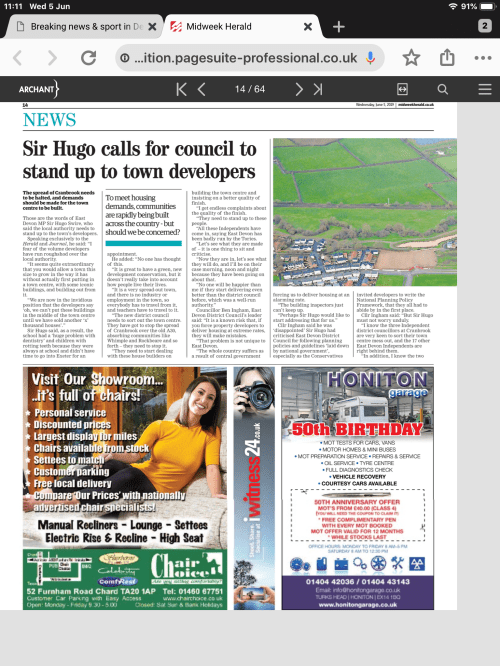
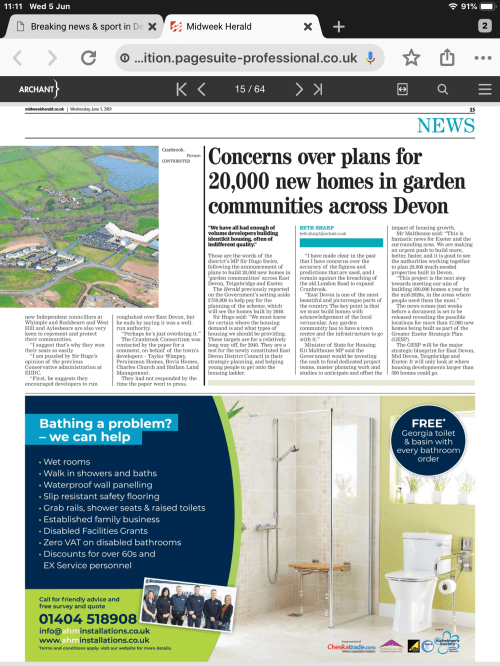
Now Tories are not in control Swire decides Cranbrook is a development problem!

Today’s Midweek Herald. SO odd that Hugo has JUST discovered that Cranbrook development is a problem … still TiggerTories involved in planning will be glad to know he is NOW onside! Such a pity he wasn’t so vocal when Tories alone were in charge!

A new way of planning: are no-overall-control councillors up for it?

” Participation not Consultation:

At Civic Voice we are aware of the growth agenda and the need for more homes to be built. Our members understand this too, yet all over England many of these members, who are knowledgeable and positive people, have had to engage in fighting Local Plans and planning proposals that they feel passionately are not right for their places.

It is time to change the way things are done and to bring communities genuinely to the heart of planning and place-making. ‘Participation not Consultation’ is about bringing people in at an early stage to develop the proposals through collaborative planning processes, also known as Charrettes.

The Charrette approach involves community members working alongside local authorities and developers to co-create design-led, visual plans and strategies. It is an inspirational and energising activity where the results of collaboration are seen immediately, with the knowledge that an individual’s input actually matters. It also has the potential to greatly increase the speed of the formal planning and design process.

Civic Voice has launched a campaign to bring these collaborative processes into mainstream planning so that, through shared working from an early stage, communities can help shape and support growth and development that is right for their place.”

Click to access Collaborative_planning_1.pdf

“Campaign to keep Brighton General Hospital land public”

“CAMPAIGNERS fighting to keep Brighton General Hospital land in public ownership are calling for more people to get involved.

About 100 people heard NHS campaigners, councillors and two MPs at a public meeting speak about the using the site for low-cost social housing.

Plans to redevelop the former Victorian workhouse at the top of Elm Grove are under discussion.

A new community health hub is proposed for the current ambulance station site, with a GP surgery and pharmacy, along with existing services for mental health, podiatry and early parenting. Health chiefs have said the cost of the project could be funded by selling the rest of the site for housing.

When Brighton and Hove City Council’s health and wellbeing board was given a briefing in November last year, one suggestion was the site be used to build homes for health workers.

An online petition, calling for meaningful public consultation about the future of the site, as well as asking for community beds and homes for social rent has more than 1,300 signatures.

Green councillor David Gibson said the site was a public asset in a city with “horrendous” housing problems. He added the Greens and Labour councillors and activists from the Brighton Housing Coalition, Sussex Defend The NHS and the Save Whitehawk Hill group had come together to shift the agenda to social housing.

Cllr Gibson said: “Privatisation and inequality have gone together. This country has become one of the most unequal countries in the developed world.

“You get better outcomes if you narrow inequality. If you want to narrow inequality, you need public provision, public support and public services which are decent.”

He said the council’s chief executive Geoff Raw would be meeting the board of the Brighton General landowner, Sussex Community NHS Foundation Trust, to discuss options.

The campaign is pushing for the site to be taken into council ownership.

Carolyn Pickering, of Sussex Defend The NHS, reminded the audience the NHS freed people from the fear of choosing which child to spend their savings on if one became ill. She said: “The land is still part of the NHS. The NHS belongs to us and the land belongs to us so they should not be allowed to sell it.”

Council leader Nancy Platts said: “We will be inviting all interested parties into meetings about the Brighton General site and this includes the Sussex Community NHS Foundation Trust as well as those campaigning about the future use of the site.”

https://www.theargus.co.uk/news/17673627.campaign-to-keep-brighton-general-hospital-land-public/

“Slums Croydon: ” Political pygmies” and their rabbit hutch flats

This is legal:

Offices to homes permitted development has led to some of the tiniest micro-flats being built in Croydon.

“PDR, as it is known, has managed to strip local authorities of their planning powers, but left them to deal with the costs and consequences arising from such developments. The government is considering extending PDR, allowing shops to be converted into flats or for extensions to be built without requiring any planning permission.

In Croydon, where the local authority used legislation to block any further office-to-resi conversions in the town centre after 2014, senior councillor Sean Fitzsimons has called such flats, “the slums of the future”.

But that was not before planning permission had already been given for the lucrative conversion of offices to at least 2,700 flats in the borough, and where some of the “micro-flats” are being marketed to Chinese investors, with one-bed apartments fetching £280,000.”

‘Political pygmies’ to blame for Croydon’s ‘slums of the future’

“An influential figure in British architecture has hit out at office-to-flat conversions – of which there have been thousands in Croydon – describing them as “ghastly little f**k-hutches”, and all thanks to policy which is being ruined by “political pygmies”.

“Copley has also discovered that 1,837 London PDR flats are smaller than the legal minimum standards, and that 240 were less than half this lowest threshold.

In a statement issued from Copley’s City Hall office they said, “Some of the worst examples are seen in Croydon where 80 per cent of properties identified failed to meet minimum space standards, including one development where the smallest flat was just 10 square metres.”

That flat is in Urban House on Cavendish Road in West Croydon.”

Slums of the Future: Croydon has capital’s smallest micro-flat

The new “sustainable” villages – beware estate rentcharges

Cranbrook has not recovered from the arrangenent where developers imposed charges on residents of their estates for such things as gardening and maintenance. In the end, the town council took over these charges and spread them over ALL residents, many of whom were naturally upset at extra charges they had never signed up for.

“Estate rent charges” – another warning on new-builds such as those in Cranbrook

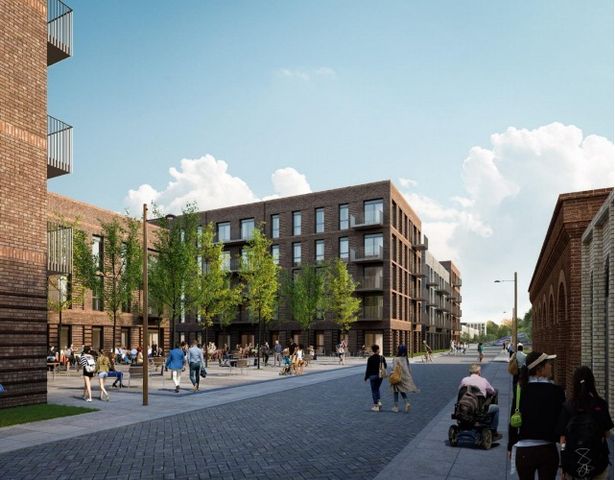
Now, the new (brutalist architecture) estate developer in Exeter says it will severely restrict parking by having only 185 car parking spaces for 400 homes and residents will need permits to use the spaces.

BUT enforcement of these parking restrictions will be done by “a specialist management company which will patrol the site to ensure vehicles are parked within dedicated spaces and to ensure that non-residents aren’t using the site”.

And who will pay these charges? Just those who have parking spaces or ALL residents? And who will control escalation of the charges?

The Greater Exeter “mini-village” – quality or quantity?

A correspondent, on seeing the post a couple of days ago about a new “mini-village” in Exeter:

https://eastdevonwatch.org/2019/05/28/design-for-new-mini-village-in-exeter/

has deja-vu as it appears to mimic another time and (local)place! Owl is still wondering if this was a late April Fool prank …!

“Kensington Council Made £129m From Selling Property That Could Have Prevented Cost-Cutting At Grenfell”

“Kensington and Chelsea council made £129m from selling property in the years leading up to the Grenfell fire tragedy – money which we can show for the first time could have prevented cost-cutting on the tower’s renovation works.

An investigation by HuffPost UK, the Bureau of Investigative Journalism and the BBC Local Democracy Reporting Service can reveal the property deals overseen by senior officers and the council’s cabinet in the run up to the Grenfell disaster.

Evidence shows one of these deals was directly linked to the financing of the Grenfell Tower renovation and our investigation reveals that the council had far greater power over its funding of the works than it has previously admitted.

The council has previously claimed legal restrictions meant it could only use rental income from local authority housing to pay for renovation works. But this was not the case.

In fact, the council’s own documents show £6m of the Grenfell works was paid for with proceeds from the sale of council property – basement units in Elm Park Gardens in Chelsea.

The government has confirmed to us that councils are free to use money from the sale of property to fund improvements in housing stock.

This new information means the council had a far larger pot of money available to invest in its council housing than it has previously acknowledged – including on Grenfell Tower.

Our investigation also found the council had £37m in the bank, specifically from the sale of property, at the time when funding decisions over Grenfell were being taken.

But in 2014, cuts were made to the budget for building work by the tenant management organisation that was managing the project, including saving £300,000 by using cheaper, more combustible cladding.

The cladding was a key contributor to the speed with which the fire tore through the building on June 14, 2017, killing 72 people and leaving hundreds of families homeless.

The revelations have prompted fury over why spending on the Grenfell works was tight when the council had a significant income stream that could have been used to increase the budget. …”

https://www.huffingtonpost.co.uk/entry/kensington-chelsea-council-property-sales-grenfell_uk_5ced6003e4b0bbe6e3342f04?utm_hp_ref=uk-homepage&guccounter=1

Design for new mini-village in Exeter

Is this an example of the level of design we can expect in Greater Exeter? Breathtakingly beautiful isn’t it (not!):

https://www.devonlive.com/news/devon-news/400-homes-pretty-village-green-2916444

“Oxfordshire’s Housing and Growth deal at risk after local elections”

Well, not much chance of this here now so many Tories stull continue to have great influence over East Devon and Greater Exeter development:

“THERE is concern a major deal with Government could be scrapped if a council decides it does not want to take part.

All Oxfordshire councils signed up to the £215m Housing and Growth Deal and it was officially agreed in March 2018.

It provides £150m for infrastructure improvements, including to roads and railways, and £60m for affordable housing.

But there is concern within other authorities after the new coalition led by Liberal Democrats and Greens at South Oxfordshire District Council said they planned to review its Local Plan.

Sources within the councils have said there are worries the Government could pull out of the deal if it is delayed. It ripped up a similar plan in Manchester in March.

But Ian Hudspeth, the leader of Oxfordshire County Council, said: “We have got to wait and see what the councils say. It is entirely up to them but having £60m for affordable homes is a major issue to the councils. Losing that would be very upsetting for everyone.

“Everyone needs to be very careful about what they do and the consequences.”

When the Growth Deal was signed, the Government told the councils that they had to submit their Local Plans to an independent inspector by the start of April. They are outlines of where authorities plan to develop until the mid-2030s.

In South Oxfordshire, Lib Dems and Greens are opposed to the plan – although they appear to be against different parts.

It is understood the Greens would rather continue the project to build homes at Chalgrove Airfield and stop development on the Green Belt. But senior Lib Dem David Turner is wholly opposed to building on the airfield. He represents Chalgrove on the council.

Leigh Rawlins, SODC’s newly appointed cabinet member for planning, said the council would undertake a review over the Local Plan as part of ‘mature consideration’ following the election.

He said: “Clearly there has been a huge amount of concern about the Local Plan, the process and how it came together across the district.”

The uncertainty has left some residents furious, who are worried that Neighbourhood Plans they helped put together could be delayed or even scrapped as part of the Local Plan.

Justine Wood, who worked on East Hagbourne’s Neighbourhood Plan, said a delay to the Local Plan could mean speculative development.

She said: “There were 1,200 homes planned for East Hagbourne, which would have quadrupled the size of the village (through speculative development). It would have been catastrophic.

“But if they scrap the Local Plan they will get more than the 28,500 they are objecting to and they will have nothing they can do about it.”

The Ministry of Housing, Communities and Local Government cancelled a £68m deal for affordable housing with the Greater Manchester Combined Authority (GMCA).

GMCA said it would build 227,200 homes until 2034/5 – but then later committed to just 201,000 homes.

https://www.oxfordmail.co.uk/news/17650662.oxfordshires-housing-and-growth-deal-at-risk-after-local-elections/

“Regulator warns housing stock-owning local authorities of application of consumer standards”

“The Regulator of Social Housing has written to the chief executives of all housing stock-owning local authorities to remind them that the watchdog’s consumer standards – in particular in relation to the health and safety of occupants – apply to them.

The move follows a letter sent by the Regulator after the Grenfell Tower fire to all registered providers of social housing to remind them of their obligations for their tenants’safety under the Regulator of Social Housing’s Consumer standards.

Since that first letter, the watchdog has issued regulatory notices to two local authorities in respect of compliance with the Home Standard (which is one of the consumer standards), and specifically a range of health and safety requirements. …

MacGregor noted that that obligation remained with the local authority where it is the stock-owning body, even if the management has been contracted to another body such as an ALMO.

She then cited an extract from the original letter saying, amongst other things, that meeting health and safety obligations was a primary responsibility for registered providers, and that boards and councillors must ensure that they have proper oversight of all health and safety issues.

The first letter stressed that contracting out delivery of services did not contract out responsibility to meet the requirements of legislation or standards, so providers needed systems to give boards assurance of compliance.

It also said that should any provider find that they have systemic failings in relation to internal control of health and safety, which indicate that they were not in compliance with the Standard, based on the co-regulatory approach, the Regulator expected them to notify it as Regulator and resolve the issues immediately.

Ms MacGregor said her latest letter was “a reminder to local authorities that the consumer standards apply to them and that while we currently only consider information that is referred to us, this does not diminish the obligation on local authorities to comply with the standards.

“Currently, legislation only permits us to take enforcement action where there has been a breach of a consumer standard, and that breach has, or could, cause serious detriment to current or future tenants. As can be seen from our various Consumer Regulation Review publications, we most commonly find breach and serious detriment in relation to the Home Standard.”

She added: “You may wish to seek your own assurance that your authority is complying with the consumer standards.”

https://www.localgovernmentlawyer.co.uk/housing-law/397-housing-news/40654-regulator-warns-housing-stock-owning-local-authorities-of-application-of-consumer-standards

“Housing market ‘to be dealt a serious blow’ as most new home sales use Help to Buy scheme”

Many of the new homes in Cranbrook are bought using this scheme.

“Almost all new homes in some parts of the country are funded by the Help to Buy equity loan scheme, raising fears about a house price slump when the programme ends.

The Government lends buyers up to 20pc of the cost of a new-build house, meaning the would-be homeowner only needs a 5pc deposit and a 75pc mortgage. In London users of the scheme can borrow up to 40pc of a home’s value.

More than 97pc of new homes in Northampton were funded by Help to Buy last year, according to modular housebuilder Project Etopia. In Burnley the figure was 93.1pc, in Derby 92.4pc and in Warrington 91.4pc. …”

https://www.telegraph.co.uk/money/consumer-affairs/housing-market-dealt-serious-blow-new-home-sales-use-help-buy/

Research has shown it adds on average £33,000 to the cost of a new home:

https://eastdevonwatch.org/2019/04/14/help-to-buy-costs-first-time-buyers-an-average-33000-extra/

Greater Exeter Strategic Plan: change or no change?

Now that the Local Election is over, we can see from this report in the Sidmouth Herald:

https://www.sidmouthherald.co.uk/news/possible-locations-for-new-devon-villages-set-to-be-released-1-6061225

that potential sites for new villages in support of the Greater Exeter Strategic Plan (GESP) have been found and are due to be unveiled shortly.

A whopping 57,000 new properties cross the four council areas adjoining Exeter will have to be built to satisfy Exeter’s growth aspirations.

Quite soon, therefore, we can expect that the newly elected Councillors who represent us on the GESP, Councillor Susie Bond and Councillor Philip Skinner, will have to decide how many new villages East Devon will take and where they will be sited. Obviously close proximity to Exeter will be a significant factor and places like Lympstone, Woodbury, Clyst St Mary, Farringdon and West Hill must be in the frame.

To give an example of the impact to expect. A tiny community between Broadclyst and Pinhoe – Westclyst, has had a whopping 1200 houses imposed upon it. Where the highest quality agricultural land lay four years ago, bounded by about 30 bungalows, there are now sprawling housing estates.

In the past these decision have been kept a closely guarded secret. Will the new regime now act with transparency and openness?

We know from the CPRE study on “Devon’s Housing Needs” that:

•​Far too many homes are already being planned for Devon in the next 10 years.
•​Two thirds of these will be occupied by inward migration.
•​Vacant and second homes are becoming a problem across the County.
•​We in East Devon are taking a disproportionate share of development. Our Local Plan annual housing target is the highest in the Greater Exeter Area: 58% higher than Exeter, 53% higher than Teignbridge and nearly three times that of Mid Devon.
•​Whilst we are planning too many houses, we are failing to plan for enough homes of the right type in the right location, especially for locally generated households.

Ex Councillor and one time Leader, Paul Diviani boasted in council, just before Christmas, that the high growth policy he advocated for East Devon was justified because “we have the land and we are good at it”.

In the election Paul Diviani was decisively rejected by the electorate, receiving a derisory 319 votes.

On 3rd May the voters clearly voted for change but are they going to get it?