“NHS outsourcing ‘put patients at risk’ “

THIS IS EXACTLY WHAT OUR CCG IS ATTEMPTING TO DO – SLASH COSTS AND IMPLEMENTING NEW MEASURES AT THE SAME TIME YEY OUR DEVON TORIES ARE HAPPY FOR THE CCG TO EXPERIMENT ON US UN THIS WAY!

“Incompetent staff may have been allowed to carry on practising, the watchdog warned

“Patients were put at risk of cancer and other serious harm because of a botched £330 million NHS outsourcing deal, the spending watchdog has found.

An attempt at cost-cutting has led to more than two years of chaos in back-office services for GPs, opticians and dentists, the National Audit Office said.

Dozens of women were wrongly told that they no longer needed cervical cancer screening and incompetent staff may have been allowed to carry on practising, the report concludes.

The outsourcing company Capita and NHS England are still bickering about the deal, leading to failures including a backlog of half a million patient registrations, the NAO warns.

“Trying to slash costs by more than a third at the same time as implementing a raft of modernisation measures . . . potentially put patients at risk of serious harm,” Meg Hillier, chairwoman of the public accounts committee, said.”

Source: The Times (pay wall)

CCG somewhat opaque on future of Honiton and Seaton hospital closures

Owl says: This is the sort of Press Release the CCG excels at. Telling us what the situation is at present but giving no guarantees that there will not be future cuts to current services (some of which, such as dermatology in Seaton, have already been closed.

Owl would also like to know how many of the extra 20,000 deaths noted in the first quarter of this year were in East Devon.

From EDA DCC Councillor Martin Shaw:

“NEW Devon CCG have issued the attached statement criticising ‘inaccurate information’ about Honiton and Seaton hospitals, after Dr Simon Kerr, Chair of the CCG’s Eastern Locality, was credibly reported as saying that these two hsopitals are ‘at risk’ in their Local Estates Strategy due this summer.

I welcome the CCG’s statement that it has no plans to close either hospital. However it has not denied that Dr Kerr said that they were at risk.

The CCG could end this controversy today if it gave an unequivocal assurance that both hospitals will continue for the foreseeable future with the present or enhanced levels of service. People in Honiton and Seaton were badly let down by the CCG over hospital beds and they won’t trust them now without a clear statement that our hospitals are safe in the coming Local Estates Strategy.”

The statement from the CCG reads:

“There have been reports today that the future of Honiton and Seaton Hospitals is under question.

NHS Northern, Eastern and Western Devon Clinical Commissioning Group wishes to make clear that there are no plans to close Honiton and Seaton hospitals.

In March 2017, the Governing Body of NHS Northern, Eastern and Western Devon Clinical Commissioning voted to implement a number of changes following a 13 week public consultation. This included the decision to close inpatient beds at both Honiton and Seaton hospitals.

Beds were closed in both hospitals in August 2017 as more care was introduced to look after people at home. Both hospitals are still open, thriving buildings providing more than 50 day services and clinics combined.”

“NHS has lost 1,000 GPs since Jeremy Hunt set workforce target”

Pulse is the newsletter for GPs:

“The GP workforce in England is continuing to decline, as official statistics reveal that 316 full-time equivalent GPs have left the profession in the last three months.

The figures released by NHS Digital today also reveal that the number of FTE GPs in the workforce has decreased more than 1,000 since September 2015 – when health secretary Jeremy Hunt announced he would increase the number of FTE GPs in England by 5,000.

NHS England is recruiting from overseas in a bid to boost GP numbers, but Pulse revealed last month that they had only managed to recruit 85 by April – despite originally touting the figure of 600.

The latest statistics show that in the last three months, the workforce has fallen from 33,890 FTE GPs in December 2017 to 33,574 as of 31 March 2018.

Meanwhile, the workforce is 1,018 GPs worse off than it was in September 2015.

This is despite the success of NHS England’s induction and refresher scheme, which has tempted 546 GPs back into the workforce since its launch in 2015.

The news comes as a Pulse investigation, published earlier this month, showed a steep rise in the number of GPs claiming their pension early. Since 2013, almost 3,000 GPs have claimed their pension before the age of 60.

The BMA has previously warned the Government that continued sub-inflation uplifts to GP pay is going to further exacerbate GP workforce shortages, having asked the independent review body on doctor’s pay to recommend a 2% uplift for 2018/19.

Dr Richard Vautrey, chair of the BMA’s GP Committee, said the latest workforce statistics are ‘extremely concerning’.

He said: ‘It’s more than two and a half years since the health secretary promised to recruit 5,000 more GPs before 2020, and these figures are a damning progress report. With less than two years until this target date, the trend is clearly going the other way and it’s a sign that a step change in action needs to be taken.

‘As GPs struggle with rising demand, increasing workloads and burdensome admin, and are expected to do so with insufficient resources, it’s no surprise that talented doctors are leaving the profession and although the number of GP training places have increased, this is not enough to address the dire recruitment and retention crisis.’

RCGP chair Professor Helen Stokes-Lampard said: ‘These figures are yet another hammer blow for family doctors, for whom going the extra mile is now the norm, and for our patients. The stark truth is that we are losing GPs at an alarming rate at a time when we need thousands more to deliver the care our patients need, and keep our profession, and the wider NHS, sustainable.

‘It is clear that substantial efforts to increase the GP workforce in England are falling short – and we need urgent action to address this. We have made great strides over the past couple of years encouraging more medical students and foundation doctors to choose general practice, but these efforts will be futile, if more GPs are leaving the profession than entering it.’

She said this comes as ‘GP workload is escalating, both in volume and complexity, and the hardworking GPs we do have are burning out as we try to cope without the resources and support we need’.

‘Longer and longer days in clinic is what our members are telling us they face when they come to work in the morning, exacerbated by a mountain of bureaucracy and paperwork. This isn’t safe for GPs, our teams, or our patients, and if it isn’t tackled GPs will continue to leave the profession early, and new GPs will be put off from joining,’ she added.

Labour’s shadow health secretary Jonathan Ashworth said the data marked ‘yet another broken promise on NHS staffing from ministers’.

‘It’s an embarrassing failure for the secretary of state that far from delivering the extra GPs primary care desperately need, there are now 1,000 fewer family doctors than in 2015.

‘The truth is that the Tories have failed to bring forward a sustainable long term plan for the NHS. The consequence is the biggest financial squeeze in its 70-year history and a failure to recruit the frontline doctors and nurses we need to care for patients.’

A department of health and social care spokesperson said: ‘We are committed to meeting our objective of recruiting an extra 5,000 GPs by 2020. This is an ambitious target and shows our commitment to growing a strong and sustainable general practice for the future.

‘More than 3,000 GPs have entered training this year, 1,500 new medical school places are being made available by 2019 and NHS England plans to recruit an extra 2,000 overseas doctors in the next three years.’

http://www.pulsetoday.co.uk/news/gp-topics/employment/nhs-has-lost-1000-gps-since-hunt-set-workforce-target/20036703.article

“Suspension of birth services at Honiton Hospital extended”

“The suspension of birth services at Honiton maternity unit has been extended.

The Royal Devon and Exeter NHS Foundation Trust (RDE) has today delayed its reintroduction until mid-September 2018.

The Trust took the decision last year to temporarily suspend births and subsequent in-patient stays at Honiton Hospital.

It said the step was taken to maintain patient safety due to a combination of factors affecting the stability of the services at this site and the other units it operates in Tiverton and Exeter.

Zita Martinez, head of midwifery at the RDE, said: “We are sorry for this continued suspension in services. Although we have successfully recruited to a number of our midwifery vacancies, we are still managing a high level of staff absence, including maternity leave.

At the same time, the positively received implementation of national policy in the Better Births and Saving Babies’ Lives guidance has meant that the complexity and acuity of women and babies we are caring for has significantly increased.

“This means that our main maternity unit in Exeter is experiencing greater levels of demand on the specialist care that we provide.

“In the context of increasing complexity, re-opening Honiton maternity unit for births and in-patient stays would result in the Trust stretching our workforce too far and potentially compromising safety in our other delivery units.”

The Trust has agreed with NEW Devon Clinical Commissioning Group to extend the suspension of births and subsequent in-patient stays at both Honiton and Okehampton until mid-September 2018 in order to ensure the safety of services across a wider geographical footprint and therefore, for more women and babies.

All antenatal and post-natal appointments, support clinics and home births will continue as normal in both communities.”

http://www.midweekherald.co.uk/news/suspension-of-birth-services-at-honiton-hospital-extended-1-5517432

East Devon Alliance DCC Martin Shaw responds to threat of full closure of Seaton Hospital

“Martin​ Shaw
County Councillor for Seaton and Colyton​

LETTER TO THE CHAIR OF NEW DEVON CCG

Dear Dr Burke,

We have seen draft notes prepared by 38 Degrees of your meeting with them on April 5th. According to these, Simon Kerr said (before your own arrival) that Seaton and Honiton hospitals were ‘at risk’ in the coming Estates Strategy. These remarks, written down at the time, have been confirmed to us by several participants. While we appreciate that no formal decision may have been taken, there seems little reason not to take them as a clear indication of CCG thinking.

As the two elected local politicians on the organising group of Seaton Health Matters, the community conversation launched together together with the CCG and RD&E, we hosted Dr Kerr at the launch meeting on 23rd March, which also heard Em Wilkinson-Bryce (copied in) appeal to the audience to trust in the ‘good intentions’ of the speakers from the NHS organisations. We have no reason at all to doubt her sincerity, but it is difficult for us to believe in the good faith of Dr Kerr and the CCG, as (unless he had only just picked up the names of the ‘at risk’ hospitals) it seems to us that you may have helped launched us into a discussion of local health needs knowing that you may be moving to deprive us of our major health resource, Seaton Hospital.

Our initial Health Matters discussion broached many areas of constructive cooperation between the local community and the NHS, which we are keen to pursue. However it also left no doubt of the need to maintain the 50+ outpatient services currently based in the Hospital, the desirability of bringing in additional services if place-based care is to be meaningful, and the needs of an elderly community (with significant pockets of deprivation and poor public transport) for as many clinics, etc., as possible on the doorstep rather than in other towns. We are ready to explore the possibility of a combined health hub for the Axe Valley, but on the basis that services would be more or less equally shared across the two hospitals and there would be no reduction in the overall level of services in each. The other thing that was clear from our discussion was that the community considers the Hospital a community resource since its building was half-funded by local donations and it has been maintained by local contributions ever since. I am sure that people in Axminster and Honiton feel the same about theirs.

You should not underestimate the local anger, only just subsiding, over the removal of beds from Seaton Hospital. It bears repeating that this was widely regarded, including outside Seaton, as an unjust choice based on a misuse of the JSNA data and misleading assumptions about the relative agedness of the populations of Seaton and Sidmouth (their age structure is in fact almost identical and the comparison did not justify a choice of Sidmouth over Seaton). It was also based on false claims that the Sidmouth option would involve a better geographical spread: a glance at the map would have shown that, on the contrary, it left the remaining community beds concentrated in the southwestern corner of East Devon with none in the Axe Valley. There is similar feeling in Honiton because the Your Future Care consultation did not even include an option which would have retained their hospital’s beds.

We mention this history not to try to reverse the beds decisions (although the shortage of beds in the recent winter should lead to it being looked at again) but because the treatment of Seaton and Honiton in those decisions should be a reason for generosity in the distribution of outpatient services and in the Estates Strategy. It is adding insult to injury to place Seaton and Honiton on a shortlist of potential closures. Having switched your decision last time against Seaton, you should now reconsider again in Seaton’s favour. This is not, of course, to suggest that any other hospital should be closed instead. On the contrary, all East Devon towns have community hospitals which reflect real local needs and you should be devising a system of health hubs which enables all communities to have a solid base for place-based care.

The next meeting of Seaton Health Matters is scheduled for 24th May. We do not wish it to be dominated by the fallout from Dr Kerr’s remarks but without an unequivocal assurance that Seaton Hospital will remain open, it is unavoidable that this will be the main topic of discussion.

We look forward to hearing from you at the earliest opportunity. We have also copied this to Sonja Manton since we discussed the Health Matters process with Em and her before it began. We should like to meet with you about this, but before the 24th any meeting would have to be late that afternoon or on the 23rd, as one of us is away until the morning of the 22nd.

Regards,

Martin Shaw
County Councillor for Seaton & Colyton

Jack Rowland
Seaton Town Council”

Seaton and Honiton hospitals “at risk ” of full closure says CCG

“CCG chair says Seaton and Honiton hospitals ‘at risk’ of closure in Local Estates Strategy”

POSTED ON MAY 14, 2018 by Councillor Martin Shaw

It has been revealed that Dr Simon Kerr, Chair of NEW Devon CCG’s Eastern Locality, told a meeting with representatives of 38 Degrees on 5th April that Seaton and Honiton hospitals were ‘at risk’ in the CCG’s Local Estates Strategy due in July. His remarks were taken down by the 38 Degrees member who produced draft notes of the meeting, and have been confirmed by other participants, but have not yet been confirmed by the CCG.

Although the hospitals both lost their inpatient beds last summer, Seaton Hospital currently hosts over 50 outpatient services (and there are probably at least as many in Honiton). Both are vital community health resources, created with decades of financial and practical support from people all around the Seaton and Honiton areas.

As part of a move to promote ‘place-based care’, the CCG and RD&E are currently taking part in two ‘community health conversations’, Honiton’s Health Matters and Seaton and Area’s Health Matters, which local voluntary groups, town and parish councils etc. are involved in. However if place-based care means anything, it should mean that communities should keep their local hospitals as health hubs, with more rather than fewer services.

Together with Cllr Jack Rowland, who stood down as mayor of Seaton last week but remains the town council’s representative on the Health Matters organising group, have written to Dr Tim Burke, Chair of the CCG, to ask for an unequivocal assurance that the hospitals will remain open.

I am hoping to shortly announce a meeting of the hospital campaign group.”

https://seatonmatters.org/

The cost of austerity and underfunding – 20,000 extra deaths last winter

We cost the NHS and Social Services nothing when we are dead.

“Researchers have called for an urgent investigation to find an explanation for more than 20,000 ‘additional deaths’ so far this year, amid severe pressure on the NHS.

Figures from the Office for National Statistics (ONS) show that in the first sixteen weeks of the year, there were 20,215 more deaths in England and Wales compared to the previous five years.

In March, academics raised concerns that Britain was facing a rise in mortality and argued that “health chiefs are failing to investigate a clear pattern of worsening health outcomes”, in an editorial for the British Medical Journal (BMJ).

The piece centred on the finding that there were 10,000 ‘additional deaths’ in the first seven weeks of the year and concluded “that neither ‘flu, nor cold weather appeared to be the main cause.”

Now the authors have now updated their findings to account for fresh statistics covering the first sixteen weeks of the year.

Their response, published on the BMJ website this week, argues that the latest statistics “sadly provide little reassurance of this being a ‘blip’ as some have suggested.”

There were 198,943 deaths in the first sixteen weeks of 2018, compared to an average of 178,778 deaths in the same period over the previous five years. The rise represents an 11.3 per cent increase on the five year average.

The weekly average for the same period was 12,434 deaths, ahead of the five year average of 11,174. The 20,215 figure is equivalent to an ‘additional death’ every eight minutes throughout the first sixteen weeks of the year. …”

https://www.telegraph.co.uk/news/2018/05/11/calls-urgent-investigation-explain-20000-additional-deaths/

Swire discovers “health hubs”

Written Answers – Department of Health and Social Care: Health Services (9 May 2018)

https://www.theyworkforyou.com/wrans/?id=2018-04-30.139412.h&s=speaker%3A11265#g139412.q0

Hugo Swire: To ask the Secretary of State for Health and Social Care, what his Department’s policy is on the establishment of health and wellbeing hubs in former community hospitals.”

Owl’s policy is that NHS community hospitals are much more important than commercial juice bars and personal trainers and should therefore be funded BEFORE health hubs, not abandoned to insert “health hubs” in their place.

Austerity and our NHS: in the relegation zone in football terms

Owl says: so, in football terms England has 8 men playing in a game with a full Barcelona premier, super-fit 11-person team. With our 8-person team consisting of six people waiting for hip operations and 2 blocking beds awaiting their home care packages!

“… The stark findings come from a new King’s Fund analysis of health data from 21 countries, collected by the Organisation for Economic Cooperation and Development. They reveal that only Poland has fewer doctors and nurses than the UK, while only Canada, Denmark and Sweden have fewer hospital beds, and that Britain also falls short when it comes to scanners.

“If the 21 countries were a football league then the UK would be in the relegation zone in terms of the resources we put into our healthcare system, as measured by staff, equipment and beds in which to care for patients,” said Siva Anandaciva, the King’s Fund’s chief analyst.

“If you look across all these indicators – beds, staffing, scanners – the UK is consistently below the average in the resources we give the NHS relative to countries such as France and Germany. Overall, the NHS does not have the level of resources it needs to do the job we all expect it to do, given our ageing and growing population, and the OECD data confirms that,” he added.

The report concludes that, given the dramatic differences between Britain and other countries: “A general picture emerges that suggests the NHS is under-resourced.”

The thinktank’s research found that the UK has the third-lowest number of doctors among the 21 nations, with just 2.8 per 1,000 people, barely half the number in Austria, which has 5.1 doctors per 1,000 of population.

Similarly, the UK has the sixth-smallest number of nurses for its population: just 7.9 per 1,000 people – way behind Switzerland, which has the most: 18 nurses, more than twice as many.

With hospital beds, the UK has just 2.6 for every 1,000 people, just over a third of the number in Germany, which has the most – 8.1 beds – and which places the UK 18th overall out of the 21 countries which the OECD gathered figures for. The number of hospital beds in England has halved over the last 30 years and now stands at about 100,000, though the NHS added about 4,000 more as an emergency measure in December, January and February to help it cope with the spike in patient numbers caused by the long, cold winter.”

https://www.theguardian.com/society/2018/may/05/nhs-lowest-level-doctors-nurses-beds-western-world

The epidemic of community hospital closures shows no signs of slowing down …

We in East Devon feel your pain:

“Former MP slams plans to close Teignmouth Hospital – the first purpose build NHS Hospital in the UK”

The area’s former MP says:

“We need more hospital beds. The Germans have 8.13 beds per 1000 people but the UK only has 2.61 beds per 1,000, and this needs to improve as there is a local and a national need for beds.”

https://www.devonlive.com/news/devon-news/former-mp-slams-plans-close-1516807

https://www.devonlive.com/news/devon-news/former-mp-slams-plans-close-1516807

“RURAL RESIDENTS FACE SOCIAL CARE ‘LOTTERY'”

The government’s system of funding social care services is unsustainable and unfair for rural communities, the Rural Services Network has warned.

Service providers operating across rural areas face inequitable costs compared to their urban counterparts for both adult and child social care, said the network.

Rural council taxpayers also faced unfair costs, warned the network in response to an inquiry by MPs who are examining the long-term future of adult social care.

RSN chief executive Graham Biggs said: “Social care is a national issue but it is in crisis.

He added: “While continuing to be delivered locally with flexibility for councils to respond to local circumstances and priorities, it should be 100% funded by central government to provide an adequate core service level for all residents nationally – irrespective of where people live.

“Council tax is an unsuitable taxation vehicle for demand responsive services and means rural residents face a postcode lottery when it comes to social care provision.”

Mr Biggs said council tax should only be used to fund social care if a given local authority decided extra money was needed to boost services above a core level locally.

It should not be used to fund the core, national, service, he added.

Mr Biggs said: “It costs substantially more to provide social care in rural areas than it does in larger towns and cities – and there is higher demand for services in rural areas.

“As a statutory duty, services have to be prioritised and other budgets – such as rural transport support, for example – are being cut significantly as a consequence.”

This was because older people make up a higher proportion of the population in rural areas than they do in urban areas, said Mr Biggs.

At the same time, the twin challenge of isolation and distance made it harder and more expensive to deliver services to dispersed rural populations.

Such costs inevitably and unfairly penalised rural councils – and were compounded by issues such as poor economies of scale and poorer external markets for delivery.

Mr Biggs said: “A future formulae to fund social care services must fully reflect the different costs of delivery imposed by both geography and population.”

http://www.rsnonline.org.uk/rural-residents-face-social-care-lottery

“Don’t save it for the duchess. All new mothers should be treated like royalty”

Very difficult to do that when local maternity units such as Honiton are closed so many routine births AND emergencies have to travel 20-30 miles plus to Exeter:

https://www.theguardian.com/commentisfree/2018/apr/24/duchess-cambridge-new-mothers-royalty

DCC cabinet refuses to accept decision of Health and Social Care Scrutiny Committee and rushes in Accountable Care Organisation without checks and balances

Claire Wright’s blog:

“The all Conservative Devon County Council Cabinet has thrown out its own health watchdog’s unanimous resolution on deferring the implementation of Devon’s Integrated Care System, while a range of assurances were received.

Dozens of objections from members of the public came flooding in at the 22 March Health and Adult Care Scrutiny Committee meeting and my resolution on the thorny issue, which can be found here –

http://www.claire-wright.org/…/devons_nhs_asked_to_provide_…

… had been backed unanimously by councillors.

A revised resolution that the Cabinet supported yesterday, merely noted that a new system was being set up and everything else was so watered down as to be almost meaningless.

The message was repeated at length that this was not an endorsement but simply noting that it was happening and that progress will be monitored.

I reminded the cabinet of the County Solicitor’s advice to the Health Scrutiny Committee in November that it is unique in scrutiny committees in that we provide a legal check on health services – the only legal check – and that our remit is to take up issues of public concern. And we were flooded with emails of public concern.

I then went through the issues as I saw them.

When summing up, Cabinet member, Andrew Leadbetter, accused me of bringing a set of ‘pre-determined’ proposals to the Health and Adult Care Scrutiny Committee.

This is a serious allegation and I immediately asked him to withdraw it. Leader, and Cabinet Chair, Cllr John Hart, backed me up and Cllr Leadbetter retracted his statement.

I had in fact prepared the proposals during the lunch-hour before the meeting. it is quite permissable (and very common) to conduct business in this way.

There was cross party support for the Health Scrutiny resolution with Cllrs Alan Connett, Brian Greenslade and Rob Hannaford also addressing Cabinet along similar lines.

Here is the Cabinet’s final resolution, which you can compare with my proposals which are set out in yesterday’s post below:

(a) that the original recommendations of the Cabinet (a – d), as outlined in Cabinet Minute *148 and reproduced below, be re-affirmed:

(i) that the key features of an emerging Devon Integrated Care System being a single Integrated Strategic Commissioner, a number of Local Care Partnerships, a Mental Health Care Partnership and shared NHS corporate services, be noted.

(ii) that the proposed arrangements in Devon as set out in paragraph 4 of the Report be endorsed, reporting to the Cabinet and Appointments and Remuneration Committee as necessary.

(iii) that the co-location of NHS and DCC staff within the Integrated Strategic Commissioner, subject to agreement of the business case, be approved; and

(iv) the Health and Adult Care Scrutiny Committee be invited to include Integrated Care System governance in its work programme.

(b) And, in light of the Scrutiny Committees deliberations, Cabinet further RESOLVE

(i) that the Health and Wellbeing Board is reformed to lead new governance arrangements for the development of integrated strategic commissioning of health and social care; and

(ii) that there is continued proactive communication to the public using clear and consistent messaging and where appropriate there will be relevant involvement and engagement.”

Here’s the webcast – https://devoncc.public-i.tv/…/po…/webcast_interactive/325467

“DCC cabinet decides tomorrow if to back Health Scrutiny resolution over controversial health plans”

Claire Wright’s blog, as she ploughs (with EDA DCC Councillor Martin Shaw) the lonely furrow of integrity and common sense – both sadly lacking in the DCC Health and Social Care Scrutiny Committee:

“Devon County Council’s cabinet will decide tomorrow whether to back the Health and Adult Scrutiny Committee’s resolution on deferring the implementation of the controversial Integrated Care System, which many local people have huge concerns over.

At the last Health and Adult Care Scrutiny Committee on 22 March, I proposed the following which was supported by the majority of the committee.

An additional line on a public engagement, was voted down by Conservative councillors:

Here’s what the cabinet will be considering. If it supports the resolution, it will be implemented with immediate effect…..

I will be speaking in support of the resolution tomorrow…… If you are keen to know the outcome or hear the discussion, the meeting is webcast live here – https://devoncc.public-i.tv/core/portal/home

(a) record the Committee’s concerns over the emerging Devon Integrated Care System being a single Integrated Strategic Commissioner, a number of Local Care Partnerships, Mental Health Care Partnership and shared NHS corporate services;

(b) defer the implementation of the Integrated Care System process until assurances are provided on governance, funding, the future of social care from a democratic perspective;

(c) recommend Councillor Ackland’s paper and proposals on the reformation of the Health and Wellbeing Board as a sound democratic way forward to provide the necessary governance on a new integrated system;

(d) give assurance that the proposals will not lead to deeper cuts in any part of Devon as a result of the ‘equalisation of funding’; and

(e) provide a copy of the business plan being developed and a summary of views from staff consultations.

For more background on Integrated Care Systems see my blog
post –

http://www.claire-wright.org/…/devons_nhs_asked_to_provide_…

The Crowdjustice judicial review of Accountable Care Organisations – update

“Update on OUR NHS – Comprehensive Healthcare for All – STAGE 3

Hello Friends

As a backer you know our Judicial Review, challenging NHS England’s contentious Accountable Care Organisation contract, will be heard on Tuesday 24th April at Leeds High Court, 1 Oxford Row Leeds LS1 3BG

We’d like to invite supporters and fellow campaigners to a rally outside the courts from 9. 30am, to support the vital NHS principles our Judicial Review aims to defend. We will be inviting Press & Media.

This week we had a really good meeting with our legal team from public law firm Leigh Day and Landmark Chambers, to discuss the ‘skeleton case’ – a summary outline – which is due to be sent to the court in the next few days.

The skeleton case is based on our deep concern that the payment mechanism proposed for the Accountable Care Organisation contract is not only unlawful under current NHS legislation – but will lead to restrictions and denial of NHS care, and the abandonment of the core NHS principle of providing comprehensive care to all who have a clinical need for it, free at the point of use.

This would mean replacing treatment based on patients’ clinical need with treatment based on assessments of financial risk and returns – a total departure from core NHS principles, replacing them with health insurance company principles.

This is because the Accountable Care Organisation contract requires NHS commissioners to pay a fixed lump sum to cover the whole range of services for the population in a given area – rather than the present system which pays NHS providers an agreed price for the treatments they have actually delivered to patients.

Without reference to the number and complexity of treatments delivered to patients, the ACO contract’s proposed fixed population payment would pass financial risk to the providers – and from providers to us the patients.

Why? Because if providers were to get more patients needing more complex treatments costing more than the fixed lump sum they receive, they would face spending money they don’t have. They’re not likely to want to do that. The only way to avoid that would be to restrict or deny patients’ access to treatments. Particularly patients whose treatments are more costly and whose prognosis means their treatment is not such good value for money.

In our view, NHS England is playing fast and loose with existing NHS law about how prices are set and payments are made for health care provided to NHS patients.

Although we don’t in any way support the 2012 Health and Social Care Act, which increased private companies’ access to NHS contracts, fragmented the NHS and removed the Secretary of State’s duty to provide a universal, comprehensive health service in England, it is the law.

If NHS England wants to change price setting and payment methods for the provision of NHS services, it should do it in accordance with the law. If changing payment mechanisms means changing the law, that is something for Parliament – and the public that puts MPs there – to decide.

Ask yourself… “what happens when government and its quangos decide they are above the law?” It doesn’t bear thinking about.

As well as being undemocratic, NHS England’s proposed changes to how NHS services are priced and paid for would undermine the NHS as a comprehensive health service for all who have a clinical need for it.

They are about enabling moves to a cut price, bargain basement NHS that uses the same business model as the USA’s limited state-funded health insurance system that provides a restricted range of health care for people who are too poor or old to pay for private health insurance.

Thanks for your support so far.

Please share this with friends and campaigners.

We will fight this all the way.”

Health Cheque Up

£20bn for the NHS over 5 years!

Does that mean that the CCG will cease its destruction of Devon’s NHS services? Does it mean that current numbers are now meaningless?

Or does it mean that the cash will arrive too late to prevent this or not arrive at all?

Or does it mean that most of the cash will be directed to marginal Tory seats before a General Election?

Campaign group forces further consideration of “integrated care” in Devon

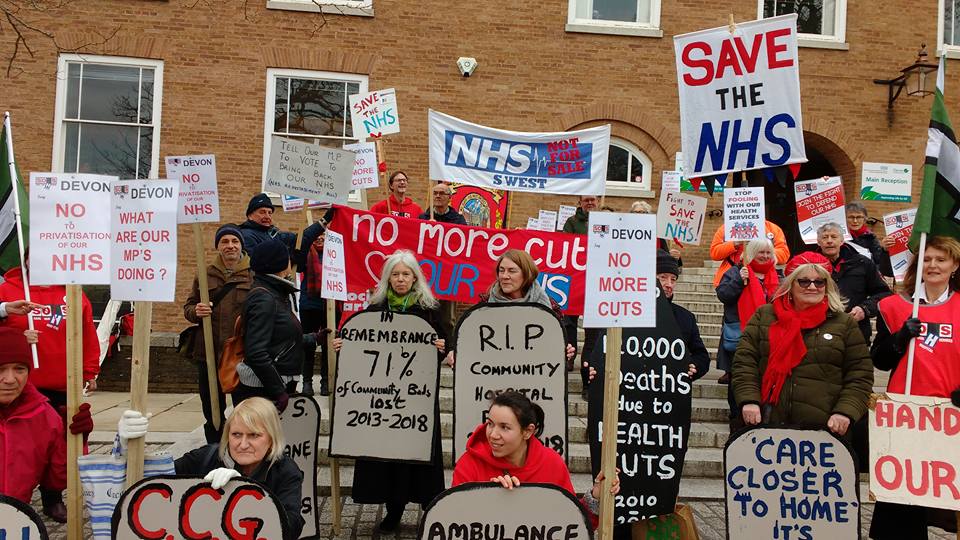
Save Our Hospital Services scored a major victory today when after its demonstrations (including another one today):

Emails, public speaking and media onslaught led to the DCC Health Scrutiny Committee refusing to agree to the commencement of the secretive and undemocratic imposition of an “Integrated Care System” (accelerating privatisation of health and social care) being forced on the county from 1 April 2018 (probably not coincidentally April Fool’s Day).

Well done SOHS!

BUT remember we are in the national local government election period and it may well be that, once this has passed, the Tory enthusiasts for this privatisation by the back door may well rediscover their taste for it!

“Councils face ‘almost impossible struggle’ to fund social care””

“Revenue from council tax and business rates in England will not keep pace with a growing social care need – and the funding gap will significantly increase, the Institute for Fiscal Studies warned today.

Even if council tax revenues increased by 4.5% a year, adult social care spending is likely to amount to half of all revenue from local taxes by 2035, the IFS has predicted.

There is “no easy way to square the circle”, the think-tank recognised in its report Adult social care funding: a local or national responsibility?, “without backtracking on reforms to local government finance and reintroducing general grant funding”.

Grant funding from government is planned to end by 2020, and councils will be expected to rely on council tax and business rates for most of their revenue.

If councils meet their social care costs through local tax revenues “the amount left over for other services – including children’s services, housing, economic development, bin collection – would fall in real terms (by 0.3% a year, on average)”, the IFS warned in the report, funded by the Health Foundation charity.

One in 10 councils are to see their share of the population aged 75 and over increase by 6 percentage points or more over the next 20 years, the IFS noted.

Potential solutions all have drawbacks, the report suggested.

These include a ring-fenced top-up grant from government but this could lead to councils cutting back on how much of their own money is allocated to these services.

If government fully funded social care, this would “remove over one-third of what councils currently spend from local control, reducing residents’ say in local spending decisions”, the report stated.

Polly Simpson, research economist at the IFS, said: “The government has to decide whether it thinks adult social care is ultimately a local responsibility, where councils can offer different levels of service, or a national responsibility with common standards across England.

“If it opts for the latter, it cannot expect a consistent service to be funded by councils’ revenues, which are increasingly linked to local capacity to generate council tax and business rates revenues.”

David Phillips, associate director at IFS, suggested the government could “decide to keep and, over time, increase the general grant funding for councils that it currently plans to abolish in 2020”.

He added: “More radically, it could devolve revenues from other more buoyant taxes, such as income tax, to councils to help fund local services.” …
http://www.publicfinance.co.uk/news/2018/03/councils-face-almost-impossible-struggle-fund-social-care

Hunt fires warning shots about social care

“Jeremy Hunt has promised an upcoming green paper will “jump start” a debate with the public about how social care should be funded in the future.

Speaking to an audience of social care workers on Tuesday, the health secretary recognised the “economics of the publicly funded social care market are highly fragile” and said care models needed to “transform and evolve”.

He said: “We will therefore look at how the government can prime innovation in the market, develop the evidence for new models and services, and encourage new models of care provision to expand at scale.”

Hunt outlined seven key principles the government is considering as it draws up its social care green paper, due to be released before the summer.

He added: “We must make sure there is a long-term financially sustainable approach to funding the whole system.”

He added that this would “take time” but “must not be an excuse to put off necessary reforms”.

“Nor must it delay the debate we need to have with the public about where the funding for social care in the future should come from – so the green paper will jump-start that debate,” Hunt promised.

He also said he would look at making paying for social care fairer and less dependent on the “lottery of which illness” a person gets.

He explained the green paper would look at giving people greater control over the care they received, announcing he would consult on personal health budgets. …”

http://www.publicfinance.co.uk/news/2018/03/hunt-vows-social-care-green-paper-will-spark-funding-debate

“WHY WE CANNOT ACCEPT THE INTEGRATED CARE SYSTEM, by the Councillor who first exposed the CCGs’ plans”

PRESS RELEASE

“I am the County Councillor who first put the ICS (Integrated Care System) on the Council’s agenda, at the last Health Scrutiny in late January. This is what has led to the item at today’s meeting. Then, the CCGs and the Council’s leadership had failed to bring the proposals to Council ​- ​although they had been agreed since September. ​They did not want debate on the proposals in the Council – still less for the public to know what is planned.​

I shall be telling Health Scrutiny [Committee, meeting today] that even now, despite having 6 months to produce proper information, they still haven’t revealed some of the most ​worrying aspects of the ICS:

funding of services in the new system, how contracts will work, and whether these will lead to privatisation

details of the proposed Local Care Partnerships for N, S, E & W Devon and for Mental Health which are key to the system, and how they will be funded/contracted

the governance of the system – as things stand, Devon County Council could be handing over control of its social care services to unelected quangos (the CCGs)​​

plans for public engagement – the Cabinet paper says this is necessary but there are no proposals.

However, we do know there will be equalisation of funding between Eastern and Western Devon. Because the CCGs say Western Devon is relatively underfunded, this means deeper cuts in Eastern Devon – probably including closures of community hospitals. Scrutiny should reject this ‘equality of misery’.

On governance, I support the proposals of Cllr Hilary Ackland that if integrated commissioning in the ICS is to go ahead, a reformed Health and Wellbeing Board with proper all-party representation should become the integrated commissioning board. Democratic control is not an optional extra.

Devon County Council cannot support these proposals as they stand. Without full answers to our questions, Health Scrutiny should call in the plans.

I should be happy to talk to (journalists) today​. I shall be with the Save Our Hospital protestors ​outside County Hall ​between 12.30 and 1​ or you can phone me on ​07972 760254.

Martin Shaw
Independent East Devon Alliance County Councillor for Seaton & Colyton”