Sidmouth Neighbourhood Plan gets underway with Public Meeting, Tues 19 January, 7pm, St Teresa’s Church Hall

“The new composition of Sidmouth Town Council, resulting from the May 2015 elections, has allowed a Neighbourhood Plan (NP) to get started at long last. A Neighbourhood Plan, as you may know, gives some protection against speculative development.

Save Our Sidmouth hopes that you will show your support for this essential work, by coming along to the Town Council’s information meeting on Tuesday 19th January 2016, 7pm, St Teresa’s Church Hall, Connaught Rd (N.B. not Woolbrook Rd, as originally stated …”

http://saveoursidmouth.com/2016/01/14/sidmouth-neighbourhood-plan-gets-underway-with-public-meeting-tues-19-january-7pm-st-teresas-church-hall/

Clyst St Mary Update

From the Save Clyst St Mary campaign

Firstly, on behalf of the Save Clyst St. Mary campaign, I would like to wish everyone a ‘Happy New Year’ and thank you all for your invaluable support during 2015. Believe it or not, it has been twelve month since we first got together and formed the group. During the year we have had many ups and downs, but so the balance has been in favour of the former; let’s hope that remains the case for 2016!

Local Plan

You may have read that the Local Plan (covering all of East Devon) has been inspected in great detail by HM Planning Inspectorate and is now deemed to be sound. It will now move to the Adoption phase which should protect the village from the onslaught of large scale, inappropriate planning applications on the extremities of of our village.

Neighbourhood Plan

The Neighbour Plan which will protect the village itself is now in its final pre-submission Consultation phase (16 Jan – 1 March 2016). A copy of the draft Plan can be found on the Bishops Clyst Planning website at:

http://www.planning.bishopsclyst.co.uk

or you can go along to one of the open sessions as listed below:

– Clyst St Mary Village Hall Saturday 6th February 1pm-6pm
– Sowton Village Hall Saturday 13th February 1pm-6pm
– Cat and Fiddle Inn Wednesday 10th February 10am – 1pm

Fibre-optic broadband

Our village has taken all of the capacity that has been provided so there are no fibre lines free at the moment. I have been in contact with Openreach and they are in the process of arranging for a second green cabinet to provide an additional one hundred lines. Apparently this is not as straightforward as it may seem, so there will be some delay before they are able to offer fibre-optic broadband to residents requesting an upgrade.

Flooding at Winslade Manor

Thank you to all the residents who got in contact to tell us about the water cascading out of the grounds of Winslade Manor (Friends Provident). We alerted the Authorities and action was taken by both the Police and the Environment Agency to resolve the problem. We have since submitted photographic evidence to East Devon District Council as obviously we would not want the proposed new houses to flood!

The following Planning applications have all either been withdrawn or refused:

Cat and Fiddle Retirement Village/ Cat and Fiddle housing development/ application by Plymouth Brethren for 40 houses/ Solar Farm off Oil Mill Lane

6 Applications for 296 houses on Friends Provident Site:
This continues to be assessed by East Devon District Council and we still await the outcome. We have worked hard with Charlie Hopkins to ensure we present as strong a case as possible.

Thank you, once again, for your continued support (and patience when it comes to signing letters); we desperately hope that 2016 is just as successful. Please remember: as an individual, it really difficult to win a battle, but as a united community we can be a powerful force for good.

Developer free-for-all: you ain’t seen nothing yet!

Hook Norton, Oxfordshire, Cotswolds, 4.5 miles from PMs Chipping Norton home. population around 2,000.

Local plan – tick
Five year land supply – tick
Neighbourhood plan – tick

Local council gets a planning application for 54 houses over and above local plan and neighbourhood plan, next to a dairy. Council says NO – it’s not in our approved Local Plan, not in our approved Neighbourhood Plan and too close to the cows: smelly and insects.

End of development – right?

WRONG!

Developer goes to appeal – planning inspector finds in their favour. Sent to Secretary of State – he agrees.

“In the secretary of state’s view, development of the whole appeal site would not necessarily conflict with [the neighbourhood plan], providing construction were to proceed incrementally in the form of three or more separate phases, each of no more than 20 dwellings built at say five year intervals. In view of this, the secretary of state considers that the degree of conflict between the proposal and [the neighbourhood plan] is limited and he finds no evidence that any significant material harm would ensue if this”, the letter said.

Overall, the letter said that Clark considered that the benefits of the development “would clearly outweigh the harm in terms of the limited conflict with the [neighbourhood plan] and the slight adverse effect on future occupiers as a result of odours generated by the adjacent Redlands Dairy Farm. He therefore concludes that the material circumstances in this case indicate that the appeal should be allowed and outline planning permission granted.”

RESULT: forget your Local Plan, forget your Neighbourhood Plan, forget your 5 year land supply – if a developer wants to build 54 houses next to pong and insects, that’s fine.

So, NPPF, Local Plans, Neighbourhood Plans, five year land supply can ALL be over-ridden by a developer, planning inspector and the Secretary of State.

It is to be hoped that there will be a judicial review – otherwise we might as well all rip up all three documents and leave the developers to it – we will have no planning rights at all.

More changes to planning policies: will they ever get it right?

10 things you need to know about this week’s consultation on changes to the National Planning Policy Framework (NPPF), including proposals to amend the planning policy definition of affordable housing, plans to require higher density development around commuter hubs, and a new presumption in favour of brownfield housing development.

1. Sanctions for under-delivering on housing targets mooted
Local planning authorities that fail to deliver the homes set out in their local plans could be required to identify ‘additional sustainable sites’, which could include new settlements, according to the consultation. It sets out further details on the operation of the housing delivery test announced in last month’s Spending Review. It says that the government proposes to amend planning policy to make clear that where significant under-delivery is identified over a sustained period, action needs to be taken to address this. “One approach could be to identify additional sustainable sites if the existing approach is demonstrably not delivering the housing required,” the consultation says. MORE.

2. Affordable housing definition broadened
The government proposes to amend the national planning policy definition of affordable housing “so that it encompasses a fuller range of products that can support people to access home ownership. We propose that the definition will continue to include a range of affordable products for rent and for ownership for households whose needs are not met by the market, but without being unnecessarily constrained by the parameters of products that have been used in the past which risk stifling innovation”. MORE.

3. Councils told to plan for needs of those who aspire to home ownership
The consultation says that the government proposes to make clearer in policy the requirement to plan for the housing needs of “those who aspire to home ownership alongside those whose needs are best met through rented homes, subject as now to the overall viability of individual sites”.

4. Push for higher densities around commuter hubs
The consultation proposes a change to national planning policy “that would expect local planning authorities, in both plan-making and in taking planning decisions, to require higher density development around commuter hubs wherever feasible”.

5. Fresh policy backing for new settlements
The government proposes to strengthen national planning policy to “provide a more supportive approach for new settlements, within locally-led plans. We consider that local planning authorities should take a proactive approach to planning for new settlements where they can meet the sustainable development objectives of national policy, including taking account of the need to provide an adequate supply of new homes”.

6. A presumption in favour of brownfield housing development
The consultation says that the government will “make clearer in national policy that substantial weight should be given to the benefits of using brownfield land for housing (in effective, a form of ‘presumption’ in favour of brownfield land). We propose to make it clear that development proposals for housing on brownfield sites should be supported, unless overriding conflicts with the local plan or the National Planning Policy Framework can be demonstrated and cannot be mitigated”. MORE.

7. Call for release of unviable employment land
The government intends to amend paragraph 22 of the NPPF “to make clear that unviable or underused employment land should be released unless there is significant and compelling evidence to justify why such land should be retained for employment use”.

8. Scope of Starter Homes initiative widened further
The scope of the current exception site policy for Starter Homes could be widened to incorporate other forms of unviable or underused brownfield land, “such as land which was previously in use for retail, leisure and non-residential institutional uses (such as former health and educational sites)”, according to the consultation document.

9. Neighbourhood planners to identify green belt Starter Home sites
The government proposes to amend national planning policy so that neighbourhood plans can allocate appropriate small-scale sites in the green belt specifically for Starter Homes, with neighbourhood areas having the discretion to determine the scope of a small-scale site.

10. Green belt brownfield policy test faces revision
The consultation says that the government proposes to amend the current policy test in paragraph 89 of the NPPF that prevents development of brownfield land where there is any additional impact on the openness of the green belt to “give more flexibility and enable suitable, sensitively designed redevelopment to come forward”

The consultation closes on 25 January 2016.

Consultation on proposed changes to national planning policy is available here.

http://www.planningresource.co.uk/article/1376060/nppf-consultation-10-things-need-know

“Government planning reforms threaten to ‘destroy’ urban/rural boundaries”


“Boundaries preventing the spread of development across the South West countryside could be “destroyed” by proposed changes to national planning policy, campaigners have warned.

Members of the Campaign to protect Rural England (CPRE) claim the Government’s reforms would open up land around towns and villages to a “flood” of new planning applications.

They also argue they would make it harder for rural communities to push for the prioritisation of brownfield sites, while undermining local control over the wider planing process.

The criticisms from the campaign group come in response to a new Government consultation on plans to reform to the National Planning Policy Framework. The aim of the changes is to boost house building – thereby addressing the UK’s growing housing crisis – by simplifying and speeding up the planning process.

Policies outlined in the document include increasing development around so-called “commuter hubs”, creating up-to-date registers of brownfield sites for new housing, and freeing up “unviable” commercial land for discount starter homes. Ministers say these proposals will encourage the delivery of high quality new homes “that the country needs”.

However, some measures, including plans to loosen restrictions for development on Green Belt sites, have come under fire from conservation groups. And the CPRE has warned that even areas like Devon and Cornwall, which do not have Green Belts, will still be affected by reforms.

One policy in particular suggests that more consideration could be given to applications for small developments “adjacent” to settlement boundaries, which act as a dividing line between urban and non-urban areas. Matt Thomson, CPRE head of planning, said this could signal the end of clear cut barriers to the development of greenfield sites.

“Those boundaries have been drawn up with good intention, usually with the support of local people, to give them certainty about how development will or will not take place in their areas,” he said.

“While we recognise that there needs to be some development, this changes the established direction of planning policy…It would destroy those boundaries.

“It opens the floodgates to speculative developments because it’s raising the hope for people that they might be able to get a development on the edge of a village.

“We expect small towns and villages will be flooded with applications for these kinds of developments as a result.”

He added that while the charity supports the overall aim to tackle the lack of new housing in the UK, a focus on planning rather than the construction industry “never has the desired impact”. He also suggested that the Government should look to achieve some of its goals by empowering local communities, including through the use of neighbourhood plans.

This is a view shared by some councillors, who have expressed concern about the impact on local control of the planning process. North Devon District Council member Brian Greenslade said the reforms could see ministers “tighten the screws on local democratic decision taking”. This would be with a “very clear drive” to “open goalposts for developers” and render local planning authorities “impotent”, he added.

“With the economic recovery not making the progress the Government wants they will resort to the blunt instrument of housing development at any price to fuel growth,” he said. “They give no consideration whatever to the impact on established communities and the infrastructure provision needed to support large housing developments.

“There are unintended consequences for housing arising from what the Government seem to be proposing.”

Responding to some of the criticisms, a Department for Communities and Local Government spokesman said changes would give communities a bigger say in deciding where developments go.

He said: “No settlement will be imposed on local communities.

“These proposals are about delivering the homes local people have already agreed and have been tested through consultation and public examination.

“Local people now have a bigger say in deciding where developments should and shouldn’t go and what is needed in their area thanks to our planning reforms.”

Councils say the proposals still need “careful consideration” to fully understand their implications. East Devon District Council said it would seek members’ views before drawing up a response to the consultation, which closes on January 25.

The implications for affordable and starter homes

Government proposals to reclassify discount starter homes as affordable housing have been a growing source of concern in recent week, particularly among rural residents.

There are fears that the prioritisation of these properties over rented accommodation could see even more low income families priced out of the countryside.

These have been re-enforced by the Government’s new planning consultation, which suggests rural sites set aside for affordable housing should be used to deliver its home ownership strategy.

Critics have been quick to point out that with caps for starter homes set at £250,000, these properties will remain out of reach for many residents of rural Devon and Cornwall.

“The proposal for starter homes with a 20% discount is fool’s gold and will not assist many young local people to buy a home,” says North Devon councillor Brian Greenslade. “The very real need is for homes for rent because of the large gap between average incomes and average house prices.

“As a survey in the Western Morning News recently shows, people on average incomes in our area would need a pay increase of some 130% to get them to the point where they may get a mortgage.

“The Government’s ideas of selling off social housing just simply will make a difficult situation worse … Local young people are facing an appalling outlook for their housing needs.”

The consultation indicates that some councils could be granted powers to introduce a local connection test when allocating affordable homes in rural areas. This would allow local authorities to prioritise the needs of local residents in “exceptional” circumstances.

Matt Thomson of the Campaign to Protect Rural England is sceptical about whether this policy will make a significant difference.

“It’s a good idea in principle but they can be difficult to manage in practice,” he said. “These local connection tests are already used in other areas with patchy result – it is often difficult to prove local connection.

“Starter homes have a role where there is a large amount of young people who would like to own a home but can’t quite afford it,” he added. “But the problem is, once they’re bought and occupied, they’re no longer a starter home – there’s no affordability in perpetuity.”

http://www.westernmorningnews.co.uk/Government-planning-reforms-threaten-destroy/story-28348092-detail/story.html

Time running out to comment on Budleigh Neighbourhood Plan

“There are just 11 days to go until the Budleigh Salterton neighbourhood plan questionnaires must be returned. So far, around 360 completed surveys have been received.”

http://www.exmouthjournal.co.uk/news/last_chance_to_have_a_say_on_budleigh_salterton_neighbourhood_plan_1_4323004

Clarification re. Clyst St Mary

From Gaeron Kayley of the Save Clyst St Mary campaign:
‘Since the Bishops Clyst Parish Council Meeting on Monday night (16th November) at the Village Hall, it has come to our notice that some of those who attended the meeting were confused by the presentation on the sports and recreation proposals incorporating the Friends Life site, the Plymouth Brethren site and the Clyst Valley Football Club site, with some residents believing that the Save Clyst St Mary Campaign was responsible for this presentation and were, in fact, in agreement with the options put forward for the future proposals on these three areas of adjoining land that were explored during the evening.

Both the Parish Council in their Emerging Neighbourhood Plan and The Save Clyst St Mary volunteers have worked tirelessly to protect the green field areas owned by Friends Life and Plymouth Brethren and are adamant that these areas should remain unspoilt as they are outside of the Built-Up Area Boundary for the village.

The concept of the land being used for the community as a sports and recreation area is agreeable in principle by both the Parish Council and the Save Clyst St Mary Campaign.
However, the Save Clyst St Mary Campaign have not been party to or participated in any negotiations concerning land swapping by the Clyst Valley Football Club and Plymouth Brethren to facilitate any residential or other development on these green areas and, indeed, we were unaware of such proposals until they were mentioned at Monday’s meeting, when one of our representatives challenged such proposals.
Be assured that our interests lie in protecting this village from inappropriate unsustainable development and the protection of these green areas are paramount and will remain at the forefront of our Campaign and should you wish to discuss any issues please feel free to contact us at  saveclyststmary@gmaol.com ‘


A few tips for the Colyton and Colyford Neighbourhood Plan

First of all, a useful link to what EXACTLY is the role of a town or parish council in the formation of a Neighbourhood Plan

What is the role of a parish or town council in neighbourhood planning?


In a designated neighbourhood area which contains all or part of the administrative area of a town or parish council, the town or parish council is responsible for neighbourhood planning.

Where a parish or town council chooses to produce a neighbourhood plan or Order it should work with other members of the community who are interested in, or affected by, the neighbourhood planning proposals to allow them to play an active role in preparing a neighbourhood plan or Order.

The relationship between any group and the formal functions of the town or parish council should be transparent to the wider public. For example it should be clear whether a steering group or other body is a formal sub-committee of the parish or town council. The terms of reference for a steering group or other body should be published and the minutes of meetings made available to the public.

http://planningguidance.planningportal.gov.uk/blog/guidance/neighbourhood-planning/who-leads-neighbourhood-planning-in-an-area/

And this website will be useful to those who are not entirely certain that the parish council has grasped what transparency means:

http://www.ourneighbourhoodplanning.org.uk/

From which we glean the following information:

Examination by a suitably qualified independent person:

The neighbourhood plan examination is one of the most important stages of the process. The plan must be examined by a suitably qualified independent person who does not have an interest in any land that may be affected by the neighbourhood plan. The examiners role is to test the plan against the basic conditions and ensure the legislative requirements have been met. Following the examination a report will be issued which will include a recommendation on whether the plan should proceed to referendum.
Here are some top tips on how to make the process of appointing an examiner as smooth as possible:
• Remember the Local Planning Authority (LPA) is responsible for appointing the examiner and paying for the cost of the examination. However, the qualifying body must agree with the appointment. It is the responsibility of the LPA to ensure the examiner:

a) is independent of the qualifying body and the authority,
b) does not have an interest in any land that may be affected by the draft order, and
c) has appropriate qualifications and experience.

Given the extensive interest in land that Colyton Council and Feoffees have, this appointment will be crucial.

Colyton: where a committee chair is elected before the comittee is chosen!

Queer goings-on in Colyton where the first public meeting to discuss developing a Neighbourhood Plan descender into chaos and must at times seemed like an episode of “Yes, Minister”.

According to the “View from Colyton” (see digital edition online) the first public meeting – where it was anticipated that people would be informed and a committee chosen – were told that the-committee-that-didn’t-yet-exist would be chaired by Parish Councillor Caroline Collier, who had been elected, in advance of the committee being constituted, by the parish council at an earlier meeting.

This news was met with cries of “Undemocratic” and with council Chairman Andrew Parr telling people “It’s the parish council’s committee” whereas, apparently, others in the room thought that the clue was in the name – and that the neighbourhood would be in charge – once a committee was constituted!

Mr Parr (husband of EDDC councillor Helen Parr) and Mrs Collier have been very, very long-standing members of the Parish Council.

It also transpired during the meeting that Mrs Parr, in 2011, had said that the area did not need a Neighbourhood Plan as the then (and still) emerging Local Plan would suffice. Her response when this was pointed out was “That was then and this is now”!

Many Neighbourhood Plan committees have few or no councillors on them so that the process can be seen to be fully inclusive and not responding to the wishes of one particular group and many are chaired by local people with no council background.

The need for Colyton Parish Council to own the process does not auger well for others who may have different views on development in the area, particularly when some councillors may also be Feoffeex and/or landowners and developers.

NPPF to be “simplified” by group of developers, consultants, the Tory MP for Henley, a Tory Councillor and a Planner from a Tory Council!…

“Planning Minister Brandon Lewis  (15 September 2015) launched a new group of experts to help streamline the local plan-making process.  The 8-strong panel will consider how it can be simplified [yet again!] with the aim of slashing the amount of time it takes for local authorities to get them in place.

This will provide greater certainty to communities regarding plans for new homes and infrastructure in their area, while speeding up the planning process so developers can get on site quicker.

Members include:

  • Chair John Rhodes of planning consultants Quod
  • Adrian Penfold from developers British Land
  • Richard Harwood QC from legal firm 39 Essex Chambers
  • Councillor Toby Elliott from Swindon Borough Council
  • Keith Holland, a retired Senior Planning Inspector
  • Liz Peace, formerly of the British Property Federation
  • John Howell MP, member for Henley
  • Derek Stebbing, Local Authority Plans Manager for Chelmsford City Council”

Quote from the Planning Minister:

“Our planning reforms have caught the imagination of communities across the country, allowing them to bring forward developments that are a real benefit to local people.

However, while many have seized this opportunity, it’s fair to say the process of getting Local Plans in place can sometimes be lengthy and complicated.

That’s why we’ve brought together this panel of experts to help look at ways to streamline the process. Their first-class advice will help councils push on and deliver the homes and infrastructure that their communities need.”

https://andrewlainton.wordpress.com/2015/09/16/its-pag-ii-they-are-the-main-cause-of-slow-local-plans-so-why-let-them-wreck-them-further/

“Group of experts, eh”.  Same old ……

Further evidence for the Local Plan and EDDC tries to pass the buck to the National Trust and Woodland Trust for required open spaces

Mr Thickett said he would allow the participants at the housing session an opportunity to see and comment on the Council’s further submissions.

The further submissions can be accessed here:
http://eastdevon.gov.uk/planning/planning-policy/emerging-plans-and-policies/the-new-local-plan/examination-and-hearing-sessions-and-further-consultation-at-april-2015/august-2015-evidence/#article-content

If you wish to make any comments on the new evidence and submissions only; on other matters will not be accepted, please submit these comments to me the Programme Officer by 30 September 2015.”

Our comment:

The EDDC “evidence” does not inspire us with enough confidence that sufficient robust evidence has been supplied by EDDC, particularly in respect of Habitat Mitigation obligations.

Many aspects have been left for the Inspector to decide because Natural England and EDDC cannot agree that enough has been done to safeguard special sites.

It also says that the Exmouth Splash Masterplan as it stood at the last hearing, may well not be the one that Exmouth ends up with but they don’t see why this should hold up the Local Plan.

Changes to neighbourhood plan procedures

The Government is to make it easier for villages to establish neighbourhood plans and allocate land for new homes, ministers have announced.

The Chancellor of the Exchequer, George Osborne, and the Secretary of State for Environment, Food and Rural Affairs, Elizabeth Truss, said this would include the use of rural exception sites to deliver ‘Starter Homes’.

A ten-point plan aimed at boosting rural productivity said: “Through the right combination of measures, the government wants to ensure that any village in England has the freedom to expand in an incremental way, subject to local agreement.”

Other proposals in the plan include:

In the current bidding round for Enterprise Zones, which closes on 18 September, preference will be given to proposals involving smaller towns, districts and rural areas;

A government review will be undertaken of planning and regulatory constraints facing rural businesses and measures that can be taken to address them by 2016;

A fast-track planning certificate process will be introduced for establishing the principle of development for minor development proposals;

Encouragement will be given to further proposals from local areas for devolution of powers “in return for strong and accountable local governance”;

Permitted development rights will be extended to taller mobile masts subject to conclusions from the Call for Evidence which closes on 21 August 2015;

There will be fairer funding for schools, including those in rural areas. “It will turn inadequate schools into academies and focus efforts to support school improvement in underperforming rural areas.”

The document, Towards a one nation economy: A 10-point plan for boosting productivity in rural areas, can be viewed here.

http://www.localgovernmentlawyer.co.uk/index.php?option=com_content&view=article&id=24138:ministers-to-make-it-easier-for-villages-to-establish-neighbourhood-plans&catid=63&Itemid=31

Developer loses legal challenge after site not included in Neighbourhood Plan

http://localgovernmentlawyer.co.uk/index.php?option=com_content&view=article&id=23944:judge-rejects-attack-on-decision-to-put-neighbourhood-plan-out-to-referendum&catid=63&Itemid=31

It’s true: localism is dead – murdered!

“Automatic planning permission would be granted on many brownfield sites in England in an attempt to boost house-building, under government plans.

Ministers would also get powers to seize disused land, while major housing projects could be fast-tracked, and rules on extensions in London relaxed.

Chancellor George Osborne said reforms were needed because Britain had been “incapable of building enough homes”.
It follows a warning this week’s Budget would cut investment in new homes.

The proposed changes feature in a 90-page document to address Britain’s productivity record, to be released later.
It is aimed at boosting British workers’ output levels, which experts say lag behind other leading nations – an issue dubbed the “productivity puzzle”.

The chancellor’s Fixing the Foundations package has been billed by the Treasury as the second half of the Budget.

Upwards extensions

BBC political correspondent Ross Hawkins said Treasury sources argue house-building boosts productivity, as it is helpful to have workers living close to their workplaces.
Housing is just one part of a broad plan, they say.

The report also features proposals on higher education, transport, devolution of powers to cities and trade.

George Osborne says reforms are needed to planning laws so more homes are built.

Under the new proposals – which will need to be approved by MPs – automatic planning permission would be granted on all “suitable” brownfield sites under a new “zonal” system, the Treasury said.

The term brownfield refers to land that has previously been developed but is vacant or derelict.

Another change would see ministers seek to scrap the need for planning permission in London for developers who want to extend buildings to the height of neighbouring properties.
Planning powers will be devolved to mayors in London and Manchester, while enhanced compulsory purchase powers will allow more brownfield land to be made available for development.

There would also be new sanctions for councils that do not deal with planning applications quickly enough, and the government would be able to intervene in councils’ local development plans.

House prices

This week, the Office for Budget Responsibility warned government plans for rent reductions in social rented homes would hit housing investment.

The OBR said 14,000 fewer affordable homes would be built and cut its forecast for investment in private housing by 0.7%.

It also said house prices were expected to rise compared with both consumer prices and household incomes.

A Treasury source said the OBR assessment considered only the impact of the Budget and did not reflect the new policy.
In his Mansion House speech in June 2014, Mr Osborne said 200,000 permissions for new homes would be made possible by 2020 as councils put in place orders to provide sites with outline planning permission.

Housing ladder

The Treasury said the new plan went further – in effect stripping away the need for any planning permission in some brownfield locations.

The Conservative manifesto pledged to “ensure that 90% of suitable brownfield sites have planning permission for housing by 2020”.

In a statement released before the publication of the productivity plan, Mr Osborne said: “Britain has been incapable of building enough homes.

“The reforms we made to the planning system in the last Parliament have started to improve the situation: planning permissions and housing starts are at a seven-year high.
“But we need to go further and I am not prepared to stand by when people who want to get on the housing ladder can’t do so.

http://www.bbc.co.uk/news/uk-politics-33472405

Changes to the judicial review process

The (only, expensive) way of allowing members of the public to bring councils and developers to justice:

http://localgovernmentlawyer.co.uk/index.php?option=com_content&view=article&id=23493:not-in-my-back-yard&catid=63&Itemid=31

Feniton: Neighbourhood Plan event 5 July

Feniton Neighbourhood Plan committee will be at the Fun Day on Sunday 5 July to continue the extensive programme of public engagement in the NP process which started in November last year. Full details of the Neighbourhood Plan are available here https://susiebond.wordpress.com/2014/11/29/first-consultation-exercise-for-fenitons-neighbourhood-plan/ and https://susiebond.wordpress.com/2015/03/17/feniton-neighbourhood-plan-powers-ahead/.

Feniton village sign(3)The stand will be manned between 1 and 5 o’clock and the committee would welcome your thoughts on how Feniton should develop in the coming 15 years.

While you’re chatting to members of the committee why not have a go at the free raffle for a chance to become a millionaire?!

Neighbourhood Plans are taking on a renewed significance with a Planning Inspector scrutinising EDDC’s Local Plan next week to decide whether it can be adopted or whether East Devon will be slung back into a planning vacuum.

This will be the last major consultation exercise before the Neighbourhood Plan questionnaire is distributed to every household later in the summer. If you have been unable to attend any of the public consultation events and would like to make your voice heard in shaping your village, please email fenitonneighbourhoodplan@gmail.com.

Pending Neighbourhood Plans: developers lose court case

http://localgovernmentlawyer.co.uk/index.php?option=com_content&view=article&id=23403:developer-loses-court-of-appeal-challenge-over-neighbourhood-plan&catid=58&Itemid=26

Local Tories show their true colours

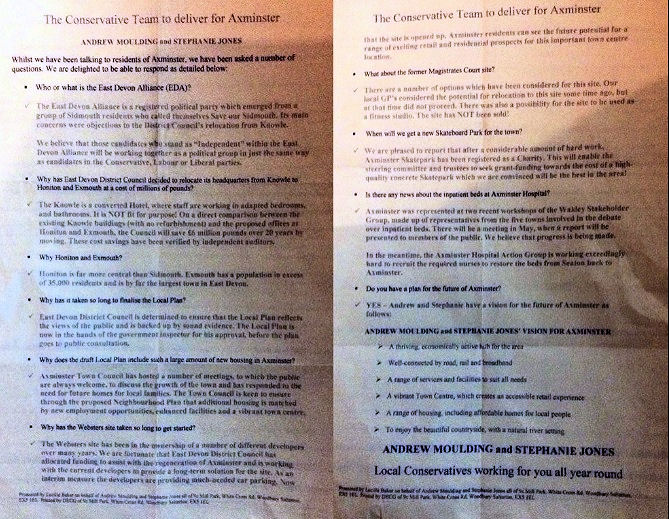
Andrew Moulding and Steph Jones’s election leaflet issued in Axminster, seems designed to misinform.

AxmstrLeaflet

A close look at the leaflet (above..click to enlarge) reveals some apparent misconceptions and economies with the truth:

Moulding/ Jones: Imply East Devon Alliance is centred in Sidmouth.
Incorrect: EDA Chair lives in Colyton; Vice-Chair in Feniton; vast majority of East Devon Alliance Independent candidates are from other parts of the District.

Moulding/Jones: Suggest Knowle is just adapted bedrooms and bathrooms.
Incorrect: Only the old part, which was once used as a hotel, then as flats.  No serious attempt has been made to market this individually to fund update of the newer building, which consists of purpose built offices in 1970-80s, with outside space for extension if required.

Moulding/Jones:  Move will save £6m over 20 years.
Figures are disputed ( posts on http://www.saveoursidmouth.com may explain why ‘Sidmouth’ is a painful subject for EDDC Deputy Leader, Cllr Moulding) – and some withheld documents concerning office relocation are still under legal review (Tribunal decision imminent: Information Commissioner and J. Woodward vs East Devon District Council).

Moulding/Jones: Why Honiton and Exmouth? “Because Honiton is more central, and Exmouth is the largest town.”
Then why did they previously support Skypark (which could not be less central) and selling the site in Honiton? In reality, a newbuild office at Honiton is just the fall-back plan, as the Honiton site couldn’t be sold for enough money to make a move to Skypark financially viable. And Exmouth has only now come into the equation, as space at the Town Hall has become available. The leaflet makes no mention of the issues of running a split site; nor of existing air pollution problems where the £7m newbuild HQ at Honiton would be sited (no such problem in Knowle parkland!), etc.,etc. 

Moulding/Jones; Why is Local Plan taking so long? “Because we want to get it right”
Or is it because EDDC are struggling, having got it so wrong in the past, and exasperating the Inspector, who rejected the previous one? (Remember the 53 ‘minor changes’ which the Inspector found to be ‘major’? SIN blogged the story: https://sidmouthindependentnews.wordpress.com/2013/11/30/sum-thing-amiss/)

Moulding/ Jones: Why so much new housing in Axminster? “Because you wanted it!!”
Who are ‘you’? Does it embellish the town and help it to thrive? Or is it symptomatic of consequences when deciding where to build the massive number of new houses EDDC has chosen to opt for?

Moulding/Jones:  Do you have a plan for the future of Axminster. “Yes, we have a vision.”
Who are ‘we’, and has the vision, with no neighbourhood plan yet in place, been led by speculative development?

This leaflet, along with quotes from Hugo Swire in the local press yesterday (https://eastdevonwatch.org/2015/05/02/east-devon-alliance-responds-to-hugo-swire-misinformation/), show tired tactics which are looking rather stale. On May 7th, East Devon voters may well show they’ve had enough of them.