
“Consultations are often a legal requirement for government departments – but this sometimes means they are formulaic and ineffective. In an extract from his report, Creating a democracy for everyone: strategies for increasing listening and engagement by government, Jim Macnamara (University of Technology Sydney/ LSE) looks at some of the failings of government consultation, and the problems with one NHS consultation [NHS Mandate public consultation conducted in October 2015] in particular.”
Category Archives: NHS (local)
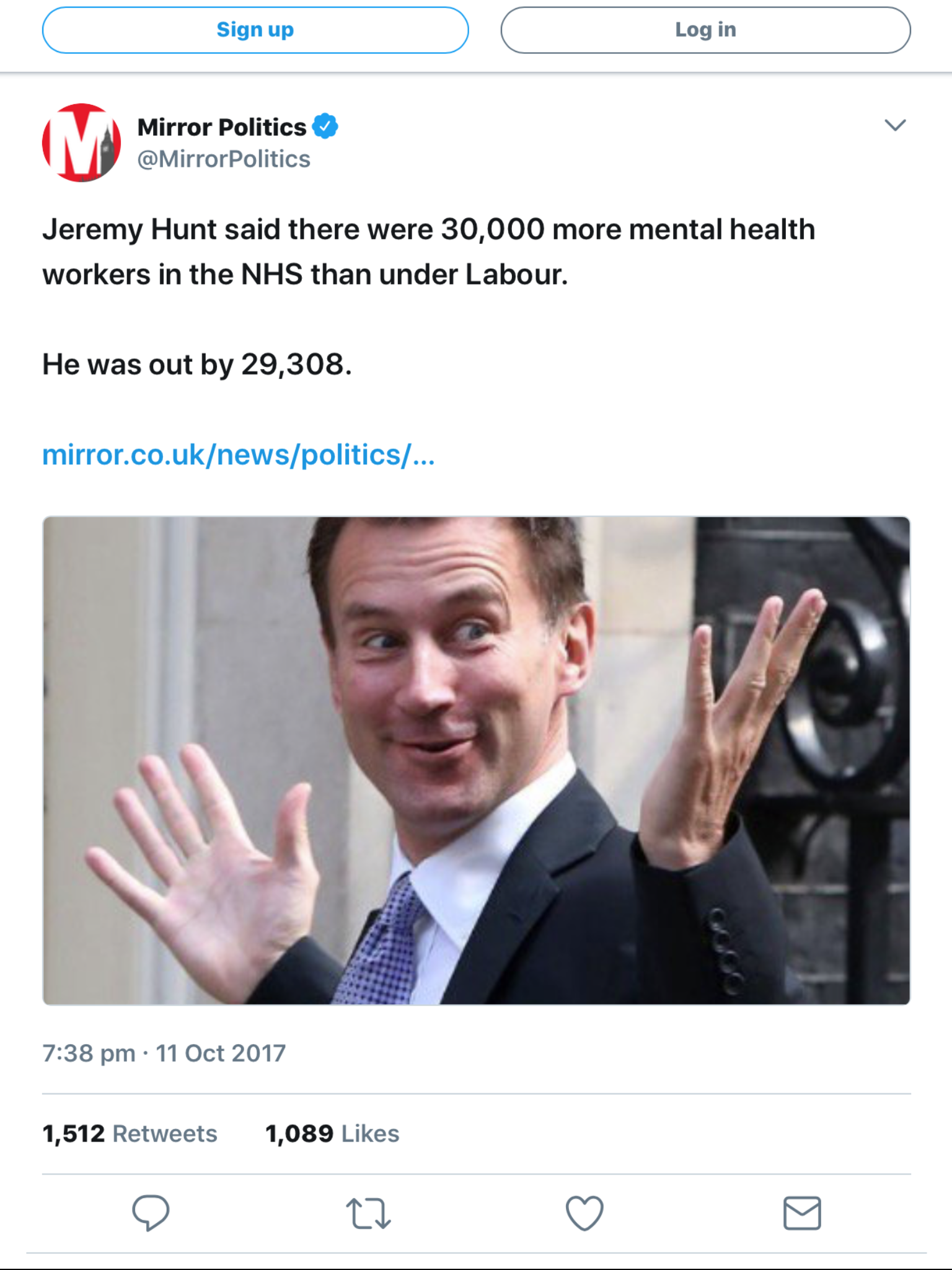
Hunt overestimates increase in mental health nurses by 98%!
Is it right for charities to offer services you pay for if the NHS or social care system isn’t picking you up?
Does this let Jeremy Hunt off the hook and allow underfunding to continue? Is it privatisation by stealth or just local people doing good deeds for payment and to be encouraged and applauded?
“Ottery Help Scheme has launched a new chargeable service to offer more support to the community as well secure its future for years to come.
The charity says it is trying to be proactive by running a home services as it currently relies on donations from grants and members of the public. Through home services, user can pay a fee and book a member of the team come out to them. The employed staff will be able to assist with in a range of ways including cleaning, shopping, meal preparation and gardening as well as offering to sit in for carers. This will sit alongside the help scheme’s free or subsidised befriending, memory café and transportation services.
Last year, more than 100 helpers gave up nearly 6,000 hours in the community, with volunteer drivers driving 49,228 miles to take residents to appointments.
Helen Harms, chief officer for the help scheme, said: “The NHS is looking for schemes to help with allowing people to stay in their own home. “We are trying to become self-sufficient, we are trying to provide services which help people stay independent and living in their own homes and provide an income to sustain the help scheme for the future.
“We do really rely on donations and if they one day stopped we would have to fund ourselves. We are being proactive to be self sufficient and not hoping of getting enough donations in, we have been very luck for such a long time and we have been going for 20 years.”
The charity has recently been boosted by the La La Choir, which raised £1,300 at its last concert. It is also being supported by a trio of East Devon law firms throughout October as part of charity will month. Gilbert Stephens, East Devon Law and Christine Ashby, will donate 50 per cent of the service fee to the scheme.
Helen added: “We are so grateful to these local firms for their support over the setting up this scheme to benefit the charity, a 50 per cent donation for their will writing service is a significant contribution.”
“Carers to use Skype calls to check on pensioners”
“Pensioners will be visited via Skype instead of in person in a new trial by Essex County Council and Essex Care Limited. They will be given tablets to communicate with carers, who will talk to them over video link rather than visit them in person.”
Telegraph p8, Mirror p13, Mail p4
So this is the future? Care in the community – whose care, whose community?
“Traditional family doctor could ‘die out’ as soaring workloads and Tory cuts trigger exodus”
Hunt tells GPs it’s up to them to them to find ways of squeezing in an extra hour of appointments into their day.
“Richard Vautrey, chair of the British Medical Association’s GP Committee, spoke out after Jeremy Hunt admitted “underinvestment” has made it “much harder” for patients to have one familiar GP.” …
… In his speech Mr Hunt promised £2.4billion for GPs by 2021, announced £20,000 ‘golden hellos’ for 200 rural GPs a year to boost numbers, and pledged a new state-backed scheme to cut soaring indemnity fees.
He also rebooted his pledge to ensure 5,000 more GPs by 2020 – despite numbers falling by 350 since he made it.
But he clashed with GPs by declaring he couldn’t solve the NHS crisis for them.
And he urged surgeries to find ways to “release between 45 and 60 minutes per GP per day” such as holding appointments online.
RCGP chair Prof Helen Stokes-Lampard warned GPs were “knackered”, “at the end of their tether” and facing “burnout”.
[Hunt continued]: “I’m sorry if that’s what you think. But let me be clear.
“I did not say when I was here before that we were going to solve these problems overnight.” He added: “You can make a big difference in your own practices.”
http://www.mirror.co.uk/news/politics/traditional-family-doctor-could-die-11333899
“Jeremy Hunt to pledge £20,000 ‘golden hello’ for rural GPs”
To be offered only to the first 200 applicants. There are nearly 42,000 GPs. Say no more.
“Newly-qualified GPs are to be offered a one-off payment of £20,000 if they start their careers in areas that struggle to attract family doctors.
The £4m scheme, to be announced by Health Secretary Jeremy Hunt, aims to boost the numbers of doctors in rural and coastal areas of England.
Mr Hunt said it will help “reduce the pressure” on practices in those areas.
The Royal College of GPs backed the plan, saying there was a “serious shortage” of family doctors.
The one-off payment will be offered to 200 GPs from 2018.
As of September 2016, there were 41,985 GPs in England.
Mr Hunt told the BBC: “What we’re looking to do is to reduce the pressure on those GP practices which are doing a very, very valiant job but can’t look after patients as well as they want to, because they’re finding it hard to recruit.”
The health secretary is due to speak at the Royal College of GPs’ annual conference in Liverpool, where he will offer something for those already in the profession too, by announcing plans for flexible working for older doctors – to encourage them to put off retirement.
He will also confirm plans for an overseas recruitment office which will aim to attract GPs from countries outside Europe to work in England. …”
Very healthy salaries to promote health in Cranbrook (unfortunately, nowhere else)
£53,152 – £57,861 pro rata for 14 hours per week
“Devon County Council are recruiting for a Programme Director and Programme Manager to work on the Cranbrook Healthy Town project. Both posts are part time, fixed term for 18 months.
Applications are welcome from people with experience of working in health care, commissioning, public health, local government and /or voluntary sector and this includes those who are interested in the posts as a secondment opportunity.
The Programme Director post will ensure the successful delivery of the Cranbrook Healthy New Town programme outcomes through effective leadership and dynamic partnership working. Working to the Executive Group, the Programme Director will secure commitment to a shared vision and set a clear direction for the second phase of the programme. The Programme Director will ensure that partner engagement and contributions translate into positive programme outcomes. Engaging and collaborating with relevant business partners at strategic level to stimulate innovation within the programme is a priority for this post. Year three funding for the Cranbrook Healthy New Town programme from NHS England is contingent upon successful delivery of year two outcomes.
This is a temporary post offered for 18 months.
Devon County Council will be hosting this post on behalf of the Cranbrook Healthy New Town Executive Group.
You will be expected to travel within Devon and across England to engage fully with national programme events, which may be held in London or at any of the other nine demonstrator sites.”
“Why won’t ministers acknowledge social care’s growing emergency?”
Another of those articles you cannot summarise – you need the whole dreadful story. 12 consultations in 20 years, no action!
“How close to the brink is the social care system? In the severest warning yet that it is fast becoming unsustainable, council leaders will on Wednesday warn that their ability to support older and disabled people is “veering steadily towards the impossible”.
The picture in children’s services is no better. The body representing directors of those services reports that their ability to make any impact at all on the lives of 4 million children living below the poverty line is increasingly constrained by relentless funding cuts.
As leaders of both children’s and adult services in England meet this week in Bournemouth for their annual joint conference, they will reflect ruefully on the deafening silence from last week’s Conservative party gathering in terms of any relevant policy or funding initiative.
Most alarming for the adult sector was the complete absence from the prime minister’s ill-fated conference address of any reference to the system reform that had been flagged in the party’s general election manifesto, promising “dignity and protection in old age”.
It was left to social care minister Jackie Doyle-Price to announce that the consultation trailed in the Queen’s speech in June would not begin until 2018.
Mark Lever, co-chair of the Care and Support Alliance, a grouping of more than 80 care charities, describes the news as incredibly disappointing: “This year marks the 20th anniversary of the launch of the royal commission on care and there have been 12 separate consultations and reviews since then. Yet the big questions on funding have repeatedly been dodged and the system is on its knees.”
Twelve months ago, the adult sector was described by its regulator, the Care Quality Commission, as “approaching a tipping point”. In a report on Wednesday, the Local Government Association (LGA), which represents councils, will lament that “inertia remains the characteristic we typically associate with the prospects for future funding and reform”.
While welcoming the £2bn one-off emergency cash injection unveiled in the spring budget, the LGA says the sector still needs £1.3bn immediately to help stabilise the care provider market. It also projects a £1bn funding gap by 2020 – not accounting for further cost pressures, such as the question of who will pay for care workers to receive the full minimum wage when doing sleep-in shifts.
Izzi Seccombe, who chairs the LGA’s community wellbeing board and is Tory leader of Warwickshire county council, says: “Councils have a proud record of getting on with the job of delivering for their local residents, and doing so in partnership, but it is no exaggeration to say that the circumstances are now veering steadily towards the impossible.”
Seccombe’s reference to partnership is pointed. Relations between local government and the NHS have soured in recent weeks amid recriminations over responsibility for delayed hospital discharges of older patients and intense government pressure to clear beds in time for a feared winter flu crisis. The LGA is furious that some councils deemed to be not pulling their weight face penalties.
One example given in Wednesday’s report is Sheffield council. Despite being one of the 20 authorities with the highest rates of delayed discharge locally, it has nearly halved the daily number of hospital beds occupied by people medically fit to go home – but held up by issues such as arrangement of a social care package – from 171 in February to 90 in July.
A survey by the Association of Directors of Adult Social Services of about 100 councils, also released on Wednesday, will reveal that some have already been fined – by up to £100,000 – since April for causing delayed discharges. More than half are expecting to be overspent on adult social care in 2017-18.
Amid mounting concern over the fragile state of the homecare market, 48% of the councils surveyed say that homecare providers have handed back contracts in the past five months because they cannot fulfil them or make them pay. That’s up on the 37% who said the same in a previous survey in the spring.
More than 45% of councils say they find it difficult to find homecare providers, while 20% report difficulty securing places in residential homes and 52% say spaces in nursing homes are hard to come by.
The Association of Directors of Children’s Services will use the Bournemouth conference to set out an eight-point plan for government to tackle poverty, including making good what the LGA forecasts will be a £2bn shortfall in funding of the children’s sector by 2020.”
Care at home? “Care homes could become most common place to die by 2040”
“Care homes could overtake hospitals as the most common place for people to die, according to new research.
Just over a fifth of annual deaths in England and Wales currently occur in care homes, but experts predict the number will more than double by 2040.
Experts from King’s College London analysed data for deaths from 2004 to 2014.
Over that period, the proportion of deaths that occurred in care homes increased from 17% to 21%, with the number of fatalities rising from 85,000 to 106,000 a year. Calculations suggest this figure could rise to nearly 230,000 a year by 2040.
Meanwhile, the number of deaths in hospitals fell between 2004 and 2014 to 241,335, and this trend is expected to continue.
The researchers said most people prefer to die in the place they are usually cared for, including home, rather than in hospital. But they warned that hospital deaths could rise again unless capacity continues to increase in care homes.
They said: “Our projections show that if current trends continue, the need for end-of-life care will rise substantially over the next 25 years, particularly at home and in care homes.
“If current trends continue, deaths in care homes, homes and hospices will almost double by 2040, which will account for 76% of all deaths.
“Care home deaths are projected to become the most common place of death by 2040.
“However, if care home capacity does not increase and these additional deaths instead occur in hospital, the decline in hospital deaths will reverse by 2023, rising to 40.5% of all deaths by 2040.” …
Mental health professionals to be replaced by volunteers
Speechless …

Saving people’s lives is costing the NHS too much money
So, it isn’t young immigrants straining our NHS – it’s overweight/diabetic/smoking/drinking (often older ) people whose lives we save!
Now there’s a conundrum.
“Researchers tracked 10 million hospital admissions for acute events, such as heart attacks or strokes, over a decade.
They found that around 37 per cent of the subsequent rise in emergency admissions was among those whose life had previously been saved, thanks to advances in cardiac care.
The improvements saved an extra 4.04 lives per 100 admissions, but also resulted in an additional 7.72 emergency admissions in the next year, from those who would previously not have been expected to survive.
The results, published in Health Services Research, found “the survival effect” caused around 426,000 extra emergency admissions annually by 2012. …”
When is enough, enough?
Owl says: “social care beds” … what exactly are they? Residential homes? Nursing homes? Community hospital beds? Whatever they are – Cornwall doesn’t have enough of them.
So, how do they measure “enough”? Certainly in Devon our Clinical Commissioning Group doesn’t do numbers, so we will be hard-pressed to know if Devon has too much, enough, not quite enough, critically few or “disastrously dangerous” levels of anything measurable.
“The Care Quality Commission’s (CQC) calling on Cornwall’s health and social care managers to have “courage” to radically overhaul services.
The CQC points to the county having less social care beds than other comparable parts of the country.
In its annual report, the CQC says the system is “straining at the seams” because of increasing numbers of frailer pensioners and people with long term complex conditions.”
“Too late for cash injection to save NHS from a winter crisis”
But Diviani and Randall-Johnson have decided there is no crisis in Devon, so that’s ok …
“It is too late for a cash injection to save the NHS from a winter crisis, according to a senior health official.
A poll of healthcare leaders found that 92 per cent are concerned about their ability to cope as the colder months arrive.
Niall Dickson, chief executive of the NHS Confederation which represents all health service organisations, said that there was “an even greater sense of foreboding” this year than last.
Writing in The Times today, Mr Dickson warns: “It is becoming hard to overstate the perilous state of the health and care system in England.”
His comments came as figures revealed that the number of the most critically ill patients waiting more than an hour for an ambulance has doubled in a year.
A separate report also suggested that 25,000 operations were cancelled last year because of a lack of beds.
Mr Dickson writes: “A cash injection at this stage is unlikely to solve the winter pressures, but the chancellor must revisit the pencilled in figures for 2018-19 and 2019-20, which if left as they are, would guarantee more crises and further delays to the reforms that are needed.”
He highlighted issues in A&Es last winter when there were ten hospitals in which less than 70 per cent of patients were seen within the four-hour target.
“Emergency departments are seen as a litmus test for the rest of the system. If the health service cannot cope at its front door, what lies behind it will also be struggling,” he says.
There has not been enough investment in community health and social care services, he adds, and draws attention to problems with staff recruitment and retention.
Figures released in July showed that the number of nurses and midwives fell by 1,783 to 690,773 in the financial year 2016-17 as 20 per cent more people left the profession than joined it.
Mr Dickson writes: “Emergency admissions are continuing to rise — in the first quarter of this year there was a 25.9 per cent jump in responses to life-threatening ambulance calls — so the ambulance service too is under increasing strain.”
Yesterday figures released to the Sunday Mirror under freedom of information laws showed that paramedics had taken more than an hour to reach 6,096 people requiring urgent treatment for conditions such as cardiac arrest in 2016-17. The total of “red” calls, which should be reached in eight minutes, waiting more than an hour was up from 2,746 in 2015-16.
Mr Dickson says that concerns have been heightened by fears of a flu epidemic. Simon Stevens, chief executive of NHS England, said last month that hospitals in Australia and New Zealand had struggled to cope with “a heavy flu season”, with the likelihood that the same strains of flu will head west and north.
Mr Stevens reiterated calls for “a comprehensive review looking at the funding of health and social care across the UK”.
A Department of Health spokesman said: “ The NHS has record funding and more doctors and nurses on our wards. The NHS planned for winter earlier this year than ever before and has robust plans in place, supported by an extra £100 million for A&E departments and £2 billion for the social care system to help improve discharging and free up beds in hospitals.”
Source: Times (pay wall)
Cancer survival poorer for rural patients – travel time may be a factor in decisions
One-year survival rates are lower for those who live in rural areas, found a study by the University of Aberdeen. They say longer travel distance limits treatment choices and follow-up care
“… It could be that living in rural areas where you have to travel further to receive treatment might limit treatment choices once a diagnosis has been made.
‘There is evidence that when faced with two treatment options, patients might weigh the costs in terms of time, expense and inconvenience of travel against the perceived benefits, for example, choosing surgery over chemotherapy to limit time in hospital.
Lengthy or difficult travel to a cancer centre or hospital could also result in less limit engagement with post-primary treatment follow-up, with consequent implications for the effective management of treatment effects and the identification of other follow-up needs.’ …”
DCC Tories torpedo Devon NHS
“PRESS RELEASE
Yesterday the Conservative Party machine defeated my final attempt to get Devon County Council to take action over the closure of community hospitals beds. My motion, seconded by Claire Wright, asked the Health Scrutiny Committee to look again at the issues it failed to scrutinise properly in July, and asked the Council to write to the Secretary of State for Health to alert him to our concern about hospital beds. I highlighted widespread NHS concern that there will be too few beds if there is a flu epidemic this winter. My speech is available here and you can watch it and the debate in the webcast (beginning at 2.18).
The Tory response was an amendment, moved by the leader, John Hart, which took the guts out of the motion. Despite all the evidence to the contrary, it said that Health Scrutiny had ‘extensively considered the issues and concerns from members of the public, elected members and others, including medical professionals, all matters relating to the closure of some community hospital beds in Honiton, Okehampton, Seaton and Whipton.’
Instead of my proposal to write to the Secretary about the beds closures, the amendment proposed to write ‘seeking reassurance that appropriate funding is provided by government to deliver the necessary health and social care services in Devon’. Not a dicky bird to the minister about community hospital beds, the whole point of the debate.
In reply I told the Council (at 3.10) that if they passed this amendment, they would be ignoring East Devon opinion just like Kensington & Chelsea Council ignored the residents of Grenfell Tower; and the Conservative Group as a whole would have made itself responsible for the failure to properly scrutinise the hospital bed closures.
The result
Although they were not formally whipped, 40 Tories fell dutifully in line to support the amendment. There were 16 votes against (these were Liberal Democrat, Labour, Independent and Green members, together with only one Conservative, Ian Hall of Axminster).
Claire made a valiant attempt to put some guts back into the motion, with another amendment – but the Tory machine squashed that too.
Martin Shaw
Independent East Devon Alliance County Councillor for Seaton & Colyton
”
DCC Tories fail, yet again, to do the right thing on our NHS
“Martin Shaw and Claire Wright were voted down… [at today’s health scrutiny committee, see below] shame on Devon County Council! Every single Tory Councillor with the exception of one voted against Martin’s motion – they put party politics above their communities interests once again.
People need to know what they did.”
Patients discharged in dressing gowns and with no home care plans
“Patients are being discharged from hospitals in dressing gowns to empty homes and without medication or support, according to a new report.
Healthwatch England also expressed concerns over the level of bed-blocking in the NHS, with patients fit to go home but staying in hospital.
The watchdog talked to more than 2,000 people about their experiences in the past two years. In a report in 2015 it had criticised “shocking” cases and “common basic failings” leading to emergency readmissions and deaths.
While hospitals are doing better overall, Healthwatch said that people “still don’t feel involved in decisions or that they have been given the information they need” and that they continue to experience delays and a lack of co-ordination between services.
In July an average of 5,861 beds a day were occupied by patients fit to go home, up 23.4 per cent on the same month in 2015, although down slightly year on year. The majority of delays were caused by the NHS, but the number attributed to social care services rose to 37 per cent from 30 per cent two years ago. The watchdog said that patients sometimes had to stay in hospital because non-emergency transport was not available to take them home.
Healthwatch warned that people felt they did not have access to the services and support they needed after being discharged. A patient who spoke to a Healthwatch branch in Berkshire said: “Discharged without support, with low blood pressure, very weak and unsteady on my feet, and diarrhoea.”
A patient in Richmond upon Thames, southwest London, said: “I was discharged in a dressing gown and had to get my own taxi home as transport was not available.”
Imelda Redmond, national director of Healthwatch England, said: “Getting people out of hospital and safely home is . . . an ongoing process that requires thought, planning and support before, during and after the moment someone is actually discharged. Things work best when all services work together.”
NHS England said: “This report provides further support for the intensive focus the NHS is giving to safe and speedy hospital discharge, and the related importance of local councils’ actions to ensure proper home care and care home places for frail older people.”
Source: Times, pay wall
Ind. East Devon Alliance Councillor Martin Shaw’s speech to DCC committee today
“Speech by County Councillor Martin Shaw (Independent East Devon Alliance, Seaton and Colyton), moving to send the issue back to Health Scrutiny, at Devon County Council, 5 October 2017:
“I represent a large division in East Devon. 2 years ago Seaton, Axminster and Honiton hospitals had in-patient beds, universally appreciated by patients & doctors, and supported by local communities. Today large parts of each hospital lie empty – nurses and other staff are dispersed – volunteers have been told they are no longer needed. We don’t even know whether the buildings will survive as centres of health services or be sold off.
This is the biggest crisis East Devon & Okehampton have faced in many years. Local communities have been united in their opposition; councillors of all parties have opposed the decisions.
After a biased consultation and flawed, unjust decisions, we looked to the Health Scrutiny Committee to hold NEW Devon CCG to account, and they have failed us. My proposal today is not a motion of NO confidence in any councillor or party. It is a motion to RESTORE confidence in this Council’s ability to represent Devon communities and stand up for their interests.
The tragedy is that Health Scrutiny started sensibly by asking the CCG 14 questions, in order to decide whether it should use its legal power to refer their decision. This proposal had cross-party backing, with the support of more Conservatives than members of any other party. A minority of the committee were, however, determined from the beginning to disregard public concern and voted not even to ask the questions.
The CCG replied to the questions but the Committee found their answers inadequate and wrote back detailing areas of concern. So far so good – a model of scrutiny. But things started to go wrong when the issue came to the new Health & Adult Care committee in June. The new Chair argued that members were insufficiently experienced to decide the issue and recommended delaying a decision until September 21st. It escaped no one’s notice that this was after the date given for permanent closure of the beds. It was seen as an attempt to prevent effective scrutiny.
Fortunately, the Committee agreed instead to a special meeting in July. For this meeting, the County Solicitor prepared a guidance paper outlining 6 issues outstanding with the CCG. Councillor Ian Hall, Councillor Mike Allen who is a Conservative District councillor, and others joined me in pressed the local communities’ case.
However the CCG gave a long powerpoint presentation which simply did not address most of the 6 issues, and before any debate could take place, Councillor Gilbert proposed there be no referral. In case anyone believed that he still wanted to scrutinise the issues, he made a point of emphasising that not referring would ‘save the committee a huge amount of work ’.
Councillor Diviani then told the committee that referral would be a waste of time, because ‘attempting to browbeat the Secretary of State to overturn his own policies is counter-intuitive’.
The Committee never discussed most of the remaining issues that the guidance paper had identified. By my reckoning, only 1 out of 6 was more or less satisfactorily addressed. Let me mention just one that wasn’t, the surprise decision to close Seaton’s beds, removing all provision from the Axe Valley. Neither the CCG nor any member gave any reason for believing this decision was justified – yet the committee voted for it anyway and the empty wards of Seaton hospital are the consequence.
There was no broad support for the anti-scrutiny motion: it was supported only by 7-6 ; 4 members abstained or were absent. The meeting was widely seen as an abdication of scrutiny. The Standards Committee says it ‘may not reflect well on the Council as a whole’. I would go further: it did not reflect well on this Council.
Since then, new evidence has shown that cutting beds to the bone brings great risks. The Head of the NHS, Simon Stevens, has called for more beds to be urgently made available this winter in face of a possible flu epidemic. Expert bodies like the Kings Fund, the College of Emergency Medicine and NHS Providers have backed the judgement that the NHS is cutting too far, too fast. These are new reasons to question the CCG’s plans.
This motion therefore proposes that
The Scrutiny Committee should look again at the issues which were not satisfactorily addressed.
The Council should tell the Secretary of State that the CCG’s decisions and the wider STP process have aroused great feeling in Devon, that people are not happy with either the decisions or the way they were made , and we are worried that we simply won’t have enough beds for the coming winter.
Finally, following a more constructive Health Scrutiny meeting on 21st September, this motion welcomes the Committee’s help in securing community hospital buildings.
Some of you may still wonder if Cllr Diviani was right, and all these proposals will be a waste of time. The answer to this is given in a recent letter from the Secretary’s own office: ‘As you may know,’ it says, ‘contested service changes can be referred to the Secretary of State, who then takes advice from the Independent Reconfiguration Panel.’ So a referral is not something the minister deals with personally; it is a legally defined procedure.
The letter continues, ‘However, as you are aware, Devon’s Health Scrutiny Committee … passed a motion … in favour of not referring the CCG’s decision to the Secretary of State.’ Cllr Diviani suggested that referral was pointless because of the minister’s opinions: the minister’s office implies it WOULD be meaningful, if only Devon would take action.
I ask you to restore this Council’s reputation and take the action which it is within your power to take, even at this late date, to save our community hospital beds.”
Care Quality Commission considering transferring control of its Clinical Commissioning Group to Cornwall Council
AND
“On the same day as the Royal Cornwall Hospitals Trust has been placed in special measures, the CQC has also highlighted problems with the wider health and social care system in Cornwall.
It said too many patients were stuck in hospital waiting for the support they needed to live at home, or be placed in residential care, and managers had lost sight of the needs of people using services.
Its review calls for “urgent and significant change to improve” to ensure people move through the system more effectively.
NHS England said it was considering transferring the management of the county’s Clinical Commissioning Group to the council. A director of adult social services and health integration could also be appointed.”
Another south-west hospital buckles under the strain
Which pushes the falling domino to Plymouth … which pushes it to Exeter … which pushes it to … us.
“The Royal Cornwall Hospitals Trust has been placed in special measures following a damning report from health watchdog the Care Quality Commission.
Inspectors visited the trust in July and raised concerns about patient safety in surgery, the maternity unit and the paediatric emergency department, as well as long delays in cardiology and ophthalmology.
Chief Inspector of Hospitals Professor Ted Baker said patients had been “let down” with some “placed at risk” and the people of Cornwall “deserved better”.
Speaking on BBC Radio Cornwall, the trust’s chief executive Kathy Byrne (pictured) apologised unreservedly for the trust’s failings.
She said patients should “not be worried” and the trust had taken action on all the areas of concerns raised by the CQC’s warning notice.”
 East Devon Watch